Is our collaborative culture slowing down our ability to act quickly? 

https://mailchi.mp/cd8b8b492027/the-weekly-gist-january-26-2024?e=d1e747d2d8

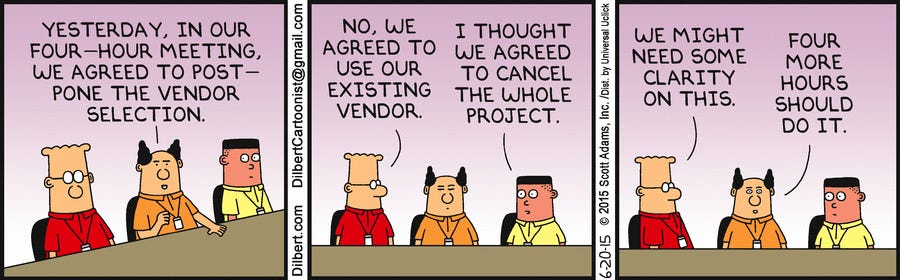
“We have a collaborative culture; it’s one of our system’s core values. But it takes us far too long to make decisions.” A health system CEO made this comment at a recent meeting, giving voice to a dilemma many system executives are no doubt facing. Of course, leaders want their teams to collaborate—in any important decision, we want to hear different voices, consider diverse points of view, and incorporate various areas of expertise.

On the other hand, collaboration takes time, which we don’t have right now. It also can add complexity, be the enemy of clear direction, and muddy accountability. This CEO went on to make an essential connection: “My concern is that this protracted decision making isn’t just a process problem, but that it’s showing up in our results. 

Take performance improvement—we all quickly agreed we need to cut costs, but it’s taking far too long for us to act, and I fear we’ll have trouble holding the new line over time.” She further mused 

“I wonder if this problem is, at least in part, due to how we make decisions. We don’t make them quickly enough, they aren’t clear enough, and we don’t have the most effective system of accountability.”


On one hand, traditional hospital culture is rightly grounded in the safety, hierarchy, and tradition of a do-no-harm world. But on the other hand, today’s economic, technological, and competitive environments require an approach to operations, revenue, and growth that has the aggressiveness of a Fortune 50 company. This should not be an either-or situation. Health systems can uphold a culture of safety while also fostering nontraditional values that will drive the organization assertively toward the future – all while committing to change.

The silent killer — toxic ambiguity

One of the most overlooked, yet lethal forms of organizational rot is toxic ambiguity. Basically, killing people with fog, Jim VandeHei writes.

Why it matters: 

Think of all the time wasted, relationships ruined, budgets missed and moods fouled by leaders or managers offering hazy direction.

  • Ambiguity is a silent killer — like a slow natural-gas leak. You don’t realize until it’s too late that you have a massive, spreading issue.

Gallup developed a workplace survey system for companies to track engagement and performance. We use it at Axios to spot pockets of emerging staff issues.

  • We often score lower than I’d like on the first question — whether “I know what is expected of me at work.” This drives me nuts: How can any person at any level not know what their damn job is?
  • Turns out, this is common. Many people feel foggy, even if leaders feel they’re being crystal clear.

The toxicity comes when the ambiguity is so thick others can exploit the cloudiness, or suffer from it. Here are some common manifestations to watch for:

  1. Fuzzy strategy. In an ideal world, any person under you should be able to jump out of bed at a moment’s notice and recite the three most important things you’re doing as a company or organization. If they can’t, how can they guide others or prioritize? The only remedy for this is constant, clear repetition of what matters most.
  2. Fuzzy thinking. If you’re a leader and you can’t articulate those three things with precision and certainty, you’re screwed. It means you didn’t sharpen your own thinking before trying to sharpen the thinking of others. This is why I constantly write down what matters most so I can stress-test my own clarity.
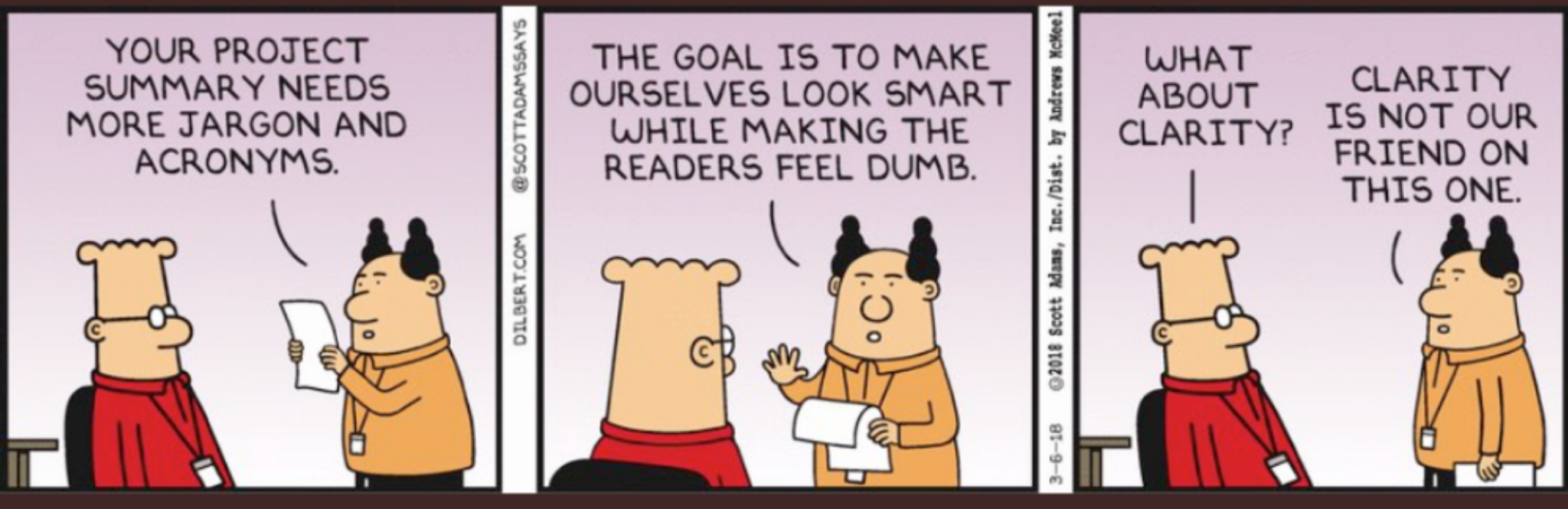
  3. Fuzzy communications. You might have strong, concrete thoughts — but not explain them clearly. That’s akin to having the perfect, delicious recipe, but not following it — and then wondering why people don’t love your dish. Your ideas might be brilliant. But if you don’t find strong, memorable words to express them, they will be lost.
  4. Fuzzy accountability. This one often trips me up. People don’t know they own something unless explicitly told and empowered. And others don’t know whom to listen to unless you make it clear who’s the decider. Little gets done right without clear accountability, dictated and announced in advance.
  5. Fuzzy feedback. Few things cripple individuals, teams and companies more than foggy feedback. Many managers are afraid to be direct, and hide what they mean by over-talking or over-complimenting. This leaves people confused about their standing and what they need to do better.

💡 What you can do: If you’re unsure what’s expected of you, that’s on you!

  • Ask your boss: “What’s the No. 1 thing I’ll be judged on?” or “What is Job 1 for me — the biggest specific thing I need to do for the team?”
  • If you get a foggy response, push for clarity. It’s tough to crush a performance review if you don’t know what’ll be reviewed.

The big picture: 

Clarity and candor are tough but essential — especially in anxious or uncertain times.

The KISS Principle

The C4Leader Blog: Colin Powell's Leadership Lessons - 14

Cartoon – Importance of Leadership Clarity

Integrity Cartoons and Comics - funny pictures from CartoonStock

Cartoon – Key to Leadership Campaigning

Cartoon – Rebuilding Trust | HENRY KOTULA

Cartoon – Importance of Election Year Clarity

Start With Why. Why it's BS.. There's a lot of snake oil masquerading… | by  Marissa Orr | Noteworthy - The Journal Blog

Warren Buffett: An appreciation

https://www.mckinsey.com/business-functions/strategy-and-corporate-finance/our-insights/warren-buffett-an-appreciation?cid=other-eml-alt-mip-mck&hlkid=500c2a923cdd4ff19d66acac00e2a9fa&hctky=9502524&hdpid=e758f2ed-7de7-4263-9faa-7daf7b3bdaa7
Celebrating Warren Buffett on his 90th birthday | McKinsey

As Warren Buffett turns 90, the story of one of America’s most influential and wealthy business leaders is a study in the logic and discipline of understanding future value.

Patience, caution, and consistency. In volatile times such as these, it may be difficult for executives to keep those attributes in mind when making decisions. But there are immense advantages to doing so. For proof, just look at the steady genius of now-nonagenarian Warren Buffett. The legendary investor and Berkshire Hathaway founder and CEO has earned millions of dollars for investors over several decades (exhibit). But very few of Buffett’s investment decisions have been reactionary; instead, his choices and communications have been—and remain—grounded in logic and value.

Buffett learned his craft from “the father of value investing,” Columbia University professor and British economist Benjamin Graham. Perhaps as a result, Buffett typically doesn’t invest in opportunities in which he can’t reasonably estimate future value—there are no social-media companies, for instance, or cryptocurrency ventures in his portfolio. Instead, he banks on businesses that have steady cash flows and will generate high returns and low risk. And he lets those businesses stick to their knitting. Ever since Buffett bought See’s Candy Shops in 1972, for instance, the company has generated an ROI of more than 160 percent per year —and not because of significant changes to operations, target customer base, or product mix. The company didn’t stop doing what it did well just so it could grow faster. Instead, it sends excess cash flows back to the parent company for reinvestment—which points to a lesson for many listed companies: it’s OK to grow in line with your product markets if you aren’t confident that you can redeploy the cash flows you’re generating any better than your investor can.

As Peter Kunhardt, director of the HBO documentary Becoming Warren Buffett, said in a 2017 interview, Buffett understands that “you don’t have to trade things all the time; you can sit on things, too. You don’t have to make many decisions in life to make a lot of money.” And Buffett’s theory (roughly paraphrased) that the quality of a company’s senior leadership can signal whether the business would be a good investment or not has been proved time and time again. “See how [managers] treat themselves versus how they treat the shareholders .…The poor managers also turn out to be the ones that really don’t think that much about the shareholders. The two often go hand in hand,” Buffett explains.

Every few years or so, critics will poke holes in Buffett’s approach to investing. It’s outdated, they say, not proactive enough in a world in which digital business and economic uncertainty reign. For instance, during the 2008 credit crisis, pundits suggested that his portfolio moves were mistimed, he held on to some assets for far too long, and he released others too early, not getting enough in return. And it’s true that Buffett has made some mistakes; his decision making is not infallible. His approach to technology investments works for him, but that doesn’t mean other investors shouldn’t seize opportunities to back digital tools, platforms, and start-ups—particularly now that the COVID-19 pandemic has accelerated global companies’ digital transformations.

Still, many of Buffett’s theories continue to win the day. A good number of the so-called inadvisable deals he pursued in the wake of the 2008 downturn ended paying off in the longer term. And press reports suggest that Berkshire Hathaway’s profits are rebounding in the midst of the current economic downturn prompted by the global pandemic.

At age 90, Buffett is still waging campaigns—for instance, speaking out against eliminating the estate tax and against the release of quarterly earnings guidance. Of the latter, he has said that it promotes an unhealthy focus on short-term profits at the expense of long-term performance.

“Clear communication of a company’s strategic goals—along with metrics that can be evaluated over time—will always be critical to shareholders. But this information … should be provided on a timeline deemed appropriate for the needs of each specific company and its investors, whether annual or otherwise,” he and Jamie Dimon wrote in the Wall Street Journal.

Yes, volatile times call for quick responses and fast action. But as Warren Buffett has shown, there are also significant advantages to keeping the long term in mind, as well. Specifically, there is value in consistency, caution, and patience and in simply trusting the math—in good times and bad.