With coronavirus cases on the rise, at-home testing remains a useful but imperfect way to mitigate risk.
I caught up with Katherine J. Wu, a staff writer who’s been covering this pandemic, to talk about what rapid-test results can—and can’t—tell us. Below you’ll find six takeaways from our conversation.
The conversation that follows has been edited and condensed for clarity.
1. With at-home tests, you trade accuracy for convenience.
“Doctors treating patients very often reach for those really sensitive PCR laboratory tests because they want to know beyond a shadow of a doubt whether the virus is present so the person can get the right treatment. Those tests are so sensitive that people can really trust when they’re negative. With the rapid tests, a negative is a lot less of a certain answer.”
2. At-home tests are most useful when a person has symptoms.
“A lot of the rapid tests we now use at home were initially designed to be taken as diagnostics for people who are feeling sick and want answers quickly. They then got the FDA greenlight to be used as screeners. Generally, right after your symptoms first appear is when they have been shown to be most accurate.”
3. They’re less accurate when used as screeners by people who feel fine.
“Things get a little tricky when you don’t have symptoms and you don’t have a known exposure—for example, if you’re hoping for a negative so that you can clear yourself to, say, go visit a grandparent.
“Rapid tests are not as good as lab tests when it comes to picking up on the virus when it’s present at really low levels. To get around that, experts say to test repeatedly. That way, if you miss the virus on Monday, maybe you’ll catch it Tuesday.”
4. At-home tests might be your only option.
“Let’s certainly not discount the value of rapid tests. With so many cases here and abroad, laboratory-testing infrastructure is going to be crushed. It may not be practical for people to seek out PCR testing as their No. 1 choice right now. If people are able to access rapid tests, they should test themselves daily at this point because we know results can change so quickly.”
5. All tests are mere snapshots of a moment in time.
“Tests cannot predict the future. The minute that swab goes into your nose—that is what the result is going to be giving you information on. We know this virus can replicate super quickly, especially if we’re talking about something like Omicron or Delta. A person can test negative in the morning and have a blazing positive result by the evening.”
6. Omicron is making things even trickier.
“We are still figuring out how quickly this variant spreads both within individual people and between different people. But based on what we know so far, it seems to be moving super fast, and there seems to be some indication that people can go from not contagious to quite contagious very quickly. And if that’s the case, then that means that negative test results actually expire sooner.”
Pregnancy can be a scary time for many reasons, one of which is having so many things feel off-limits for the safety of the fetus. But what about vaccines? Especially the Covid-19 vaccine? To understand the answer to this question you need data about the vaccine in pregnancy, but you also need data about lacking protection from Covid-19 in pregnancy. Fortunately, we discuss both in this episode!
COVID-19 cases are surging across the U.S. ahead of Christmas, sparking the cancellation of sporting events and a growing list of hospitals postponing nonessential surgeries — both a reminder of last year’s holiday surge and a sign that the next several weeks will determine the pandemic’s trajectory for the rest of the winter months.
Nationwide, the daily average for new cases was more than 133,000 on Dec. 18, a 21 percent jump over the last two weeks, according to data compiled byThe New York Times.
Health officials have warned the omicron variant — which appears to cause less severe illness, though is more transmissible — could exacerbate the ongoing delta-fueled surge and overwhelm the healthcare system.
“I think we’re really just about to experience a viral blizzard,” Michael Osterholm, PhD, director of the Center for Infectious Disease Research and Policy at the University of Minnesota, told CNN during a Dec. 17 interview. “I think in the next three to eight weeks, we’re going to see millions of Americans are going to be infected with this virus, and that will be overlaid on top of delta, and we’re not yet sure exactly how that’s going to work out.”
New York — where omicron accounts for at least 13 percent of new cases — for two consecutive days set a record for the daily number of new cases reported. Health officials reported more than 21,000 new cases on Dec.17 and 21,908 on Dec. 18. Three Midwestern states and Vermont also set COVID-19 records last week, including Ohio, which reported nearly 12,000 new cases Dec. 16.
While early data suggests omicron is tied to less severe illness than the original strain, health officials have warned against underestimating the virus. The outgoing National Institutes of Health director, Francis Collins, MD, PhD, offered a grim projection during a Dec. 19 interview with NPR.
“Even if it has somewhat lower risk of severity, we could be having a million cases a day if we’re not really attentive to all of those mitigation strategies,” Dr. Collins said.
Anthony Fauci, MD, director of the National Institute of Allergy and Infectious Diseases, said areas with low vaccination coverage will likely be especially hard hit across the coming weeks.
“We are going to see significant stress in some regions of the country on the hospital system, particularly in those areas where you have a low level of vaccination, which is one of the reasons why we continue to stress the importance of getting those unvaccinated people vaccinated,” he told CNNDec. 19, adding that in some regions of the U.S., omicron accounts for 50 percent of new infections, “which means it’s going to take over.”
“This virus is extraordinary. It has a doubling time of anywhere from two to three days,” Dr. Fauci said.
The daily average for U.S. COVID-19 hospitalizations was more than 69,000 as of Dec. 19, marking a 16 percent rise across the last two weeks; and while omicron may be associated with lower disease severity, a significant surge would inevitably lead to more hospitalizations and deaths, health officials say. Connecticut, Washington, D.C., and Rhode Island have seen the highest percent increase in hospitalization rates over the last two weeks.
As the holidays and planned celebrations near, Dr. Fauci emphasized the importance of booster doses in combating the surge. He urged against holiday gatherings and travel among people who have not been fully vaccinated or received their boosters. Given a rise in breakthrough cases, he also suggested people take a rapid test before attending a gathering.
“If you do these things … I do believe that you can feel quite comfortable with a family setting, the dinners and the gatherings that you have around the holiday season,” Dr. Fauci told ABC NewsDec. 19. “Nothing is 100 percent risk-free, but I think if you do the things that I just mentioned, you’d actually mitigate that risk enough to feel comfortable about being able to enjoy the holiday.”
Moderna said Dec. 20 that a booster dose of its vaccine increased antibody levels against omicron 37-fold. Laboratory findings from Pfizer also indicate its booster offers significant protection against the strain.
CDC data showed 61.4 percent of the nation’s population had been fully vaccinated as of Dec. 19. Nearly 30 percent of the fully vaccinated population had received their booster dose.
On the spectrum from active outbreak to eradication, control is the most likely path forward for COVID-19 in the U.S., NIAID Director Anthony Fauci, MD, said during a National Press Club briefing today.
Fauci’s words served as a reality check for those holding out hope that COVID-19 one day might be as rare as measles or polio in America.
“We’re never going to eradicate this,” he said. “We’ve only eradicated one virus, and that’s smallpox. Elimination may be too aspirational, because we’ve only done that with infections for which we’ve had a massive vaccination campaign like polio and measles. Even though we haven’t eradicated [those viruses] from the planet, we have no cases, with few exceptions, in the U.S.”
Fauci said the country should focus on control — a level of infection “that isn’t zero, but that with the combination of the vast majority of the population vaccinated and boosted, together with those who recovered from infection and also are hopefully boosted, that we will get a level of control that will be non-interfering with our lives, our economy, and the kinds of things we would do, namely to get back to some degree of normality.”
“It’s not going to be eradication, and it’s likely not going to be elimination,” he said again later in the briefing. “It’s going to be a low, low, low level of infection that really doesn’t interfere with our way of life, our economy, our ability to move around in society, our ability to do things in closed indoor spaces.”
Fauci said the only way to achieve this will be with vaccinations, boosters, and mitigation strategies such as wearing masks in congregate settings.
“Over time, we feel confident we will get this under control,” he said. While he said he “hopes” this comes in the “next several months,” he cautioned that he “never predict[s], because you never get it right. Sure enough, someone will come back and say, ‘You said this in December and you were wrong.'”
In terms of boosters, Fauci said it’s possible that a third shot — “and maybe an additional one” — will be enough to provide durable immunity, but that “we’ll just have to wait and see. We don’t know yet.”
Kids under age 5 who have yet to be vaccinated will have to wait a few more months to get their shots, he added. While the lower, 3 μg dose of the Pfizer vaccine looked sufficient for children ages 6 months up to 2 years, that dose was not sufficient for those ages 2 to 5, he said.
“The company decided that they believe this is really a three-dose vaccine, and there’s no doubt if you give three doses you’re going to get an effective and safe vaccine,” he said. “But they haven’t proven it yet, so that’s the delay.”
“I can guarantee you it’s going to be effective,” Fauci added.
Data aren’t expected until the end of the first quarter of 2022, he said, meaning vaccines for this pediatric population likely won’t be available until “a few months into 2022.”
A federal appeals court has reinstated in 26 states a Biden administration vaccination mandate for health workers at hospitals that receive federal funding.
A three-judge panel of the 5th U.S. Circuit Court of Appeals in New Orleans ruled(PDF) that a lower court had the authority to block the mandate in only the 14 states that had sued and was wrong to impose a nationwide injunction.
It marks a modest win for the Biden administration’s pandemic strategy following a series of legal setbacks to the health worker vaccine mandate. Numerous lawsuits have been filed seeking to block vaccine mandates issued by governments and businesses as public health measures amid a pandemic that has killed more than 800,000 Americans.
The Centers for Medicare & Medicaid Services (CMS) announced in early November that it would be requiring applicable healthcare facilities to have a policy in place ensuring that eligible staff receive their first dose of a COVID-19 vaccine series by Dec. 5 and to have completed their series by Jan. 4, 2022. Failure to comply with the requirement, which covers 17 million healthcare workers, would place an organization’s Medicare funding in jeopardy.
But the mandate was blocked before the deadline and remains temporarily blocked in 24 states: the 14 states involved in the case reviewed by the New Orleans appeals court and 10 states where the mandate was blocked by a Nov. 29 ruling from a federal judge in St. Louis.
The 14 states that sued are Alabama, Arizona, Georgia, Idaho, Indiana, Kentucky, Louisiana, Mississippi, Montana, Ohio, Oklahoma, South Carolina, Utah and West Virginia.
In the lawsuits, states argued that CMS exceeded its authority with the rule and did not have good cause to forego the required notice and comment period. States that sued the Biden administration over the vaccine mandate also cited the ongoing workforce shortages affecting healthcare providers in their states.
In explaining its ruling, the 5th Circuit noted that the Louisiana-based federal judge had given “little justification for issuing an injunction outside the 14 states that brought this suit.”
As it stands, the vaccine requirement for Medicare and Medicaid providers is blocked by courts in about half of U.S. states but not in the other half, creating the potential for patchwork enforcement across the country.
However, the administration’s broader requirements have so far faced stiff competition from courts as well as right-leaning lawmakers and governors alike.
The Supreme Court this week also blocked a challenge to New York’s requirement that healthcare workers be vaccinated against COVID-19 even when they cite religious objections.
America was not prepared for COVID-19 when it arrived. It was not prepared for last winter’s surge. It was not prepared for Delta’s arrival in the summer or its current winter assault. More than 1,000 Americans are still dying of COVID every day, and more have died this year than last. Hospitalizations are rising in 42 states. The University of Nebraska Medical Center in Omaha, which entered the pandemic as arguably the best-prepared hospital in the country, recently went from 70 COVID patients to 110 in four days, leaving its staff “grasping for resolve,” the virologist John Lowe told me. And now comes Omicron.
Will the new and rapidly spreading variant overwhelm the U.S. health-care system? The question is moot because the system is already overwhelmed, in a way that is affecting all patients, COVID or otherwise. “The level of care that we’ve come to expect in our hospitals no longer exists,” Lowe said.
The real unknown is what an Omicron cross will do when it follows a Delta hook. Given what scientists have learned in the three weeks since Omicron’s discovery, “some of the absolute worst-case scenarios that were possible when we saw its genome are off the table, but so are some of the most hopeful scenarios,” Dylan Morris, an evolutionary biologist at UCLA, told me. In any case, America is not prepared for Omicron. The variant’s threat is far greater at the societal level than at the personal one, and policy makers have already cut themselves off from the tools needed to protect the populations they serve. Like the variants that preceded it, Omicron requires individuals to think and act for the collective good—which is to say, it poses a heightened version of the same challenge that the U.S. has failed for two straight years, in bipartisan fashion.
The coronavirus is a microscopic ball studded with specially shaped spikes that it uses to recognize and infect our cells. Antibodies can thwart such infections by glomming onto the spikes, like gum messing up a key. But Omicron has a crucial advantage: 30-plus mutations that change the shape of its spike and disable many antibodies that would have stuck to other variants. One early study suggests that antibodies in vaccinated people are about 40 times worse at neutralizing Omicron than the original virus, and the experts I talked with expect that, as more data arrive, that number will stay in the same range. The implications of that decline are still uncertain, but three simple principles should likely hold.
First, the bad news: In terms of catching the virus, everyone should assume that they are less protected than they were two months ago. As a crude shorthand, assume that Omicron negates one previous immunizing event—either an infection or a vaccine dose. Someone who considered themselves fully vaccinated in September would be just partially vaccinated now (and the official definition may change imminently). But someone who’s been boosted has the same ballpark level of protection against Omicron infection as a vaccinated-but-unboosted person did against Delta. The extra dose not only raises a recipient’s level of antibodies but also broadens their range, giving them better odds of recognizing the shape of even Omicron’s altered spike.In a small British study, a booster effectively doubled the level of protection that two Pfizer doses provided against Omicron infection.
Second, some worse news: Boosting isn’t a foolproof shield against Omicron. In South Africa, the variant managed to infect a cluster of seven people who were all boosted. And according to a CDC report, boosted Americans made up a third of the first known Omicron cases in the U.S. “People who thought that they wouldn’t have to worry about infection this winter if they had their booster do still have to worry about infection with Omicron,” Trevor Bedford, a virologist at Fred Hutchinson Cancer Research Center, told me. “I’ve been going to restaurants and movies, and now with Omicron, that will change.”
Third, some better news: Even if Omicron has an easier time infecting vaccinated individuals, it should still have more trouble causing severe disease. The vaccines were always intended to disconnect infection from dangerous illness, turning a life-threatening event into something closer to a cold. Whether they’ll fulfill that promise for Omicron is a major uncertainty, but we can reasonably expect that they will. The variant might sneak past the initial antibody blockade, but slower-acting branches of the immune system (such as T cells) should eventually mobilize to clear it before it wreaks too much havoc.
To see how these principles play out in practice, Dylan Morris suggests watching highly boosted places, such as Israel, and countries where severe epidemics and successful vaccination campaigns have given people layers of immunity, such as Brazil and Chile. In the meantime, it’s reasonable to treat Omicron as a setback but not a catastrophe for most vaccinated people. It will evade some of our hard-won immune defenses, without obliterating them entirely. “It was better than I expected, given the mutational profile,” Alex Sigal of the Africa Health Research Institute, who led the South African antibody study, told me. “It’s not going to be a common cold, but neither do I think it will be a tremendous monster.”
That’s for individuals, though. At a societal level, the outlook is bleaker.
Omicron’s main threat is its shocking speed, as my colleague Sarah Zhang has reported. In South Africa, every infected person has been passing the virus on to 3–3.5 other people—at least twice the pace at which Delta spread in the summer. Similarly, British data suggest that Omicron is twice as good at spreading within households as Delta. That might be because the new variant is inherently more transmissible than its predecessors, or because it is specifically better at moving through vaccinated populations. Either way, it has already overtaken Delta as the dominant variant in South Africa. Soon, it will likely do the same in Scotland and Denmark. Even the U.S., which has much poorer genomic surveillance than those other countries, has detected Omicron in 35 states. “I think that a large Omicron wave is baked in,” Bedford told me. “That’s going to happen.”
More positively, Omicron cases have thus far been relatively mild. This pattern has fueled the widespread claim that the variant might be less severe, or even that its rapid spread could be a welcome development. “People are saying ‘Let it rip’ and ‘It’ll help us build more immunity,’ that this is the exit wave and everything’s going to be fine and rosy after,” Richard Lessells, an infectious-disease physician at the University of KwaZulu-Natal, in South Africa, told me. “I have no confidence in that.”
To begin with, as he and others told me, that argument overlooks a key dynamic: Omicron might not actually be intrinsically milder. In South Africa and the United Kingdom, it has mostly infected younger people, whose bouts of COVID-19 tend to be less severe. And in places with lots of prior immunity, it might have caused few hospitalizations or deaths simply because it has mostly infected hosts with some protection, as Natalie Dean, a biostatistician at Emory University, explained in a Twitter thread. That pattern could change once it reaches more vulnerable communities. (The widespread notion that viruses naturally evolve to become less virulent is mistaken, as the virologist Andrew Pekosz of Johns Hopkins University clarified in The New York Times.) Also, deaths and hospitalizations are not the only fates that matter. Supposedly “mild” bouts of COVID-19 have led to cases of long COVID, in which people struggle with debilitating symptoms for months (or even years), while struggling to get care or disability benefits.
And even if Omicron is milder, greater transmissibility will likely trump that reduced virulence. Omicron is spreading so quickly that a small proportion of severe cases could still flood hospitals. To avert that scenario, the variant would need to be substantially milder than Delta—especially because hospitals are already at a breaking point. Two years of trauma have pushed droves of health-care workers, including many of the most experienced and committed, to quit their job. The remaining staff is ever more exhausted and demoralized, and “exceptionally high numbers” can’t work because they got breakthrough Delta infections and had to be separated from vulnerable patients, John Lowe told me. This pattern will only worsen as Omicron spreads, if the large clusters among South African health-care workers are any indication. “In the West, we’ve painted ourselves into a corner because most countries have huge Delta waves and most of them are stretched to the limit of their health-care systems,” Emma Hodcroft, an epidemiologist at the University of Bern, in Switzerland, told me. “What happens if those waves get even bigger with Omicron?”
The Omicron wave won’t completely topple America’s wall of immunity but will seep into its many cracks and weaknesses. It will find the 39 percent of Americans who are still not fully vaccinated (including 28 percent of adults and 13 percent of over-65s). It will find other biologically vulnerable people, including elderly and immunocompromised individuals whose immune systems weren’t sufficiently girded by the vaccines. It will find the socially vulnerable people who face repeated exposures, either because their “essential” jobs leave them with no choice or because they live in epidemic-prone settings, such as prisons and nursing homes. Omicron is poised to speedily recap all the inequities that the U.S. has experienced in the pandemic thus far.
Here, then, is the problem: People who are unlikely to be hospitalized by Omicron might still feel reasonably protected, but they can spread the virus to those who are more vulnerable, quickly enough to seriously batter an already collapsing health-care system that will then struggle to care for anyone—vaccinated, boosted, or otherwise. The collective threat is substantially greater than the individual one. And the U.S. is ill-poised to meet it.
America’s policy choices have left it with few tangible options for averting an Omicron wave. Boosters can still offer decent protection against infection, but just 17 percent of Americans have had those shots. Many are now struggling to make appointments, and people from rural, low-income, and minority communities will likely experience the greatest delays, “mirroring the inequities we saw with the first two shots,” Arrianna Marie Planey, a medical geographer at the University of North Carolina at Chapel Hill, told me. With a little time, the mRNA vaccines from Pfizer and Moderna could be updated, but “my suspicion is that once we have an Omicron-specific booster, the wave will be past,” Trevor Bedford, the virologist, said.
Two antiviral drugs now exist that could effectively keep people out of the hospital, but neither has been authorized and both are expensive. Both must also be administered within five days of the first symptoms, which means that people need to realize they’re sick and swiftly confirm as much with a test. But instead of distributing rapid tests en masse, the Biden administration opted to merely make them reimbursable through health insurance. “That doesn’t address the need where it is greatest,” Planey told me. Low-wage workers, who face high risk of infection, “are the least able to afford tests up front and the least likely to have insurance,” she said. And testing, rapid or otherwise, is about to get harder, as Omicron’s global spread strains both the supply of reagents and the capacity of laboratories.
Omicron may also be especially difficult to catch before it spreads to others, because its incubation period—the window between infection and symptoms—seems to be very short. At an Oslo Christmas party, almost three-quarters of attendees were infected even though all reported a negative test result one to three days before. That will make Omicron “harder to contain,” Lowe told me. “It’s really going to put a lot of pressure on the prevention measures that are still in place—or rather, the complete lack of prevention that’s still in place.”
The various measures that controlled the spread of other variants—masks, better ventilation, contact tracing, quarantine, and restrictions on gatherings—should all theoretically work for Omicron too. But the U.S. has either failed to invest in these tools or has actively made it harder to use them. Republican legislators in at least 26 states have passed laws that curtail the very possibility of quarantines and mask mandates. In September, Alexandra Phelan of Georgetown University told me that when the next variant comes, such measures could create “the worst of all worlds” by “removing emergency actions, without the preventive care that would allow people to protect their own health.” Omicron will test her prediction in the coming weeks.
The longer-term future is uncertain. After Delta’s emergence, it became clear that the coronavirus was too transmissible to fully eradicate. Omicron could potentially shunt us more quickly toward a different endgame—endemicity, the point when humanity has gained enough immunity to hold the virus in a tenuous stalemate—albeit at significant cost. But more complicated futures are also plausible. For example, if Omicron and Delta are so different that each can escape the immunity that the other induces, the two variants could co-circulate. (That’s what happened with the viruses behind polio and influenza B.)
Omicron also reminds us that more variants can still arise—and stranger ones than we might expect. Most scientists I talked with figured the next one to emerge would be a descendant of Delta, featuring a few more mutational bells and whistles. Omicron, however, is “dramatically different,” Shane Crotty, from the La Jolla Institute for Immunology, told me. “It showed a lot more evolutionary potential than I or others had hoped for.” It evolved not from Delta but from older lineages of SARS-CoV-2, and seems to have acquired its smorgasbord of mutations in some hidden setting: perhaps a part of the world that does very little sequencing, or an animal species that was infected by humans and then transmitted the virus back to us, or the body of an immunocompromised patient who was chronically infected with the virus. All of these options are possible, but the people I spoke with felt that the third—the chronically ill patient—was most likely. And if that’s the case, with millions of immunocompromised people in the U.S. alone, many of whom feel overlooked in the vaccine era, will more weird variants keep arising? Omicron “doesn’t look like the end of it,” Crotty told me. One cause for concern: For all the mutations in Omicron’s spike, it actually has fewer mutations in the rest of its proteins than Delta did. The virus might still have many new forms to take.
Vaccinating the world can curtail those possibilities, and is now an even greater matter of moral urgency, given Omicron’s speed. And yet, people in rich countries are getting their booster six times faster than those in low-income countries are getting their first shot. Unless the former seriously commits to vaccinating the world—not just donating doses, but allowing other countries to manufacture and disseminate their own supplies—“it’s going to be a very expensive wild-goose chase until the next variant,” Planey said.
Vaccines can’t be the only strategy, either. The rest of the pandemic playbook remains unchanged and necessary: paid sick leave and other policies that protect essential workers, better masks, improved ventilation, rapid tests, places where sick people can easily isolate, social distancing, a stronger public-health system, and ways of retaining the frayed health-care workforce. The U.S. has consistently dropped the ball on many of these, betting that vaccines alone could get us out of the pandemic. Rather than trying to beat the coronavirus one booster at a time, the country needs to do what it has always needed to do—build systems and enact policies that protect the health of entire communities, especially the most vulnerable ones.
Nurse Katie Sefton never thought Covid-19 could get this bad — and certainly not this late in the pandemic. “I was really hoping that we’d (all) get vaccinated and things would be back to normal,” said Sefton, an assistant manager at Sparrow Hospital in Lansing, Michigan. But this week Michigan had more patients hospitalized for Covid-19 than ever before. Covid-19 hospitalizations jumped 88% in the past month, according to the Michigan Health & Hospital Association.
“We have more patients than we’ve ever had at any point, and we’re seeing more people die at a rate we’ve never seen die before,” said Jim Dover, president and CEO of Sparrow Health System.
“Since January, we’ve had about 289 deaths; 75% are unvaccinated people,” Dover said. “And the very few (vaccinated people) who passed away all were more than 6 months out from their shot. So we’ve not had a single person who has had a booster shot die from Covid.”
Among the new Covid-19 victims, Sefton said she’s noticed a disturbing trend.
“We’re seeing a lot of younger people. And I think that is a bit challenging,” said Sefton, a 20-year nursing veteran.She recalls helping the family of a young adult say goodbye to their loved one. “It was an awful night,” she said. “That was one of the days I went home and just cried.”
‘We haven’t peaked yet’
It’s not just Michigan that’s facing an arduous winter with Covid-19. Nationwide, Covid-19 hospitalizations have increased 40% compared to a month ago, according to data from the US Department of Health and Human Services. This is the first holiday season with the relentless spread of the Delta variant — a strain far more contagious than those Americans faced last winter.
Sparrow Hospital nurse Danielle Williams said the vast majority of her Covid-19 patients are not vaccinated — and had no idea they could get pummeled so hard by Covid-19.“Before they walked in the door, they had a normal life. They were healthy people. They were out celebrating Thanksgiving,” Williams said. “And now they’re here, with a mask on their face, teary eyed, staring at me, asking me if they’re going to live or not.”
‘The next few weeks look hard’
Dover said he’s saddened but not surprised that his state is getting walloped with Covid-19.“Michigan is not one of the highest vaccination states in the nation. So it continues to have variant after variant grow and expand across the state,” he said.
“The next few weeks look hard. We’re over 100% capacity right now,” Dover said.”Most hospitals and health systems in the state of Michigan have gone to code-red triage, which means they won’t accept transfers. And as we go into the holidays, if the current growth rate that we’re at today, we would expect to see 200 in-patient Covid patients by the end of the month — on a daily basis.”And that would mean “absolutely stretching us to the breaking point,” Dover said.”We’ve already discontinued in-patient elective surgeries,” he said. “In order to create capacity, we took our post-anesthesia recovery care unit and converted it into another critical care unit.”
‘There’s a lot of frustration’
Nurse Leah Rasch is exhausted. She’s worked with Covid-19 patients since the beginning of the pandemic and was stunned to see so many people still unvaccinated enter the Covid unit.
“I did not think we’d be here. I truly thought that people would be vaccinated,” the Sparrow Hospital nurse said.”I don’t remember the last time we did not have a full Covid floor.”The relentless onslaught of Covid-19 patients has impacted Rasch’s own health. “There’s a lot of frustration,” she said. “The other day, I had my first panic attack … I drove to work and I couldn’t get out of the car.”
‘We need everybody to get vaccinated’
Dover said many people have asked how they can support health care workers.”If you really want to support your staff, and you really want to support health care heroes, get vaccinated,” he said. “It’s not political. We need everybody to get vaccinated.”
He’s also urging those who previously had Covid-19 to get vaccinated, as some people can get reinfected.”My daughter’s a good example. She had Covid twice before she was eligible for a vaccine,” Dover said. “She still got a vaccine because we know that if you don’t get the vaccine, just merely having contracted Covid is not enough to protect you from getting it again. And I know that from personal experience. “And those who are unvaccinated shouldn’t underestimate the pandemic right now, Dover said.
“The problem is, it’s not over yet. I don’t know if people realize just how critical it still is,” he said.”But they do realize it when they come into the ER, and they have to wait three days for a bed. And at that point, they realize it.”
COVID-19-related hospitalizations have been on an upward trend in New York state since last month, but there appears to be a drastic divide between the Big Apple and some of the state’s more rural areas, health data shows.
In New York City, the seven-day average of new COVID-19 hospitalizations per 100,000 people rose from 0.5 on Nov. 10 to 1.1 on Dec. 7, the New York State Department of Health said.
The story is different in several counties hundreds of miles north, where new COVID-19 hospitalizations are rising at a higher rate. In the Finger Lakes region, officials in several counties declared a state of emergency after the seven-day average of new COVID-19 hospitalizations per 100,000 people went from 2.9 on Nov. 10 to 4.9 on Dec. 7.
David Larsen, an associate professor of public health at Syracuse University, told ABC News that there are several factors behind this divide, but the most important one is the lower vaccination rates in certain counties upstate.
“At the end of the day, you’re more likely to get severe COVID-19 symptoms and go to the hospital if you’re not vaccinated,” Larsen said.
Health experts and state officials predict the situation upstate is only going to get worse during the holidays and colder months, but the tide can be turned if more people get their shots and heed health warnings.
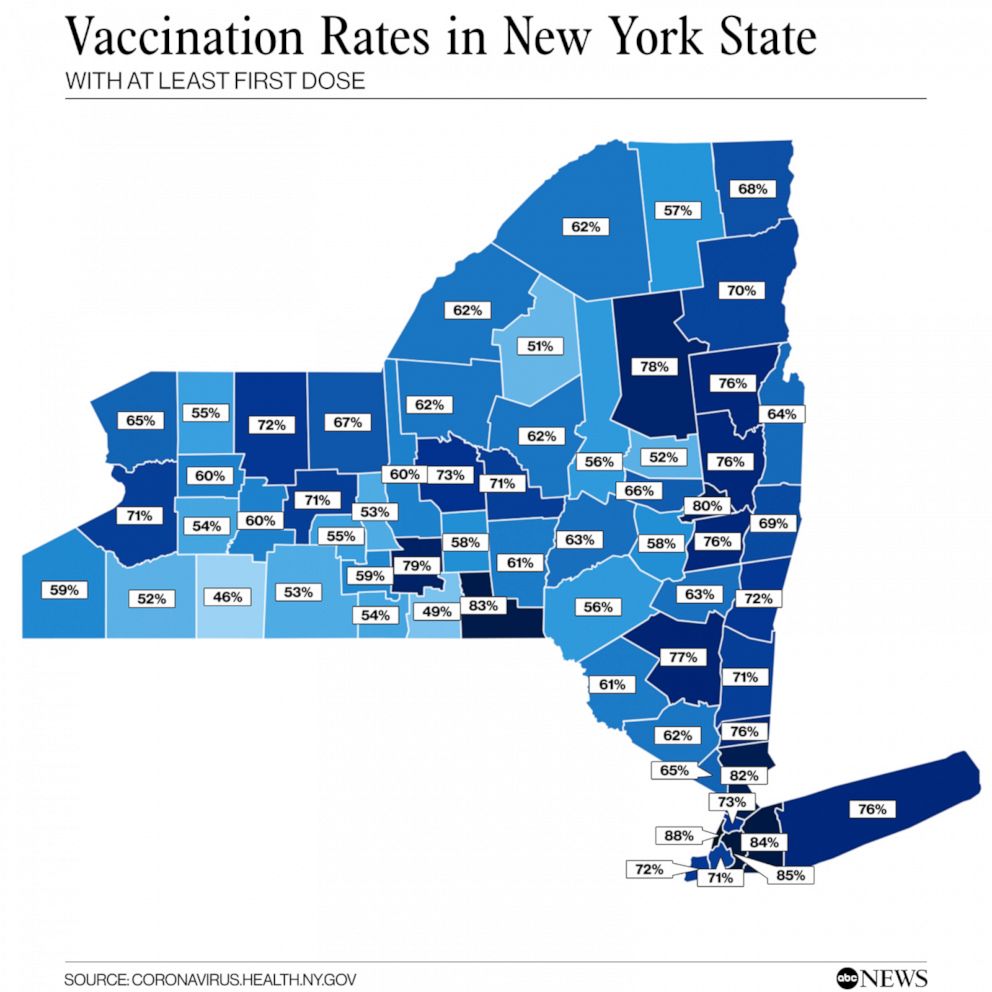
As of Dec. 8, 74.9% of all New York state residents have at least one COVID-19 vaccine dose, but those numbers vary by region, according to state health data.
New York City and Long Island had over 78% of their populations with at least one shot, the state data showed. Further north, the rates for at least one dose in the Mohawk Valley, the Finger Lakes and North Country sections were 60.6%, 68.5%, and 63% respectively.
There is even more division within the regions when it comes to vaccination, the data shows; for example, counties that are along the Interstate 87 corridor, such as Hamilton, Schenectady and Saratoga, all have rate of at least one dose above 75% of their populations.
Counties directly west of those locations, Schoharie, Fulton and Montgomery, have one-dose vaccination rates under 65%, the state data showed.
New York Gov. Kathy Hochul has repeatedly highlighted that the unvaccinated are the ones suffering and being hospitalized.
“It is a conscious decision not to be vaccinated. And the direct result is a higher rate of individuals in those regions upstate as well as it has a direct correlation to the number of hospitalizations,” she said during a Dec. 2 news conference.
Dr. Isaac Weisfuse, an adjunct professor of public health at Cornell University, told ABC News that there are fewer options for upstate residents to turn to for medical help and fewer hospitals in the area are handling patients from more locations.
Weisfuse, a former deputy health commissioner for New York City’s Health Department, noted that New York City residents have much closer access to amenities like free testing sites and medical clinics than their upstate counterparts.
“If you live in a rural county in New York state and it takes a while to get to a doctor, you may put it off. So when you do eventually go get care, you may be sicker versus someone who lives closer and gets a quicker diagnosis,” he said.
Larsen added that there has been pandemic fatigue across the country, and many Americans have scaled back on mitigation measures, especially mask-wearing indoors.
“We’re doing less mask wearing. What that does is it increases transmission, which is fine for the vaccinated people but it does go to the unvaccinated people and they are higher risk,” he said.
Weisfuse said the hospitalizations are likely to grow upstate and have ripple effects for those regions. The governor has ordered elective surgeries to be postponed at 32 hospitals upstate that have seen their available beds decrease.
State officials said they are beefing up their marketing efforts to encourage eligible New Yorkers to get their shots.
Weisfuse said this outreach needs to be done meticulously if upstate officials want to avoid more overcrowded emergency rooms this winter.
“The state needs to take a good look at the pockets of non-vaccination,” he said. “They need to make some targeted intervention in those neighborhoods.”
Anyone who needs help scheduling a free vaccine appointment can log onto vaccines.gov.
Top US scientist Anthony Fauci said Tuesday that while it would take weeks to judge the severity of the new Covid-19 variant Omicron, early indications suggested it was not worse than prior strains, and possibly milder.
Speaking to AFP, President Joe Biden’s chief medical advisor broke down the knowns and unknowns about Omicron into three major areas: transmissibility, how well it evades immunity from prior infection and vaccines, and severity of illness.
The new variant is “clearly highly transmissible,” very likely more so than Delta, the current dominant global strain, Fauci said.
Accumulating epidemiological data from around the world also indicates re-infections are higher with Omicron.
Fauci, the long-time director of the National Institute of Allergies and Infectious Diseases (NIAID), said lab experiments that tested the potency of antibodies from current vaccines against Omicron should come in the “next few days to a week.”
On the question of severity, “it almost certainly is not more severe than Delta,” said Fauci.
“There is some suggestion that it might even be less severe, because when you look at some of the cohorts that are being followed in South Africa, the ratio between the number of infections and the number of hospitalizations seems to be less than with Delta.”
But he added it was important to not over-interpret this data because the populations being followed skewed young, and were less likely to become hospitalized.
“I think that’s going to take another couple of weeks at least in South Africa,” where the variant was first reported in November, he said.
“As we get more infections throughout the rest of the world, it might take longer to see what’s the level of severity.”
Fauci said a more transmissible virus that doesn’t cause more severe illness and doesn’t lead to a surge of hospitalizations and deaths was the “best case scenario.”
“The worst case scenario is that it is not only highly transmissible, but it also causes severe disease and then you have another wave of infections that are not necessarily blunted by the vaccine or by people’s prior infections,” he added.
“I don’t think that worst case scenario is going to come about, but you never know.”
Preliminary laboratory studies demonstrate that three doses of the Pfizer-BioNTech COVID-19 Vaccine neutralize the Omicron variant (B.1.1.529 lineage) while two doses show significantly reduced neutralization titers
Data indicate that a third dose of BNT162b2 increases the neutralizing antibody titers by 25-fold compared to two doses against the Omicron variant; titers after the booster dose are comparable to titers observed after two doses against the wild-type virus which are associated with high levels of protection
As 80% of epitopes in the spike protein recognized by CD8+ T cells are not affected by the mutations in the Omicron variant, two doses may still induce protection against severe disease
The companies continue to advance the development of a variant-specific vaccine for Omicron and expect to have it available by March in the event that an adaption is needed to further increase the level and duration of protection – with no change expected to the companies’ four billion dose capacity for 2022
NEW YORK & MAINZ, Germany–(BUSINESS WIRE)– Pfizer Inc. (NYSE: PFE) and BioNTech SE (Nasdaq: BNTX) today announced results from an initial laboratory study demonstrating that serum antibodies induced by the Pfizer-BioNTech COVID-19 Vaccine (BNT162b2) neutralize the SARS-CoV-2 Omicron variant after three doses. Sera obtained from vaccinees one month after receiving the booster vaccination (third dose of BNT162b2 vaccine) neutralized the Omicron variant to levels that are comparable to thoseobserved for the wild-type SARS-CoV-2 spike protein after two doses.
Sera from individuals who received two doses of the current COVID-19 vaccine did exhibit, on average, more than a 25-fold reduction in neutralization titers against the Omicron variant compared to wild-type, indicating that two doses of BNT162b2 may not be sufficient to protect against infection with the Omicron variant. However, as the vast majority of epitopes targeted by vaccine-induced T cells are not affected by the mutations in Omicron, the companies believe that vaccinated individuals may still be protected against severe forms of the disease and are closely monitoring real world effectiveness against Omicron, globally.
A more robust protection may be achieved by a third dose as data from additional studies of the companies indicate that a booster with the current COVID-19 vaccine from Pfizer and BioNTech increases the antibody titers by 25-fold. According to the companies’ preliminary data, a third dose provides a similar level of neutralizing antibodies to Omicron as is observed after two doses against wild-type and other variants that emerged before Omicron. These antibody levels are associated with high efficacy against both the wild-type virus and these variants. A third dose also strongly increases CD8+ T cell levels against multiple spike protein epitopes which are considered to correlate with the protection against severe disease. Compared to the wild-type virus, the vast majority of these epitopes remain unchanged in the Omicron spike variant.
“Although two doses of the vaccine may still offer protection against severe disease caused by the Omicron strain, it’s clear from these preliminary data that protection is improved with a third dose of our vaccine,” said Albert Bourla, Chairman and Chief Executive Officer, Pfizer. “Ensuring as many people as possible are fully vaccinated with the first two dose series and a booster remains the best course of action to prevent the spread of COVID-19.”
“Our preliminary, first dataset indicate that a third dose could still offer a sufficient level of protection from disease of any severity caused by the Omicron variant,” said Ugur Sahin, M.D., CEO and Co-Founder of BioNTech. “Broad vaccination and booster campaigns around the world could help us to better protect people everywhere and to get through the winter season. We continue to work on an adapted vaccine which, we believe, will help to induce a high level of protection against Omicron-induced COVID-19 disease as well as a prolonged protection compared to the current vaccine.”
While these results are preliminary, the companies will continue to collect more laboratory data and evaluate real-world effectiveness to assess and confirm protection against Omicron and inform the most effective path forward. On November 25, the companies started to develop an Omicron-specific COVID-19 vaccine. The development will continue as planned in the event that a vaccine adaption is needed to increase the level and duration of protection against Omicron. First batches of the Omicron-based vaccine can be produced and are planned to be ready for deliveries within 100 days, pending regulatory approval. Pfizer and BioNTech have tested other variant-specific vaccines as well, which have produced very strong neutralization titers and a tolerable safety profile. Based on this experience the companies have high confidence that if needed they can deliver an Omicron-based vaccine in March 2022. The companies have also previously initiated clinical trials with variant-specific vaccines (Alpha, Beta, Delta & Alpha/Delta Mix) and data from these studies will be submitted to regulatory agencies around the world to help accelerate the process of adapting the vaccine and gaining regulatory authorization or approval of an Omicron-specific vaccine, if needed. The companies have previously announced that they expect to produce four billion doses of BNT162b2 in 2022, and this capacity is not expected to change if an adapted vaccine is required.
About the Pfizer-BioNTech Laboratory Studies
To evaluate the effectiveness of BNT162b2 against the Omicron variant, Pfizer and BioNTech immediately tested a panel of human immune sera obtained from the blood of individuals that received two or three 30-µg doses of the current Pfizer-BioNTech COVID-19 vaccine, using a pseudovirus neutralization test (pVNT). The sera were collected from subjects 3 weeks after receiving the second dose or one month after receiving the third dose of the Pfizer-BioNTech COVID-19 vaccine. Each serum was tested simultaneously for its neutralizing antibody titer against the wild-type SARS-Cov-2 spike protein, and the Omicron spike variant. The third dose significantly increased the neutralizing antibody titers against the Omicron strain spike by 25-fold. Neutralization against the Omicron variant after three doses of the Pfizer-BioNTech COVID-19 vaccine was comparable to the neutralization against the wild-type strain observed in sera from individuals who received two doses of the companies’ COVID-19 vaccine: The geometric mean titer (GMT) of neutralizing antibody against the Omicron variant measured in the samples was 154 (after three doses), compared to 398 against the Delta variant (after three doses) and 155 against the ancestral strain (after two doses). Data on the persistence of neutralizing titers over time after a booster dose of BNT162b2 against the Omicron variant will be collected.
The Pfizer-BioNTech COVID-19 vaccine, which is based on BioNTech’s proprietary mRNA technology, was developed by both BioNTech and Pfizer. BioNTech is the Marketing Authorization Holder in the United States, the European Union, the United Kingdom, Canada and other countries and the holder of emergency use authorizations or equivalents in the United States (jointly with Pfizer) and other countries. Submissions to pursue regulatory approvals in those countries where emergency use authorizations or equivalent were initially granted are planned.









 HENRY KOTULA