Return-to-Office Mandates: Layoffs in Sheep’s Clothing

https://www.reworked.co/employee-experience/return-to-office-mandates-layoffs-in-sheeps-clothing/

Companies demand employees come into the office for many legitimate reasons. But in some cases, it appears to be a tactic to force employees out.

Companies, large and small, are asking employees to return to the office at least a few days a week. But in some cases, these return-to-office (RTO) policies appear to be a passive-aggressive approach to eliminate roles, rather than doing layoffs.

Case in point: AT&T recently said it would require thousands of managers from across the country to work in person at just nine locations. One manager referred to the move as “a layoff wolf in return-to-office sheep’s clothing.”  

Dell stated employees who chose to work fully remotely won’t be eligible for promotion. Google plans to factor an employee’s in-person attendance into their performance evaluation

While there are several reasons companies could be using RTO to avoid actively laying people off, Maurice Cayer, lecturer and coordinator of the master of science human resources program at the University of New Haven, said it could backfire.

“It’s a blunt instrument,” he said of the tactic. 

A Disconnect Between Employers and Employees 

Research from the University of Pittsburgh found companies use RTO mandates at times for “power grabbing and blaming employees for poor performance,” yet the results harm employee satisfaction and fail to improve performance. 

Still, 90% of organizations plan to implement RTO policies this year, and 80% will track in-office attendance, such as via badge swipes and desk sensors. 

Most employees prefer remote or hybrid work. Nearly 50% said they would quit their jobs if their employer mandated a full-time RTO policy, according to the Integrated Benefits Institute.  

Employees’ feelings about in-office work are clear. So why are companies choosing to enforce such an unpopular — and ineffective — tactic? 

One reason is that some organizations, especially tech companies, overstaffed as they rebounded from the pandemic and now have too many employees, Cayer said. The introduction of new technology, like artificial intelligence, also might be behind a reduction in staff. 

Others may be using RTO as a test. The mandate in those cases screens employees to determine “who’s the most committed to the organization” and open to a more traditional work model, said Colleen Flaherty Manchester, a professor in the Work and Organizations department at the University of Minnesota. 

The tactic highlights the disconnect between employers’ perceptions of flexible work and employees’ desires to work remotely for personal or productivity reasons, she said. 

Requiring employees to return to work in person may have some advantages, such as improved communication and more opportunities for mentorship, but organizations typically haven’t experienced extensive productivity issues with remote work, said Carrie Urrutia, a labor and employment attorney at Eastman & Smith in Toledo, Ohio. 

“Many companies simply want things to revert to the way they were before COVID,” she said. 

The Consequences of Using RTO to Trim Staff 

Companies risk losing their best people with RTO policies, said Cayer. 

“Organizations are placing bets, and they’re willing to live with the consequences of losing some highly desirable people in the process,” he explained. “But, maybe they’ll make up for it by having people who are engaged at work.” 

Quietly laying off workers under the RTO guise could anger employees and damage an organization’s reputation, which might impact future hiring and meeting business goals, Urrutia added. 

Yet the approach is attractive to companies. “It could be a less-costly way to achieve a goal of reducing the workforce without a formal reduction in force,” said Urrutia.

Employees who quit as a result of RTO mandates wouldn’t be eligible for unemployment compensation and typically wouldn’t receive a severance package as opposed to those who were laid off, she explained. “Generally speaking, employees who voluntarily resign are not entitled to those benefits.”

However companies would be better served implementing hiring freezes or enabling more flexibility, she argued. Urrutia said organizations should examine their current remote or hybird work arrangements and assess what’s working for them and employees. If RTO is mandated, they should clearly articulate the business reasons why it’s necessary and why remote work isn’t working. 

“Aim to find a sweet spot that achieves the manager’s goals of in-person connection for innovation and group productivity, yet also meets some of the needs of employees,” Manchester said. 

Are Quiet Layoffs Legal? 

As a rule, employees don’t have a legal right to work from home, so employers are free to require in-person work as a condition of employment, Urrutia said. Workers therefore typically don’t have legal recourse if they feel a RTO mandate is designed to make them quit.

One exception is if an employee had a contract that specifically stipulated they’re allowed to work remotely, Urrutia explained. Another is unionized employees, where RTO could be a subject of collective bargaining.  

Organizations also must ensure their RTO decisions aren’t discriminatory or unfairly impact groups protected under the Civil Rights Act, Cayer said. The law prohibits employment discrimination based on race, color, sex, national origin, age, disability and medical history. 

Employers are also required to provide reasonable accommodation under the Americans with Disabilities Act or Pregnant Workers Fairness Act, and that might include allowing remote work, Urrutia added. 

“Employees who work from home are not a protected classification, but many employees who work from home are in protected classifications,” she said. 

Still, employees could file a lawsuit if they feel they RTO policies unfairly led them to quit, Cayer added. Organizations can choose to protest the suit. “A lot of times that leads into some settlement,” he said.
Expanding beyond patient experience 

https://mailchi.mp/cd8b8b492027/the-weekly-gist-january-26-2024?e=d1e747d2d8

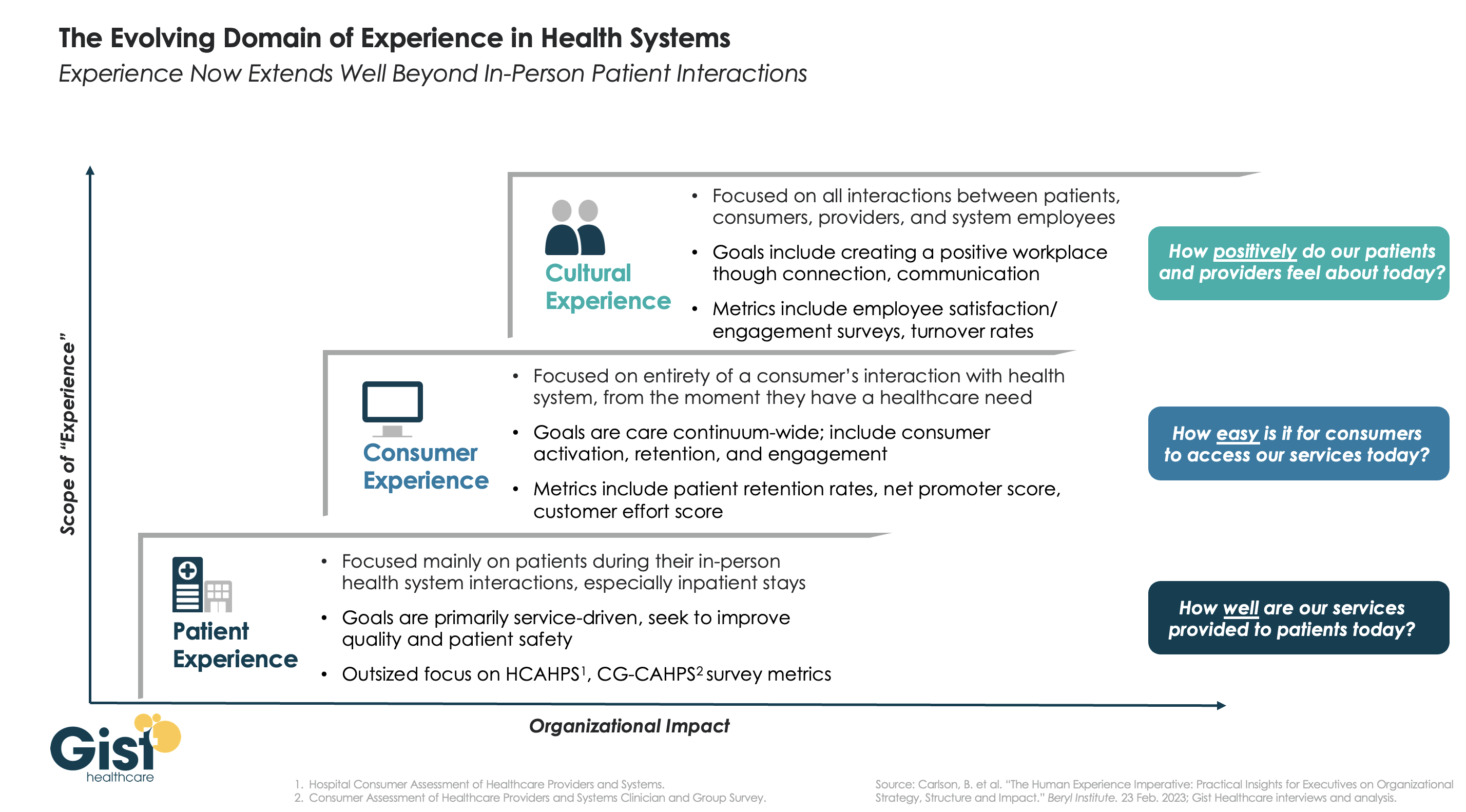
In this week’s graphic, we highlight the importance of broadening the domain of health system experience initiatives beyond patients to include consumers and even employees.

While reimbursements tied to HCAHPS (Hospital Consumer Assessment of Healthcare Providers and Systems) and CG-CAHPS (Clinician and Group Consumer Assessment of Healthcare Providers and Systems) scores have made patient experience a main focus for years, an increasingly consumer-driven healthcare industry means that health systems must consider the experience of all consumers in their markets, with the hopes of meeting their needs and eventually welcoming them as new—or retuning—patients. 

Embracing this mindset requires focusing on the entirety of a consumer’s interactions with the health system and the tracking of non-traditional metrics that measure the strength and value of their relationship to the system. Some systems are expanding their experience purview even further by also focusing on the working conditions and morale of their providers and other staff, as a healthy workplace environment serves to better both the patient and consumer experience. Easily accessible services and positive interactions with providers and other staff can determine a consumer’s view of their experience before any care is actually delivered. 

Cultural and strategic shifts that integrate experience from the top down into all operational facets of the health system will ultimately strengthen consumer loyalty, employee retention, and the financial health of the system.

The Great Resignation is over, quit rates return to pre-pandemic levels

https://www.axios.com/2023/05/31/great-resignation-quitting-boom

A phenomenon that defined the pandemic-era labor market is over: the Great Resignation — workers furiously quitting for new, likely higher paying jobs — is a thing of the past.

Why it matters:

The historic surge of quitters was a symptom of an on-fire labor market, where demand for workers far outstripped supply of them.

  • Now the job market may be entering a different era — one that more closely resembles pre-pandemic times.

By the numbers:

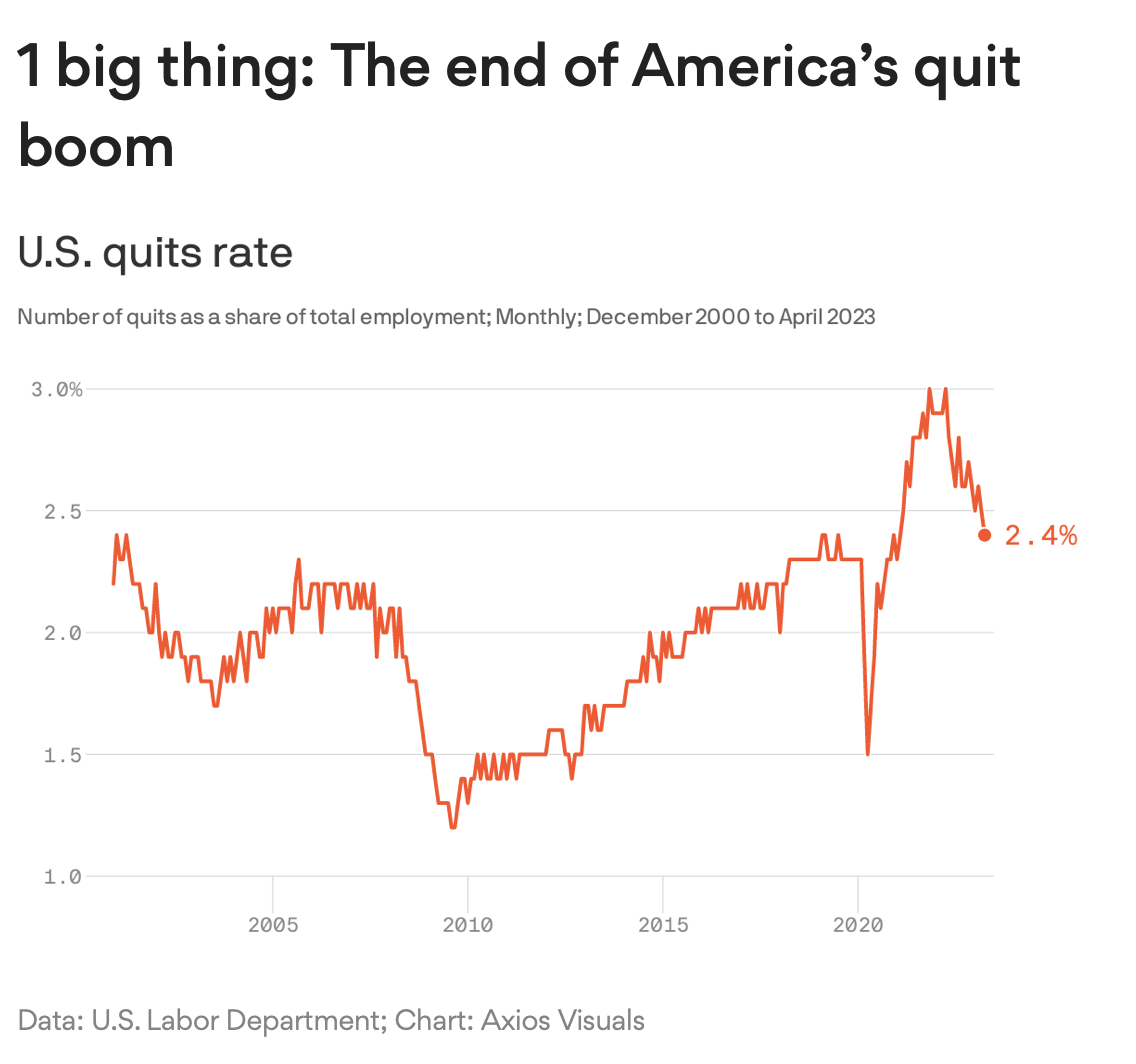
The quits rate fell to 2.4% in April, according to the Job Openings and Labor Turnover Survey, released this morning.

  • That is just a tick (0.1 percentage point) higher than the quits rate in February 2020 — and roughly in line with the average quits rate in 2019.
  • Even leisure and hospitality workers, once the poster child for the quits boom, are returning to pre-pandemic norms: the quits rate in this segment hit 4.6% in April — very close to the January 2020 rate of 4.4%, and well-below the peak 5.8% recorded last summer.

What they’re saying:

“We are pretty much back to a strong, robust labor market, but one that is no longer overheating,” says Julia Pollak, an economist at ZipRecruiter.

  • “One that isn’t plagued by widespread labor shortages that are wreaking havoc across the economy, and causing firms to offer off-cycle wage increases and dispense of all hiring requirements. The deck isn’t totally stacked in jobseekers‘ favor anymore.”

Flashback:

At the height of the Great Resignation, the overall quits rate most recently peaked at 3% in April 2022, when there were roughly 4.5 million quits in a single month.

  • Turnover of that magnitude had never been seen before — at least not since the Labor Department started collecting the data in 2000.
  • Workers were in such high demand that they felt confident enough to ditch current gigs for new (likely higher paying) ones.

The bottom line:

Americans who did job hop over the past few years have seen heftier pay gains. But that phenomenon, too, is fading — another sign of some heat coming off the labor market.

  • Job-changers saw annual pay grow more than 13% in April, according to payroll professor ADP — more than double the annual rate of job-stayers.
  • Still that was the slowest pace of growth since November 2021.

Improved earnings not enough to solve healthcare worker shortage

https://mailchi.mp/a44243cd0759/the-weekly-gist-february-3-2023?e=d1e747d2d8

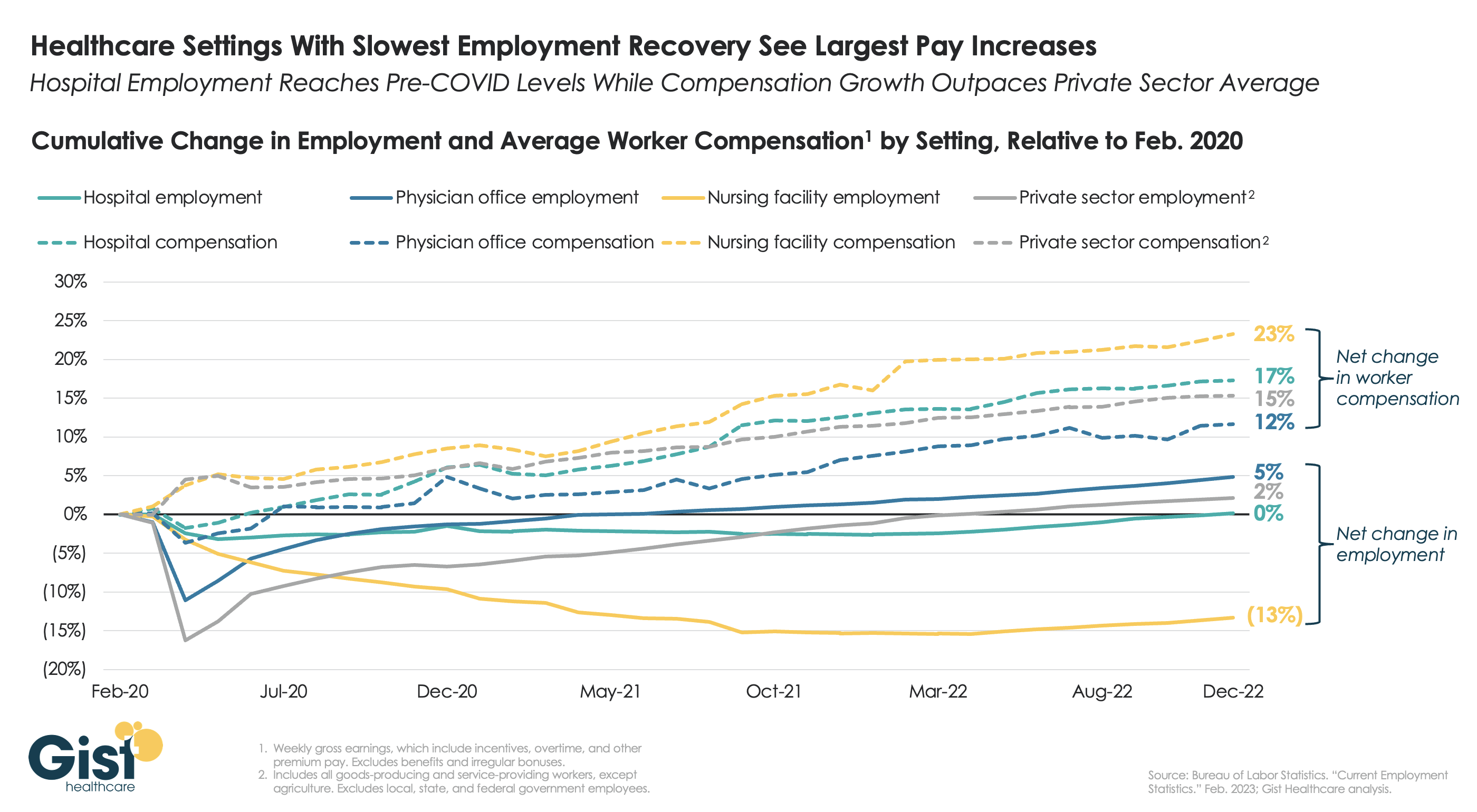
The healthcare sector has been navigating an intransigent staffing crisis since the widespread layoffs during the first few months of COVID. The graphic above uses Bureau of Labor Statistics data to illustrate the impact of this labor shock on both total employment and employee compensation. 

Across key healthcare settings, workplaces with the slowest recovery of total workers have seen the largest increases in employee earnings. Hospital employment largely tracked with the rest of the private sector; however, hospitals raised employee compensation by two percent more than the private sector, while recovering two percent fewer jobs.

It is important to note that the relationship between employment levels and employee compensation is not causal, as evidenced by the ongoing labor shortages in nursing facilities, despite boosting average pay over 20 percent. Rather, the data suggest that, for as long as the tight labor market persists, pay raises alone are not sufficient to recruit and retain talent. Plus, while inflation may be abating, it has still outpaced earnings growth since December 2021. 

Given that many healthcare workers saw pay bumps early in the pandemicsome are left still feeling underpaid, even if their compensation over the past three years has more than kept pace with inflation

The Coming Insurance Storm

Employers face a brutal increase in health-insurance premiums for 2023, Axios’ Arielle Dreher writes from a Kaiser Family Foundation report out this morning.

  • Why it matters: Premiums stayed relatively flat this year, even as wages and inflation surged. That reprieve was because many 2022 premiums were finalized last fall, before inflation took off.

“Employers are already concerned about what they pay for health premiums,” KFF president and CEO Drew Altman said.

  • “[B]ut this could be the calm before the storm … Given the tight labor market and rising wages, it will be tough for employers to shift costs onto workers when costs spike.”

🧠 What’s happening: Nearly 159 million Americans get health coverage through work — and coverage costs and benefits have become a critical factor in a tight labor market.

🔎 Between the lines: In the tight labor market, some employers absorbed rising costs of coverage instead of passing them on to workers.

  • An October survey of 1,200 small businesses found that nearly half had raised prices to offset rising costs of health care.

🧮 By the numbers: It cost an average of $22,463 to cover a family through employer-sponsored health insurance in 2022, KFF found.

  • Workers contributed an average of $6,106.

Read the report

4 health systems retaining talent with perks beyond pay

As hospitals and health systems continue to grapple with staffing shortages, employers are using perks beyond pay to recruit and retain talent. 

Incentives beyond the norm are attractive to employees: They prove the employer values them personally, beyond their work performance. 

These four health systems offer perks beyond pay, like extra paid time off, well-being coaches, adoption assistance and local discounts. 

Food, entertainment and staycations

Nashville, Tenn.-based Vanderbilt Health said it will launch a new employee awards program in September that offers workers perks, discounts and a grand prize “staycation.”

The month-long Work Perks program will feature a website where employees can play games to earn perks in music and entertainment, health and wellness, dining and Nashville-area attractions, according to an Aug. 29 news release shared with Becker’s.  

Workers will also be able to enter a drawing for a staycation. Five employees will win grand prizes including a one-night stay at a downtown hotel, passes to Nashville attractions, dinner at a local restaurant and a gift basket with items from Nashville businesses, including a winery and chocolate company, Vanderbilt Health said.

“We’re excited to show appreciation for our dedicated workforce in this way, and we’re grateful to so many generous partners to help make it happen,” Amy Schoeny, PhD, chief human resources officer, said in a release. “This is just one of the many benefits and perks that we offer to those who choose to pursue careers in making healthcare personal for our patients today and in the future.”

Work Perks will launch Sept. 5.

“We Hours” program

Marlton, N.J.-based Virtua Health told Becker’s it has instituted a “We Hours” program “to give employees more time to do the things that are important to them — from self-care to community service.”

The program offers eight additional hours of scheduled, paid time off per year for most of Virtua’s 13,000 employees. 

“The ultimate goal is to encourage mindfulness and a healthy work-life balance,” Rhonda Jordan, Virtua’s executive vice president and chief human resources officer, told Becker’s. “We Hours are intended for colleagues to pursue something rewarding or fulfilling, such as volunteering, recognizing a religious or cultural event, or ‘recharging their battery’ with extra time away.”

Ms. Jordan said Virtua workers may also use the program for practical matters, such as a physician’s visit or attending to household repairs.

The program name stems from Virtua’s “Culture of We,” a set of guiding principles that include continuous learning and innovation, open communication and inclusive teamwork, among others. 

A colleague committee developed the tenets in 2019, and employees are encouraged to share how they spend their We Hours in a private Facebook group, according to Ms. Jordan. She cited examples including photos from a visit to a botanical garden, a description of volunteer work helping nonprofit organizations, and a photo of the day one worker spent with her son, who’d been away serving in the U.S. Marine Corps.

“One of my favorite outcomes of the We Hours is that they invite us to learn more about our colleagues and the people, causes and activities that are most important to them,” Ms. Jordan adds.

Walking trails and well-being coaching 

Charlotte, N.C.-based Atrium Health encourages all-around health through their LiveWell programs. 

“[LiveWell] exists to support teammates in working meaningfully, eating healthfully, learning continuously and living fully … living their best lives so that we can deliver on the mission of Atrium Health,” Scott Laws, vice president of enterprise total rewards at Atrium Health, told Becker’s. 

Physical health is encouraged through perks like discounted gym enrollment, tobacco cessation programs and on-site walking trails at Atrium Health facilities. Financial assistance is provided through free webinars and individual medication management consultations. One-on-one well-being coaches encourage employees to consider personal health.

Those that take advantage of the LiveWell resources are rewarded. 

“By completing certain physical, personal and financial well-being goals — which include participation in wellness exams and programs or financial education — teammates are eligible for financial incentives, paid into their HSAs,” Mr. Laws said. 

Adoption assistance

Springfield, Ill.-based Hospital Sisters Health System offers adoption assistance as part of its benefits package.

“HSHS provides financial support up to $7,500 per child for eligible adoption expenses to qualified colleagues,” Catie Sheehan, vice president of advocacy and communications at Hospital Sisters, told Becker’s

Alicia Corman, an occupational therapist in the health system, was first to receive the benefit. After the adoption decree was signed, the human resources department helped her submit a breakdown of what the financial support would cover, Ms. Corman said in a video shared with Becker’s. The funds she received aided Ms. Corman and her husband in adopting their son. 

“I’m very grateful because if you look across the U.S., adoption is not very supported in a workplace,” Ms. Corman said.

Why 67% of nurses want to quit—and what would make them stay

As RNs struggle to work through staffing shortages, their job satisfaction has sharply declined, with 67% saying they plan to leave their jobs within the next few years, according to a survey from the American Association of Critical-Care Nurses (AACN) published in Critical Care Nurse.

RNs cite poor work environments

For the survey, AACN collected responses from 9,862 nurses, 9,335 of which met the study criteria of being currently practicing RNs, in October 2021. The mean age was 46.5 years, and the mean years of experience was 17.8 years.

Of the participants, 78.3% worked in direct care, and 19.4% worked in a Beacon unit, meaning that their unit had been recognized by an AACN Beacon Award for Excellence. Half of the participants said they spent 50% or less of their time caring for Covid-19 patients, while the other half said they spent 50% or more.

To measure the health of a work environment, AACN looked at six standards:

  • Skilled communication
  • True collaboration
  • Effective decision-making
  • Meaningful recognition
  • Authentic leadership
  • Appropriate staffing

Overall, AACN found that nurses’ perceptions of quality on these six measures had declined across the board since the organization’s 2018 survey.

In particular, appropriate staffing was the lowest rated of all the standards at 2.33 out of 4, which is the lowest rating the standard has received since AACN first began the survey in 2006. Only 24% of RNs said their units had the right number of nurses with the right knowledge and skills more than 75% of the time—down from 39% who said the same in 2018.

In addition, there was a significant decline in how RNs rated the quality of care in their organizations and their units. Only 16% rated their organizations’ quality of care as excellent (compared to 24% in 2018), and 30% rated their units’ quality of care as excellent (compared to 44% in 2018). Over 50% of nurses said quality of care in their organization or unit has gotten somewhat or much worse over the last year.

Many nurses also reported difficulties with their physical and psychological well-being in the survey. For example, less than 50% of RNs said they felt their organization values their health and safety, a significant decline from 68% who said the same in 2018.

In addition, 40% of participants reported that they were not emotionally healthy. The percentage of RNs who reported experiencing moral distress also doubled from 11% in 2018 to 22% in 2021.

A significant portion of RNs also reported experiencing verbal abuse, physical abuse, sexual harassment, or discrimination over the past year. Of the 7,399 RNs who answered this question, 72% said they had experienced at least one negative incident, with verbal abuse being the most common at 65%, followed by physical abuse at 28%.

RN job satisfaction

Only 40% of RNs said they were “very satisfied” with their job, down from 62% who said the same in 2018. Further, a significant number of RNs in the survey reported planning to leave their jobs within the next few years.

Overall, 67% of RNs said they planned to leave their current position within the next three years, compared to 54% in 2018. Of this group, 36% said they planned to leave within the next year, with 20% planning to leave within the next six months.

According to the respondents, the top factors that could lead them to reconsider their decision to leave their job were a higher salary and more benefits (63%), better staffing (57%), and more respect from administration (50%).

“Without improvements in the work environment, the results of this study indicate that nurses will continue to exit the workforce in search of more meaningful, rewarding, and sustainable work,” the survey’s authors wrote. “It is time for bold action, and this study shows the way.” (Firth, MedPage Today, 8/3; Ulrich et al., Critical Care Nurse, 8/1)

Hard truths on the current and future state of the nursing workforce

image

Concerns about an imbalance in supply and demand in the nursing workforce have been around for years. The number of nursing professionals nationally may be healthy, but many nurses are not in the local areas, sites of care, or roles where they’re needed most. And many of today’s nurses don’t have the specialized skills they need, widening the existing gap between nurse experience and job complexity.

As a result, gaping holes in staffing rosters, prolonged vacancies, unstable turnover rates, and unchecked use of premium labor are now common.

Health care leaders need to confront today’s challenges in the nursing workforce differently than past cyclical shortages. In this report, we present six hard truths about the nursing workforce. Then, we detail tactics for how leaders can successfully address these challenges—stabilizing the nursing workforce in the short term and preparing it for the future.

Read More

Hospitals face increasing competition for lower-wage workers 

https://mailchi.mp/8e26a23da845/the-weekly-gist-june-17th-2022?e=d1e747d2d8

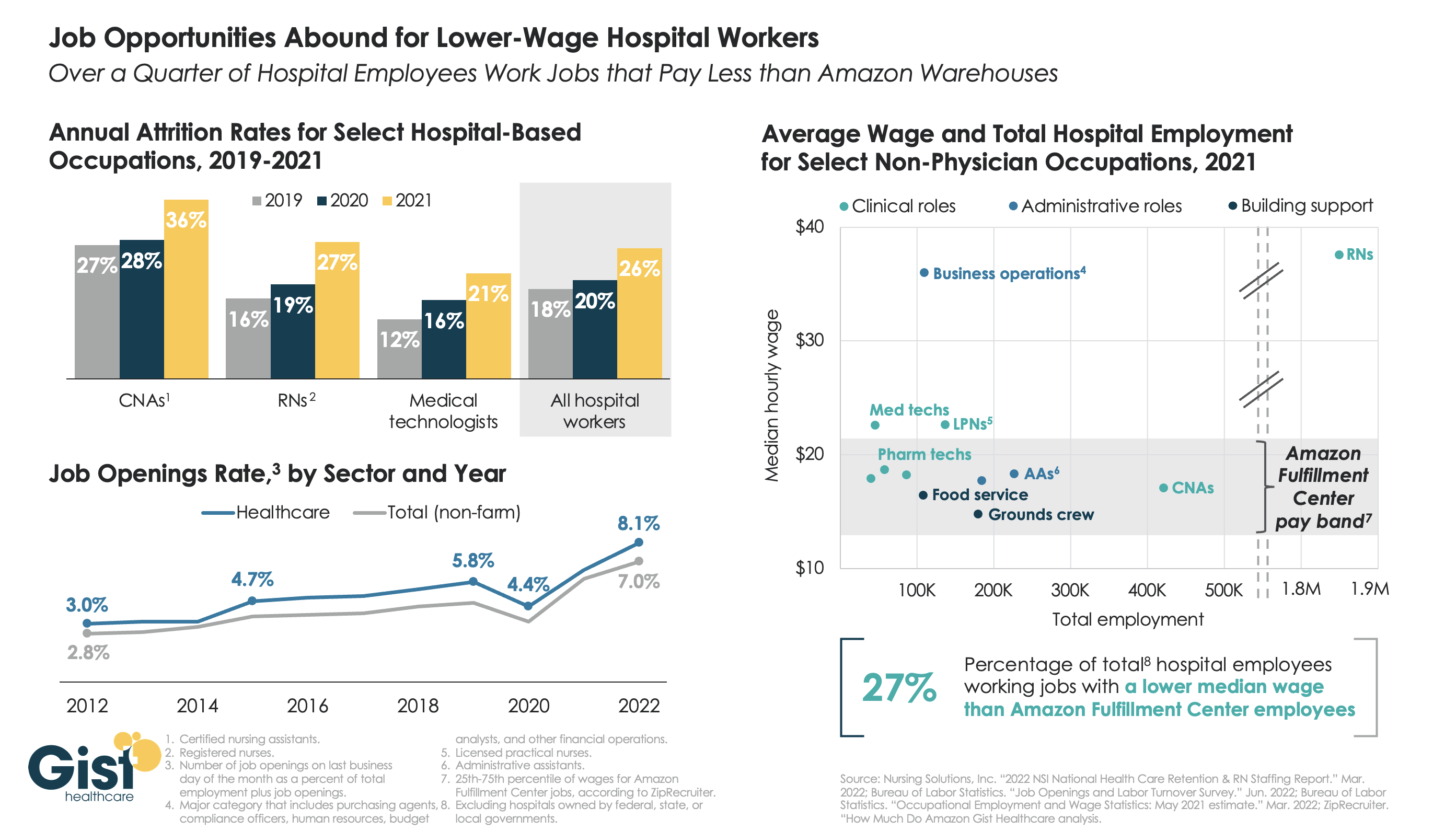
Although the nursing shortage has attracted much attention in recent months, the healthcare workforce crisis is hitting at all levels of the labor force. As the graphic above shows, the attrition rate for all hospital workers in 2021 was eight percentage points higher than in 2019. 

Among clinicians and allied health professionals, certified nursing assistants (CNAs) have the highest turnover levels. Given the demands of the job and relatively low pay, CNA openings have been consistently difficult to fill. But it’s become even harder to hire for the role in today’s labor market as job openings near an all-time high. 

Although labor force participation rates have rebounded to 2019 levels, pandemic-induced economic shifts have led to a boom in lower-wage jobs. In 2021 alone, Amazon opened over 250 new fulfillment centers and other delivery-related work sites. The company is competing directly with hospitals and nursing facilities for the same pool of workers at many of these new sites.

In fact, our analysis shows that more than a quarter of hospital employees currently work in jobs with a lower median wage than Amazon warehouses. Health systems have historically relied on rich benefits packages and strong career ladder opportunities to attract lower-wage employees, but that’s no longer enough—Amazon and other companies have ramped up their benefits, such that they now meet, or even surpass, what many hospitals are providing. 

The time has come for health systems to reevaluate their position in local labor markets, and better define and promote their employee value proposition.