


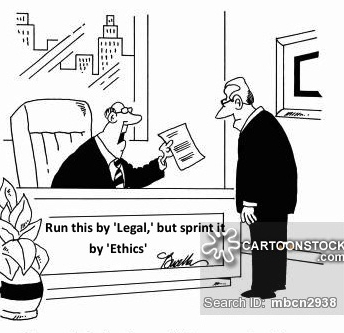
Cartoon – Unethical Ethics

A group of emergency room physicians filed a lawsuit in March alleging representatives for their employer, American Physician Partners, discouraged them from testing for COVID-19 and pressured them to work while ill, according to the Houston Chronicle.
Brentwood, Tenn.-based American Physician Partners staffs and manages ER physicians at more than 15 Houston Methodist facilities, including hospitals and emergency care centers. The lawsuit, which does not involve Houston Methodist employees, centers on a dispute between eight physicians and APP.
The physicians allege APP is underpaying them and engaging in “unethical practices,” such as urging physicians with COVID-19 to work, as a way to boost revenue.
APP’s protocol, “discourages testing and disregards physician, staff, and patient safety when a doctor does test positive for COVID-19,” the lawsuit alleges. The physicians claim APP is putting “profit over patient.”
APP denied its involvement in the alleged financial damages in a response to the physicians’ complaint filed April 25. The company told the Houston Chronicle that it has been in discussions with the physicians since they raised concerns four months ago.
“We advised them at that time that their concerns do not reflect the facts known to APP and otherwise appear to be based on misinformation,” APP said in a statement to the Chronicle. “Thus we are disappointed these physicians — who represent a very small minority of the physicians APP partners with in the Houston area — have decided to move forward with this litigation. We remain open to continuing our dialogue with these physicians outside of the litigation, which, again, APP believes is without merit.”
Houston Methodist, which isn’t involved in or named in the lawsuit, said it cannot comment on the specific allegations, according to the Chronicle. “We are unaware of any ER doctor who came to work after testing positive for COVID-19,” a hospital spokesperson told Becker’s.
Read the full Houston Chronicle article here.

It’s not just you, and it’s not just in healthcare: Poor behavior ranging from the impolite to the violent is having a moment in society right now.
The Atlantic’s Olga Khazan spoke with more than a dozen experts on crime, psychology and social norms to suss out contributing factors to the spike in poor behavior, which she details in her piece, “Why People Are Acting So Weird,” published March 30.
Stress is one likely explanation for the bad behavior. Keith Humphreys, PhD, a psychiatry professor at Stanford, told Ms. Khazan the pandemic has created a lot of “high-stress, low-reward” situations, in which someone who has experienced a lot of loss due to the pandemic may be pushed over the edge by an inoffensive request.
Not only are people encountering more provocations — like staff shortages or mask mandates — but their mood is worse when provoked.
“Americans don’t really like each other very much right now,” Ryan Martin, PhD, a psychology professor at the University of Wisconsin at Green Bay who studies expressions of anger, told Ms. Khazan.
It doesn’t help that rudeness can be contagious. At work, people can spread negative emotions to colleagues, bosses and clients regardless of whether those people were the source of the negativity.
“People who witness rudeness are three times less likely to help someone else,” Christine Porath, PhD, a business professor at Georgetown University, said in the report.
Just as the pandemic has reaped high-stress, low-reward moments, it has brought on a level of isolation that has affected how people behave.
“We’re more likely to break rules when our bonds to society are weakened,” Robert Sampson, PhD, a Harvard sociologist, told Ms. Khazan. “When we become untethered, we tend to prioritize our own private interests over those of others or the public.”
Richard Rosenfeld, PhD, a criminologist at the University of Missouri at St. Louis, went one step further to describe society operating with “a generalized sense that the rules simply don’t apply.”
Ms. Khazan makes a point to distinguish mental health in the broader conversation about poor behavior.
“People with severe mental illness are only a tiny percentage of the population, and past research shows that they commit only 3 to 5 percent of violent acts, so they couldn’t possibly be responsible for the huge surge in misbehavior,” she said.
For a quantified look at how problematic behavior — including crime, dangerous driving, unruly passenger incidents and student disciplinary problems — has spiked, turn to journalist Matthew Yglesias’ deep dive, born from his observation that “the extent to which we seem to be living through a pretty broad rise in aggressive and antisocial behavior” is underdiscussed.


It’s “a trickle that will become a torrent,” Ashish Jha, dean at Brown University’s School of Public Health, tweeted.
More hospitals are likely to require employees receive a COVID-19 vaccine, experts said, to further protect the sick and vulnerable patients who rely on them for care.
A Houston-area hospital captured headlines after taking a firm stance on requiring vaccines that prevent severe illness of the coronavirus, which has killed more than 600,000 in the U.S. and ravaged the economy.
Houston Methodist employees who refused the vaccine were either terminated or resigned. A judge earlier this month sided with the hospital and tossed out an employee lawsuit that was seeking to block the mandated inoculation. The ruling may give other hospitals the green light to require the jab, and as more facilities put a similar policy in place, others are likely to follow, experts said.
It’s “a trickle that will become a torrent,” Ashish Jha, professor and dean at Brown University’s School of Public Health, posted Thursday on Twitter.
3 large health systems in Massachusetts to require all workers to be vaccinated.
Given the critical need to protect vulnerable patients, its critical all hospitals do this.
Leading systems will do it soon.
Laggards will get there eventually.
Joining the growing tide of vaccine mandates are a variety of systems and hospitals, including Mass General Brigham in Boston, BJC Healthcare in St. Louis and Inova Health System in Virginia.
Some of the nation’s largest health systems have yet to mandate the shot, including Kaiser Permanente and CommonSpirit Health.
“Vaccination will only be required for Kaiser Permanente employees if a state or county where we operate mandates the vaccine for health care workers,” the company said in an email.
The American Hospital Association continues to hear that a growing number of its members are requiring the vaccine, with some exemptions. However, many member hospitals are waiting until the FDA grants full approval, a time when more safety and efficacy data will be made available.
“Getting vaccinated is especially critical for health care professionals because they work with patients with underlying health conditions whose immune systems may be compromised,” AHA, which has not taken on stance on the requirement, said in a statement.
The mandates raise ethical questions, some say, pointing to the profession’s promise to “do no harm.”
Arthur Caplan, head of medical ethics at New York University School of Medicine, said the codes of ethics that doctors and nurses says to put patients first, do no harm and protect the vulnerable.
“Of course they should be vaccinated,” he said. “If they don’t want to get vaccinated, I think they’re in the wrong profession.”
The Equal Employment Opportunity Commission said employment law does not prohibit employers from requiring the jab, essentially giving the green light to employers to put incentives and requirements in place for their workers. The EEOC is the federal agency tasked with ensuring that workplaces do not discriminate.
Some states are going against the tide and signing legislation that bars vaccine mandates, including Florida. The city of San Francisco will require hospital employees and workers in high-risk settings to get the vaccine. San Francisco, like other employers and universities, will require all city workers get inoculated.
The differing policy stances across the country creates additional hurdles for corporations with a large footprint.
 HENRY KOTULA