At least 247,000 people have died from coronavirus in the U.S.

(The Washington Post, as of 3:55 p.m. Eastern)

At least 11,357,000 cases have been reported.

The disease caused by the novel coronavirus has killed at least 247,000 people in the United States since February and has enveloped nearly every part of the country.

As health officials long predicted, autumn brought soaring case counts, strained hospital capacity and increased deaths nationwide, as the virus is not only popping up in new places but also circling back to areas that once appeared to have it contained. Nearly all metrics in most of the country are trending in the wrong direction.

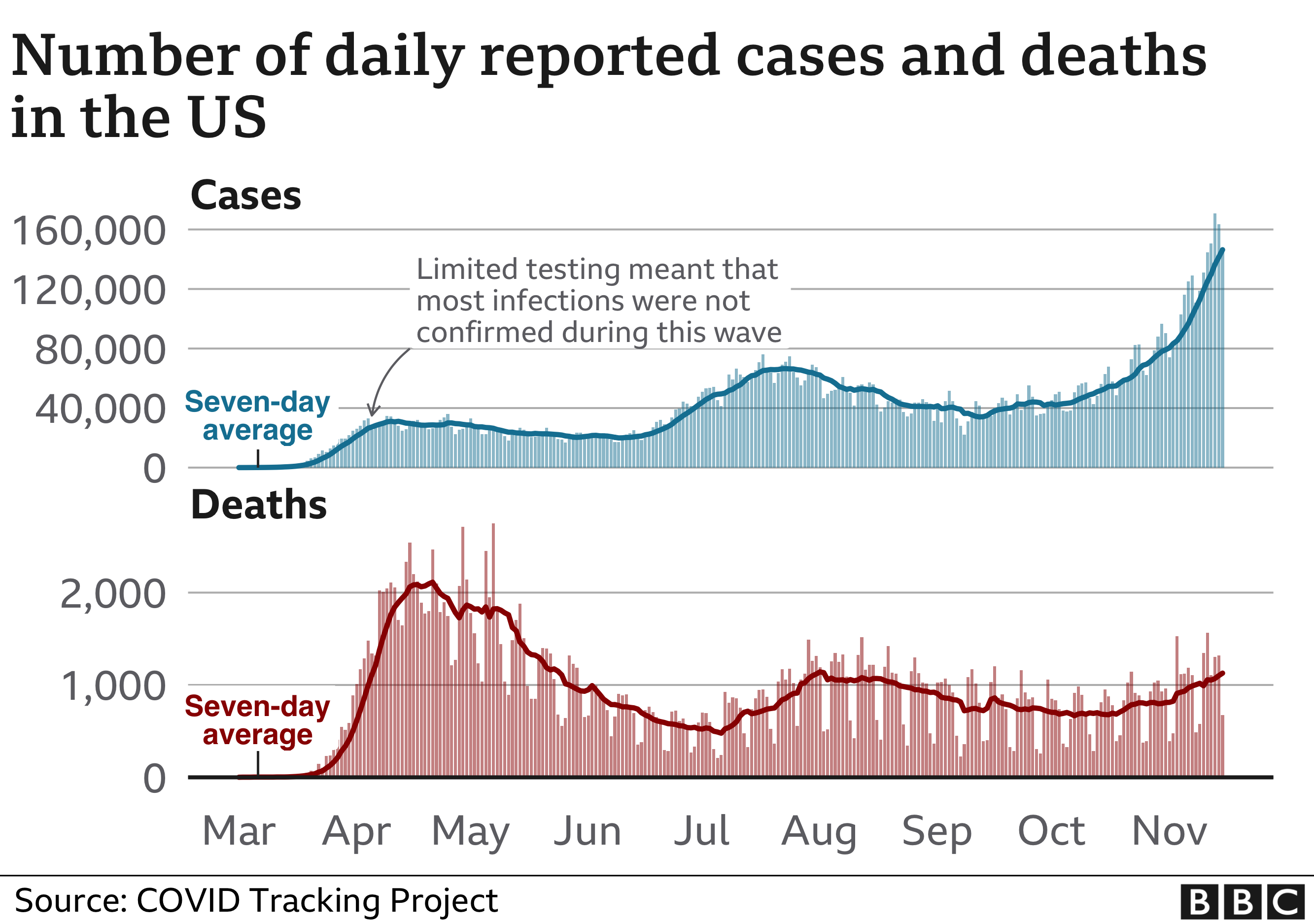
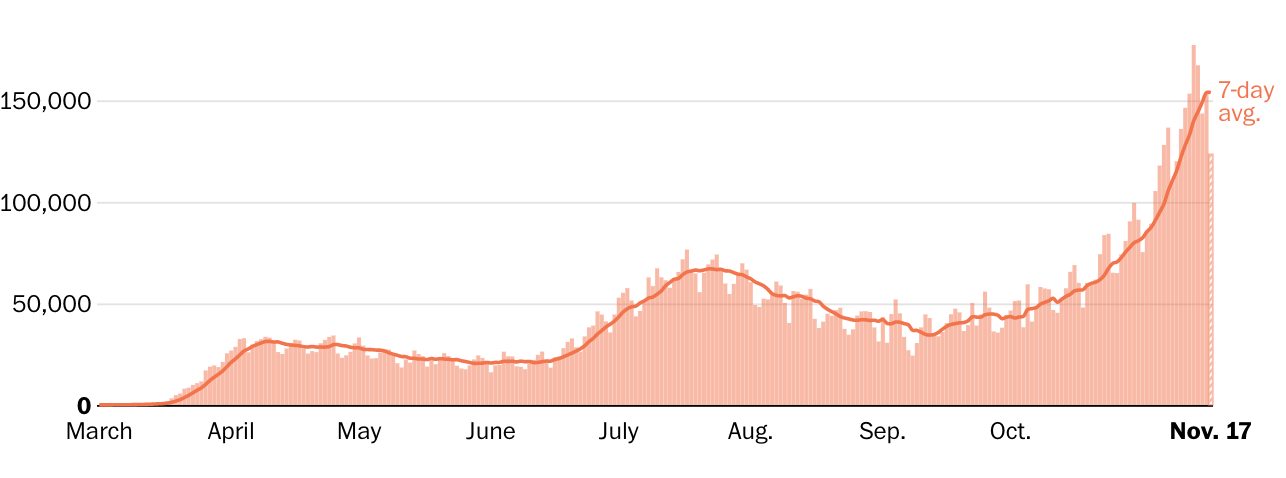
During an April peak, the seven-day-average U.S. death toll hit more than 2,000 per day, but cases were concentrated largely in the Northeast. During a July lull, average deaths sank to a low of 463 per day, although cases surged in the Sun Belt.

By early November, however, the country was recording more new cases than ever — well over 100,000 per day — and many states reported record-high caseloads and hospitalizations. The average U.S. deaths per day again shot past 1,000, despite improvements in treatment that make survival more likely.

In the past week in the U.S….New daily reported cases rose 26% New daily reported deaths rose 13.5% Covid related hospitalizations  rose 23.9%.

Among reported tests, the positivity rate was 10%.

The number of tests reported rose 9.6%  from the previous week.

Numbers in this article have fluctuated as testing and reporting criteria have evolved, particularly in areas that were hit early. Three spikes in the deaths chart above reflect large, one-time adjustments: In mid-April, New York City added more than 3,700 deaths. New Jersey added more than 1,800 on June 25. And in September, The Post changed its methodology for reporting deaths in New York and added a one-day increase of more than 2,700 on Sept. 18.

Health officials, including the country’s top infectious disease expert, Anthony S. Fauci, have said the virus has killed more people than official death tolls indicate.

No longer concentrated solely in a few urban areas or in nursing homes, prisons and factories, the virus seems to flourish wherever people let down their guard.

New York, which was slammed with the new disease in spring and where at least 33,000 have died, is one of several states experiencing a second or even third wave.

Sun Belt states had serious outbreaks after Memorial Day when people flocked to beaches. By late summer, parts of the Midwest were inundated. In August and September, clusters appeared in newly reopened college campuses, particularly in the Northeast and Midwest. By October, Upper Midwest, Great Plains and Western states that had previously been mostly spared were reporting major outbreaks, including MinnesotaWisconsinArkansasthe Dakotas and Alaska.

In November, most states reported record-high case counts and greater demand for hospital beds. Several set records for single-day fatalities.

In the absence of a federal plan, containment strategies vary by state and locality and have often reflected political polarization. The mounting crush of cases this fall, however, has prompted officials of both parties to tighten mask mandatesreimpose restrictions on gatherings and discourage holiday travel and gatherings to try to squelch the spread.

A majority of states and many retail chains required masks in public places by late July, and public health officials touted them as one of the easiest ways to stop the pandemic. Still, some people in even the hardest-hit areas refuse to wear them, despite evidence that they protect wearers and those around them.

People older than 65 and those with obesity and underlying health problems are the mostly likely to die from covid-19, but a large percentage of infections occur in younger, more mobile people. People younger than 40 tend to become less sick but also unknowingly may pass the disease to others around them.

The virus rarely kills children, although researchers have linked it to a mysterious and deadly inflammatory syndrome.

Outbreaks of covid-19 have hit Black, Hispanic and Native American communities particularly hard.

Sparsely populated areas don’t have the huge raw numbers that cities have reported, but some rank among the highest in deaths and cases per capita.

By late October, covid-19 had been documented in all but three U.S. counties and areas in Montana, the Dakotas and Idaho had some of the highest per capita caseloads.

People in very rural areas may be more vulnerable to covid-19 than urbanites, according to a Post analysis of CDC data.

Testing was slow to begin in the United States, and a system has yet to be standardized.

Demand has often overwhelmed testing infrastructure, muddying the ability of officials to get a true picture of the virus’s reach. In June, CDC Director Robert Redfield estimated that, based on antibody tests, the actual number of U.S. residents who had been infected by the virus was likely to be 10 times as high as the number of confirmed cases. More recently, conflicting CDC guidelines about whether people without symptoms should be tested caused confusion and inhibited contact tracing.

A sharp increase in hospitalizations in late October and November demonstrates that the virus is spreading, not just that more testing is finding more asymptomatic cases. A group of Illinois health-care workers predicted in a Nov. 10 open letter to state and Chicago officials that “Illinois will surpass its ICU bed capacity by Thanksgiving.”

Some hospitals, straining to find beds and health-care workers to handle the crush of patients, are considering unusual measures.

In North Dakota, health-care workers who test positive but have no symptoms can continue working in covid-19 wards, according to Gov. Doug Burgum (R). Some facilities in Oklahoma, Kansas and Ohio are limiting routine care and deferring non-emergency surgeries.

Not all news is bleak, however.

On Nov. 9, Pfizer announced that its promising vaccine — one of many in the works — appeared more than 90 percent effective in an ongoing trial. The same day, regulators granted emergency authorization to an antibody treatment that may keep mild illness from becoming severe.

And the next day, Fauci told CNN that the average American may have access to a vaccine by April.

1 Million Covid Kids

https://services.aap.org/en/pages/2019-novel-coronavirus-covid-19-infections/children-and-covid-19-state-level-data-report/

More than half a million children in the U.S. have had COVID-19

State-level reports are the best publicly available data on child COVID-19 cases in the United States. The American Academy of Pediatrics and the Children’s Hospital Association are collaborating to collect and share all publicly available data from states on child COVID-19 cases (definition of “child” case is based on varying age ranges reported across states; see report Appendix for details and links to all data sources).

As of November 12th, over 1 million children have tested positive for COVID-19 since the onset of the pandemic. The age distribution of reported COVID-19 cases was provided on the health department websites of 49 states, New York City, the District of Columbia, Puerto Rico, and Guam. Children represented 11.5% of all cases in states reporting cases by age.

A smaller subset of states reported on hospitalizations and mortality by age; the available data indicated that COVID-19-associated hospitalization and death is uncommon in children.

The number of new child COVID-19 cases reported this week, nearly 112,000, is by far the highest weekly increase since the pandemic began. At this time, it appears that severe illness due to COVID-19 is rare among children. However, there is an urgent need to collect more data on longer-term impacts on children, including ways the virus may harm the long-term physical health of infected children, as well as its emotional and mental health effects.

Summary of Findings (data available as of 11/12/20) :

(Note: Data represent cumulative counts since states began reporting)

Cumulative Number of Child COVID-19 Cases*

  • 1,039,464 total child COVID-19 cases reported, and children represented 11.5% (1,039,464/9,037,991) of all cases
  • Overall rate: 1,381 cases per 100,000 children in the population

Change in Child COVID-19 Cases*

  • 111,946 new child COVID-19 cases were reported the past week from 11/5-11/12 (927,518 to 1,039,464)
  • Over two weeks, 10/29-11/12, there was a 22% increase in child COVID-19 cases (185,829 new cases (853,635 to 1,039,464))

Testing (10 states reported)*

  • Children made up between 5.0%-17.4% of total state tests, and between 3.9%-18.8% of children tested were tested positive

Hospitalizations (23 states and NYC reported)*

  • Children were 1.2%-3.3% of total reported hospitalizations, and between 0.5%-6.1% of all child COVID-19 cases resulted in hospitalization

Mortality (42 states and NYC reported)*

  • Children were 0.00%-0.21% of all COVID-19 deaths, and 16 states reported zero child deaths
  • In states reporting, 0.00%-0.15% of all child COVID-19 cases resulted in death

* Note: Data represent cumulative counts since states began reporting; All data reported by state/local health departments are preliminary and subject to change

Download Full Report  (11/12/2020) 

Download Full Report  (11/5/2020) 

Download Full Report  (10/29/2020) 

Additional Information

Time to End Covid Denialism

Michigan, Washington order new restrictions as U.S. passes 11 million coronavirus cases

https://www.washingtonpost.com/politics/2020/11/15/incoming-biden-chief-staff-calls-seamless-transition-pandemic-surges/

Covid: Michigan and Washington State clamp down as US cases pass 11 million  mark - BBC News

Coronavirus cases reported in the United States passed 11 million on Sunday, as the nation shatters records for hospitalizations and daily new infections and as leaders turn to new, painful restrictions to stem the pandemic’s long-predicted surge.

The milestone came one week after the country hit 10 million cases, a testament to just how rapidly the virus is spreading — the first 1 million cases took more than three months. This new wave has increased covid-19 hospitalizations past the peaks seen in April and July, straining health-care systems and pushing some reluctant Republican governors to enact statewide mask mandates for the first time.

Other states are reenacting stay-at-home orders and store closures. Michigan Gov. Gretchen Whitmer (D) on Sunday announced sweeping new limits on gatherings for three-weeks — including a ban on indoor dining at restaurants and bars, and a halt to in-person classes at high schools and colleges. Washington Gov. Jay Inslee (D) also laid out a slew of new rules, which prohibit indoor social gatherings with people outside one’s household and indoor service at restaurants, bars and more.

“As hard as those first months were for our state, these next few are going to be even harder,” Whitmer said at a news conference, as health experts fear that winter weather driving people indoors will accelerate the crisis.

Inslee acknowledged that slowing the virus would come at a steep price for struggling businesses, even as the state works to distribute millions more in aid. He and Whitmer both appealed to the federal government to step in with more help. Congress remains deadlocked on a stimulus package, and President Trump — still denying his election loss — has largely tuned out the pandemic’s surge; his refusal to concede is also stalling the transition to a new administration, including the formal transfer of information on the nation’s pandemic response.

Whitmer said that Trump has “an opportunity to meet the needs of the people of this country” and emphasized the importance of his final months in office. Inslee was already looking ahead to the administration of President-elect Joe Biden.

“All of us who feel, as I do, the pain of the small-business people ought to be pounding the doors of the Congress and the new president, who I’m glad we’re going to have, to really get this job done,” Inslee said.

Washington’s restrictions are not as tough as its stay-at-home order issued in March but extend into nearly every aspect of daily life. Wedding and funeral receptions are forbidden. Religious services and in-store retail are forced to operate at reduced capacity. Even outdoor social gatherings must be kept to a maximum of five people from outside one’s household.

Inslee and other leaders in the state emphasized the need to intervene early amid spiraling statistics, even as Washington posts some of the lowest numbers for new coronavirus infections in the country. The number of hospital patients with covid-19 recently rose about 40 percent in a week, officials said, and Seattle’s mayor said that nearly a fifth of the city’s cases have come just in the past two weeks.

Clint Wallace, an ICU nurse in Spokane, joined Inslee at Sunday’s news conference to plead with residents for their help. He called the ICU “as busy as I’ve seen it.”

“We are exhausted,” Wallace said of health-care workers around the state.

State and local officials nationwide are reinstating restrictions to fight the virus. New Mexico and Oregon on Friday ordered extensive new statewide shutdowns, while the Navajo Nation — devastated early on by the virus — reissued its stay-at-home order for at least three weeks. The Navajo Nation said cases threaten to swamp the health system on the southwestern reservation without immediate action.

North Dakota Gov. Doug Burgum (R) on Friday issued a statewide mask mandate and new capacity limits on businesses, less than a week after Utah Gov. Gary R. Herbert (R) announced a similar mask order in the face of overwhelmed hospitals warning that they might have to ration care.

“Our situation has changed, and we must change with it,” Burgum said in a late-night video message.

But state rules are just one piece of the puzzle, and some leaders are looking to Congress and the incoming president to take stronger action.

Ron Klain, Joe Biden’s incoming chief of staff, said Sunday it’s critical for the president-elect’s transition team to start working with Trump administration officials to ensure “nothing drops in this change of power” that could imperil the distribution of a potential coronavirus vaccine.

“Joe Biden is going to become president of the United States in the midst of an ongoing crisis. That has to be a seamless transition,” Klain said on NBC News’s “Meet the Press.”

President Trump’s White House is blocking the administration from formally cooperating with Biden, forcing the president-elect’s transition team to continue preparations with recently departed government officials and other experts. That means Biden’s team has not heard from Trump’s about vaccine development and other work to combat the pandemic.

A health expert on Biden’s covid-19 advisory board said there’s “a lot of information that needs to be transmitted. It can’t wait until the last minute.”

It is in the nation’s interest that the transition team get the threat assessments that the team knows about, understand the vaccine distribution plans, need to know where the stockpiles are, what the status is of masks and gloves,” said Atul Gawande, a surgeon at Brigham and Women’s Hospital and a professor at Harvard Medical School, on ABC News’s “This Week.”

Anthony S. Fauci, head of the National Institute of Allergy and Infectious Diseases, compared the process Sunday to “passing a baton in a race.”

“I’ve been through multiple transitions now, having served six presidents for 36 years, and it’s very clear that transition process that we go through … is really important in a smooth handing over of the information,” Fauci said on CNN’s “State of the Union.”

“Of course it would be better if we could start working with them,” he added when asked whether working with Biden’s team would serve the public interest.

On “Meet the Press,” Klain said there is “not that much Joe Biden can do right now to change things,” because he is not yet president.

“Right now we have a crisis that’s getting worse,” Klain said. “We had never had a day with 100,000 cases in a single day until last week. By next week, we may see 200,000 cases in a single day.”

Biden’s Panel Outlines Proactive Pandemic Response as COVID-19 Toll Soars

Essential Coverage

On the morning of November 7, major news networks starting with CNN called the presidential election for Joe Biden. Although the election has yet to be officially certified, Biden and Vice President-elect Kamala Harris have wasted no time preparing their response to the rapidly worsening coronavirus pandemic.

Over the past week, the US has averaged more than 150,000 new COVID-19 cases per day, an increase of 81% from the average on November 1. The US had a record 181,200 new reported cases on November 13. Over 11 million Americans have been infected, and the nation is nearing a grim milestone of 250,000 deaths. Experts warn that the worst is yet to come. As temperatures drop and family-centric holidays approach, people are likely to spend more time socializing indoors with non-household members, increasing the risk for COVID-19 transmission.

Mitigating the spread of the coronavirus and preventing more deaths are top priorities for the incoming Biden-Harris administration. Biden’s campaign team published a seven-point plan to beat COVID-19, and on November 9, the Biden-Harris transition team named a COVID-19 Advisory Council tasked with guiding the federal response to the pandemic immediately after the inauguration.

The council “will be consulting with state and local officials to gauge public-health steps needed to bring the virus under control,” Evan Halper and Noam Levey reported in the Los Angeles Times. “The board will also focus on racial and ethnic disparities in how, where, and how quickly the virus is spreading.”

Innovative Plan: Tell the Truth

The Biden-Harris plan sets a new tone for the nation’s coronavirus response, using federal powers and leadership to centralize the acquisition and distribution of personal protective equipment (PPE), along with the coordination of testing and contact tracing, instead of leaving those vital resources to be led in 50 different ways by state governors. It emphasizes evidence-based guidance and empowers public health officials and scientists to guide and revise the nation’s reopening strategy as the pandemic evolves.

You’ll immediately see a change of tone, a change in communication,” Ezekiel Emanuel, MD, PhD, the vice provost for global initiatives at the University of Pennsylvania, told Politico. “This is the stuff of real leadership: telling the truth, modeling the right behaviors like wearing a mask, only having small crowds, putting the scientists out there.”

The first priority in the plan is to ensure that all Americans have access to regular, reliable, and free coronavirus testing. Rapid testing is vital for identifying, isolating, and treating new cases of COVID-19, but the US has been crippled by continuing test shortages and long lag times before results are reported. Biden plans to double the number of drive-through testing sites while scaling up next-generation solutions like home tests.

Contact tracing goes hand-in-hand with testing in the public health response to COVID-19, and the plan would establish a US Public Health Job Corps to train and mobilize 100,000 Americans to perform culturally competent contact tracing in communities most affected by COVID-19.

The second priority is to fix the nation’s PPE problems. N95 masks, gloves, gowns, and other PPE used by health care staff are still in short supply. AARP reported that one in four nursing homes ran short of PPE between August 24 and September 20. (Nursing homes continue to be a hot spot for coronavirus transmission.) Biden would use the Defense Production Act to increase production of PPE and distribute the supply to states instead of leaving states to fend for themselves.

For the third priority, Biden would tap the nation’s wealth of science experts to provide clear public guidance on how communities should navigate the pandemic. The US Centers for Disease Control and Prevention (CDC) would lead this effort, with an emphasis on helping communities determine when it is safe to reopen schools and various types of businesses.

Navigating Hurdles to Safe, Effective, Accepted Vaccine

Although the pharmaceutical company Pfizer announced on November 9 that its coronavirus vaccine trial showed positive early results, the road to vaccinating all Americans is tortuous. Pfizer still needs to seek emergency use authorization from the Food and Drug Administration (FDA) and ramp up vaccine production to meet the global need. In the meantime, Biden plans to invest $25 billion in a vaccine manufacturing and distribution plan that ensures every American can get vaccinated for free. This fourth priority would make the vaccine accessible to all people and communities regardless of income or any other factor.

The fifth priority is to protect Americans who are at high risk of getting seriously ill or dying from COVID-19. This includes people over 65, nursing home residents, and people living in neighborhoods with higher rates of COVID-19. Biden would establish a COVID-19 Racial and Ethnic Disparities Task Force (PDF) to report on disparities in COVID-19 infection, hospitalization, and death rates, as well as to provide recommendations to Congress and the Federal Emergency Management Agency on how best to distribute resources and relief funds to combat these disparities. The plan also calls for strengthening the Affordable Care Act to ensure that during the pandemic, Americans have health insurance coverage.

During the presidential campaign, Biden called for a national mask mandate based on the growing body of evidence that mask-wearing can considerably reduce the transmission of respiratory viruses like the one that causes COVID-19. Biden plans to coordinate with governors and mayors to convince Americans to wear a mask when they are around people outside their household. Currently, 34 states and the District of Columbia mandate face masks in public, but there is no nationwide requirement.

Finally, the plan takes the long view on pandemic threats by rebuilding and reinvesting in defenses that will help the world predict and prevent future pandemics. The Biden administration has declared that the US will rejoin the World Health Organization, restore the White House National Security Council Directorate for Global Health Security and Biodefense, which was eliminated by the Trump administration in 2018, and shore up CDC’s global corps of disease detectives.

Public Health Experts at the Helm

The newly announced COVID-19 Advisory Council is a who’s who of public health experts, former government officials, and doctors, including several from California. The panel currently comprises 13 members, but Biden has said it may be expanded.

The three cochairs of the advisory board are former surgeon general Vivek Murthy, MD; former FDA commissioner David Kessler, MD, a UCSF professor of pediatrics, and of epidemiology and biostatistics; and Marcella Nunez-Smith, MD, MPH, an associate professor of internal medicine, public health, and management at Yale University whose research focuses on health disparities.

The other members appointed so far include:

  • Luciana Borio, MD, vice president at the venture capital firm In-Q-It. Borio served in multiple leadership roles in the Trump and Obama administrations in the National Security Council and FDA.
  • Rick Bright, PhD, director of the Biomedical Advanced Research and Development Authority under Trump and Obama. Bright resigned from the government in October after being removed from his vaccine development role by President Trump.
  • Ezekiel Emanuel, MD, PhD, the vice provost for global initiatives at the University of Pennsylvania. Emanuel served in the Obama administration as special advisor for health policy to Peter Orszag, PhD, the former director of the Office of Management and Budget.
  • Atul Gawande, MD, MPH, a professor at Harvard Medical School and the Harvard T.H. Chan School of Public Health. Gawande is a staff writer covering health and medicine at the New Yorker and served in the Clinton administration as senior adviser in the Department of Health and Human Services.
  • Eric Goosby, MD, a professor of medicine at UCSF. Goosby, an expert on HIV/AIDS, led policy work in this field under Clinton and Obama.
  • Celine Gounder, MD, a clinical assistant professor of internal medicine and infectious diseases at New York University.
  • Julie Morita, MD, executive vice president of the Robert Wood Johnson Foundation and former commissioner of the Chicago Department of Public Health.
  • Michael Osterholm, PhD, MPH, director of the Center for Infectious Disease Research and Policy at the University of Minnesota.
  • Loyce Pace, MPH, president and executive director of the Global Health Council.
  • Robert Rodriguez, MD, a professor of emergency medicine at UCSF.

Cartoon – What’s the Matter with America?

Tribune Editorial: Ignorance and apathy in Utah increase threat of  coronavirus - The Salt Lake Tribune

Cartoon – Price of Freedom

A B- for Canada, an F for the U.S. | The Seattle Times

States split on COVID-19 responses as cases surge

https://thehill.com/homenews/state-watch/525952-states-split-on-covid-19-responses-as-cases-surge?rnd=1605382007

Ben Sargent

Governors across the country are grappling with an alarming surge of coronavirus cases and hospitalizations, so far putting forward a fractured response.

Despite the escalating public health crisis, many governors have taken only modest actions; most states still allow major sources of spread such as bars and indoor restaurants to remain open.

President Trump on Friday touted progress on a vaccine but did not announce any major new steps aimed at slowing the spread of the virus in the short term, and he is leaving most of those decisions to states.

Experts are urging governors to impose stronger measures such as closing bars and gyms, prohibiting indoor dining, mandating masks, and advising people to limit in-person gatherings.

“There are many very troubling warning signs in outbreaks across the U.S.,” said Anita Cicero, deputy director of the Johns Hopkins Center for Health Security. “I do feel that more immediate action is required.”

While most state actions have been relatively minor, stricter rules are starting to pop up, particularly from states with Democratic officials, underscoring the red versus blue divide on public health measures reminiscent of earlier this year.

New Mexico Gov. Michelle Lujan Grisham (D) on Friday instructed residents to stay home except for essential business, and Chicago Mayor Lori Lightfoot (D) issued a similar advisory. More such orders could be coming as the situation worsens.

Experts for the most part are not calling for a return to full-scale lockdowns, saying much has been learned since the spring about how the virus spreads, and there is little reason to stop low-risk activities such as curbside pickup from a store.

But significant sources of spread such as bars, indoor restaurants and gyms should be closed in hard-hit areas, they said.

Many states have not taken those steps, despite the ever-mounting case counts.

The country is now recording an unprecedented 150,000 new cases every day, with hospitalizations at record levels of more than 60,000 and deaths at around 1,000 per day and starting to rise. Hospitals in some areas are reaching capacity and becoming overwhelmed.

These trends show no signs of slowing as temperatures get colder and more activity moves indoors.

Just 13 states have closed their bars, according to a tracker from the Kaiser Family Foundation.

But there’s bipartisan pressure for states to do more.

A Washington Post op-ed on Wednesday — authored by Richard Danzig, Navy secretary under former President Clinton; James Lawler, an infectious disease doctor at the University of Nebraska; and Tom Bossert, a former homeland security adviser to President Trump — called on states to take three specific actions: limit indoor gatherings to no more than 10 people, close indoor restaurants and bars, and require masks in public.

The authors said those steps should be taken in any region where there are more than 20 new cases per 100,000 people per day. Forty states are already above that threshold, according to the COVID Exit Strategy tracking site.

Still, governors in some of the hardest-hit states have resisted actions such as statewide mask mandates and bar closures.

Iowa Gov. Kim Reynolds (R) has long opposed a statewide mask mandate, but amid the worsening outbreak, she issued an order last week requiring masks at businesses such as barbershops and at large gatherings.

At the same time, she emphasized that she did not want to close businesses.

“You can still eat in a restaurant, you can still go to a movie and work out at a gym, and in many states you can’t do that,” she said at a press conference on Tuesday. “Iowa is open for business, and we intend to keep it that way.”

Mississippi Gov. Tate Reeves (R) struck a similar note in an address on Thursday.

“We’re trying to open things up but to do it in a safe, responsible way,” he said. “We’re not going to shut down businesses. We’re not going to have long term mandates with no end in sight.”

On Capitol Hill, congressional leaders have been deadlocked over a new round of economic aid, which could provide relief for businesses such as bars and restaurants and allow them to temporarily close to slow the spread of the virus without taking a major financial hit.

“There needs to be a policy lever to help support and maintain those small businesses,” said Preeti Malani, chief health officer and professor of medicine at the University of Michigan.

In New York City, bars and restaurants are still open, with a new 10 p.m. curfew. But the prospect of schools closing has sparked criticism about the city’s priorities.

“If NYC closes schools and continues to allow indoor dining our priorities are totally backwards,” tweeted New York City Council member Mark Levine.

Malani said schools have been a “good-news situation” and have not been a significant source of transmission.

“If the balance is between keeping the bars open and keeping the schools open, that’s an easy decision in my mind,” she said.

Celine Gounder, a coronavirus adviser to President-elect Joe Biden, made a similar point on Friday.

“Some of those higher-risk places are, for example, restaurants, bars and gyms, whereas schools are not zero risk, but they’re much much lower risk, and they’re an essential service really,” she told CNBC. “So I think we need to close only those things that really are contributing to the spread and really try to let as much as possible remain open, like schools, if they’re not contributing to spread.”

Anthony Fauci, the government’s top infectious disease expert, said at an event hosted by the think tank Chatham House on Thursday that the news that Pfizer’s vaccine candidate was more than 90 percent effective in an interim analysis provides something of a light at the end of the tunnel.

That promising news, he said, should encourage people to take some tough steps for a few months until the vaccine is widely available.

“Ever since it became clear a few days ago that we have a really quite effective vaccine getting ready to deploy, [the message] is rather than ‘Hey. Don’t worry. You’re OK,’ it’s ‘Don’t stop shooting. The cavalry is coming. But don’t put your weapons down. You better keep fighting because they’re not here yet,'” Fauci said.

Cartoon – Covid Denialism

Cartoons

Cartoon – State of Denial

Granlund cartoon: State of denial