Top Trump adviser bluntly contradicts president on covid-19 threat, urging all-out response

https://www.washingtonpost.com/health/2020/11/02/deborah-birx-covid-trump/

“This is not about lockdowns. … It’s about an aggressive balanced approach that is not being implemented,” says internal White House report that challenges many of Trump’s pronouncements.

A top White House coronavirus adviser sounded alarms Monday about a new and deadly phase in the health crisis, pleading with top administration officials for “much more aggressive action,” even as President Trump continues to assure rallygoers that the nation is “rounding the turn” on the pandemic.

“We are entering the most concerning and most deadly phase of this pandemic … leading to increasing mortality,” said the Nov. 2 report from Deborah Birx, coordinator of the White House coronavirus task force. “This is not about lockdowns — it hasn’t been about lockdowns since March or April. It’s about an aggressive balanced approach that is not being implemented.”

Birx’s internal report, shared with top White House and agency officials, contradicts Trump on numerous points: While the president holds large campaign events with hundreds of attendees, most without masks, she explicitly warns against them. While the president blames rising cases on more testing, she says testing is “flat or declining” in many areas where cases are rising. And while Trump says the country is “rounding the turn,” Birx notes that the country is entering its most dangerous period yet and will see more than 100,000 new cases a day this week.

Through a spokesperson, Birx did not respond to a request for comment.

Other health experts, including Anthony S. Fauci, director of the National Institute of Allergy and Infectious Diseases, have warned of record surges in cases and hospitalizations as the United States records more than 9 million cases and 230,000 deaths.

“We’re in for a whole lot of hurt,” Fauci told The Washington Post late Friday, predicting a long and potentially deadly winter unless there’s an “abrupt change” — prompting Trump to suggest that he planned to fire the scientist after the election.

But Birx’s daily missives go further, revealing how much the administration’s internal reports are in direct conflict with Trump’s public pronouncements that downplay the seriousness of the threat and erroneously suggest that few people are dying. They also speak to the increasing desperation of health officials to spotlight the risks of a pandemic that is forecast to take thousands more lives as the weather worsens unless people change their behaviors. Some officials are also concerned about recouping their reputations in a post-Trump era.

The increasingly dire tone of Birx’s reports has gotten little traction, according to an administration official who works with her and spoke on the condition of anonymity to share sensitive information. “She feels like she’s being ignored,” the official said.

Birx’s message “has been urgent for weeks,” said another administration official, “as has the plea for the administration to ask the American people to use masks, avoid gatherings and socially distance, basically since it became apparent that we were heading into a third surge.”

The report hits hard on the worsening situation: “Cases are rapidly rising in nearly 30 percent of all USA counties, the highest number of county hotspots we have seen with this pandemic,” it said. “Half of the United States is in the red or orange zone for cases despite flat or declining testing.”

Sounding a similar theme to past reports, it calls for “much more aggressive action from messaging, to testing, to surging personnel around the country before the crisis point.”

What is “essential at this time point,” the report said, is “consistent messaging about uniform use of masks, physical distancing and hand washing with profound limitation on indoor gatherings especially with family and friends.”

It adds: “This is about empowerment Americans with the knowledge and data for decision-making to prevent community spread and save lives.”

The president appears unpersuaded by such messages, convinced by new medical adviser Scott Atlas, a neuroradiologist with no infectious-disease experience, that allowing healthy people to return to daily activities without restrictions will hasten herd immunity and bolster the economy, say some advisers who spoke on the condition of anonymity because they were not authorized to speak publicly.

Trump plans to hold a large indoor gathering for 300 to 400 guests at the White House on Tuesday to watch the election returns, only a few weeks after a White House event to announce his Supreme Court nominee Amy Coney Barrett became a superspreader event.

White House communications director Alyssa Farah disputed the report’s suggestion that the administration’s response has been inadequate to the crisis. She said the White House has “significantly increased” the U.S. national stockpile to ensure the country has sufficient personal protective equipment; bought 150 million coronavirus tests and distributed them to the most vulnerable populations, including nursing homes, assisted-living facilities and Native American tribal areas; and sent special teams to states and nursing homes with the most cases.

In addition, she said, the administration continues to work to “safely rush therapeutics” to the sick and develop vaccines. “We are working around-the-clock to safely treat the virus and ultimately defeat it,” Farah said.

Birx’s report goes to pains to dispute Trump’s false claims that coronavirus cases are increasing only because of increases in testing. Monday’s report notes that although testing is flat, a rising number of tests are positive, suggesting “community spread is much worse than is evident by current [measurements].”

An earlier, Oct. 17 report sounded the same theme: It cited increasing daily hospital admissions, rising fatalities and emergency room visits, and bluntly stated, “this is not due to increased testing but broad and ever-increasing community spread.”

That report added these words highlighted in bold: “There is an absolute necessity of the Administration to use this moment to ask the American people to wear masks, physical distance and avoid gatherings in both public and private spaces.” On that day, Trump held two large rallies, according to his public schedule, one in Michigan and one in Wisconsin.

Birx’s report goes to pains to dispute Trump’s false claims that coronavirus cases are increasing only because of increases in testing. Monday’s report notes that although testing is flat, a rising number of tests are positive, suggesting “community spread is much worse than is evident by current [measurements].”

An earlier, Oct. 17 report sounded the same theme: It cited increasing daily hospital admissions, rising fatalities and emergency room visits, and bluntly stated, “this is not due to increased testing but broad and ever-increasing community spread.”

That report added these words highlighted in bold: “There is an absolute necessity of the Administration to use this moment to ask the American people to wear masks, physical distance and avoid gatherings in both public and private spaces.” On that day, Trump held two large rallies, according to his public schedule, one in Michigan and one in Wisconsin.

Officials describe Birx as frustrated with Atlas’s growing influence. She has challenged his views in task force meetings, suggesting that reopening society without any restrictions would lead to thousands of deaths.

In recent weeks, Birx has crisscrossed the country, traveling to dozens of virus hot spots, where she has urged state and local officials to mandate masks, close bars and restaurants and encourage distancing.

Birx is said to be close to Vice President Pence, but he’s been on the road campaigning in recent weeks, taking his attention away from the coronavirus, according to a senior administration official who spoke on the condition of anonymity to share internal discussions.

Unlike Fauci, a highly regarded civil servant who Trump has criticized as a “Democrat,” Birx was chosen by the administration to helm the response and has been lavishly praised in the past by Trump.

Fauci said in his interview Friday that he and Birx lost the president’s ear as Trump worried increasingly about a sputtering economy and his reelection prospects.

“They needed to have a medical message that was essentially consistent with what they were saying, and one of the ways to say: ‘The outbreak is over. [Mitigation strategies are] really irrelevant because it doesn’t make any difference. All you need to do is prevent people from dying and protect people in places like the nursing homes,’ ” Fauci said.

U.S. reports record-breaking number of daily COVID-19 cases, but experts say the worst is yet to come

https://www.healthcarefinancenews.com/news/us-reports-record-breaking-number-daily-covid-19-cases-experts-say-worst-has-yet-come

US coronavirus cases break global daily record, and experts warn -  WRCBtv.com | Chattanooga News, Weather & Sports

Last Friday, the CDC reported 99,750 new cases, a record high from the day before.

The United States reported its highest number of new COVID-19 cases in a single day on Friday as cases across the country have been rising since mid-September, according to the Centers for Disease Control and Prevention’s COVID-19 data tracker.

Last Friday, the CDC reported 99,750 new cases, a record high from the day before when there were 90,155 new cases.

The overall national percentage of positive COVID-19 tests increased from 6.6% from the week ending on Oct. 17 to 7.1% for the week ending on Oct. 24, according to the CDC’s weekly surveillance summary.

WHAT’S THE IMPACT

With the spike in cases, the U.S. now has 9,182,628 total COVID-19 cases, with 565,607 of these coming in the last week.

Hospitalization rates have also increased since September, according to the CDC’s weekly COVID-19 summary. In the most recent report, the COVID-19-related hospitalization rate was about 200 hospitalizations per 100,000 population.

States that are being hardest hit with the most cases in the last week are Illinois (44,570), Texas (42,480), Wisconsin (32,506), California (28,505) and Florida (28,149).

While hospitals in surge areas of Texas, South and North Dakota, Utah and Wisconsin are reportedly overwhelmed, The New York Times reported that the death rate for seriously ill COVID-19 patients has declined. At one New York hospital system, the report said, where 30% of coronavirus patients died in March, the death rate dropped to 3% by the end of June.

Racial minorities continue to be harder hit by the pandemic; the hospitalization rate for Hispanic or Latino people was approximately 4.4 times that of non-Hispanic whites. The rate was 4.3 times higher for non-Hispanic American Indian or Alaska Native and 4.2 times higher for non-Hispanic Black individuals compared with non-Hispanic whites.

COVID-19 deaths in the U.S. have remained fairly consistent at 700 to 800 deaths per week since the beginning of September. The current death toll sits at 230,383, according to the CDC.

THE LARGER TREND

Congress has been unable to agree on legislation for more relief funding that might help hospitals, as the Coronavirus Aid, Relief and Economic Security Act did.

The recent surge in cases marks the country’s third and highest peak. Meanwhile, as other countries began locking down after their own increases in COVID-19 cases, President Trump criticized the preventative measures as “draconian.”

This is only the beginning of a new wave of COVID-19 cases, according to public health officials. Dr. Anthony Fauci, the nation’s leading infectious disease expert, told The Washington Post, “We’re in for a whole lot of hurt,” as the winter months come closer. Former FDA Commissioner Dr. Scott Gottlieb warned on CBS News’ “Face the Nation” that Thanksgiving is going to be the point where the country will begin to see “exponential growth in a lot of states,” with December likely being the hardest hit month.

With what hospitals and health systems learned from the first wave of COVID-19, ensuring their medical supply chains are intact and their telehealth offerings remain easy to use will be critical. Other strategies from the CDC include creating a written and structured COVID-19 plan that includes communication, triage and visitor protocols.

Cartoon – We have it under control!

How political cartoons are commenting on Trump's covid-19 case - The  Washington Post

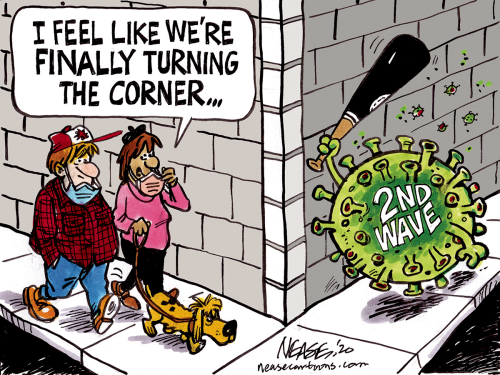
Cartoon – We’ve Turned the Corner

10/25 Mike Luckovich: Turning a corner

Cartoon – Finally Turning the Corner

The Corner

How Are Americans Catching the Virus? Increasingly, ‘They Have No Idea’

How Are Americans Catching the Virus? Increasingly, 'They Have No Idea' -  The New York Times

New outbreaks used to be traced back to crowded factories and rowdy bars. But now, the virus is so widespread not even health officials are able to keep up.

When the coronavirus first erupted in Sioux Falls, S.D., in the spring, Mayor Paul TenHaken arrived at work each morning with a clear mission: Stop the outbreak at the pork plant. Hundreds of employees, chopping meat shoulder to shoulder, had gotten sick in what was then the largest virus cluster in the United States.

That outbreak was extinguished months ago, and these days, when he heads into City Hall, the situation is far more nebulous. The virus has spread all over town.

“You can swing a cat and hit someone who has got it,” said Mr. TenHaken, who had to reschedule his own meetings to Zoom this past week after his assistant tested positive for the virus.

As the coronavirus soars across the country, charting a single-day record of 99,155 new cases on Friday and surpassing nine million cases nationwide, tracing the path of the pandemic in the United States is no longer simply challenging. It has become nearly impossible.

Gone are the days when Americans could easily understand the virus by tracking rising case numbers back to discrete sources — the crowded factory, the troubled nursing home, the rowdy bar. Now, there are so many cases, in so many places, that many people are coming to a frightening conclusion: They have no idea where the virus is spreading.

“It’s just kind of everywhere,” said Crystal Watson, a senior scholar at the Center for Health Security at the Johns Hopkins Bloomberg School of Public Health, who estimated that tracing coronavirus cases becomes difficult once the virus spreads to more than 10 cases per 100,000 people.

  • The election. And its impact on you.

In some of the hardest-hit spots in the United States, the virus is spreading at 10 to 20 times that rate, and even health officials have all but given up trying to figure out who is giving the virus to whom.

There have been periods earlier in the pandemic when infections spread beyond large, well-understood clusters in prisons, business meetings and dinner parties, tearing through communities in ways that were nearly impossible to keep track of. But for the most part, that experience was isolated to hard-hit places like New York City in the spring and portions of the Sun Belt in the summer.

This time, the diffuse, chaotic spread is happening in many places at once. Infections are rising in 41 states, the country is recording an average of more than 79,000 new cases each day, and more Americans say they feel left to do their own lonely detective work.

“I was so careful,” said Denny Taylor, 45, who said he had taken exacting precautions — wearing a mask, getting groceries delivered — before he became the first in his family and among his co-workers to test positive for the virus. Lying in a hospital bed in Omaha this past week, he said he still had no idea where he caught it.

Uncovering the path of transmission from person to person, known as contact tracing, is seen as a key tool for containing the spread of the coronavirus. Within a day or two of testing positive, residents in many communities can expect to get a phone call from a trained contact tracer, who conducts a detailed interview before beginning the painstaking process of tracking down each new person who may have been exposed.

“We were pretty successful and we were very proud of how the case numbers went down,” said Dr. Sehyo Yune, who supervised a team of contact tracers in Massachusetts this spring. It was one of several strategies that helped tamp down earlier outbreaks in places like Massachusetts, New York and Washington, D.C.

But as cases skyrocket again in many states, many health officials have conceded that interviewing patients and dutifully calling each contact will not be enough to slow the outbreak. “Contact tracing is not going to save us,” said Dr. Ogechika Alozie, chief medical officer at Del Sol Medical Center in El Paso, where hospitalizations in the county have soared by more than 400 percent and officials issued a new order for residents to stay at home.

The problem, of course, is that failing to fully track the virus makes it much harder to get a sense of where the virus is flourishing, and how to get ahead of new outbreaks. But once an area spins out of control, trying to trace back each chain of transmission can feel like scooping cupfuls of water from a flood.

In some places, overwhelmed health officials have abandoned any pretense of keeping up.

In North Dakota, state officials announced they could no longer have one-on-one conversations with everyone who may have been exposed. Aside from situations involving schools and health care facilities, people who test positive were advised to notify their own contacts, leaving residents largely on their own to follow the trail of the outbreak.

In Philadelphia, where cases recently spiked to more than 300 per day, city officials acknowledged that they now must leave some cases untracked. Most people, they said, are catching the virus through family and friends.

“We weren’t supposed to get to this point,” said Dr. Arnold S. Monto, a professor of epidemiology at the University of Michigan, who said the process of tracking cases and notifying people who may have been exposed is a gold standard of disease prevention but impractical after a certain level of infection.

“If you have five clusters going on at the same time,” he said, “it’s hard to say where it came from.”

When a first major outbreak hit Grand Forks, N.D., in April, the problem was clear: More than 150 employees of a wind turbine blade factory were infected. The factory shut its doors for several weeks, and public health officials tested and contact traced each case.

For the rest of the summer, Grand Forks, a college town of 56,000 on the border with Minnesota, saw almost no new infections. An uptick in August was quickly tied to students at the University of North Dakota and largely contained.

Now, though, any sense of control has vanished. Active cases of Covid-19 have quadrupled since the beginning of October to 912 in Grand Forks County, and about half the people contacted by the health department say they are not sure how they became infected.

“People are realizing that you can get it anywhere,” said Kailee Leingang, a 21-year-old nursing student who also works as a state contact tracer in Grand Forks. Even Ms. Leingang has fallen ill, along with several of her colleagues. She traces her case to her parents, who first started showing symptoms. Beyond that, the trail goes cold.

“They have no idea,” she said of where her parents came in contact with the virus.

Ms. Leingang, isolating at her home with her cat, feels sicker by the day. Dishes have piled up in the sink — she is too weak to stand long enough to wash them. But she is still working, calling at least 50 people a day to notify them that their tests came back positive, though her job is no longer to track who else they may have infected. “With the high number of cases right now,” she said, “our team can’t afford to have somebody not work.”

In earlier, quieter periods of the pandemic, the virus spread with some degree of certainty. In all but the hardest-hit cities, people could ask a common question — “Where did you get it?” — and often find tangible answers.

A popular college bar in East Lansing, Mich., Harper’s Restaurant and Brewpub, became a hot spot this summer after dozens of people piled into the bar, drinking, dancing and crowding close together. At least 192 people — 146 people at the bar and 46 people with ties to those at the bar — were infected. Afterward, Gov. Gretchen Whitmer shut down indoor dining in bars in parts of the state.

In Ingham County, which includes much of East Lansing, it is far harder to tell where the virus is spreading now. Of the county’s 4,700 reported cases over the course of the pandemic, more than 2,700 have come since the beginning of September.

Much of the new spread may be tied to students at Michigan State University, where students are living off campus and taking classes online. But every day, employers and residents call the Health Department to report random cases that defy easy explanation.

“It’s just a hodgepodge,” said Linda Vail, the Ingham County health officer.

Heidi Stevens is among the newly infected who considers her case a mystery. As a columnist at The Chicago Tribune, Ms. Stevens works from home. Her children attend school online. She wears a mask when she goes for a run, and she has not had a haircut since January.

So when she got a precautionary test a few weeks ago, with the hopes of inviting friends over to have cake for her daughter’s 15th birthday, Ms. Stevens was shocked to learn she was positive.

“I would drive myself crazy if I tried to really nail it down,” said Ms. Stevens, 46, who was hospitalized for three days and still wakes up with headaches. Did she pick up an infected apple at the grocery store and somehow touch her eye? Should she have been wearing a face shield, in addition to her mask? The possibilities feel endless.

“It’s just out there,” she said.

Coronavirus Update

The latest

The United States reported a record high of more than 90,000 new coronavirus infections on Friday, and today’s count is on pace to go even higher. The country has now exceeded 9 million cases since the outbreak began, with the last 1 million added in just the last two weeks.

More than 1,000 coronavirus deaths were also reported Thursday, a sadly frequent milestone, which the president’s son Donald Trump Jr. effectively dismissed Thursday night when he claimed in a Fox News interview that the death rate had dropped to “almost nothing.”

As evidence, Trump Jr. cited a misleading graph on his Instagram page – apparently compiled from incomplete and already outdated federal data – which was used as evidence to suggest that the “death rate” has been falling dramatically in the last two weeks. In fact, daily deaths are slightly rising after a long plateau, and the situation is expected to worsen in November as the virus takes its toll on the newly infected. “I realize I am naive,” Ashish K. Jha, the dean of the Brown University School of Public Health, tweeted in response to the interview. “But I’m still shocked by the casualness by which our political and media leaders and their families dismiss the daily deaths of nearly a thousand Americans.”

A federal program to inspect nursing homes in the early days of the U.S. outbreak cleared nearly 80 percent of them of any infection-control violations, including some facilities that were experiencing covid-19 outbreaks during the inspections. “All told, homes that received a clean bill of health earlier this year had about 290,000 coronavirus cases and 43,000 deaths among residents and staff, state and federal data shows,” our Business desk reported.

Hundreds of thousands of Americans will have coronavirus infections on Election Day, and options are dwindling for those who intend to vote. “Some will be required to get doctor’s notes or enlist family members to help,” our Investigations desk reported. “Others, in isolation, will need to have a witness present while they vote. Planned accommodations — such as officials hand-delivering ballots — may prove inadequate or could be strained beyond limits.”

The norms around science and politics are cracking

https://www.axios.com/science-politics-norms-cracking-f67bcff2-b399-44f4-8827-085573f5ae52.html

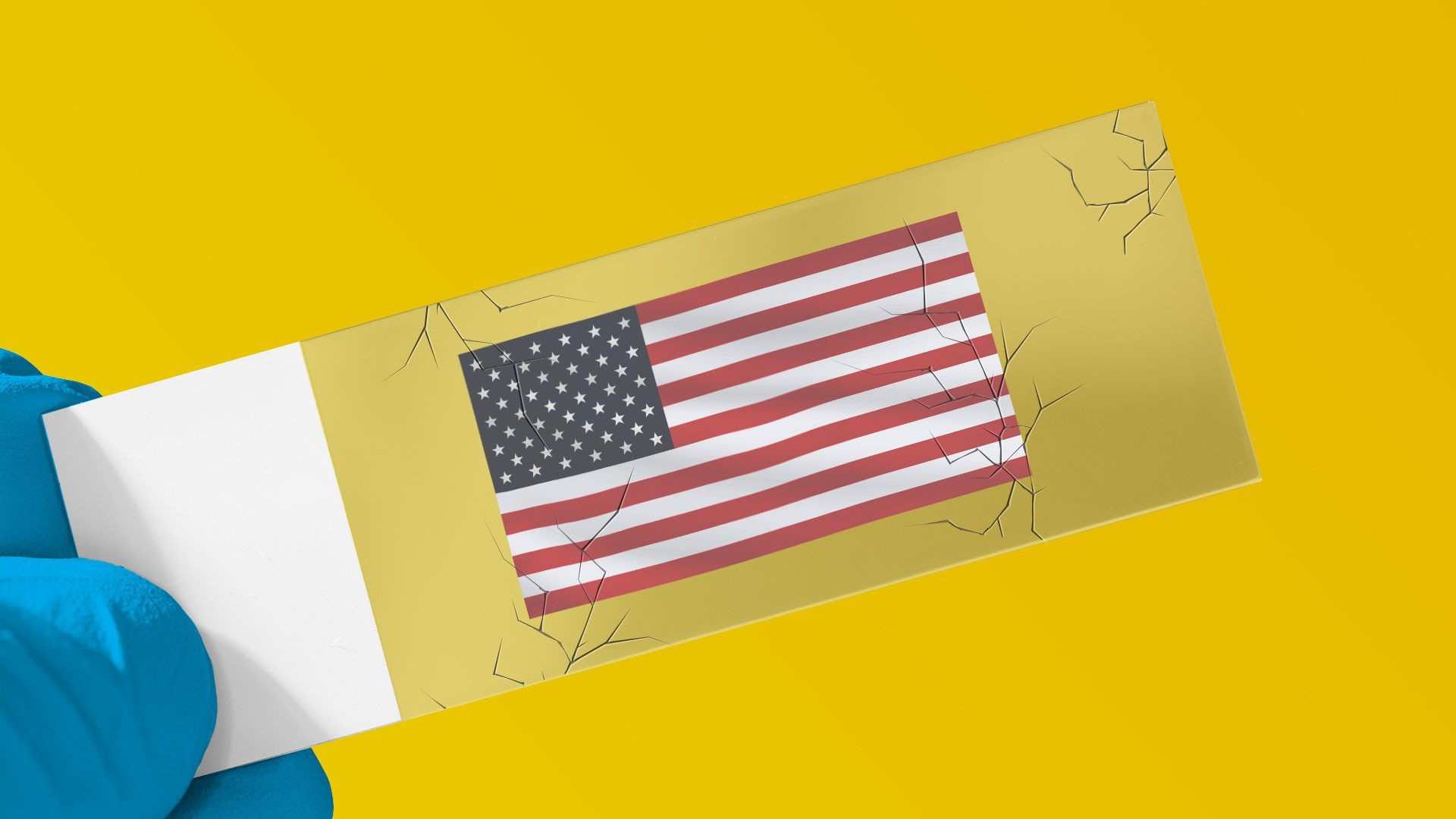
Illustration of a hand holding a cracked microscope slide containing the U.S. flag.

Crafting successful public health measures depends on the ability of top scientists to gather data and report their findings unrestricted to policymakers.

State of play: But concern has spiked among health experts and physicians over what they see as an assault on key science protections, particularly during a raging pandemic. And a move last week by President Trump, via an executive order, is triggering even more worries.

What’s happening: If implemented, the order creates a “Schedule F” class of federal employees who are policymakers from certain agencies who would no longer have protection against being easily fired— and would likely include some veteran civil service scientists who offer key guidance to Congress and the White House.

  • Those agencies might handle the order differently, and it is unclear how many positions could fall under Schedule F — but some say possibly thousands.
  • “This much-needed reform will increase accountability in essential policymaking positions within the government,” OMB director Russ Vought tells Axios in a statement.

What they’re saying: Several medical associations, including the Infectious Diseases Society of America, strongly condemned the action, and Democrats on the House oversight panel demanded the administration “immediately cease” implementation.

  • “If you take how it’s written at face value, it has the potential to turn every government employee into a political appointee, who can be hired and fired at the whim of a political appointee or even the president,” says University of Colorado Boulder’s Roger Pielke Jr.
  • Protections for members of civil service allow them to argue for evidence-based decision-making and enable them to provide the best advice, says CRDF Global’s Julie Fischer, adding that “federal decision-makers really need access to that expertise — quickly and ideally in house.”

Between the lines: Politics plays some role in science, via funding, policymaking and national security issues.

  • The public health system is a mix of agency leaders who are political appointees, like HHS Secretary Alex Azar, and career civil servants not dependent on the president’s approval, like NIAID director Anthony Fauci.
  • “Public health is inherently political because it has to do with controlling the way human beings move around,” says University of Pennsylvania’s Jonathan Moreno.

Yes, but: The norm is to have a robust discussion — and what has been happening under the Trump administration is not the norm, some say.

  • “Schedule F is just remarkable,” Pielke says. “It’s not like political appointees editing a report, [who are] working within the system to kind of subvert the system. This is an effort to completely redefine the system.”
  • The Center for Strategic and International Studies’ Stephen Morrison says that the administration has been defying normative practices, including statements denigrating scientists, the CDC and FDA.

The big picture: Public trust in scientists,which tends to be high, is taking a hit, not only due to messaging from the administration but also from public confusion over changes in guidance, which vacillated over masks and other suggestions.

  • Public health institutions “need to have the trust of the American people. In order to have the trust of the American people, they can’t have their autonomy and their credibility compromised, and they have to have a voice,” Morrison says.
  • “If you deny CDC the ability to have briefings for the public, and you take away control over authoring their guidance, and you attack them and discredit them so public perceptions of them are negative, you are taking them out of the game and leaving the stage completely open for falsehoods,” he adds.
  • “All scientists don’t agree on all the evidence, every time. But what we do agree on is that there’s a process. We look at what we know, we decide what we can clearly recommend based on what we know, sometimes when we learn more, we change our recommendations, and that’s the scientific process,” Fischer says.

What’s next: The scientific community is going to need to be proactive on rebuilding public trust in how the scientific process works and being clear when guidance changes and why it has changed, Fischer says.

Coronavirus surge threatens to shut schools down again

The nationwide surge in coronavirus cases is forcing many school districts to pull back from in-person instruction, Axios’ Marisa Fernandez reports.

Why it matters: Remote learning is a burden on parents, teachers and students. But the wave of new infections, and its strain on some hospitals’ capacity, makes all forms of reopening harder to justify.

Where it stands: Over 60% of U.S. public school students will be attending schools with in-person options, up 20% from Labor Day, Education Dive reports. But some of those districts are pulling back.

  • Spikes in COVID-19 cases are forcing two Salt Lake County high schools to close their doors and switch to online-only instruction — in a district where half the high schools were already closed, the Salt Lake Tribune reports.
  • Both Boston and Chicago’s public school districts shut down in-person learning as health officials investigate outbreaks in nearby suburbs.
  • Nineteen Minnesota counties are on the verge of closing their K-12 schools for the foreseeable future because of rising coronavirus cases, the Pioneer Press reports.
  • high school in Milwaukee had to close after six staff members had to quarantine this week.

The other side: Early evidence suggests that in-person school reopenings have been safe — and fears that they’d become hotspots haven’t come to pass.

  • Some experts say local governments trying to contain their outbreaks should close bars and restaurants first, shutting down schools only as a last resort.
  • That’s the approach Germany took this week. The government will allow schools and day cares to remain open while paying bars and restaurants to shut down, in an effort to curb the rise in cases.

The bottom line: School districts are in a tough spot as they try to juggle the safety of their staff, frustrated parents and the needs of their students.

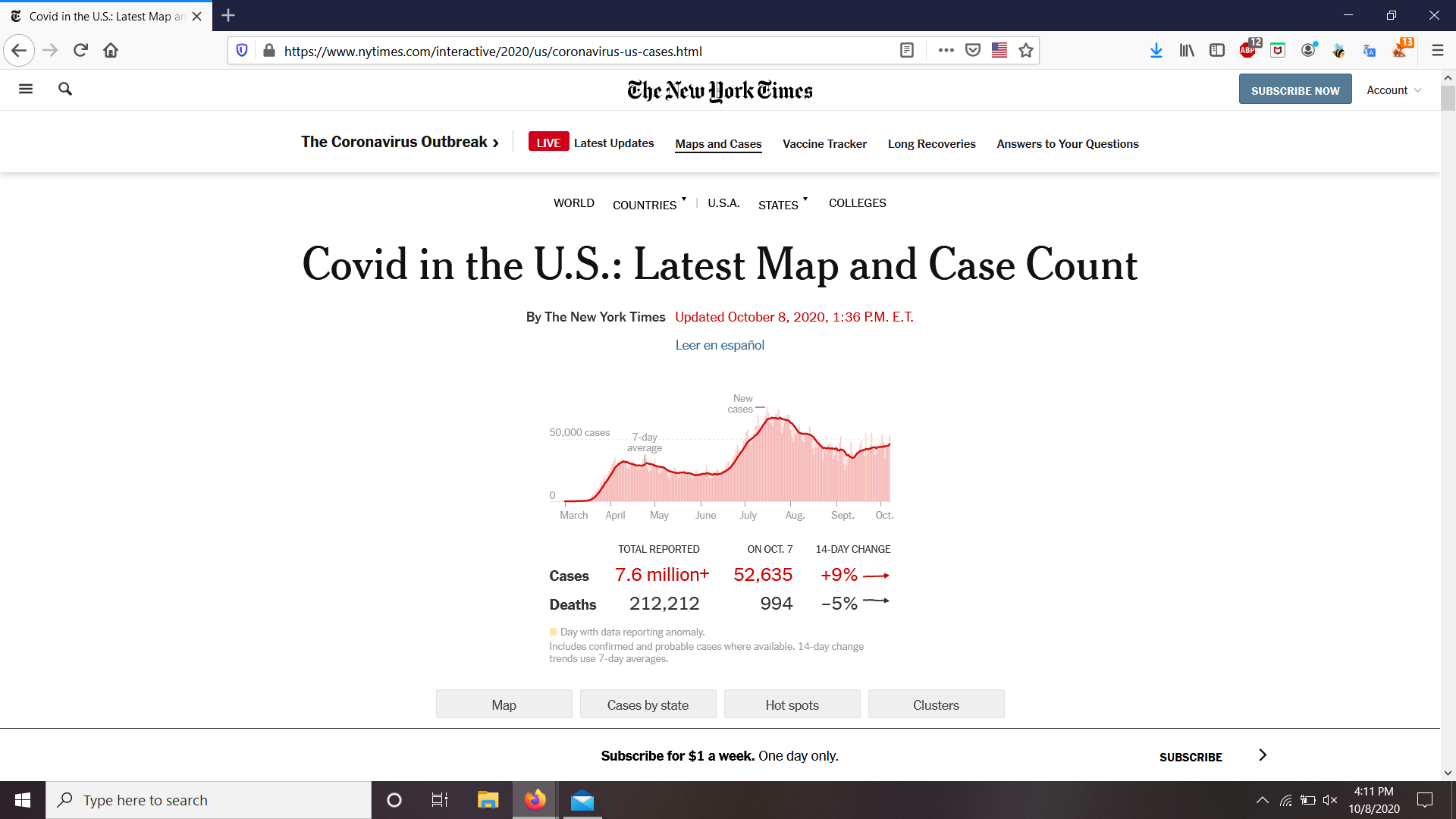
Covid in the U.S.: Latest Map and Case Count

https://covid-19archive.org/files/original/ce33d05f1f89e57f13ea7f309f0e1592024f6fb8.png

At least 1,004 new coronavirus deaths and 90,728 new cases were reported in the United States on Oct. 29. Over the past week, there have been an average of 77,865 cases per day, an increase of 42 percent from the average two weeks earlier.

As of Friday afternoon, more than 9,078,400 people in the United States have been infected with the coronavirus and at least 229,200 have died, according to a New York Times database.

Covid in the U.S.: Latest Map and Case Count - The New York Times

Case numbers in the United States have reached alarming new records in recent days as outbreaks continue to grow across the country. Though rural counties and small metro areas continue to see some of the worst growth, infections are also rising rapidly around major cities like Chicago and Milwaukee.

The national trajectory is worsening rapidly. Wisconsin has opened a field hospital. North Dakota, which not long ago had relatively few cases, has grown so overwhelmed that it has now ended most contact tracing. Cases have reached record levels recently in more than 20 states, including Illinois, Tennessee, New Mexico, Nebraska and Utah.