Fed chief: New surge in cases is beginning to weigh on the economy

https://www.washingtonpost.com/business/2020/07/29/powell-fed-economy/?utm_campaign=wp_main&utm_medium=social&utm_source=facebook&fbclid=IwAR2CvBwHTLxHdQVT0I2uItlkVA9TMiJQpxdEyT2wucJ-3r1J3isD2U8y6Ic

US Central Bank Chief Says Surge In Coronavirus (COVID-19) Cases ...

The Federal Reserve is keeping interest rates unchanged at close to zero, but the Fed is also extending programs to buy Treasuries and mortgage-backed securities.

The head of the Federal Reserve said Wednesday that rising numbers of coronavirus cases since mid-June are beginning to weigh on the economy, reinforcing that the fate of the recovery depends on containing the pandemic.

“On balance, it looks like the data are pointing to a slowing in the pace of the recovery,” Federal Reserve Chair Jerome H. Powell said during a news conference on Wednesday. “I want to stress it’s too early to say both how large that is and how sustained it will be.”

Job gains from May and June came “sooner and stronger” than expected, Powell said. But those encouraging signs were closely followed by a surge in coronavirus cases nationwide. Powell said that at the same time people’s lives depend on containing the public health crisis, it is also important to “deal with the economic ramifications.”

Powell said some measures of consumer spending, based on debit card and credit card use, have moved down since late June. Powell also mentioned recent labor market indicators that are pointing to slower job growth, especially for smaller businesses. Hotel occupancy rates have flattened out, Powell said, while Americans are not going to restaurants, gas stations and beauty salons as much as they had been earlier in the summer.

Powell said the upcoming jobs reports and other surveys will help flesh out the Fed’s economic outlook, cautioning that he did not “want to get ahead of where the data are on this.” But as he has for months, Powell again emphasized that the economy’s recovery depends on the country’s ability to stop the virus from spreading.

“The path of the economy is going to depend, to a very high extent, on the course of the virus and on the measures we take to keep it in check,” Powell said. “The two things are not in conflict. Social distancing measures and a fast reopening of the economy actually go together. They’re not in competition with each other.”

As expected, the Fed’s policymaking board decided to keep interest rates, which are already near zero, unchanged as it concluded two days of policy meetings this week. Markets responded optimistically to the news, with the Dow Jones industrial average ending up 160 points at Wednesday’s close.

The Federal Reserve signaled in its statement on Wednesday that the Fed would continue to use “its full range of tools” to steer the economy out of recession, even as the virus significantly shapes the future of the economy.

“The ongoing public health crisis will weigh heavily on economic activity, employment, and inflation in the near term, and poses considerable risks to the economic outlook over the medium term,” the Fed’s top panel of policymakers said in a statement at the conclusion of two days of meetings.

After sharp declines, economic activity and employment “have picked up somewhat in recent months,” the Fed said. Economists have been closely watching July indicators, which could help explain whether the recovery from earlier this summer is beginning to fizzle as some states and cities reimpose restrictions on businesses to combat rising coronavirus cases.

“Overall financial conditions have improved in recent months, in part reflecting policy measures to support the economy and the flow of credit to U.S. households and businesses,” the Fed statement read.

To support the flow of credit to households and businesses, the Fed said it would increase its holdings of Treasury securities and agency residential and commercial mortgage-backed securities at least at the current pace over the coming months. The Fed has said its support of the markets should remain in place to help safeguard the broader financial system during the pandemic.

At his news conference, Powell said the Fed was committed to keeping its lending facilities and other emergency measures in place not only during the shutdown and reopening, but also through the “long tail where a large number of people are struggling to get back to work.”

“We’re in this until we’re well through it,” Powell said.

Powell’s news conference comes as Congress clashes over another stimulus bill and an extension for enhanced unemployment benefits. On Tuesday, President Trump brushed off the new $1 trillion Senate GOP coronavirus legislation as “sort of semi-irrelevant.”

Powell has repeatedly said that the Fed cannot heal the economy alone and that more help will be needed from Congress to ease the pain for millions of Americans. On Wednesday, Powell said funding from the Cares Act has been key to keeping people in their homes and jobs. He praised the Paycheck Protection Program, for example, for getting money directly to businesses that couldn’t necessarily have been saved through a Fed lending program.

“Lending is a particular tool, and we’re using it very aggressively, but fiscal policy is essential here,” Powell said. “As I’ve said, more will be needed from all of us, and I see Congress is negotiating now over a new package, and I think that’s a good thing.”

Powell has stopped short of telling lawmakers exactly what they should do, or how urgently they should act, saying it isn’t his role to tell other parts of government how to do their jobs. But on Wednesday, Powell pushed the success of Congress’s earlier programs as reason for lawmakers to act again, said Skanda Amarnath, research director of Employ America, a policy group that advocates for full employment and higher wages.

Amarnath said Powell’s framing could give some cover to Republican lawmakers who are less convinced more help is needed, or who dispute the connection between the virus and the recovery.

“[Powell] is trying to reiterate that you can’t think of this as ‘either or,’ ” Amarnath said, adding that when it comes to tackling the pandemic and the economy, “you’re going to have to tackle one to tackle the other.”

For months, Powell has insisted that the virus will dictate an economic turnaround, which he says can’t happen until Americans feel safe going about their daily routines. Since the Fed’s last meeting in June, rising case counts have forced states to reimpose restrictions on business activity. Minutes from the Fed’s June meeting showed officials were worried the United States could enter a much worse recession later this year if the pandemic is not contained.

At this week’s Fed meeting, Fed leaders were expected to discuss other policy tools, such as forward guidance and asset purchases, without necessarily coming away with any firm conclusions. Economists are also awaiting the release of the Fed’s long-term monetary policy review, which could change the way the Fed approaches its inflation target.


The U.S. plans to lend $500 billion to large companies. It won’t require them to preserve jobs or limit executive pay.

https://www.washingtonpost.com/business/2020/04/28/federal-reserve-bond-corporations/?fbclid=IwAR21PBlVqLVVDVf8CeVxGpTuHgxXbDqy49K49BpeeYav-KmKYxS_xfnAX5A&platform=hootsuite

DownWithTyranny!: April 2020

The Fed’s coronavirus aid program lacks restrictions Congress placed on companies seeking financial help under other programs.

A Federal Reserve program expected to begin within weeks will provide hundreds of billions in emergency aid to large American corporations without requiring them to save jobs or limit payments to executives and shareholders.

Under the program, the central bank will buy up to $500 billion in bonds issued by large companies. The companies will use the influx of cash as a financial lifeline but are required to pay it back with interest.

Unlike other portions of the relief for American businesses, however, this aid will be exempt from rules passed by Congress requiring recipients to limit dividends, executive compensation and stock buybacks and does not direct the companies to maintain certain employment levels.

Critics say the program could allow large companies that take the federal help to reward shareholders and executives without saving any jobs. The program was set up jointly by the Federal Reserve and the Treasury Department.

“I am struck that the administration is relying on the good will of the companies receiving this assistance,” said Eswar Prasad, a former official at the International Monetary Fund and economist at Cornell University. “A few months down the road, after the government purchases its debt, the company can turn around and issue a bunch of dividends to shareholders or fire its workers, and there’s no clear path to get it back.”

Treasury Secretary Steven Mnuchin defended the corporate aid program, saying that the lack of restrictions on recipients had been discussed and agreed to by Congress. “This was highly discussed on a bipartisan basis. This was thought through carefully,” he said in an interview with The Washington Post. “What we agreed upon was direct loans would carry the restrictions, and the capital markets transactions would not carry the restrictions.”

Democrats asked for restrictions on how companies can use the money from the central bank’s bond purchases but were rebuffed by the administration during negotiations about the Cares Act, said a spokesman for Senate Minority Leader Charles E. Schumer (D-N.Y.). The spokesman said Democrats won meaningful concessions from the administration on reporting transparency in the final agreement. (Transparency requirements do not apply to the small-business loans, the biggest business aid program rolled out to date.)

Mnuchin also said the program had already bolstered investor confidence in U.S. capital markets, which in turn helped firms raise capital they used to avoid layoffs.

“The mere announcement of these facilities, quite frankly, led to a reopening of a lot of these capital markets,” Mnuchin said in an interview. “Even before these facilities are up and running, they’ve had their desired impact of having stability in the markets. Stability in the markets allows companies to function, and raise money and allows them to keep and retain workers and get back to work.”

The corporate debt purchases by the Fed stand in stark contrast with other portions of the federal aid for U.S. businesses that come with requirements to protect jobs or limit spending.

The Paycheck Protection Program, which offers $659 billion for small businesses, requires companies to certify that the money will be used to “retain workers and maintain payroll or make mortgage payments, lease payments, and utility payments.”

The “Main Street” program offering up to $600 billion to “midsize” businesses — with 500 to 10,000 employees — forbids companies from issuing dividends and places limits on executive compensation, according to a term sheet issued by the Fed. Those restrictions are in effect until 12 months after the loan is no longer outstanding. The companies must also “make reasonable efforts” to maintain payroll and retain employees.

Likewise, the $46 billion program for airlines, air cargo companies and national security forbids dividends and limits executive pay. Its requirement on retaining employment is more rigorous, however. Companies are supposed retain at least 90 percent of their employees.

The first version of the Fed program to buy bonds from large companies, known as the Primary Market Corporate Credit Facility, probably would have compelled recipients of the aid to limit executive pay and dividends. That version of the program, described in a March 23 term sheet issued by the Fed, offered direct loans and bond purchases to companies. Under the Cares Act, the federal programs offering direct loans must set restrictions on company dividends and CEO pay; those that buy only corporate bonds do not. Both are forms of lending, although bonds are more easily resold.

But on April 9, the Fed altered the design of the program to exclude direct corporate lending. The Fed program will still essentially lend money to large companies — by buying their bonds — but the Fed will not be compelled by the Cares Act to ensure that companies abide by the divided and CEO pay rules.

“The change to the term sheet between March and April is the smoking gun on the Fed’s own culpability here,” said Gregg Gelzinis, a senior policy analyst at the Center for American Progress, a left-leaning think tank. “The basic principle of the Cares Act was that if we’re going to provide taxpayer funding to private industry, we need conditions to make sure it is in the public interest. This violates that principle.”

Bharat Ramamurti, an aide to Sen. Elizabeth Warren (D-Mass.) who was appointed to the board overseeing the bailout, said in a statement: “Big corporations have shown time and again that they will put their shareholders and executives ahead of their workers if given the choice. That’s why I’m so concerned that the Treasury and the Fed have chosen to direct hundreds of billions of dollars to big companies with no strings attached.”

A spokesman for the Federal Reserve declined to comment. The Fed’s board of governors unanimously approved the new bond purchasing program on March 22. The Fed has said it will purchase only the bonds of firms above a certain grade. The issuer of the bond also must meet the conflicts-of-interest requirements in the Cares Act, which preclude federal lawmakers or their relatives from benefiting financially from the government bailout.

In the interview, Mnuchin also said many companies are ceasing stock buybacks and are likely to use the additional capital to retain workers.

“A lot of companies have stopped their share buybacks and slashed their dividends, because they need that capital to invest in their business. Even though these restrictions don’t necessarily apply, that’s already happening,” he said.

Some experts disputed that assertion. “Some companies have ceased buybacks and dividends and some haven’t. We shouldn’t have to keep our fingers crossed,” Gelzinis said.

It is unknown what the terms will be for the Fed lending under the program, or how favorable they will be for recipients. The term sheet says only that they will depend on the company and be “informed” by market conditions.

Companies selling their bonds to the central bank are expected to be primarily investment grade, publicly traded firms and therefore subject to more disclosure and oversight than those that are privately held. Patricia C. Mosser, a former senior official at the Federal Reserve Bank of New York, said these corporations are scrutinized by the U.S. Securities and Exchange Commission, private investors and the credit rating agencies.

“It’s true that there’s nothing stopping these companies from continuing to pay stock dividends. You may not like that, and I have sympathy for that position,” said Mosser, now a professor at Columbia University. “But it’s easier to unmask bad behavior in public companies. Large companies certainly don’t do everything right, but they have to admit publicly how they pay top executives, where their profits go and how they use them. That history of disclosure and oversight means the risk of not being repaid is lower.”

The weaker restrictions on recipients of the Fed’s lending program may be partly justified, said Nathan Tankus, research director at the Modern Money Network, which studies monetary policy. The corporate bonds that the Fed is purchasing from companies can be resold, whereas direct loans establish an agreement between the company and the government that makes the asset less valuable to the central bank, he said.

“Purchases of debt are a slightly more arm’s-length transaction than the loan, which is forming a bilateral relationship,” Tankus said. “But this is really just the fig leaf the Fed can use to justify lifting the restrictions.”


The next dominoes in the coronavirus economy

https://www.axios.com/the-next-dominoes-in-the-coronavirus-economy-b73d198b-6177-4d8b-bac8-d6ecb168e2c9.html

Image result for The next dominoes in the coronavirus economy

Coronavirus is already the most serious threat to the U.S. economy since the financial crisis, and the dominoes are aligned for a severe recession that could erase much of the 11-year recovery.

What’s happening: While the outbreak itself is unlikely to drive an economic collapse, the U.S. has been something of a ticking time bomb for some time.

  • Growth has declined over the last two years despite higher government spending and a $23.4 trillion national debt.
  • While the labor market has boomed, many of the jobs added have been hourly service-industry positions that offer limited scope for savings or health insurance.
  • 44% of all U.S. workers earn barely enough to live on, a Brookings Institution study found in January.

Where it stands: While President Trump said late Monday that he would work with Senate Republicans on a “very substantial” payroll tax cut and relief for hourly workers, such measures — if they can be enacted — could still be insufficient to fend off a recession.

At the same time, corporate America is more heavily indebted than ever before, due to years of record-low interest rates and increased borrowing.

  • The Federal Reserve has repeatedly warned that this spike in leveraged lending — combined with loosening covenants — has created risks not only to bond issuers, but also to the wide network of hedge funds and mutual funds (yes, mutual funds) that actually hold the debt.
  • In short, it’s an economic haystack awaiting a match.

One big difference between 2020 and 2008 is breadth. The financial crisis began with financial services companies and insurers, which meant bailouts and structural fixes could be aimed at Wall Street. But this crisis is hitting the entire economy with a single blow — harming not just the Fortune 500, but also mom-and-pop businesses.

Between the lines: The cavalry may not be coming to the rescue this time.

  • The Federal Reserve, which helped rescue the economy after the 2008 crisis, is effectively out of ammunition.
  • Starting in 2007, the Fed cut interest rates by 500 basis points, bought an unprecedented amount of U.S. debt and unleashed a flurry of stimulus programs that propped up the economy.
  • Rather than winding them down, the Fed has had to extend the programs throughout the recovery.
  • As a result, after last week’s emergency rate cut — and possibly another that’s expected at next week’s policy meeting — the central bank has limited ability to take action.

Threat level: Government also increasingly looks broken. The dysfunction in Washington is dimming hopes for major fiscal stimulus that economists say will be needed to offset the outbreak’s negative impact.

  • The $8 billion allotted to coronavirus so far “is an insult,” Claudia Sahm, who formerly served as top economist for the Fed’s Board of Governors, tells Axios. “It has to be hundreds of billions of dollars, and it has to be now.”
  • “I want to see it — and maybe I will,” Sahm, now director of macroeconomic policy at the Washington Center for Equitable Growth, says. “But without that piece, we are in a recession before the end of the year.”


Federal Reserve Report on the Economic Well Being of U.S. Holdholds in 2018

Click to access 2018-report-economic-well-being-us-households-201905.pdf

2018 Employer Health Benefits Survey – Section 7: Employee Cost Sharing

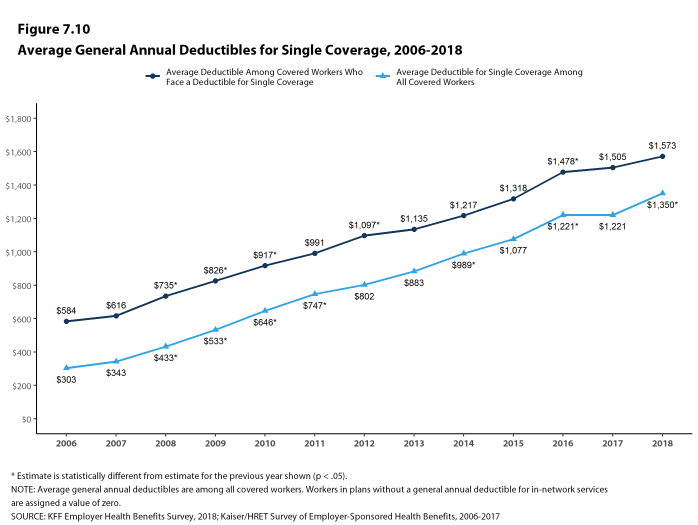
Figure 7.10: Average General Annual Deductibles for Single Coverage, 2006-2018

Shot: Almost 40% of Americans would struggle to handle a surprise expense of $400, according to a new Federal Reserve report.

Chaser: The average deductible today among all workers is more than $1,300, according to the Kaiser Family Foundation.