Senators demand Cigna, Optum turn over documents on insulin prices

https://www.fiercehealthcare.com/payer/senators-demand-cigna-optum-turn-over-documents-insulin-prices-deliver-subpoena-threat?utm_medium=nl&utm_source=internal&mrkid=959610&mkt_tok=eyJpIjoiWm1Rd1kyVTNaVFl6WWpoayIsInQiOiJcL0ZDakZBUCtJWXhjNXBxUzVPRytqNUZBOU04ODlOU1I2ZFZyQ3ROcUo4eWoxckNMS2JsMVFBV1F6MEtHVkJZSVhZdWJQV2hoMVVTalwveTFnNUJYeFR6N3ZxaVZTUTNWVzI1UkMyQzh5MUxISUJaYm9KSEdYNlgyZVYyd0Q4Q0lvIn0%3D

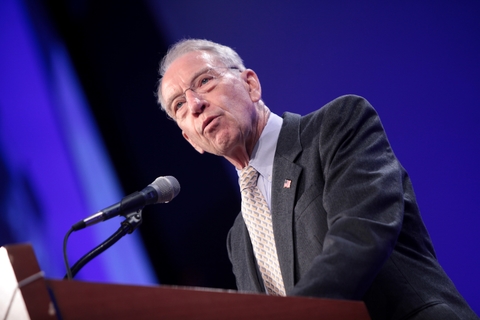
Chuck Grassley

Sen. Chuck Grassley, R-Iowa, and Ron Wyden, D-Ore., are demanding Optum and Express Scripts turn over documents on how they determine insulin prices.

Leaders of the Senate Finance Committee demanded Cigna and Optum produce critical documents over the pricing of insulin, with a subpoena threat looming.

Cigna failed to produce any documents related to the committee’s request back in April 2019 and Optum didn’t produce essential documents, according to letters to both companies sent earlier this week by committee leaders. The documents would relate to the actions of pharmacy benefit managers such as Cigna’s Express Scripts on the rising costs of insulin.

“Cigna’s unwillingness to provide the documents we requested fits an industry-wide pattern of fighting efforts to shed light on PBMs’ practices,” the letter (PDF) to the insurer read.

Sens. Chuck Grassley, R-Iowa, and Ron Wyden, D-Ore., the committee’s chairman and ranking member respectively, wrote that Cigna’s failure to comply has “reached an endpoint.” The insurer has until March 10 to provide more information or face a subpoena.

UnitedHealth Group’s Optum did produce thousands of pages for the committee, but a majority of them were irrelevant, already publicly available or duplicative.

“For example, Optum has produced more than 4,000 pages of publicly available formulary information guides and internal formulary drug lists that contain virtually no information related to the insulin therapeutic class,” the senators’ letter (PDF) to Optum said.

The original request for documentation had called for internal communications that would help the committee understand how Optum made decisions on “the out-of-pocket price patients pay for their insulin,” the letter said.

Grassley and Wyden launched the investigation last February into the price of insulin, which has increased up to 500%. The senators sent letters to leading insulin manufacturers Eli Lilly, Novo Nordisk and Sanofi regarding the spike.

The senators also wanted to learn the process used for negotiations and agreements between PBMs and large plans on patient cost-sharing.

Cigna-Express Scripts said that it takes the committee’s inquiry “very seriously and have been engaged with them on this request. We are committed to being cooperative.”

Optum said that it share’s the committee’s concens regarding the high prices for insulin set by manufacturers.

“We have provided thousands of pages of documents in response to the committee’s request, and will continue to work with them on this important issue,” the company said.


Half of insured adults are skipping primary care visits. Cost a major reason why

https://www.beckershospitalreview.com/finance/half-of-insured-adults-are-skipping-primary-care-visits-cost-a-major-reason-why.html?utm_medium=email

Image result for Half of insured adults are skipping primary care visits. Cost a major reason why.

In a given year by 2016, almost 50 percent of adults with commercial insurance hadn’t visited a primary care physician, according to a study published in the Annals of Internal Medicine.

For the study, researchers from Harvard Medical School in Boston, the Icahn School of Medicine at Mount Sinai in New York City and the University of Pittsburgh School of Medicine wanted to better characterize primary care declines among adults. To do so, the study authors analyzed deidentified claims data from a national private insurer that covers roughly 20 million members each year, according to NPR.

They found from 2008-16, adult visits to primary care physicians fell by nearly 25 percent. The decline was largest among younger adults. The proportion of adults with no visits to primary care physicians in a given year climbed from 38.1 percent to 46.4 percent within the same period.

While the number of preventive checkups rose — likely because the ACA made the appointments cost-free — problem-based visits, such as going to a primary care physician for sickness or injury, declined more than 30 percent, according to NPR.

Problem-based visits saw out-of-pocket costs increase 31.5 percent during the study period, which could have affected the decline, according to researchers. Additionally, visits to alternative sites like urgent care clinics grew by 46.9 percent in the study period.

“Our results suggest that this decline may be explained by decreased real or perceived visit needs, financial deterrents, and use of alternative sources of care,” the study authors concluded. 


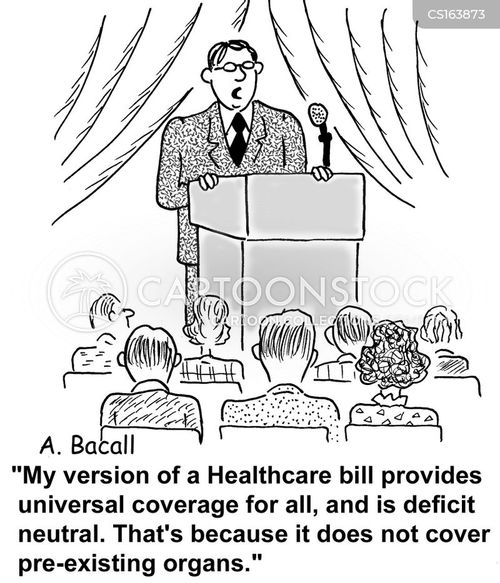
Cartoon – Modern Health Insurance Coverage

Image result for cartoon inadequate health insurance coverage


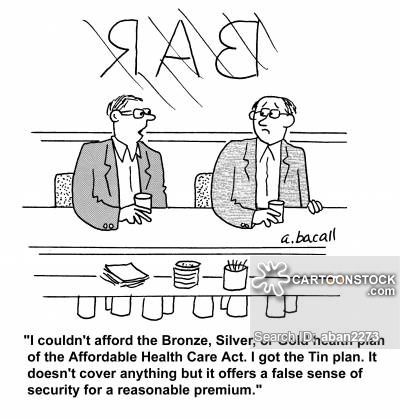
Cartoon – The Tin Plan

Image result for cartoon inadequate health insurance coverage

Cartoon – Acme Health Insurance

Image result for cartoon inadequate health insurance coverage

Cartoon – I can’t afford that diagnosis

Image result for Cartoon high cost of medical care

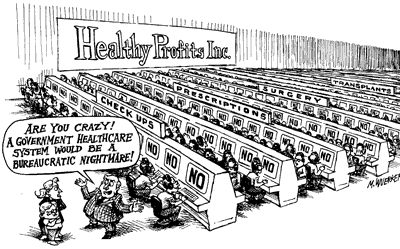
Cartoon – A Bureaucratic Nightmare?

Image result for Cartoon high cost of medical care


Patients Caught In Crossfire Between Giant Hospital Chain, Large Insurer

Patients Caught In Crossfire Between Giant Hospital Chain, Large Insurer

After Zoe Friedland became pregnant with her first child, she was picky about choosing a doctor to guide her through delivery.

“With so many unpredictable things that can happen with a pregnancy, I wanted someone I could trust,” Friedland said. That person also had to be in the health insurance network of Cigna, the insurer that covers Friedland through her husband’s employer.

Friedland found an OB-GYN she liked, who told her that she delivered only at Sequoia Hospital in Redwood City, California, a part of San Francisco-based Dignity Health. Friedland and her husband, Bert Kaufman, live in Menlo Park, about 5 miles from the hospital, so that was not a problem for them — until Dec. 12.

That’s the day Friedland and Kaufman received a letter from Cigna informing them their care at Sequoia might not be covered after Jan. 1. The insurance company had not signed a contract for 2020 with the hospital operator, which meant Sequoia and many other Dignity medical facilities around the state would no longer be in Cigna’s network in the new year.

Suddenly, it looked as if having their first baby at Sequoia could cost Friedland and Kaufman tens of thousands of dollars.

“I was honestly shocked that this could even happen because it hadn’t entered my mind as a possibility,” Friedland said.

She and her husband are among an estimated 16,600 people caught in a financial dispute between two gigantic health care companies. Cigna is one of the largest health insurance companies in the nation, and Dignity Health has 31 hospitals in California, as well as seven in Arizona and three in Nevada. The contract fight affects Dignity’s California and Nevada hospitals, but not the ones in Arizona.

“The problem is price,” Cigna said in a statement just before the old contract expired on Dec. 31. “Dignity thinks that Cigna customers should pay substantially more than what is normal in the region, and we think that’s just wrong.”

Tammy Wilcox, a senior vice president at Dignity, said, “At a time when many nonprofit community hospitals are struggling, Cigna is making billions of dollars in profits each year. Yet Cigna is demanding that it pay local hospitals even less.”

In 2018, the most recent full year for which earnings data is available, Cigna generated operating income of $3.6 billion on revenue of approximately $48 billion. Dignity Health reported operating income of $529 million on revenue of $14.2 billion in its 2018 fiscal year.

It’s possible Cigna and Dignity can still reach an agreement. Both sides said they will keep trying, though no talks are scheduled.

Disagreements between insurers and health systems that leave patients stranded are a perennial problem in U.S. health care. Glenn Melnick, a professor of health economics at the University of Southern California, said such disputes, which are disruptive to consumers, are often settled.

Melnick believes Dignity is using an “all or nothing” strategy in contract negotiations, meaning either all its facilities are in the insurer’s network or none are.

“This allows them to increase their market power to get higher prices, which is not necessarily good for consumers,” Melnick said.

Dignity replied in an emailed statement: “We do not require payers to contract with all or none of Dignity Health’s providers. We do try to make sure patients have access to the full range of Dignity Health services and facilities in each of our communities.”

Dignity faces a number of legal and financial challenges while it works to implement a February 2019 merger with Englewood, Colorado-based Catholic Health Initiatives that created one of the nation’s largest Catholic hospital systems — known as CommonSpirit Health.

California Attorney General Xavier Becerra approved the deal with conditions, including that Dignity’s California hospitals spend $10 million in the first three years on services for people experiencing homelessness and offer free care to more low-income patients.

The requirement to treat more poor patients at no charge followed a period, from 2011 to 2016, in which Dignity’s charity care declined about 35% while its net income was $3.2 billion.

Last October, CommonSpirit announced an operating loss of $582 million on revenue of nearly $29 billion for the 2019 fiscal year, its first annual financial statement after the merger took effect. Much of the loss was due to merger-related costs and special charges.

The same month, Dignity completed a five-year “corporate integrity agreement” with the U.S. Office of the Inspector General following an investigation into how it billed the government for hospital inpatient stays. Dignity said it “fully complied” with the agreement.

Dignity is also defending itself in a class-action lawsuit alleging that it bills uninsured patients at grossly inflated rates even though it claims to provide “affordable” care at “the lowest possible cost.”

More recently, an appeals court judge ruled Dignity could not charge higher prices — often a lot higher than state-set rates — for treating enrollees of L.A. Care’s Medi-Cal health plan at its Northridge Hospital Medical Center.

Dignity disagreed with the court’s ruling in that case, saying that although the Northridge facility did not have a contract with L.A. Care, many of the health plan’s enrollees who initially sought emergency treatment there stayed in the hospital for additional care after they had been stabilized. The hospital “seeks appropriate reimbursement for providing this care,” Dignity said.

If Dignity does not reach an agreement with Cigna, its hospitals, outpatient surgery centers and medical groups in most of California will soon be out-of-network for many Cigna enrollees. In-network coverage for Open Access (OAP) and Preferred Provider (PPO) ended Feb. 1, and for HMO patients it is set to end April 1.

Peter Welch, president and general manager for Cigna in Northern California and the Pacific Northwest, said Cigna can provide “adequate access” to other hospitals and doctors.

Certain Cigna enrollees can apply to continue visiting Dignity facilities and doctors under California’s Continuity of Care law, enacted in 2014. Eligible enrollees include patients with chronic conditions, those already scheduled for pre-authorized services, people in need of emergency care and pregnant women in their third trimester.

Friedland and Kaufman applied, hoping she would be able to continue seeing her Dignity-affiliated OB-GYN at in-network rates.

On Jan. 22, less than a month from Friedland’s Feb. 15 due date, they received written confirmation that their request had been approved. They wouldn’t have to shop for a new doctor or face stiff medical bills after all.

Early Tuesday evening, Friedland gave birth to a baby girl, Eliza, who entered the world 11 days earlier than expected, weighing in at 7 pounds, 3 ounces.

“While the ordeal was stressful, and the communication fraught, we were happy to receive confirmation of continuity of care and that it ended in the best possible way — with the birth of our healthy baby daughter with the provider where we established care,” Kaufman said. “For the sake of those caught in the middle and now having to start relationships with new health care providers, we hope the two sides can come to an agreement.”


Cartoon – Got a Hand?

Related image


New York State Investigates Christian Health Cost-Sharing Affiliate

Image result for New York State Investigates Christian Health Cost-Sharing Affiliate

Subpoenas have been issued to a company that solicits memberships for a health insurance alternative that offers no guarantees for covering medical bills.

New York State officials are investigating a business representing a major Christian group offering an alternative to health insurance, joining several states scrutinizing these cost-sharing programs that provide limited coverage.

On Wednesday, New York state insurance regulators issued a subpoena to Aliera, which markets the Christian ministry run by Trinity Healthshare, according to people who have seen the subpoena.

More than one million Americans have joined such groups, attracted by prices that are far lower than the cost of traditional insurance policies that must meet strict requirements established by the Affordable Care Act, like guaranteed coverage for pre-existing conditions.


These Christian nonprofit groups offer low rates because they are not classified as insurance and are under no legal obligation to pay medical claims. But state regulators are questioning some of the ministries’ aggressive marketing tactics, saying some consumers were misled or did not grasp the lack of comprehensive coverage in the case of a catastrophic illness.

Some members have paid hundreds of dollars a month, and then have been left with hundreds of thousands in unpaid medical bills in several states where the ministries, which are not subject to regulation as insurers, failed to follow through on pooling members’ expenses.

Numerous states are taking action against Aliera Healthcare, the for-profit company based in Georgia that was been the subject of an investigation by The Houston Chronicle. The Texas attorney general sued Aliera last summer to stop it from offering “unregulated insurance products to the public,” while Connecticut, Washington and New Hampshire are trying to stop Trinity and Aliera from doing business in those states.

Regulators say they are concerned that the ministry is, in fact, operating as an insurer. In New York, which has not previously investigated any ministries, there have been 15 to 20 complaints, including accusations that Aliera misrepresented the coverage being offered. It’s not clear how many customers Aliera has in New York.

“It’s deeply disappointing to see state regulators working to deny their residents access to more affordable alternatives offered by health care sharing ministries,” said Aliera in an emailed statement.

“We’re proud of the work we do to help ministries provide a more flexible method for securing affordable high-quality health care, and we will continue to vigorously defend against the false claims about our company, just as we expect the health care sharing ministries we serve to vigorously defend their members’ right to exercise their religious convictions in making health care choices,” it said.

Trinity, which was not subject to the subpoena, has said its website makes clear that the ministry does not offer health insurance.