Trump craves big action on drug prices to take to the campaign trail

https://www.washingtonpost.com/news/powerpost/paloma/the-health-202/2019/07/03/the-health-202-trump-craves-big-action-on-drug-prices-to-take-to-the-campaign-trail/5d1b9aa21ad2e552a21d5228/?utm_term=.e49cb9f99e60

Image result for high drug prices

There may be a modest slowdown this year in the growth of drug prices, but it’s nowhere near the seismic shift President Trump has called for. And that seems to be irking the president to no end.

Much of the president’s frustration has been borne by Health and Human Services Secretary Alex Azar, a former drug executive who until very recently pushed back on proposals to allow the importation of lower-cost drugs from Canada and give the government the tools to directly negotiate lower drug prices in the Medicare program, my Washington Post colleagues Yasmeen Abutaleb, Josh Dawsey and Laurie McGinley report.

But now, under intense pressure, Azar has reversed his long-standing opposition to at least one of those ideas: drug importation, an idea typically embraced by Democrats and dismissed by Republicans and the drug industry.

“Inspired by the president’s passion, Secretary Azar has been pushing FDA to go even bigger and broader on importation,” a senior administration official told my colleagues, although the official declined to detail specific policy changes.

It’s been a little more than a year since Trump promised Americans, in a speech from the Rose Garden, he would slash the price of prescription drugs in the United States. In that time, his administration has proposed some bold new regulations that could help move the needle, but only one has so far been finalized — a new requirement that went into effect this month for drugmakers to list prices in television ads.

While Azar has championed a proposal to eliminate the secretive rebates drug manufacturers pay to insurers, opposition to the idea from Domestic Policy Council head Joe Grogan is hamstringing the effort, my colleagues report. Grogan dislikes its estimated $180 billion price tag and doesn’t view the measure as central to the administration’s drug-pricing effort, they write.

There’s another proposal under review at the Office of Management and Budget to tie some Medicare drug prices to those paid by other countries, but it’s opposed by key Senate Republicans and the drug industry.

A senior administration official downplayed talk of tension between Azar and Grogan, saying the two, along with White House legislative affairs director Eric Ueland, speak three times a week about what is happening on Capitol Hill.

And on Monday, the New York Post published a joint op-ed by Azar and Grogan praising a recent executive order from Trump aimed at more transparency around the prices negotiated between hospitals and insurers.

“President Trump has promised a better vision: a health care system that treats you like a person, not a number,” Azar and Grogan write. “He wants to hold providers and Big Pharma accountable to transparency and reasonable prices.”

Meanwhile, drugmakers have continued hiking prices, albeit a bit more slowly on average. List prices for branded drugs grew 3.3 percent in this year’s first quarter, compared with 6.3 percent in the first quarter of 2018, according to SSR Health pharmaceutical analysts. Bernstein analysts told Politico that drug prices jumped 10.5 percent over the past six months, less than over the same period last year but still four times the rate of inflation.

Trump has frequently referenced some encouraging data from the consumer price index, where the index for prescription drugs fell by 0.6 percent for the 12 months ending in December, according to the Bureau of Labor Statistics. The index also dropped in January, February, March and May — a string of monthly declines not seen since 1973, my Post fact-checking colleagues recently noted.

Yet these data are a far cry from the drastic price reductions Trump would love to tout on the campaign trail as he seeks reelection in 2020.

“By all accounts, drug prices are a fixation for Trump, who frequently sends advisers news clippings and summons them to the White House to rant about the issue,” Yasmeen, Josh and Laurie write. “The guy likes to make money, and he thinks they make too much money,” said one former senior administration official.

A senior administration official told my colleagues there was frustration at a lack of executive branch tools to lower drug prices and that some of Trump’s ideas were ambitious but unworkable.

“Disagreements over how to proceed have created a policy free-for-all as different advisers — and the president himself — pursue what appear to be ad hoc and sometimes dueling approaches,” they write. “Trump entertains proposals usually pushed by progressive Democrats one moment and free-market GOP ideas the next.”


Out-of-pocket costs rising even as patients transition to lower-cost care settings

https://www.healthcarefinancenews.com/news/out-pocket-costs-rising-even-patients-transition-lower-cost-care-settings?mkt_tok=eyJpIjoiWldZeVlXTm1aVEF6TVdKbSIsInQiOiJjbWFzeVA2TGlWZkNkXC9odGxcLzdLczFZSDYxd1hoYW04b0wxY0ljQ25zblpYN1VWc2FMWFFCQWpmc2tCYmE4d1Z3eVdMd2htY3JiSjZ3N2Urek43SHFJbWFsckdRbUNycFJoQjhzZm5VcGpJUUhKUDlBMWF2eGJzRUhmZGFlUUx0In0%3D

Patients saw increases of up to 12% in their out-of-pocket responsibilities for inpatient, outpatient and ED care in 2018.

A new TransUnion Healthcare analysis has found that most patients likely felt a bigger pinch to their wallets as out-of-pocket costs across all settings of care increased in 2018. The new findings were made public yesterday at the 2019 Healthcare Financial Management Association Annual Conference in Orlando.

The analysis reveals that patients experienced annual increases of up to 12% in their out-of-pocket responsibilities for inpatient, outpatient and emergency department care last year.

In 2017, the average inpatient cost was $4,068; the average outpatient cost was $990; and the average emergency department cost was $577.

In 2018, the average inpatient cost was $4,659; the average outpatient cost was $1,109; and the average emergency department cost was $617.

FUELING THE TREND

There are certain factors that are influencing this trend, according to Jonathan Wiik, principal of healthcare strategy at TransUnion Healthcare.

“Patients are becoming more aware that emergency care is expensive and somewhat inefficient,” Wiik said. “No one wants to go to the emergency room unless we have to, because we don’t want to deal with the time there or the expense. They aren’t the best place to get primary or even urgent care.”

Another factor, he said, is that providers realize the emergency department is a care setting of last resort for many. Providers want to make sure that have room in the ED for cases that are real emergencies, so they’re essentially curating their patients, steering patients to the most cost effective settings possible — often primary care, which is the least expensive setting.

Noting that the biggest annual increases were in inpatient and outpatient care, Wiik said that was largely a function of utilization and just a general wariness, in addition to the fact that most EDs have pretty flat contracts. Financial communication with patients is also an issue.

“Most people can’t afford the average out-of-pocket, so providers are really trying to educate patients as early as they can about those costs,” said Wiik. “Emergency care is a really hard place to educate people on finances, let alone collect on them.”

RISING COSTS

The analysis found that, during a hospital visit, patients are likely experiencing cost increases that continue the trend of higher out-of-pocket costs. About 59% of patients in 2018 had an average out-of-pocket expense between $501 and $1,000 during a healthcare visit. This was a dramatic increase from 39% in 2017. Conversely, the number of patients that had an average out- of-pocket expense of $500 or below decreased from 49% in 2017 to 36% in 2018.

And with out-of-pocket costs increasing, the trend toward consumerism is growing as more patients, payers and providers transition to lower cost settings of care.

One example: Inpatient care, traditionally the most expensive healthcare option, has seen a leveling off with the percentage of price estimates remaining at 8% between 2017 and 2018. The percentage of outpatient services estimates, generally about one-quarter of the cost of inpatient services, rose in that same timeframe from 65% to 73%.

“Patients are likely seeing more providers and payers recommending that they take advantage of cost-effective healthcare options, which brings down costs for all parties,” said Wiik. “This is especially important as costs continue to rise in all areas of healthcare, particularly in inpatient, outpatient and emergency department services.”

This is having an impact on providers, payers and patients, he said.

“Let’s pretend Joanna had an MRI in her head, and that ran $3,200. That might have been paid by Blue Cross Blue Shield, and $100 out of Joanna’s pocket. Now Joanna’s paying $300. Most patients don’t look up how much the MRI’s going to be. They just get the bill later and try to figure it out. I think the patient portion of the bill is going to be in the 35, 40% range very soon. What that means is we’re quickly approaching half of the bill coming from the patient and half from the payer. That’s not insurance anymore, that’s a bank account.”

A recent Kaiser Family Foundation study indicated that 34% of patients are finding it difficult to pay their deductible before insurance kicks in. In addition to patients being challenged to make payments, the trend is that providers are also feeling the pressure of increased denial rates and write-offs, which is increasing bad debt.

Considering these factors together — increased out-of-pocket expenses, a patient’s challenge to make payment, and increased denial rates — collecting payments from all payers is critical for providers. In order for providers to ensure they receive payment for the patient-care services rendered, it is vital that they implement strategies that maximize reimbursements.


On the Doorstep With a Plea: Will You Support Medicare for All?

Art Miller listened patiently as the stranger on his doorstep tried to sell him on the Medicare for All Act of 2019, the single-payer health care bill that has sharply divided Democrats in Congress and on the presidential campaign trail.

The visitor, Steven Meier, was a volunteer canvasser who wanted Mr. Miller to call his congresswoman, Abby Finkenauer, the young Democrat who took a Republican’s seat last year in this closely divided district — and press her to embrace Medicare for all. Beyond congressional politics, there was the familiar role that Iowa plays as the first state to weigh in on the fight for the Democratic presidential nomination.

“I want to know how my grandkids are going to pay for it, O.K.?” Mr. Miller, 71, mused, peering at the flier that Mr. Meier had handed him.

It was a fairly typical encounter for Mr. Meier, 39, who with hundreds of volunteers around the country is working with National Nurses United, the country’s largest nurses’ union, to build grass-roots support for the single-payer bill, a long shot on Capitol Hill and a disruptive force in the party. House Democrats have declared this Saturday and Sunday to be “a weekend of action on health care” — but they are split over whether to embrace extreme change or something closer to the status quo.

A single-payer health care system would more or less scrap private health insurance, including employer-sponsored coverage, for a system like Canada’s in which the government pays for everyone’s health care with tax dollars. Democrats not ready for that big a step are falling back on a “public option,” an alternative in which anyone could buy into Medicare or another public program, or stick with private insurance — a position once a considered firmly on the party’s left wing.

Lawmakers like Ms. Finkenauer, mindful of the delicate political balance in their districts, fear the “socialism” epithet that President Trump and his party are attaching to Medicare for all. On Friday, Mr. Trump called the House bill “socialist health care” that would “crush American workers with higher taxes, long wait times and far worse care.” But even Ms. Finkenauer, who beat the incumbent Republican in November by 16,900 votes, has been pulled left by the debate, embracing the public option, which could not get through Congress when the Affordable Care Act passed in 2010.

“In a divided Congress, I’m focused on what we can do to bring immediate relief to Iowans,” she said in an email.

The nurses’ union and a number of other progressive groups want nothing less than a government system that pays for everyone’s health care, seizing on the issue’s prominence and a round of Medicare for all hearings in the House with canvassing in the districts of many of the 123 House Democrats who have not thrown their support behind a single-payer system.

“Hearings are a moment for us to have a national stage for this campaign,” Jasmine Ruddy, the lead organizer for the nurse union’s Medicare for all campaign, told several dozen new volunteers on a training call last month. “It’s up to us to take advantage of the momentum we already see happening and turn it into political power.”

But building support for a single-payer health care system has been slow going. On Wednesday, the chairman of the Ways and Means Committee, Representative Richard E. Neal of Massachusetts, convening the House’s third Medicare for all hearing, said it was about “exploring ideas.”

Republicans warned darkly of sky-high tax increases, doctor shortages and long waits for care. Representative Kevin Brady of Texas, the senior Republican on the committee, said his constituents were “frightened” about their private coverage being “ripped out from under them.”

The nurses’ union campaign began just after Democrats won the House in November, when the union and several other groups held a strategy call with Representative Pramila Jayapal, Democrat of Washington, the chief author of the Medicare for All Act, and Senator Bernie Sanders of Vermont, who pushed Medicare for all into the mainstream during his 2016 presidential campaign.

“Rather than try to convince people it’s the right system,” Ms. Ruddy said, “our strategy is to reach the people who are already convinced that health care is a human right, to bring them in and actually make them feel the action they are taking matters.”

In Dubuque, Mr. Meier and his partner, Briana Moss, have knocked on 250 doors and gathered about 50 signatures over the past few months. About 20 volunteers, including a retired nurse and several college students, are also involved. Nationwide, canvassers have knocked on 20,000 doors and collected 14,000 signatures since February.

On a Saturday afternoon, Mr. Miller, a Vietnam veteran, told Mr. Meier about his positive experience with government health care through the Department of Veterans Affairs, saying, “I’ve seen how it can work.”

A few houses down, a woman who owns a cleaning service and would give only her first name, Sharon, and her party affiliation, Republican, said that if the bill covered abortions, “I won’t go for that.”

She added that she would be happy to stop paying $170 a month for supplemental insurance to cover what Medicare does not, but she did not want to see people who do not work receive free care. From the garage, her husband hollered that he agreed. Conceding defeat, Mr. Meier and Ms. Moss moved along.

Both Sanders supporters, they took on the cause in part because Ms. Moss has Type 1 diabetes and has struggled on and off to stay insured, though now she has Medicaid under the Affordable Care Act’s expansion of the program. Ms. Moss, 30, went to see Ms. Finkenauer in her district office this year and asked if she supported a government system that eliminated insurance. Ms. Finkenauer, she said, stated her preference for a public option.

“That’s simply a compromise that leaves the insurance companies still in the game,” said Mr. Meier, who recently started working at John Deere building backhoes and will soon have employer-based coverage after being uninsured for his entire adult life.

The Jayapal and Sanders bills would both expand traditional Medicare to cover all Americans, and change the structure of the program to cover more services and eliminate most deductibles and co-payments. There would effectively be no private health insurance, because the new system would cover almost everything; Mr. Sanders has said private coverage could be sold for extras like cosmetic surgery.

While polling does show that Medicare for all has broad public support, that drops once people learn it would involve raising taxes or eliminating private insurance. That finding bewilders Mr. Meier, given many of the conversations he has on people’s front steps.

Those conversations keep coming. Rick Plowman 66, complained bitterly about how despite having Medicare, he had to pay nearly $500 for inhalers to treat his chronic obstructive pulmonary disease. Still, he was skeptical.

“I just don’t know what it’s going to look like down the road,” Mr. Plowman said. “Even Social Security for kids, you know? Even for you guys?”

“I’m willing to start making that sacrifice right now,” Mr. Meier pushed back. Mr. Plowman signed the petition.

At a white bungalow around the corner, Mr. Meier found — finally — that he was preaching to the choir with Bobby Daniels, 50, and his wife, Andrea, 46. Mr. Daniels, a forklift operator from Waterloo, said their coverage came with a $3,000 deductible and he would “most definitely” support Medicare for all. Ray Edwards, 36, an uninsured barber, also heartily signed on.

At the final stop of the day, Mr. Meier and Ms. Moss encountered Jeremy Shade, 36, a registered Republican who promptly told them his sister lived in Canada and had spent “hours and hours in the hospital, waiting for care” under that country’s single-payer system.

“I get that concern, and it’s something I’m worried about, too,” Mr. Meier said as Mr. Shade’s dog barked. “Would you be interested in maybe just calling Abby Finkenauer and saying, ‘Hey, what are we doing about the health care problem in this country?’”

“My wife would,” Mr. Shade said, explaining that she was a Democrat. “I’m real wary about it.”

Two hours of hot canvassing amid swarms of gnats had yielded six petition signatures and a few pledges to call Ms. Finkenauer. Mr. Meier was determined to end on a positive note. “I really think health care could be the issue that could get people to stop being so on one side or the other,” he said, a point that Mr. Shade accepted, shaking his hand before retreating inside.


Oral arguments to be heard in birth control coverage case

Image result for birth control coverage case

A federal judge in California will hear oral arguments today in a case that could decide whether employers can refuse to provide certain health services that go against their religious beliefs.

Following a 2011 HHS mandate that required employers to provide certain health care — including birth control and emergency contraception — the Catholic nonprofit Little Sisters of the Poor sued in 2013 to be exempt from the rule, but five years and lengthy court battles later, the case is still ongoing.

New HHS rules created in 2017 allowed for religious exemptions for employers, including the group run by nuns, but 13 states and the District of Columbia sued to block the rules.

Two judges in January temporarily blocked the rules from going into effect, and today’s hearing will decide whether those injunctions will stay in place.

Why Are at So Many Children Losing Medicaid/CHIP Coverage?

Why Are So Many Children Losing Medicaid/CHIP Coverage?

Along with the American Academy of Pediatrics, First Focus and Children’s Defense Fund, Georgetown University CCF held a press tele-conference and released a report examining an alarming trend in children’s health coverage. The report shows that more 800,000 fewer children had Medicaid/CHIP coverage at the end of 2018 compared to 2017. This trend comes amid broader efforts to restrict access to health coverage and discourage participation by legal immigrants.

The report found little evidence to support claims that the improving economy was responsible for the 2.2 percent decline in enrollment. Instead data suggest this 2018 could be the second year in a row that the rate of uninsured children increases. The U.S. Census Bureau will release the 2018 child uninsured rate data later in the fall.

Enrollment declines are concentrated in seven states – California, Florida, Illinois, Missouri, Ohio, Tennessee, and Texas – which account for nearly 70 percent of the losses. Nine states – Idaho, Illinois, Maine, Mississippi, Missouri, Ohio, Tennessee, Utah, and Wyoming – had decreases of more than double the national average.

Please listen to the recording of the press call or read the report for more details. Here a few excerpts from Thursday’s press conference:

Joan Alker of CCF moderated the call and explained why this drop in child enrollment is so alarming.

“We are extremely concerned about what we are seeing and what it portends for the uninsured numbers these fall,” she said. “For many years there’s been a national bipartisan commitment to reduce the number of uninsured children and the effort have borne fruit. Unfortunately, today we do not feel confident that this national commitment still exists.”

Tricia Brooks, lead author of the report, explained the many factors have likely led to the decline in child enrollment.

“Knowing that the economy had a minimal impact at best, we must call on state and national policymakers to address the factors contributing to the enrollment decline,” said Brooks. “From systems and renewal issues to enrollment barriers to threats like public charge, we must take a hard look at what these administrative actions and barriers to coverage mean for our kids’ health.”

Dr. Laura Guerra-Cardus, Deputy Director for the Children’s Defense Fund of Texas  said overly cumbersome eligibility checks are causing thousands of eligible children to lose coverage in her state. Nine out of every 10 Texas children being dropped are losing coverage due to red-tape. She said this is causing significant confusion for families and throughout the Texas health care system as many families don’t learn their children are uninsured until they show up for an appointment with their health care provider.

“These income checks are erroneously flagging families – at the very least 30% of the time. Families are not being given enough time to respond,” she said. “They are given only ten days to respond and the timeline starts once flagged by the system which could be before the parents even receive notification.”

Bruce Lesley, President of First Focus, pointed out that bipartisan legislation in the U.S. Congress would address the issues raised by Dr. Guerra by requiring 12 months continuous health coverage for children. He also cited polls that show strong support for children’s health coverage in general.

“The American public is with us on this. Kids are a priority but we’re seeing a failure of policymakers to adhere to what voters want and make children a priority,” Lesley said.

Dr. Lanre Falusi, a pediatrician at the Children’s National Health System and national spokesperson for the American Academy of Pediatrics said pediatricians are very concerned about the decline in Medicaid and CHIP enrollment. In addition to cumbersome enrollment process and administrative burdens discouraging families from enrolling eligible children, she pointed out that immigrant families also encounter the chilling effect the proposed public charge rule.

“The public charge proposal presents immigrant families with an impossible choice: keep your family healthy but risk being separated or forgo vital services like Medicaid so your family can remain together in this country. Although the final rule has yet to be issued, the proposal has already caused immigrant families to avoid or even disenroll from programs they are eligible for out of fear, like Medicaid. I have seen this myself,” Dr. Falusi said.

“We need all children in the United States to reach their full potential if we are to reach ours as a nation. Ensuring children are enrolled in health coverage designed to meet their needs is necessary to making that possible. Our lawmakers must pass policies that keep programs like Medicaid and CHIP strong, not those that jeopardize the critical gains we’ve made in children’s coverage.”


Toward 2020: A Survey of ACA Market Insurers

Click to access Toward_2020_A_Survey_of_ACA_Market_Insurers.pdf


Even the most seasoned patients are no match for the Medical Insurance Industrial Complex

https://www.kevinmd.com/blog/2019/05/even-the-most-seasoned-patients-are-no-match-for-the-medical-insurance-industrial-complex.html

Image result for Medical Insurance Industrial Complex

“Does my insurance cover this?”

I cannot calculate how often a patient poses this inquiry to me assuming wrongly that I have expertise in the insurance and reimbursement aspects of medicine. If I — a gastroenterologist — do not even know how much a colonoscopy costs, it is unlikely that I can speak with authority to a patient’s general insurance coverage issues.

Of course, patients assume that we physicians have an expansive expertise of the medical universe, both in the business and the practice of medicine. Often, friends and acquaintances will informally present a medical issue for my consideration that is wildly beyond my limited specialty knowledge, and yet they expect an informed opinion. “Hey, aren’t you a doctor?” Yes, I am, but if you think a gastroenterologist — a colonoscopy crusader — can advise you on your upcoming hip surgery, psoriasis treatment retinal detachment, or cardiac rehab, think again.

And, I likely know more about psoriasis treatment than I do about the enigma of insurance coverage. I have to check with our billing expert to understand my own medical coverage, and I’m in the business. And, at the risk of appearing as a simpleton to my erudite readers, I cannot aver that I fully grasp the meaning of the EOB (explanation of benefits) forms that I receive for my own care that purport to explain exactly where my insurance company responsibilities end and mine begin.

Imagine for a moment that you are an actual physician as you counsel a patient who is sent to you for a screening colonoscopy. (To assist you in this role play, a screening colonoscopy means there are no symptoms or any other abnormalities that would justify the procedure. A screening study is done on patients who are entirely well as a preventive medicine exercise. In contrast, if a patient has a symptom, such as pain or bleeding, then the colonoscopy is considered diagnostic and not screening.) You advise your 50-year-old patient that his screening colonoscopy will be fully covered by insurance. The patient is happy.

However, during the screening colonoscopy, a polyp is discovered and removed. Indeed, removing polyps is the mission of the procedure. However, polyp removal automatically changes the procedure from screening to diagnostic. And, guess what? Now, the procedure may not be free and the patient may be subject to copays or diving into his deductible. When the patient receives his EOB, and properly decodes it, he is no longer happy. Then, our office is likely to receive a phone call.

This is but one example of the Medical Insurance Industrial Complex. Even our most seasoned patients are no match against this machine. It’s not a fair fight. They make the rules, change them at will and serve as the referees. And, if the insurance company ruling doesn’t fall your way, relax, you can certainly appeal. This process is about as pleasurable as undergoing a rigid sigmoidoscopy. The appeals process is not for the faint of heart. You must have the patience of Job, the fortitude of a Navy SEAL, accept rejection gracefully, welcome irrationality, regard a dropped phone connection as an amusing event and have several consecutive hours available typically at times most inconvenient for you. On reflection, perhaps the sigmoidoscopy is the more pleasant option.


Federal Reserve Report on the Economic Well Being of U.S. Holdholds in 2018

Click to access 2018-report-economic-well-being-us-households-201905.pdf

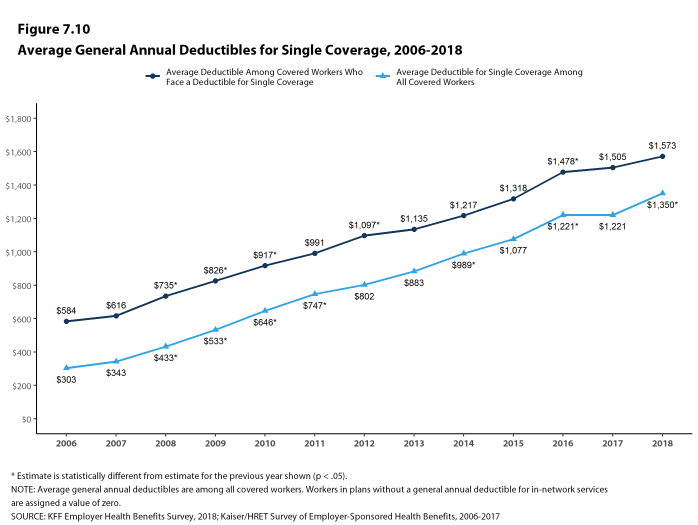
2018 Employer Health Benefits Survey – Section 7: Employee Cost Sharing

Figure 7.10: Average General Annual Deductibles for Single Coverage, 2006-2018

Shot: Almost 40% of Americans would struggle to handle a surprise expense of $400, according to a new Federal Reserve report.

Chaser: The average deductible today among all workers is more than $1,300, according to the Kaiser Family Foundation.


GOP Needs a Health Care Plan, Not an Immigration Plan

https://www.realclearpolitics.com/articles/2019/05/20/gop_needs_a_health_care_plan_not_an_immigration_plan_140372.html?utm_source=morning-scan&utm_medium=email&utm_campaign=mailchimp-newsletter&utm_source=RC+Health+Morning+Scan&utm_campaign=85626cbe0d-MAILCHIMP_RSS_EMAIL_CAMPAIGN&utm_medium=email&utm_term=0_b4baf6b587-85626cbe0d-84752421

Image result for health policy

On Thursday, President Trump unveiled his proposal for shifting the United States to a merit-based program for admitting future immigrants. The plan, which offers meaningful change and deserves serious consideration, is a non-starter politically, given that it does nothing to address the question of the Dreamers, or the millions of other immigrants already in the country illegally. Democrats, as expected, quickly condemned the president’s plan.

Trump isn’t wrong to highlight immigration. A broad-based restructuring of our immigration system is a laudable goal, and we do have a crisis on our southern border – as some Democrats now begrudgingly admit.

So immigration, legal and illegal, is an important issue, particularly to the president’s political base. The problem is that it’s not the most important issue for a most Americans, including many Republicans. It’s not even close. On the issue that is considered the most important – health care –Trump and the Republican Party have no plan at all.

Last week our polling firm, RealClear Opinion Research, released a new survey showing that health care is far and away the most important issue to Americans. At 36%, it was 10 percentage points above the number two issue – the economy – and more than 21 points ahead immigration, which ranked as the number three issue at 15%. (Education and the environment were tied at 11%, and foreign policy ranked last at just 3%.)

Attitudes about our current health care system were even more striking. Although 72% of registered voters rated their own health care as “excellent” or “good,” just 4% said the system was working for all Americans well enough that it needs no significant changes, while 28% think the current system is broken and needs to be replaced.  The vast majority (68%) is somewhere in the middle, viewing the current system either positively or negatively but agreeing that it is in need of improvements.

RealClear Opinion Research pollster John Della Volpe described the findings this way: “Significant proportions of Democrats, Republicans, and Independents agree that the current system needs substantial reform. The debate will be where to start, and how dramatic the correction.”

Democrats are already having that debate. Every single one of the 23 candidates running for the party’s nomination has embraced some form of reform, from expanding Obamacare or advocating “Medicare for All” to calling for a government-run single-payer system.

Meanwhile Trump and the GOP are standing on the sidelines. Nearly two months ago, Trump’s Justice Department came out in support of a Texas district court ruling striking down all of Obamacare. At the same time, the president took to Twitter (where else?) to declare that “the Republican Party will become ‘The Party of Healthcare!'”

Trump claimed that “the Republicans are developing a really great healthcare plan with far lower premiums (cost) & deductibles than Obamacare,” further promising that a “vote will be taken right after the Election when Republicans hold the Senate & win…”

After Republicans complained Trump had caught them off guard, on April 3 the president tweeted, “I was never planning a vote prior to the 2020 Election on the wonderful HealthCare package that some very talented people are now developing for me & the Republican Party. It will be on full display during the Election as a much better & less expensive alternative to ObamaCare…”

Since then, crickets. The thumping the GOP took in the House in 2018 should have been a wake-up call given the prominent role health care played in sending Republicans down to defeat. According to exit polls, 41% of voters in 2018 said health care was the most important issue facing the country, with immigration and the economy running a distant second and third place at 23% and 22%, respectively. More than two-thirds of voters said the health care system needed “major changes.”

Notice how closely those numbers mirror our new findings from RealClear Opinion Research. Six months after Republicans lost the House, voters’ opinions about the importance of health care and the need for reform haven’t budged. If  the president and his party don’t come up with a viable plan to address voters’ concerns, they may find it’s “déjà vu all over again” in 2020.