The Tricky Politics of Healthcare

https://www.latimes.com/politics/story/2019-11-20/elizabeth-warren-medicare-all-healthcare-democrats

Image result for medicare at 50

Last spring, at the dawn of the endless Democratic primary debates, it seemed as if presidential candidates couldn’t wait to endorse the idea of “Medicare for all.”

It was a fine slogan, even if they didn’t agree on what it meant. Everyone likes Medicare; every Democrat wants to move toward universal health coverage. What could go wrong?

Only this: Bernie Sanders had already written a detailed healthcare bill — and in it, Sanders laid claim to sole ownership of Medicare for all.

Sanders’ version of national healthcare is expensive and ambitious. It would abolish private health insurance, cover much more than Medicare does now, and raise middle-class income taxes to pay for it. It’s hard to imagine Congress considering it.

Other candidates were hit with a predictable question: Do you support Sanders’ bill, including the abolition of private insurance?

Elizabeth Warren boasted of having a plan for everything else, but she outsourced this one.

“I’m with Bernie,” she said.

Kamala Harris agreed, saying she wanted to “eliminate” the hassle of dealing with insurance companies.

Cue the backlash. It turned out that progressive activists who attend Democratic town halls are ready for Canadian-style government insurance, but millions of other voters aren’t.

Polls found that most voters thought Medicare for all meant everyone would be allowed to opt into Medicare if they wanted, not that private health insurance — the kind most Americans buy through their employers — would disappear.

They also weren’t keen on paying more in federal taxes, even though Sanders and other advocates argued that they’d save money on premiums and other healthcare costs in the end.

The moderate candidates pushed back. Joe Biden proposed a more gradual route toward universal coverage, a government-run public option that anyone could choose to buy, and that he said would be “like Medicare.”

Pete Buttigieg proposed a similar plan and dubbed it “Medicare for all who want it.” Both said they’d allow people to keep private insurance.

After weeks of waffling, Harris came up with hybrid: a government-run plan with private insurance as an option, similar to the role “Medicare Advantage” plays in the current Medicare system.

Oddly, Harris’ plan resembles present-day Medicare more closely than Sanders’, which would change Medicare into something much bigger.

On Nov. 1, Warren belatedly offered details of how she’d finance a Sanders-style Medicare for all through more than $15 trillion in new taxes on businesses and the rich. But that didn’t stop the criticism.

So last week, she backpedaled.

In the great debate between Sanders’ big leap to a single government-run health plan and Biden’s incremental steps toward broader coverage, Warren declared herself in favor of both.

She’s still in favor of Sanders’ plan. But she acknowledged that it would take a while to get through Congress. That’s if she can pass it at all — although she doesn’t say that part out loud.

So Warren proposed fast-track legislation in the interim to make traditional Medicare available to everyone over 50 and create a Biden-style public option plan available through Obamacare. She calls this the “Medicare for all option,” which sounds a lot like Buttigieg.

Meanwhile, she promises, she’ll try to pass a full Sanders-style bill later, probably in the second half of her first term.

By then, she said, “the American people will have experienced the full benefits of a true Medicare for all option,” and public support will be stronger. Never mind that most new presidents have more sway in their first two years in office, rarely years three and four.

Needless to say, Warren took flak from both sides.

Sanders, in Los Angeles, said he’d turn his plan into law right away — implying that Warren’s strategy is too slow.

A spokeswoman for Biden accused Warren of “double talk.” A spokeswoman for Buttigieg said Warren still “wants to force 150 million people off their private insurance, whether they like it or not.”

It’s true that Warren’s plan calls for abolishing private insurance and imposing huge new taxes — and voters aren’t sold on those ideas.

But Warren’s new plan is smart for one big reason: None of these proposals was ever going to sail through Congress — not even the relatively moderate Biden plan.

The Democrats’ debate on healthcare has suffered from a bad case of fairy dust.

They’ve argued plenty about policy — about how they want to change the nation’s health system and how they’d pay for it.

But their progressive candidates sometimes sound as if they’ve forgotten basic politics: Which proposal will help them win the White House? And how will they get it through a Congress in which Republicans might retain a majority (or at least a near-majority) in the Senate?

No president’s agenda survives its encounters with Congress unscathed. Barack Obama arrived in the White House in 2009 with big majorities in both houses, and his Affordable Care Act — less ambitious than even Biden’s current plan — barely survived.

In that sense, what Warren has done is useful. She’s tacitly acknowledged that she can’t get everything she wants on Day One, and she needs a backup plan. She doesn’t admit that Medicare for all will be hard to pass — “I’ll fight my heart out at each step,” she promises — but that’s what she means.

It’s a nod toward realism. It’s a step forward in the Democrats’ debate on voters’ top domestic issue.

And it’s an intriguing step forward in the still-brief political career of Elizabeth Warren. She’s no head-in-the-clouds Harvard professor. She’s become a cannier, more practical politician.


Warren’s path to Medicare for All is rocky

https://www.axios.com/newsletters/axios-vitals-e30baa47-bebc-4081-81a6-cb96115c5e55.html

Illustration of Elizabeth Warren holding out a health plus.

Sen. Elizabeth Warren’s two-part plan to pass a public option as a transition into “Medicare for All” — and then full-blown “Medicare for All” a few years later — has revealed the difficulty of appealing to both the pragmatic and progressive wings of the party.

The big picture: Warren’s already being criticized by progressives for not being a “Medicare for All” purist, and because of the realities of governing, they may have a point: Passing two major health reforms in one term is unheard of.

  • “In my first week as president, we will introduce Medicare for All legislation,” Sen. Bernie Sanders tweeted on Friday.

Details: Warren’s transition plan — which she said she’ll try to pass within her first 100 days in office — would allow anyone over 50 to enroll in an “improved Medicare program,” and “every person in America” could get coverage through a “Medicare for All option.”

  • Coverage under the public option would immediately be free for children under 18 and families making 200% of the federal poverty level or less. Over time, it’d become free for everyone.
  • Then, by no later than her third year in office, Warren would push Congress to pass full-blown “Medicare for All.”

Reality check: The political capital that it’d take to pass Warren’s public option, even through a special procedure called “budget reconciliation” that’d allow her to bypass GOP opposition, would be enormous.

What they’re saying: “Passing one major piece of health care legislation with a knock down, drag out fight, followed by another one three years later, sounds pretty difficult,” said the Kaiser Family Foundation’s Larry Levitt.

  • A more likely scenario is that a public option would pass, and be given time to work. Depending on how that debate went, Medicare for [A]ll could be a rallying cry for a reelection campaign.”


More older Americans need Medicare and Medicaid

https://www.axios.com/newsletters/axios-vitals-e30baa47-bebc-4081-81a6-cb96115c5e55.html


Image result for More older Americans need Medicare and Medicaid

Retirement in America is growing less secure, physically and financially, given the omnipresent threat and cost of serious illness or disease, Bob reports.

Why it matters: Qualifying for Medicare does not guarantee that older adults will skirt potentially ruinous medical bills. Millions of seniors have also come to rely on the taxpayer-funded program for lower income people — Medicaid — and there’s no indication that will slow down.

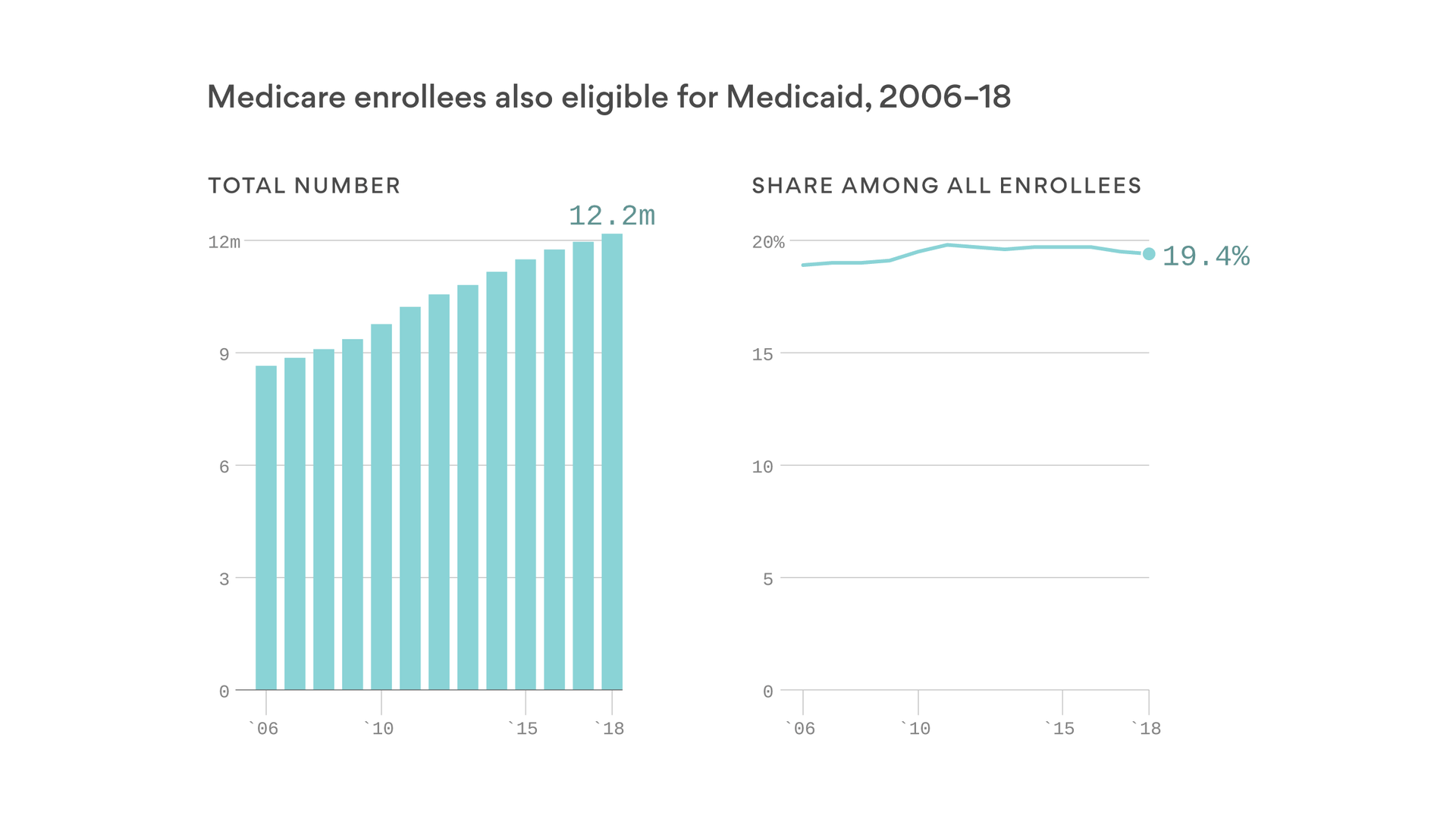
By the numbers: More than 12 million Americans — most of them over 65 — have both Medicare and Medicaid coverage.

  • That represents about one-fifth of all Medicare enrollees, a percentage that has stayed stable over time even as more baby boomers enter the program.
  • This low-income population has some of the most expensive health care conditions and disabilities — averaging roughly $30,000 in annual spending per person, or double the average Medicare enrollee.

Between the lines: Some people who age into Medicare have very few assets and income, and therefore automatically qualify for Medicaid.

  • But retirees who consider themselves middle-class increasingly have to resort to Medicaid because high costs, like dementia or nursing home care, consume their entire nest egg.

What to watch: The federal government has been experimenting with ways to coordinate care better for this population, but that’s a reaction to seniors falling into poverty due to health care costs.

  • Unless policymakers address the high and rising costs of care, more retirees and their families will have to depend on both Medicare and Medicaid.


Health Care System Accepting New Math: Housing = Health

Health Care System Accepting New Math: Housing = Health

Apartment complex with swimming pool on a sunny day

The Residences at Camelback West in Phoenix has 500 rental units ranging from studios to two-bedroom apartments, of which 100 are set aside for homeless UnitedHealth Medicaid members. Photo: Tiempo Development & Management

In the course of a single year, a homeless man named Steve in Phoenix, Arizona, visited the emergency room 81 times. Only 54 years old, Steve is coping with a daunting array of medical conditions: multiple sclerosis, cerebral palsy, heart disease, and diabetes. Because of his health and reliance on emergency rooms, his medical costs averaged about $13,000 per month that year.

Thanks to an innovative housing program run by the nation’s largest health insurer, UnitedHealth Group, Steve no longer sleeps outside — a crucial prerequisite to improved health. He is one of about 60 formerly homeless people covered by Arizona Medicaid who now receive housing and support services in Phoenix, John Tozzi reported for Bloomberg Businessweek. The UnitedHealth housing program, called myConnections, represents the growing recognition across the health care system that improved health cannot be achieved exclusively by traditional clinical models. Getting patients off the streets is often the first — and most important — step to helping them heal, physically and mentally.

Patients like Steve wind up in the ER because they don’t fit into the ways we deliver health care. . . . [The US system] is not set up to keep vulnerable people housed, clothed, and nourished so they’ll be less likely to get sick in the first place. —John Tozzi, Bloomberg News

“Patients like Steve wind up in the ER because they don’t fit into the ways we deliver health care,” Tozzi explained. “The US system is engineered to route billions of dollars to hospitals, clinics, pharmacies, and labs to diagnose and treat patients once they’re sick. It’s not set up to keep vulnerable people housed, clothed, and nourished so they’ll be less likely to get sick in the first place.”

MyConnections was the brainchild of a partnership between UnitedHealthcare (a division of UnitedHealth) and the Camden Coalition, a New Jersey–based nonprofit dedicated to improving care for people with complex health and social needs. The partnership was established in 2017 at the same time Jeffrey Brenner, MD, founder and executive director of the Camden Coalition, announced he was leaving the nonprofit to lead myConnections. He is now UnitedHealthcare’s senior vice president for integrated health and human services. UnitedHealthcare provides managed care to about six million people nationwide, according to company filings. It does not get reimbursed by Medicaid for housing assistance.

Making the Case for Addressing Social Determinants

Brenner hopes myConnections will show that both a health care and a business case can be made for investing in a Housing First (PDF) model. Tozzi reported that UnitedHealth “aims to reduce expenses not by denying care, but by spending more on social interventions, starting with housing.”

At the Residences at Camelback West, a Phoenix apartment complex of 500 apartments ranging from studios to two-bedroom units, up to 100 apartments are set aside for UnitedHealth Medicaid members enrolled in myConnections. The rest of the units are rented out at market rates. Five health coaches use an on-site office to serve as case managers and counselors for the myConnections residents. The coaches make sure that their clients remember medical appointments, and arrange transportation for them and sometimes accompany them to the doctor.

Since receiving housing and health coaching from Brenner’s team, Steve’s average monthly medical costs have dropped from $12,945 to $2,073. An analysis of the first 41 participants in Phoenix shows that “housing and support services proved cost effective for the 25 most expensive patients, reducing their overall costs dramatically,” Tozzi reported. But total spending for the other 16 increased, highlighting the complexity of this work.

“The return’s only going to work out if we target the right people,” Brenner told Tozzi. The myConnections team selects patients who are enrolled in UnitedHealth, are homeless, and who have annual medical spending greater than $50,000 mostly because of ER visits and inpatient stays. Those high-cost patients are UnitedHealth’s best bet for recovering the cost of its housing investment.

UnitedHealth is starting with 10 subsidized apartments in each new city where it’s introducing the program, including in places where there might be hundreds of homeless Medicaid members on its rolls, Tozzi reported. MyConnections will be in 30 markets by early 2020.

Kaiser Addresses Homelessness in Its Backyard

In its home base of Oakland, California, health system Kaiser Permanente has invested $200 million in an affordable housing project, Hannah Norman reported in the San Francisco Business Times. Its help is not targeted exclusively at Kaiser members, instead aiming to benefit any residents who live in communities it serves.

The initiative was championed by Bernard Tyson, the late chairman and CEO of Kaiser, who died unexpectedly this month. In a New York Times remembrance, Reed Abelson noted that Tyson was committed to addressing social determinants of health in the places where Kaiser operates. “He had the organization examine broad issues like housing shortages, food insecurity, and gun violence and their impact on health and well-being,” Abelson wrote.

Tyson, who was the health system’s first Black chief executive, served as chair of the Bay Area Council, a business association dedicated to economic development in the San Francisco region. His chairmanship culminated in a major report (PDF) that documented the severity of the homelessness crisis and recommended ways to address it, Norman reported.

“We don’t believe as a mega-health system that our only lane is medical care,” Tyson said in April. “It’s a critical lane, but it’s not our only lane.”

Steady Rents in Buildings with Seismic Upgrades

Kaiser announced its $200 million housing initiative, the Thriving Communities Fund, in January. Since then, it partnered with Enterprise Community Partners, a nonprofit organization focused on affordable housing, and the nonprofit East Bay Asian Local Development Corporation to invest a total of $8.7 million ($5.2 million from Kaiser) in Kensington Gardens, a 41-apartment building in East Oakland. “The trio of organizations plans to keep the residents in place and the rent steady at $1,597 per month for a studio and $2,250 for a two-bedroom,” Norman wrote. “Some residents receive federal housing benefits, including Section 8, to help cover the cost.”

The Kensington Gardens purchase is part of the Thriving Communities Fund’s strategy to keep rents steady and to make health and safety upgrades such as seismic upgrades and new roofs.

Kaiser’s Built for Zero initiative committed $3 million over three years to a data-driven, county-level approach to understanding the dynamics of homelessness. Built for Zero tracks the homeless population in a county from month to month to understand “who they are, what they need, and even how many of them are repeatedly visiting emergency rooms,” Norman reported. Fifteen Kaiser communities, including eight in California, are participating in the program.


The Politics of Medicaid Expansion Have Changed

https://www.pewtrusts.org/en/research-and-analysis/blogs/stateline/2019/11/13/the-politics-of-medicaid-expansion-have-changed

Year by year, resistance to extending Medicaid to more low-income Americans in conservative states has given way. That trend seems likely to continue into 2020.

In some states, Democratic governors who favor expansion have replaced Republicans who were stalwart opponents. GOP critics have had a change of heart in some holdout states. And in several Republican-led states, citizen ballot initiatives are driving expansion.

Serious efforts are underway in Kansas, Missouri, North Carolina and Oklahoma that could add them to the 36 states, plus Washington, D.C., that have opted to expand Medicaid under the Affordable Care Act (ACA), also known as Obamacare. Three of those states adopted the expansion but have yet to implement the program.

Organizers in Missouri say they have collected a quarter of the 172,000 signatures they need to get a measure on the ballot next year. In Oklahoma, organizers say they have turned in 135,000 more signatures than required.

Proponents also are optimistic about a legislative breakthrough in Kansas, where Democratic Gov. Laura Kelly is finishing up her first year in office and expansion missed by a single vote this year in a Senate committee. And in North Carolina, a new Democratic governor and a Republican-led legislative effort give expansion the best chance it’s had in that state.

In Maine, Democratic Gov. Janet Mills in January signed an executive order implementing Medicaid expansion, which had been approved by voters in 2017 but blocked by her Republican predecessor. And in Montana, Democratic Gov. Steve Bullock in May signed a law extending Medicaid expansion for another six years.

Meanwhile, Idaho, Nebraska and Utah have submitted applications to the federal government to expand Medicaid after voters approved ballot initiatives last year.

History may be repeating itself. Although Congress created Medicaid in 1966, it was another 16 years before every state agreed to participate in the government health plan for lower-income Americans. In 1982, Arizona became the last state to sign up.

The politics surrounding the issue have changed dramatically in the past five years. Republican officeholders have shown an increasing willingness to break with party orthodoxy to support expansion. And the benefits of expansion have been thoroughly researched and publicized: Millions of Americans have gained coverage in expansion states, while rural and safety net hospitals have benefited from the additional federal resources.

Republican officeholders also have seen voters in red states signal their support for expansion at the ballot box.

In Mississippi, Democratic gubernatorial candidate Jim Hood championed expansion during his campaign. He eventually lost, but observers believe the issue helped him run a surprisingly close race against Republican Tate Reeves.

Although Kentucky has already expanded Medicaid, the winning Democratic gubernatorial challenger, Andy Beshear, made protection of the ACA a central feature of his campaign. His Republican opponent, incumbent Gov. Matt Bevin, is an outspoken opponent of the ACA. Beshear’s victory also is likely to mean that the state will stop trying to impose work requirements on Medicaid beneficiaries, a Bevin initiative.

Even Georgia’s conservative governor, Republican Brian Kemp, who highlighted his opposition to expansion in his 2018 campaign against Stacey Abrams, has softened. Earlier this week, he unveiled his own modified Medicaid expansion plan.

If not quite a conservative bandwagon, momentum is certainly moving in one direction, and policymakers in non-expansion states are taking note.

“People in Missouri know that other states right next door have passed it,” said Connie Farrow, spokeswoman for Healthcare for Missouri, the group leading the signature-gathering for that state’s ballot initiative. “Nebraska is a conservative state, and they passed it. Arkansas is a conservative state, and they passed it. Conservative states like Idaho and Utah, they’ve passed it.”

The experience states have had with expansion has made it harder to continue to stand against it, said Jesse Cross-Call, a senior health policy analyst with the Center on Budget Policy and Priorities, a liberal-leaning research and policy institute in Washington.

“There’s been a ton of evidence showing large gains in health care coverage, while helping states economically and keeping rural hospitals open,” Cross-Call said. “And it hasn’t hurt state budgets. It remains a really good deal for states to cover hundreds of thousands of people.”

New research this summer also makes the case that Medicaid expansion is literally a life-or-death decision for states. A study by the National Bureau of Economic Research found that at least 19,200 lives of adults aged 55 to 64 had been saved in states that had expanded Medicaid between 2014 and 2017.

At the same time, 15,600 people in that demographic died because their states hadn’t expanded. The deaths and non-deaths related to whether people with treatable chronic conditions, such as diabetes, heart disease and cancer, had access to health care.

It’s not just research that has made Medicaid expansion more palatable for Republican lawmakers, said Chris Pope, a health policy analyst with the Manhattan Institute, a free market policy center.

“As time goes by, the extent to which [Medicaid expansion] is associated with the Obama administration is weakening,” he said. “That makes it easier for Republicans in red states to move closer to expansion without being seen as complicit with Obamacare.”

“Plus,” Pope added, “the money is so attractive.”

Nevertheless, some Republicans are holding fast against expansion, warning that it is a financial risk their states can’t afford to take.

Missouri state Rep. Cody Smith, the Republican chairman of the House Budget Committee, told The Joplin Globe in August that he was “gravely concerned” about the Medicaid expansion initiative in his state. Missouri already spends a third of its budget on Medicaid, he pointed out. Smith did not respond to a message seeking comment.

“If we obligate ourselves to spend more money on Medicaid, those dollars have to come from other programs,” including education, Smith told the paper.

Red States Trickle In

Medicaid expansion was supposed to be a settled political issue after the Affordable Care Act passed in 2010. That’s because the law called for all states to expand Medicaid, offering eligibility to any adult earning up to 138% of the federal poverty line ($17,236 annual income for an individual), even those without children or a disability.

Federal and state governments share the financial burden of Medicaid, but Washington, D.C.’s share for the expansion population is higher than what it provides for the non-expansion Medicaid population. In the first years, the federal government paid 100% of the costs of the Medicaid expansion population. Starting next year, the federal match will be 90%.

The U.S. Supreme Court upended the original plan regarding expansion. In a 2012 ruling that otherwise upheld the ACA, the court made Medicaid expansion optional for states.

States with Democratic governors and legislatures signed up for the expansion for the start of its implementation in January 2014. A few Republican-led states, including Arizona, Michigan and Ohio, also joined immediately. Since then, red states have trickled into the expansion fold — including the three states that held initiatives last year and Montana. All are awaiting final federal approval.

And, if expansion proponents have their way, that trend will continue next year.

Donny Lambeth, a state representative in North Carolina, is among those Republican officeholders who have had a change of heart regarding expansion. He introduced a measure in the North Carolina House that would expand Medicaid, though with several wrinkles that depart from the plan by Democratic Gov. Roy Cooper.

Chief among those differences is a requirement that enrollees either work or enroll in a school or job training program. Lambeth also would raise taxes on hospitals to pay for the state’s increased Medicaid expenses.

“These are proud people who are working and want to take care of their families, but they can’t afford private insurance,” Lambeth said. He added that the trend of rural hospitals closing will continue unless expansion passes.

Eleven rural hospitals have closed in North Carolina since 2007, according to the North Carolina Rural Health Research Program at the University of North Carolina. Across the country, the program says 161 rural hospitals have shut their doors since 2005.

Support for expansion in North Carolina has come at the local level as well. The county commission in rural Graham County, by the Tennessee border, voted in September to urge the legislature to pass expansion.

“Republican leadership in the state just took the national Republican stance on it and opposed it just because it was something the Democrats had pushed,” said Dale Wiggins, the Republican chairman of the GOP-majority commission. “People doing what their political party wants rather than what the people of this country needs — that’s wrong.”

In Oklahoma, Republican lawmakers haven’t budged noticeably on expansion, but proponents got a boost in September when the former speaker of the House, Kris Steele, a Republican who had been wary of the ACA while in office, came out in favor of expansion at a town hall meeting.

“I believe [expansion] improves lives of working individuals and gives them an opportunity to be healthy and ultimately flourish in society,” Steele said in an interview. “From a conservative aspect of it, I think it makes sense for Oklahoma to have our own tax dollars to come back to our state to help out citizens.”

Strongest Prospects in Kansas

Prospects for expansion are likely strongest in Kansas. The legislature passed expansion in 2017, only to have the bill vetoed by then-Gov. Sam Brownback, a Republican. This year, the House passed an expansion bill in its legislative session but a Senate committee came up one vote shy of moving the measure to the floor.

Democratic Gov. Laura Kelly has redoubled efforts for passage next year. At the same time, Republican Senate Majority Leader Jim Denning has promised to put out his own expansion bill and has asked a special Senate committee to explore the issue.

In an interview with Stateline, Kelly said she is confident expansion will pass next year. “This is a huge issue in Kansas,” she said. “Everybody is up for re-election in 2020, and I think it is essential that this gets passed if they stand any chance of getting re-elected.”

Although the Trump administration has reviled both the ACA and Medicaid expansion, the Manhattan Institute’s Pope says that the administration’s actions may have pushed Republicans to seek expansion. From the beginning, the administration has encouraged states to customize their Medicaid programs, for example by requiring beneficiaries to work.

Conservative states such as Arkansas and Kentucky fashioned their expansion applications to the federal government around such proposals.

“The Trump administration by expanding options has made it more attractive to states,” Pope said.

A federal judge earlier this year threw out work requirements in Arkansas, Kentucky and New Hampshire. Those cases have been appealed. Arizona and Maine have both suspended plans to implement work requirements, and Democratic governors in Michigan and Virginia have raised alarms about carrying them out in their states.

The administration may want to give states flexibility in running their Medicaid programs, but it has also made clear it has no interest in encouraging expansion.

When Utah’s Republican governor and lawmakers this year tried to do a limited expansion that would have extended Medicaid eligibility only to residents with incomes below the poverty line, the Trump administration said it would not pay the higher federal match for a partial expansion. It said it didn’t want to encourage more states to expand Medicaid, even partially.


Moody’s chief economist: Numbers check out on Warren’s ‘Medicare for All’ funding plan

https://www.beckershospitalreview.com/hospital-management-administration/moody-s-chief-economist-numbers-check-out-on-warren-s-medicare-for-all-funding-plan.html?origin=cfoe&utm_source=cfoe

Related image


Despite openly disagreeing with Massachusetts Sen. Elizabeth Warren’s single-payer healthcare plan, Moody’s Analytics Chief Economist Mark Zandi says the numbers check out, and the Democratic presidential candidate’s plan is fully financed without adding a new tax on the middle class, according to an op-ed he wrote for CNN Business.

“Criticism that Senator Warren’s Medicare for All plan can’t be paid for, at least not without putting a greater financial burden on lower- and middle-income Americans, is wrong,” Mr. Zandi wrote. He was asked by Ms. Warren’s campaign to review the plan, and in the op-ed, walks through his reasoning on each of the main funding mechanisms for the plan, including employer premiums, income and payroll taxes, bank taxes, and the wealth tax.

“I don’t agree with Warren’s vision for our healthcare system, but I admire that she has clearly and credibly laid out that vision and that she sought out the opinions of those who may disagree with her to provide independent validation of her numbers,” Mr. Zandi wrote. “That’s the kind of rigor we should expect from all of our presidential candidates.”

Read the full column here.


Opinion: ‘Medicare for all’ won’t fix soaring healthcare costs

https://www.latimes.com/opinion/story/2019-11-15/medicare-for-all-health-care-costs?fbclid=IwAR0uMTlEMcPuefoVjeuSvyIa69AIRk8v4N0d4ux6f1HMg1k4wMbM_SRElh8

Medical bill

The idea of “Medicare for all” advanced another step with the recent release of Sen. Elizabeth Warren’s more detailed health proposal. It is expansive and bold, and has brought some excitement to the progressive core of the Democratic Party. While policy mavens can delight in the details, the enormity of the proposal is a sign that this debate has clearly gone off the rails.

There is no question that healthcare cost is a pocketbook challenge for all of us. Employer and employee premiums for private health insurance for a household now average $20,576, before deductibles and copayments, and before payroll and state and local taxes to pay for healthcare for the elderly and the poor.

National health expenditures increased 179% between 2000 and 2019 to $3.8 trillion, and 50% of this increase was directly due to increases in unit prices and service intensity by hospital systems and physicians. In the U.S., healthcare is 28% more expensive than the next highest cost system, Switzerland, and 78% more expensive than in Germany. For a primary care doctor in the U.S., submitting invoices to insurers and collecting payments costs almost $100,000 per year.

What we should be debating — instead of the politics around Medicare for all — is how this market evolved in such a malignant direction, and whether anything can be done to change these trends.

Hospital consolidation has been shown to drive up healthcare costs, and yet 90% of U.S. hospital markets are highly consolidated. Physician employment by hospitals and health systems has increased from 26% to 44% of the market from 2012 to 2018, increasing the pricing leverage of consolidated systems even further.

These changes directly result in higher prices for commercial health insurance as hospitals use their exaggerated hospital “charges,” often many multiples of their costs or of the market price, to drive up their reimbursement rates for in-network care and especially for out-of-network care, where there is no price negotiation. Further, even at most not-for-profit healthcare systems, hospital leaders are compensated based on the profits they generate, not premiums they reduce, as is the case with leaders of for-profit hospital systems.

The pharmaceutical market has also come under scrutiny for the enormous prices of newly approved medications, and for price increases of existing medicines such as insulin. Behind the scenes are layers of businesses that further exploit this market. For example, one pharmaceutical benefit manager (a company hired by a health plan or employer to oversee prescription drug benefits) reported profits of $1.8 billion in 2013 that rose to $4.5 billion in 2017 despite a 4% reduction in revenue reported over this period.

It’s easy to see that consumers need relief from this market. One might imagine that politicians from both political parties would band together in a search for actionable solutions. Yet the debate has migrated from a discussion of why costs are spiraling out of control to a simple and unrealistic answer — Medicare for all. Here are some ideas on how to frame a meaningful discussion about costs.

Reducing administrative costs has been a stated policy goal of the federal government since the passage of the Health Insurance Portability and Accountability Act (HIPAA) in 1996, yet these costs continue to increase. To reduce these costs, we have to simplify the complexity of the billing process for hospitals and physicians across the multiple different health plans in the market, and we need to transform the expensive set of public data reporting mandates into a model in which we are assured these data are used by providers internally to improve the quality of care they provide.

We need to rebalance negotiating power between hospitals and physicians and insurers. Hospitals and other providers have been allowed to set their list prices without any relationship to the cost of care they provide. These inflated prices are then imposed on out-of-network patients, most egregiously in the practice of surprise medical billing in which patients encounter deliberately out-of-network air ambulances and independent anesthesiologists. In billing disputes, state law should offer these patients a default of a market price closer to Medicare payments than to hospital charges.

Finally, it’s time to stop the practices that are driving up prescription drug costs for all of us. Secret payments between pharmaceutical manufacturers and pharmaceutical benefit managers and distributors totaled over $100 billion in 2016. This business model needlessly inflates drug prices for the benefit of intermediaries in the market. We need laws requiring price transparency at the pharmacy for brand and generic drugs, and price competition for medications at the retail level.

The problem with focusing on Medicare for all is that rather than developing practical approaches, the debate is heading down a path likely to leave us without any tenable solutions to address healthcare costs — the issue that ignited the public’s interest in the first place.


Another reality check on hospital beds

https://www.axios.com/newsletters/axios-vitals-1a6dd9a6-5198-4abf-812f-dbf8dd8e67cb.html

Image result for reality check

Hospital beds are not filling up like they used to, but that doesn’t mean hospitals want their beds to be empty, Axios’ Bob Herman reports.

What they’re saying: Even though more patients are being treated in outpatient clinics rather than hospitals, “we’ll still be able to keep our beds pretty full,” Don Scanlon, chief financial officer at Mount Sinai Health System, said this week at an investor lunch held at Goldman Sachs headquarters in New York City.

Details: Mount Sinai, a not-for-profit hospital system based in Manhattan with $5 billion in annual revenue, is preparing to sell $475 million in bonds, and was making its pitch to bondholders about why buying that debt would be a good deal.

Between the lines: Mount Sinai’s discharges have trended down, but the hospital doesn’t want to lose the bigger dollars tied to inpatient stays. And the system wants to reassure municipal investors they will see returns.

  • As a result, Mount Sinai has invested more money in outpatient centers in other parts of New York that serve as “feeders” for its main city hospitals, Scanlon said.

The bottom line: Mount Sinai, Trinity HealthBanner Health and a host of other hospital systems have openly touted plans to boost or retain admissions even though they say they want to keep people out of the hospital. This is a fundamental disconnect between “value-based care” and the system’s financial incentives.

Go deeper: How banks and law firms make millions from hospital debt


CMS pitches ramped up oversight of Medicaid payments, promises block grant guidance

https://www.healthcaredive.com/news/cms-pitches-ramped-up-oversight-of-medicaid-payments-promises-block-grant/567135/

Image result for medicaid block grants

UPDATE: Nov. 13, 2019: This brief has been updated to include comments from provider groups.

Dive Brief:

  • CMS proposed a new rule Tuesday that would establish stricter requirements for states to report information on supplemental Medicaid payments to providers in a bid to clamp down on spending and promote transparency.
  • The agency will also soon release guidance on how states can test alternative financing approaches in the safety net program like block grant and per-capita cap proposals for “certain optional adult populations,” CMS Administrator Seema Verma said Tuesday at the National Association of Medicaid Director’s annual conference in Washington, D.C.
  • Later this year, CMS will also issue guidance on how states can promote value-based payments and social determinants of health factors in Medicaid, Verma said. The Center for Medicare and Medicaid Innovation is currently developing several new payment models to push providers to take on more risk for their patient populations in those programs.

Dive Insight:

The moves are in line with sweeping changes from the Trump administration moving more power to the states and asking more from recipients. The CMS administrator teased late last month the agency would soon release new guidance for states to inject flexibility into their Medicaid programs.

“We shouldn’t ration care but instead make how we pay for care more rational,” Verma said Tuesday. “Medicaid must move toward value-based care.”

Speaking to the Medicaid directors Tuesday, Verma said the changes are aimed preserving Medicaid for future generations.

“Going forward there will be no new [State Innovation Model] grants, no more open-ended one-off district waivers,” she said. “We must move forward with a more unified, cohesive approach across payers, across CMS, across states.”

The proposed rule, called Medicaid Fiscal Accountability (MFAR), will add more scrutiny to supplemental payments, which are Medicaid payments to providers in addition to medical services rendered to Medicaid beneficiaries, such as payments supporting quality initiatives or bolstering rural or safety net providers.

Some states rely heavily on these additional payments to offset low Medicaid reimbursement or support struggling hospitals. Provider lobbies did not take kindly to the new rule.

“We share the government’s desire to protect patients and taxpayers with transparency in federal programs, but today’s proposal oversteps this goal with deeply damaging policies that would harm the healthcare safety net and erode state flexibility,” Beth Fledpush, SVP of policy and advocacy for America’s Essential Hospitals, said in a statement.

AEH, which includes more than 300 member hospital and health systems, many of which are safety net providers, asked CMS to withdraw the proposal. The American Hospital Association told Healthcare Dive it was still reviewing the rule and declined comment.

However, government oversight agencies like the Government Accountability Office and the Office of Inspector General have recommended changes to these payments, which have increased from 9.4% of Medicaid payments in 2010 to 17.5% in 2017, according to CMS.

MFAR would also propose new definitions for “base” and “supplemental” payments in order to better enforce statutory requirements around and eliminate vulnerabilities in program spending.

Verma has long teased CMS support of block grants, an idea popular with conservatives, but Tuesday’s speech solidifies the agency’s support of such proposals. A handful of red states have been mulling over capped spending to gain more clarity around budgets.

In September, Tennessee unveiled its plan to move to a block grant system that would set a floor for federal contributions adjusted on a per capita basis if enrollment grows. Any savings would be shared between the state and the government.

Tennessee must submit a formal application to CMS to later than Nov. 20. If approved, it would become the first state to use a block grant funding mechanism in Medicaid. Additionally, Utah submitted a waiver application seeking per-capita Medicaid caps in June; Oklahoma Gov. Kevin Stitt, a Republican, is reportedly considering such a program; and Alaska and Texas have both commissioned block grant studies.


Federal investigators probe Ascension, Google project

https://www.beckershospitalreview.com/cybersecurity/federal-investigators-probe-ascension-google-project.html

Image result for nightingale project

The Office of Civil Rights of HHS is asking for more information about Google’s “Project Nightingale” with St. Louis-based Ascension, according to a Nov. 12 The Wall Street Journal report.

Investigators “will seek to learn more information about this mass collection of individuals’ medical records to ensure that HIPAA protections were fully implemented,” OCR Director Roger Severino told WSJ.

Ascension and Google partnered last year to gather and share patient information to create healthcare solutions. Physicians and patients from 21 Ascension locations were not informed that information was being shared with Google. It is estimated that Google will gather data on 50 million patients.

Patient data that is being secretly shared with Google includes lab results, diagnoses and hospitalization records, reports WSJ. In some instances, Google has access to patients’ complete health history, including names and dates of birth. 

Although Ascension employees have questioned the ethical and technological ways Google is gathering data, privacy experts said it appears to be acceptable under federal law. Hospitals are generally allowed to share data with business partners without informing patients if the information is used “only to help the covered entity carry out its healthcare functions.”

An Ascension spokesperson said patient data wouldn’t be used to sell ads, reports WSJ.

“We are happy to cooperate with any questions about the project. We believe Google’s work with Ascension adheres to industry-wide regulations (including HIPAA) regarding patient data, and comes with strict guidance on data privacy, security and usage,” a spokesperson for Google said in a statement to WSJ.

Legislators on Nov. 12 also commented on the project. Presidential hopeful Sen. Amy Klobuchar of Minnesota said that there needs to be government oversight for the amount of data Google is handling, adding there are “very few rules of the road in place regulating how it is collected and used.”

Google has mapped out plans to develop a search tool that would aggregate patient data into a central location. Ascension physicians would then be able to use the tool to more quickly access patient information.

Ascension leader Eduardo Conrado, executive vice president of strategy and innovations for Ascension, shared his reactions to the WSJ Nov. 11 report on Project Nightingale on Nov. 12. Find his commentary here.