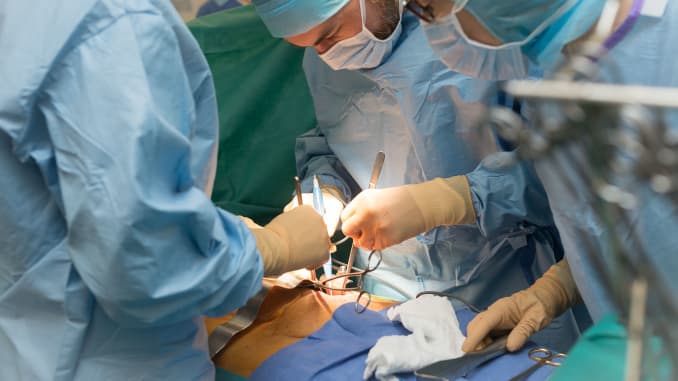
What seven ICU nurses want you to know about the battle against covid-19

What seven ICU nurses want Americans to know about COVID - Washington Post

They have been at this for almost a year. While politicians argued about masks, superspreader weddings made the news, a presidential election came and went, and at least 281,000 Americans died, nurses reported for work. The Post asked seven ICU nurses what it’s been like to care for the sickest covid patients. This is what they want you to know.

As of Dec. 7, Idaho has seen 110,510 total confirmed cases, 1,035 deaths, and 477 people are currently hospitalized with the virus.

Kori Albi, 31

Covid unit intensive care nurse and unit supervisor, Saint Alphonsus Regional Medical Center

Our staff are getting sick. Our physicians are getting sick. And they’re not getting it from the hospital. They’re getting it from the community. We are almost lucky to care for the covid patients because we know who they are. Anytime we go into these rooms, we know exactly what we need to do. We have all the PPE we need. And as long as we are diligent and follow all the processes that are in place, we can keep ourselves safe. That’s not what worries me at all. Going out into the community is scarier than coming into work every day. Because you don’t know who has it.

This virus has caused this feeling, this sense of isolation. The covid unit is an isolated desert. Every door is shut. Every room has negative airflow. By the time you put your N95 mask on and then your surgical mask over the top of that, then you put your isolation gown on and your face shield on top of that, you can’t tell who is who. So much of health care is about that personal touch — now, our patients can’t even see our name badges because they are on under our gowns. All they see are our eyes through our face mask.

A lot of families are hesitant to have Zoom calls with patients because it can be uncomfortable and awkward. Especially if these patients are sedated and intubated. There’s always that awkwardness of: Can they hear you? Can they not hear you? Even as nurses, we feel like we’re talking to the wall. But we talk to them just as if they were awake. Allowing families to play their music that they like or pray with them or just talk to them can absolutely help. You see vital signs change.

One patient, all she wanted to do was have her son sing her a song. I think I spent over an hour in the room listening to him play the guitar and sing her a song. He sang her mostly hymns.

Death is a very intimate event that normally involves a lot of family members that help bring closure and that helps everyone process. In normal circumstances, health care providers form these relationships with the family at the bedside. All of that has been removed. And we now have to try to form those relationships over the telephone. It’s a traumatic experience. And it’s a long drawn-out process. A lot of people don’t make it out of here. It’s a slow, lonely death.

The amount of death with covid is profound. As nurses, we have learned to process death, but the amount of death has happened in such a short span of time — that’s what’s been overwhelming. I had a patient that we did a Zoom call with. His four-year-old granddaughter lived with him. And she brought tears to the room. The naivete of a four-year-old. Her grandfather was intubated so he couldn’t talk. But he could kind of look around the room. But the innocence of her, saying, “Come home, Pa. I miss you, Pa. I love you Pa,” all through a video screen. The 14-year-old that also lived with them couldn’t formulate words to say anything, and he didn’t know what to do or say in that video. But the four-year-old was telling Pa to come home.

JACKSON, MISS.

As of Dec. 7, Mississippi has seen 166,194 total confirmed cases, 3,961 deaths, and 1,157 people are currently hospitalized with the virus.

Catie Carrigan, 28

ICU, University of Mississippi Medical Center

There are some patients who have been in their younger 20s and their younger 30s, and I think maybe those are the hardest cases. They have families and they have kids just like I do, and it’s hard coming into work and taking care of them. Knowing they’re supposed to be going to college, they’re supposed to be getting married, they’re supposed to be having kids and, instead, they’re laying in a hospital bed on a ventilator fighting for their life.

They have their whole entire lives ahead of them, and then they get hit with this disease that everybody thinks is a hoax and then they die.

I worked in the ER a month ago, so I know exactly what’s going on down there, and now I work in the ICU, so I know exactly what’s going on on both sides of it. There are no ICU beds in the hospital. None. When there are no ICU beds, we hold them in the ER, or we hold them in the PACU (post-anesthesia care unit). The ER still has to treat our trauma patients, our car accidents, our gunshot victims. So when we have those ICU holds in the ER, it obviously makes the jobs of nurses and doctors in the ER way more difficult than it needs to be. We are treating patients in the hallway. They’re just trying to do the best they can with the resources that we have.

There is no room left, essentially, and I think that’s really what people don’t seem to understand. And I get it, when you’re not in health care you don’t really see our side of it, but we’re seeing the worst of it. It’s hard for us to convey that to the public because they don’t seem to want to take our word for it — but take our word for it. Take our word for it.

IOWA CITY

As of Dec. 7, Iowa has seen 244,844 total confirmed cases, 2,717 deaths, and 898 people are currently hospitalized with the virus.

Allison Wynes, 39

Medical intensive care unit, University of Iowa Hospitals and Clinics

I cry every day when I walk in to work, and I cry every day when I walk to my car after work.

You get it out of your system before you show up and you do your job and you’re fine. Then, you go home and you cry before you get home. And then you go home and be mom.

My 9-year-old daughter asks frequently, “Mommy, how many patients were there today? Mommy, how many sick ones were there today? Were you safe? Was everything okay? Do you have to go to work again? How many patients?” She gets it.

I think one thing that people do not appreciate is it’s not only the number or volume of patients that comes through — it’s the level of care that they require, which is so much greater than a standard patient in the ICU or a standard patient in the floor, because they can get very, very sick very quickly.

We were walking a patient who was on ECMO, which is extracorporeal membrane oxygenation, and it took five people to walk her. That’s not normal.

I work in the MICU, so it’s never like a party up in here, but it used to at least be, nine times out of ten, calm and controlled and tidy and clean. Occasionally stuff would go bad and we would all run and help, and then we would all go about our days. Now it just feels like, especially of late, there is equipment everywhere. There are gowns everywhere. There are gloves everywhere, there are people everywhere, and there are fires everywhere.

I’m actually scared, and I’ve never been scared at work before. I am scared that we will lose control.

It’s the human resources we are running low on. We can make a bed, we can find a ventilator, we have PPE. But it’s the human cost of caring for these patients that has been keeping me up at night the past couple of weeks and really making me nauseous every day.

I didn’t think it would be over by now, but I didn’t think we’d be getting hit this hard this late. I thought we’d still just be smoldering. I didn’t know that we would just be a raging fire at this point in time. We’re not prepared for that, but here we are.

After this, I’m going to take my kids to a beach or somewhere.

GLENVIEW, ILL.

As of Dec. 7, Illinois has seen 796,264 total confirmed cases, 14,216 deaths, and 5,190 people are currently hospitalized with the virus.

Luisa Alog Penepacker, 51

ICU, Glenbrook Hospital

I’ve taken care of a lot of husband-wife patients, unfortunately. One of the cases was one in which the husband had tested positive for covid first, but he was a mild case. She was a little bit more serious. She ended up on our unit.

The husband ended up in the hospital the next day, but he was on the step-down unit. When I admitted her, she was terrified, especially knowing that her husband was upstairs in another unit. She was having a hard time breathing, and she grabbed onto my hand and looked at me. She goes, “Am I gonna die?” I mean, I didn’t know what to say. And I just told her, “Not on my watch.” So we just kept on going. But unfortunately, she got intubated the next day.

Then I was sent to work upstairs on the step-down unit. I had her husband that next day, and he was actually quite happy that I saw her. He goes, “You took care of my wife, how is she? I heard that she’s not doing well.” I didn’t know what to say to him, either. I just said, “You know, she’s in the best of care. We’ll take really good care of her.” And he looked really relieved. He goes, “I’m just so glad that someone who had seen her is here now to talk to me.” And my heart broke with that.

She ended up passing. A few days after, he went home, and I didn’t see him, so I don’t know how he took it. He wasn’t able to see her before she passed.

We wear personal air purification respirators on our heads — these big white domes over our heads with a respirator hose going to a machine strapped around our waist, and we look like astronauts walking through the unit, going in and out of patients’ rooms with our plastic gowns and gloves.

It can be frightening to family members if they’re allowed to come to visit and definitely for patients because we’re kind of scary-looking. It can be frantic at times. You walk through the hall, and you see a lot of patients on ventilators. You hear a lot of beeping. People are rounding constantly to check on patients. It’s a busy place.

You don’t know what to tell family members when you see them. What can you say? You just say, “I’m sorry.” You can’t even hug them. I used to be able to hug family members, but you can’t with all the gear.

When patients are scared, I will hold their hand even though I’m wearing gloves. I look them in the eyes as much as I can because really, that’s all you can see. You can’t see our faces. You can barely even hear past the mask. So I’ll make sure to look at them. I try to make an effort to smile with my eyes and to just hold their hand if they need it.

MURRAY, UTAH

As of Dec. 7, Utah has seen 215,407 total confirmed cases and 939 deaths.

Tammy Kocherhans, 41

Respiratory ICU, Intermountain Healthcare

These patients are different than the typical patient. They’re very complex. They can change in the blink of an eye. And it’s very hard as a nurse when you wrap your heart and soul into taking care of these patients. I started noticing that I was emotionally tired. I was physically completely exhausted. And I was beginning to question whether or not I could continue forward being a nurse at all. I was past my physical capacity.

I happened to be working a day where another health care worker who was a veteran said that this was like a combat zone, and for some reason in my head, that validated the way that I was feeling. So I reached out to one of my best friends who is a veteran, a flight medic, and he said, “I meditate and do yoga.”

Once I started doing that, I was able to handle the emotional crises, the physical pain of working so, so many long, hard hours. We do something called proning, where you take patients and flip them over onto their bellies. And that sounds really easy, but it takes a team of a minimum of five people. It is extremely taxing on your body. It hurts. And I lift weights! The meditation and yoga really has saved my life, my mental capacity, my spiritual capacity, my physical capacity, everything that is required to give to these patients.

Hopefully by 8 p.m., I’m out in the parking lot and spend a minute in my car to unload from my day. It’s all about taking a moment to breathe for myself and then going through whatever came up that day that I need to let go of. It depends on how complicated my patient was that day, whether I can let my whole day go or if I have to spend time to go through each piece and work it down to: What did I do right? Did I miss something? Sometimes I just can’t let some details go quickly, and I have to work them down to allow myself to say I did everything that I possibly could for this individual this day, in this time, in this situation. And whatever the outcome was or is, I followed protocol. I did everything that I knew how to do. And it’s going to be OK.

I find it very frustrating when I go out and about on my days off and I see people very blatantly not wearing masks or trying to tell me how come they don’t work or telling me that this pandemic isn’t real. I find it completely disrespectful to the work we do to save people’s lives, to have people think that this pandemic isn’t real, to show utter disregard for people around them, not trying to do their part.

And I really wish that I could take people on a day with me so that they can see what I see. So that they can feel your feet ache so bad that you wish they’d just fall off, because you’re on that concrete for so many hours. Your back aches because you’re wearing equipment to save your life — so that you can save somebody else’s life. And your head hurts. I’ve never had so many headaches in my life because part of the equipment sits on your head, and after 12 hours, it starts to exert so much pressure that you start to have a headache, and you’re dehydrated.

Early in the pandemic, I remember walking into this room, and this young patient was crying and asked me if they were going to die. And I’m a mom of teenagers. For me, that was awful because this patient was all alone, and we as staff were minimizing contact because we didn’t want to get the virus.

This patient started physically trembling in the bed. I couldn’t take it anymore, and I went over and just held this patient because that’s what I’d want somebody to do for my children. That was my first patient that I held like that. And there have been many since.

MURRAY, UTAH

As of Dec. 7, Utah has seen 215,407 total confirmed cases and 939 deaths.

Nate Smithson, 28

Respiratory ICU, IntermountainHealthcare

A few weeks ago, my wife and I were on a date at a restaurant. And in the middle of nowhere, I had this panic attack and went and hid in the bathroom stall for half an hour. I have no idea what brought it on. I just couldn’t handle being there right then, which was weird for me. That’s the first time anything like that has happened. But since then, it’s happened multiple times, where the anxiety and stress is overwhelming, and I can’t handle it. So I have to go and excuse myself for a little bit.

Balancing work and life is something that used to seem possible. Now it doesn’t seem like there is any difference between the two. I fall asleep and I dream about my patients.

When we got our first covid patient in February in the hospital, in the ICU, we all kind of thought it was a little bit of a joke, to be honest. I had this patient, and he was sitting there with minimal amounts of oxygen in the room just watching TV. He’s like, “I’m fine. I don’t know why everyone’s freaking out about this.” And I thought the same thing. And then a few hours later, he stands to go pee, and I’m looking at his monitor. And it drops down to the low 90s. Ninety-two is about as low as you want to go. And then it starts dropping down lower, to about the 70s. Then it gets down into the 60s and 50s. And that’s dangerous territory. That’s where brain cells start dying and you start having some serious problems.

I run into the room. We get him back into bed and throw all the oxygen that we have in the room on him, crank everything up, and he’s not recovering from it. We had to intubate right then and there. And about an hour later, he finally starts recovering a little bit. But at this point, he’s sedated, he’s on the ventilator. Everything is worse. And that’s the first time where it’s like: Oh, crap, this is serious. This is something else. I’ve never seen anything like that before.

If a patient’s heart stops or if they stop breathing, we call a code blue, and that’s when the doctor, respiratory therapist, nurses, everybody comes into the room. We start chest compressions or CPR or that kind of stuff. This one patient’s heart is not working. So I call the code blue. We all get in there. We start doing the chest compressions. Five minutes later, we get the patient back. We all go back about our work. Twenty minutes later, same thing happens again. We start doing the chest compressions. We start pushing medications as fast as we can to get the patient back again.

The spouse comes into the hospital. I explain: “Just so you know, this is what happened before. It could possibly happen again. If it does, I’m going to need you to step outside of the room.” And as I’m explaining this, sure enough, it happens again. We lose the pulse. We lose the heartbeat. So I ask her to leave the room. Everyone gets in there, and we start going for it. We went for almost two hours: chest compressions, pushing medications, shocking the patient’s heart.

The doctor is ultimately the one who makes the decision about when we stop, and they call time of death. But typically in situations like that, where it’s unexpected and sudden, they want to make sure that everybody can go home that night feeling OK about what they did, knowing that they did everything. And after an hour, he stops, turns to the room and asks: Does anyone have a problem with us stopping?

I didn’t have a problem, but then as he’s saying that, I look out the window, and the patient’s wife is just watching us. She’s been sitting out there watching us for an hour, and no one’s saying anything.

And I ask them to keep going.

So we did. We went almost for another hour after that, and we didn’t get the patient back. He ended up dying.

But I think for me, that was important — to keep going. Not because we thought we would get them back, but so that his wife would know that we did everything we could.

I still go to bed with her face kind of burned into my mind, of just seeing her sitting out there watching us, and that’s what kills me.

COLUMBUS, OHIO

As of Dec. 7, Ohio has seen 475,024 total confirmed cases and 6,959 deaths.

Kahlia Anderson, 32

ICU, Ohio State University Wexner Medical Center

I graduated from nursing school in May 2019. I started here at the Wexner in August. Our orientation is a 20-week program, and so I came out on my own Jan. 12, 2020. The pandemic hit us at the end of February.

In nursing school, I think your biggest fears are making med errors, or harming your patient in some way, or just not knowing how to do everything. Did I check my patient’s blood pressure before I gave this blood pressure medication, or did I give the correct dose of a specific medication? I had heard stories about that on the unit, like make sure you’re careful with the needle stick, or make sure you’re careful with this medication. And I don’t even think about those kinds of things anymore.

Now it’s the fear of the unknown. It’s the fear that anything could happen because of this virus and my patient could die regardless of what I do.

When I got my first covid-positive patient, I remember thinking: Somebody did the assignment wrong because there’s no way that they believe that I should be taking care of this patient. I can remember the feeling. I can remember the day. It was a weekend. I was on a day shift. And I was thinking to myself: Who trusted me, the new nurse to take care of a covid-positive patient? How am I going to do this? How am I going to keep this patient safe? How am I going to keep myself safe? Am I safe? Wait, who cares about me? Let’s get back to the patient. What do they need?

At the time, I didn’t even understand some of the ventilator settings because I was still that new, and it was still that fresh to me. And I thought: This machine is doing that much work for them, and I don’t know enough about it, but I’m going to make sure that I get it done and I’m going to figure it out today to make sure that this patient gets everything that they need. And I’m going to call their family and double check with them and check in with them and call them.

That patient is alive. That patient is no longer in the hospital. As far as I know, that patient is home and safe with family.

I would feel like: There’s someone more experienced. There’s someone more adequate to deal with this. And I was like — oh, it’s me. This is me, I’m doing this, and I’ve been doing it ever since.

I saw new nurses come out of orientation, and I saw the type of assignments that they would get. So my mind fixated on like: I’m going to get patients that are ready to transfer out. They can talk, they can eat. They’re just waiting for a bed on another unit. Or maybe it’s a patient who needs long-term care. So they’re waiting to go to a facility to be discharged. And so I was thinking to myself: I’m going to get my feet wet. It’s going to be great. I’m going to build up this experience, and then I’m going to start getting sicker patients, and I’m going to be ready.

Once covid hit, there was no room for those types of patients anymore. Everyone had covid, everyone was sick, everyone was intubated or approaching intubation.

And for me, I just wanted my first experience. I wanted to have the simple experience of building and getting better. But that’s not what was in store. And I can’t say that I’m upset about it today. I’m grateful for this experience. I don’t wish this pandemic on anyone. I wish it was not here. I wish that it was different. But as a nurse, as a new nurse, these experiences are unique to me. It’s making me a better nurse. It’s made me a better person, and I can only continue to just be.

We did cry in the beginning, and now not so much. I think we all struggled when we had a young death. Someone in their 20s was very difficult for us. Because you think: That was a young life. What a young life that was, and they’re not here anymore. Because of a virus. That’s hard. It’s very hard.

But now it’s just — it’s almost everyone’s story.
Hospitals continue to crack under the surge

https://s.yimg.com/ny/api/res/1.2/WOZOpgmZDY6rdw4hdu62fw--/YXBwaWQ9aGlnaGxhbmRlcjt3PTcwNTtoPTQwMi43NTMwOTkxNzM1NTM3/https://s.yimg.com/os/creatr-uploaded-images/2020-12/b78fb490-3664-11eb-bf97-2dd2b05a8603

Hospitals across the country are reaching their breaking point on ICU and bed capacity as COVID surges, forcing many health systems to begin diverting patients from emergency rooms and ration care, Axios’ Orion Rummler reports.

What’s happening:

  • New Mexico Gov. Lujan Grisham (D) plans to allow hospitals to ration care depending on how likely a patient is to survive, the Washington Post reports. Grisham required residents to wear masks and re-enacted strict mitigation efforts.
  • Georgia: Major hospitals, including Grady Memorial and Emory University, have had to turn away patients brought in ambulances, the Atlanta-Journal Constitution reports.
  • South Dakota: The Monument Health Rapid City Hospital and Sanford USD Medical Center — some of the biggest in the state — say they have no more ICU beds, the Mitchell Republic reports.
  • Colorado: More than a third of hospitals across the state said in a survey they expect staffing shortages this week, Colorado Public Radio reports.

Context: White House coronavirus task force coordinator Deborah Birx noted on Sunday’s “Meet the Press” that U.S. hospitals are usually anywhere from 80 to 90% full in the fall and winter — and “when you add 10, 15, 20% COVID-19 patients on top of that, that’s what puts them at the breaking point.”

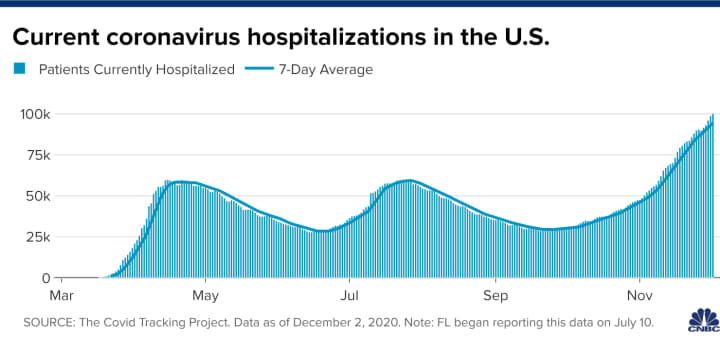
Coronavirus hospitalizations top 100,000 for the first time

https://www.axios.com/coronavirus-hospitalizations-pandemic-cases-outbreak-bad-1ce7ea5e-15a6-43d2-addd-92cb5eee534f.html

U.S. Covid hospitalizations top 100,000, an 'unfathomable' milestone

More than 100,000 Americans are now in the hospital with coronavirus infections — a new record, an indication that the pandemic is continuing to get worse and a reminder that the virus is still very dangerous.

Why it matters: Hospitalizations are a way to measure severe illnesses — and severe illnesses are on the rise across the U.S. In some areas, health systems and health care workers are already overwhelmed, and outbreaks are only getting worse.

By the numbers: For weeks, every available data point has said the same thing — that the pandemic is as bad as it’s ever been in the U.S.

  • Yesterday’s grim new milestone represents an 11% increase in hospitalizations over the past week, and a 26% jump over the past two weeks.
  • Hospitalizations are rising in 38 states, in some cases reaching unsustainable levels.

A staggering 29% of all the hospital beds in Nevada are occupied by coronavirus patients, the highest rate in the country.

  • That represents an enormous influx of new patients, on top of all the other people who are in the hospital for other reasons — which puts a serious strain on hospitals’ overall capacity, and on the doctors and nurses who staff them.
  • Fueled by that surge in coronavirus patients, 77% of Nevada’s inpatient beds and 80% of its intensive-care beds are now in use, according to federal data. And coronavirus infections are continuing to rise, so many more beds will soon be full.

Between the lines: Many rural areas already have more patients than they can handle, prompting local hospitals to send their coronavirus patients to the nearest city with some capacity left to spare. But as cases keep rising, everyone’s capacity shrinks.

  • In New Mexico, for example, coronavirus patients are using 27% of hospital beds. To put that number in perspective: It’s a surge that has left the entire state with just 16 ICU beds left to spare.

Coronavirus patients are also filling 20% of the hospital beds in Colorado and Arizona. And in 32 more states, at least 10% of all hospital beds have a coronavirus patient in them.

How it works: Each week, Axios has been tracking the change in new coronavirus cases. But the Thanksgiving holiday disrupted states’ reporting of those numbers, and we’re afraid that could paint a distorted picture this week.

  • The holiday led to some significant reporting delays, which would make the number of new cases seem artificially low — and then when states report that backlog of data all at once, the spike in cases could be artificially high.
  • Hospitalization data is not subject to the same reporting issues, so we’re using that this week as a more reliable measure of where the pandemic stands.

Surging Virus Exposes California’s Weak Spot: A Lack of Hospital Beds and Staff

Surging Virus Exposes California's Weak Spot: A Lack of Hospital Beds and  Staff - The New York Times

Many of the state’s hospitals have maintained lower numbers of beds in part to limit the length of patient stays and lower costs. But that approach is now being tested.

For all its size and economic might, California has long had few hospital beds relative to its population, a shortfall that state officials now say may prove catastrophic.

California is experiencing its largest surge in coronavirus cases with an average of nearly 15,000 new cases a day, an increase of 50 percent from the previous record over the summer.

So even though the state has some of the country’s most restrictive measures to prevent the spread of the virus, an influx of people with severe cases of Covid-19 may force overwhelmed hospitals to turn patients away by Christmas, Gov. Gavin Newsom warned this week.

A dearth of hospital beds has been a worldwide problem throughout the pandemic, but California, with a population of 40 million, has a particularly acute shortage. The wealthiest state in the wealthiest country has 1.8 hospital beds per 1,000 people, a level that exceeds only two states, Washington and Oregon, according to 2018 data compiled by the Kaiser Family Foundation. California has one-third the number of beds per capita as Poland.

Many hospitals in California have maintained lower numbers of beds in part to limit the length of patient stays and lower costs. But that approach is now being tested.

In addition to beds, a shortage of nursing staff will make handling the surge of virus cases “extraordinarily difficult for us in California,” said Carmela Coyle, the head of the California Hospital Association, which represents 400 hospitals across the state.

“This pandemic is a story of shortage, whether it is shortages of personal protective equipment, shortages of testing supplies, shortages of the trained staff needed to deal with these patients,” Ms. Coyle said. “It’s what has made this pandemic unique and different from other disasters.”

Also unlike other catastrophes, California will not be able to rely on other states for assistance. Mutual aid has been a cornerstone in its planning for disasters, requesting, for example, thousands of firefighters from neighboring states to help in dousing the mega-fires of recent years.

But with so many parts of the country struggling with the coronavirus at the same time, there are few traveling nurses available or nearby hospital beds to spare.

“You have to think of this as a natural disaster, like an earthquake — there’s a lot of need for hospitalization,” said Dr. George Rutherford, a professor of epidemiology at the University of California, San Francisco. “But the difference here is that it’s happening across the country. We can’t send people to Reno, Phoenix or Tucson. We’re stuck.”

The state government says it has 11 surge facilities, or alternative setups, including mothballed medical buildings and at least one sports arena, ready if hospitals become overloaded.

Beyond California, hospitals have been scrambling in recent weeks to handle a new rush of patients, particularly in parts of the Sun Belt and New England that had largely avoided coronavirus spikes in the spring and summer. The country is likely to hit a record 100,000 hospitalizations this week.CALIFORNIA TODAY: The news and stories that matter to Californians (and anyone else interested in the state).Sign Up

As hospitals exceed or get close to exceeding their capacity for coronavirus patients, state and local officials have been opening hospitals in parking lots or unoccupied buildings.

In Rhode Island, where infections have rapidly increased in recent weeks, a field hospital opened on Monday in the state’s second-largest city, Cranston. At a cost of $8 million, a former call center for Citizens Bank was converted into a 335-bed field hospital. In New Mexico, a vacant medical center in Albuquerque was being used for recovering coronavirus patients. “We are seeing the worst rates that we’ve seen since the pandemic hit,” Mayor Tim Keller said in a recent interview.

Nancy Foster, the American Hospital Association’s vice president for quality and patient safety policy, said hospital systems that are busy during the pandemic have not yet fully examined how they could have been better prepared. But she said the lack of hospital beds in many states reflected pre-Covid times.

“In an era when you’re focused on reducing the cost of health care, having excess capacity — that you’re heating and lighting and cleaning and all of that stuff — is just antithetical to your efforts to be as lean as possible, to be as cost-efficient as possible,” Ms. Foster said. “So we’re going to have some critical thinking around what’s that right balance between keeping costs low and being prepared in case a disaster happens.”

The number of hospital beds in California has declined over time partly because of a trend toward more outpatient care, said Kristof Stremikis, an expert on the state’s hospital system at the California Health Care Foundation. But more acute than the shortage of beds, Mr. Stremikis says, are staffing shortages, especially in regions with high concentrations of Black, Latino and Native American patients.

“The system is blinking red when it comes to the work force,” Mr. Stremikis said. “It’s nurses, doctors, allied health professionals — we don’t have enough of many different types of clinicians in California and they’re not in the right places. It’s a huge issue.”

Mr. Newsom has said California would draw from a registry of retired or nonpracticing health care workers and deploy them to hospitals.

But Ms. Coyle, the head of the California Hospital Association, says she does not think volunteers can bridge the gap.

“We are down to a very, very small fraction who are willing to serve,” she said. “Those volunteers were not trained at a level to be as helpful in a hospital setting.”

At the county level, health officers are counting down the days until their hospitals are full. On Sunday, California became the first state to record more than 100,000 cases in a week, according to a New York Times database. The state government estimates that about 12 percent of cases end up in a hospital.

Dr. Sara Cody, the chief health officer for Santa Clara County, which includes a large slice of Silicon Valley, projects that hospitals in the county will reach capacity by mid-December.

“This is the most difficult phase of the pandemic so far,” Dr. Cody said. “Everyone is tired.”

She is expecting a spike in cases from Thanksgiving gatherings, which could accelerate the timeline, she said.

Few states have been as aggressive in combating the pandemic as California, which now has a stockpile of a half-billion face masks. Los Angeles last week announced a ban on gatherings with other households. In Santa Clara County, hotels are now only reserved for essential travel and a ban on contact sports is forcing the San Francisco 49ers to play home games in Arizona.

“We have done everything that we can do as local leaders and health officials,” said Dr. Cody, who led the effort in March to put in place the country’s first shelter-in-place order. “We have worked as hard as we can work. We have tried everything that we know how to do. But without bold action at the state or federal level we are not going to be able to slow this down. We are not an island.”

Across California a weary populace wondered about the effectiveness of the state’s measures.

In Los Angeles, local officials were under fire after hundreds of tests scheduled for Tuesday at Union Station were canceled because of a film shoot, a remake of the 1990s romantic comedy “She’s All That.” People who had scheduled tests were informed of the cancellation on Monday afternoon, and it was not until after midnight that Mayor Eric Garcetti announced the tests were back on.

The filming was still taking place on Tuesday morning as Wendy Ambriz swabbed her mouth at the station’s testing kiosk.

Ms. Ambriz did not think the county’s restriction of outdoor dining, which went into effect last week, was necessary, noting that kitchen staffs are fastidious about cleanliness. But she did not blame government officials for the coronavirus spiraling out of control in Southern California.

“People don’t really follow directions,” she said.

That assessment appears to hold true for some of the state’s officials.

Sheila Kuehl, who sits on the county board of supervisors, was spotted at an Italian restaurant in Santa Monica hours after publicly calling outdoor dining “a most dangerous situation” and voting to ban it. In a statement on Monday, Ms. Kuehl’s office noted that the ban had not yet gone into effect when the dinner occurred. Her meal recalled another moment of apparent hypocrisy, a meal attended by Mr. Newsom and a gaggle of lobbyists at the luxurious French Laundry restaurant in Napa Valley just as the governor was advising residents to avoid meeting with large groups.

Outside the Broad Street Oyster Company in Malibu last week, picnic tables were cordoned off and the restaurant was not seating customers. But that did not stop people from eating there — they just ducked under the tape.

Federal system for tracking hospital beds and COVID-19 patients provides questionable data

https://www.sciencemag.org/news/2020/11/federal-system-tracking-hospital-beds-and-covid-19-patients-provides-questionable-data?fbclid=IwAR0E66OcpYN6ZvT4OLRStyaOANpUlDBUbOrnF4xV63icIsYYrYsPMAkH1A0

In mid-November, as the United States set records for newly diagnosed COVID-19 cases day after day, the hospital situation in one hard-hit state, Wisconsin, looked concerning but not yet urgent by one crucial measure. The main pandemic data tracking system run by the Department of Health and Human Services (HHS), dubbed HHS Protect, reported that on 16 November, 71% of the state’s hospital beds were filled. Wisconsin officials who rely on the data to support and advise their increasingly strained hospitals might have concluded they had some margin left.

Yet a different federal COVID-19 data system painted a much more dire picture for the same day, reporting 91% of Wisconsin’s hospital beds were filled. That day was no outlier. A Science examination of HHS Protect and confidential federal documents found the HHS data for three important values in Wisconsin hospitals—beds filled, intensive care unit (ICU) beds filled, and inpatients with COVID-19—often diverge dramatically from those collected by the other federal source, from state-supplied data, and from the apparent reality on the ground.

“Our hospitals are struggling,” says Jeffrey Pothof, a physician and chief quality officer for the health system of the University of Wisconsin (UW), Madison. During recent weeks, patients filled the system’s COVID-19 ward and ICU. The university’s main hospital converted other ICUs to treat the pandemic disease and may soon have to turn away patients referred to the hospital for specialized care. Inpatient beds—including those in ICUs—are nearly full across the state. “That’s the reality staring us down,” Pothof says, adding: The HHS Protect numbers “are not real.”

HHS Protect’s problems are a national issuean internal analysis completed this month by the Centers for Disease Control and Prevention (CDC) shows. That analysis, other federal reports, and emails obtained by Science suggest HHS Protect’s data do not correspond with alternative hospital data sources in many states (see tables, below). “The HHS Protect data are poor quality, inconsistent with state reports, and the analysis is slipshod,” says one CDC source who had read the agency’s analysis and requested anonymity because of fear of retaliation from the Trump administration. “And the pressure on hospitals [from COVID-19] is through the roof.”

Both federal and state officials use HHS Protect’s data to assess the burden of disease across the country and allocate scarce resources, from limited stocks of COVID-19 medicines to personal protective equipment (PPE). Untrustworthy numbers could lead to supply and support problems in the months ahead, as U.S. cases continue to rise during an expected winter surge, according to current and former CDC officials. HHS Protect leaders vigorously defend the system and blame some disparities on inconsistent state and federal definitions of COVID-19 hospitalization. “We have made drastic improvements in the consistency of our data … even from September to now,” says one senior HHS official. (Three officials from the department spoke with Science on the condition that they not be named.)

CDC had a long-running, if imperfect, hospital data tracking system in place when the pandemic started, but the Trump administration and White House Coronavirus Task Force Coordinator Deborah Birx angered many in the agency when they shifted much of the responsibility for COVID-19 hospital data in July to private contractors. TeleTracking Technologies Inc., a small Pittsburgh-based company, now collects most of the data, while Palantir, based in Denver, helps manage the database. At the time, hundreds of public health organizations and experts warned the change could gravely disrupt the government’s ability to understand the pandemic and mount a response

The feared data chaos now seems a reality, evident when recent HHS Protect figures are compared with public information from states or data documented by another hospital tracking system run by the HHS Office of the Assistant Secretary for Preparedness and Response (ASPR). ASPR manages the Strategic National Stockpile of medicines, PPE—in perilously short supply in many areas—and other pandemic necessities. ASPR collects data nationwide, although it is more limited than what HHS Protect compiles, to help states and hospitals respond to the pandemic.

In Alabama, HHS Protect figures differ by 15% to 30% from daily state COVID-19 inpatient totals. Karen Landers, assistant state health officer, said nearly all of the state’s hospitals report data to HHS via the Alabama Department of Public Health. Although reporting delays sometimes prevent the systems from syncing precisely, Landers says, she cannot account for the sharp differences. 

Many state health officials contacted by Science were reluctant to directly criticize HHS Protect or attribute supply or support problems to its data. Landers notes that Alabama relies on its own collected data, rather than HHS Protect’s, for its COVID-19 response. “We are very confident in our data,” she says, because the state reporting system was developed over several years and required little adjustment to add COVID-19. HHS, she adds, has generally been responsive to state requests for medicines and supplies, although Alabama has not always gotten all the PPE it has requested.

Other states, however, say they do rely on HHS Protect. A spokesperson for the Wisconsin Department of Health Services wrote in a response to questions, “When making decisions at the state level we use the HHS Protect data,” but declined to comment about its accuracy. HHS informed Wisconsin officials it distributes scarce supplies based on need indicated by HHS Protect data, the spokesperson wrote.

Pothof says UW’s hospital system has its own sophisticated data dashboard that draws on state, local, and internal sources to plan and cooperate on pandemic response with other hospitals. But small hospitals in Wisconsin—now experiencing shortages of some medicines, PPE, and other supplies—are more dependent on federal support largely based on HHS Protect data. Help might not arrive, Pothof says, if the data show “things look better than they are.”

If the HHS Protect data are suspect, “that’s a very large problem,” says Nancy Cox, former director of CDC’s influenza division and now an affiliated retiree of the agency. If HHS officials use bad data, they will not distribute medicines and supplies equitably, Cox notes, adding: “Undercounting in the hardest hit states means a lower level of care and will result in more severe infections and ultimately in more deaths.”

Birx and the other managers of HHS Protect “really had no idea what they were doing,” says Tom Frieden, CDC director under former President Barack Obama. (Birx declined to comment for this article.) Frieden cautions that ASPR data might also be erroneous—pointing to the need for an authoritative and clear federal source of hospital data. The original CDC system, called the National Healthcare Safety Network (NHSN), should be improved, he said, but it handles nursing home COVID-19 data skillfully and could do the same with hospitals. NHSN is “not just a computer program. It’s a public health program” built over 15 years and based on relationships with individual health facilities, Frieden says. (CDC insiders say HHS officials recently interfered with publication of an analysis showing that NHSN performed well early in the pandemic [see sidebar, below]).

An HHS official says HHS Protect’s data are complex and the department can’t verify any findings in the reports reviewed by Science without conducting its own analysis, which it did not do. But the official says HHS Protect has improved dramatically in the past 2 months and provides consistent and reliable results.

As for the difference between state and HHS Protect data, an HHS official contends state numbers “are always going to be lower” by up to 20%. That’s because hospitals could lose Medicare funding if they do not report to HHS, the official says, but face no penalty for failing to report to the state. So rather than expect identical numbers, HHS looks for state and federal data to reflect the same trajectory—which they do in all cases for COVID-19 inpatient data, according to another confidential CDC analysis of HHS Protect, covering all 50 states.

Yet the same analysis found 27 states recently alternated between showing more or fewer COVID-19 inpatients than HHS Protect—not always just fewer, as HHS says should be the case. Thirty states also showed differences between state and HHS Protect figures that were frequently well above the 20% threshold cited by HHS, and HHS Protect data fluctuated erratically in 21 states (see chart, below).

“Hospital capacity metrics can and should be a national bellwether,” the CDC data expert says. “One important question raised by the discordant data reported by HHS Protect and the states is whether HHS Protect is systematically checking data validity.” HHS has not provided its methodology for HHS Protect data estimates for review by independent experts. But an HHS official says a team of data troubleshooters, including CDC and ASPR field staff, work to resolve anomalies and respond to spikes in cases in a state or hospital.

Out of sync

Tracking hospital inpatients who have COVID-19 has become a crucial measure of the pandemic’s severity. Department of Health and Human Services (HHS) data from the HHS Protect system often diverge sharply from state-supplied data. This chart, drawn from a data analysis from the Centers for Disease Control and Prevention, summarizes some of the similarities and differences for COVID-19 inpatient totals over the past 2 months.

Along with improving trust in its data, HHS Protect needs to make it more accessible, CDC data scientists say. The publicly accessible HHS Protect data are far less complete than the figures in its password-protected database. This effectively hides from public view key pandemic information, such as local supplies of protective equipment.

The site also does not provide graphics highlighting patterns and trends. This might explain, in part, why most media organizations—as well as President-elect Joe Biden’s transition team—instead have relied on state or county websites that vary widely in completeness and quality, or on aggregations such as The Atlantic magazine’s COVID Tracking Project, which collects, organizes, and standardizes state data. (In comparing state and federal data, CDC also used the COVID Tracking Project.)

Frieden and other public health specialists call reliable, clear federal data essential for an effective pandemic response. “The big picture is that we’re coming up to 100,000 hospitalizations within the next few weeks. Hospital systems all over the country are going to be stressed,” Frieden says. “There’s not going to be any cavalry coming over the hill from somewhere else in the country, because most of the country is going to be overwhelmed. We’re heading into a very hard time with not very accurate information systems. And the government basically undermined the existing system.”

Inside a hospital as the coronavirus surges: Where will all the patients go?

https://www.washingtonpost.com/nation/2020/11/29/inside-hospital-coronavirus-surges-where-will-all-patients-go/?arc404=true

An open bed is “a gift” at a Wisconsin hospital where patients can’t believe other people still don’t take covid-19 seriously.

As the coronavirus pandemic swelled around the 160-bed Mayo Clinic hospital, the day was dawning auspiciously. Two precious beds for new patients had opened overnight. At the morning “bed meeting,” prospects for a third looked promising.

Better yet, by midmorning, there were no patients in the Emergency Department. None. Even in normal times, a medium-size hospital like this can go many months without ever reaching zero.

Everyone knew better than to trust this good fortune. They were right.

From 9 a.m. to 10 a.m., seven patients arrived at the emergency room. Fourteen descended the next hour, then 10 more the hour after that.

About a third had signs of covid-19, the illness caused by the virus, most with trouble breathing. But there was also the man who had smashed his fingers with a hammer. The unresponsive woman who had to be resuscitated. An injured elbow. Neck pain. Acute depression.

By 12:05 p.m., Mayo had put itself on “bypass,” sending all ambulances to the two other hospitals in town, a last-resort move rarely employed. By late afternoon, the emergency room was stashing patients in four beds erected in the ambulance garage — the first time it had adopted that tactic — and holding others for hours as they waited for places in the overflowing hospital.

With more than 91,000 covid-19 patients in their beds, U.S. hospitals are in danger of buckling beneath the weight of the pandemic and the ongoing needs of other sick people. In small- and medium-size facilities like this hit hardest by the outbreak’s third wave, that means finding spots in ones and twos, rather than adding hundreds at a time as New York hospitals did when the coronavirus swept the Northeast in the spring.

“A bed is a gift right now,” said Jason Craig, regional chair for the Mayo Clinic Health System in northwest Wisconsin. “I’ll take all of them.”

In Utah, some doctors acknowledge they are informally rationing care, a euphemism for providing some patients a lower level of service than they should receive. In El Paso, the National Guard has been dispatched to handle the overwhelming number of covid-19 corpses, many held in 10 refrigerated trailers outside the medical examiner’s office.

So far, such extreme measures are not widespread, but only because hospitals have spent months preparing for this catastrophe — one expected to grow worse in the weeks to come as the weather turns cold and Americans move indoors.

More challenging still is locating doctors, nurses, respiratory technicians and other staff needed to provide care as the pandemic places unprecedented demand on the entire nation simultaneously. Even Mayo, one of the most prestigious and well-resourced systems in U.S. medicine, is supplementing its Wisconsin staff with nurses from its hospitals in Arizona, Florida and Minnesota, redeploying nurses from other parts of this hospital and hiring temporary travel nurses who sign on for short assignments.

With nearly 300 staff infected or quarantined in northwest Wisconsin, the system has turned to technological solutions and shuttling patients between hospitals as beds open.

“No one could have forecast what we’re dealing with right now, in regard to what the staff are having to do, what the patients are going through,” said Elysia Goettl, nurse manager of the hospital’s medical-surgical unit.

For two days this month, Nov. 18 and 19, Mayo allowed The Washington Post to watch from inside the largest of its five northwest Wisconsin hospitals as it coped with the virus’s staggering consequences.

On that Wednesday, the health system tallied 341 positive coronavirus tests out of 1,295 given in the main facility and four tiny hospitals in Barron, Bloomer, Menomonie and Osseo — an astonishing positivity rate of 26.3 percent. The state’s seven-day rolling average infection rate that day was even higher, at 32.5 percent. (Six days later, Mayo’s rate would fall to 17.6 percent, and later to 14 percent, though its models forecast a continuing surge of patients.)

In contrast, New York Mayor Bill de Blasio (D) closed the nation’s largest school system the same day, when the city’s seven-day average exceeded just 3 percent. Two days earlier, California Gov. Gavin Newsom (D) imposed tough new restrictions when the state’s 14-day average positivity rate reached 4.7 percent.

In the main 160-bed hospital here, there were 166 patients at 9 a.m. Wednesday, 60 of them with covid-19. At 4 p.m., after a day of transfers and discharges, there were a total of 147. By Thursday morning, as emergency room patients and others found their way into the hospital, there were 167.

“We thought we may get some bed relief, and then, of course, the law of health care kicks in,” Craig said.

Wisconsin largely evaded the first two waves of the U.S. pandemic, which crashed through the New York area in March and April and the Sun Belt this summer. Unlike Seattle and elsewhere, Wisconsin’s younger people were infected first as the state reopened. Now, the virus is reaching into the older, more vulnerable population.

In room 41129, on the hospital’s fourth floor, 63-year-old Mark Ahrens was beginning to recover from covid-19. Ahrens fell ill about two weeks earlier, overcome by paralyzing fatigue. His lungs clogged, leading to pneumonia.

Three floors down, his wife, Kathryn, was undergoing surgery the same day to clear out pockets of thick fluid from severe covid-19 infection in one of her lungs. A double-leg amputee with diabetes and high blood pressure, she contracted the disease at the same time as her husband. The couple were admitted together. Ahrens hadn’t spoken to his wife in a week.

“I feel real lucky that I’m still here,” Ahrens said. “Because I was in really bad shape when we came in.”

A careful mask-wearer outside the home, Ahrens believes he and his wife, who is 57, were infected by Kathryn’s grandchildren, who visited the couple’s home for a week. Kathryn’s daughter, Sandy Kassa, assumes her children picked up the virus during an outbreak at their day-care center, then passed it on to her and the couple.

“I thought I had the flu,” Kassa said. She suffered from fever, chills and difficulty breathing, which has lingered for weeks, though she has recovered. “Somebody was reaching up inside my rib cage and squeezing my lungs.”

Small family gatherings are thought to be a significant avenue of virus transmission in the current surge. But Kassa didn’t heed the public health warnings until the virus struck three generations of her family.

“I honestly thought before I became sick that people were just being dramatic,” she said. “Now that I’ve experienced it myself, I just know that it’s real.

“I shouldn’t have had my kids over there.”

Ahrens is incredulous at how casually some people are still treating the virus.

“People were … saying it was fake news and stuff. They’ll probably realize in a year from now, when they lose somebody. If they would listen now, they would be here for the next holidays,” he said.

In the room next to Ahrens, 72-year-old Donna Keller said she fought diarrhea, vomiting and dehydration from covid-19 before she was finally hospitalized. “I thought I could whip it,” she said.

Keller said she, too, was careful to safeguard herself against the virus and is unsure how she became infected. But she doesn’t like what she sees on the street.

“The younger kids, I think, feel they can fight this and it doesn’t affect them,” she said. “But they don’t realize that they pass it on to the older people that have a harder time fighting it.”

Ahrens and Keller were discharged Nov. 20, Ahrens to the small Mayo hospital in Bloomer, where he began rehab, and Keller to her home. On Friday, Ahrens’s wife joined him at the hospital in Bloomer.

Until the surge, the floor where they convalesced was reserved for all kinds of medical and surgical patients. On Nov. 18, 38 of its 40 beds were occupied by covid-19 patients, and the hospital was seeking staff so it could fill the last two. More covid-19 patients spill onto the third and fifth floors and into the intensive care unit.

In normal times, Mayo is nearly this full, said Richard A. Helmers, a pulmonologist and vice president for the region’s hospitals. Mayo does brisk business in high-end care, including cardiac surgery and neurosurgery.

But those patients generally follow a predictable course. Doctors and administrators know when they’ll leave, when the next bed will open. Covid-19 patients can linger for weeks, even a month or more, complicating the effort to find space for the current endless surge of sick people.

Despite the overcrowding, officials stress that the hospital is still open to anyone who needs its care.

A glimpse inside the hospital’s sandstone walls reveals little of the stress it is under. The corridors are clean and quiet. Little equipment is visible. Few people scurry through public areas or cluster in conversation. The hospital was designed this way 10 years ago. If necessary, Mayo could close off the covid unit and create one giant negative-pressure system in an attempt to keep the airborne virus contained.

On Ahrens’s floor, nurses attend to covid-19 patients at least once an hour, and each nurse typically is responsible for at least three patients. In an eight-hour shift, nurses must don gowns, gloves, N95 masks and face shields a minimum of 24 times, checking to ensure they are protected against the virus. After each visit, they carefully strip off the protection and dispose of it.

Some nurses are working 12-hour shifts and overtime in a job in which they are holding patients’ hands as they die and helping others grieve over lost loved ones.

Marybeth Pichler was filling in on the floor recently when another nurse asked her to sit with a dying covid-19 patient. He had perhaps an hour to live. He had been given morphine to ease his discomfort.

“I just sat down, and he just talked,” she said. “He talked about how he used to farm and how he had dairy cows and after he sold the dairy cows, he had Black Angus.” After about 25 minutes, the patient took off the mask that provided him high-flow oxygen and soon passed away.

With no visitors allowed, Pichler said she “felt it was an honor to be able to sit with him and hear about his life. Otherwise … he would have been alone when he died.”

“I knew when I volunteered what I was volunteering for,” she added. “When I’m going to work in the morning, I actually pray to be a blessing to someone or to be there for someone.”

For hospital personnel everywhere, the early part of the pandemic meant confronting a new, lethal and unpredictable virus. Now, the dominant theme is burnout from responding all year with no end in sight, coupled with the complications of home life.

“They’re struggling — emotionally, physically. They’re exhausted,” Goettl, the nurse manager of the medical-surgical unit, said. “And they have given 120 percent on their shift, and they walk out exhausted. They go home to a family where they have to give another 120 percent. We do that day in and day out.”

Sara Annis, who supervises the medical-surgical nurses, works long hours at the hospital while her husband puts in 60 to 80 hours a week trying to keep the couple’s brewpub alive. When neither can be home, they leave their children, ages 9 and 12, there alone to attend school online. Neighbors check up on them.

“It’s a huge, huge struggle just to try to balance work and family life right now,” she said.

Mayo is exploring technology to help with the crisis. Before the pandemic, its advanced care at home program was designed as an experiment to determine whether patients who should be hospitalized could be treated in their own homes. They are provided hospital equipment, full-time monitoring from a central control room and visits by paramedics, nurses or nurse practitioners.

But when the virus struck, the program was pressed into service to help ease crowding. Mayo is now caring for five people at home, including covid-19 patient Rita Huebner.

A Mayo paramedic visited Huebner’s small apartment before she arrived, making room for the hospital equipment she would need. Then he and two others delivered her there late that afternoon.

Huebner, 83, said she may have to rehab in a nursing home but for now accepts recuperating at home. “I’m doing pretty good, but not good enough,” she said. “I’m so damn weak.”

Patients trade the security of having trained caregivers at their bedside for the advantages of staying in their own beds, at times with family around them, said Margaret Paulson, chief clinical officer for the at-home program. Remote monitoring can be done at long distances, including from Mayo’s main headquarters in Minnesota.

On Wednesday, the federal Centers for Medicare and Medicaid Services announced new measures to encourage more hospitals to adopt telehealth programs that could ease the strain of the pandemic.

Until the surge eases, there is only one glimmer of light at the end of this crisis. On Nov. 19, Mayo was notified that its first shipment of the coronavirus vaccine would arrive in early January. A team already is devising a distribution plan.

“We need hope right now,” Craig said. “Hope is what’s going to get us through the winter.”

Fears of coronavirus jump intensify in Thanksgiving’s aftermath

At a rural health system in Wisconsin, officials and medical experts began drawing up protocols for the once unthinkable practice of deciding which patients should get care. The chief quality officer of a major New York hospital network double- and triple-checked his system’s stockpile of emergency equipment, grimly recalling the last time he had to count how many ventilators he had left. In Arizona, a battle-weary doctor watched in horror as people flooded airports and flocked to stores for Black Friday sales, knowing it was only a matter of time before some of them wound up in his emergency room.

Days after millions of Americans ignored health guidance to avoid travel and large Thanksgiving gatherings, it’s still too soon to tell how many people became infected with the coronavirus over the course of the holiday weekend. But as travelers head home to communities already hit hard by the disease, hospitals and health officials across the country are bracing for what scientist Dave O’Connor called “a surge on top of a surge.”

“It is painful to watch,” said O’Connor, a virologist at the University of Wisconsin at Madison. “Like seeing two trains in the distance and knowing they’re about to crash, but you can’t do anything to stop it.”

“Because of the decisions and rationalizations people made to celebrate,” the scientist added, “we’re in for a very dark December.”

The holiday, which is typically one of the busiest travel periods of the year, fell at a particularly dire time in the pandemic. Some 4 million Americans have been diagnosed with the coronavirus in November — twice the previous record, which was set last month. More than 2,000 people are dying every day. Despite that, over a million people passed through U.S. airports the day before Thanksgiving — the highest number of travelers seen since the start of the outbreak.

Many states did not report new case counts over the holiday, and it typically takes about a week for official records to catch up after reporting delays, said Caitlin Rivers, an epidemiologist at the Johns Hopkins Center for Health Security.

But in two to three weeks, she said, “I fully expect on a national level we will see those trends continue of new highs in case counts and hospitalizations and deaths.”

The nation has already notched several bleak milestones over the holiday weekend. On Thanksgiving Day, hospitalizations in the United States exceeded 90,000 people for the first time. The following day, the country hit 13 million cases. At least nine states have seen 1 in every 1,000 residents die of the coronavirus.

Mark Jarret, the chief quality officer for New York’s Northwell Health system, said he understood that many people are tiring of constant vigilance after nine months of isolation and Zoom gatherings and waving at people from six feet away.

“But we’re so close to getting some control,” he said, noting that federal officials are on the verge of authorizing one or more vaccines against the virus next month. “This is not the time to let up. This is the time to put on the best defense we can to prevent further spread, further death.”

Officials urged people who traveled or spent time with people outside their household to stay at home for 14 days to avoid further spread of the virus. Some jurisdictions are moving toward lockdown measures not seen since the spring. Los Angeles County on Friday issued a three-week “safer at home” order, limiting business capacity and prohibiting gatherings other than religious services and protests.

Meanwhile, the December holidays are looming.

“Hopefully people will try to minimize their risks around Christmas, especially if there’s data that show Thanksgiving was really harmful,” O’Connor said.

To Cleavon Gilman, a Navy veteran and emergency room doctor in Yuma, Ariz., the wave of holiday travel was “a slap in the face.”

“It’s as if there’s not a pandemic happening,” he said. “We’re in a war right now, and half the country isn’t on board.”

On Friday, members of the University of Arizona coronavirus modeling team issued an urgent warning to state health officials, projecting that the state will exceed ICU capacity by the beginning of December.

“If action is not immediately taken, then it risks a catastrophe on a scale of the worst natural disaster the state has ever experienced,” the team wrote in a letter to Steven Bailey, chief of the Bureau of Public Health Statistics. “It would be akin to facing a major forest fire without evacuation orders.”

Arizona has no statewide mask mandate, and businesses in many parts of the state, including indoor dining at restaurants, remain open.

Gilman said the intensive care unit at his hospital is full and there’s nowhere to transfer new patients. When he’s home, his mind echoes with the sound of people gasping for breath. He and his colleagues are exhausted, and with cases spiking across the country, he worries there is no way they can handle the surge that will probably follow Thanksgiving celebrations.

In La Crosse, Wis., Gundersen Health System chief executive Scott Rathgaber echoed that fear. “We’ve had to tell our hard-working staff, ‘There’s no one out there to come rescue us,’” he said.

Like many in his college town, Rathgaber is anxious about what will happen when students who spent the holiday with their families return to campus. Though the University of Wisconsin and other schools shifted classes online for the remainder of the semester, he anticipates students who have jobs and apartments in La Crosse will return to town.

“We had trouble the first time the students came back,” Rathgaber said, noting that the start of college classes in September preceded outbreaks in nursing homes and a spike in deaths in La Crosse County. “I will continue to implore, to beg people to take this seriously.”

Gundersen has already more than tripled the size of the covid-19 ward at its main hospital, and even before this week it was almost entirely full. Physicians from the system’s rural clinics have been reassigned to La Crosse to help in the ICU. Staff who may have been exposed to the virus are being called back before completing their 14-day quarantine. And Rathgaber now attends regular meetings with ethicists and end-of-life caregivers to figure out Gundersen’s triage protocol if the hospital becomes overwhelmed.

“We’re not at a breaking point, but we are getting there,” Rathgaber said. “I’m concerned about what the next two weeks will bring.”

66 hospitals postponing elective procedures amid the COVID-19 resurgence

Hospitals still scheduling elective surgery during coronavirus crisis

Hospitals across the U.S. are beginning to suspend elective procedures to respond to an uptick in hospitalized COVID-19 patients. 

Below is a breakdown of 66 hospitals postponing or canceling the procedures to free up space, ensure proper staffing or enough protective gear to care for COVID-19 patients:

1. Mercy Health Youngstown (Ohio) will indefinitely suspend elective procedures that require an inpatient admission starting Nov. 26, according to the Tribune Chronicle. 

2. Prescot, Ariz.-based Yavapai Regional Medical Center, which recently joined Dignity Health, will limit elective procedures effective Nov. 26 to Dec. 4, according to The Daily Courier. 

3. South Bend, Ind.-based Beacon Health System is suspending nonemergency surgeries to free up bed space and staff to care for a surge in COVID-19 cases, according to WSBT. The surgeries affected include those that require an inpatient stay. 

4. Citing a spike in COVID-19 cases, Goshen (Ind.) Health is suspending nonurgent surgeries, according to WSBT.

5. Stormont Vail Health in Topeka, Kan., is rescheduling some elective surgeries that require overnight stays to free up bed space, according to local news station WIBW. 

6. UW Medicine in Seattle will suspend nonemergency surgeries that require an inpatient hospital stay, effective Nov. 23 through Feb. 1.

7. Mercy Hospital South in St. Louis plans to delay some nonurgent procedures that require longer hospital stays amid a spike in COVID-19 hospitalizations, according to the St. Louis Post-Dispatch.  

8. Metro Health-University of Michigan Health in Wyoming, Mich., has delayed some surgeries that require an inpatient stay, according to MiBiz.

9. Albuquerque, N.M.-based Presbyterian Healthcare Services is canceling nonurgent surgeries that require hospitalization, according to local news station KBOB. The health system said it will postpone those surgeries that can be delayed for six weeks or longer safely.  

10. HSHS Sacred Heart Hospital in Eau Claire, Wis., is postponing electives on a case-by-case basis amid a surge in COVID-19 cases, according to The Leader-Telegram.

11. IU Health Methodist Hospital in Indianapolis has started to reduce the amount of elective procedures it will perform, while still trying to catch up on those that were postponed during the initial surge, according to MedPageToday.

12. Carson Tahoe Hospital in Carson City, Nev., has delayed non-time sensitive surgeries for a few weeks to free up space and staff to care for a surge in COVID-19 hospitalizations, according to local station News 4

13. The 267-bed Mercy Health Muskegon (Mich.) has begun to delay elective surgeries as needed amid an influx of COVID-19 cases, according to MiBiz.

14. Buffalo, N.Y.-based Catholic Health will halt all inpatient elective surgeries that require an overnight stay for two weeks amid a COVID-19 hospitalization surge, according to Buffalo News. The healthcare system will start rescheduling procedures Nov. 21, and reevaluate if an extension is needed Dec. 5. 

15. Chicago-based Northwestern Medicine will reduce the number of nonemergency surgeries it performs to help preserve bed capacity and staff to help care for a surge in COVID-19 cases, according to the Northwest Herald

16. Morris (Ill.) Hospital and Healthcare Centers postponed some inpatient surgeries requiring overnight stays the week of Nov. 16 due to a bed shortage exacerbated by the rise in COVID-19 cases, according to NBC Chicago. 

17. Memorial Community Hospital and Health System in Blair, Neb., is limiting elective surgeries requiring an overnight hospital stay for several weeks to preserve bed capacity and ensure proper staffing levels to care for the influx of COVID-19 cases, according to the Pilot-Tribune & Enterprise

18. Spectrum Health in Grand Rapids, Mich., is deferring elective surgeries requiring an overnight hospital stay, according to Michigan Radio. The deferral rate is about 10 percent, according to the report. 

19. Avera St. Mary’s Hospital in Pierre, S.D., is postponing nonemergency procedures so staff can care for the influx of COVID-19 cases and respond to emergent needs, according to DRGNews.

20. Salt Lake City-based Intermountain Healthcare will postpone some surgeries that require an inpatient admission to free up beds, preserve supplies and free up providers amid a surge in COVID-19 hospitalizations. The hospital system will only delay those that can be safely postponed. 

21. Froedtert Health in Wauwatosa, Wis., will delay non-urgent surgeries that require an inpatient admission post-surgery in an effort to free up staff and beds amid the coronavirus case surge in Wisconsin, according to local news station TMJ4. The hospitals are located in Wauwatosa, Menomonee Falls and West Bend. 

22. Memorial Hospital in Aurora, Neb., has suspended elective surgeries that take place at its Wortman Surgery Center to dedicate staff to inpatient and emergency care.

23. Minneapolis-based Allina Health is delaying some non-urgent procedures at three of its hospitals until at least Nov. 27, according to The Star Tribune. The delays will affect non-urgent procedures that require an overnight hospital stay. 

24. Bloomington, Minn.-based HealthPartners has started postponing some total joint surgeries, including hip or knee replacements, at three Minnesota hospitals, according to The Twin Cities Business Journal. The affected hospitals are Methodist Hospital in St. Louis Park, Regions Hospital in St. Paul and Lakeview Hospital in Stillwater. 

25. Southern Illinois Healthcare, a two-hospital system based in Carbondale, will reduce its elective surgery volume by about 50 percent as more people seek inpatient care for COVID-19, according to The Southern Illinoisan. The surgeries affected by the delay include those that require an overnight hospital stay.

26. University of Cincinnati Health activated surge operations Nov. 16, requiring a 50 percent reduction in elective inpatient surgeries and procedures across the health system, according to local news station WLWT.

27. Rochester, Minn.-based Mayo Clinic has started scaling back elective care to ensure it can care for patients with emergent needs and a high influx of COVID-19 patients, according to The Post Bulletin. 

28. Citing a 1,500 percent increase in COVID-19 hospitalizations between Nov. 1 and Nov. 17, Lake Health in Concord Township, Ohio, is pausing elective surgeries that require an overnight stay, according to The News-Herald. The pause will continue through Nov. 20, but the system will reevaluate if the pause needs to be extended on a weekly basis. 

29. Cook County Health, the public hospital system based in Chicago, is suspending elective surgeries requiring inpatient stays, according to WBEZ. The decision was made to ensure adequate staffing to care for an influx in COVID-19 cases.  

30. Urbana, Ill.-based Carle Foundation Hospital has canceled some elective procedures that require an overnight hospital stay in an effort to free up beds and staff to care for COVID-19 patients, according to The News Gazette.

31. Elkhart (Ind.) General Hospital stopped all elective surgeries Nov. 17 after more than 200 patients were admitted to its 144-bed hospital, according to The New York Times. Of those patients 90 were being treated with COVID-19. The hospital also diverted ambulances during this time.

32. Advocate Aurora Health, with dual headquarters in Milwaukee and Downers Grove, Ill., has started reducing elective procedures by 50 percent at some of its facilities, according to a Nov. 16 media briefing. The health system said that more hospitals will look into the option to postpone elective procedures later the week of Nov. 16. 

33. The University of Kansas Health System in Kansas City started postponing some elective surgeries to free up inpatient beds Nov. 12.

34. St. Luke’s Health System in Boise, Idaho, will stop scheduling certain elective surgeries and procedures through Dec. 25, according to a company news release. The temporary delay starts Nov. 16. St. Luke’s medical centers in Boise, Meridian, Magic Valley and Nampa will also cancel elective cases requiring an overnight stay scheduled for the week of Nov. 16, according to the news release. 

35. Citing an increased demand for inpatient beds, Ascension Genesys Hospital in Grand Blanc, Mich., will not schedule any new inpatient elective surgeries until at least Nov. 30. The hospital said it has asked surgeons to “thoughtfully examine” already scheduled cases requiring extended recovery through Nov. 30.

36. SSM Health St. Mary’s Hospital in Madison began rescheduling nonemergent surgeries to free up intensive care unit bed space, according to local news station NBC 15.

37. Cedar Rapids, Iowa-based Mercy Medical Center will reduce elective surgery cases through Nov. 20. It also temporarily stopped scheduling new elective procedures.

38. Columbia Memorial Hospital in Astoria, Ore., will reduce some elective procedures due to an increase in COVID-19 cases, according to the Cannon Beach Gazette.

39. St. Louis-based BJC HealthCare will postpone some elective surgery cases at all 15 of its hospitals and ambulatory care settings starting Nov. 16. The surgery postponement will last eight weeks. The announcement comes just one week after the health system started rescheduling nonemergency surgeries at four of its hospitals.

40. Citing a significant increase in COVID-19 hospitalizations, Cleveland Clinic said it will postpone some nonemergency surgeries. Cleveland Clinic said it will reschedule nonessential surgical cases that require an inpatient stay at its hospitals in Ohio through Nov. 20.  It will reassess its scheduled surgical cases daily to determine if more cases need to be delayed.

41. Baxter County Regional Medical Center in Mountain Home, Ark., said Nov. 11 it will begin postponing nonemergency surgeries. The hospital will only defer procedures requiring an overnight hospital stay in order to free up beds for COVID-19 patients. 

42. Portland, Ore.-based Legacy Health will reduce the number of elective procedures requiring an overnight hospital stay by 25 percent.

“We will monitor the situation and adjust as needed,” Trent Green, Legacy Health COO, wrote in an email to staff. “If the number of hospitalized patients continues to grow, we may cancel more surgeries. As hospital volumes lower, we will add back elective surgeries.”

43. Kaiser Permanente Northwest, which has hospitals in Oregon and southwest Washington state, is implementing a “scheduling pause” at some of its Oregon medical centers through Dec. 31.

44. Portland-based Oregon Health & Sciences University is implementing voluntary elective surgery deferrals. The hospital system will evaluate surgical cases daily to ensure it has the appropriate capacity to care for all patients.

45. Aurora, Colo.-based UCHealth began postponing some nonemergency surgeries due to a surge in COVID-19 hospitalizations. The health system will defer nonemergent surgeries that require inpatient admission. The health system began postponing some of those surgeries the week of Nov. 2.

46. As of Nov. 11, Grand Rapids, Mich.-based Spectrum Health has 14 hospitals nearing capacity amid a surge of COVID-19 cases. As a result it is starting to delay inpatient surgeries that require overnight stays.

47. Community Memorial Hospital in Cloquet, Minn., has halted some elective surgeries to free up beds amid a surge in hospitalizations.

48. Sarah Bush Lincoln, a 145-bed hospital in Mattoon, Ill., is postponing most inpatient elective surgeries due to bed capacity constraints. The hospital said it will make the decision on whether to postpone a surgery on a case-by-case basis. 

49. Memorial Health System in Springfield, Ill., will begin delaying some nonurgent surgeries Nov. 16.

50. Evanston, Ill.-based NorthShore University HealthSystemhas started evaluating elective surgeries on a case-by-case basis and delaying those that can be postponed safely.

51. UnityPoint Health Meriter in Madison, Wis., is rescheduling nonemergent surgeries that require overnight stays to save beds for COVID-19 patients. The hospital has seen a “significant” uptick in COVID-19-related hospitalizations, with about one-third of UnityPoint Meriter’s beds occupied by patients with the virus.

52. St. Luke’s, a two-hospital system in Duluth, Minn., is postponing nonemergency surgeries amid a surge in COVID-19 patients. The health system said it will only delay surgeries that require an overnight stay and can be rescheduled safely.

53. Omaha, Neb.-based Methodist Health System began postponing elective surgeries at its flagship hospital Oct. 29, president and CEO Steve Goeser told Becker’s. It is reviewing the surgery schedule to determine which ones can be postponed safely.

54. Omaha-based Nebraska Medicine is limiting nonurgent procedures due to a rise in COVID-19 hospitalizations. The health system said that it has enough beds, but high-level intensive care unit providers “aren’t an infinite resource.”

55. CHI Health in Omaha, Neb., said that some nonurgent procedures will be postponed amid the COVID-19 resurgence. By postponing some surgeries, CHI Health said it aims to free up beds and capacity for patients.

56. Sanford Health, a 46-hospital system based in Sioux Falls, S.D., will begin rescheduling some nonemergency inpatient surgeries that require an overnight hospital stay due to an influx of COVID-19 patients. 

57. Bryan Health, based in Lincoln, Neb., will begin scaling back elective surgeries requiring an overnight hospitalization due to a rise in COVID-19 cases. The system said it will decrease elective surgeries requiring overnight stay by 10 percent for the week of Nov. 2 to ensure it is able to care for COVID-19 patients and perform essential surgeries.

58. Mayo Clinic Health System began deferring elective procedures at its hospitals in Northwest Wisconsin Oct. 31 amid an escalation of COVID-19 cases. The health system did not say when elective procedures will restart. The Mayo Clinic Health System has clinics, hospitals and other facilities across Iowa, Minnesota and Wisconsin.

59. Madison, Wis.-based UW Health is postponing a small number of elective procedures to free up bed capacity to care for COVID-19 patients, according to WKOW. Jeff Pothof, MD, UW Health’s chief quality officer, said that patients may be asked to push back a non-emergency procedure by about a week. 

60. Saint Vincent Hospital in Erie, Pa., will postpone a small number of elective procedures after some patients and caregivers tested positive for COVID-19. The hospital did not specify the number of patients and staff who tested positive. 

61. Johnson City, Tenn.-based Ballad Health will begin deferring elective procedures at three of its Tennessee hospitals due to a spike in COVID-19 hospitalizations. On Oct. 26, Ballad began rescheduling up to 25 percent of elective services at Holston Valley Medical Center in Kingsport, Tenn. Procedures are also expected to begin being deferred at Bristol Regional Medical Center and Johnson City Medical Center. 

62. Maury Regional Medical Center in Columbia, Tenn., will suspend elective procedures requiring an overnight stay for two weeks. Hospital leadership will re-evaluate the feasibility of elective surgeries by Nov. 9.

63. Cookeville (Tenn.) Regional Medical Center said Oct. 26 it suspended elective procedures requiring an overnight stay after it was caring for a record high of 71 COVID-19 patients, according to WKRN.

64. Salt Lake City-based University of Utah Hospital canceled elective procedures after its intensive care unit hit capacity on Oct. 16. The hospital said it needed to postpone the elective care to allocate staff to care for critically ill patients. 

65. Sanford Health in Sioux Falls, S.D., will stop scheduling new elective surgery cases requiring an overnight stay, according to system CMO Mike Wilde, MD. New elective cases requiring an overnight stay were not scheduled for Oct. 19-23, but previously scheduled elective surgeries were performed.

66. Billings (Mont.) Clinic began evaluating each surgical case for urgency in late September. It is postponing those it says can wait, according to The Wall Street Journal.

Striving to maintain normal operations in the third wave

https://mailchi.mp/4422fbf9de8c/the-weekly-gist-november-20-2020?e=d1e747d2d8

What Does 'Batten Down the Hatches' Mean?

In talking to our health system members from across the country in the past few weeks, we’ve heard that the COVID surge is happening everywhere. Nearly everyone we’ve talked to has told us that their inpatient census of COVID patients is as high or higher now than during the initial wave of the pandemic in March and April. And nearly everyone is expecting it to get much worse over the next few weeks, as hospitalizations increase in the wake of the explosion of cases we’re seeing now.

But there is something striking in our conversations in comparison to eight months ago: no one seems to be panicking. Crisis management processes that were developed and honed early in the pandemic are proving very helpful now. Normal patient care services are continuing despite the uptick in COVID volume, and protections are in place to keep the care environment segregated and COVID-free as possible.
 
While dozens of health systems, many in the hardest hit states in the Midwest and Great Plains, have announced plans to curtail elective care during this third wave, the decisions are based on individual hospital capacity and staffing, instead of being mandated by states. Having largely worked through the “COVID backlog” across the summer and early fall, system leaders want to avoid canceling surgeries again, and few are expecting state governments to force them to. 

Many of our members have drawn up plans for selective cancellations depending on capacity, but we’re not likely to see sweeping shutdowns again—unless the workforce becomes so overstretched that it impacts operations.

That’s good news, and will likely lead to less interrupted patient care. And it’s good news for hospitals’ and doctors’ economic survival, as many would not be able to absorb the body blow of another widespread shutdown. Fingers crossed.

Missouri’s COVID-19 data reports send ‘dangerous message to the community,’ say health systems

Marion County reports six additional COVID-19 cases | KHQA

A group of health system leaders in Missouri challenged state-reported hospital bed data, saying it could lead to a misunderstanding about hospital capacity, according to a Nov. 19 report in the St. Louis Business Journal.

A consortium of health systems, including St. Louis-based BJC HealthCare, Mercy, SSM Health and St. Luke’s Hospital, released urgent reports warning that hospital and ICU beds are nearing capacity while state data reports show a much different story.

The state reports, based on data from TeleTracking and the CDC-managed National Healthcare Safety Network, show inpatient hospital bed capacity at 35 percent and remaining ICU bed capacity at 29 percent on Nov. 19. However, the consortium reported hospitals are fuller, at 84 percent capacity as of Nov. 18, and ICUs at 90 percent capacity based on staffed bed availability. The consortium says it is using staffed bed data while the state’s numbers are based on licensed bed counts; the state contends it does take staffing into account, according to the report.

Stephanie Zoller Mueller, a spokesperson for the consortium, said the discrepancy between the state’s data and consortium’s data could create a “gross misunderstanding on the part of some and can be a dangerous message to the community.”