Trauma center hospitals charged above-market prices for non-trauma care

Prices for non-trauma inpatient admissions were 4.4 percent higher at trauma center hospitals than at hospitals without a trauma designation.

Hospitals designated as trauma centers charged higher prices for non-trauma inpatient admissions and emergency department visits compared to non-trauma center hospitals, a Health Affairs study found.

Hospital prices are the largest driver of rising healthcare spending in the commercial market and are often influenced by the structure of hospital markets. Trauma centers are a critical aspect of the hospital market as they are highly regulated and endowed by regulators with monopoly power over trauma patients in their service areas.

In most states, regulations are designed to encourage the entry of new trauma centers in areas that do not already have one and restrict new entry into areas that already have a trauma center. Additional regulations often require all trauma patients within an area to be transported or transferred to the designated hospital serving the area.

These restrictions create local monopolies for hospitals that are designated as trauma centers. Those in favor of the regulations argue that the monopolies are necessary to ensure each trauma center has sufficient volume to support high-quality and low-cost care. However, this structure could allow hospitals with market power over trauma services to raise prices for non-trauma services.

Researchers used claims data from 2011 to 2018 to assess whether hospitals designated as trauma centers use their market power for trauma services to receive above-market rates for non-trauma services. The sample included 2,000 hospitals with more than two million inpatient admissions and ten million emergency department visits over the study period.

The share of hospitals included in the sample serving as trauma centers increased from 21 percent in 2012 to 28 percent in 2018, resulting in a net addition of 138 trauma centers. The share of non-trauma inpatient admissions and emergency department visits at hospitals serving as trauma centers also increased between 2012 and 2018.

Hospitals serving as trauma centers every year from 2012 to 2018 were categorized as an always trauma center. Opened trauma centers were those not serving as a trauma center in 2012 but serving as one by 2018. Hospitals serving as a trauma center in 2012 but not in 2018 were closed trauma centers, and hospitals that did not serve as a trauma center at all during the study period were called “never trauma centers.”

The average price for non-trauma inpatient admissions among all hospitals was $21,112. Always trauma center hospitals had a higher average price of $22,568 per inpatient admission. The average price per admission was $22,097 at opened centers, $20,589 at closed centers, and $19,769 at never centers. Emergency department prices were similar, with always and opened center hospitals having higher prices than closed and never trauma center facilities.

Always trauma center hospitals were generally larger compared to the other hospital types and were more likely to be in more concentrated hospital markets. The average new injury severity score among emergency department visits in never trauma center hospitals was smaller compared to scores at other hospitals. The average MS-DRG weight for always trauma center hospitals was 1.61 compared to 1.54 for opened and never trauma center hospitals.

Holding these patient and hospital characteristics constant, prices for non-trauma inpatient admissions were 4.4 percent higher in hospitals with trauma center designation than at non-trauma center hospitals. Prices for non-trauma emergency department visits were 5.2 percent higher in trauma center hospitals.

“The results presented here provide an example of an important challenge: How to ensure access to specialized services and protect public health while also accounting for and possibly managing the effects of concomitant market failure,” researchers wrote.

“Our findings provide empirical support for the notion that provider market power in one area can be leveraged to affect prices in other areas.”

The No Surprises Act limits the amounts that hospitals can charge to out-of-network patients for emergency services, including trauma services. This may help limit trauma emergency cross-service leverage pricing, researchers said.
Nurse practitioners fueling primary care workforce growth

https://mailchi.mp/fc76f0b48924/gist-weekly-march-1-2024?e=d1e747d2d8

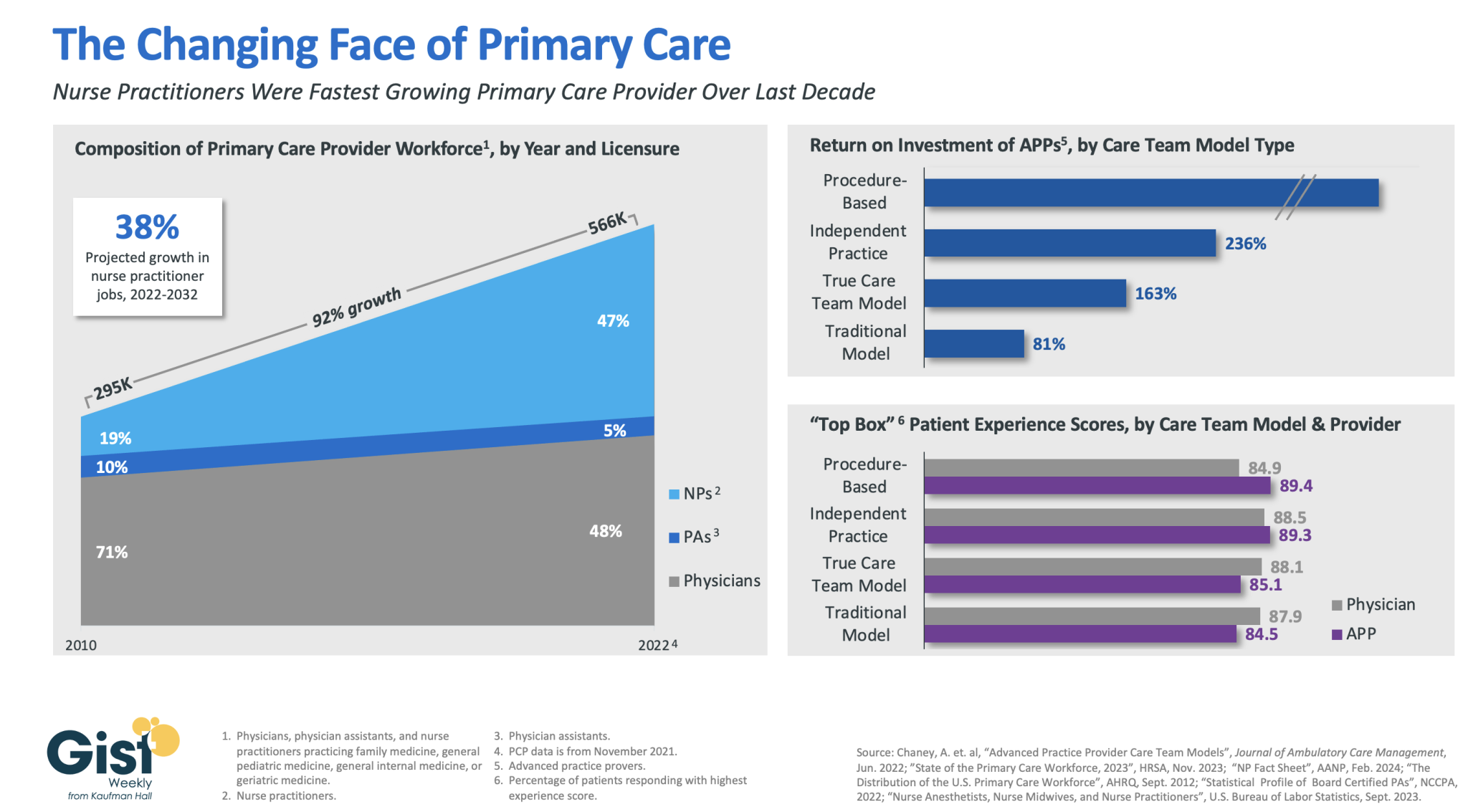
In this week’s graphic, we highlight how the primary care provider workforce has evolved over the past decade in both the pursuit of team-based care models and value-based care, as well as in response to rising labor costs and physician shortages.

In 2010, physicians made up more than 70 percent of the primary care workforce. But over the next 12 years, the number of primary care providers nearly doubled, largely driven by immense growth of nurse practitioners in the workforce. 

As of 2022, more than half of primary care providers were advanced practice providers (APPs), who continue to have a strong job outlook across the next decade (especially nurse practitioners).This shift has been beneficial to many provider organizations.

In a study from the Mayo Clinic, the return on investment was positive across a variety of APP practice models, especially in procedural-based specialties but across both independent practice models and full care team models as well. 

APPs also receive similar patient experience scores as their physician counterparts. 

Continued integration of APPs in team-based care models remains a key strategy for health systems seeking to improve access while lowering costs, especially in primary care.

Chasing downstream margin over downstream revenue

https://mailchi.mp/fc76f0b48924/gist-weekly-march-1-2024?e=d1e747d2d8

A recent engagement with a health system executive team to discuss an underperforming service line uncovered a serious issue that’s becoming more common across the industry. 

“Our providers are more productive than ever,” the CFO informed our team, “and yet we keep losing money on the service line.” 

After digging into their physician compensation model, we came upon one source of the system’s issue. Because it was incentivizing physician RVUs equally across all payers, its providers responded, quite rationally, by picking up market share where growth was easiest: Medicaid patients, who weren’t generating any margin. 

“We recognize that we’ve been employing these physicians as loss leaders in order to generate downstream revenue,” the CFO shared, “but what’s the point of that revenue if there’s no longer any downstream margin?”


The economics of physician employment becomes a tough conversation very quickly; it’s a sensitive topic to many, and one with myriad facets. 

But the loss leader physician employment model obviously only works when it produces positive downstream margins. 

We’re in a critical window of time, where hospital margins are just beginning to recover as volumes return—but those volumes are not necessarily in the same places as before. 

The opportunity is ripe for systems to work closely with their aligned physicians to reexamine the post-pandemic margin picture for individual service lines and ensure incentives are aligning all parties to hit operating margin goals. 

Are these kinds of conversations taking place at your health system?

Layoffs cool as hospital margins stabilize

Layoffs are slowing at hospitals and health systems as margins gradually improve, but CFOs continue to focus on controlling costs — particularly on the labor and supply fronts — to secure the long-term sustainability of their organizations.

Last year was characterized by hospital and health systems big and small trimming their workforces due to financial and operational challenges. 

From October 2022 through December 2023, Becker’s reported on more than 100 hospitals and health systems across the country that laid off workers, eliminated positions or reduced or closed certain facilities and services to help shore up finances. 

While layoffs have been reported at some hospitals this year, workforce cuts have been occuring at a slower rate compared to last year. 

Hospital revenues are up year over year as patient volumes continue to rebound. Operating margins have fluctuated in the last 12 months, from a -1.2% low in February 2023 to 5.5% highs in June and December, according to Kaufman Hall. In January, average operating and operating EBITDA margins dropped to 5.1%.

Kaufman analysts noted that too many hospitals are losing money and high-performing hospitals doing better and better, “effectively pulling away from the pack.” 

Fitch Ratings has described 2024 as another “make or break” year for a significant portion of the nonprofit hospital sector, which continues to battle an ongoing “labordemic.” However, the U.S. has also avoided a recession so far, partly due to a robust healthcare job market, according to The Wall Street Journal.

Where some COOs, CFOs are passing the baton

Nearly a quarter of health systems are appointing new executives to lead provider compensation — a function previously headed by COOs and CFOs, according to a recent report shared with Becker’s

That stat comes from the American Association of Provider Compensation Professionals, which recently surveyed 75 U.S. health systems and medical groups to learn more about their management methods. 

Health systems have been expanding their provider networks since the late 2000s and are continuing to work toward alignment, according to the report. Previously, COOs and CFOs might have led provider compensation strategy — but the arena has grown too complex and calls for an executive presence of its own. 

As such, a number of roles specific to provider compensation have emerged, from the executive director level up to the senior vice presidency. Nearly 25% of health systems surveyed have created a new executive position to develop and lead a provider compensation department; 93% of these departments have sole responsibility for their organization’s compensation design and 84% have full control of compensation strategy, from management of fair market value to contract management. 

“The core function of this new resource, department, and team was to build and manage compensation models developed for physicians. For many organizations, this expanded to include advanced practice providers,” the report says. “Over the years, organizations have understood the role to be much more strategic than initially proposed, which is why organizations across the country have developed roles [specific to provider compensation].”

Hospital expenses per inpatient day across 50 states

Below are the adjusted expenses for nonprofit, for-profit and government hospitals per inpatient day in 2022 in every U.S. state, according to the latest estimates provided by Kaiser State Health Facts. 

The figures are based on information from the 2022 American Hospital Association Annual Survey. They are an estimate of the expenses incurred in a day of inpatient care and have been adjusted higher to reflect an estimate of outpatient service volumes, according to the Kaiser Family Foundation. 

The foundation notes the figures are “only an estimate of expenses incurred by the hospital” for one day of inpatient care and do not substitute actual charges or reimbursement for care provided.

National average 
Nonprofit hospitals: $3,167
For-profit hospitals: $2,383 
State/local government hospitals: $2,857

Alabama
Nonprofit hospitals: $1,984
For-profit hospitals: $1,723
State/local government hospitals: $1,929

Alaska 
Nonprofit hospitals: $2,130
For-profit hospitals: $3,152
State/local government hospitals: $1,905

Arizona
Nonprofit hospitals: $3,430
For-profit hospitals: $2,746
State/local government hospitals: $2,833

Arkansas
Nonprofit hospitals: $2,082
For-profit hospitals: $1,942
State/local government hospitals: $4,263

California
Nonprofit hospitals: $4,719
For-profit hospitals: $2,655
State/local government hospitals: $4,338

Colorado 
Nonprofit hospitals: $3,862
For-profit hospitals: $3,408
State/local government hospitals: $2,528

Connecticut 
Nonprofit hospitals: $3,223
For-profit hospitals: $2,584
State/local government hospitals: $5,234

Delaware
Nonprofit hospitals: $3,399
For-profit hospitals: $1,429
State/local government hospitals: n/a

District of Columbia
Nonprofit hospitals: $4,272
For-profit hospitals: $3,081
State/local government hospitals: n/a

Florida 
Nonprofit hospitals: $3,063
For-profit hospitals: $2,301
State/local government hospitals: $2,884

Georgia 
Nonprofit hospitals: $2,556
For-profit hospitals: $2,312
State/local government hospitals: $814

Hawaii
Nonprofit hospitals: $3,551
For-profit hospitals: n/a
State/local government hospitals: $1,598

Idaho
Nonprofit hospitals: $4,570
For-profit hospitals: $2,944
State/local government hospitals: $2,406

Illinois 
Nonprofit hospitals: $3,168
For-profit hospitals: $2,403
State/local government hospitals: $3,862

Indiana
Nonprofit hospitals: $3,327
For-profit hospitals: $2,865
State/local government hospitals: $2,686

Iowa
Nonprofit hospitals: $1,847
For-profit hospitals: $1,596
State/local government hospitals: $1,942

Kansas
Nonprofit hospitals: $2,287
For-profit hospitals: $2,551
State/local government hospitals: $2,314

Kentucky
Nonprofit hospitals: $2,485
For-profit hospitals: $2,637
State/local government hospitals: $3,484

Louisiana
Nonprofit hospitals: $2,788
For-profit hospitals: $2,336
State/local government hospitals: $2,345

Maine
Nonprofit hospitals: $2,944
For-profit hospitals: $1,154
State/local government hospitals: $1,082

Maryland
Nonprofit hospitals: $3,617
For-profit hospitals: $1,734
State/local government hospitals: n/a

Massachusetts
Nonprofit hospitals: $3,670
For-profit hospitals: $2,559
State/local government hospitals: $2,545

Michigan
Nonprofit hospitals: $2,546
For-profit hospitals: $2,449
State/local government hospitals: $893

Minnesota 
Nonprofit hospitals: $2,813
For-profit hospitals: n/a
State/local government hospitals: $2,273

Mississippi
Nonprofit hospitals: $1,615
For-profit hospitals: $1,753
State/local government hospitals: $1,229

Missouri
Nonprofit hospitals: $2,864
For-profit hospitals: $2298
State/local government hospitals: $2,379

Montana
Nonprofit hospitals: $2,192
For-profit hospitals: $2,708
State/local government hospitals: $750

Nebraska 
Nonprofit hospitals: $2,832
For-profit hospitals: $4,769
State/local government hospitals: $1,765

Nevada 
Nonprofit hospitals: $2,771
For-profit hospitals: $2,127
State/local government hospitals: $2,972

New Hampshire
Nonprofit hospitals: $3,030
For-profit hospitals: $2,720
State/local government hospitals: n/a

New Jersey
Nonprofit hospitals: $3,415
For-profit hospitals: $2,361
State/local government hospitals: $2,451

New Mexico 
Nonprofit hospitals: $2,973
For-profit hospitals: $2,686
State/local government hospitals: $3,710

New York 
Nonprofit hospitals: $3,721
For-profit hospitals: n/a
State/local government hospitals: $3,675

North Carolina 
Nonprofit hospitals: $2,810
For-profit hospitals: $2,391
State/local government hospitals: $2,411

North Dakota
Nonprofit hospitals: $2,308
For-profit hospitals: $4,196
State/local government hospitals: n/a

Ohio
Nonprofit hospitals: $3,402
For-profit hospitals: $2,447
State/local government hospitals: $3,761

Oklahoma
Nonprofit hospitals: $2,450
For-profit hospitals: $2,580
State/local government hospitals: $1,964

Oregon
Nonprofit hospitals: $3,827
For-profit hospitals: $3,368
State/local government hospitals: $5,155

Pennsylvania 
Nonprofit hospitals: $3,045
For-profit hospitals: $2,251
State/local government hospitals: $1,609

Rhode Island 
Nonprofit hospitals: $3,102
For-profit hospitals: n/a
State/local government hospitals: n/a

South Carolina 
Nonprofit hospitals: $2,430
For-profit hospitals: $1,874
State/local government hospitals: $2,598

South Dakota 
Nonprofit hospitals: $1,673
For-profit hospitals: $4,275
State/local government hospitals: $780

Tennessee
Nonprofit hospitals: $2,960
For-profit hospitals: $2,133
State/local government hospitals: $2,019

Texas
Nonprofit hospitals: $3,291
For-profit hospitals: $2,325
State/local government hospitals: $3,768

Utah
Nonprofit hospitals: $3,550
For-profit hospitals: $3,232
State/local government hospitals: $3,542

Vermont
Nonprofit hospitals: $3,079
For-profit hospitals: n/a
State/local government hospitals: n/a

Virginia
Nonprofit hospitals: $2,813
For-profit hospitals: $2,194
State/local government hospitals: $4,208

Washington
Nonprofit hospitals: $3,753
For-profit hospitals: $3,696
State/local government hospitals: $4,079

West Virginia
Nonprofit hospitals: $2,447
For-profit hospitals: $1,206
State/local government hospitals: $1,500

Wisconsin 
Nonprofit hospitals: $2,796
For-profit hospitals: $3,055
State/local government hospitals: $3,641

Wyoming 
Nonprofit hospitals: $3,092
For-profit hospitals: $3,133
State/local government hospitals: $1,485

Sutter Health Oakland hospital could close by 2030

Oakland, Calif.-based Alta Bates Summit Medical Center, part of Sacramento, Calif.-based Sutter Health, could close by 2030.

“This closure would strain healthcare access in Berkely and send shockwaves across the region,” Jesse Arreguin, mayor of Berkeley, Calif., said in a Feb. 27 news release shared with Becker’s. “The impacts to EMS response times and service cuts for our most voluerable communities are simply unaccebtable.”

Amid the fear of closure, a spokesperson for Sutter Health told Becker’s in a statement that the health system is developing a comprehensive plan to meet the needs of the community.

This includes thoroughly evaluating how our patients use our services, including outpatient clinics, specialty care, hospital care, and emergency services, with a focus on identifying and addressing unmet community needs,” the spokesperson said. “It’s a major undertaking that has taken longer than anticipated; however, it’s important to emphasize that no final decisions have been made.”

The Berkeley City Council voted on Feb. 27 to allocate $300,000 from the Berkeley General Fund to help explore current or potential opportunities to secure future healthcare and hospital access for the community. 

“We cannot underestimate the repercussions of losing such a critical healthcare resource,” Sophie Hahn, a Berkeley City Council member, said in the release. “Beyond undermining our healthcare system, this closure would result in a profound loss of local jobs and impacts to our economy.”

The Numbers Behind the Numbers

https://www.kaufmanhall.com/insights/thoughts-ken-kaufman/numbers-behind-national-hospital-flash-report

U.S. Hospital YTD Operating Margin Index November 2021-December 2023

The observations and questions from this chart are both interesting and required reading for hospital executives:

  • Why were hospitals profitable at the 4% plus level through the worst of the 2021 Covid period?
  • What exactly happened between December of 2021 and January of 2022 that resulted in a profitability decrease from a positive 4.2% to a negative 3.4%?
  • Despite the best efforts of hospital executives, overall operating margins were negative throughout calendar year 2022 and did not return to positive territory until March of 2023.
  • Hospital margins remained positive throughout 2023 and into 2024. However, overall margins have remained below those experienced in both 2021 and in the pre-Covid year of 2019.

The above questions and observations have proven interesting, and the ongoing numbers have proven quite useful in many quarters of healthcare. But recently I was talking with Erik Swanson, who is the leader of the Kaufman Hall Flash Report and our executive behind the data, numbers, and statistics. Erik and I were speculating about all of the above observations, but our key speculation was whether the 2023 operating margin results actually reflected a hospital financial turnaround or, in fact, were there “numbers behind the numbers” that told a different and much more nuanced story. So Erik and I asked different questions and took a much deeper dive into the Flash Report numbers. The results of that dive were quite telling:

  1. Too many hospitals are still losing money. Despite the fact that the Operating Margin Index median for 2023 and into 2024 was over 2%, when you look harder at the Flash Report data, you find that 40% of American hospitals continue to lose money from operations into 2024.
  2. There is a group of hospitals that have substantially recovered financially. Interestingly, the data shows over time that the high-performing hospitals in the country are doing better and better. They are effectively pulling away from the pack.
  3. This leads to the key question: Why are high-performing hospitals doing better? It turns out that several key strategic and managerial moves are responsible for high-performing hospitals’ better and growing operating profitability:
    • Outpatient revenue. Hospitals with higher and accelerating outpatient revenue were, in general, more profitable.
    • Contract labor. Hospitals that have lowered their percentage of contract labor most quickly are now showing better operating profitability.
    • An important managerial fact. The Flash Report found that hospitals with aggressive reductions in contract labor were also correlated to rising wage rates for full-time employees. In other words, rising wage rates have appeared to attract and retain full-time staff which, in turn, has allowed those hospitals to reduce contract labor more quickly, all of which has led to higher profitability.
    • Average length of stay. No surprise here. A lower average length of stay is correlated to improved profitability. Those hospitals that have hyper-focused on patient throughput, which has led to appropriate and prompt patient discharge, have also proven this to be a positive financial strategy.
  4. Lower financial performers have financially stagnated throughout the pandemic. The data shows that throughout the pandemic, hospitals with good financial results improved those results, but of more consequence, hospitals with poor financial performance saw that performance worsen. The Flash Report documents that the poorest financially performing hospitals currently show negative operating margins ranging from negative 4% to negative 19%. Continuation of this level of financial performance is not only unstainable but also makes crucial re-investment in community healthcare impossible.
  5. The urban hospital/rural hospital myth. A popular and often quoted hospital comparison is that there is an observable financial divide between urban and rural hospitals. Erik Swanson and I found that recent data does not support this common perception. When you compare “all rurals” to “all urbans” on the basis of average operating margin, no statistically significant difference emerges. However, what does emerge—and is a very important statistical observation—is that the lowest performing 20% of rural hospitals are, in fact, generating much lower margins then their urban counterparts this year. It is at this lowest level of rural hospital performance where the real damage is being done. 
  6. Rural hospitals and obstetrics. The data does confirm one very important American healthcare issue: Obstetrics and delivery services are one of the leading money losers of all hospital service offerings. And the data further confirms that rural hospitals are closing obstetric departments with more frequency in order to protect the financial viability of the overall rural hospital enterprise. This is a health policy issue of major and growing consequence.

The point here is that data, numbers, and statistics matter both to setting long-term social health policy agendas and to the strategic management of complex provider organizations. But the other point is that the quality and depth of the analysis is an equally important part of the process. A first glance at the numbers may suggest one set of outcomes. However, a deeper, more careful and penetrating analysis may reveal critical quantitative conclusions that are much more telling and sophisticated and can accurately guide first-class organizational decision-making. Hopefully the analytics here are a good example of this very point.

Physician burnout persisting above pre-pandemic levels

https://mailchi.mp/f9bf1e547241/gist-weekly-february-23-2024?e=d1e747d2d8

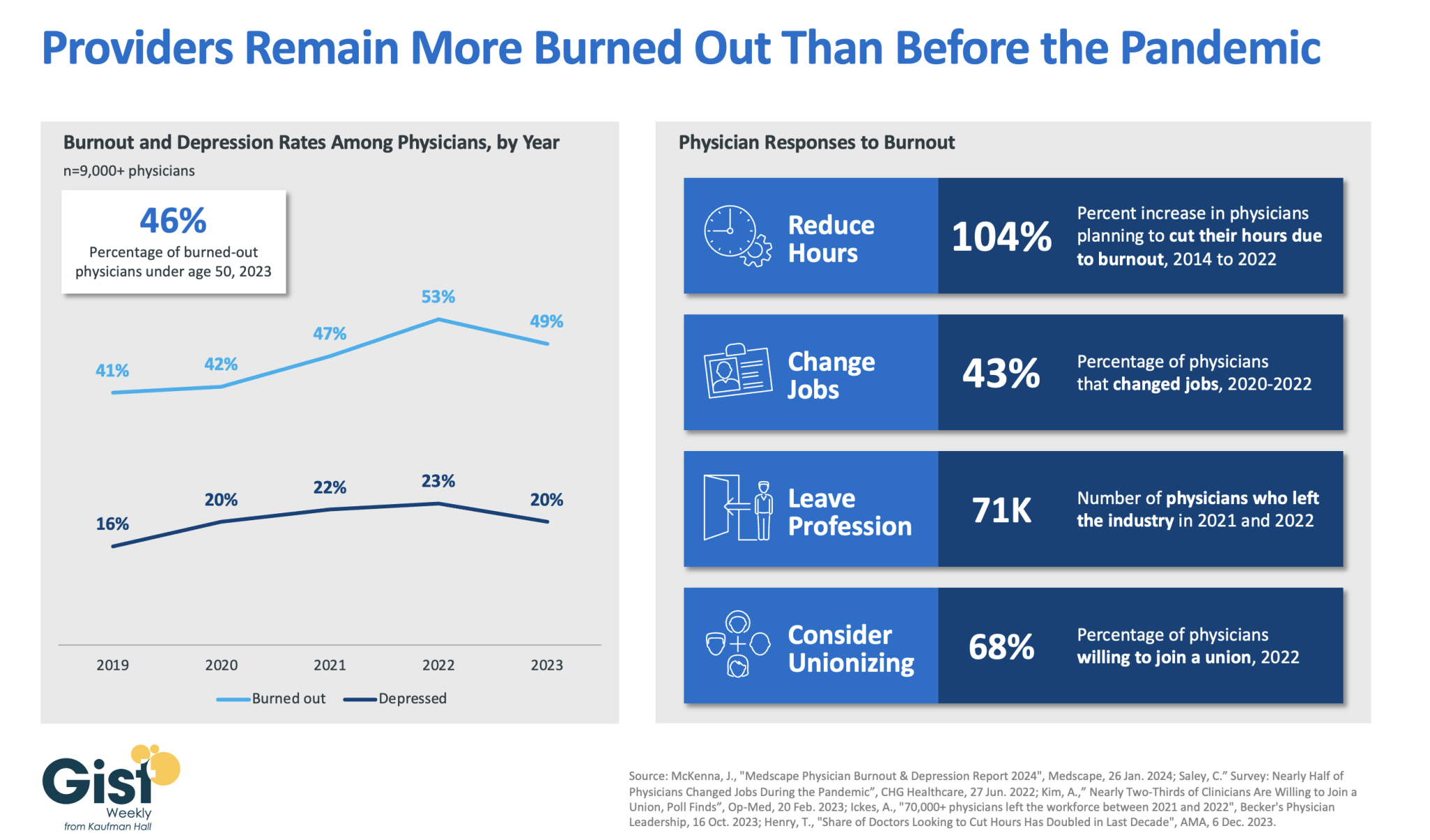
In this week’s graphic, we highlight new data from the 2024 Medscape Physician Burnout & Depression Report on the sustained high rates of physician burnout. 

In 2023, nearly half of physicians reported feeling burned out, and a fifth reported feeling depressed. Although this does represent a drop from 2022’s peak, physicians remain more distressed than they were before the pandemic. 

These numbers reveal some of the toll that the continued labor shortages, financial challenges, and payment changes of the past few years have taken on providers. In response to feeling burned out, an increased number of physicians say they are planning to cut their hours and over a third say they actually have changed jobs. Many have left the industry all together and the majority now say they are willing to join a union.

Health systems have long prioritized addressing provider burnout, but tighter operating margins have heightened both the challenge and the importance of helping to relieve it. 

Continuing to find solutions to reduce administrative tasks, enhance team-based care models, and empower providers in decision-making processes are as important as ever for provider organizations today. 

CMS finalizes DSH cuts for some hospitals

https://mailchi.mp/f9bf1e547241/gist-weekly-february-23-2024?e=d1e747d2d8

On Tuesday, the Centers for Medicare and Medicaid Services (CMS) published a final rule redefining how disproportionate share hospital (DSH) payments are determined.

Hospitals used to calculate their Medicaid shortfalls based on the costs and payments associated with all of their Medicaid-eligible patients, even if some of those patients used a different primary payer. Prompted by Congress to address this issue in 2021, CMS is now limiting the scope of Medicaid shortfall to only patients for whom Medicaid is their primary payer. The rule exempts safety-net hospitals providing care to the highest percentages of low-income patients, defined as those in the 97th percentile of inpatient days treating Medicare SSI (Social Security Income) recipients.

This change is expected to amount to an $8B annual reduction in DSH payments over the next four years. Congress has repeatedly delayed the implementation of these cuts, which are now set to go in effect on March 8, 2024.

The Gist: Though the formula for calculating appropriate DSH payments has always been complex, the point of the program is to provide additional support to hospitals caring for underserved, low-income populations.

This $8B cut may be targeted at hospitals with slightly better payer mixes, but it will be felt heavily by many safety-net providers reliant on the payments, especially in today’s challenging financial operating environment where over 40 percent of hospitals are still losing money on operations.