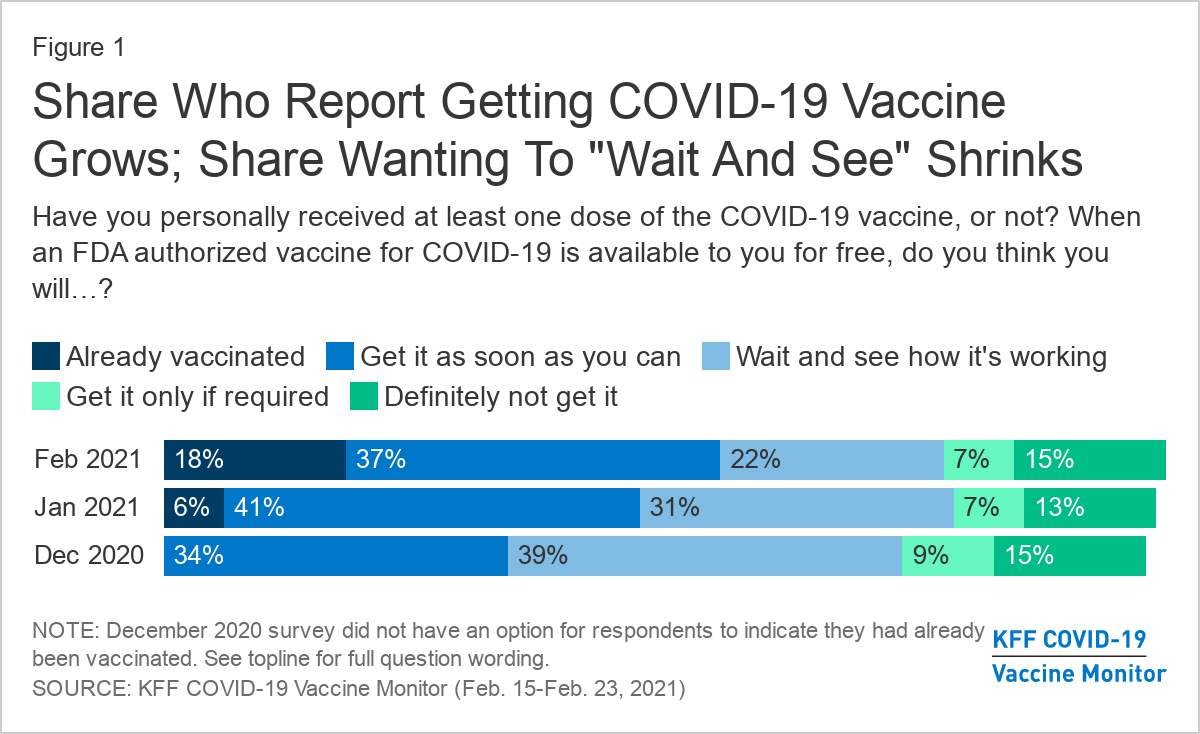
More than half of adults in the U.S. (55%) say they’ve already gotten one dose of Covid-19 vaccine or they’re eager to get one as soon as they can, an increase in acceptance from January (47%), a new poll reports. About 1 in 5 people are waiting to see how the vaccine rollout goes, but don’t rule out vaccination. Another 1 in 5 people are more reluctant: 7% would get vaccinated only if required by work, school, or some other activity, and 15% say no to vaccine under any circumstance. The increase in eagerness spans all demographic groups, but Black adults and young adults under age 30 were most likely to say they want to wait and see.
In the seven states hit hardestby the pandemic, more than 1 in every 500 residents have died from the coronavirus.
Why it matters:The staggering death toll speaks to America’s failure to control the virus.
Details:In New Jersey, which has the highest death rate in the nation, 1 out of every 406 residents has died from the virus. In neighboring New York, 1 out of every 437 people has died.
In Mississippi, 1 out of every 477 people has died. And in South Dakota, which was slammed in the fall, 1 of every 489 people has died.
States in the middle of the pack have seen a death rate of around 1 in 800 dead.
California, which has generally suffered severe regional outbreaks that don’t span the entire state, has a death rate of 1 in 899.
Vermont had the lowest death rate, at 1 of every 3,436 residents.
The bottom line:Americans will keep dying as vaccinations ramp up, and more transmissible variants of the coronavirus could cause the outbreak to get worse before it gets better.
Experts also say it’s time to start preparing for the next pandemic — which could be deadlier.
Doctors and scientists have been relieved that the dreaded “twindemic”—the usual winter spike of seasonal influenza superimposed on the COVID pandemic—did not materialize.
In fact, flu cases are at one of the lowest levels ever recorded, with just 155 flu-related hospitalizations this season (compared to over 490K in 2019). A new piece in the Atlantic looks at the long-term ramifications of a year without the flu.
Public health measures like masking and handwashing have surely lowered flu transmission, but scientists remain uncertain why flu cases have flatlined as COVID-19, which spreads via the same mechanisms, surged.
Children are a much greater vector for influenza, and reduced mingling in schools and childcare likely slowed spread. Perhaps the shutdown in travel slowed the viruses’ ability to hop a ride from continent to continent, and the cancellation of gatherings further dampened transmission.
Nor are scientists sure what to expect next year. Optimists hope that record-low levels of flu could take a strain out of circulation. But others warn that flu could return with a vengeance, as the virus continues to mutate while population immunity declines.
Researchers developing next year’s vaccines, meanwhile, face a lack of data on what strains and mutations to target—although many hope the mRNA technologies that proved effective for COVID will enable more agile flu vaccine development in the future.
Regardless, renewed vigilance in flu prevention and vaccination next fall will be essential, as a COVID-fatigued population will be inclined to breathe a sigh of relief as the current pandemic comes under control.
A family member in her 70s called with the great news that she received her first dose of the COVID vaccine this week. She mentioned that she was hoping to plan a vacation in the spring with a friend who had also been vaccinated, but her doctor told her it would still be safest to hold off booking travel for now: “I was surprised she wasn’t more positive about it. It’s the one thing I’ve been looking forward to for months, if I was lucky enough to get the shot.”
It’s not easy to find concrete expert guidance for what it is safe (or safer?) to do after receiving the COVID vaccine. Of course, patients need to wait a minimum of two weeks after receiving their second shot of the Pfizer or Moderna vaccines to develop full immunity.
But then what? Yes, we all need to continue to wear masks in public, since vaccines haven’t been proven to reduce or eliminate COVID transmission—and new viral variants up the risk of transmission. But should vaccinated individuals feel comfortable flying on a plane? Visiting family? Dining indoors? Finally going to the dentist?
It struck us that the tone of much of the available guidance speaks to public health implications, rather than individual decision-making. Take this tweet from CDC director Dr. Rochelle Walensky. A person over 65 asked her if she could drive to visit her grandchildren, whom she hasn’t seen for a year, two months after receiving her second shot. Walensky replied, “Even if you’ve been vaccinated, we still recommend against traveling until we have more data to suggest vaccination limits the spread of COVID-19.”
From a public health perspective, this may be correct, but for an individual, it falls flat. This senior has followed all the rules—if the vaccine doesn’t enable her to safely see her grandchild, what will? It’s easy to see how the expert guidance could be interpreted as “nothing will change, even after you’ve been vaccinated.”
Debates about masking showed us that in our individualistic society,public health messaging about slowing transmission and protecting others sadly failed to make many mask up.
The same goes for vaccines:mostAmericans are motivated to get their vaccine so that they personally don’t die, and so they can resume a more normal life, not by the altruistic desire to slow the spread of COVID in the community and achieve “herd immunity”.
In addition to focusing on continued risk,educating Americans on how the vaccinated can make smart decisions will motivate as many people as possible to get their shots.
The national COVID indicators all continued to move in the right direction this week, with new cases down 16 percent, hospitalizations down 26 percent, and deaths (while still alarmingly high at more than 3,000 per day) down 6 percent from the week prior.
More good news: both nationally and globally, the number of people vaccinated against COVID now exceeds the total number of people infected with the virus, at least according to official statistics—the actual number of coronavirus infections is likely several times higher.
On the vaccine front, Johnson & Johnson filed with the Food and Drug Administration (FDA) for an Emergency Use Authorization for its single-dose COVID vaccine, which could become the third vaccine approved for use in the US following government review later this month. The J&J vaccine is reportedly 85 percent effective at preventing severe COVID disease, although it is less effective at preventing infection than the Pfizer and Moderna shots.
Elsewhere, TheLancet reported interim Phase III results for Russia’s Sputnik V vaccine trials, showing it to be 91 percent effective at preventing infection, and a new study found the Oxford-AstraZeneca vaccine to be 75 percent effective against the more-contagious UK virus variant.
Amid the positive vaccine news, the Biden administration moved to accelerate the vaccination campaign, invoking the Defense Production Act to boost production and initiating shipments directly to retail pharmacies. With the House and Senate starting the budget reconciliation process that could eventually lead to as much as $1.9T in stimulus funding, including billions more for vaccines and testing, it feels as though the tide may be finally turning in the battle against coronavirus.
While the key indicators are still worrisome—we’re only back to Thanksgiving-week levels of new cases—and emerging variants are cause for concern, it’s worth celebrating a week that brought more good news than bad.
Best to follow Dr. Fauci’s advice for this Super Bowl weekend, however: “Just lay low and cool it.”
Remember 2019, when the scariest “new” pathogen was Candida auris, a drug-resistant fungus that was creeping into hospitals and nursing homes, often proving fatal to elderly and immune-compromised patients who came in contact with it? C. auris proved difficult to eliminate from infected facilities, sometimes requiring drywall to be ripped out of patient rooms in order to fully decontaminate.
With all of our attention focused on COVID-19, C. auris and other drug resistant bacteria and fungi have been making a resurgence, according to a recent New York Times report. In Los Angeles County alone, 250 facilities now report C. auris infection, up from just a handful before the pandemic.
Unlike COVID-19, these pathogens cling relentlessly to surfaces, so protocols allowing the reuse of protective equipment in order to conserve resources inadvertently provided a mechanism for these bugs to spread.
Steroids used to treat COVID-19 patients suppress the immune system, making patients more vulnerable. According to one expert, the spread of these drug-resistant infections shows the danger of “seeing the world as a one-pathogen world”.
Providers have had a laser focus on preventing the aerosol spread of COVID—now is the time to double down on surface decontamination and infection mitigation procedures to make sure we don’t meet the end of the pandemic with the rise of other classes of “superbugs”.
A view of the JHMR slopes and the village at the base of the mountain in Jackson, Wyoming.
Tucked in the shadow of the Tetons, the town of Jackson, Wy., and surrounding Teton County is home to less than 25,000 fulltime residents, but annually hosts over 2.5 million visitors. The valley’s natural beauty attracts an influx of tourists, who in turn are responsible for roughly 30% of the region’s jobs and over $1 billion in annual revenue, but this year, visitors came with an unwelcome price tag for locals: “Every time in this pandemic that we’ve had an influx of visitation, whether that’s second homeowners, or people just coming for a weekend, it follows with an uptick in cases and hospitalizations” says Dr. Jeff Greenbaum, medical director at the Emergency Department for St. John’s hospital and the Jackson Hole Mountain Ski Resort (JHMR) ski patrol.
With just one major hospital and eight emergency room physicians serving Teton County, any increase in COVID-19 cases is cause for concern. And in January, following the Christmas and New Year’s tourism rush, COVID-19 cases in Teton County skyrocketed to some of their highest levels since the pandemic began. Despite these developments, the ski resort, hotels, bars and restaurants remain open in the town. And Greenbaum remains optimistic that with the right strategies and precautions, the small hospital will not be overwhelmed by cases and skiing can stay open during the season for both visitors and locals. “The nightmare scenario is if the patients are stacking up in the emergency room and we don’t have enough personnel to treat them,” says Greenbaum. “But we’ll see that coming in advance, and we are not there yet.” The local hospital still has over 50% of its ICU beds unoccupied and has no COVID-19 patient on a ventilator. JHMR is similarly optimistic that it can stay open the entire season, trusting in the protocols it has put in place to protect both guests and staff.
Teton is the wealthiest county in the U.S., with a per capita income of over $250,000. At the start of the pandemic, a flurry of private jets landed at the Jackson Hole Airport, sometimes with a private ventilator in tow, as second homeowners and new buyers escaped to this rural paradise. Greenbaum posits that part of the reason why St. John’s hasn’t been overrun by cases is that many of the tourists that get COVID-19 in Teton County might not stay to get treatment in Teton County. At a time when millions of Americans are out of work, when daily infection rates are at an all-time high, and when thousands across the country are dying daily from the virus, should the wealthy indulge in an après ski, looking out onto the beautiful Teton mountains, all while potentially shuttling COVID-19 into and out of Jackson?
“This place is pretty much a gigantic country club, relying on second homeowners and tourism for its revenue,” says Jesse Bryant, a doctoral candidate in American Sociology at Yale University and creator of Yonder Lies, a podcast exploring the history of Jackson Hole. “But Jackson has to balance the ultra-wealthy with the real reality of people eking out a living here.” Teton County has the largest income gap of any county in the U.S., with the top 1% making almost 150 times more than the other 99%. From mountain guides to house cleaners to bartenders, much of the employment in Jackson cannot easily be transitioned to remote work, meaning that Jackson’s working class are among the most susceptible to unemployment from the pandemic. All across America the costs of the pandemic are being born by the poorest members of society; a Pew Research Center survey from September found that about 50% of low-income Americans say they or someone in their household has lost employment or had take a pay cut due to the pandemic, and similarly about 50% of low-income Americans reported having trouble paying their bills since the pandemic started.
During the spring and summer, the Coronavirus Aid, Relief, and Economic Security Act passed by the federal government at the start of the pandemic had provided $600 in additional unemployment payment per week, assuring many local and seasonal workers that their livelihoods were safe even if their jobs weren’t. But almost a year into the pandemic, Jackson’s working class are left with far fewer options: federal unemployment relief dropped to $300 and state unemployment benefits in Wyoming, although extended by 13 weeks, dry up after 39 weeks. “Many of the workers here don’t have a six-month buffer saved up,” said one restaurant worker who wished to remain anonymous for risk of losing their job, “so, while tourism presents a risk, we’re willing to take it to keep our paychecks coming in.”
This is the predicament that America has put herself in: a country with a limited safety net during the pandemic forces her workers to choose between the risk of getting sick, or losing their livelihoods. The mountain and the town are left trying to find a balance between keeping the economy open for tourists, and keeping COVID-19 out. As the second largest employer in Teton County, JHMR takes center stage in this unfolding drama. The resort is responsible for the livelihood of around 2,000 seasonal and local workers, and if the mountain were to shut down, many of the ancillary services in the town, like hotels, restaurants, rental shops, clothing stores and other retailers, would likely shutter their doors as well. In 2017, when the resort had to close for five days because of a power outage, the net economic impact to the local economy topped $5.5 million. “What’s happening in Jackson isn’t just a story of wealthy people coming into the rural west and getting the locals sick,” says Bryant. “This place has become more like a symbiotic relationship.”
One particularly vulnerable population is the Latino community, a significant number of which is undocumented, that lives in Jackson, and in the neighboring towns of Victor and Driggs. While it’s difficult to get exact numbers of their contribution to the economy, these workers keep Jackson running by filling jobs in all sectors, from house cleaners and construction workers to cooks and waiters.
“I’ve lived in Jackson for 25 years and used to go back to Mexico every winter because it was just too cold,” says Jorge, an undocumented construction worker in the town. “But then I got used to the cold and began skiing every single day.” Asked whether opening up the resort is worth the risk of bringing more COVID-19 into Jackson, Jorge says that by and large the Latino community welcomes the tourism with open arms, because it means job security. This lines up with findings from a survey undertaken by the Yale School of Environment this past summer, showing that Latino residents in the rural West had some of the highest rates of COVID-related unemployment in the country. “My wife and I work hard, her as a house cleaner, me in construction,” said Jorge. “The resort opening up and tourists coming to town is how many of us make our living.”
For its part, JHMR has been doing nearly everything within its power to keep COVID-19 from spreading on its slopes, iterating as the situation evolves to try to keep the 2021 season operating. In March of 2020, as the first wave of the pandemic was sweeping across the globe, the Wyoming State Health Officer shut down JHMR for the remainder of the season. The resort reopened in May, first for hikers and then mountain bikers—the summer tourists that in total are only about 10% the size of the winter tourist population. Before reopening for the summer crowd, it tested every single one of its staff members for COVID-19, and the resort’s human resources department transitioned into a contact-tracing team, coordinating with town officials whenever a case arose. While Wyoming didn’t issue a statewide mask mandate until Dec. 7, the resort instituted a mandatory mask policy during the summer. JHMR also learned to be more flexible in its operations: staff are now trained to perform a number of different functions, so they can sub in if there’s a shortage in a department, and shifts function as separate pods, meaning that if a person in one group has been exposed to COVID-19, another totally isolated pod can come in to take its place.
Over the summer and fall, tourists came in droves to Jackson, with as many as 40,000 total visitors in a day. According to the Jackson Hole Chamber of Commerce, both Yellowstone and Grand Teton National Parks—both within a quick drive from of Jackson—had about 50% more visitors in October of 2020 than they did for the same month in 2019. While many of the outdoor activities that bring people to Teton County during the summer—hiking, biking, climbing—have been deemed relatively safe during the pandemic, tourists also flocked indoors to the bars, restaurants and stores that remained open throughout most of the summer and fall. As a result, Teton County experienced large COVID-19 spikes in July and again at the end of October and into November.
Unsurprisingly, workers got sick. In response, Teton County’s Health Officer, Travis Riddell, sent out a series of recommendations pressing citizens to not gather with groups outside of their immediate family, avoid crowded indoor spaces and not congregate at trail heads, parks or other outside spaces. Still, most businesses stayed open as patrons kept coming. Riddell noted that the town had little choice: “Economic disasters are public health disasters,” Riddell said in an interview in July 2020 to National Geographic. “We know that when there are economic downturns, where there is an increase in poverty, an increase in uninsured numbers—that has direct health effects.”
Once JHMR opened for skiing the weekend after Thanksgiving, it was clear that demand for outdoor recreation would carry into winter; even with almost no international travel, JHMR expects demand during the 2021 winter months to be comparable to past years, at least. “If we just opened up [completely], the mountain would be packed, because demand itself is through the roof,” says LaMotte, “but we’ve imposed a maximum daily capacity for the mountain, to keep guests and staff safe.”
On a bluebird day near Christmas, the resort was sold out. It had snowed almost 15 inches the day before, and cars inched into the packed parking lot. Skiers and snowboarders waited in line for the lot shuttle bus, which, despite operating at 25% capacity, still felt uncomfortably full. The restaurants and bars looking out onto the sunny mountain were similarly capped at 25% capacity, and while masks and social distancing were required, patrons waiting for tables escaped the cold by standing shoulder to shoulder in the foyer.
At the resort, the socially distanced lines for the gondola were dangerously compressing. A resort worker cheerfully reminded guests from every corner of the U.S. to keep their distance and their masks above their noses. “We’re going to make it all the way through the season, without closing” yelled the worker, to cheers from the crowds. The lines moved slow—normally eight people fit onto the gondola, but under the new policies there was no mixing between groups, so often times the gondola ascends with just one or two passengers. At the top of the mountain, with views of the valley floor against the backdrop of the jagged Tetons, everyone breathed a bit easier.
Rob Kingwill and Emilé Zynobia, professional snowboarders based out of Jackson, stepped off the gondola into the cold Wyoming air, about 4,000 feet above the valley floor. Both sported COVID-19 masks made by Kingwill’s apparel company, Avalon 7. “I feel like this is almost an essential service, to give people the opportunity to be outside, said Kingwill. “We need this for our mental health.” When JHMR shut down in March of 2020, Kingwill strapped his snowboard to his backpack and hiked up Teton Pass’s infamous 1,300-foot Glory Boot Pack—every day for 77 days until all the snow had melted. But, he points out, most recreational skiers don’t have the knowledge and skills to navigate such technical terrain—and without the money those tourists bring in, Jackson’s working class would suffer. “It seems like the benefits outweigh the costs of keeping the resort open,” agreed Zynobia, as she and Kingwill strapped onto their boards. “Even though this is an activity skewed towards to wealthier people, it is helping a remote economy, and it is getting people outside at a time when we feel caged in.”
By the middle of January, Teton County’s COVID-19 cases were skyrocketing.Teton County currently has the highest caseload per capita of any county in the state of Wyoming and the highly contagious U.K. variant of COVID-19 was found to be circulating in the area. While the state of Wyoming had loosened COVID-19 gathering restrictions, the county reissued a series of guidelines on Jan. 25 that kept indoor gatherings capped at 25% and limited outdoor gatherings to 250 guests. At the resort, group ski lessons have been replaced by private lessons (at no extra cost), and the gondolas and lifts are ascending the mountain with minimal group mixing. Still JHMR can only control what happens on the mountain; “My main concern is not skiing itself,” says Greenbaum. “But rather I’m concerned about peripheral activity to skiing that lead people indoors, whether it’s a bar, a restaurant, a hotel lobby, a rental shop, a bus.”
Across the nation cases are surging, and other Colorado mountain towns like Telluride and Crested Butte have had similar spikes, likely due to an influx of winter tourism. The infection ratein Pitkin County, Colo., home to the Aspen and Snowmass ski resorts, was skyrocketing in the middle of January, with an incidence rate of about 3,500 per 100,000 people. In response, the county’s health department shut down all indoor dinning operations, but left the ski resorts open. The results were promising: in the past two weeks the COVID-19 rates for Pitkin County dropped by over 50%. “We’re on pace to be below 700 [cases per 100,000 people] in early February and I don’t think any of us thought that would happen so quickly,” said Josh Vance, the county’s epidemiologist, in an interview with the Aspen Times. “I’ll be honest—I think not having indoor dining plays a role.”
In Teton County, restaurants and bars remain open for indoor operations long as they follow social distancing guidelines. The reliance on the ultra-rich creates an undeniable risk to the livelihood of Jackson residents and workers. In the early days of the pandemic, ski resorts across Europe became super spreaders, with visitors transporting the virus like carry-on luggage, threatening other tourists and locals alike. As a result, resorts have been closed this winter across much of Europe, including in France, Germany and Italy. These precautions protect remote mountain towns from an influx of the virus, but there are other, massive costs associated with closing down. Without government support, there is little option for communities like Jackson but to stay open, follow existing public health guidelines and hope for the best. “When the pandemic first started coming to work felt like entering the lion’s den,” said the restaurant worker from Jackson who wished to remain anonymous. “But by now we’re all used to the risk, and really what choice do we have?”
Anthony Fauci on Friday said that a lack of facts “likely did” cost lives over the last year in the nation’s efforts to fight the coronavirus pandemic.
In an appearance on CNN, the nation’s leading infectious diseases expert was directly asked whether a “lack of candor or facts” contributed to the number of lives lost during the coronavirus pandemic over the past year.
“You know it very likely did,” Fauci said. “You know I don’t want that … to be a sound bite, but I think if you just look at that,you can see that when you’re starting to go down paths that are not based on any science at all, that is not helpful at all, and particularly when you’re in a situation of almost being in a crisis with the number of cases and hospitalizations and deaths that we have.”
“When you start talking about things that make no sense medically and no sense scientifically, that clearly is not helpful,” he continued.
President Biden on Thursday unveiled a new national coronavirus strategy that is, in part, aimed at “restoring trust in the American people.”
When asked why that was important, Fauci recognized that the past year of dealing with the pandemic had been filled with divisiveness.
“There’s no secret. We’ve had a lot of divisiveness, we’ve had facts that were very, very clear that were questioned. People were not trusting what health officials were saying, there was great divisiveness, masks became a political issue,” Fauci said.
“So what the president was saying right from the get-go was, ‘Let’s reset this. Let everybody get on the same page, trust each other, let the science speak.’”
Fauci, who was thrust into the national spotlight last year as part of former President Trump‘s coronavirus task force, often found himself at odds with the former president. Trump frequently downplayed the severity of the virus and clashed publicly with Fauci.
Speaking during a White House press briefing on Thursday, Fauci said it was “liberating” to be working in the Biden administration.
There have been more than 24,600,000 coronavirus infections in the U.S. since the pandemic began, according to a count from Johns Hopkins University. More than 410,000 people have died.






 HENRY KOTULA