Getting a flu shot this year is more important than ever because of COVID-19

https://theconversation.com/getting-a-flu-shot-this-year-is-more-important-than-ever-because-of-covid-19-144034?utm_medium=email&utm_campaign=Latest%20from%20The%20Conversation%20for%20August%2019%202020%20-%201707616486&utm_content=Latest%20from%20The%20Conversation%20for%20August%2019%202020%20-%201707616486+Version+A+CID_ee5f6e1a20d69ba14ac919d3b2025202&utm_source=campaign_monitor_us&utm_term=Getting%20a%20flu%20shot%20this%20year%20is%20more%20important%20than%20ever%20because%20of%20COVID-19

Flu shot more important than ever during COVID-19 pandemic, expert ...

With the coronavirus still spreading widely, it’s time to start thinking seriously about influenza, which typically spreads in fall and winter. A major flu outbreak would not only overwhelm hospitals this fall and winter, but also likely overwhelm a person who might contract both at once.

Doctors have no way of knowing yet what the effect of a dual diagnosis might be on a person’s body, but they do know the havoc that the flu alone can do to a person’s body. And, we know the U.S. death toll of COVID-19 as of Aug. 17, 2020 was 170,000, and doctors are learning more each day about the effects of the disease on the body. Public health officials in the U.S. are therefore urging people to get the flu vaccine, which is already being shipped in many areas to be ready for September vaccinations.

Flu cases are expected to start increasing early in October and could last late into May. This makes September and early October the ideal time to get your flu shot.

But there’s reason to be concerned that flu vaccination rates could be lower this year than in past years, even though the risk of getting seriously ill may be higher because of widespread circulation of the coronavirus.

In an effort to avoid getting sick, millions of Americans avoided seeing their health care provider the past few months. Social distancing and stay-at-home orders have resulted in a decreased use of routine medical preventive services such as vaccinations. Many employers that often provide the flu shot at no cost to employees are allowing employees to work from home, potentially limiting the number of people who will get the flu shot at their jobs.

As a health care professional, I urge everyone to get the flu vaccine in September. Please do not wait for flu cases to start to peak. The flu vaccine takes up to two weeks to reach peak effectiveness, so getting the vaccine in September will help provide the best protection as the flu increases in October and later in the season.

A lifesaver in previous years, but more so now

Both COVID-19 and the flu are contagious respiratory illness that present with similar symptoms. Both viruses can impact the elderly and those with certain chronic conditions, such as heart and lung disease, the hardest.

Data on flu vaccination rates from 2018-2019 show that only 49% of Americans six months of age and older received the flu vaccine. The vaccine’s effectiveness varies each season, with early data from the 2019-2020 flu season indicating a vaccine effectiveness rate of 50% overall, and 55% in youth.

While some may think this effectiveness rate is low, the flu vaccine remains the single best way to prevent the flu and related complications. For example, during the 2018-2019 flu season, flu vaccination was estimated to prevent 4.4 million flu illnesses, 58,000 flu hospitalizations and 3,500 deaths. Early data from the 2019-2020 flu season estimates there were 39-56 million flu illnesses, 18-26 million flu-related medical visits, 410-740,000 hospitalizations and up to 62,000 deaths. Much of this disease burden is preventable from higher flu vaccination rates.

It is now quite apparent that COVID-19 will still be circulating during flu season, which makes getting a flu vaccine more important than ever. As schools, our communities and our economy continue to reopen, it is vital to get the flu vaccine for personal, family and community protection.
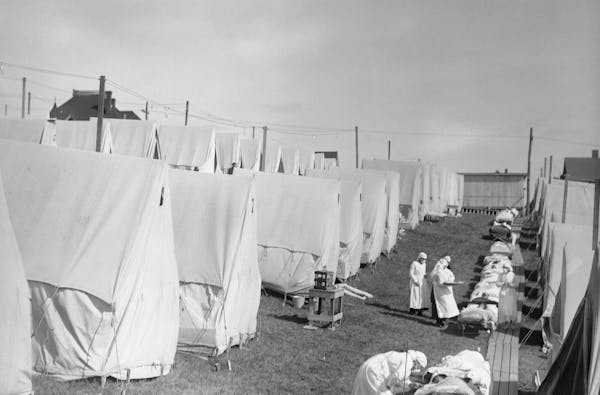
A flu camp in Lawrence, Maine during the 1918 influenza pandemic. Nurses and doctors tried desperate measures to stop the spread of the disease, which ultimately killed more than 675,000 people in the U.S. alone. Bettmann/Getty Images

Severe cases of both COVID-19 and the flu require the same lifesaving medical equipment. This highlights the importance of getting the flu vaccine for not only your own personal health but also the health of your community. Receiving the flu vaccine will help reduce the burden of respiratory illness on our already very overstretched health care system. By increasing flu vaccination rates, we can reduce the overall impact of respiratory illnesses on the population and hence lower the resulting burden on the health care system during the COVID-19 pandemic.

Because flu vaccination protects against one of these respiratory illnesses, the CDC recommends everyone (with few exceptions) six months of age and older get an annual flu vaccine. While the flu vaccine will not protect you against COVID-19, the flu vaccine will reduce your risk of developing the flu as well as reduce your risks of flu-related complications including hospitalization and even death.

While it may seem like there is so much out of our control during this pandemic, getting the flu vaccine, practicing proper hand washing, social distancing and wearing face coverings are within our control and will protect not only you but also your family and community.

If you are not getting the flu vaccine from your employer, think about alternative sources now. Vaccines should be available in most areas by Sept. 1.

  • Call you doctor’s office to ask how you can get a flu shot.
  • Call your local public health department.
  • Consider getting a vaccine while you are grocery shopping or picking up prescriptions.

Mainly, make sure you take advantage of this potentially lifesaving vaccine. Get it on your calendar for early September now. And remember, the flu shot cannot give you the flu.


Notre Dame cancels in-person classes after surge of COVID-19 cases

https://www.axios.com/notre-dame-cancels-classes-coronavirus-a7bd3249-f757-44a9-baf8-fb4de0bbefa3.html?stream=health-care&utm_source=alert&utm_medium=email&utm_campaign=alerts_healthcare

The University of Notre Dame announced Tuesday that it is canceling in-person classes for at least two weeks following a spike in coronavirus cases.

Why it matters: Notre Dame is the second prominent university to announce this week that it would revert back to remote learning, following the the University of North Carolina at Chapel Hill on Tuesday. The reversals underscore the challenges facing colleges and universities as more students are set return to campus.

Between the lines: As was the case with UNC, most of the COVID-19 infections at Notre Dame have been linked to off-campus parties.

  • The nearly 12,000 students that returned to Notre Dame were all tested before arriving on campus on Aug. 10, and just 33 tested positive, according to the Journal.
  • Through Monday, 147 of the 927 students who had shown symptoms tested positive for the virus — a sharp uptick in the positivity rate.

What they’re saying: Our contact-tracing analysis indicates that most infections are coming from off-campus gatherings,” said University of Notre Dame President Rev. John Jenkins. “Students infected at those gathering passed it on to others, who in turn have passed the virus on to others, resulting in the positive cases we have seen.”

  • “For your sake and the sake of our community and for continuing our semester on campus, please observe health protocols and avoid behavior that puts yourself or others at risk,” Jenkins added.


Fearing a ‘Twindemic,’ Health Experts Push Urgently for Flu Shots

Fearing a 'Twindemic,' Health Experts Push Urgently for Flu Shots ...

There’s no vaccine for Covid-19, but there’s one for influenza. With the season’s first doses now shipping, officials are struggling over how to get people to take it.

As public health officials look to fall and winter, the specter of a new surge of Covid-19 gives them chills. But there is a scenario they dread even more: a severe flu season, resulting in a “twindemic.”

Even a mild flu season could stagger hospitals already coping with Covid-19 cases. And though officials don’t know yet what degree of severity to anticipate this year, they are worried large numbers of people could forgo flu shots, increasing the risk of widespread outbreaks.

The concern about a twindemic is so great that officials around the world are pushing the flu shot even before it becomes available in clinics and doctors’ offices. Dr. Robert Redfield, director of the U.S. Centers for Disease Control and Prevention has been talking it up, urging corporate leaders to figure out ways to inoculate employees. The C.D.C. usually purchases 500,000 doses for uninsured adults but this year ordered an additional 9.3 million doses.

Dr. Anthony Fauci, director of the National Institute of Allergy and Infectious Diseases, has been imploring people to get the flu shot, “so that you could at least blunt the effect of one of those two potential respiratory infections.”

In Britain, Prime Minister Boris Johnson has been waging his own pro flu-shot campaign. Last month, he labeled people who oppose flu vaccines “nuts” and announced the country’s largest ever rollout of the shots. In April, one of the few reasons Australia allowed citizens to break the country’s strict lockdown was to venture out for their flu shots.

The flu vaccine is rarely mandated in the U.S. except by some health care facilities and nursery schools, but this month the statewide University of California system announced that because of the pandemic, it is requiring all 230,000 employees and 280,000 students to get the flu vaccine by November 1.

A life-threatening respiratory illness that crowds emergency rooms and intensive care units, flu shares symptoms with Covid-19: fever, headache, cough, sore throat, muscle aches and fatigue. Flu can leave patients vulnerable to a harsher attack of Covid-19, doctors believe, and that coming down with both viruses at once could be disastrous.

The 2019-20 flu season in the United States was mild, according to the C.D.C. But a mild flu season still takes a toll. In preliminary estimates, the C.D.C. says that cases ranged from 39 million to 56 million, resulting in up to 740,000 hospitalizations and from 24,000 to 62,000 flu-related deaths.

According to the C.D.C., flu season occurs in the fall and winter, peaking from December to February, and so was nearing its end as the pandemic began to flare in the United States in March.

But now, fighting flu proactively during the continuing pandemic presents significant challenges: not only how to administer the shot safely and readily, but also how to prompt people to get a shot that a majority of Americans have typically distrusted, dismissed and skipped.

With many places where the flu shot is administered en masse now inaccessible — including offices and plants that offered it free to employees on site and school health clinics — officials have been reaching out to local health departments, health care providers and corporations to arrange distribution. From now through Oct. 31, publicity campaigns will blast through social media, billboards, television and radio. Because the shot will be more difficult to access this year, people are being told to get it as soon as possible, although immunity does wane. There will be flu shot tents with heaters in parking lots and pop-up clinics in empty school buildings.

Because of the efforts, vaccine makers are projecting that a record 98 million flu shots will be given this year in the United States, about 15 percent more than doses ordered last year. The Kaiser Permanente health care system will be flooding more than 12 million of its members with flu shot reminders via postcard, email, text and phone calls.

Pharmacies and even supermarkets are expected to play a bigger role than they have in previous years. As of this week, Walgreens and CVS will have flu shots available. Walgreens will be hosting additional off-site flu vaccine clinics in community centers and churches. To reduce contact time, CVS is allowing patients to fill out paperwork digitally.

In New York City, which averages about 2,000 flu-related deaths a year, the health department has been reaching out to hundreds of independent pharmacies to administer the shots, because they are often located in outer-borough neighborhoods where the coronavirus has been rampaging. The health department has a detailed online flu vaccine locator.

“Access is a problem for all adult vaccines,” said L. J. Tan, chief strategy officer for the Immunization Action Coalition, a nonprofit group that works to increase vaccination rates, who was an early promoter of the term twindemic. “Adults may think, If I can get the flu shot easily, I might consider it.”

But as difficult as getting the flu shot to people safely will be, perhaps harder still will be persuading them to actually get it. In the 2018-19 flu season in the United States, only 45.3 percent of adults over 18 got the vaccine, with rates for those ages 18 to 50 considerably lower.

Skepticism to this vaccine runs high, particularly in communities of color because of longstanding distrust and discrimination in public health.2017 study in the journal Vaccine noted that, compared with white people, “African Americans were more likely to report barriers to vaccination, were more hesitant about vaccines in general and the flu vaccine specifically, more likely to believe in conspiracy theories and use naturalism as an alternative to getting vaccinated.”

Across all demographic groups, perhaps the most striking reason given for avoiding the flu vaccine is that people do not see it as efficacious as, say, the measles vaccine.

Indeed, it is a good vaccine but not a great one. It must be repeated annually. Immunity takes up to two weeks to kick in. But its efficacy also depends on how accurately infectious disease centers worldwide forecast which strains are expected to circulate in the coming year. And then those strains can mutate.

Although the flu shot confers immunity at all ages over six months, it can be less complete in people over 65. Depending on many factors, the shot’s effectiveness in a given year can range from 40 to 60 percent.

“But a vaccine not given won’t protect anyone,” said Dr. Jane R. Zucker, assistant commissioner for the Bureau of Immunization at the New York City Health Department, which has been hosting webinars for providers about how to have conversations about the flu shot with hesitant patients.

As health officials note, should a vaccinated person contract the flu, the severity will almost certainly be reduced, hospitalization rarely necessary. Especially with Covid-19 raging, public officials reason, those odds look pretty good.

Another reason people give for not getting the shot is they think it makes them sick.

“People who say ‘I’ll never get it because it gives me the flu’ have not had the flu and don’t know what it is,” said Patsy Stinchfield, senior director of infection prevention at Children’s Minnesota.

“What you’re feeling is your body’s immune response to the virus’s antigens,” said Ms. Stinchfield, a member of the C.D.C.’s influenza work group. “You may feel flu-ish. And that’s a good thing. It’s your body’s way of saying, ‘I am ready for the flu, and I won’t get as sick if I get the real one.’”

Public campaigns will describe the shot as a critical weapon during the pandemic. “Hopefully people will say, ‘There’s no Covid vaccine so I can’t control that, but I do have access to the flu vaccine and I can get that,’” Ms. Stinchfield said. “It gives you a little power to protect yourself.”

Other campaigns will emphasize familial and community responsibility.

Usually, flu vaccine compliance rates among people ages 18 to 49 are low. Vermont’s, for example, is only about 27 percent.

Christine Finley, the state’s immunization program manager, believes that rates will improve because of the pandemic’s stay-at-home households. “People are more aware that the risks they take can negatively impact others,” she said. “They’re often taking care of young children and older parents.”

If any example could prove instructive about protective behavior and flu vaccines during the coronavirus epidemic, it could well be Australia.

Australia’s flu vaccine rate tends to be modest, but this year demand was high. The government’s rollout of the shot began earlier than usual for the June-through-August winter because the coronavirus pandemic was exploding. Though the government had also issued strict no-entry limits among many states and territories and bans on international travel, the flu shot was one of the few reasons people could emerge from lockdown.

The prevalent strain circulating in the country is Type A, the most common and virulent form of flu, said Dr. Kelly L. Moore, a public health expert at the Vanderbilt University School of Medicine.

According to the C.D.C., Type A is the most likely to circulate globally. It mutates readily, particularly as it jumps between animals and humans.

“There are two strains of Type A influenza in the vaccine,” Dr. Moore said, “and so the very best way to protect yourself is to get the shot.”

Reported cases of flu in Australia have dropped 99 percent compared with 2019.

Australia’s milder-than-usual flu season is likely the result of a number of factors — strong flu vaccination uptake, social distancing, but also severely decreased movement of people,” said Dr. Jonathan Anderson, a spokesman for Seqirus, a supplier of flu vaccine.

But though American public health authorities usually look to Australia’s flu season as a predictive, Australians say this year it’s not a reliable indicator.

“This situation is of no comfort as these measures do not apply to the United States where the populace has never been effectively physical distancing,” nor have the country’s entry restrictions been as onerous, said Dr. Paul Van Buynder, a public health professor at Griffith University in Queensland, Australia.

All that Americans can do is get vaccinated against flu, he added, because circulation of the coronavirus remains high.

“It is likely they will have a significant influenza season this northern winter,” he said.


More than 1,000 people in the US have died of coronavirus nearly every day this month

https://www.cnn.com/2020/08/17/health/us-coronavirus-monday/index.html?utm_source=Sailthru&utm_medium=email&utm_campaign=Issue:%202020-08-17%20Healthcare%20Dive%20%5Bissue:29123%5D&utm_term=Healthcare%20Dive

Corpse Starts to Move In Body Bag - Valdelucio Goncalves - YouTube

The Covid-19 death toll in the United States has soared to more than 170,000, just 18 days after the nation marked 150,000 lives lost.

As cases have increased in the US, the lull between grim milestones has grown shorter. It took 54 days for the number of people killed by the virus to go from one to 50,000, and then 34 days to cross 100,000 mark on May 27. Now, more than 5.4 million people have been infected and 170,052 have died, according to data from Johns Hopkins University.
By September 5, the number of deaths could grow to 189,000, according to a projection from an ensemble forecast by the US Centers for Disease Control and Prevention.
More than 1,000 coronavirus deaths have been reported nearly every day this month. Since July 27, only five days have been under that threshold.

Cases and deaths are climbing as a potential vaccine is still months away and as students return to school for in-person classes amid growing outbreaks among younger populations.


‘We’ve got to break through to our young people’

While older Americans are more at risk for severe illness from coronavirus, health experts and officials are continuing to warn that younger populations are at the forefront of its spread.
“We’ve got to break through to our young people that they are not immune to the virus,” Chicago Mayor Lori Lightfoot said.
The city has seen a steady increase in cases, which she attributed to 18 to 29-year-olds.
Also steadily increasing is the number of cases among children, according to CDC guidance.
Early data led many experts to believe that children did not contract or spread the virus in the same way that adults do. But as more research has been done into their age group, that belief is changing, the CDC said.
“Recent evidence suggests that children likely have the same or higher viral loads in their nasopharynx compared with adults and that children can spread the virus effectively in households and camp settings,” the guidance states.
The new guidance comes as many schools have opened their doors to bring students back for in-person learning. Several have already experienced outbreaks, prompting quarantines and closures.
The Los Angeles Unified School District (LAUSD), which will begin its school year virtually this week, is launching a new program “that will provide regular COVID-19 testing and contact tracing to school staff, students and their families,” Superintendent Austin Beutner announced in a news release Sunday.
“Extraordinary circumstances call for extraordinary actions, and while this testing and contact tracing effort is unprecedented, it is necessary and appropriate,” Beutner said.

Infections reported as colleges reopen

Cases have also cropped up at colleges and universities as students return to campus.
Oklahoma State University announced Sunday that at least 23 sorority members in an off-campus house tested positive for the virus. The entire house is in isolation or quarantine and “will be prohibited from leaving the facility,” the university said.
Less than a week after starting classes, the University of North Carolina at Chapel Hill announced its fourth cluster of coronavirus on Sunday. The clusters were located at two residence halls, a private apartment complex that serves students and the Sigma Nu fraternity.
The North Carolina Department of Health and Human Services defines a cluster as five or more cases in close proximity.
The latest cases come after some universities reported infections even before the new school year began.
Over the summer, at least 38 students living in 10 University of Washington fraternity houses tested positive for the virus. And officials at UC Berkley confirmed 47 cases in just one week in July. Most of those cases, the university said in a statement, came from “parties connected to the CalGreek system.”

Positivity rates climbing

Health officials are hopeful that a new saliva test could give Americans a fast and inexpensive way to learn if they have Covid-19 and help to prevent increasing spread.
The SalivaDirect test, from researchers at the Yale School of Public Health, received emergency use authorization from the Food and Drug Administration on Saturday.
“If cheap alternatives like SalivaDirect can be implemented across the country, we may finally get a handle on this pandemic, even before a vaccine,” said Nathan Grubaugh, a Yale assistant professor of epidemiology.
The test comes as frustration grows over testing delays and shortages. Seventeen states are performing fewer tests this past week compared with the previous week, according to the Covid Tracking Project.
But while testing has gone down in those states, test positivity rates have increased in 34 states.
The test positivity rate is the percentage of tests being performed that come back positive for the virus. It is one of the metrics experts encourage officials to monitor when making reopening decisions.
Part of Illinois will be under new guidelines after three days in a row with a test positivity rate of 8% or higher, according to a news release from Gov. J.B. Pritzker.
Beginning Tuesday, all bars, restaurants and casinos in the Metro East area of Illinois will close by 11 p.m. Party buses will be closed and gatherings will be limited to 25 people or less, Pritzker said Sunday.
“If the data shows we need to go backwards in our reopening, I won’t hesitate to tighten restrictions to protect our collective health,” said Pritzker.


‘We’ve got to do better than this’: College students raise alarm by packing bars, avoiding masks

https://www.washingtonpost.com/nation/2020/08/17/alabama-georgia-college-parties-covid/?utm_campaign=wp_main&utm_medium=social&utm_source=facebook&fbclid=IwAR12brHn8KNahffNq1suWFbq1vjIJUj-LH8Y911HNVw-hhjhA-RIYiZqKdo

As college students pack bars, local officials sound a dire ...

Music blared outside a row of off-campus houses on Saturday near the University of North Georgia as hundreds of students packed the streets and front yards. Virtually no one wore a mask.

The huge party in Dahlonega, Ga., captured in a viral Twitter video, was one of a number of mass gatherings around the country this weekend as tens of thousands of students returned to college towns already on edge amid the novel coronavirus pandemic.

Local officials from Georgia to Alabama to Oklahoma reacted with horror and anger on Sunday, warning that unless students take social distancing and mask rules seriously, the fall semester could come to a swift end.

“Why?” tweeted Walt Maddox, mayor of Tuscaloosa, Ala., above a photo of hundreds of mostly mask-free University of Alabama students outside downtown restaurants. “We are desperately trying to protect @tuscaloosacity.”

Some universities are already battling coronavirus outbreaks, including the University of North Carolina at Chapel Hill — where four viral clusters have emerged one week after in-person classes started — and Oklahoma State University, where a single sorority house has 23 confirmed cases.

There’s no national consensus on how to approach college this fall, with many schools going at least partially online and others trying mass testing of students. But other large schools are welcoming everyone back to campus and relying on masks and social distancing to avoid outbreaks — a plan, as local leaders noted this past weekend, that could crumble if students don’t abide by the recommendations.

In Dahlonega, university officials chided the hundreds of students who gathered at an off-campus housing complex for the Saturday night party. In-person classes are scheduled to start Monday for the school’s roughly 19,000 students.

“We are disappointed that many of our students chose to ignore COVID-19 public health guidance by congregating in a large group without social distancing or face coverings,” a school spokeswoman told the Gainesville Times.

At Alabama’s two biggest schools, football players were particularly vocal in sounding the alarm as they watched fellow students congregate without face coverings. Although many of college football’s biggest conferences have canceled their fall seasons, the Big 12, ACC and SEC are pushing ahead — assuming campus outbreaks don’t interfere.

At Auburn University, wide receiver Anthony Schwartz tweeted Saturday that he had “seen crowds of people and none of them are wearing masks.” Chris Owens, a center at the University of Alabama, tweeted a photo on Sunday afternoon of a crowd of students with barely any face coverings in sight, asking: “How about we social distance and have more than a literal handful of people wear a mask? Is that too much to ask Tuscaloosa?”

Alabama’s athletic director, Greg Byrne, also warned that the scenes in Tuscaloosa put the season at risk.

“Who wants college sports this fall?? Obviously not these people!!” he tweeted Sunday. “We’ve got to do better than this for each other and our campus community. Please wear your masks!”

Maddox, the mayor, said he would ask the school’s police force to help Tuscaloosa police enforce mask rules. “Wearing a mask and practicing social distancing is not much to ask for to protect yourself, your family, your friends … and the jobs of thousands of people,” he tweeted.

In Stillwater, Okla., the editor at Oklahoma State’s student newspaper shot videos this weekend of packed clubs and bars and long lines outside downtown establishments.

The campus was already on high alert after the school announced Saturday it had quarantined dozens of students inside the Pi Beta Phi sorority house following at least 23 positive tests on Friday. “I’ve decided.. I’m not going to class on Monday,” Tre Sterling, a defensive back on OSU’s football team, tweeted above videos of student crowds downtown.

Stillwater Mayor Will Joyce said the city council would consider new pandemic rules on Monday, including an “emergency declaration, if necessary.”

“Every single person in Stillwater has a responsibility to help,” he tweeted. “Take every precaution you can to slow the spread. Wear your mask, avoid crowded areas, wash your hands, be a good neighbor.”


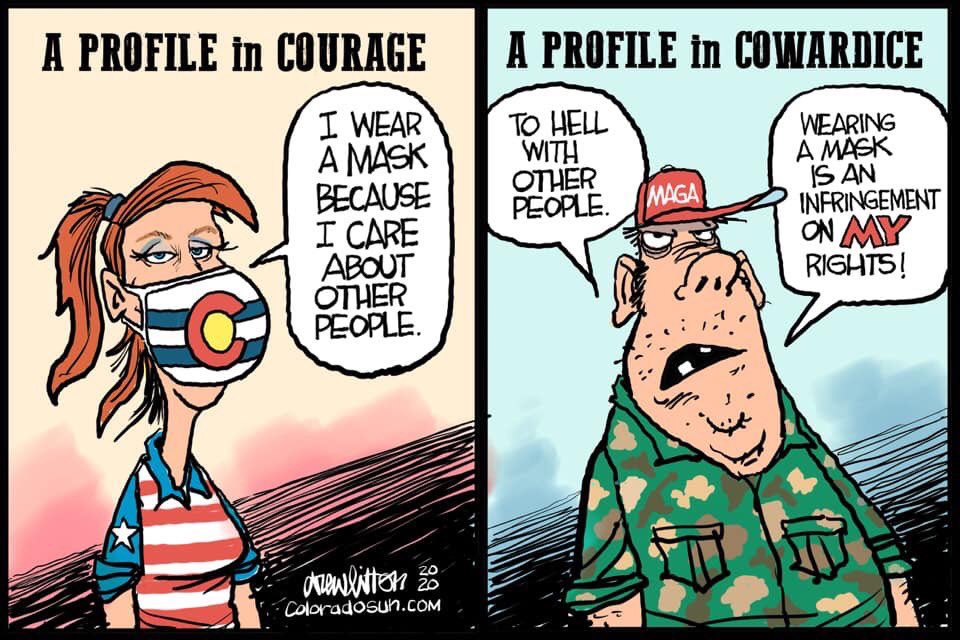
Cartoon – What does your mask say about you?

Jim Morrissey: What does your coronavirus mask say about you ...

Cartoon – Profile in Courage vs. Cowardice

COVID-19 News - Updated Daily

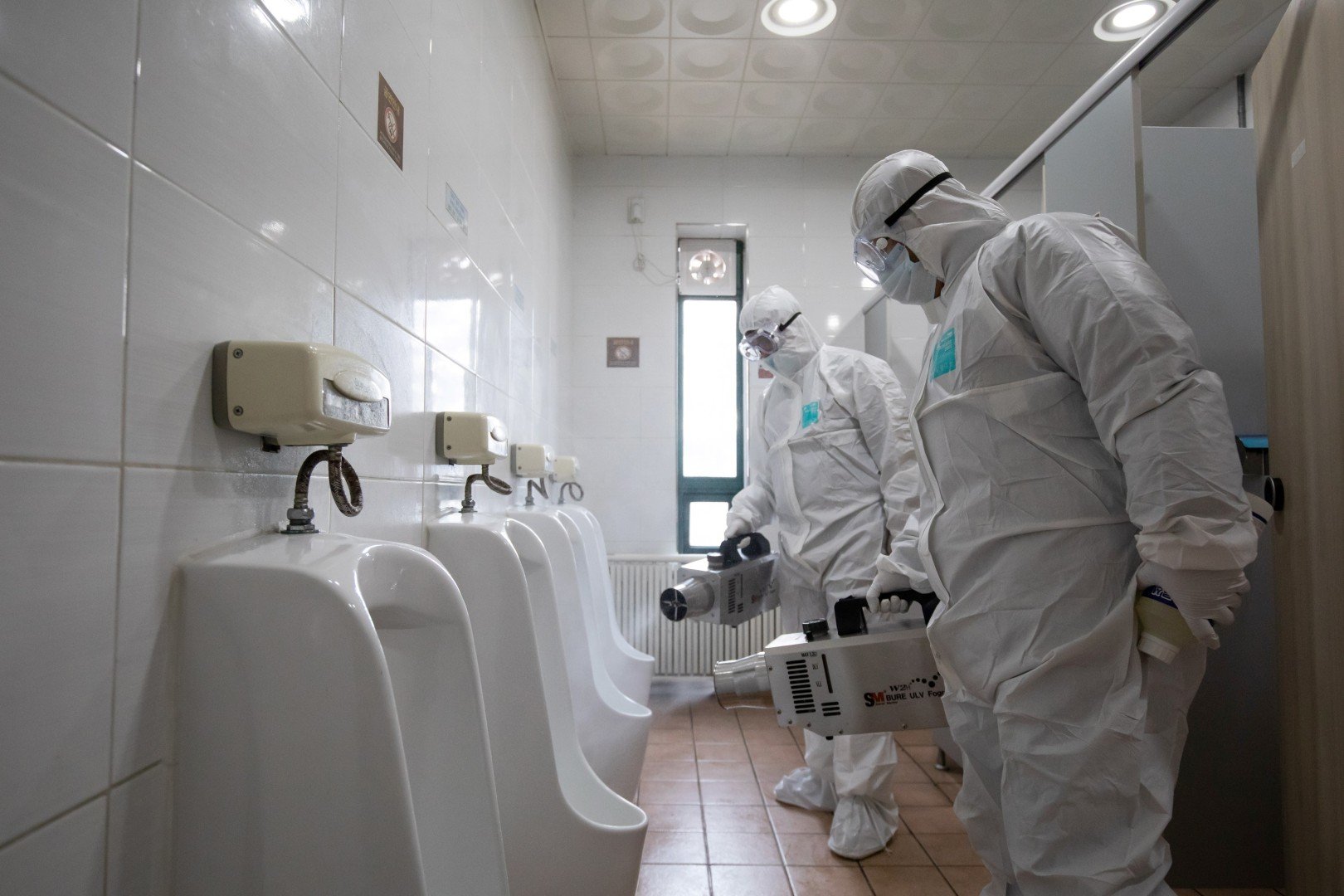
Beware the office toilet

https://mailchi.mp/647832f9aa9e/the-weekly-gist-august-14-2020?e=d1e747d2d8

Coronavirus can be killed with disinfectant but beware high-touch ...

Returning to the office after months of lockdown may bring an unexpected risk for workers. According to the New York Times, the CDC recently closed some of its Atlanta offices after finding that its water sources contained Legionella, the bacteria that causes Legionnaire’s disease.

The bacteria can grow in stagnant water systems, including plumbing and air conditioning units. After a prolonged absence, inhaled vapors from flushing toilets, running taps or restarted air conditioners can carry Legionella into the lungs.

While older individuals with lung conditions are most vulnerable, Legionnaire’s pneumonia carries a 10 percent fatality rate—leading the CDC to publish reopening guidelines for building operators that include flushing long-dormant systems with heated water and additional disinfectant in advance of reopening, and the suggestion that at-risk individuals should wear an N95 respirator or facepiece when aerosol generation is likely. (Unsurprisingly, the guidelines have been criticized as overly vague and lacking prescriptive advice.)

As if we all didn’t have enough to worry about, don’t forget to bring a N95 mask for any bathroom breaks during your first day back at the office! (Or maybe just hold it.)


Prosecuting the case against the COVID response

https://mailchi.mp/647832f9aa9e/the-weekly-gist-august-14-2020?e=d1e747d2d8

Bruce Plante Cartoon: Corona virus denial

This week, in her debut as running mate to presidential candidate Joe Biden, California Sen. Kamala Harris gave a preview of one of the Democratic ticket’s key arguments for the fall campaign, making a full-throated, prosecutorial case against the Trump administration’s handling of the coronavirus pandemic.

“The virus has impacted almost every country,” Harris said, “but there’s a reason it has hit America worse than any other advanced nation. It’s because of Trump’s failure to take it seriously from the start.

After receiving a briefing from public health experts on Thursday, Biden and Harris argued for a more comprehensive, aggressive national strategy to battle the virus, including major federal investment in contact tracing, a national mask mandate, and guaranteed free access to a COVID vaccine when it becomes available.

The remarks came as the US experienced the deadliest day of the summer so far, with nearly 1,500 COVID fatalities on Wednesday, and a seven-day rolling average of over 1,000 deaths per day for the last 17 days. Meanwhile, a new analysis by the New York Times, using data from the Centers for Disease Control and Prevention (CDC), indicated that the true US death toll from COVID may be as much as 35 percent higher than the reported total of 167K—a finding based on “excess deaths” above normal levels since March.

As President Trump continued to urge schools to reopen for in-person instruction nationwide, the White House released new guidance for ensuring students’ safe return to school. The guidance encouraged social distancing, frequent handwashing, better ventilation of school facilities, and the use of outdoor settings wherever possible.

Despite the President’s claim last week that children are “virtually immune” from the virus, a new analysis from the American Academy of Pediatrics and the Children’s Hospital Association showed that 97,000 children tested positive for COVID in the last two weeks of July alone, a 40 percent increase in the total number of known cases over that period.

About 340,000 children have tested positive so far, representing about 9 percent of all US cases. As schools face pressure to reopen, those numbers are likely to mount, and early-opening school districts in Georgia, Tennessee, Indiana, and Mississippi are already struggling to keep schools open amid rising cases.

Federal assistance to help schools deal with what seems like inevitable rounds of positive cases and closures is not forthcoming, however: after failing to reach a deal on another round of COVID relief, lawmakers have left Washington until September.

US coronavirus update: 5.2M cases; 167K deaths; 64.6M tests conducted.


U.S. records deadliest coronavirus day of the summer

https://www.axios.com/1485-us-coronavirus-death-record-5ee493cc-df91-4549-8c9d-43a5fee0bd87.html

U.S. records deadliest coronavirus day of the summer - Axios

The U.S. reported 1,485 deaths due to the coronavirus on Wednesday, COVID Tracking Project data shows.

Why it matters: It’s the highest single-day COVID-19 death toll since May 15, when the country reported 1,507 deaths. The U.S. has seen a total of 157,758 deaths from the virus.

The big picture: Georgia reported 109 deaths on Wednesday — its second triple-digit day in a row.

Go deeper: 5 states set single-day coronavirus case records last week