New jobless claims totaled 184,000 last week, reaching lowest since 1969

https://finance.yahoo.com/news/weekly-unemployment-claims-week-ended-dec-4-2021-192034644.html
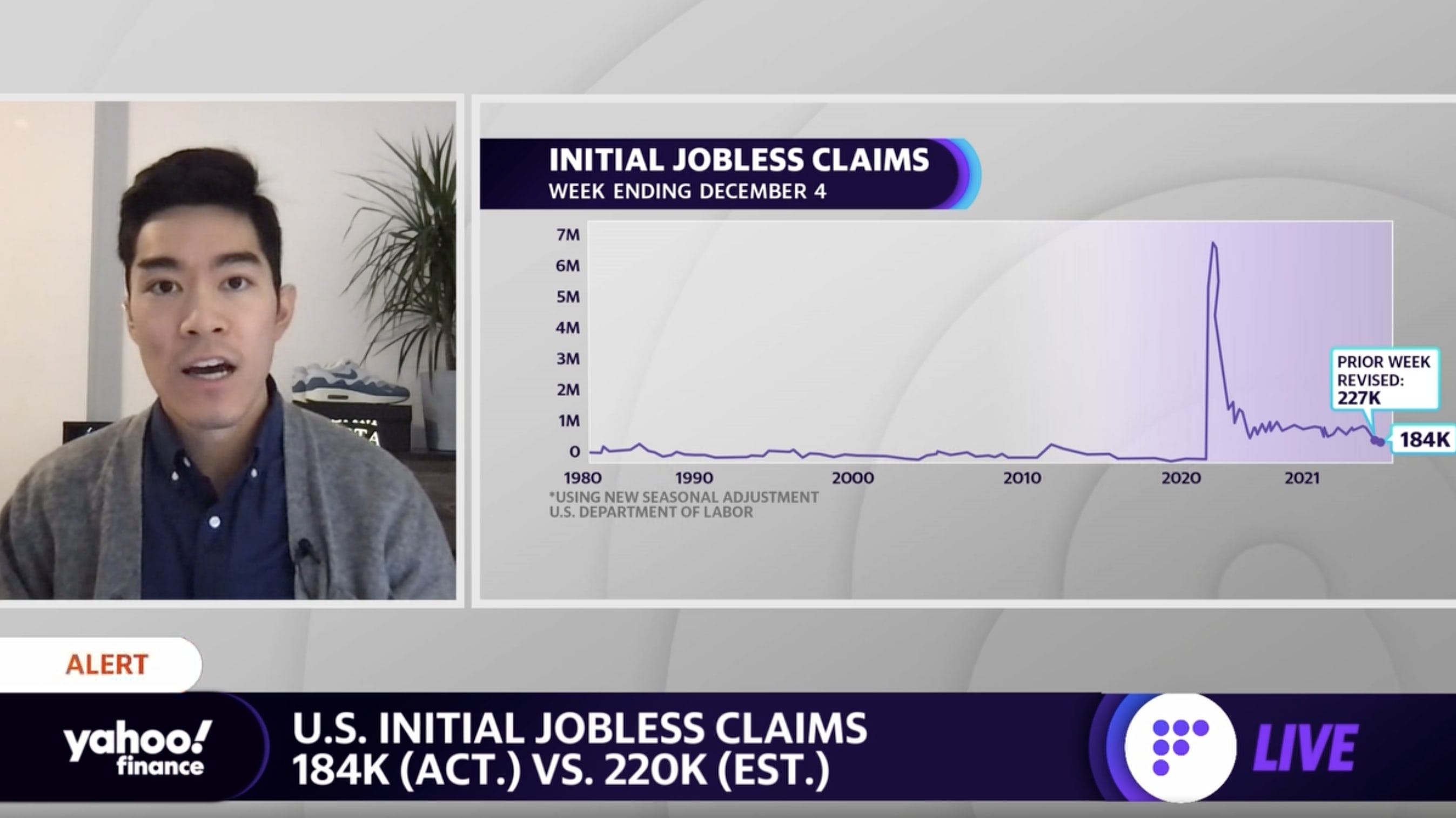
Weekly U.S. jobless claims fell to 184,000, lowest level since 1969

New initial jobless claims improved much more than expected last week to reach the lowest level in more than five decades, further pointing to the tightness of the present labor market as many employers seek to retain workers. 

The Labor Department released its weekly jobless claims report on Thursday. Here were the main metrics from the print, compared to consensus estimates compiled by Bloomberg:

  • Initial unemployment claims, week ended Dec. 4: 184,000 vs. 220,000 expected and an upwardly revised 227,000 during prior week 
  • Continuing claims, week ended Nov. 27: 1.992 million vs. 1.910 million expected and a downwardly revised 1.954 million during prior week

Jobless claims decreased once more after a brief tick higher in late November. At 184,000, initial jobless claims were at their lowest level since Sept. 1969. 

“The consensus always looked a bit timid, in light of the behavior of unadjusted claims in the week after Thanksgiving in previous years when the holiday fell on the 25th, but the drop this time was much bigger than in those years, and bigger than implied by the recent trend,” Ian Shepherdson, chief economist for Pantheon Macroeconomics, wrote in an email Thursday morning. “A correction next week seems likely, but the trend in claims clearly is falling rapidly, reflecting the extreme tightness of the labor market and the rebound in GDP growth now underway.”

After more than a year-and-a-half of the COVID-19 pandemic in the U.S., jobless claims have begun to hover below even their pre-pandemic levels. New claims were averaging about 220,000 per week throughout 2019. At the height of the pandemic and stay-in-place restrictions, new claims had come in at more than 6.1 million during the week ended April 3, 2020. 

Continuing claims, which track the number of those still receiving unemployment benefits via regular state programs, have also come down sharply from pandemic-era highs, and held below 2 million last week. 

“Beyond weekly moves, the overall trend in filings remains downward and confirms that businesses facing labor shortages are holding onto workers,” wrote Rubeela Farooqi, chief U.S. economist for High Frequency Economics, in a note on Wednesday. 

Farooqi added, however, that “the decline in layoffs is not translating into faster job growth on a consistent basis, which was evident in a modest gain in non-farm payrolls in November.” 

“For now, labor supply remains constrained and will likely continue to see pandemic effects as the health backdrop and a lack of safe and affordable child care keeps people out of the workforce,” she added. 

Other recent data on the labor market have also affirmed these lingering pressures. The November jobs report released from the Labor Department last Friday reflected a smaller number of jobs returned than expected last month, with payrolls growing by the least since December 2020 at just 210,000. And the labor force participation rate came in at 61.8%, still coming in markedly below its pre-pandemic February 2020 level of 63.3%. 

And meanwhile, the Labor Department on Wednesday reported that job openings rose more than expected in October to top 11 million, coming in just marginally below July’s all-time high of nearly 11.1 million. The quits rate eased slightly to 2.8% from September’s record 3.0% rate. 

“There is a massive shortage of labor out there in the country that couldn’t come at a worst time now that employers need workers like they have never needed them before. This is a permanent upward demand shift in the economy that won’t be alleviated by companies offering greater incentives to their new hires,” Chris Rupkey, FWDBONDS chief economist, wrote in a note Wednesday. “Wage inflation will continue to keep inflation running hot as businesses fall all over themselves in a bidding war for talent.”

$1.7 trillion U.S. spending bill would not stoke inflation: Moody’s

Dive Brief:

  • The $1.7 trillion “social infrastructure” legislation passed by the House and now before the Senate would spur growth, expand employment and boost productivity with limited inflationary impact, according to Moody’s Investors Service.
  • The spending “would occur over 10 years, include significant revenue-raising offsets and would likely only start to flow into the economy later in 2022 at a time when inflationary pressures from disruptions to global supply chains and U.S. labor supply will likely have diminished,” Moody’s Vice President-Senior Analyst Rebecca Karnovitz said
  • “Investments in childcare, education and workforce development have the potential to boost labor force participation and increase productivity over the medium and longer term,” she said. While the Senate will likely insist on amendments, the Build Back Better (BBB) bill currently would invest $555 billion in clean energy and “climate resilience” and $585 billion in childcare, universal prekindergarten and paid family leave.

Dive Insight:

CFOs concerned about rising prices and the risk of a wage-price spiral have found sympathy from some lawmakers who warn that the $5.7 trillion in spending Congress has already approved during the pandemic will further stoke inflation.

“Inflation is hammering working families across America,” Senate Minority Leader Mitch McConnell told the chamber last week. The Kentucky Republican called BBB a “socialist wish list” and an inflationary “taxing and spending spree.”

Some Democrats — including Sens. Kyrsten Sinema of Arizona and Joe Manchin of West Virginia — have cautioned that excessive spending could push up prices and worsen the fiscal outlook.

Sinema and Manchin have said that they want less costly legislation. With Democrats holding the smallest possible Senate majority, support from the two senators is essential for final passage of the bill.

“I have been concerned about high levels of spending that are not targeted or are not efficient and effective,” Sinema told the Washington Post on Nov. 18 while noting rising inflation.

“The threat posed by record inflation to the American people is not ‘transitory’ and is instead getting worse,” Manchin said on Twitter this month after the Labor Department reported that consumer prices rose 6.2% in October on an annual basis.

CFOs face even higher price gains for wholesale goods. The producer price index for final demand, a measure of what suppliers charge, soared 8.6% in October from the prior year, according to the Labor Department. That was a record jump in a series of data first published in 2010.

The Moody’s analysis suggests that concerns about the impact of BBB on inflation and the U.S. fiscal outlook may be overblown.

“We expect the spending package to have a limited impact on inflation,” Moody’s said.

Referring to the U.S. credit outlook, Moody’s said, “we expect the legislation to have only a small effect on the sovereign’s fiscal position, given that the spending would be spread over a decade and the revenue-raising measures would help offset the impact on federal budget deficits.”

The Congressional Budget Office estimates that the House version of BBB would push up fiscal deficits by $367 billion over a 10-year period.

Yet the estimate excludes about $200 billion in revenue that would come from a provision in the bill funding tougher tax enforcement and collection, Moody’s said.

“Estimates of the bill’s impact on the deficit are likely to shift in accordance with provisions that may be stripped from the Senate’s final version of the legislation,” according to Moody’s.

Business forecasters see inflation heating up to 5.1%

Dive Brief:

  • Inflation as measured by the consumer price index will surge 5.1% year-over-year during the fourth quarter, forecasters for the National Association for Business Economics (NABE) said, raising their estimate in May for a 2.8% year-over-year increase in prices. The forecasters anticipate inflation will ease to 2.4% year-over-year during the fourth quarter of 2022, according to a survey.
  • “Inflation expectations have moved up significantly from those in the May 2021 survey,” according to Holly Wade, survey chair and executive director for the research center at the National Federation of Independent Business. “But panelists anticipate inflation will ease in 2022.”
  • The NABE panel reduced its estimate for growth in gross domestic product (GDP) this year to 5.6% from 6.7% in May, citing the coronavirus delta variant as the biggest risk to the expansion.

Dive Insight:

NABE expectations that inflation will cool next year align with the view of Federal Reserve Chair Jerome Powell and Treasury Secretary Janet Yellen. Both policy-makers have staked record stimulus in part on the premise that the fastest price gains in decades will slow as pandemic-induced kinks in supply chains even out.

The Fed’s preferred inflation measure — the core personal consumption expenditures price index — rose 3.6% in July compared with a year earlier, well above the central bank’s 2% target.

In an estimate released after a two-day meeting on Wednesday, Fed officials forecast that so-called core inflation will rise 2.3% next year, slightly above the 2.2% estimate by the NABE panel.

Confident that inflation will ease, Fed policy-makers indicated after their meeting that they may begin to cut $120 billion in monthly purchases of Treasury and mortgage bonds as early as their next scheduled gathering in November. Powell said that the Fed will gradually taper and may conclude bond buying “around the middle of next year.”

Half of the 18 participants in the Fed’s policy-making committee expect to raise the benchmark interest rate from a record low by the end of 2022.

“I expect inflation to decelerate,” Fed Governor Lael Brainard said Monday in a speech to NABE. “But with delta disrupting the rotation from goods to services and prolonging supply bottlenecks, it is uncertain just how fast and how much inflation will decelerate over the remainder of the year and into next year.”

With the delta variant disrupting demand and supply, the employment report for September due out on Oct. 8 “may be weaker and less informative of underlying economic momentum than I had hoped,” she said.

More than half (58%) of the NABE forecasters see downside risks to economic growth for the remainder of 2021, while 16% “expect the balance to be to the upside — a complete reversal from the May survey results,” Wade said.

Sixty-three percent of panelists identify the delta variant as the leading risk to growth, while 5% of respondents said fiscal policy inaction or gridlock as their greatest growth concern, NABE said. Two-thirds (67%) of survey respondents predict that nonfarm payrolls will return to pre-pandemic levels by the end of 2022.

Powell and Yellen will have an opportunity to update their views on inflation and the economy, and the outlook for record monetary and fiscal stimulus, in testimony scheduled for Tuesday before the Senate Banking Committee.

The NABE panel of 47 forecasters spans a range of organizations, including economists from Ford, Grant Thornton, Moody’s Analytics, the Conference of State Bank Supervisors, Nationwide Insurance, Morgan Stanley, the National Association of Homebuilders, Visa and Wells Fargo.

If the U.S. economy is in good shape, why is the Federal Reserve cutting interest rates?

https://www.washingtonpost.com/business/2019/07/31/if-us-economy-is-good-shape-why-is-federal-reserve-cutting-interest-rates/?utm_term=.1346fb3da080&wpisrc=nl_most&wpmm=1

Federal Reserve Board Chair Jerome Powell speaks during a Senate Banking Committee hearing on July 11.

The Federal Reserve is all but certain Wednesday to do something it hasn’t done in more than a decade: cut interest rates. The question on a lot of people’s minds is why.

Lowering interest rates, the Fed’s main way to boost the economy, is typically used in dire times, which it’s difficult to argue the United States is experiencing right now. Instead, top Fed officials are defending this as an “insurance cut” that’s akin to an immunization shot in the arm. They want to counteract the negative effects of President Trump’s trade war and prevent the United States from catching the same cold that Europe, China and elsewhere seem to have.

The Fed’s big decision comes at 2 p.m. Wednesday and will be followed by a 2:30 p.m. news conference from Fed Chair Jerome H. Powell, a frequent target of Trump’s criticism.

The Fed is widely expected to do a modest cut on Wednesday, probably lowering the benchmark interest rate from about 2.5 percent down to just shy of 2.25 percent. But the Fed seldom does just one cut, which is why Trump, Wall Street and much of the world will be listening closely to Powell for signs of when another cut is likely.

Wall Street is pricing in that the Fed will lower interest rates to about 1.75 by the end of the year, a far more dramatic move. And Trump has been blasting the Fed for months, saying he wants to see a “large” cut.

“The Fed is often wrong,” Trump said this week, reiterating his view that the stock market would be up 10,000 more points if the Fed had not raised interest rates four times last year. “I’m very disappointed in the Fed. I think they acted too quickly, by far. I think I’ve been proven right.”

But there are plenty of economists and prominent investors saying the Fed shouldn’t cut at all because it is not justified and will look as though the Fed is caving in to Trump’s bullying — or Wall Street’s.

“I have to conclude the Fed has lost some independence here,” said Blu Putnam, chief economist at CME Group.

The last time the Fed cut rates was in December 2008, when unemployment was over 7 percent (and rising quickly), the stock market had lost a third of its value, and a major financial institution, Lehman Brothers, had just declared bankruptcy, rocking the financial system.

Today unemployment is at a half-century low (3.7 percent), the economy is growing at a healthy pace (over 2 percent) and the stock market is sitting at record highs.

Congress gave the Fed two mandates: to keep unemployment low and prices stable. By about any measure one can look at, the Fed has achieved those goals. The job market is strong, and inflation remains surprisingly low.

The world will be listening closely for Powell’s rationale for lowering rates during fairly good economic times — and for his signal about whether another cut is coming in the fall.

It’s a tricky calculus. The one thing nearly everyone agrees on is this would be the biggest gamble yet for Powell, who took over as the central bank’s chair in early 2018.

The likely cut on Wednesday should make loans a little cheaper for businesses and Americans looking to buy homes and cars or start a company. But realistically, one cut won’t do much. The reason the stock market has rallied sharply in recent weeks is an expectation that this is the first of several cuts.

If the Fed does not do three cuts this year, the market could pull back, making financial conditions “tight” again, even though the Fed is cutting rates to try to loosen conditions.

Top Federal Reserve leaders see three key reasons to cut now.

1. Trump’s trade war. There is concern about the trade war, as well as weakness overseas, dragging down the U.S. economy. A closer look at the U.S. economy reveals there are already a few yellow, if not red, flags. Manufacturing was in a “technical recession” the first half of the year, the housing market remains sluggish, and business investment tanked in the spring as corporate leaders grow more wary of the ongoing trade tensions.

Powell and Fed Vice Chair Richard Clarida refer to these as “head winds” and “downside risks” that are picking up, and they prefer to address them before they grow into deeper problems. Clarida often points to 1995, when the Fed did three modest rate cuts (starting in July 1995 and ending in January 1996) that helped keep the economy growing for years to come.

2. The Fed needs to act sooner rater than later. New York Fed President John Williams, among others, has made the case that the Fed has limited medicine in the medicine cabinet to aid the economy and that it’s better to administer the pills at the first signs of trouble rather than waiting for full-blown illness when there might not be enough medicine left to make a difference. “When you only have so much stimulus at your disposal, it pays to act quickly to lower rates at the first sign of economic distress,” Williams said in a speech earlier this month.

Interest rates are very low by historical standards. For example, the benchmark rate was over 5 percent before the Fed started reducing it in 2007. Now the benchmark rate is half that amount, meaning there will be less stimulus this time around from cutting rates.

3. Inflation is too low. The Fed wants to see inflation of about 2 percent a year. For the past several years, it’s been running below that threshold and is currently sitting around 1.6 percent. Some Fed leaders, such as St. Louis Fed President James Bullard, say the Fed should cut rates to try to run the economy a bit hotter to boost inflation. They see little risk in doing this since inflation is so low, but they see great risk in not getting inflation back to target because business leaders will stop believing that 2 percent is the true target if it is never achieved.

While there are reasons to cut, some Fed leaders, including Boston Fed President Eric Rosengren and Kansas City Fed President Esther George, have raised doubts about whether it makes sense to cut now, before there are clear signs of trouble in the United States.

Rosengren has warned in recent speeches that insurance cuts do not come without a cost. Keeping rates low tends to spur bubbles that can come back to harm the economy later on. Already there are concerns about too much risky corporate lending, and lower rates are only likely to encourage more of those loans. He and others have also pointed out that using up the medicine now doesn’t leave much left to fight worse problems later on.

There are 10 members on the Fed’s committee that decides interest rate policy, and they do not appear to be in unison on this decision, let alone what to do in the fall, a reminder of just how much debate there is about the right course of action.

The U.S. economy is in the midst of a record-breaking expansion that has been growing for more than a decade, the longest expansion in U.S. history. Powell says keeping it going is his top goal.