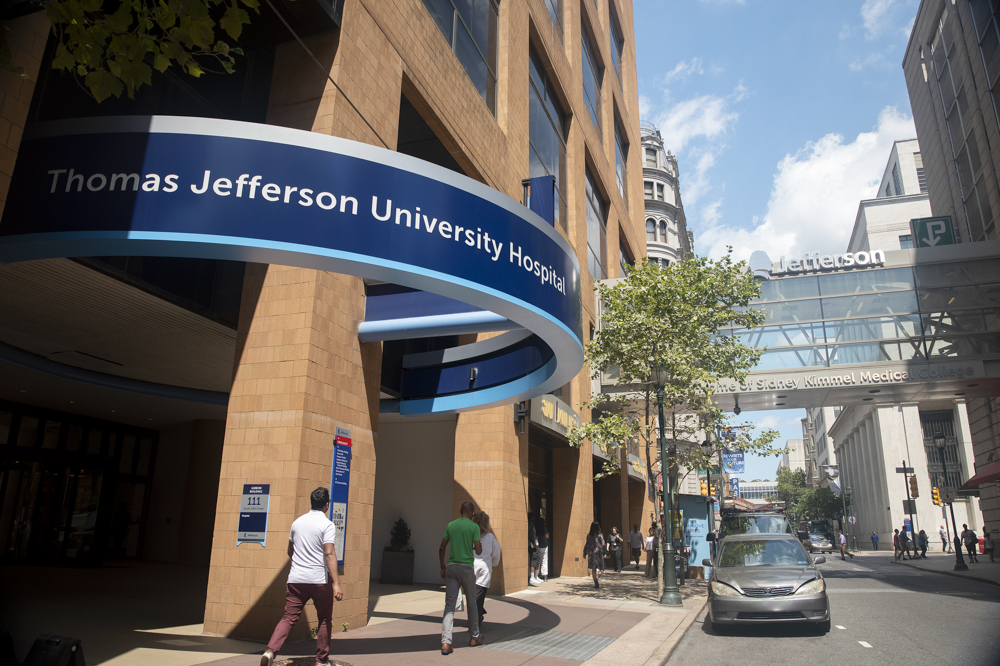
Philadelphia-based Thomas Jefferson University, including Jefferson Health, reported a multimillion-dollar loss in the third quarter ending Sept. 30.
Five things to know:
1. Thomas Jefferson University reported an $83.5 million loss for the quarter, down significantly from a $12.8 million gain in the same period last year.
2. Thomas Jefferson University reported $29.9 million in operating revenue. Clinical operations reported an $87.3 million loss from operations, and the insurance operations reported a $7.1 million gain for the quarter.
3. The organization reported a -3.7 percent operating margin, compared to 0.9 percent for the third quarter last year.
4. Hospital inpatient admissions grew 30.4 percent year over year to 39,463 cases for the quarter. Outpatient observations were also up 21.6 percent to 11,744 cases. Outpatient visits were up 36 percent year over year to 524,200 visits.
5. Days cash on hand for clinical operations dropped by nearly 11 days since the start of the fiscal year to 158.5 days due to nonoperating investment losses and repaying Medicare advance payments.
Driven by strong investment gains, Oakland, Calif.-based Kaiser Permanente recorded a net income of $8.1 billion in 2021, an increase of $1.7 billion from 2020, according to its financial results released Feb. 11. However, its operating income fell sharply.
For the 12 months ended Dec. 31, the integrated healthcare provider with 39 hospitals recorded an operating revenue of $93.1 billion, up from $88.7 billion recorded last year. Additionally, Kaiser saw its expenses rise 6.9 percent to $92.5 billion in 2021.
In 2021, Kaiser saw its operating income fall to $611 million, an operating margin of 0.7 percent. This compares to a $2.2 billion operating income in 2020 and an operating margin of 2.5 percent.
Kaiser attributed the sharp decrease in operating income to an increase in care delivery expenses due to COVID-19 surges.
Total other income and expenses, which includes investment income, reached $7.5 billion in 2021. In 2020, Kaiser saw a gain of $4.1 billion.
“Our financial performance underscores the strength of our integrated model, which allows us to weather unexpected challenges such as the COVID-19 pandemic while continuing to serve our members,” said Kathy Lancaster, Kaiser Permanente executive vice president and CFO.
In 2021, Kaiser also said its health plan membership grew by 185,000 members. It now has more than 12.5 million members.
Here are 11 health systems and hospitals with strong operational metrics and solid financial positions, according to reports from Fitch Ratings, Moody’s Investors Service and S&P Global Ratings.
1. Morristown, N.J.-based Atlantic Health System has an “Aa3” rating and stable outlook with Moody’s. The credit rating agency expects the health system to continue to generate favorable operating performance and to maintain double-digit operating cash flow margins and solid debt coverage.
2. Charlotte, N.C.-based Atrium Health has an “Aa3” rating and stable outlook with Moody’s and an “AA-” rating and stable outlook with S&P. Atrium and Winston-Salem, N.C.-based Wake Forest Baptist Health merged in October. The addition of the Winston-Salem service area and Wake Forest Baptist’s academic and research programs enhances Atrium’s position within the highly competitive North Carolina healthcare market, S&P said.
3. Dallas-based Baylor Scott & White Health has an “Aa3” rating and stable outlook with Moody’s. The system has strong liquidity and is the largest nonprofit health system in Texas, Moody’s said. The credit rating agency expects Baylor Scott & White Health to continue to benefit from its centralized operating model, proven ability to execute complex strategies and well-developed planning abilities.
4. Pittsfield, Mass.-based Berkshire Health System has an “AA-” rating and stable outlook with Fitch. The health system has improved its liquidity while investing in facilities without increasing its debt load, Fitch said. The credit rating agency expects the system to maintain a strong financial profile.
5. Mishawaka, Ind.-based Franciscan Alliance has an “Aa3” rating and stable outlook with Moody’s. The system has leading positions in key markets and a strong cash position, Moody’s said. The credit rating agency expects the system to sustain double-digit operating cash flow margins.
6. Falls Church, Va.-basedInova Health System has an “Aa2” rating and stable outlook with Moody’s. The system has a strong financial profile, and Moody’s expects Inova’s balance sheet to remain exceptionally strong.
7. Palo Alto, Calif.-based Lucile Packard Children’s Hospital at Stanford has an “AA-” rating and stable outlook with Fitch. The hospital is nationally known, has a strong market position and is one of two key clinical partners of Stanford University, Fitch said.
8. Grand Blanc, Mich.-based McLaren Health Care has an “AA-” rating and stable outlook with Fitch. The health system has a strong financial profile and a leading market position over a broad service area that covers much of Michigan, Fitch said.
9. Winston-Salem, N.C.-based Novant Health has an “AA-” rating and stable outlook with Fitch. The system has strong margins, and each of its markets has met or exceeded budgeted expectations over the past four years, Fitch said.
10. Renton, Wash.-based Providence has an “Aa3” rating and stable outlook with Moody’s. Providence has a large revenue base and a leading market share in most of its markets, according to Moody’s. The credit rating agency expects the system’s operations to improve this year.
11. Livonia, Mich.-based Trinity Health has an “AA-” rating and stable outlook with Fitch. The rating is driven by Trinity’s national size and scale, with significant market presence in several states, Fitch said. The credit rating agency expects the system’s operating margins to improve in the long term.











 HENRY KOTULA