More than 4K Stanford nurses vote to strike in California

UPDATE: April 14, 2022: Nurses will begin striking April 25 if they are unable to reach a deal with the system by then, according to a Wednesday statement from the union. The two sides have met with a federal mediator three times, and the strike would be open-ended.

Dive Brief:

  • Unionized nurses at Stanford hospitals in California voted in favor of authorizing a strike Thursday, meaning more than 4,500 nurses could walk off the job in a bid for better staffing, wages and mental health measures in new contracts.
  • Some 93% of nurses represented by the Committee for Recognition of Nursing Achievement voted in favor of the work stoppage, though the union did not set a date, according to a union release. It must give the hospitals 10 days notice before going on strike.
  • Nurses’ contracts expired March 31 and the union and hospital have engaged in more than 30 bargaining sessions over the past three months, including with a federal mediator, according to the union.

Dive Insight:

As the COVID-19 pandemic has worsened working conditions for nurses, some unions have made negotiating contracts a priority. Better staffing is key, along with higher wages and other benefits to help attract and retain employees amid ongoing shortages.

The California nurses’ demands in new contracts focus heavily on recruitment and retention of nursing staff “amid an industry-wide shortage and nurses being exhausted after working through the pandemic, many in short-staffed units,” the union said in the release.

They’re also asking for improved access to time off and more mental health support.

Nurses say their working conditions are becoming untenable and relying on travel staff and overtime shifts is not sustainable, according to the release.

The hospitals are taking precautionary steps to prepare for a potential strike and will resume negotiations with the union and a federal mediator Tuesday, according to a statement from Stanford.

But according to CRONA, nurses have filed significantly more assignment despite objections documents from 2020 to 2021 — forms that notify hospital supervisors of assignments nurses take despite personal objections around lacking resources, training or staff.

And a survey of CRONA nurses conducted in November 2021 founds that as many as 45% were considering quitting their jobs, according to the union.

That’s in line with other national surveys, including one from staffing firm Incredible Health released in March that found more than a third of nurses said they plan to leave their current jobs by the end of this year.

The CRONA nurses “readiness to strike demonstrates the urgency of the great professional and personal crisis they are facing and the solutions they are demanding from hospital executives,” the union said in the release.

No major strikes among healthcare workers have occurred so far this year, though several happened in 2021 and in 2020, the first year of the pandemic.

Stanford, Packard nurses greenlight strike

Thousands of nurses at Stanford and Lucile Packard Children’s hospitals in Palo Alto, Calif., have authorized the union representing them to call a strike. 

In an April 8 news release, the Committee for Recognition of Nursing Achievement said more than 4,500 nurses at Stanford and Packard, or 93 percent of all nurses eligible, voted in favor of strike authorization. They are calling on hospital management to adequately address staffing, citing consistent overtime and nurses’ complaints of inadequate resources, training or staff. They also seek improved access to mental health counseling, as well as competitive wages and benefits.

“The decision by members to overwhelmingly authorize a strike shows that we are fed up with the status quo of working conditions at the hospitals,” Colleen Borges, union president and a nurse in the pediatric oncology department, said in the release. “We need contracts that allow us to care for ourselves and our families so we can continue providing world-class care.”

Nurses authorized the strike after bargaining for the last 13 weeks and are working without contracts. The vote does not mean a strike will occur, but it gives the union the ability to issue an official strike notice. 

In a statement shared with Becker’s, Stanford expressed its support for negotiations rather than a strike.

“We are committed, through good faith bargaining, to reach agreement on new contracts that provide nurses a highly competitive compensation package, along with proposals that further our commitment to enhancing staffing and wellness benefits for nurses,” the statement said.

The hospital also said it is taking the steps to prepare for the possibility of a strike, while hoping a strike is averted.

“Given the progress we have made by working constructively with the union, we should be able to reach agreements that will allow us to continue to attract and retain the high caliber of nurses who so meaningfully contribute to our hospitals’ reputation for excellence,” the statement read. 

Kaiser Permanente averts strike in tentative deal with health care workers

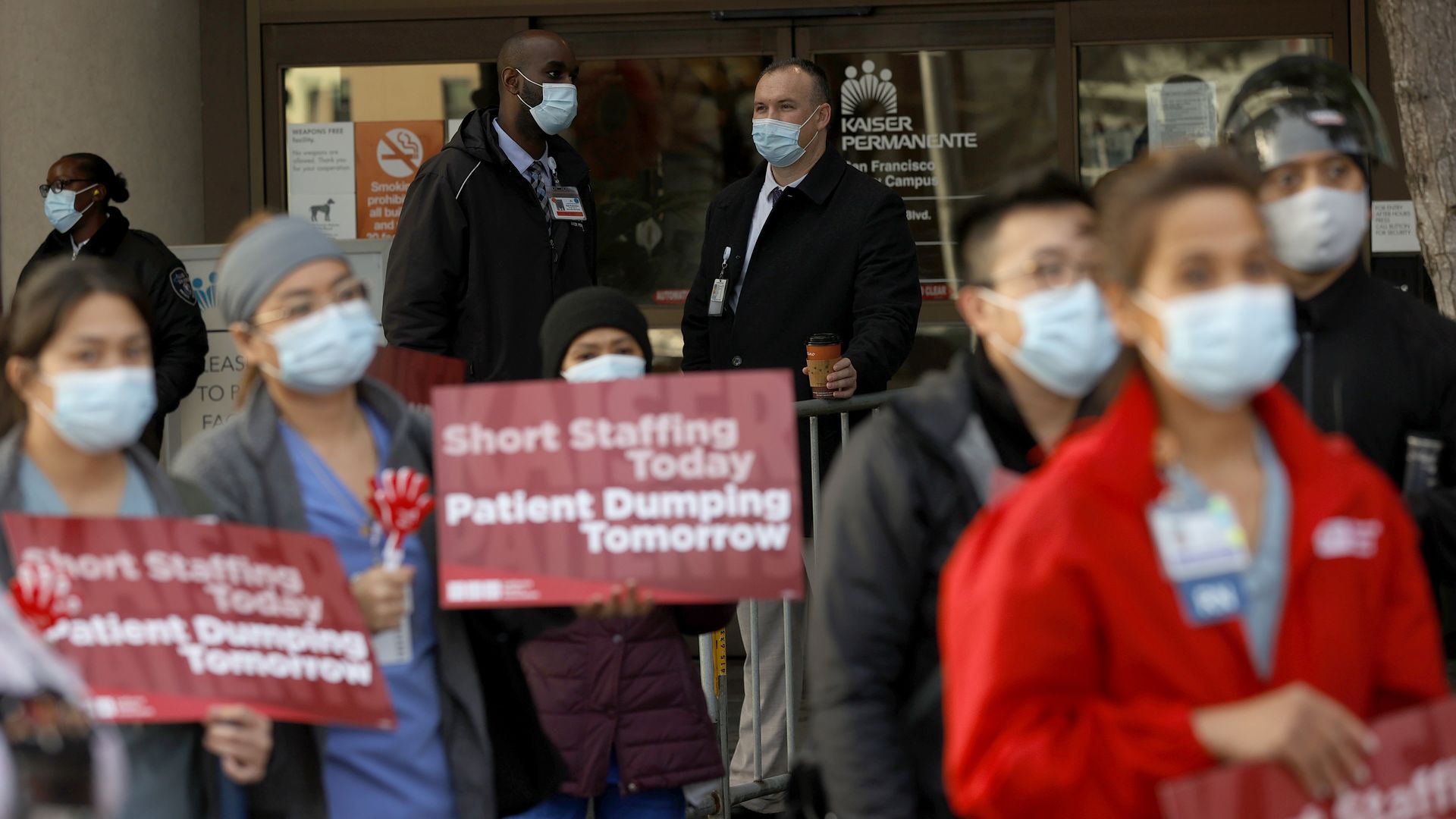
Kaiser Permanente security guards monitor an informational picket outside of the Kaiser Permanente San Francisco Medical Center on November 10, 2021 in San Francisco, California.

Union leaders representing nearly 50,000 health care workers and medical staff reached a tentative agreement in a labor dispute Saturday, avoiding a strike set to begin Monday.

Why it matters: The breakthrough in talks comes as nurses, front-line technicians and other hospital employees face worker shortages and burnout due to the ongoing COVID-19 pandemic.

The big picture: More than 30,000 Kaiser Permanente employees in Oregon, Washington, California and other states threatened to walk out on Monday over lower pay for new hires, Reuters reports.

  • Kaiser and the Alliance of Health Care Unions ended up reaching a tentative four-year deal that includes wage increases, health and retirement benefits and bonus opportunities, per CBS News.

What they’re saying: “This agreement will mean patients will continue to receive the best care, and Alliance members will have the best jobs,” Hal Ruddick, executive director of Alliance, said in the statement.

  • “This landmark agreement positions Kaiser Permanente for a successful future focused on providing high-quality health care that is affordable and accessible for our more than 12 million members and the communities we serve,” said Christian Meisner, senior vice president and chief human resources officer at Kaiser.

What’s next: The agreement heads to union members for ratification, and, if ratified, it will become retroactive to Oct. 1.

UPMC workers to strike Nov. 18

Workers at Pittsburgh-based UPMC plan to strike over wages and benefits, the Post-Gazette reported Nov. 5. 

Service Employees International Union Healthcare Pennsylvania, which does not represent the workers but is supporting them, told Becker’s Hospital Review the strike would involve workers at UPMC hospitals in Pittsburgh, including transporters, dietary workers, housekeepers, nurses, patient care techs, medical assistants, pharmacy techs, surgical techs, valets, therapists, health unit coordinators and administrative assistants. Workers plan to strike for one day on Nov. 18.

The workers are demanding a $20 per hour minimum wage, affordable high-quality healthcare, elimination of all medical debt and respect for union rights, according to a union news release.

Their strike notice came after UPMC announced Nov. 2 that the health system is giving 92,000 staff members a bonus of $500 to thank them for their work during the pandemic. UPMC will issue the bonuses on Nov. 26. The health system also announced improvements to employee compensation and benefit programs, including raising the entry level wage to $15.75 in January, according to the Post-Gazette

“There was no ‘thank you pay’ until we started organizing to strike,” Juilia Centofanti, pharmacy tech at UPMC Children’s Hospital of Pittsburgh, said in a news release.

Ms. Centofanti added that employees are “owed this [$20 per hour wage] and so much more,” and said she “will continue organizing with my co-workers for the pay, safer staffing and union rights we deserve.”

In announcing the bonuses, Leslie Davis, president and CEO of UPMC, told workers, “Over the past 20 months, you have risen in truly exceptional ways to meet challenges we could have never anticipated. With your critical support, UPMC continues to care for so many.”

A UPMC spokesperson declined to comment to Becker’s on Nov. 5.

UPMC is a $23 billion healthcare provider and insurer. SEIU Healthcare Pennsylvania has been trying to organize about 3,500 hourly workers at UPMC Presbyterian and Shadyside hospitals for nearly a decade, but has not yet held a unionization vote, according to the Post-Gazette.

Read the full report here.

Possible strike looms for 28,000 Kaiser workers in Southern California

80,000 Kaiser Permanente workers to strike nationwide in October | Fox  Business

Nurses and other healthcare workers have voted to authorize a strike at Kaiser Permanente in Southern California, according to a union news release.

The vote covers 21,000 registered nurses, pharmacists, midwives, physical therapists and other healthcare professionals represented by the United Nurses Associations of California/Union of Health Care Professionals, as well as 7,000 members of United Steelworkers. It does not mean a strike is scheduled. However, it gives bargaining teams the option of calling a strike. Unions representing the workers would have to provide a 10-day notice before striking.

The vote comes as Oakland, Calif.-based Kaiser is negotiating for a national contract with UNAC/UHCP, along with about 20 other unions in the Alliance of Health Care Unions. The alliance, which has been in negotiations with Kaiser since April, covers more than 50,000 Kaiser workers nationwide.

UNAC/UHCP said union members are facing “protracted understaffing” amid record levels of burnout during the COVID-19 pandemic.

“While healthcare workers are facing record levels of burnout after 18 months of the COVID pandemic, they continue to deal with protracted understaffing. Talks at the table center on how to recruit to fill open positions that impact patient care and service,” the union said in a news release. “Kaiser Permanente … wants to slash wages for new nurses and healthcare workers and depress wages for current workers trying to keep up with rising costs for food, housing and other essentials.”

Kaiser has defended its pay amid a challenging pandemic, saying its proposal includes wage increases for current employees “on top of the already market-leading pay and benefits,” as well as a market-based compensation structure for those hired in 2023 and beyond.

In a statement shared with Becker’s Oct. 11, the system also emphasized its continued focus on high-quality, safe care.

“In the event of any kind of work stoppage, our facilities will be staffed by our physicians along with trained and experienced managers and contingency staff,” the system said. 

This strike would affect Kaiser hospitals and medical centers in Anaheim, Bakersfield, Baldwin Park, Downey, Fontana, Irvine, Los Angeles, Ontario Vineyard, Panorama City, Riverside, San Diego, West Los Angeles and Woodland Hills, as well as various clinics and medical office buildings in Southern California.

Kaiser Permanente union in California nearing strike

Dive Brief:

  • A union representing 24,000 Kaiser Permanente clinicians in California has put a pause on its 24-year partnership with management, the group said Friday.
  • Leadership of the union voted last week to move forward with a membership vote that would authorize the bargaining team to call a strike.
  • The United Nurses Associations of California/Union of Health Care Professionals said in a press release Kaiser Permanente is planning “hefty cuts” to nurse wages and benefits despite the ongoing COVID-19 pandemic and high levels of burnout among nurses.

Dive Insight:

Union activity at hospitals has been ramping up since the onset of the pandemic, as front-line healthcare workers have been stretched to the brink with full ICUs, worries of infection and sick coworkers.

Now, Kaiser Permanente nurses in California are saying they’re not being appreciated for their efforts.

“How do you tell caregivers in one breath you’re our heroes, we’re invested in you, I want to protect you, but in the next say I want to take away your wages and benefits? Even say you’re a drag on our bottom line,” Charmaine Morales, executive vice president of the union, said in a press release. “For the first time in 26 years, we could be facing a strike.”

The most recent bargaining session between the health system and the union was Sept. 10. Another one hasn’t been scheduled, despite most contracts being set to expire at the end of the month, the union said.

The labor management partnership started in the 1990s as an attempt for the union and management to share information and decision-making, the union said.

But they also said company leaders have not been invested in the agreement recently.

“Kaiser Permanente has stepped back from the principles of partnership for some time now, and they have violated the letter of our partnership agreement in the lead up to our present negotiations,” union president Denise Duncan said in the press release. “Despite that, we are here and ready to collaborate again if KP leaders find their way back to the path — where patient care is the true north in our value compass, and everything else falls in line behind that principle. Patient care is Kaiser Permanente’s core business, or at least we thought so.”

The press release cites Kaiser’s profitability, as the system’s net income was nearly $3 billion in the second quarter of this year. However, that was a decrease of more than a third from the prior-year period.

It also noted multiple lawsuits alleging Kaiser tried to game the Medicare Advantage program by submitting inaccurate diagnosis codes. The Department of Justice has joined six of those lawsuits.

Kaiser Permanente did not respond to a request for comment by time of publication.

Are recent labor actions getting nursing unions what they want?

While nurses in Cook County, Illinois, struck a deal in recent days, those on a three-month-plus strike against a Tenet hospital in Massachusetts plan a protest at the chain’s Dallas headquarters.

Thousands of healthcare workers have waged strikes this summer to demand better staffing levels as the pandemic brought greater attention to what happens when a nurse must take care of more patients than they can reasonably handle.

In New York, a report from the attorney general that found nursing homes with low staffing ratings had higher fatality rates during the worst COVID-19 surges last spring helped spur legislators to pass a safe staffing law long-advocated for by the New York State Nurses Association.

While unions elsewhere face a steeper climb to win the success found in New York, through strikes and other actions, they’re attempting to get new staffing rules outlined in their employment contracts.

Most nursing strikes include demands for ratios, or limits on the number of patients a nurse can be required to care for, Rebecca Givan, associate professor in the School of Management and Labor Relations at Rutgers University, said.

“And employers are very anxious about that because it threatens their bottom line, so often when a compromise is found, it’s something that approaches a ratio but maybe has a bit more flexibility,” Givan said.

Some have been successful, like the 1,000 Chicago-area nurses at Stroger Hospital, Provident Hospital and Cook County Jail who waged a one-day strike on June 24 after negotiating with the county over a new contract for nearly eight months.

They reached a tentative agreement shortly after the strike, stipulating the hiring of 300 nurses, including 125 newly added positions throughout the system within the next 18 months.

The deal also includes wage increases to help retain staff, ranging from 12% to 31% over the contract’s four-year term, according to National Nurses United.

Meanwhile, 700 nurses at Tenet’s St. Vincent Hospital in Worcester, Massachusetts, have been on strike for over 100 days over staffing levels. Nurses represented by the Massachusetts Nurses Association have been trying to get an actual nurse-to-patient ratio outlined for specific units in their next contract.

The two sides haven’t come close to reaching a deal yet, and some nurses will travel to Tenet’s headquarters in Dallas on Wednesday in an attempt to appeal to corporate executives, according to MNA.

At the same time, federal lawmakers wrote to Tenet CEO Ron Rittenmeyer seeking details on the chain’s use of federal coronavirus relief funds amid the strike and alongside record profits it turned last year.

The hospital denied lawmakers’ claims in the letter that Tenet used federal funds to enrich executives and shareholders rather than meet patient and staff needs, saying in a statement it strongly objects to the “mischaracterization of the facts and false allegations of noncompliance with any federal program.”

The strike is currently the longest among nurses nationally in a decade, according to the union.

A number of other major hospital chains have contracts covering their nurses expiring this summer, including for-profit HCA Healthcare and nonprofit Sutter Health.

Unionized nurses at 10 HCA hospitals in Florida have reached a deal on a new collective bargaining agreement, though members still need to ratify it, according to National Nurses United. The details are still unclear.

And after joining NNU just last year, 2,000 nurses at HCA’s Mission Hospital in Asheville, North Carolina, ratified their first contract Saturday, which includes wage increases and the formation of a nurse-led staffing committee.

Newly-formed unions take an average of 409 days to win a first contract, according to an analysis from Bloomberg Law. In the healthcare industry, new unions take an average of 528 days to win a first contract, the longest among all sectors examined.

Across the country at Sutter’s California hospitals, disputes haven’t been so easily resolved. Healthcare workers at eight Sutter hospitals planned protests throughout July “to expose the threat to workers and patients caused by understaffing, long patient wait times and worker safety issues at Sutter facilities,” according to Service Employees International Union United Healthcare Workers West, which represents the workers.

Similar to the ongoing Tenet hospital strike, SEIU is highlighting Sutter’s profits so far this year and the federal relief funds it received.

Tenet California hospital workers set May 6 union rally after shareholders meeting

South California healthcare workers plan payment, safety protest during Tenet  Healthcare investor meeting | FierceHealthcare

Workers at three Tenet Healthcare hospitals in Southern California will hold a rally May 6 to highlight their concerns about staffing, wages and benefits during the COVID-19 pandemic, according to the union that represents them. 

The rally comes as the National Union of Healthcare Workers is in negotiations with Dallas-based Tenet for more than 600 direct Tenet employees at Fountain Valley Regional, including respiratory therapists, nursing assistants and X-ray technicians. The union is also in negotiations with the Compass Group, a food and support services provider, for about 225 housekeepers and food service workers at Tenet California hospitals in Fountain Valley, Los Alamitos and Lakewood, who are subcontracted by Tenet and employees of Compass.

Union spokesperson Matt Artz told Becker’s workers contend Tenet has remained profitable during the pandemic, but it did not implement appropriate safety measures. He said Tenet also rejected proposals to better staff certain units, and it has rejected the union’s proposal to stop subcontracting out the housekeepers and food service workers who have struggled to afford healthcare.

The union said Tenet, a major for-profit hospital operator, has the financial means to address these issues. The company reported a $97 million profit in the first quarter of 2021. Tenet stock also recently hit a new 52-week high, according to an April 29 report from Zacks Equity Research. 

“These profits are not helping workers or patients,” Christina Rodriguez, a respiratory therapist at Fountain Valley (Calif.) Regional Hospital, said in a May 5 news release. “They’re being made at the expense of patient care and the people who have put their health on the line to help patients during this pandemic. At the height of the surge, I would go home crying that we didn’t have enough staff to help patients struggling to survive.”

Tenet contends the issue is not about Tenet but rather about negotiations between Compass and the union. Tenet said it is focused on staff and patients. 

“This matter is not about us. It’s about a negotiation strictly between the NUHW and the Compass Group, which is a vendor that provides a range of food, laundry and other support services to hospitals,” Tenet told Becker’s. “At all times, our main concern is the safety of our staff, the integrity of our facilities and the best possible outcomes for our patients, and we remain hopeful that the NUHW and Compass will reach a positive outcome at the conclusion of their respective negotiations.”

But the union said Tenet can decide whether to bring the subcontracted housekeepers and food service workers in-house, which would benefit them in terms of wages and health benefits. 

Meanwhile, Compass said it will continue to negotiate in good faith, with union members.

“Our hardworking team members are at the heart of what we do, and their determination to provide best-in-class care and service is inspiring,” a Compass spokesperson told Becker’s. “We take pride in paying competitive wages and providing affordable benefits and continue to uphold our agreement with the NUHW. We have a long history of listening to our employees, working productively with unions, and will continue to meet and negotiate — always in good faith.” 

Respiratory therapists, housekeepers, nursing assistants, medical technicians, dietary workers and others represented by the union said they plan to rally from 11 a.m. to noon May 6 outside Fountain Valley Regional. 

The rally, scheduled after Tenet’s shareholders meeting, includes workers from Los Alamitos (Calif.) Medical Center and Lakewood (Calif.) Regional Medical Center. Union workers whose jobs are subcontracted to Compass will speak during the rally, the union said. 

Examining the economic pressures facing healthcare workers

https://mailchi.mp/94c7c9eca73b/the-weekly-gist-april-16-2021?e=d1e747d2d8

As health systems look to address the “social determinants of health”, one obvious but often overlooked place to start is with their own employees. The left side of the graphic below shows forecasted employment growth and salaries across a range of healthcare occupations. Many of the fastest-growing healthcare jobs—including home health and personal aides, medical assistants, and phlebotomists—are among the lowest-paid.

Case in point: home health and personal care aides are among the top 20 fastest-growing occupations in the US, and median wage for these jobs is only about $12 per hour, or around 200 percent of the federal poverty level—well below the living wage in many parts of the nation. (Note that this analysis does not include support staff who are not healthcare specific, like custodial or dietary workers, so the number of low-wage workers at health systems is likely higher.)
 
Among of the many struggles lower-income healthcare employees face is finding affordable housing. Using fair market rent data from the US Department of Housing and Urban Development, the right side of the graphic shows that healthcare support workers, even at the 90th percentile salary level, struggle to afford rent in the majority of the 50 largest US metros areas. In particular, home health aides in the top decile of earners can only afford rent in 14 percent of major cities.

These disparities have caught the attention of lawmakers. The $400B in President Biden’s proposed infrastructure plan devoted to home healthcare for seniors includes tactics to increase the wages and quality of life for these caregivers. But as we await policy solutions, health systems should pay careful attention to issues of housing insecurity and other structural challenges facing their workers and look to increase wages and provide targeted support to these critical team members.

Striking Tenet nurses, hospital CEO trade jabs with no end in sight for standoff

About 800 nurses at a Tenet hospital are on the third week of a strike that’s shaping up to be one of the longest among healthcare workers in recent years.

At the hospital chain’s St. Vincent Hospital in Worcester, Massachusetts, nurses represented by the Massachusetts Nurses Association have been on strike since March 8 following a breakdown in negotiations over a new contract they’ve been bargaining for since November 2019.

Nurses have been active on the labor organization front in wake of the COVID-19 pandemic, and share a common issue at stake — staffing levels, and more specifically the nurse to patient ratio.

At St. Vincent, unionized nurses say their staffing has been worsened by the pandemic, affecting their ability to adequately care for patients. They point to hundreds of unsafe staffing reports filed by nurses over the past year, and the departure of more than 100 St. Vincent nurses over the past 10 months.

The hospital rejects those claims, and said only two citations have been issued by the Massachusetts Department of Public Health since 2019, according to a release.

The changes MNA is asking for are “excessive,” St. Vincent Hospital CEO Carolyn Jackson contended in an interview with Healthcare Dive, and the hospital cannot agree to the “aggressive” levels the union is proposing.

The two sides haven’t met again since the strike began, and do not have a timeline to get back to the table.

Right now, St. Vincent operates on staffing guidelines brokered after its nurses waged a 49-day strike over their first union contract in 2000Under those terms, one nurse in its medical surgical units can be assigned to either four or five patients.

The terms proposed by MNA stipulate that one nurse in those units would be assigned to four patients at a maximum. MNA is also asking for a five-nurse critical care float pool, and for the hospital to double its emergency department staff from 71 employees to 157, Jackson said.

California is currently the only state with mandated ratios of one nurse to five patients in medical surgical units.

“It has been our request for them to remove some of those unreasonable, or preferably all of those unreasonable staffing requests, and come back to the table and really work on getting a reasonable deal done,” Jackson said.

During the first week of the strike, the hospital paid over $5 million to hire replacement nurses, according to a release. When asked directly about how much the hospital has spent so far, Jackson declined to answer.

“It is definitely an added expense to the hospital, and that is challenging,” she said.

The strike in 2000 ended when both parties reached a deal brokered by former Sen. Ted Kennedy, D-Mass., that resulted in provisions to limit mandatory overtime and the staffing guidelines currently in place.

But this time it seems “there is no point at which anybody’s going to step in and settle this for the two parties,” Paul Clark, professor and director of Penn State’s school of labor and employment relations said.

The union has garnered support from Massachusetts lawmakers including Sen. Elizabeth Warren, Rep. James McGovern and former Rep. Joe Kennedy, who visited the picket line on March 12, along with state Attorney General Maura Healey, who visited Wednesday.

The Worcester City Council also approved a resolution in support of the striking nurses at St. Vincent on March 16.

But those moves wield little power to break the strike, although the political pressure could hurt the hospital.

“The increased cost is, perhaps, public opinion beginning to coalesce behind the union,” Clark said.

Strikes have costs for both sides, as nurses on the picket line have gone without pay for almost three weeks now.

“Until the cost becomes too great to one or the other sides, they’re going to continue down this road,” Clark said.