


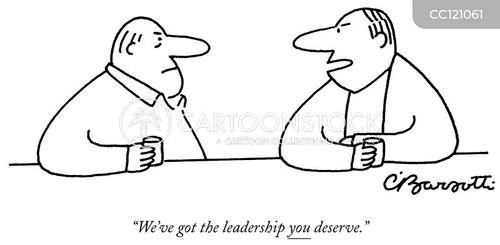
Cartoon – Modern Decision Making


President Trump said at a Fox News town hall Tuesday that he would “love” to have the country “opened up, and just raring to go” by Easter, or April 12, despite warnings from public health officials that easing social distancing restrictions too soon could cause the number of coronavirus cases to skyrocket.
New York City Mayor Bill de Blasio told a news conference Tuesday he plans to release from Rikers Island some 300 nonviolent inmates who are over 70 years old as a measure against the novel coronavirus pandemic.
The USS Theodore Roosevelt reported three cases of sailors contracting COVID-19 Tuesday, Navy officials said at a briefing — marking the first U.S. sailors to test positive aboard a Navy ship while at sea.
A minor died from the novel coronavirus in Los Angeles County, California, the county’s health department said Tuesday, although it later said that “there may be an alternate explanation” for the death of a California teenager whose “early tests indicated a positive result for COVID-19.”
The trade groups representing hospitals, doctors and nurses called on the public today to stay at home to slow the spread of the new coronavirus.
Up to 5,000 students will be allowed to return to Liberty University’s campus this week, as the Lynchburg, Virginia, college bucks the national trend of school closures.
https://www.axios.com/new-york-battle-coronavirus-58626845-3b0f-4afb-89e7-12be2346396b.html
New York’s fight against the novel coronavirus is also the nation’s fight, as the state — and the city in particular — emerges with “astronomical numbers” of cases, to quote Gov. Andrew Cuomo.
Why it matters: The Empire State has 5% of the world’s COVID-19 cases and about 50% of the nation’s. Its success — or failure — in fighting the virus, safeguarding citizens and treating the afflicted will tell us a lot about what can succeed in the rest of the U.S.
It’s a national travel hub, so it could be the catalyst for outbreaks elsewhere.
Cuomo is trying to shut the state down and stop the spread.
A pivotal moment: Cuomo spoke passionately at a press conference Tuesday about the importance of devoting all resources to New York’s rapidly escalating caseload.
Later in the day, at a media briefing by the White House coronavirus task force, the White House advised people who had recently left New York City to self-quarantine for 14 days.
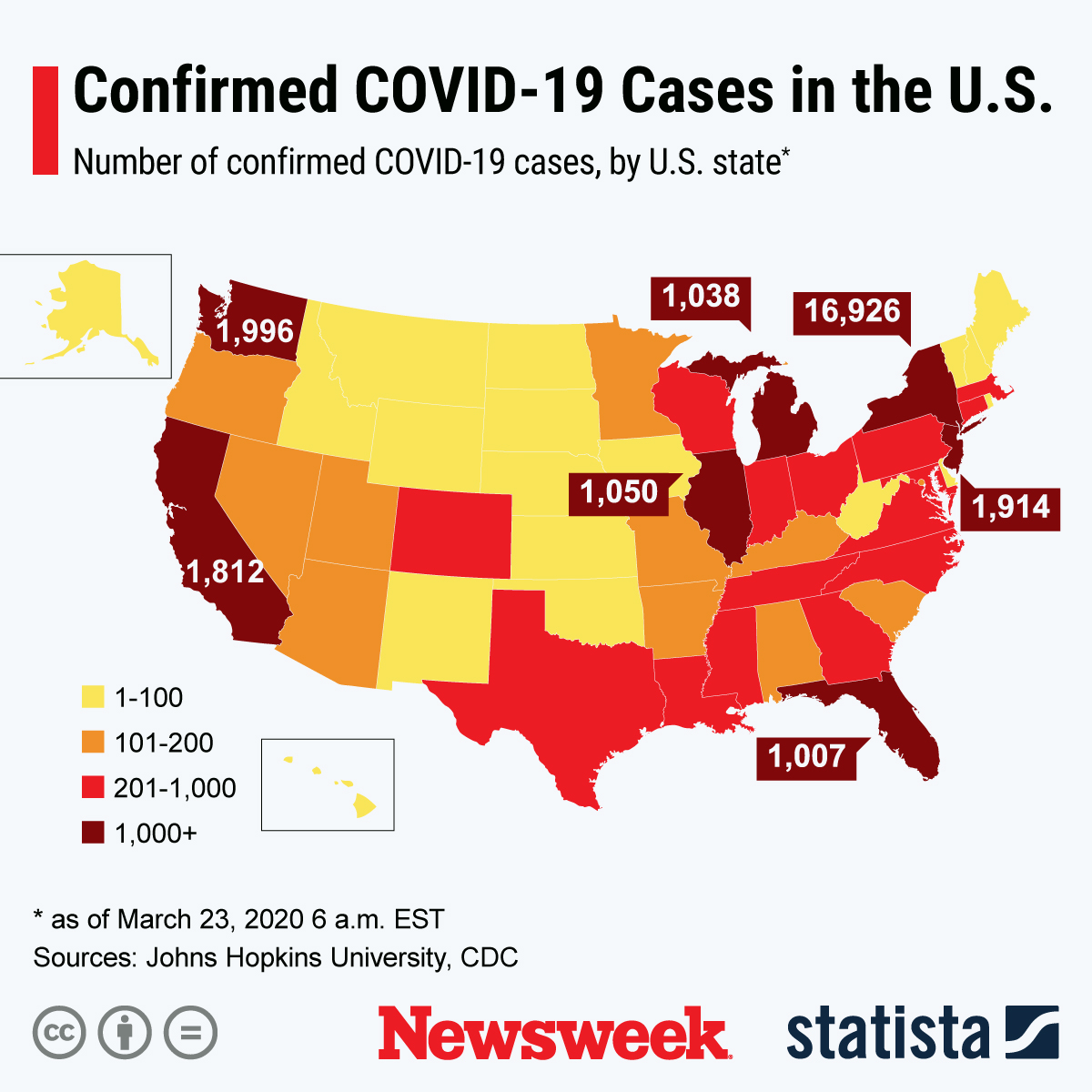
By the numbers: New York has 25,000 cases of the novel coronavirus, vs. 2,800 in California, 2,200 in Washington state and 1,200 in Florida, Cuomo said.
New York is throwing everything against the wall. Not only have residents been told to stay home whenever possible — and schools and most retail stores are closed — but the state is also trying experimental treatments and testing far more people for the virus than other places in the U.S.
“What happens in New York, we can expect to see in other cities around the world, but maybe not at the same scale,” Denis Nash, an epidemiologist at City University of New York’s school of public health, told Axios.
Be smart: Population density, which a New York Times headline called a “trait defining New York life,” is the reason the Big Apple has become the U.S. focal point.
As the densest city in the country, “New York is really a testing ground” for ways to fight the coronavirus, Tomas Hoyos, co-founder of Voro, an online social network where people share recommendations for doctors, told Axios.
My thought bubble: As a born-and-bred New Yorker who watched from my office window as the second plane hit the Twin Towers on 9/11, I find eerie similarities between the empty streets I see this week — and the constant wail of emergency sirens — and the days after the terror attacks.

If President Trump follows through on his statements that he wants to “open” the U.S. up again, an already patchwork shield of state “stay at home” orders could look like even more of a patchwork, Axios’ David Nather reports.
The big picture: Just 17 states have ordered people to stay at home, and most of those are states with Democratic governors. Only Ohio, Indiana, Massachusetts and West Virginia have Republican governors.
Between the lines: Some Republican governors, like Greg Abbott of Texas, have resisted calls to issue statewide stay-at-home orders, leaving it to cities and counties to issue their own restrictions.
The bottom line: The “mitigation strategy” of social distancing urged by health experts has been uneven throughout the U.S. — and it’s likely to get more uneven.
The U.S. keeps reacting too late to the novel coronavirus, prolonging its economic pain and multiplying its toll on Americans’ health.
Why it matters: The spread and impact of the coronavirus may be unfathomable, but it’s not unpredictable. And yet the U.S. has failed to respond accordingly over and over again.
First, it happened with testing — a delay that allowed the virus to spread undetected.
Between the lines: Proactive containment and mitigation steps would have required extraordinary political and economic capital, especially if they had come early in the process, when many Americans didn’t grasp the full weight of this challenge.
Now, even as testing and hospital capacity remain limited, President Trump is eager for an economic recovery — even though, by all estimates, the outbreak is only going to get worse.
The bottom line: When I asked one senior Health and Human Services official how all of this keeps happening, the official said it’s at least partially due to disconnects — between Trump and his administration; between the government and the private sector, and between the U.S. and the rest of the world.

President Trump is eager to ease off of stringent coronavirus mitigation steps “soon,” he said yesterday, but that would have a calamitous impact on Americans’ health — and it’s not clear how much it would help the economy, either.
Why it matters: For now, the only way to avoid large numbers of deaths is to keep people away from each other to stop the virus’ spread. And as long as the coronavirus is spreading, it’s likely to hurt the economy.
Driving the news: “This is a medical problem. We are not going to let it turn into a long-lasting financial problem,” Trump said in a press conference yesterday.
Between the lines: Missing from Trump’s rhetoric is any real acknowledgement that the situation is going to get worse in the near term.
“A policy of returning people to work too soon should be called the ‘let old people die already’ policy,“ a former Trump administration official told me.
The big picture: The number of confirmed U.S. cases is still rising at an alarming rate — and that’s not counting the thousands who have it but are unable to get tested.
Reality check: The choice between saving lives and saving the economy may not even be a real one.
 HENRY KOTULA