While many hospitals face financial hardships and rising expenses from the COVID-19 pandemic, several large health systems ended 2021 with profits above $1 billion.
These big health systems attributed the financial performance to several factors, including bigger investment gains and higher-acuity patients.
Seven health systems that posted net income of $1 billion last year:
1. Pittsburgh-based UPMC, an integrated delivery system with 40 hospitals, recorded a net income of $1.1 billion in 2021, driven by an operating income of $843 million and nonoperating gains of $810 million.
2. AdventHealth, a 48-hospital system based in Altamonte Springs, Fla., recorded a net income of $1.5 billion in 2021. The net income included an operating income of $994.6 million and investment gains of $517.7 million. In 2020, the health system’s net income was $914.8 million.
3. Cleveland Clinicreported a 66.7 percent increase in net income for the 12 months ended Dec. 31. The 19-hospital system saw its net income hit $2.2 billion, including an operating income of $746.3 million and investment gains of $1.4 billion.
4. Rochester, Minn.-based Mayo Clinic’s net income for 2021 was $3.6 billion, up from $2.5 billion a year earlier. The results included an operating income of $1.2 billion.
5. Driven by strong investment gains, Oakland, Calif.-based Kaiser Permanenterecorded a net income of $8.1 billion in 2021, an increase of $1.7 billion from 2020. The sharp rise in net income from the integrated delivery system with 39 hospitals included $7.5 billion in other income, including investment gains, and $611 million in operating income for 2021.
6. Nashville, Tenn.-based HCA Healthcare, a 182-hospital system, reported a net income of $7.7 billion in 2021, including investment gains and operating profits.
7. Tenet Healthcare, a 60-hospital system based in Dallas, reported net income of $1.5 billion on revenues of $19.5 billion in 2021. Tenet ended the 12-month period with an operating income of $2.9 billion, up from $2 billion recorded one year before. It also recorded losses on nonoperating activities and said its results for the year ending Dec. 31 included a pretax gain of $406 million associated with the divestiture of five Miami area hospitals, as well as stimulus funds totaling $205 million.
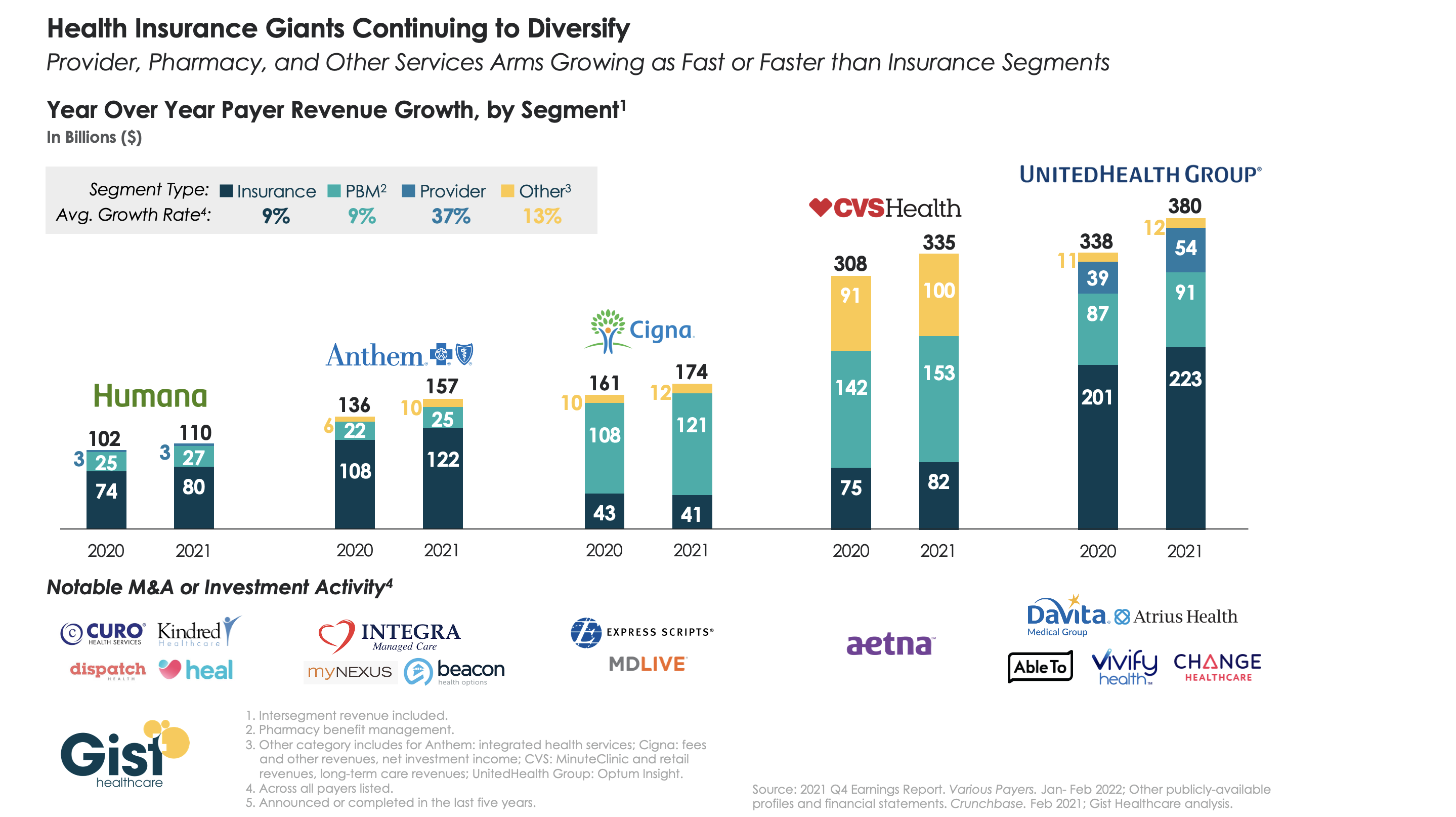
The largest health insurers are quickly becoming vertically integrated healthcare organizations that span the care and coverage continuum. While 2021 was a mixed year for these companies as healthcare volumes bounced back, their diversified portfolios helped cushion losses from higher claims.
The graphic above analyzes revenue growth by segment for the five largest insurers across the last two years. On averagethe insurance and pharmacy benefit management components of the companies grew at nine percent, while care delivery and integrated health services grew at much higher rates. UnitedHealth Group (UHG) and Anthem boasted the highest year-over-year revenue growth, driven by UHG’s Optum subsidiary and Anthem’s integrated health services.
Cigna and CVS Health each earned less than a quarter of their total revenue from their insurance arms lastyear. While Humana lags the others in topline revenue, it has assembled a robust portfolio of care delivery investments and partnerships, surpassed only by UHG.
As antitrust scrutiny on vertical integration increases (case in point: the DOJ is now challenging UHG’s acquisition of Change Healthcare), insurers will face the hard task of integrating their portfolio of service—and demonstrating that they deliver value to consumers and patients.
DOJ alleges that allowing UHG’s Optum subsidiary to acquire Change, a direct competitor used by most large commercial insurers for healthcare claims solutions, would give UHG 75 percent of the healthcare claims processing and management market. This would significantly reduce competition, the DOJ claims, while simultaneously giving UHG access to its competitors’ sensitive plan design and pricing information. UHG called the DOJ’s position ‘deeply flawed’ and promised to fight the case.
The Gist: This is the second big move by antitrust regulators in a week to put the brakes on consolidation in healthcare: shortly after the DOJ sued to block Rhode Island’s two largest health systems, Care New England and Lifespan, from merging, those systems abandoned plans to combine.
We are seeing the first real signs that the Biden administration is following through on plans to more closely scrutinize healthcare deals, including payer-led vertical integration. For both payers and providers, increased scrutiny will place a premium on the consumer value proposition of any combination—and force merging companies to deliver on the benefits of scale.
The Federal Trade Commission is suing to block Rhode Island’s two largest health systems from merging, alleging the tie-up between Lifespan and Care New England would increase prices and diminish the quality of care.
In the state’s own review, Rhode Island’s attorney general said the union would result in “extraordinary market power” and denied the merger application under state law that requires a review of such tie-ups. Rhode Island’s attorney general will join FTC’s federal lawsuit seeking to block the deal.
The FTC alleges that, together, Lifespan and Care New England would control at least 70% of Rhode Island’s market for inpatient hospital services and also reduce competition in several nearby Massachusetts communities.
Dive Insight:
The union between Lifespan, the state’s largest health system, and Care New England, the second largest, quickly raised alarms in Rhode Island.
A 25-page report from the state’s insurance department found that the merger would “significantly alter” the state’s healthcare market, which currently enjoys a “relatively competitive” market. State regulators were also concerned about the control the new system would have over physician services. Given these risks, the state insurance commissioner proposed a set of conditions on the deal including price caps. Health system executives were open to working under certain conditions.
However, executives seemed surprise by Thursday’s announcement that the deal to create an integrated academic medical system with Brown University at the forefront would be blocked.
“On four separate occasions in prior years, the FTC reviewed the same proposed merger and allowed it to proceed,” a joint statement released Thursday said. The management teams said they offered up 30 conditions to regulators to satisfy antitrust concerns about the merger, “but neither the FTC or the AG ever discussed these conditions or others with the two systems prior to today’s decisions,” according to the statement.
After flirting with the idea of combining the systems for years, Lifespan and Care New England inked a deal to merge last February after the coronavirus pandemic revived talks.
The two touted the deal as a way to create an integrated academic health system with Brown University’s medical school in a central role. Brown University committed $125 million to the creation of the new system.
However, FTC commissioners voted unanimously to block the union over concerns it would extinguish competition between the two.
And although regulators have long leaned on the argument that hospital mergers lead to higher prices, a joint letter from FTC Chair Lina Khan and Commissioner Rebecca Kelly Slaughter points to the harmful effects consolidation has on labor markets, an argument growing in importance within the agency.
“Just as we want firms to compete with each other to sell goods and services to their customers, we want employers to compete with each other to attract and retain workers,” the letter states. “Indeed, there is a growing body of empirical research about the potential for competitive harm to labor markets from consolidation and concentration.”
The news follows reports that the Department of Justice is preparing to sue to stop UnitedHealth Group’s blockbuster acquisition of Change Healthcare, a healthcare technology firm. Concerned about the “massive consolidation” of healthcare data, the American Hospital Association urged antitrust regulators to thoroughly examine the proposed transaction in a letter sent to DOJ last spring.
After taking office, President Joe Biden has signaled his administration would take an aggressive antitrust stance, including getting tough on hospital mergers. Last summer, the president issued an executive order that called on antitrust regulators to “review and revise” merger guidelines to ensure patients are not harmed by proposed deals.
Biden specifically called out the healthcare industry, rife with consolidation and accompanying research that shows hospital unions lead to higher prices.
“Thanks to unchecked mergers, the ten largest healthcare systems now control a quarter of the market,” the release from the White House said.
Still, the FTC has become overwhelmed by the sheer number of proposed transactions. In August, the agency said it was hit by a “tidal wave” of merger filings and warned applicants it may not vet all submissions before the applicable deadlines. But in letters sent to merging companies, the FTC warned the delay should not be interpreted as a green light for any deal.
“Companies that choose to proceed with transactions that have not been fully investigated are doing so at their own risk,” the regulator said in a statement.
Los Angeles-based Prospect Medical Holdings has inked deals to sell its seven hospitals in Connecticut and Pennsylvania.
The company announced Feb. 10 that it is selling three Connecticut hospitals with a combined 708 beds to Yale New Haven (Conn.) Health System. The deal is expected to close later this year. If the deal is finalized, the hospitals will transition from for-profit to nonprofit organizations.
Prospect Medical Holdings announced Feb. 11 that it is selling Crozer Health, a four-hospital system based in Springfield, Pa., to Newark, Del.-based ChristianaCare. Under the deal, ChristianaCare would acquire Crozer’s hospitals, medical group, ambulatory centers and clinics. Crozer’s hospitals have more than 800 beds combinded.
The deal with ChristianaCare was announced the same day Crozer got a new CEO. The health system appointedKevin Spiegel, senior vice president of strategy and revenue development at Prospect, as its new CEO. He replaced Peter Adamo, who served in that role at Crozer for two years. Mr. Adamo’s last day at Crozer was Feb. 11, according to the Philadelphia Business Journal.
“The pandemic has demonstrated the vital importance of working together to meet the clinical needs of the communities we serve,” Mr. Spiegel said in a Feb. 11 news release. “We are excited by the potential to join these two great organizations so that we can continue to provide the high-quality, accessible care that our communities — Delaware County and beyond — rely on.”
The sale of the hospitals to ChristianaCare is expected to close in the second half of this year. If the deal is finalized, Crozer would become a nonprofit organization.









 HENRY KOTULA