It will be darkest before dawn

https://mailchi.mp/e38b070b8787/the-weekly-gist-december-18-2020?e=d1e747d2d8

It's Always Darkest Before The Dawn – Peter Scott

But first, we have a difficult period to get through. This week again saw record-breaking numbers of cases, hospitalizations, and deaths from COVID-19, with Thursday alone bringing more than 238,000 new cases—and a staggering 3,293 fatalities.

Nearly 115,000 Americans are currently hospitalized with COVID, a rise of 16 percent from just two weeks ago, and in many places a precarious capacity situation has turned perilous. Conditions have worsened precipitously in California, with only Tennessee, Oklahoma, and Rhode Island registering more daily COVID cases per 100,000 population than the Golden State, although cases are still on the rise across 80 percent of states and territories.

 Intensive care availability in Southern California hit zero, with ICU volume there expected to double or triple by this time next month. The same stresses are playing out in dozens of markets across the country, leading to a staffing sustainability crisis that can’t be solved through paying overtime, cancelling vacations or looking to travel nurses to fill the gaps in a now nationwide crisis. With the Christmas and New Year’s holidays still ahead, experts predict COVID cases won’t peak until sometime in mid-January, with a peak in hospitalizations and deaths following several weeks after.

Several states and cities tightened restrictions on gatherings and issued new stay-at-home orders, in an effort to keep new cases at a level that allows hospitals to manage through the next several weeks and maintain care quality and access for COVID and non-COVID patients alike. The coming weeks will require every American to take greater precautions than at any time during the course of this pandemic.

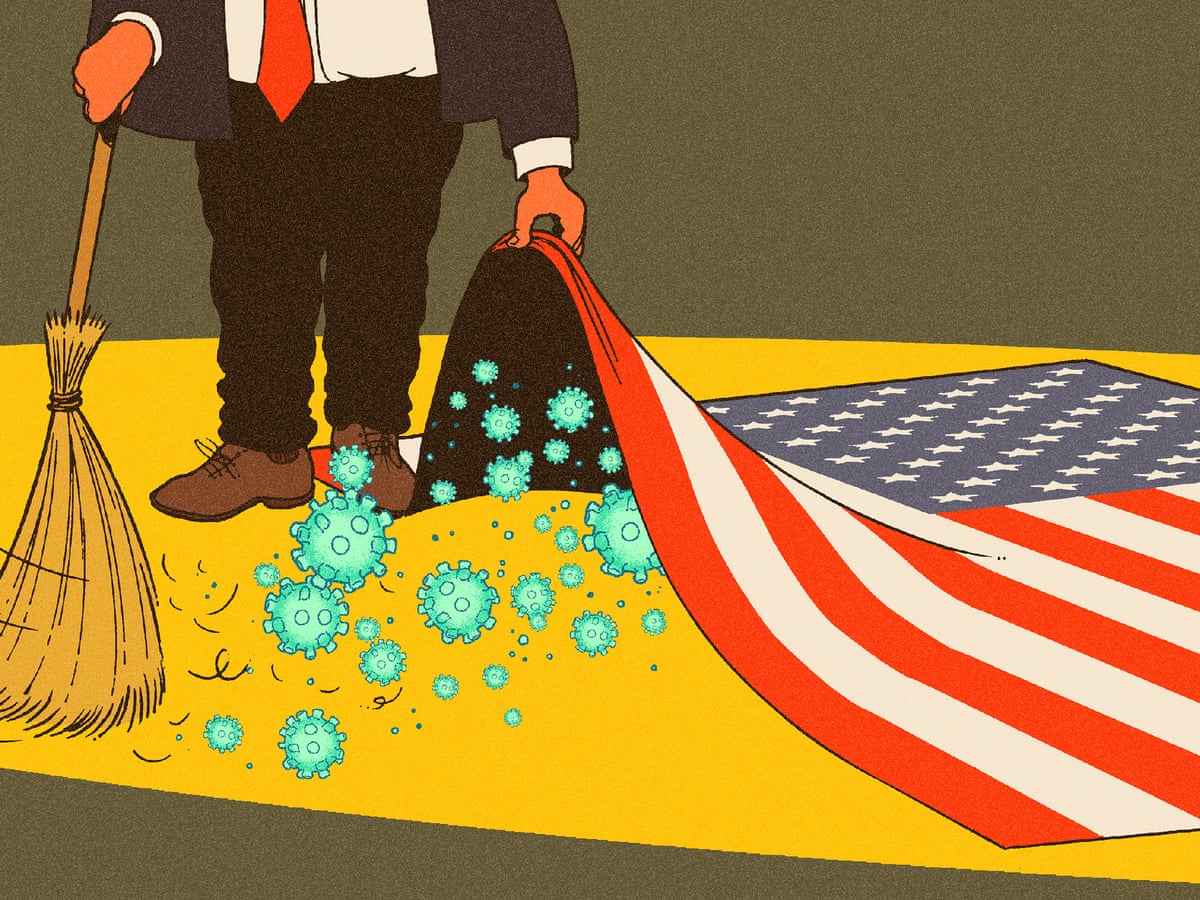
Cartoon – 2020 Sign of the Times

Cartoon – War on the Truth

Donald Trump's war on coronavirus is just his latest war on truth |  Jonathan Freedland | Opinion | The Guardian

Cartoon – Virus or a Hoax?

Beware conspiracy theories on coronavirus | Editorial - South Florida Sun  Sentinel - South Florida Sun-Sentinel

Cartoon – Do You Believe in Magic?

There's much blame for Florida teen's COVID death | COMMENTARY - Baltimore  Sun

U.S. Hits Highest 1-Day Toll From Coronavirus With 3,054 Deaths

https://www.npr.org/sections/coronavirus-live-updates/2020/12/09/944844088/u-s-hits-highest-one-day-death-toll-from-coronavirus-with-3-054?fbclid=IwAR0mP-0McBNWX43iXLzLWIJyQmI8dR73ChPEg98YtDAS6F1DI_36ZOpjnA4

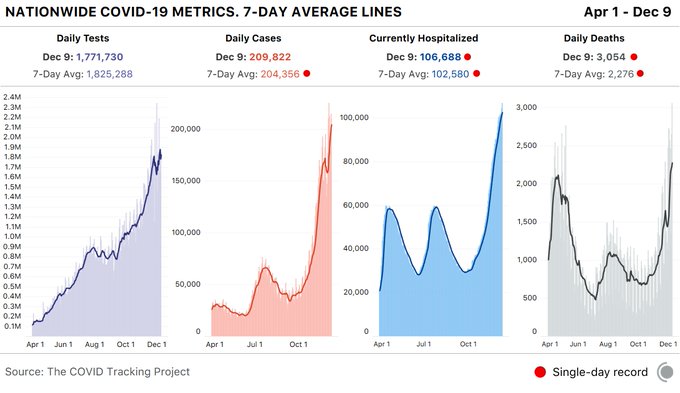
4 bar charts showing key COVID-19 metrics for the US over time. Today, states reported 1.8M tests, 210k cases, 106,668 currently hospitalized (record), and 3,054 deaths (record).

The coronavirus pandemic pushed the U.S. past another dire milestone Wednesday, the highest daily death toll to date, even while the mortality rate has decreased as health experts learn more about the disease.

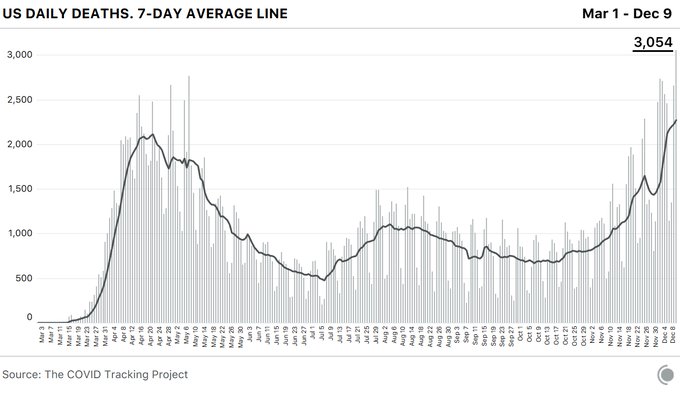
The Covid Tracking Project, which tracks state-level coronavirus data, reported 3,054 COVID-19 related deaths — a significant jump from the previous single-day record of 2,769 on May 7.

The spread of the disease has shattered another record with 106,688 COVID-19 patients in U.S. hospitals. And overall, states reported 1.8 million tests and 210,000 cases. According to the group, the spike represents more than a 10% increase in cases over the last 7 days.

Additionally, California nearly topped its single-day case record at 30,851. It is the second highest case count since December 6, the organization reported.

Chart showing COVID-19 deaths over time by day. Deaths hit a record high today (Dec 9) at 3,054.

The staggering spike in fatalities and infections has overwhelmed hospitals and intensive care units across the nation, an increase attributed by many experts to people relaxing their precautions at Thanksgiving.

2020, in 12 photographs

Dean Baquet, The Times’s executive editor, believes that 2020 will go down as a signature year in history, alongside years like 1968, 1945 and 1865. “It will long be remembered and studied as a time when more than 1.5 million people globally died during a pandemic, racial unrest gripped the world, and democracy itself faced extraordinary tests,” he writes.
Those words come from Dean’s introduction to The Times’s annual Year in Pictures feature. Here, my colleagues on The Morning and I have chosen a dozen of those pictures that we think best summarize 2020. But we obviously have room here for only a fraction of the year’s photographs — so I encourage you to check out the full selection.
As you do, ask yourself which pictures you would have selected if you had to pick only 12 to sum up 2020.
Early in the year, the virus hit Western Europe harder than any other place in the world. In March, a coronavirus patient was examined at his home in Cenate Sotto, Italy.
The pandemic forced people to find new ways to socialize. Circles painted on the grass at Domino Park in Brooklyn helped people spend time safely outdoors in May.
Donald Trump became only the fourth elected president in the last century not to win re-election, joining Herbert Hoover, Jimmy Carter and George H.W. Bush. Trump departed Air Force One in August after returning from a campaign rally.
Joe Biden struggled badly early in the Democratic primaries, only to rally to win the nomination and the presidency. He prayed at the Corinthian Baptist Church in Des Moines in January.
Climate change wrought destruction on the planet in multiple ways during 2020. In Azusa, Calif., a wildfire burned more than 4,200 acres during the most active wildfire year on record for the West Coast.
The killing of George Floyd in May inspired mass demonstrations against police brutality across the country. In Minneapolis, officers confronted protesters on May 31.
Protesters marched in New York in June as anger spread across the country.
Around the world, people spent far more time at home this year than usual. In São Paulo, Brazil, residents gathered at their windows in March to protest the government’s pandemic response.
The pandemic led to a sharp economic downturn in much of the world. In May, people lined up for food distribution at a church in Brooklyn.
More than 1.5 million people around the world have died from Covid complications. Mourners gathered in April at a cemetery in Brazil where workers were busy digging lines of open graves.
Amid illness, death and separation in 2020, people also experienced great joys — even if they sometimes required adaptation. In April, Precious Anderson, a Covid-19 patient, was shown her newborn baby for the first time with the help of a live video feed at a hospital in Brooklyn.

Again, you can find the full Year in Pictures here.

The vaccine as a fire hose

The vaccine news continues to seem very encouraging. Britain started its mass vaccination effort today, and the U.S. isn’t far behind.
But there is still one dark cloud hanging over the vaccines that many people don’t yet understand.
The vaccines will be much less effective at preventing death and illness in 2021 if they are introduced into a population where the coronavirus is raging — as is now the case in the U.S. That’s the central argument of a new paper in the journal Health Affairs. (One of the authors is Dr. Rochelle Walensky of Massachusetts General Hospital, whom President-elect Joe Biden has chosen to run the Centers for Disease Control and Prevention.)
An analogy may be helpful here. A vaccine is like a fire hose. A vaccine that’s 95 percent effective, as Moderna’s and Pfizer’s versions appear to be, is a powerful fire hose. But the size of a fire is still a bigger determinant of how much destruction occurs.
I asked the authors of the Health Affairs study to put their findings into terms that we nonscientists could understand, and they were kind enough to do so. The estimates are fairly stunning:
At the current level of infection in the U.S. (about 200,000 confirmed new infections per day), a vaccine that is 95 percent effective — distributed at the expected pace — would still leave a terrible toll in the six months after it was introduced. Almost 10 million or so Americans would contract the virus, and more than 160,000 would die.
This is far worse than the toll in an alternate universe in which the vaccine was only 50 percent effective but the U.S. had reduced the infection rate to its level in early September (about 35,000 new daily cases). In that scenario, the death toll in the next six months would be kept to about 60,000.
It’s worth pausing for a moment on this comparison, because it’s deeply counterintuitive. If the U.S. had maintained its infection rate from September and Moderna and Pfizer had announced this fall that their vaccines were only 50 percent effective, a lot of people would have freaked out.
But the reality we have is actually worse.
How could this be? No vaccine can eliminate a pandemic immediately, just as no fire hose can put out a forest fire. While the vaccine is being distributed, the virus continues to do damage. “Bluntly stated, we’ll get out of this pandemic faster if we give the vaccine less work to do,” A. David Paltiel, one of the Health Affairs authors and a professor at the Yale School of Public Health, told me.
There is one positive way to look at this: Measures that reduce the virus’s spread — like mask-wearingsocial distancing and rapid-result testing — can still have profound consequences. They can save more than 100,000 lives in coming months.

In the past seven days, 15,813 people in the U.S. died from the virus, breaking a record that had stood since mid-April.

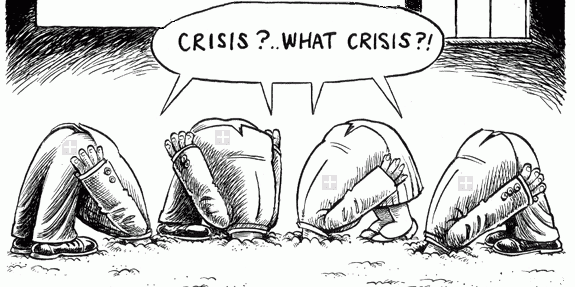
Cartoon – Crisis? What Crisis?

Bury your head in the sand