Vaccine skepticism and disregard for containment efforts go hand in hand

It seems pretty clear the path the United States is on. Within a few months, everyone who wants to be vaccinated against the coronavirus will be, save for those below the minimum age for which vaccines are available. For everyone else, the pandemic Wild West will continue, with the country hopefully somewhere near the level of immunity that will keep the virus from spreading wildly but with large parts of the population — again, including kids — susceptible to infection.

That really gets at one of the two outstanding questions: How many Americans won’t get the vaccine? If the figure is fairly low, the ability of the virus to spread will be far lower. If it’s high, we have a problem. And that’s the other outstanding question: How big of a problem will the virus be, moving forward?

We know that even as vaccines are being rolled out, cases are slowly climbing. While the number of new infections recorded each day is well off the highs seen in the winter, we’re still averaging more cases on a daily basis than we saw even a month into the third wave that began in September. A lot of people are still getting sick, and, even with most elderly Americans now protected with vaccine, a lot more people will probably die.

Data released by Gallup this week shows that both of the questions posed above share a common component. It is, as you probably suspected, those who are least willing to get vaccinated who are also least likely to take steps to contain the virus.

Gallup asked Americans about their vaccination status, finding that about a fifth had been fully vaccinated and an additional 13 percent partially vaccinated. More than a quarter of respondents, though, said they didn’t plan to get vaccinated. It was those in that latter group who were least likely to say that they were completely or mostly isolating in an effort to prevent the virus spreading.

It was also those skeptics who were least likely to say that, in the past seven days, they had avoided crowds, group gatherings or travel. If you’re not inclined to get vaccinated, it is at least consistent that you would be similarly disinclined to take other steps aimed at limiting the spread of the virus.

Gallup didn’t break out those groups by party, but it’s clear that few of them are Democrats. Data from YouGov, compiled on behalf of Yahoo News, shows that Democrats (and those who voted for Joe Biden in particular) are more likely to say that they have already received a vaccine dose.
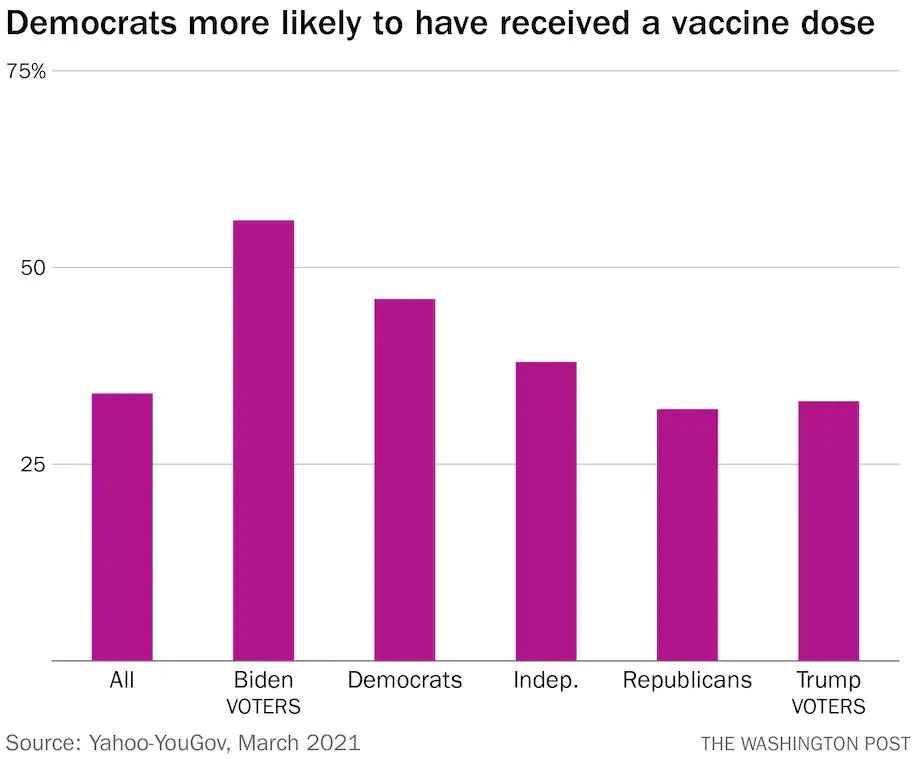
Among those who hadn’t yet received a dose, Democrats were far more likely to indicate that they planned to do so as soon as possible. Among Republicans, half of those who haven’t been vaccinated say that they don’t have any plans to do so at all.

One reason is that Republicans are simply less worried about the virus. More than half say that they’re not very worried about it or not worried at all. Among those who voted for Donald Trump, the figure is over two-thirds. By contrast, more than three-quarters of Democrats say that they are at least somewhat worried about the virus.
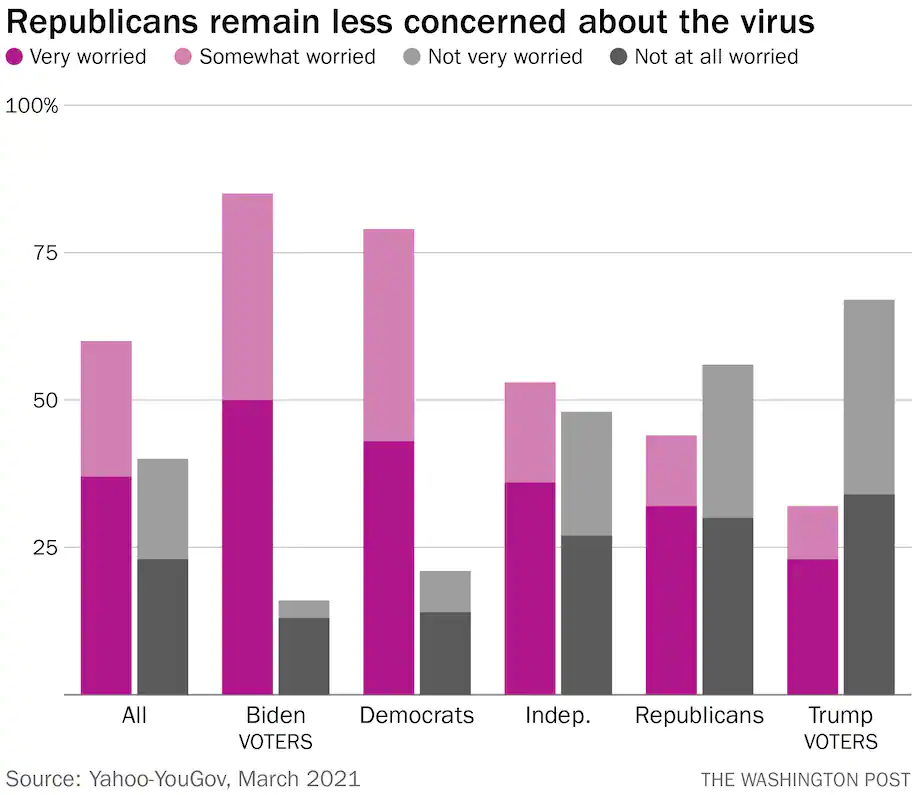
In the YouGov polling, 60 percent of Republicans say that the worst of the pandemic is behind us. They’re also much more likely to say that restrictions aimed at preventing the spread of the virus — mask mandates, limits on indoor dining — should be lifted immediately.

As we mentioned Thursday, there are two ways to achieve herd immunity. One is fast and safe: widespread vaccinations. The other — people contracting the virus — is slow and dangerous. The path the United States is on will take us to a place where much of the country has opted for the first option and the rest, the latter.

So the question again becomes: How many people will die, both over the short term and the long term, as a result of those choices?

Experts take pro-vaccine message to right-wing skeptics

Experts take pro-vaccine message to right-wing skeptics

Stick your vaccine up your arse' – the Covid-19 vaccine, the science and  the sceptics

Top public health experts and officials are developing new strategies to reach out to the conservatives most skeptical of or hesitant about receiving a coronavirus vaccine.

The efforts are targeting supporters of former President Trump, who have emerged as the most significant hurdle to widespread vaccination.

The officials and experts are making appearances on Fox News and Newsmax and taking part on panels with prominent conservative politicians to reach out to vaccine skeptics on the right.

And the public health experts are not taking an antagonistic approach either. They say many conservatives have legitimate questions about COVID-19 vaccinations that are worth listening to and answering.

“These are folks who really feel disrespected. They feel that COVID and the vaccines and the response has been politicized and weaponized, in their words,” said Tom Frieden, the former director of the Centers for Disease Control and Prevention under President Obama. “They feel deeply alienated from the government.”

Up to now, the main problem with increasing vaccinations has been one of supply and demand, but administration officials expect that to change shortly. 

“We are approaching the point where we will have a sufficient supply of vaccines for everybody in the United States to have the chance to get immunized by the end of May,” Francis Collins, director of the National Institutes of Health (NIH), said in an interview with The Hill on Wednesday. 

At that point, convincing skeptical conservatives to get a shot could mean the difference between the U.S. achieving herd immunity and resuming normal life or variants of COVID-19 getting second and third winds, leading to new lockdowns or restrictions on life.

As Collins puts it, “the hesitancy will begin to become the defining factor on whether we reach herd immunity or not.”

“I think that means this has to be the moment where we really pull into this conversation all of the trustworthy voices,” he added.

A recent CBS poll found a third of Republicans said they would not be vaccinated, compared to 10 percent of Democrats. A “PBS NewsHour” poll showed similar results: Nearly half of U.S. men who identify as Republicans said they have no plans to get vaccinated.

The underlying mistrust comes after a year in which Trump and his allies played down the severity of a virus that has killed more than half a million Americans already. 

Circumstances have conspired to allow that skepticism to grow: The coronavirus arrived later in more rural, conservative enclaves than it did in liberal metropolitan areas like Seattle, New York and Detroit, giving some the sense that they had been locked out of the economy to protect against a virus that was not yet present in their community.

Julie Morita, executive vice president of the Robert Wood Johnson Foundation, who advised the Biden transition team on COVID-19 issues, said she has been surprised to see how political vaccine hesitancy has become.

In the past, Morita said, public health officials have focused on race and ethnicity. “We didn’t really look at politics or political affiliation,” she said.

Morita said her message remains the same, but that she has had to focus on where to deliver it. She recently co-wrote a Fox News op-ed answering some of the common questions about the available COVID-19 vaccines and urging people to get the shots when they’re available.

“Whether you’re a community of color, or whether you’re a conservative, these are the questions that people ask and want to have the answers to before they get vaccinated,” Morita said. “I don’t feel like that’s a shifted message as much as maybe we’re just able to get it into a more conservative news outlet.”

Convincing a group of people who did not vote for the president presents a challenge to a Democratic administration. So President Biden has been outsourcing the message. 

Appearing on Hugh Hewitt’s radio show this week, Anthony Fauci, the director of the National Institute for Allergy and Infectious Diseases, said he doesn’t shy away from conservative outlets that may not be friendly.

“I say yes to a wide variety of requests. I’ve been on Fox multiple times, so I don’t shy away from that, no,” Fauci said.

Health officials are increasingly convinced that successful messaging is not going to come from politicians or government officials but from doctors, clergy and trusted community leaders.

Last month, Frieden participated in focus groups with vaccine-hesitant Republican voters led by veteran GOP pollster Frank Luntz. 

The groups, first reported by The Washington Post, showed vaccine-hesitant conservatives were not swayed by Republican politicians like House Minority Leader Kevin McCarthy (Calif.) or former New Jersey Gov. Chris Christie — or even by Trump himself. 

Instead, Frieden said, the message that moved the hesitant to the accepting hit closer to home: Their doctors took the vaccine when it was offered.

“You listen to the audience, you understand where they are and you address their concerns. And that’s the same thing we have to do for Trump voters who are reluctant to get vaccinated or African Americans or Latinx or vegans who don’t want to get vaccinated,” Frieden said.

Morita said she thinks the same efforts and resources that go into convincing communities of color should also be directed at conservatives.

“High-level government officials espousing the importance of vaccines and sharing their experiences with it is really important but it’s not sufficient,” Morita said. 

Support for Trump and a distrust of the government is not the only reason conservatives might be reluctant to accept the vaccine. Many are concerned about how quickly the vaccines were developed. 

Still others object on religious grounds, which is where Collins, the NIH director, comes in.

A devout Christian who is open about his faith, Collins has become an ambassador to the faith community. He spends hours a day talking to faith leaders, assuring them of the vaccine’s soundness and science.

Collins told The Hill he frames the decision to get vaccinated in religious terms.

“Is this a love your neighbor moment? Yes, it is,” Collins said. “And whatever faith you are, the Golden Rule seems to apply, and the Golden Rule would say, for your neighbor or for your family, for your neighbors down the street who may be vulnerable, this is something you can do for them.”

A stark global vaccine divide

The vaccine divide: Wealthy nations have 23 jabs for every one in a poorer  country | World News | Sky News

Wealthy nations — including the U.S., the U.K. and the EU — have vaccinated their citizens at a rate of one person per second over the last month, while most developing countries still haven’t administered a single shot, according to the People’s Vaccine Alliance.

Why it matters: As higher-income countries aim to achieve herd immunity in a matter of months, most of the world’s vulnerable people will remain unprotected.

  • Experts say that mutations that may arise while the virus spreads could be a danger to us all, vaccinated or not.

The big picture: Even though more vaccines will arrive in developing nations soon, only 3% of people in those countries are likely to be vaccinated by mid-2021.

  • At best, only a fifth of their population will be vaccinated by the end of the year, per the People’s Vaccine Alliance.

What we’re watching: Three dozen countries have bought several times the amount of vaccine that they’ll need to vaccinate their entire population.

  • The U.S. alone has ordered more than a billion extra dosesScience Magazine reports. Global health leaders are saying it’s time to figure out where all of these excess doses will go.
  • “Over the next year or two, U.S. surplus doses and those from other countries could add up to enough to immunize everyone in the many poorer nations that lack any secured COVID-19 vaccine,” Science writes.

The danger of a fourth wave

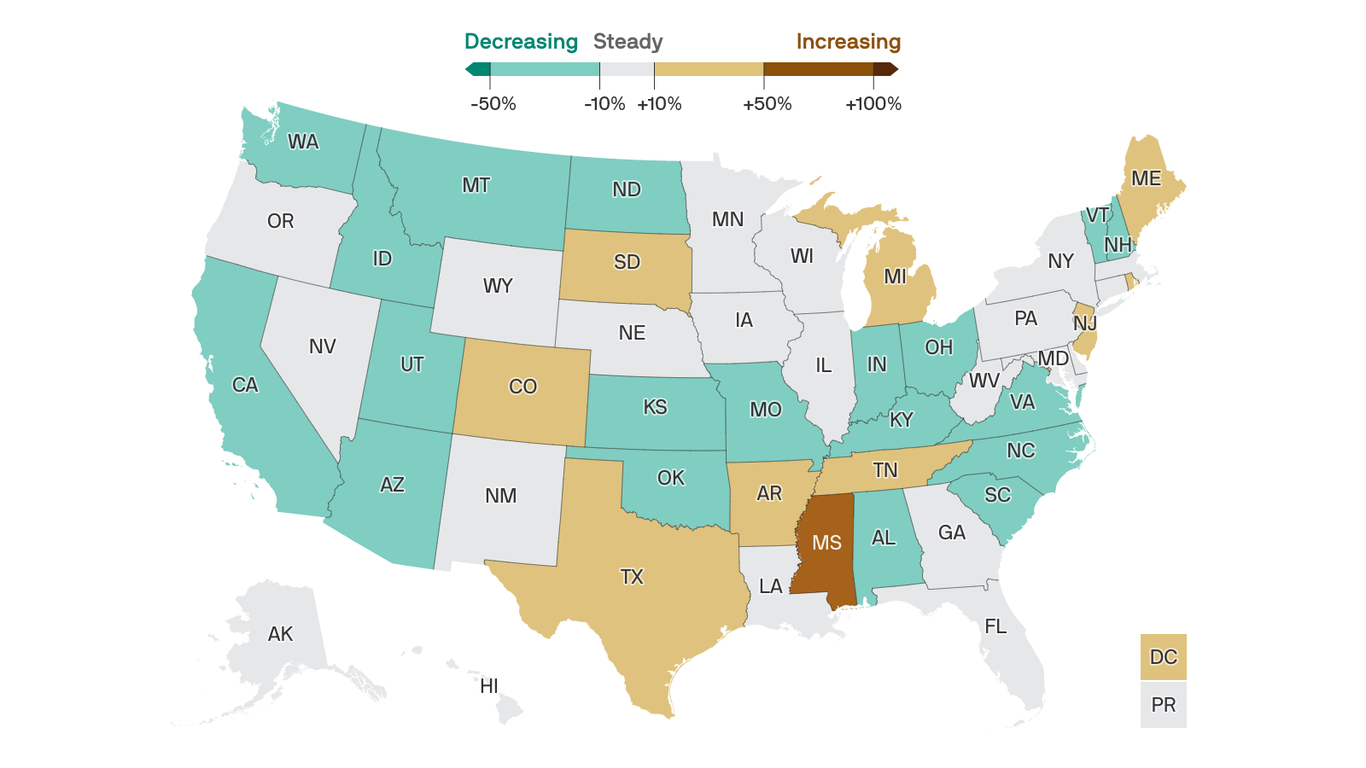
Change in new COVID-19 cases in the past week

Percent change of the 7-day average of new cases

on Feb. 23 and March 2, 2021

The U.S. could be in danger of a fourth coronavirus wave - Axios

The U.S. may be on the verge of another surge in coronavirus cases, despite weeks of good news.

The big picture: Nationwide, progress against the virus has stalled. And some states are ditching their most important public safety measures even as their outbreaks are getting worse.

Where it stands: The U.S. averaged just under 65,000 new cases per day over the past week. That’s essentially unchanged from the week before, ending a six-week streak of double-digit improvements.

  • Although the U.S. has been moving in the right direction, 65,000 cases per day is not a number that indicates the virus is under control. It’s the same caseload the U.S. was seeing last July, at the height of the summer surge in cases and deaths.

What we’re watching: Texas Gov. Greg Abbott on Tuesday rescinded the state’s mask mandate and declared that businesses will be able to operate at full capacity, saying risk-mitigation measures are no longer necessary because of the progress on vaccines.

  • But the risk in Texas is far from over. In fact, its outbreak is growing: New cases in the state rose by 27% over the past week.
  • Mississippi Gov. Tate Reeves also scrapped all business restrictions, along with the state’s mask mandate, on Tuesday. New cases in Mississippi were up 62% over the past week, the biggest jump of any state.
  • The daily average of new daily cases also increased in eight more states, in addition to Mississippi and Texas.

How it works: If Americans let their guard down too soon, we could experience yet another surge — a fourth wave — before the vaccination campaign has had a chance to do its work.

  • The vaccine rollout is moving at breakneck speed. The U.S. should have enough doses for every adult who wants one by May, President Biden said this week.
  • At the same time, however, more contagious variants of the coronavirus are continuing to gain ground, meaning that people who haven’t gotten their vaccines yet may be spreading and contracting the virus even more easily than before.

What’s next: The bigger a foothold those variants can get, the harder it will be to escape COVID-19 — now or in the future.

  • The existing vaccines appear to be less effective against two variants, discovered in South Africa and Brazil, which means the virus could keep circulating even in a world where the vast majority of people are vaccinated.
  • And that means it’s increasingly likely that COVID-19 will never fully go away — that outbreaks may flare up here and there for years, requiring vaccine booster shots as well as renewed protective measures.

The bottom line: Variants emerge when viruses spread widely, which is also how people die.

  • Whatever “the end of the pandemic” looks like — however good it’s possible for things to get — the way to get there is through ramping up vaccinations and continuing to control the virus through masks and social distancing. Not doing those things will only make the future worse.
  • “Getting as many people vaccinated as possible is still the same answer and the same path forward as it was on December 1 or January 1 … but the expected outcome isn’t the same,” Shane Crotty, a virologist at the La Jolla Institute for Immunology in San Diego, told Reuters.

A somber milestone on the path to brighter days ahead

https://mailchi.mp/05e4ff455445/the-weekly-gist-february-26-2021?e=d1e747d2d8

U.S. tops 500,000 COVID-19 deaths | PBS NewsHour

Although the nation reached a grim and long-dreaded milestone on Monday, surpassing 500,000 lives lost to COVID—more than were killed in two World Wars and the Vietnam conflict combined—the news this week was mostly good, as key indicators of the pandemic’s severity continued to rapidly improve.

Over the past two weeks, hospitalizations for COVID were down 30 percent, deaths were down 22 percent, and new cases declined by 32 percent—the lowest levels since late October. This week’s numbers declined somewhat more slowly than last week’s, leading Dr. Rachel Walensky, director of the Centers for Disease Control and Prevention, to caution people against letting their guard down just yet: “Things are tenuous. Now is not the time to relax restrictions.” Of particular concern are new variants of the coronavirus that have emerged in numerous states, including one in New York and another in California, that may be more contagious than the original virus.
 
The best news of the week was surely a report from the Food and Drug Administration (FDA) evaluating the new, single-shot COVID vaccine from Johnson & Johnson (J&J), showing it to be highly effective at preventing severe disease, hospitalization, and death caused by COVID, including variants. On Friday, a panel of outside experts met to assess whether to approve the J&J vaccine for emergency use, which would make it the third in the nation’s arsenal of COVID vaccines. If approved, the vaccine will be rolled out next week, according to the White House, with up to 4M doses available immediately.

The sooner the better: new data show that since vaccinations began in late December, new cases among nursing home residents have fallen more than 80 percent—a hopeful glimpse at the future that lies ahead for the general population once vaccines become widely available.

Enthusiasm for getting Covid vaccine is growing

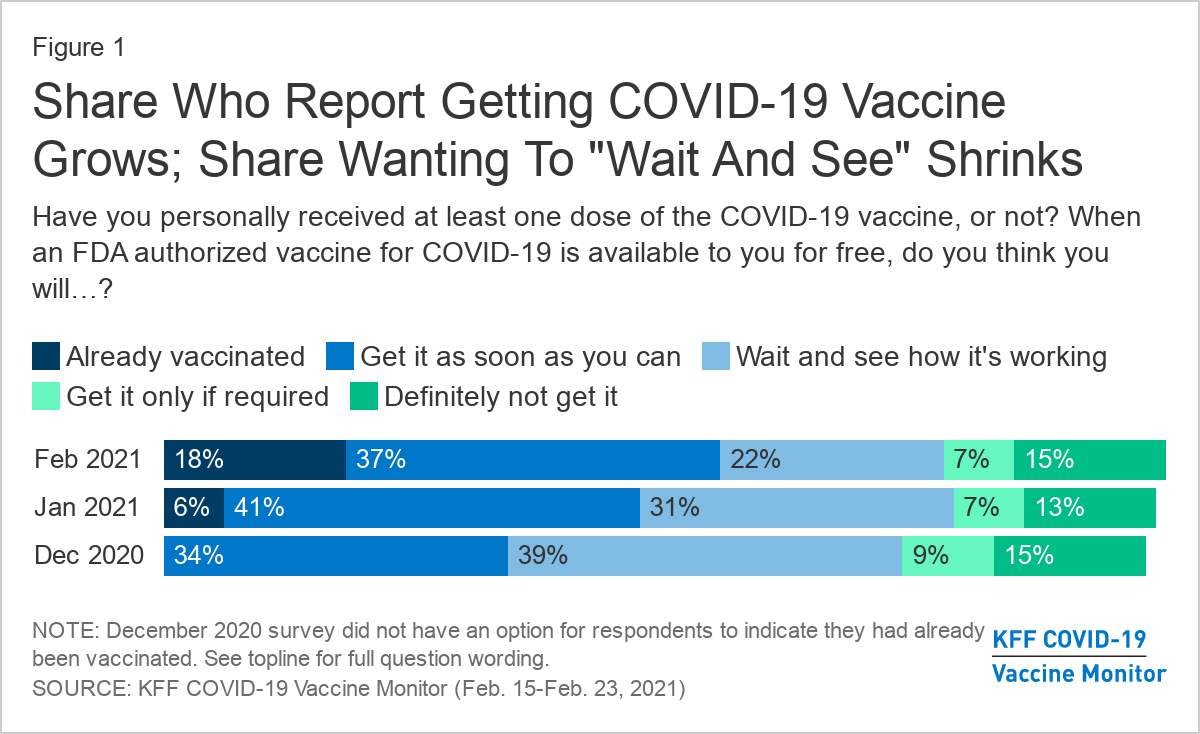
More than half of adults in the U.S. (55%) say they’ve already gotten one dose of Covid-19 vaccine or they’re eager to get one as soon as they can, an increase in acceptance from January (47%), a new poll reports. About 1 in 5 people are waiting to see how the vaccine rollout goes, but don’t rule out vaccination. Another 1 in 5 people are more reluctant: 7% would get vaccinated only if required by work, school, or some other activity, and 15% say no to vaccine under any circumstance. The increase in eagerness spans all demographic groups, but Black adults and young adults under age 30 were most likely to say they want to wait and see.

We look at the need to accelerate the U.S. vaccination program.

Three million shots a day
The Biden administration has been quite cautious in setting its public vaccination goals.
During the transition, officials said they hoped to give shots to one million Americans per day — a level the Trump administration nearly reached in its final days, despite being badly behind its own goals. In President Biden’s first week in office, he raised the target to 1.5 million, although his aides quickly added that it was more of a “hope” than a “goal.” Either way, the country is now giving about 1.7 million shots per day.
I have spent some time recently interviewing public-health experts about what the real goal should be, and I came away with a clear message: The Biden administration is not being ambitious enough about vaccinations, at least not in its public statements.
An appropriate goal, experts say, is three million shots per day — probably by April. At that pace, half of adults would receive their first shot by April and all adults who wanted a shot could receive one by June, saving thousands of lives and allowing normal life to return by midsummer.
Biden struck a somewhat more ambitious tone yesterday, telling CNN that anybody who wanted a vaccine would be able to get one “by the end of July.” But Dr. Anthony Fauci also said that the timeline for when the general population could receive shots was slipping from April to May or June.
The shots are on their way
The key fact is that the delivery of vaccine doses is on the verge of accelerating rapidly. Since December, Moderna and Pfizer have delivered fewer than one million shots per day to the government.
But over the next month and a half, the two companies have promised to deliver at least three million shots per day — and to accelerate the pace to about 3.3 million per day starting in April. Johnson & Johnson is likely to add to that total if, as expected, it receives the go-ahead to start distributing shots in coming weeks.
Very soon, the major issue won’t be supply. It will be logistics: Can the Biden administration and state and local governments administer the shots at close to the same rate that they receive them?
“I’m not hearing a plan,” Dr. Peter Hotez, a vaccine expert at Baylor College of Medicine, told me. “In the public statements, I don’t hear that sense of urgency.”
Bankers’ hours for vaccine clinics
The experts I interviewed said they understood why Biden had set only modest public goals so far. Manufacturing vaccines is complex, and falling short of a high-profile goal would sew doubt during a public-health emergency, as Barry Bloom, a Harvard immunologist, told me. If he were president, Bloom added, he would also want to exceed whatever goal was appearing in the media.
But setting aside public relations, experts say that the appropriate goal is to administer vaccine shots at roughly the same rate that drug makers deliver them — with a short delay, of a week or two, for logistics. Otherwise, millions of doses will languish in storage while Americans are dying and the country remains partially shut down.
“We should be doing more,” Jennifer Nuzzo, an epidemiologist at Johns Hopkins, said. “I am kind of surprised by how constrained we’ve been.” Many vaccine clinics operate only during business hours, she noted. And the government has not done much to expand the pool of vaccine workers — say, by training E.M.T. workers.
The newly contagious variants of the virus add another reason for urgency. They could cause an explosion of cases in the spring, Hotez said, and lead to mutations that are resistant to the current vaccines. But if the vaccines can crush the spread before then, the mutations may not take hold.
“We need to be laser focused on getting as many people vaccinated now as possible,” Dr. Paul Sax, a top infectious-disease official at Brigham and Women’s Hospital in Boston, told me.
As my colleague Katie Thomas, who covers the vaccines, said: “The future looks bright — if we can do vaccination quickly enough, if people actually want the vaccines and if the variants don’t mess with the plan.”
‘Our historic moment of crisis’
Nobody doubts that vaccinating three million Americans every day for months on end would be a herculean task.
When I asked Biden about his virus plan during a December phone call, he used the term “logistical nightmare” to describe a rapid national vaccination program. “This is going to be one of the hardest and most costly challenges in American history,” he said.
Since then, his aides have emphasized the challenges — the possibility of manufacturing problems, the difficulty of working with hundreds of local agencies, the need to distribute vaccines equitably. They also point out that they have nearly doubled the pace of vaccination in their first month in office, accelerated the pace of delivery from drugmakers and have plans to do more, like open mass-vaccination clinics and expand the pool of vaccine workers.
Part of me wonders whether the White House knows that three million shots per day is the right goal and simply doesn’t want to say so.
When Biden and his advisers talk about the fight against Covid-19, they sometimes compare it to wartime mobilization. And the U.S. has accomplished amazing logistical feats during wartime. A single Michigan auto plant figured out how to manufacture a new B-24 bomber plane every hour during World War II, and a network of West Coast factories built one warship per day — for four years.
“This is our historic moment of crisis and challenge,” Biden said during his inaugural address. “We have never, ever, ever failed in America when we have acted together.”
Near the end of the speech, he added a question: “Will we rise to the occasion?”

Where the pandemic has been deadliest

Image result for Ratio of COVID-19 deaths to population Map: Michelle McGhee and Andrew Witherspoon/Axios

In the seven states hit hardest by the pandemic, more than 1 in every 500 residents have died from the coronavirus.

Why it matters: The staggering death toll speaks to America’s failure to control the virus.

Details: In New Jersey, which has the highest death rate in the nation, 1 out of every 406 residents has died from the virus. In neighboring New York, 1 out of every 437 people has died.

  • In Mississippi, 1 out of every 477 people has died. And in South Dakota, which was slammed in the fall, 1 of every 489 people has died.

States in the middle of the pack have seen a death rate of around 1 in 800 dead.

  • California, which has generally suffered severe regional outbreaks that don’t span the entire state, has a death rate of 1 in 899.
  • Vermont had the lowest death rate, at 1 of every 3,436 residents.

The bottom line: Americans will keep dying as vaccinations ramp up, and more transmissible variants of the coronavirus could cause the outbreak to get worse before it gets better.

  • Experts also say it’s time to start preparing for the next pandemic — which could be deadlier.

Turning the tide in the battle against the virus

https://mailchi.mp/85f08f5211a4/the-weekly-gist-february-5-2021?e=d1e747d2d8

Image result for Turning the tide

The national COVID indicators all continued to move in the right direction this week, with new cases down 16 percent, hospitalizations down 26 percent, and deaths (while still alarmingly high at more than 3,000 per day) down 6 percent from the week prior.

More good news: both nationally and globallythe number of people vaccinated against COVID now exceeds the total number of people infected with the virus, at least according to official statistics—the actual number of coronavirus infections is likely several times higher.

On the vaccine front, Johnson & Johnson filed with the Food and Drug Administration (FDA) for an Emergency Use Authorization for its single-dose COVID vaccine, which could become the third vaccine approved for use in the US following government review later this month. The J&J vaccine is reportedly 85 percent effective at preventing severe COVID disease, although it is less effective at preventing infection than the Pfizer and Moderna shots.

Elsewhere, TheLancet reported interim Phase III results for Russia’s Sputnik V vaccine trials, showing it to be 91 percent effective at preventing infection, and a new study found the Oxford-AstraZeneca vaccine to be 75 percent effective against the more-contagious UK virus variant.

Amid the positive vaccine news, the Biden administration moved to accelerate the vaccination campaigninvoking the Defense Production Act to boost production and initiating shipments directly to retail pharmacies. With the House and Senate starting the budget reconciliation process that could eventually lead to as much as $1.9T in stimulus funding, including billions more for vaccines and testing, it feels as though the tide may be finally turning in the battle against coronavirus.

While the key indicators are still worrisome—we’re only back to Thanksgiving-week levels of new cases—and emerging variants are cause for concern, it’s worth celebrating a week that brought more good news than bad.

Best to follow Dr. Fauci’s advice for this Super Bowl weekend, however: “Just lay low and cool it.”

Biden ramps up vaccine distribution to 200 million doses by the end of summer

https://www.healthcarefinancenews.com/news/biden-ramps-vaccine-distribution-200-million-doses-end-summer

Biden administration to buy 200 million more doses of Covid vaccine -  POLITICO

The death toll from the pandemic is projected to climb to 500,000 by the end of  February.

President Joe Biden yesterday announced he is ramping up COVID-19 vaccine distribution to have 200 million doses delivered by the end of the summer.

This is an additional 100 million doses Biden set as his goal for his first 100 days in office.

In remarks yesterday, Biden directed COVID-19 Response Coordinator Jeff Zeints to work with the Department of Health and Human Services to increase the nation’s total supply. 

“And we believe that we’ll soon be able to confirm the purchase of an additional 100 million doses for each of the two FDA-authorized vaccines: Pfizer and Moderna,” Biden said. “That’s 100 million more doses of Pfizer and 100 million more doses of Moderna — 200 million more doses than the federal government had previously secured. Not in hand yet, but ordered. We expect these additional 200 million doses to be delivered this summer.”

After review of the current vaccine supply from manufacturing plants, the federal government believes it can increase overall weekly vaccination distribution to states, tribes, and territories from 8.6 million doses to a minimum of 10 million doses, starting next week.  

But the pandemic is expected to get worse before it gets better, Biden said, with experts predicting the death toll as likely to top 500,000 by the end of  February.

But the brutal truth is: It’s going to take months before we can get the majority of Americans vaccinated. Months. In the next few months, masks — not vaccines — are the best defense against COVID-19,” he said.

WHY THIS MATTERS

The increases in the total vaccine order in the United States from 400 million ordered to 600 million doses will be enough vaccine to fully vaccinate 300 Americans by the end of the summer or the beginning of fall, Biden said.  

“It’ll be enough to fully vaccinate 300 [million] Americans to beat this pandemic — 300 million Americans,” he said. “And this is an aggregate plan that doesn’t leave anything on the table or anything to chance, as we’ve seen happen in the past year.”

Biden’s team said they found the vaccine program to be in worse shape than they thought it would be and that they were starting from scratch.

“But it’s also no secret that we have recently discovered, in the final days of the transition — and it wasn’t until the final days we got the kind of cooperation we needed — that once we arrived, the vaccine program is in worse shape than we anticipated or expected,” Biden said. 

Governors have been guessing at what they’ll receive for vaccine shipments, the president said.

The federal  government is working with the private industry to ramp up production of vaccine and protective equipment such as syringes, needles, gloves, swabs and masks. The team has already identified suppliers and is working with them to move the plan forward.

Also, the Federal Emergency Management Agency is being directed to to stand up the first federally-supported community vaccination centers and to make  vaccines available to thousands of local pharmacies beginning in early February.

THE LARGER TREND

Last week, Biden signed a declaration to begin reimbursing states 100% for the use of their National Guard to help the COVID-19 relief effort, both in getting sites set up and in using some of their personnel to administer the vaccines. 

Biden has also said he wants to expand testing, which will help reopen schools and businesses.

He has formalized the Health Equity Task Force to ensure that the most vulnerable populations have access to vaccines. 

He is also pushing for a $1.9 trillion relief package.