Charity Care Spending By Hospitals Plunges

Charity Care Spending By Hospitals Plunges

Image result for Charity Care Spending By Hospitals Plunges

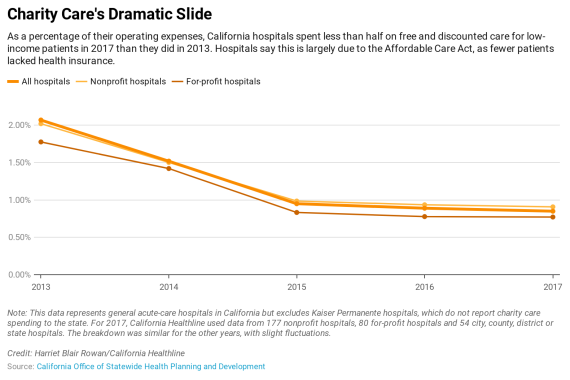
California hospitals are providing significantly less free and discounted care to low-income patients since the Affordable Care Act took effect.

As a proportion of their operating expenses, the state’s general acute-care hospitals spent less than half on these patients in 2017 than they did in 2013, according to data the hospitals reported to California’s Office of Statewide Health Planning and Development.

The biggest decline in charity care spending occurred from 2013 to 2015, when it dropped from just over 2% to just under 1%. The spending has continued to decline, though less dramatically, since then.

The decline was true of for-profit hospitals, so-called nonprofit hospitals and those designated as city, county, district or state hospitals.

Health experts attribute the drop in charity care spending largely to the implementation of the federal Affordable Care Act, popularly known as Obamacare. The law expanded insurance coverage to millions of Californians, starting in 2014, and hospitals are now treating far fewer uninsured patients who cannot pay for the care they receive.

With fewer uninsured patients, fewer patients seek financial assistance through the charity care programs, according to the California Hospital Association.

Cori Racela, deputy director at the Western Center on Law & Poverty, countered that many people still need financial assistance because — even with insurance — they struggle to pay their premiums, copays and deductibles.

“The need for charity care has changed,” she said, “but it still exists.”

The data on charity care comes from most of the state’s general acute-care hospitals but does not include Kaiser Permanente hospitals, which are not required by the state to report their charity care totals. (Kaiser Health News, which produces California Healthline, has no affiliation with Kaiser Permanente.)

For 2017, California Healthline used data from 177 nonprofit hospitals, 80 for-profit hospitals and 54 city, county, district or state hospitals. The breakdown was similar for the other years, with slight fluctuations.

Nonprofit hospitals, whose charity care spending dropped from 2.02% of operating expenses to 0.91% over the five-year period, are required by state and federal law to provide “community benefits” in exchange for their tax-exempt status.

They can meet that requirement beyond providing free and discounted care in a variety of ways: They can offer community public health programs, write off uncollected patient debt and claim the difference between what it costs to provide care and the amount that they are reimbursed by government insurance programs.

Nonprofit “hospitals get tax-exempt status, but they don’t get it for free,” said Ge Bai, associate professor of accounting and health policy at Johns Hopkins University. Charity care “is part of the implicit contract between hospital and taxpayers.”

Bai sees the reduced spending on charity care as part of a trend of nonprofit hospitals acting more like their for-profit counterparts.

Many nonprofit hospitals “no longer consider charity care their primary mission,” she said. “They are making more and more money but they are dropping their charity care.”

The state and federal governments set no minimum requirements for charity spending by hospitals, although the California Attorney General has created standards for a few nonprofit hospitals that have changed ownership in recent years.

Jan Emerson-Shea, a spokeswoman for the California Hospital Association, said hospitals are giving back to their communities in ways beyond charity care.

“You see charity care declining, but Medi-Cal losses are increasing,” Emerson-Shea said. She pointed to the growing shortfalls many hospitals report from caring for more patients covered by the public insurance program. “Every Medi-Cal patient we treat we lose money on.”

Medi-Cal, the state’s Medicaid program for low-income residents, increased its rolls by 5.6 million — or about 70% — from 2013 to 2017.

Racela, of the Western Center on Law & Poverty, would like to see changes in California’s charity care rules to address high out-of-pocket costs.

And she wants hospitals to abide by the state law that requires them to inform patients that they may be eligible for charity care based on their income.

“There is still a big unmet need for charity care across the state,” Racela said.



When a hospital wields monopoly power

https://www.axios.com/newsletters/axios-vitals-1b40c794-c913-4681-b2ac-7a6e9746718f.html?utm_source=newsletter&utm_medium=email&utm_campaign=newsletter_axiosvitals&stream=top

Illustration of a giant health plus on top of a pile of cash, the ground underneath is cracking.

NorthBay Healthcare, a not-for-profit hospital system in California, recently gave a candid look into how it operates, telling investors it has used its negotiating clout to extract “very lucrative contracts” from health insurance companies.

Why it matters: This is a living example of the economic theories and research that suggest hospitals will charge whatever they want if they have little or no competition, Axios’ Bob Herman reports.

Details: NorthBay owns two hospitals and several clinics in California’s Solano County. Kaiser Permanente owns the only other full-service hospital in the county, and Sutter Health operates some medical offices. (A NorthBay spokesperson argued the system is “more akin to the David among two Goliaths.“)

Three health insurers have terminated their contracts with NorthBay over the past couple years. During a June 19 call with bondholders, executives explained why this has happened.

“We’ve been able to maintain very lucrative contracts without the competition. And what the payers are saying is, they would like us to be like 90% of the rest of the United States in terms of contract structure.”

Jim Strong, interim CFO, NorthBay Healthcare

Between the lines: NorthBay’s revenue has increased by 50% over the past few years, from $400 million in 2013 to $600 million in 2018, due in large part to its natural monopoly and oligopoly over hospital services.

  • This is exactly what we should expect to happen when sellers have the upper hand over buyers, economists say.

NorthBay also serves as a cautionary tale for price transparency, the policy fix du jour.

  • If the health care system is consolidated, consumers don’t have anywhere else to go,” said Sunita Desai, a health economist at NYU. “Even if they see the prices of a given hospital, they’re limited in terms of how much they can ‘shop’ across providers.”


Hospitals as medical debt litigators

https://www.axios.com/newsletters/axios-vitals-71839597-afb8-4809-895b-f601b1990f15.html?utm_source=newsletter&utm_medium=email&utm_campaign=newsletter_axiosvitals&stream=top

Illustration of rope lassoing a hospital bill.

Tax-exempt hospitals are again raising eyebrows over how they harass patients, often the poorest, in court by trying to recoup medical debts, my colleague Bob Herman writes.

Driving the news: ProPublica and MLK50 published a deep dive yesterday on Methodist Le Bonheur Healthcare, a $2 billion not-for-profit and faith-based hospital system in Tennessee that has filed more than 8,300 lawsuits against patients over the past 5 years.

  • One of the patients featured in the story made less than $14,000 last year, and Methodist is suing her for more than $33,000. The hospital operates in the second-poorest large metropolitan area in the nation.
  • Methodist obtained wage garnishment orders in almost half of the cases it filed between 2014 and 2018, meaning that the debtor’s employer was required to send the court a portion of the worker’s after-tax income.

Between the lines: As we wrote this week, hospitals taking patients to court is both common and longstanding.

The bottom line: Not-for-profit hospitals market themselves as charities, but they act more like for-profit peers — renewing questions of whether those organizations’ tax exemptions are justified.

  • Coincidentally, the American Hospital Association released a paper Thursday touting hospitals’ community benefits, but the paper has some of the same flaws as prior analyses.

What we’re watching: These practices have drawn the ire of Sen. Chuck Grassley, who is now chairman of the powerful Finance Committee.

  • “Such hospitals seem to forget that tax exemption is a privilege, not a right. In addition to withholding financial assistance to low-income patients, they give top executives salaries on par with their for-profit counterparts,” Grassley wrote in a 2017 op-ed.


Not-for-profit hospitals are financially resilient due to strong management, S&P Global Ratings says.

https://www.healthcarefinancenews.com/news/not-profit-hospitals-and-health-systems-have-shown-financial-resilience-due-strong-management?mkt_tok=eyJpIjoiTmpJME5qVTNOVEU1TXpRdyIsInQiOiJDdUIxQ1NKdng1b0FkQ1wvQlwvNFBTc1JIbmVwYUZOeUhCZ3VlNlZzdmhNbkhBQlhnXC9JeTI4c2NDeE80REk0YWJ1Nk1jSzl4QjFDbjFMTkxKdmVCblY1RUlSYTIwUmlhSEJ6VXpkOUZZdytUWDhaV1poaEljcVh5ZFdEOUdVZlQzZyJ9

The broad balance sheet shows hospitals are improving financial strength and flexibility compared to two decades ago.

Not-for-profit hospitals and health systems are financially keeping up with changes in the healthcare landscape, according to a new S&P Global Ratings report.

S&P Global Ratings said it believes the not-for-profit healthcare sector has been incredibly resilient over the past two decades, in large part due to strong management and governance.

The broad balance sheet shows improved financial strength and flexibility compared to two decades ago, as is also the case for maximum annual debt service coverage.

Hospitals have done this throughout a time when changes in government policy, reimbursement and the move to value-based care have been factors in their operating performance and financial position. The report shows more variability in operating revenue and excess margins. 

S&P Global looked at providers rated from BBB+ to AA. The stronger providers have seen margin improvement, while weaker rated providers have been generally stable with some pockets of weakness at the lowest reported rating levels, the report said.

WHY THIS MATTERS

Health system challenges include increasing levels of competition and disruption; consumerism and the heightened focus on quality measures and outcomes; the rapid growth in technology and big data analytics; the rise of population health and changes in payment delivery models; and a fundamental shift in how and where patients are treated.

“To be successful, provider management teams must adapt and adjust or run the risk of being left behind,” the credit analysts said.

A factor benefiting health systems has been the low interest rate environment. This has allowed hospitals to finance strategic capital assets, while keeping carrying costs at very manageable levels.

Industry consolidation has had a favorable impact on enterprise profiles, the report said.  While ample “horizontal” competition exists for both hospitals and health systems, in many markets consolidation has made it more manageable.

But competition between hospitals and health systems and new market entrants seeking to control niche services or some aspect of ambulatory care services is presenting new and rapidly evolving threats to enterprise profiles, the report said.

OUTCOMES

Net patient service revenue has risen across all S&P rated categories for both stand-alone and system providers. This is due to a variety of reasons, including the addition of more business lines such as physician and insurance services, and increased industry consolidation;

Operating and excess margins are more complicated, highlighting the ebb and flow of industry trends, including increased joint venture and affiliation activity and investment market volatility.

Maximum annual debt service coverage has grown in all but the weakest rated levels, highlighting an improving balance between operational performance and debt.

Growth in days’ cash on hand has been a universal success even as capital expenditures remain robust.

Debt levels have been favorable with an improved cushion ratio and declining debt as a percentage of capitalization, both well-established trends.

TREND

Momentum continues to build for major legislative and regulatory changes at both the national and state level.

Many of the hospitals and health systems in S&P Global’s rated portfolio have navigated through numerous changes. Historically, a review of ratios over time demonstrates that providers have responded well to change as a group, although results have varied among individual organizations.

While credit quality can and will change over time,  the majority of the rated portfolio is well-positioned to compete effectively as new strategies are required, the analysts said.

S&P Global Ratings analyzes and publishes not-for-profit healthcare median ratios annually, and has been doing so for over 20 years.

ON THE RECORD

“In our view, senior leadership and management teams have provided guidance and direction through a series of difficult and changing periods and have emerged as generally stronger organizations from a financial profile standpoint,” the credit analysts said. “We believe the vast majority of rated hospitals and health systems have the financial discipline and expertise to navigate the challenges over the next decade and beyond, and while there may be some movement in underlying trends in these key metrics, the overall financial outlook, barring any significant shocks from policy or macroeconomic shifts, should remain generally consistent.”