America’s nightmarish year is finally ending

America's nightmare year of COVID is finally ending

One year after the World Health Organization declared COVID-19 a pandemic, the end of that pandemic is within reach.

The big picture: The death and suffering caused by the coronavirus have been much worse than many people expected a year ago — but the vaccines have been much better.

Flashback“Bottom line, it’s going to get worse,” Anthony Fauci told a congressional panel on March 11, 2020, the day the WHO formally declared COVID-19 to be a global pandemic.

  • A year ago today, the U.S. had confirmed 1,000 coronavirus infections. Now we’re approaching 30 million.
  • In the earliest days of the pandemic, Americans were terrified by the White House’s projections — informed by well-respected modeling — that 100,000 to 240,000 Americans could die from the virus. That actual number now sits at just under 530,000.
  • Many models at the time thought the virus would peak last May. It was nowhere close to its height by then. The deadliest month of the pandemic was January.

Yes, but: Last March, even the sunniest optimists didn’t expect the U.S. to have a vaccine by now.

  • They certainly didn’t anticipate that over 300 million shots would already be in arms worldwide, and they didn’t think the eventual vaccines, whenever they arrived, would be anywhere near as effective as these shots turned out to be.

Where it stands: President Biden has said every American adult who wants a vaccine will be able to get one by the end of May, and the country is on track to meet that target.

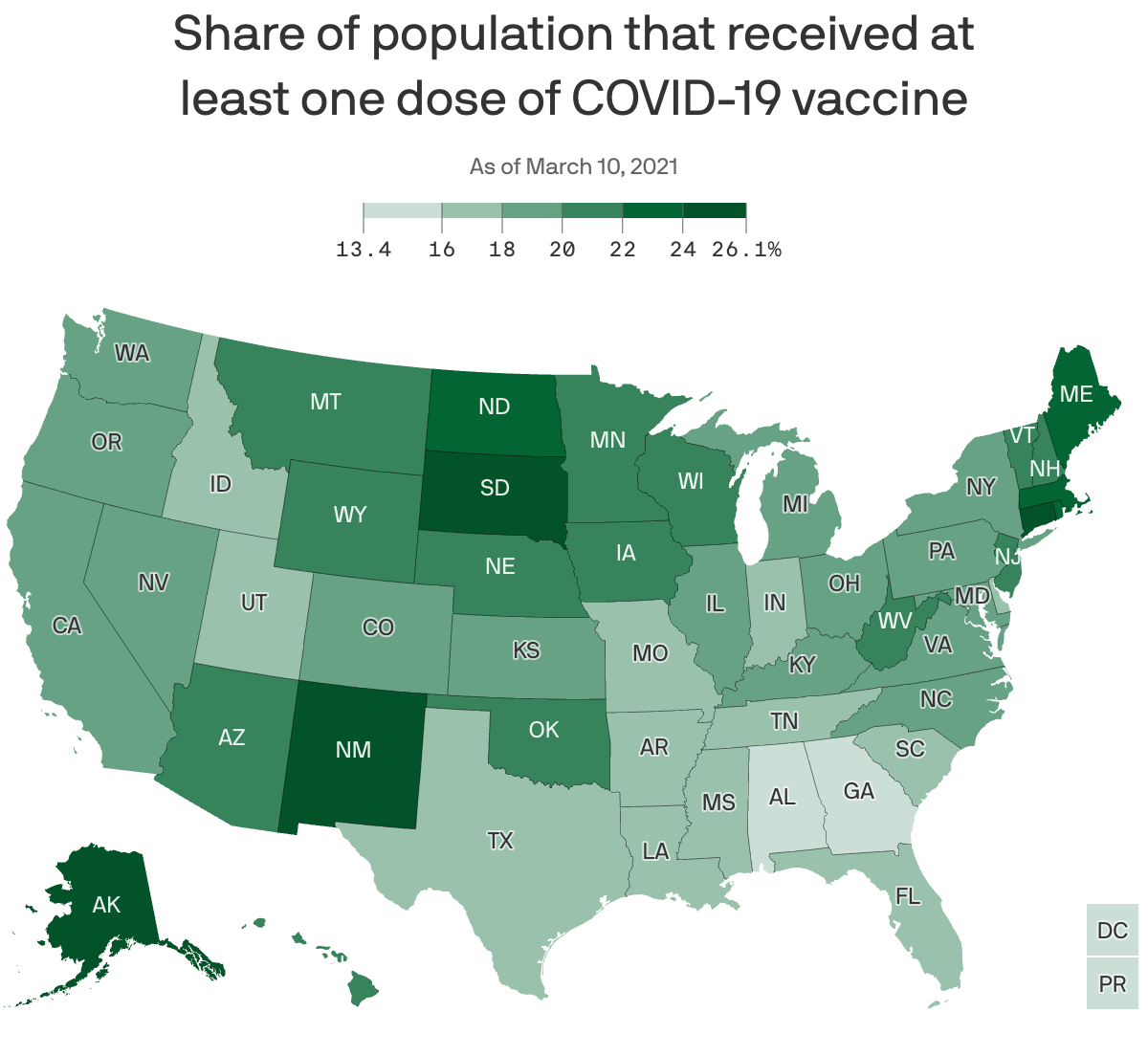
  • The U.S. is administering over 2 million shots per day, on average. Roughly 25% of the adult population has gotten at least one shot.
  • The federal government has purchased more doses than this country will be able to use: 300 million from Pfizer, 300 million from Moderna and 200 million from Johnson & Johnson.
  • The Pfizer and Moderna orders alone would be more than enough to fully vaccinate every American adult. (The vaccines aren’t yet authorized for use in children.)

Yes, millions of Americans are still anxiously awaiting their first shot — and navigating signup websites that are often frustrating and awful.

  • But the supply of available vaccines is expected to surge this month, and the companies say the bulk of those doses should be available by the end of May.
  • Cases, hospitalizations and deaths are all falling sharply at the same time vaccinations are ramping up.

The bottom line: Measured in death, loss, isolation and financial ruin, one year has felt like an eternity. Measured as the time between the declaration of a pandemic and vaccinating 60 million Americans, one year is an instant.

  • The virus hasn’t been defeated, and may never fully go away. Getting back to “normal” will be a moving target. Nothing’s over yet. But the end of the worst of it — the long, brutal nightmare of death and suffering — is getting close.

Providence posts $306M loss in 2020 after patient revenue takes hit from COVID-19

Providence posts $306M loss in 2020 after patient revenue takes hit from  COVID-19 | FierceHealthcare

Providence Health posted a $306 million operating loss for 2020 as the system’s patient service revenue declined by nearly $1 billion due to COVID-19.

Providence struggled with a major decline in patient volumes, which were down 9% compared to 2019 and led to a 5% decline in net patient service revenue.

While volumes have recovered since an initial decline at the onset of the pandemic, “operational recovery continues to be variable and market-specific as the pandemic continues across our footprint,” the 51-hospital system said in its earnings report released late Monday.

Providence generated $25.6 billion in operating revenue in 2020, slightly above the $25 billion that it generated the year before. However, Providence’s expenses shot up to $25.9 billion, a major spike from the $24.8 billion it paid for in 2019. This led to an operating deficit of $306 million.

A major reason was the system’s response to the COVID-19 pandemic, which Providence got a jump start on as it was the first U.S. hospital system to treat a patient with the virus.

“The impact included a significant reduction in revenue, coupled with an increase in costs incurred for [personal protective equipment] and pharmaceuticals, and increases in labor costs for staffing to serve those impacted by the virus,” Providence’s report said.

Net patient service revenue was $19 billion for 2020, down by nearly $1 billion from the $19.9 billion it posted in 2019.

Providence’s non-operating income totaled $1 billion in 2020 compared to $1.1 billion the previous year. The non-operating income, which is made up of investment gains, helped to “recoup operating losses resulting from the pandemic and offset reimbursement shortfalls from Medicaid and Medicare coverage, allowing us to serve vulnerable populations while balancing our financial standing,” the report said.

Providence’s operating earnings before interest, depreciation and amortization (EBITDA) was $1.1 billion, or 4.4% of its operating revenues. This was a decline from the $1.6 billion (6.2%) in EBITDA for 2019.

The system also got $957 million in relief funding under the CARES Act, which partly offset the losses from lower volumes, the report said.

Providence is an outlier among other larger for and not-for-profit systems that ended 2020 in the black. For instance, Mayo Clinic posted a net operating income of $728 million, helped by $587 million in donations and a massive increase in business from its lab division to help provide COVID-19 tests.

University of Pittsburgh Medical Center also posted a $1 billion profit for 2020 thanks to a boost of enrollment in its insurance business.

Hospitals will likely continue to have staffing shortages despite falling COVID-19 cases

https://www.healthcarefinancenews.com/news/hospitals-will-likely-continue-have-staffing-shortages-despite-falling-covid-19-cases

Hospitals will likely continue to have staffing shortages despite falling  COVID-19 cases | Healthcare Finance News

Estimations show that between now and March 20, 7% of U.S. counties will experience “significant strains” on their hospital workforces.

Despite recent declines in coronavirus cases nationwide, many hospitals may still have workforce shortages over the next 30 days due to COVID-19 hospitalizations, according to estimates from George Washington University.

The university’s Fitzhugh Mullan Institute for Health Workforce Equity recently launched its COVID-19 County Workforce Estimator, which predicts that between now and March 20, 7% of U.S. counties will experience “significant strains” on their hospital workforces. It attributes the strain to long-standing staffing problems with the added pressure of the pandemic.

It also predicts that 209 counties will need to implement crisis workforce strategies due to its analysis that ICU doctors in those counties will be forced to take care of 24 or more patients at a time. Hospitals in those locations will likely need to use non-ICU-trained staff to help care for patients, the analysis said.

Further, the tool suggests that 12 counties will need to use contingency workforce strategies that include adding more patients per team, float pools and overtime due to COVID-19 hospitalization rates of 25% or more.

While it estimates a portion of counties will face staffing strains over the next month, the estimator calculated that 2,189 counties will be able to maintain normal workforce strategies due to COVID-19 hospitalization rates of 25% or less.

An additional 736 counties either did not have a hospital or didn’t have enough data to assess potential COVID-19 workforce strains.

The estimator tool was built in collaboration with Premier, a healthcare improvement company, the National Association of County and City Health Officials, and IQVIA, a healthcare data and analytics organization.

WHY THIS MATTERS

Healthcare staffing shortages have been a worry for some time now due to the nation’s increasingly aging population, but COVID-19 has only added to the concern.

Even before the pandemic, studies predicted physician staffing shortages by upwards of 140,000 by 2030, as well as shortages in-home health aides, nursing assistants, nurse practitioners and medical lab technicians by 2025.

Labor experts suggest hospitals develop a proactive response to staff shortages, and the George Washington estimator was designed to do exactly that, according to Clese Erikson, the principal investigator on the project and deputy director of the Health Equity Workforce Research Center.

Local leaders and hospital administrators can use the tool to gauge their county’s ability to care for COVID-19 hospitalized patients and others who need critical care services.

THE LARGER TREND

Outside of the ICU, many hospitals are also experiencing nursing shortages for several reasons, including the possibility that nurses could get $150 an hour to be a traveling nurse versus the $48 an hour they are paid as hospital staff.

In other cases, nurses had to choose between work and having children at home while schools were not holding in-person sessions. Some nurses who were close to retirement chose to leave while others left for work outside of acute care settings.

On top of workforce shortages, the ongoing COVID-19 pandemic has led many healthcare workers to experience strains on their mental health, including anxiety, stress, depression and loneliness.

ON THE RECORD

“The shortages could occur just as public health officials warn that variants of the coronavirus are spreading in the United States and could trigger a sharp rise in the number of Americans infected,” Erikson said.

“Our new online estimator will help county and local public health officials project shortages in the near future and take steps to help keep staffing at safe levels.”

RemoteICU sues HHS for not reimbursing for telehealth provided by physicians outside of the country

https://www.healthcarefinancenews.com/news/remoteicu-sues-hhs-not-reimbursing-telehealth-provided-physicians-outside-country

Tele ICU - What It Is, How It Works & Its Advantages

The Medicare Act “prohibits Medicare payment for services that are not furnished within the United States,” according to the filing.

RemoteICU, a telemedicine provider group, is suing the Department of Health and Human Services and the Centers for Medicare and Medicaid Services for not reimbursing telehealth services provided by physicians who are located outside the United States, according to a federal lawsuit filed last week in Washington.

RICU wants reimbursement for telehealth services provided within the U.S., but not necessarily by a physician who lives within its borders.

The company employs physicians who live outside the country, but are U.S. board-certified critical-care specialists and licensed in one or more U.S. jurisdictions. With RICU’s telecommunications system, these physicians can provide critical-care services in U.S. hospital ICUs, the lawsuit said.

“Although RICU’s physicians live abroad, they serve as full-time, permanent staff members of the U.S. hospitals at which they serve patients,” the company said in the court filing.

“By employing U.S.-licensed intensivists who live overseas, RICU has enabled the American healthcare system to recapture talent that would otherwise be lost to it – and this has helped to alleviate the ongoing shortage of intensivists in American hospitals.

When CMS expanded the list of telehealth services for which it reimbursed in December 2020 to include critical care services, RICU began offering its physicians to hospitals that couldn’t afford ICU telehealth without Medicare reimbursement, the court filing said.

However, after the company reached out to several officials from HHS and CMS, it was notified that Medicare could not reimburse the client hospitals for RICU’s services, because the Medicare Act “prohibits Medicare payment for services that are not furnished within the United States,” according to the filing.

The company is seeking a preliminary injunction to stop HHS and CMS from denying Medicare reimbursement for telehealth services on the basis of a provider’s physical location outside of the United States at the time of service.

WHAT’S THE IMPACT?

RICU claims that, by failing to reimburse for the critical care telehealth services provided by its physicians, HHS and CMS are causing “immediate harm both to RICU and to the public.”

It argues that it’s filling a gap in critical care that has been exacerbated by the pandemic.

“There remains [a] significant unmet need for critical care services, as desperately sick patients have overwhelmed ICU resources across the country,” RICU said in the court filing.

“In some cases, lack of adequate care can mean the difference between life or death. And one of the groups most at risk from death and serious illness due to COVID-19 is the elderly – the very same population that relies upon Medicare.”

Without reimbursement, RICU says that some of its current clients, as well as potential customers, will not be able to offer its services.

The company argues that this causes “significant, unrecoverable monetary damages” because tele-ICU providers that use physicians located within the U.S. are eligible for reimbursement and therefore have a competitive edge over RICU.

Further, it says that it has already begun losing business because of hospitals’ inability to receive Medicare reimbursement.

THE LARGER TREND

CMS has widely expanded the list of telehealth services it will reimburse for during the pandemic to include services such as emergency department visits, initial inpatient and nursing facility visits, and discharge-day management.

While only 14 states currently have true “payment parity” for telehealth, 43 states and D.C. have implemented a telemedicine coverage law, according to Foley & Lardner report.

That report, among others, claims telehealth will continue to grow as an integral part of healthcare as time goes on.

Last year, Geisinger health system in Danville, Pennsylvania, implemented telehealth ICU technology in several of its hospitals to support its in-person clinical staff.

ON THE RECORD

“The Critical Care Ban is causing irreparable harm to RICU, which is suffering ongoing financial and reputational harms that cannot be remedied in the future,” the court filing said.

The balance of the equities favors an injunction, because Defendants have already admitted that there is a desperate medical need for the critical care that RICU would provide but for the Critical Care Ban.

“And, finally, preliminary injunction would be in the public interest because, across the United States, Americans stricken by the COVID-19 pandemic are in desperate need of critical care – a need that RICU can help meet. It is not hyperbole to say that the requested injunctive relief is in the public interest because it could save lives.”

Experts warn US risks delaying ‘normal’ summer

Experts warn US risks delaying ‘normal’ summer

Overnight Health Care: Experts warn US risks delaying 'normal' summer |  Alabama GOP governor extends mask mandate | Senate votes to take up relief  bill | TheHill


President Biden‘s announcement that there will be enough vaccines for all adults by May is raising hopes for a return to normal soon.

But the next few months in the pandemic are critical. Concern is growing over moves by some states to lift restrictions already, while new variants of the virus are on the rise in the U.S. Experts warn that actions taken now risk delaying getting back to some semblance of normal.

Health officials are urging restrictions to remain in place for the final stretch, saying that it will not be much longer before the situation markedly improves, and it does not make sense to lift all restrictions when widespread vaccinations are in sight.    

Biden on Wednesday issued his most forceful comments to date, calling out the governors of Texas and Mississippi for lifting their states’ mask mandates and all capacity limits on businesses. 

He noted that vaccinations for all adults are on the horizon.

The last thing we need is Neanderthal thinking that in the meantime everything’s fine, take off your mask, forget it,” he said. “It still matters.”

Estimates differ on when exactly the country might return to something like “normal,” though many say they expect this summer will be much better.

Former Food and Drug Administration Commissioner Scott Gottlieb said on CNBC on Wednesday that he thinks even as soon as April will be “profoundly better,” given that vaccine supply will have ramped up significantly, allowing vaccine availability to be “wide open” by then.

Centers for Disease Control and Prevention Director Rochelle Walensky on Wednesday put the time frame at three months until the country could be vaccinated. 

“The next three months are pivotal,” she said.   

Thomas Tsai, a researcher at the Harvard T.H. Chan School of Public Health, said that by summer, “I think we can have a much more, I don’t want to say normal, but at least a ‘new normal’ summer.”

But experts warn that the return to normal could actually be delayed if restrictions are lifted too soon, causing a new spike in cases in the near term. 

Tsai likened the current situation to the seventh inning stretch of a baseball game. “Progress has been made; it’s OK to take stock of that,” he said. “How we play the next two innings determines if this is a single game or turns into a doubleheader.”

Maintaining restrictions as people get fatigued and see the end in sight could be a challenge, though, particularly in red states that were skeptical of instituting health restrictions from the start. 

Texas Gov. Greg Abbott and Mississippi Gov. Tate Reeves, both Republicans, pointed to the ongoing vaccination campaign in saying that the time has come to end restrictions. 

“With the medical advancements of vaccines and antibody therapeutic drugs, Texas now has the tools to protect Texans from the virus,” Abbott said Tuesday. “We must now do more to restore livelihoods and normalcy for Texans by opening Texas 100 percent.”

Responding to Biden’s criticism on Wednesday, Reeves added: “Mississippians don’t need handlers.” 

“As numbers drop, they can assess their choices and listen to experts,” he added. “I guess I just think we should trust Americans, not insult them.”

Gottlieb argued for a middle ground, saying that public health officials risk having the public simply ignore all guidance if they do not provide a “realistic glide path to a better future,” though March is “a little bit premature” to lift all restrictions. 

“March really is a difficult month,” he said. “It sits between two worlds. February was a raging epidemic, it was very clear we needed to have measures in place. I think April’s going to be profoundly better, and March is sitting in the middle.”

Variants of the virus also pose a threat that adds another degree of uncertainty. The most common variant spreading in the US, known as B117, or the United Kingdom variant, responds well to vaccines, but is more infectious. 

“The B117 hyper-transmissible variant looms ready to hijack our successes to date,” Walensky said. 

Variants first identified in Brazil and South Africa also pose a risk of reducing the effectiveness of the vaccines, though the extent is not fully clear, and vaccine manufacturers are preparing backup plans to provide booster shots or updated vaccines if necessary. 

“We are at a critical nexus in the pandemic,” Walensky said. “So much can turn in the next few weeks.”

After weeks of declines, both cases and deaths are ticking up. According to CDC data, the seven-day average of new cases per day, at 66,000, is up 3.5 percent from the past week, and deaths, at just over 2,000 per day, are up 2.2 percent. 

Barbara Alexander, president of the Infectious Diseases Society of America, issued a statement Wednesday calling on people to continue wearing masks, distancing from others, and avoiding large gatherings. 

“All of these measures together will bring us closer to ending the pandemic,” she said. “Abandoning them now will postpone the day we can put COVID-19 behind us.”  

Still, the declines in past weeks and the increasing pace of vaccinations is offering some hope after a long year.

“I’m more optimistic than I have been in the last year,” Tsai said. 

Cartoon – It’s not the Heat, it’s the Stupidity!

How cartoons are chronicling the battle between mask wearers and Trump -  The Washington Post

Cartoon – We’re all in this together

Not all in this together - ND Cartoons

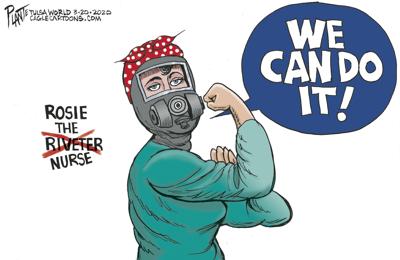
Cartoon – We can do it!

Editorial Cartoon: Rosie the Nurse | Opinion | dailyastorian.com

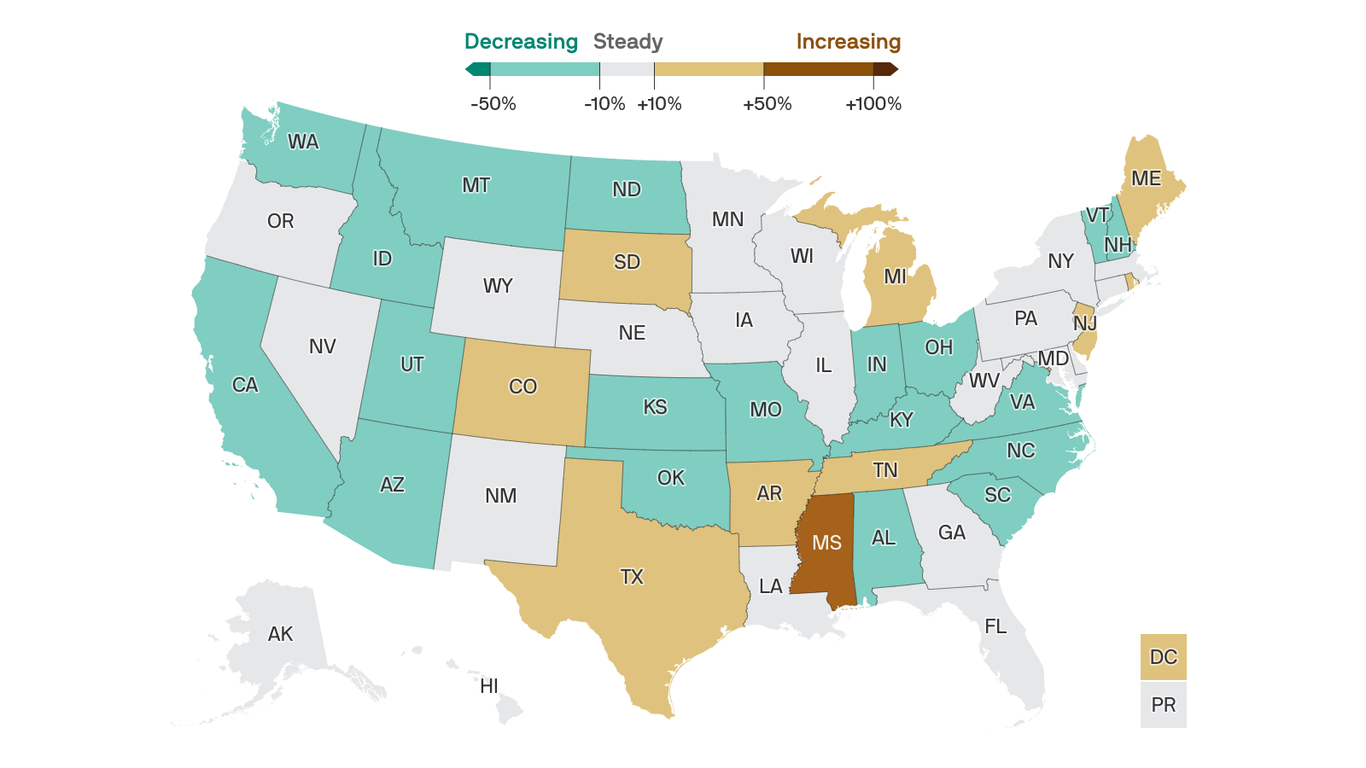
The danger of a fourth wave

Change in new COVID-19 cases in the past week

Percent change of the 7-day average of new cases

on Feb. 23 and March 2, 2021

The U.S. could be in danger of a fourth coronavirus wave - Axios

The U.S. may be on the verge of another surge in coronavirus cases, despite weeks of good news.

The big picture: Nationwide, progress against the virus has stalled. And some states are ditching their most important public safety measures even as their outbreaks are getting worse.

Where it stands: The U.S. averaged just under 65,000 new cases per day over the past week. That’s essentially unchanged from the week before, ending a six-week streak of double-digit improvements.

  • Although the U.S. has been moving in the right direction, 65,000 cases per day is not a number that indicates the virus is under control. It’s the same caseload the U.S. was seeing last July, at the height of the summer surge in cases and deaths.

What we’re watching: Texas Gov. Greg Abbott on Tuesday rescinded the state’s mask mandate and declared that businesses will be able to operate at full capacity, saying risk-mitigation measures are no longer necessary because of the progress on vaccines.

  • But the risk in Texas is far from over. In fact, its outbreak is growing: New cases in the state rose by 27% over the past week.
  • Mississippi Gov. Tate Reeves also scrapped all business restrictions, along with the state’s mask mandate, on Tuesday. New cases in Mississippi were up 62% over the past week, the biggest jump of any state.
  • The daily average of new daily cases also increased in eight more states, in addition to Mississippi and Texas.

How it works: If Americans let their guard down too soon, we could experience yet another surge — a fourth wave — before the vaccination campaign has had a chance to do its work.

  • The vaccine rollout is moving at breakneck speed. The U.S. should have enough doses for every adult who wants one by May, President Biden said this week.
  • At the same time, however, more contagious variants of the coronavirus are continuing to gain ground, meaning that people who haven’t gotten their vaccines yet may be spreading and contracting the virus even more easily than before.

What’s next: The bigger a foothold those variants can get, the harder it will be to escape COVID-19 — now or in the future.

  • The existing vaccines appear to be less effective against two variants, discovered in South Africa and Brazil, which means the virus could keep circulating even in a world where the vast majority of people are vaccinated.
  • And that means it’s increasingly likely that COVID-19 will never fully go away — that outbreaks may flare up here and there for years, requiring vaccine booster shots as well as renewed protective measures.

The bottom line: Variants emerge when viruses spread widely, which is also how people die.

  • Whatever “the end of the pandemic” looks like — however good it’s possible for things to get — the way to get there is through ramping up vaccinations and continuing to control the virus through masks and social distancing. Not doing those things will only make the future worse.
  • “Getting as many people vaccinated as possible is still the same answer and the same path forward as it was on December 1 or January 1 … but the expected outcome isn’t the same,” Shane Crotty, a virologist at the La Jolla Institute for Immunology in San Diego, told Reuters.