Why is healthcare so expensive? This Johns Hopkins surgeon might have the answers

https://www.fiercehealthcare.com/hospitals-health-systems/why-healthcare-so-expensive-johns-hopkins-surgeon-might-have-answers?mkt_tok=eyJpIjoiTTJNMVpURTNNelJpTVRBeiIsInQiOiJEYTZVeG1LN2VxWEMzUXRTb3dQWWkrbDNKdHBnSzQ5NUpuZVZoXC9US1QzQVwvcUVDSU9mMHZLR2pwZWFcLzNkbk9XYTdPRUtTM2tRVU5oOXhhMXRhSFd5STFZY2VzVlo2UTl0cGxOZjdSMUROVjhZVFZNeXFrMWRZdEdIRVBFS0M2VyJ9&mrkid=959610

For a small group of vascular surgery centers in metropolitan Washington, D.C., it was local churches that turned out to be surprisingly lucrative.

It was at health screening fairs hosted by these houses of worship where Marty Makary, M.D., found surgeons drumming up business for pricey—and often unnecessary—leg stents. It’s among the collection of systemic and human examples Makary examines in his new book “The Price We Pay: What Broke American Health Care—and How to Fix It” as driving forces behind rising U.S. health costs.

Makary, a surgeon at Johns Hopkins and New York Times best-selling author, hits every segment of the market, from a health system in New Mexico that has sued 1 in 5 residents in town to a health insurance conference where brokers described over drinks why they usually aren’t helping employers get the best deal.

“Healthcare has adopted a business model that uses middlemen, price gouging and sometimes delivers care that can be inappropriate, and this bloated economy has a tremendous amount of waste,” Makary said. “So our research really asks the question: ‘What is the experience of the everyday American interfacing with our healthcare system?’”

I caught up with Makary recently to discuss some of the problems he highlights in his new book, which is being released Sept. 10, and some of his ideas on how we solve them.

FierceHealthcare: Why did you write this book?

Marty Makary: Hospitals are amazing places and there is a tremendous amount of public trust in hospitals. But I’ve been seriously concerned about the erosion of public trust by the price gouging and predatory billing practices that patients are describing all over America. Our research team found bills are marked up as much as 23 times higher than what hospitals will accept from Medicare. We kept hearing over and over again that, ‘No one is expected to pay these bills. Hospital CEOs assured me when I showed them inflated bills that nobody is expected to pay the sticker price.’ But that didn’t seem to match the stories we were hearing on the ground.

FH: One of the hospitals you highlight in this book in Carlsbad, New Mexico, had a practice of hiking prices and suing patients who were unable to pay. What did you find there?

MM: We decided to shift our research into the question: “Are Americans asked to pay the sticker price and if so, what happens when they can’t afford it?”

A woman sent me a message where not only was the bill inflated, but the care was—in her opinion, unnecessary—and the hospital had sued her. When I reached out, she said, “They’ve sued all my friends as well and garnished our paychecks.” I couldn’t believe this, and so I flew out to Carlsbad. The driver of the Chamber of Commerce taxi service that picked us up from the airport, the receptionist at the hotel, the waitress at the breakfast place, the clerk’s office staff, families in the courthouse: You couldn’t believe it. Everywhere you turned, people had been terrorized financially by this local community hospital. I thought: “Where is the spirit of medicine? Do these executives even know the consequences on the ground of these billing practices?”

FH: In the book, you mention many hospital executives don’t even know they’re suing patients.

MM: Oftentimes, there’s detachment. And when we’re detached from the consequences or problems, that’s when horrible things happen in societies historically. I found sometimes hospital executives, board members and certainly our research supports doctors not knowing about this practice. And when they find out, the clinicians are outraged. By and large, board members want it to stop … I think if you look at any major issue in the United States, whether it be race, poverty or healthcare, if we are not proximate to the problem, we tend to rationalize financial systems that enable the problem. In healthcare, what I’ve noticed is, when I would share these stories at conferences, other healthcare experts argued it was not a problem that was diabolical, they just weren’t proximate to the issue.

FH:  You also document that many hospitals are doing the right thing.

MM: Most hospitals try to do the right thing. But I think it tells us a lot about the practice of suing patients and that it’s unnecessary. When all the revenue generated from suing patients amounts to less than the amount of the CEO pay increase in one year, which is something we’ve seen, the argument that it’s essential to sue patients in order for the hospital to be sustainable melts away.

FH: But obviously, the problem is not just about hospitals, right?

MM: A lot of people are getting rich in healthcare. We’ve created tens of thousands of millionaires that are not patient-facing. If you look at the earnings on Wall Street of some of these healthcare companies, for example, UnitedHealth Group reported a 25% increase in earnings in a recent earnings report. How do earnings go up 25% in an actuarial insurance business? They said on their call it was in part due to their pharmacy benefit manager (PBM), a well-known middleman that profits from spread pricing and money games. Hospitals are on target this year for their highest margin in history—5.1% based on early 2019 data. At the same time rural hospitals are closing, large hospitals are making barrels of money. Although they are claiming razor-thin margins, the cost shift accounting is so sophisticated, that they can use their profit to buy new buildings, pay down debt, buy more real estate, increase executive pay. What we have right now is an arms race of profiteering in healthcare where all the stakeholders are making a lot of money except for one, and that’s the patient.

FH: In the book, you talk about efforts to address practice outliers like those vascular surgeons through the use of big data, which led to the creation of the “Improving Wisely” initiative. What did you do?

MM:  Most doctors do the right thing or always try to. But the fraction that are responding to the consumerist culture or the perverse incentives or are just not practicing state of the art care can cost the system a lot more money than those who aren’t … Instead of hammering doctors that do the right thing with reporting burdens and other hassles, we can shunt those resources to address outliers identified in the data using metrics endorsed by the experts in each specialty, and gold card the good doctors so they don’t have to deal with reporting hassles and the expense of the reporting hassles.

In studying the issue of inappropriate care and delivering measures of the appropriateness of care, we’ve been meeting with individual specialists around the country and many of these doctors are telling us about the practice pattern that a fraction of specialists in their field are doing that represents overuse. Our work called “Improving Wisely” partners with associations to send outlier physicians their data around a specialty-endorsed measure of overuse. What we’ve seen is, among doctors, among outlier physicians who see their data with a confidential dear doctor letter, that 83% reduce their pattern of overuse. The initial project two years ago that cost $150,000 has resulted in $27 million worth of savings. This is an example of a high consensus approach that results in real savings that you just don’t see in other areas. By and large, politicians are talking about different ways to fund the broken healthcare system and not ways to fix it. We need to talk about how to fix it.

FH: In the book, you really seem to try to take on everyone: doctors, hospitals, air ambulances, workplace wellness companies, PBMs.

MM:  Almost all the voices in healthcare are beholden to some special interest or stakeholder. We desperately need a global critique of how this system has gone awry and there’s a lot of finger-pointing going on right now, especially at the insurance companies and pharma. But the reality is, we all have a piece of this pie. I don’t think there’s really any one villain in the healthcare system. I don’t even think there’s much deliberate malfeasance that goes on. I think we have a system that’s largely run by people doing what they are told to do and they are doing it in a place where they may not be proximate to the hardship the system creates.

FH: So the big question: How do we fix the problems?

MM: For every problem I described, I tried to describe one of the most exciting disrupters in this space. With the pricing failure problem, I highlight the Free Market Medical Association and the individuals who are saying they are going to make all prices transparent and fair regardless of who’s paying whether it’s a patient or an insurance company. There’s one fair price. Keith Smith of the Surgery Center of Oklahoma is offering one fair true price. Not a sticker price but a true price, regardless of who’s paying. You look at MDsave and Clear Health Costs. They are offering ways for people to shop. If the government does nothing on healthcare, I’m still optimistic we are moving in the right direction because businesses in American are realizing that they’re getting ripped off on their healthcare and pharmacy plans. They’re increasingly doing direct contracting and looking closely at their health insurance benefits and pharmacy design and realizing there is a lot of money wasted.

One of the root issues in healthcare is the way we physicians are educated. It uses a model that’s highly flawed, relying highly on rote memorization of things that are easily available on the Internet today and omits training in effective communication, public policy and healthcare literacy. It turns out that many doctors feel paralyzed in fixing this broken system even as they’re suspicious of the waste in it. One of the goals of writing the book was creating healthcare literacy because we in the field are taught medical literacy but we’re never taught healthcare literacy. One of the exciting disrupters I had the privilege of spending time was the Sidney Kimmel Medical College (in Philadelphia). They have an academic standard in the admissions process. Once people meet that academic standard, everybody is considered based on their empathy, self-awareness and communication skills. It’s revolutionary as simple as it sounds. But they’re focusing on what matters.


US health care: An industry too big to fail

https://theconversation.com/us-health-care-an-industry-too-big-to-fail-118895

Image result for US health care: An industry too big to fail

As I spoke recently with colleagues at a conference in Florence, Italy about health care innovation, a fundamental truth resurfaced in my mind: the U.S. health care industry is just that. An industry, an economic force, Big Business, first and foremost. It is a vehicle for returns on investment first and the success of our society second.

This is critical to consider as presidential candidates unveil their health care plans. The candidates and the electorate seem to forget that health care in our country is a huge business.

Health care accounts for almost 20% of GDP and is a, if not the, job engine for the U.S. economy. The sector added 2.8 million jobs between 2006 and 2016, higher than all other sectors, and the Bureau of Labor Statistics projects another 18% growth in health sector jobs between now and 2026. Big Business indeed.

This basic truth separates us from every other nation whose life expectancy, maternal and infant mortality or incidence of diabetes we’d like to replicate or, better still, outperform.

As politicians and the public they serve grapple with issues such as prescription drug prices, “surprise” medical bills and other health-related issues, I believe it critical that we better understand some of the less visible drivers of these costs so that any proposed solutions have a fighting chance to deflect the health cost curve downward.

As both associate chief medical officer for clinical integration and director of the center for health policy at the University of Virginia, I find that the tension between a profit-driven health care system and high costs occupies me every day.

The power of the market

Housing prices are market-driven. Car prices are market-driven. Food prices are market-driven.

And so are health care services. That includes physician fees, prescription drug prices and non-prescription drug prices. So is the case for hospital administrator salaries and medical devices.

All of these goods or services are profit-seeking, and all are motivated to maximize profits and minimize the cost of doing business. All must adhere to sound business principles, or they will fail. None of them disclose their cost drivers, or those things that increase prices. In other words, there are costs that are hidden to consumers that manifest in the final unit prices.

To my knowledge, no one has suggested that Rolls-Royce Motor Cars should price its cars similarly to Ford Motor Company. The invisible hand of “the market” tells Rolls Royce and Ford what their vehicles are worth.

Prescription drugs pricing has different rules

Ford can (they won’t) tell you precisely how much each vehicle costs to produce, including all the component parts that they acquire from other firms. But this is not true of prescription drugs. How much a novel therapeutic costs to develop and bring to market is a proverbial black box. Companies don’t share those numbers. Researchers at the Tufts Center for the Study of Drug Development have estimated the costs to be as high as US$2.87 billion, but that number has been hotly debated.

What we can reliably say is that it’s very expensive, and a drug company must produce new drugs to stay in business. The millions of research and development(R&D) dollars invested by Big Pharma has two aims. The first is to bring the “next big thing” to market. The second is to secure the almighty patent for it.

U.S. drug patents typically last 20 years, but according to the legal services website Upcounsel.com: “Due to the rigorous amount of testing that goes into a drug patent, many larger pharmaceutical companies file several patents on the same drug, aiming to extend the 20-year period and block generic competitors from producing the same drug.” As a result, drug firms have 30, 40-plus years to protect their investment from any competition and market forces to lower prices are not in play.

Here’s the hidden cost punchline: concurrently, several other drugs in their R&D pipelines fail along the way, resulting in significant product-specific losses . How is a poor firm to stay afloat? Simple, really. Build those costs and losses into the price of the successes. Next thing you know, insulin is nearly US$1,500 for a 20-milliliter vial, when that same vial 15 years ago was about $157.

It’s actually a bit more complicated than that, but my point is that business principles drive drug prices because drug companies are businesses. Societal welfare is not the underlying use. This is most true in the U.S., where the public doesn’t purchase most of the pharmaceuticals – private individuals do, albeit through a third party, an insurer. The group purchasing power of 300 million Americans becomes the commercial power of markets. Prices go up.

The cost of doing business, er, treating

I hope that most people would agree that physicians provide a societal good. Whether it’s in the setting of a trusted health confidant, or the doctor whose hands are surgically stopping the bleeding from your spleen after that jerk cut you off on the highway, we physicians pride ourselves on being there for our patients, no matter what, insured or not.

Allow me to state two fundamental facts that often seem to elude patient and policymaker alike. They are inextricably linked, foundational to our national dialogue on health care costs and oft-ignored: physicians are among the highest earners in America, and we make our money from patients. Not from investment portfolios, or patents. Patients.

Like Ford or pharmaceutical giant Eli Lilly, physician practices also need to achieve a profit margin to remain in business. Similarly, there are hidden-to-consumer costs as well; in this case, education and training. Medical school is the most expensive professional degree money can buy in the U.S. The American Association of Medical Colleges reports that median indebtedness for U.S. medical schools was $200,000.00 in 2018, for the 75% of us who financed our educations rather than paying cash.
Our “R&D” – that is, four years each of college and medical school, three to 11 years of post doctoral training costs – gets incorporated into our fees. They have to. Just like Ford Motors. Business 101: the cost of doing business must be factored into the price of the good or service.

For policymakers to meaningfully impact the rising costs of U.S. health care, from drugs to bills to and everything in between, they must decide if this is to remain an industry or truly become a social good. If we continue to treat and regulate health care as an industry, we should continue to expect surprise bills and expensive drugs.

It’s not personal, it’s just…business. The question before the U.S. is: business-as-usual, or shall we get busy charting a new way of achieving a healthy society? Personally and professionally, I prefer the latter.


The fight over the future of our most expensive drugs

https://www.axios.com/the-fight-over-the-future-of-our-most-expensive-drugs-034b6e4d-b596-4f48-9b53-6e2c267e01e3.html

An illustration of a hammer and a concrete pill.

The market designed to create competition for biologics — typically our most expensive drugs — has been slow to take off, but some experts say that even its best-case scenario doesn’t do enough to lower drug prices.

Why it matters: While wonks debate the future of biosimilars in policy journals and on editorial pages, the argument is reflected in the political divide over whether enhanced drug competition or price regulation is the best way to address drug prices.

The big picture: Congress created the pathway for biosimilars to come to market knowing that they’d look different than small-molecule generics, and even their most ardent supporters say biosimilars will never achieve the steep discounts that generics do.

  • That’s because biosimilars are much harder to make than normal generics, meaning that drug companies have to charge enough to make their endeavor worthwhile.
  • Nevertheless, the Biosimilars Council says on its website that biosimilars could lead to more than $54 billion in savings over the next decade. A recent analysis by the Pacific Research Institute found that biosimilars could save $7.2 billion a year under the most optimistic modeled scenario.

Yes, but: Some experts are arguing that that’s not enough, and that biosimilars aren’t the best way to control biologic prices.

  • Last week, Memorial Sloan Kettering Cancer Center’s Peter Bach and MIT’s Mark Trusheim published an editorial in the Wall Street Journal arguing that biosimilars don’t produce enough savings and that the resources spent developing them would be better used to bring new, innovative drugs to market.
  • Bach and Trusheim proposed that the government instead regulate the price of older biologics after they’ve been on the market for a certain period of time, which they wrote could save around $50 billion a year.

The other side: Former FDA Commissioner Scott Gottlieb wrote an editorial in the WSJ yesterday in response, arguing that Congress should speed up the use and development of biosimilars instead of regulating prices.

  • “Among other dangers, [price regulation] could trigger shortages of the drugs. It would also discourage investment in manufacturing, as few drugmakers would want to produce complex drugs in perpetuity for little profit,” Gottlieb writes.

The bottom line: This argument isn’t just for the academics. The leading Democratic presidential candidates are also arguing for drug price regulation, a major shift left for the party.

  • “Price regulation may be a tough sell in some quarters, but it’s the best way to keep the promise of America’s extraordinary pharmaceutical industry alive,” Bach and Trusheim write.


The Big Pharma Takeover of Medical Cannabis

The Big Pharma Takeover of Medical Cannabis

Image result for The Big Pharma Takeover of Medical Cannabis


As evidence of cannabis’ many benefits mounts, so does the interest from the global pharmaceutical industry, known as Big Pharma. The entrance of such behemoths will radically transform the cannabis industry—once heavily stigmatized, it is now a potentially game-changing source of growth for countless companies.

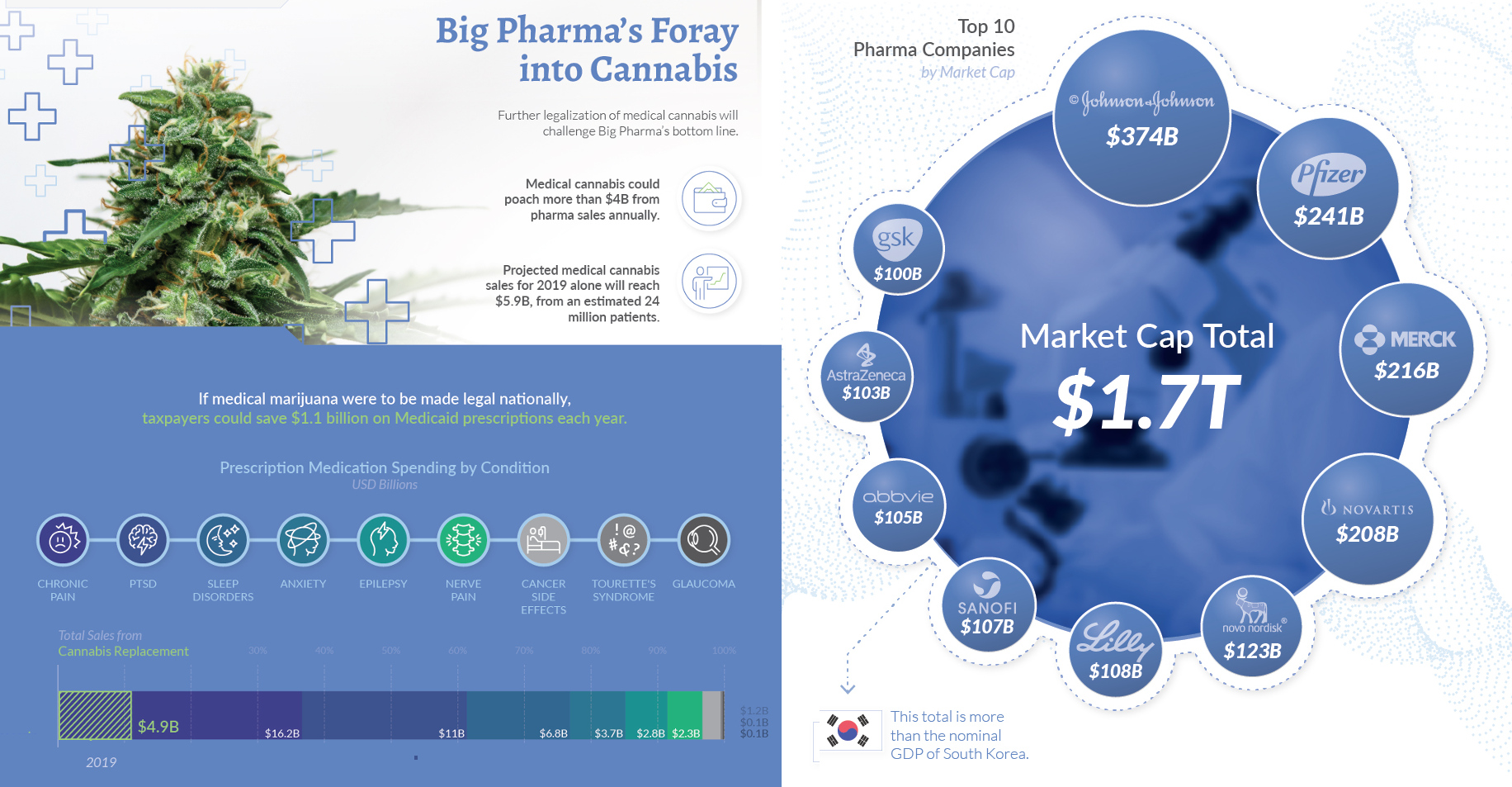
Today’s infographic comes to us from CB2 Insights, and explores how and why the notorious Big Pharma are interested in the nascent cannabis industry.

Who are “Big Pharma”?

The term refers to some of the largest pharmaceutical companies in the world, considered especially influential as a group. To give a sense of their sheer size, the market cap of the top 10 Big Pharma companies is $1.7 trillion—Johnson & Johnson being the largest, with a market capitalization of $374 billion.

So far, Big Pharma has watched the cannabis industry from the sidelines, deterred by regulatory concerns. What we are seeing now is the sleeping giant’s takeover slowly intensifying as more patents, partnerships, and sponsored clinical trials come to fruition.

Could Cannabis be Sold Over the Counter?

The cannabis plant has been used in medicine for 6,000 years. However, there is still considerable debate around the role it plays in healthcare today. There are currently almost 400 active and completed clinical trials worldwide surrounding cannabidiol (CBD), a type of cannabinoid that makes up 40% of the cannabis plant’s extract.

Cannabis relies on CBD’s therapeutic properties, and recent studies suggest it may be useful in combating a variety of health conditions, such as:

  • Epilepsy
  • Schizophrenia
  • Multiple sclerosis
  • Migraines
  • Arthritis
  • Cancer side effects

As of 2019, 33 states and the District of Columbia have legalized cannabis for medical use. Its potential for pain management has led some experts to recommend it as an alternative to addictive painkillers, with one study of 13 states showing opiate-related deaths decreasing by over 33% in the six years since medical cannabis was legalized.

As the industry evolves, data is becoming increasingly important in understanding the potential of cannabis—both as a viable medical treatment, and as a recreational product. The shift away from anecdotal evidence towards big data will inform future policies, and give rise to a new era of consumer education.

Big Pharma’s Foray into Cannabis

Further legalization of cannabis will challenge Big Pharma’s bottom line, and poach more than $4 billion from pharma sales annually. In fact, medical cannabis sales are projected to reach $5.9 billion in 2019, from an estimated 24 million patients.

Seven of Canada’s top 10 cannabis patent holders are major multinational pharmaceutical companies, a trend that is not unique to Canada.

It comes as no surprise that many pharmaceutical giants have already formed strong partnerships with cannabis companies, such as Novartis and Tilray, who will develop and distribute medical cannabis together in legal jurisdictions around the world.

Data is the Missing Link

While the body of knowledge about the many uses of cannabis continue to grow, clinical evidence is key for widespread adoption.

Products backed by data will be a defining criteria for major companies to come into the market en masse. And ultimately, Big Pharma’s entry could accelerate public understanding and confidence in cannabis as a viable option for a range of ailments, and mark the next major milestone for the industry.


Conservatives buck Trump over worries of ‘socialist’ drug pricing

Conservatives buck Trump over worries of ‘socialist’ drug pricing

Image result for socialist drug pricing

Conservatives are growing increasingly uneasy with the Trump administration’s new drug pricing policy.

President Trump is desperately seeking an elusive political win in his efforts to lower prescription drug costs, but he faces a hard sell to conservative groups and GOP lawmakers as he touts ideas traditionally favored by Democrats and presidential candidate Sen. Bernie Sanders (I-Vt.).

In a rare break with Trump, conservatives are now pushing back against key administration policies and accusing the president of supporting what they call Sanders-style socialism.

The president has embraced importing drugs from Canada, as well as an international pricing policy that would bar Medicare from paying more than other countries for prescription drugs.

The moves are designed to co-opt Democratic talking points and position Trump as a populist champion of the free market.

Trump has made lowering drug prices a top priority of his presidency, but he has suffered some high-profile setbacks in recent weeks.

Drug importation and the international pricing caps proposal are the only remaining policies remaining that the White House can use to make a splash heading into 2020.

Trump has frequently railed against “global freeloading” and said he doesn’t think it’s fair that the U.S. subsidizes research and development in other countries.

Last year he went to the Department of Health and Human Services (HHS) and announced the plan to cap U.S. payments for expensive drugs, over the objections of some White House advisers.

Those objections later spread to include conservative groups.

Facebook ads this year from FreedomWorks, a conservative advocacy group, urged people to tell HHS Secretary Alex Azar to oppose “socialist-style price controls.”

Another ad warned the administration against “importing socialist European drug prices in America.”

Separately, a website sponsored by the American Conservative Union rails against the administration’s pricing index, calling it an experiment “directly out of the Bernie Sanders and Hillary Clinton government health care takeover playbook.”

In the GOP-controlled Senate, a bill backed by the administration is facing Republican opposition over a provision that would impose a limit on drug price increases in Medicare’s Part D prescription drug program.

The legislation would force drug companies to pay money back to the government if their prices rise faster than inflation.

The Senate Finance Committee approved the measure late last month in a 19-9 vote — all Democrats voted for it, and all nine “no” votes came from Republicans. Some GOP senators said they were concerned because they think the Medicare Part D provision violates traditional free-market principles.

The bill faces long odds of making it to the Senate floor without substantial changes.

“I’m not comfortable with putting price controls on drugs,” Sen. Pat Toomey (R-Pa.), a member of the Finance Committee, told The Hill.

Toomey offered an amendment to strip out the provision, which failed on a tie vote of 14-14. All but two Republicans voted for his amendment.

Aside from capping drug payments, Trump has also softened his stance on importing drugs from Canada. The administration last week announced a proposal that would set the groundwork for states or wholesalers to launch pilot programs to safely import drugs.

Shipping in drugs from abroad has long been a goal of progressives like Sanders, but has also won the support of libertarian-leaning conservatives like GOP Sens. Rand Paul (Ky.), Ted Cruz (Texas) and Mike Lee (Utah).

But with Trump looking for a win on drug pricing, political analysts and health experts argue he doesn’t necessarily care about gaining the support of conservatives.

“This is the administration throwing down a wild card,” said health care consultant Alex Shekhdar, founder of Sycamore Creek Healthcare Advisors. “In order to win in 2020, they need to take into consideration independents and anyone else who thinks drug prices are an issue.”

Joe Antos, a health care expert at the conservative American Enterprise Institute, said it doesn’t matter if the policies Trump is embracing are traditionally Democratic ones.

“Just because Democrats endorsed it in the past, doesn’t mean Trump can’t take ownership and call it his idea. He might not call them Republican ideas, but he’ll call them Donald Trump ideas,” Antos said.

But some GOP senators cautioned against letting Democrats play too much of a role.

After the Finance Committee advanced the drug-pricing bill, Chairman Chuck Grassley (R-Iowa) told reporters that Republicans don’t want Trump negotiating with Speaker Nancy Pelosi (D-Calif.).

A competing bill from House Democrats is far more sweeping than the Senate’s, and includes direct Medicare negotiation on drug prices.

“It seems to me that the Grassley-Wyden approach is a very moderate approach to what could come out,” Grassley said, referring to the bill backed by him and Sen. Ron Wyden (Ore.), the ranking Democrat on the Finance Committee.

But a stalled bill could still work to Trump’s advantage, according to Antos, who said the president doesn’t necessarily need to lower drug prices, he just needs to convince the public he is trying. 

In that sense, Antos argued, Republicans haven’t offered anything better, and they will eventually support whatever the administration does.

“Republicans don’t have any alternative ideas,” Antos said. “Trump has full control of Republicans in Congress, so there’s just not going to be any response other than going along with what comes along.”


Pentagon Sees Security Threat in China’s Drug-Supply Dominance

https://www.bloomberg.com/news/articles/2019-08-05/pentagon-sees-security-threat-in-china-s-drug-supply-dominance

Image result for Pentagon Sees Security Threat in China’s Drug-Supply Dominance

  • Defense Department official says risk ‘cannot be overstated’
  • China is the top maker of active pharmaceutical ingredients

The Trump administration sees the increasing use of Chinese-made active ingredients in drugs taken by U.S. troops and civilians as a national security risk.

China has become the world’s largest supplier of active pharmaceutical ingredients, or API, providing key components to drugmakers worldwide. But a yearlong recall of tainted heart drugs taken by millions of Americans is prompting U.S. national security officials to ask whether China’s growing role in the pharmaceutical supply chain could pose a threat to the health of military personnel.

“The national security risks of increased Chinese dominance of the global API market cannot be overstated,” Christopher Priest, the acting deputy assistant director for health care operations and Tricare for the Defense Health Agency, told a U.S.-China advisory panel last week in Washington.

The Defense Health Agency manages much of the health care of military members, including prescription drugs.

Concerns about the safety and efficacy of Chinese-made drugs are rising at a time of heightened trade tensions between Washington and Beijing. Last week, Trump unveiled plans for new tariffs on Chinese goods; China plans to halt imports of U.S. crops in response. The yuan sank on Monday against the dollar.

The National Security Council is looking into Chinese drug manufactuing and trying to identify the most at-risk medications, Priest told the U.S.-China Economic and Security Review Commission in Washington, without elaborating. The National Security Council declined to comment.

The Defense Health Agency is supposed to use drugs that comply with the Trade Agreements Act, a 1979 law that requires many federal purchases to be made in the U.S. or another compliant country. China isn’t on the approved list, but the agency has waivers for almost 150 drugs they otherwise wouldn’t be able to procure, Priest said. The TAA covers only finished products, not their components.

Many drugs taken by military members and civilians have active ingredients made in China. While drugmakers typically don’t disclose where every molecule in a pill comes from, the recall of contaminated blood-pressure drugs has shown that many of their active components originated in Chinese factories.

Rocket Fuel

Larry Wortzel, a member of the U.S.-China commission and a military retiree, said four of his blood-pressure medications were recalled in three months. Wortzel’s pills, versions of a drug called valsartan, were manufactured in India but had active ingredients from China.

“They were contaminated with rocket fuel,” Wortzel said. “I imagine active people have the same problem. This affects the readiness of our troops.”

The recalled valsartan contained a probable carcinogen known as NDMA, a manufacturing byproduct once used to make rocket fuel and also found in grilled and cured meats.

Priest called the recalls “a never-ending saga” and a “wake-up call.”

The recalls began in July 2018 with valsartan made by China’s Zhejiang Huahai Pharmaceutical Co. The U.S. Food and Drug Administration has largely blamed the company’s manufacturing process for creating the NDMA, which went undetected for as long as four years. Drugmakers in other countries who used similar processes have also had to recall blood-pressure pills.

Some valsartan purchased by the Defense Logistics Agency and later recalled was TAA-compliant, said Patrick Mackin, a spokesman for the DLA. The agency manages the supply chain for the U.S. military, including ensuring pharmaceuticals make their way to military treatment facilities. With valsartan in shortage, according to the FDA, the agency sought a TAA waiver for valsartan on July 15, Mackin said.

A Bloomberg investigation this year detailed doubts among U.S. health officials about the data generic-drug companies, including Zhejiang Huahai and others involved in the valsartan recalls, use to prove their products are safe and effective.

“We wouldn’t have our aircraft carriers and nuclear submarines built in China, and for very important medications, we really should look at what it takes to purchase based on value not just price,” Rosemary Gibson, the author of the book “China Rx,” told the commission. “We want cheap, we can buy cheap. But what’s missing from the whole equation is quality.”

Shortage Fears

Quality isn’t the only concern. Shortages could also arise from attempts by the Chinese to cut off supply, particularly amid the U.S.-China trade standoff.

“If China shut the door on exports, our hospitals would cease to function, so this has tremendous urgency,” Gibson said.

Priest said pharmaceutical companies should be compelled, using the buying power of the entire federal government, to maintain the infrastructure to make drugs without relying on countries like China.

The House Energy and Commerce Committee is investigating the FDA’s ability to police foreign manufacturing. The committee’s leaders asked the agency for more information on the valsartan recall in June, including about a dispute between senior officials and an agency inspector who raised red flags at Zhejiang Huahai more than a year before the NDMA was detected. The panel also asked the Government Accountability Office to look at the FDA’s oversight of foreign drug manufacturing.

“Shame on us for not paying attention to something so critical and assuming, which has been the orthodoxy for a long time, that the industry would regulate itself,” Benjamin Shobert, senior associate for international health at The National Bureau of Asian Research, told the commission.


Lowering Out-of-Pocket Health Costs Isn’t Easy. States Have Tried

https://www.governing.com/topics/health-human-services/gov-trump-prescription-drug-prices-states-canada-import.html?utm_term=Lowering%20Out-of-Pocket%20Health%20Costs%20Isn%27t%20Easy.%20States%20Have%20Tried.&utm_campaign=Lowering%20Out-of-Pocket%20Health%20Costs%20Isn%27t%20Easy.%20States%20Have%20Tried.%20Now%20Congress%20Is%20Giving%20It%20a%20Shot.&utm_content=email&utm_source=Act-On+Software&utm_medium=email

U.S. Sen. Bill Cassidy shows a chart during a congressional hearing.

Congress has promised to tackle high consumer health-care costs this year. It’s one of the few issues where lawmakers on both sides of the aisle find common ground.

The Lower Health Care Costs Act, introduced in June, is an almost 200-page piece of legislation that seeks to prevent surprise medical bills, lower prescription drug prices and force hospitals to be more transparent about what they bill insurance companies.

But there are already signs of potential failure.

Despite early momentum, Congressional leaders postponed a vote on the measure until after August recess. The pharmaceutical industry as well as hospital and provider groups have started to lobby against the legislation, meeting with President Trump in July to make their case.

Although the Affordable Care Act led to more people having health insurance, many Americans still struggle with out-of-pocket costs, especially ones they weren’t expecting. Meanwhile, health care is taking up an ever-growing size of state budgets. Governors and lawmakers try to tackle this issue almost every legislative session, but few have succeeded in a meaningful way.

“It’s usually a third of state budgets. States have every reason to try and control health-care costs. And yet, everybody struggles to,” says Josh Shaferstein, vice dean of Johns Hopkins University’s Office of Public Health Practice and Training, and a former health secretary for the state of Maryland.

Battling the Health-Care Industry

The first and usually biggest hurdle is private interest groups who see reforms as a threat to their livelihood.

“There are a lot of stakeholders that have vested interest and lobbyists on the ground that will fight tooth and nail, whether it’s doctors and nurses groups or insurance companies. They are perhaps moreso willing to fight at the state level,” says Sabrina Corlette, research professor at Georgetown University’s Center on Health Insurance Reforms.

She points to a bill introduced in Colorado this year that would have capped payments to hospitals in order to lower premiums. After pushback from hospital groups, lawmakers amended the legislation — which was signed into law — so that hospitals will be paid the same but will have to pay back a portion of their revenue to help lower premiums. 

In Washington state, which passed a first-in-the-nation “public option” bill this year, lawmakers rewrote the original legislation after doctor and hospital groups fought a provision that would have set the same cap on provider payments as Medicare. The final legislation reflected a compromise for insurers to pay providers 160 percent of Medicare rates.

At least eight other states discussed or introduced public option bills this year, but they failed to gain traction.

In Delaware — a state that ranks third in health-care spending but 31st in health outcomes — Gov. Jay Carney signed an executive order in November that outlines eight goals the state will work toward to curb the growth in health spending. But Kara Odom Walker, the state’s health secretary, concedes that they weren’t able to convince stakeholders to enact new penalties or regulations.

“Being a small state makes it a lot harder to do things that might be unpopular. Any conversation that includes words like ‘penalty’ or ‘payment cap’ is like a bomb going off,” she says.

The health-care industry is one of the biggest in the country. That gives it a lot of leverage.

“The health systems are often the largest employers in town. The governor says they want to slow health-care spending growth, and the hospital group will say, ‘that means losing jobs,’” says Robert Mechanic, executive director of the Health Industry Forum.

But as Congress tries to lower out-of-pocket costs, they have an asset that states don’t: better data. Corlette says states often lack impartial numbers on potential policies, hurting their ability to assess and defend legislation.

“It’s very hard for your average state legislator to pierce the veil,” Corlette says. “There’s an imbalance of info for legislators to really tackle the problem. They don’t have a Congressional Budget Office.”

One Person’s Savings Are Another’s Costs

Many compare efforts to control health-care costs to a game of whack-a-mole. A state might successfully regulate spending in one area only to see costs skyrocket in another.

“You might be able to cut rates in Medicaid, but then rates will pop up in private insurance. The standard toolkit for states is fraught with political danger,” says Shaferstein.

“Health care is so complex, and there are so many different players. It’s really hard to get your arm around the whole bundle,” says Mechanic.

For instance, Medicare lowered the limit for how long older patients can stay in hospitals. But there’s some evidence that the Medicare savings became extra costs for nursing homes because hospitals started providing fewer services for elderly patients altogether.

State Legislation

When it comes to controlling drug prices, states haven’t made much progress. They have made more headway regulating surprise medical bills.

Half the states have passed surprise billing laws. Only nine of them, though, included “comprehensive protections” that apply to all insurance plans, according to the Commonwealth Fund.

While states have struggled to actually lower drug prices, like Congress plans to do, they have passed laws to make them more transparent and to clamp down on pharmacy benefit managers — middlemen who negotiate drug benefits for plans.

Five states have enacted laws that require drug companies to notify them if they will significantly raise the price of a drug, and at least a dozen have restricted the power that a pharmacy benefit manager can have, like requiring them to register with the state.

Solutions That Have Worked

There are some success stories and lessons learned that Congress could use to lower health-care spending in general.

“States should be thinking of more global solutions because you kind of have to go big. Oftentimes people are looking to save $1 to $2 million a year, but that’s not going to make much of a difference,” says Shafterstein.

Only a couple of states have “gone big” in this sense.

Massachusetts passed what became the framework for the federal Affordable Care Act in 2006, known as “RomneyCare,” which requires residents to have health insurance. Health-care spending has since slowed in recent years. Mechanic credits that to the law’s requirements for private health entities to publicly justify price hikes and high spending.

In Maryland, it has taken decades to get health-care spending under control. The state has had an all-payer system for hospitals since the 1970s, meaning they get a fixed sum every month rather than bill insurers for every claim. While that system — which is only used by one other state, Vermont — curbed hospital spending per patient, hospital spending overall grew at a slightly higher rate than the national average.

So in 2014, Maryland forced hospitals to limit their spending to 0.5 percent less than the national growth rate. It has largely been deemed a success, with a report commissioned by the federal Centers for Medicare and Medicaid Services finding that “Maryland hospitals were able to operate within their global budgets without adverse effects on their financial status.”

On a less global scale, states have been able to drive down premiums by implementing reinsurance programs, meaning the government pays for the most expensive patients, taking that bill off insurance companies’ plate.

But reinsurance is like slapping a band-aid on a much larger wound.

“Recent state efforts on reinsurance have worked, but they aren’t really getting at the overall cost of coverage,” says Kevin Lucia, research professor at Georgetown University’s Health Policy Institute.


White House races to come up with health-care wins for Trump’s campaign

https://www.washingtonpost.com/health/trump-to-unveil-drug-price-health-initiatives-in-walk-up-to-2020/2019/07/31/f4adc4de-af1a-11e9-8e77-03b30bc29f64_story.html?utm_term=.559659aa0911&wpisrc=nl_most&wpmm=1

Image result for healthcare initiatives


White House advisers, scrambling to create a health-care agenda for President Trump to promote on the campaign trail, are meeting at least daily with the aim of rolling out a measure every two to three weeks until the 2020 election.

One of the initiatives would allow states to import lower-priced drugs from Canada and other countries and another would bar Medicare from paying more than any other country for prescription drugs, according to two senior administration officials and lobbyists — controversial ideas in line with Democratic proposals. Yet it remains unclear the administration has the legal authority to execute some of these policies without Congress.

The White House is already facing fierce pushback on some proposals from Republicans on Capitol Hill and the pharmaceutical industry, which will likely go to court to challenge any measure it opposes.

The furious push reflects the administration’s sense of vulnerability on an issue that Democrats successfully used in 2018 to win control of the House of Representatives. White House officials are eager to inoculate the president against a repeat of that strategy in 2020 — and reduce the GOP disadvantage on an issue that pollsters say plays to Democratic strengths. Most of the Democratic presidential candidates have made health-care proposals, including Medicare-for-all plans, key to their campaigns. Health care is already playing a starring role in the debates and Democrats are sure to assail Trump for his attempts to eliminate coverage for millions of people by challenging the Affordable Care Act in court.

“President Trump has said we will protect people with preexisting conditions, lower drug prices, end surprise medical bills, and make sure Americans get the highest quality of care they deserve,” said White House spokesman Judd Deere. “While the radical left has sweeping proposals for a total government takeover of the health system that will hurt seniors and eliminate private insurance for 180 million Americans, the Trump administration is working on real solutions.”

Some, however, are doubtful a flurry of executive orders and new regulations would have an immediate effect on consumers’ pocketbooks. What is clear is that the approach, which includes White House support for a bipartisan Senate bill to cap Medicare drug price increases to the rate of inflation, is putting congressional Republicans in a tough spot: Embrace Trump’s agenda and abandon conservative precepts about interference in the marketplace, or buck the president on one of his top priorities.

While Republicans have largely fallen in line with Trump on free trade and immigration even when he has blown up GOP orthodoxy, many rely heavily on donations from the pharmaceutical industry and are reluctant to sour those relationships.

One lobbyist, who spoke on the condition of anonymity, described being stunned at a recent White House meeting when Domestic Policy Council Director Joe Grogan said the administration would not let Democrats run to the president’s left on lowering the prices of prescription medicines.

In another tense meeting, top pharmaceutical executives were told bluntly “it wasn’t in the industry’s best interests” to block the bipartisan Senate bill backed by Trump. If it failed, they were told, they’d see “the president of the United States negotiating with Nancy Pelosi [on allowing the government to negotiate drug prices in Medicare],” said a person familiar with the meeting.

On Wednesday, Health and Human Services Secretary Alex Azar announced the outlines of a plan to eventually allow Americans to import certain lower-cost drugs from Canada and other countries. White House officials are also weighing an Obamacare replacement that Congress would take up after the election, a Medicare plan to contrast with Democratic Medicare-for-all proposals, help for beleaguered rural hospitals and steps to reduce maternal death rates, according to two senior administration officials.

The health-care effort is being driven by the White House’s Domestic Policy Council Director Joe Grogan, Chief of Staff Mick Mulvaney and the White House Office of Management and Budget acting director Russ Vought. Other participants in the sometimes contentious daily meetings include Azar, the president’s son-in-law and senior adviser Jared Kushner, White House counselor Kellyanne Conway and representatives from the vice president’s office.

One senior administration official, who spoke on the condition of anonymity to discuss internal deliberations, said the White House believes it has “tremendous authority” to write executive orders under food, drug and cosmetic laws, as well as through the ACA, which gives the government broad power to test ways to improve health care and reduce costs in government programs.

“We think the [ACA] authority is pretty tremendous,” the official said. The administration is currently arguing in federal court to overturn the law, however, with a decision expected late summer or fall.

But many health policy and legal experts disagree and are also skeptical the steps the administration is talking about would have a tangible effect on consumers before the election.

“It’s unlikely the administration is going to be able to use an executive order that Americans are going to be able to notice before the election,” said Benedic Ippolito, a health economist at the American Enterprise Institute. “It’s an incredibly ambitious timeline.”

Others see court challenges as inevitable, noting the drug industry has already shown a willingness to sue the administration over policies it opposes; it recently won a lower court victory against an Health and Human Servies regulation that would have required drugmakers to include the list prices of their medications in television ads.

“I’m not sure they can get anything done and survive a court challenge before the election,” said Chris Meekins, a former HHS official who is now a health care policy research analyst at Raymond James, a financial services firm.

The White House is also attempting to build support for the Senate bill authored by Finance Committee Chairman Charles E. Grassley (R-Iowa) and ranking Democrat Sen. Ron Wyden (Ore.), that for the first time would require drugmakers to pay back the federal government if they raised the prices of medications in the Medicare program in excess of the rate of inflation. It would also limit out-of-pocket costs for beneficiaries.

The pharmaceutical industry opposes the bill, and some Republicans have already derided the legislation as tantamount to negotiating drug prices or imposing “price controls”a line in the sand for many who oppose what they see as government interference in the market. Senate Majority Leader Mitch McConnell (R-Ky.) has not said whether he will bring a drug-pricing legislative package up for a vote, but he is generally opposed to voting on health-care legislation ahead of the election.

Against the advice of many congressional Republicans, White House advisers are also working to craft an Obamacare replacement plan that Trump could campaign on, especially if the Fifth Circuit should declare the law unconstitutional this fall and catapult the issue to the forefront of the 2020 races.

Some GOP lawmakers and strategists worry about rolling out a plan that has no chance of passage in the current Congress and that Democrats could pick to pieces during a long campaign. Many also have little appetite to return to the debate over repealing Obamacare.

Nonetheless, the White House is considering a plan, put together by conservative think tanks, that would eliminate the ACA’s subsidies for low-income consumers and replace the open-ended federal commitment to Medicaid with a lump-sum payment for each state in the form of a block grant, according to a copy posted online. The proposal largely follows the outlines of a 2017 Republican bill, which the Senate never voted on because it did not garner enough support.

“We don’t have a lot of buy in on the Hill,” acknowledged the senior administration official, “but we’re figuring it out.”

Some of the other health-care proposals under review also appear largely aspirational, for instance, a draft executive order that instructs agencies to speed development of a universal flu vaccine, first reported by Politico, that proposes no new funding. Other efforts, such as the initiatives to reduce HIV infections, reduce end-stage kidney disease and double the number of transplants, contain new funding and have been widely heralded.

“Every chance we have to set or tweak a rule we are doing it.” said the senior official. “This administration has been more creative and accomplished more when it comes to health care and health than anybody has given us credit for.”

How a Medicare Buy-In or Public Option Could Threaten Obamacare

Related image

Some Democrats are proposing a government alternative to private insurance. But allowing people to choose such a plan may destabilize the A.C.A., some experts say.

It seems a simple enough proposition: Give people the choice to buy into Medicare, the popular federal insurance program for those over 65.

Former Vice President Joseph R. Biden Jr. is one of the Democratic presidential contenders who favor this kind of buy-in, often called the public option. They view it as a more gradual, politically pragmatic alternative to the Medicare-for-all proposal championed by Senator Bernie Sanders, which would abolish private health insurance altogether.

A public option, supporters say, is the logical next step in the expansion of access begun under the Affordable Care Act, passed while Mr. Biden was in office. “We have to protect and build on Obamacare,” he said.

But depending on its design, a public option may well threaten the A.C.A. in unexpected ways.

A government plan, even a Medicare buy-in, could shrink the number of customers buying policies on the Obamacare markets, making them less appealing for leading insurers, according to many health insurers, policy analysts and even some Democrats.

In urban markets, “a public option could come in and soak up all of the demand of the A.C.A. market,” said Craig Garthwaite, a health economist at the Kellogg School of Management at Northwestern University.

And in rural markets, insurers that are now profitable because they are often the only choices may find it difficult to make money if they faced competition from the federal government.

Some insurers could decide that a smaller and uncertain market is not worth their effort.

If the public option program also matched the rates Medicare paid to hospitals and doctors, “I think it would be really hard to compete,” Mr. Garthwaite said. Even leading insurers do not have the leverage to demand lower prices from hospitals and other providers that the government has.

Whether to implement a public option or Medicare buy-in has become a defining question among Democratic presidential candidates and is likely to be a contentious topic at this week’s debates.

On Monday, Senator Kamala Harris took an alternate route, unveiling a plan that would allow private insurers to participate in a Medicare-for-all scheme, akin to their role currently offering private plans under Medicare Advantage.

The recent spate of proposals reprises some of the most difficult questions leading up to the passage of the A.C.A., in many ways a compromise over widely divergent views of the role of the government in ensuring access to care.

After a shaky start, the federal and state Obamacare marketplaces are surprisingly robust, despite repeated attempts by Republicans to weaken them. They provide insurance to 11 million customers, many of whom receive generous federal subsidies to help pay for coverage.

The A.C.A. is now a solidly profitable business for insurers, with several expanding options after earlier threats to leave. For example, Centene, a for-profit insurer, controls about a fifth of the market, offering plans in 20 states. It is expected to bring in roughly $10 billion in revenues this year by selling Obamacare policies.

In spite of stock drops because of investors’ concerns over Medicare-for-all proposals, for-profit health insurers have generally thrived since the law’s passage.

But a buy-in shift in insurance coverage could profoundly unsettle the nation’s private health sector, which makes up almost a fifth of the United States economy. Depending on who is allowed to sign up for the plan, it could also rock the employer-based system that now covers some 160 million Americans.

In a recent ad, Mr. Biden features a woman who wants to keep her current coverage. “I have my own private insurance — I don’t want to lose it,” she said.

A spokesman for Mr. Biden argued that a public option can extend the success of the Affordable Care Act.

“Joe Biden thinks it would be an egregious mistake to undo the A.C.A., and he will stand against anyone — regardless of their party — who tries to do so,” said Andrew Bates, a spokesman for Mr. Biden, in an email.

Major insurers and hospital chains, pharmaceutical companies and the American Medical Association have joined forces to try to derail efforts like Medicare-for-all and the public option. Mr. Sanders denounced these powerful interests in a recent speech.

“The debate we are currently having in this campaign and all over this country has nothing to do with health care, but it has everything to do with the greed and profits of the health care industry,” he said.

Other critics of the public option, including Seema Verma, the administrator of the Centers for Medicare and Medicaid Services, argue Democrats’ programs will lead to a “complete government takeover.”

“These proposals are the largest threats to the American health care system,” she said in a speech earlier this month.

Some experts predict that private insurers will adapt, while others warn that the government could wind up taking on the sickest customers with high medical bills, leaving the healthier, profitable ones to private insurers.

It’s uncertain whether hospitals, on the other hand, could thrive under some versions of the public option. If the nation’s 5,300 hospitals were paid at much lower rates by a government plan — rates resembling those of Medicare — they might lose tens of billions of dollars, the industry claims. Some would close.

One variant of the public option — letting people over 50 or 55 buy into Medicare — is often depicted as less drastic than a universal, single-payer program. But this option would also be problematic, experts said.

This consumer demographic is quite valuable to insurers, hospitals and doctors.

Middle-aged and older Americans have become the bedrock of the Obamacare market. Some insurers say this demographic makes up about half of the people enrolled in their A.C.A. plans and, unlike younger people who come and go, is a reliable and profitable source of business for the insurance companies.

The aging-related health issues of people in this group guarantee regular doctor visits for everything from rising blood pressure to diabetes, and they account for a steady stream of lucrative joint replacements and cardiac stent procedures.

The 55-to-64 age group, for example, accounts for 13 percent of the nation’s population, but generates 20 percent of all health care spending, according to the Kaiser Family Foundation.

Several experts said that designing a buy-in program that is compatible with the existing public and private plans could be daunting.

“You’d have to do it carefully,” said Representative Donna Shalala, a Florida Democrat who served as the secretary of health and human services under President Bill Clinton.

Linda Blumberg, a health policy expert at the Urban Institute, a nonpartisan think tank, agreed. “The idea of Medicare buy-ins was taken very seriously before there was an Affordable Care Act,” she said. “In the context of the A.C.A., it’s a lot more complicated to do that.”

Many dismiss concerns about whether insurers can compete.

“Any time a market shrinks in America, insurers don’t like it,” said Andy Slavitt, the former acting Medicare administrator under President Obama and a former insurance executive. Mr. Slavitt noted that insurers raised similar concerns about the federal law when it was introduced. “They’ll figure it out,” he said.

In Los Angeles County, five private insurers that sell insurance in the A.C.A. market already compete with L.A. Care Health Plan, which views itself as a kind of public option, said John Baackes, the plan’s chief executive.

The insurer offers the least expensive H.M.O. plan in the county by paying roughly Medicare rates. “We’ve proved that the public option can be healthy competition,” he said.

But the major insurance companies, which were instrumental in defeating the public option when Congress first considered making it a feature of the A.C.A., are already flexing their lobbying muscle and waging public campaigns.

In Connecticut, fierce lobbying by health insurers helped kill a state version of the public option this spring. Cigna resisted passage of the bill, threatening to leave the state. “The proposal design was ill-conceived and simply did not work,” the company said in a statement.

Blue Cross plans could lose 60 percent of their revenues from the individual market if people over 50 are shifted to Medicare, said Kris Haltmeyer, an executive with the Blue Cross Blue Shield Association, citing an analysis the company conducted. He said it might not make sense for plans to stay in the A.C.A. markets.

Siphoning off such a large group of customers could also lead to a 10 percent increase in premiums for the remaining pool of insured people, according to the Blue Cross analysis. More younger people with expensive medical conditions have enrolled than insurers expected, and insurers would have to increase premiums to cover their costs, Mr. Haltmeyer said.

Tricia Neuman, a senior vice president at the Kaiser Family Foundation, which studies insurance markets, said a government buy-in that attracted older Americans could indeed raise premiums for those who remained in the A.C.A. markets, especially if those consumers had high medical costs.

But some experts countered that prognosis, predicting that premiums could go down if older Americans, whose health care costs are generally expensive, moved into a Medicare-like program.

“The insurance companies are wrong about opposing the public option,” Ms. Shalala said.

Dr. David Blumenthal, the president of the Commonwealth Fund, a foundation that funds health care research, said a government plan that attracted people with expensive conditions could prove costly.

“You might, as a taxpayer, become concerned that they would be more like high-risk pools,” he said.

Jonathan Gruber, an M.I.T. economist who advised the Obama administration during the development of the A.C.A., likes Mr. Biden’s plan and argues there is a way to design a public option that does not shut out the private insurers.

“It’s all about threading the needle of making a public option that helps the failing system and not making the doctors and insurers go to the mat,” he said.

Many experts point to private Medicare Advantage plans, which now cover one-third of those eligible for Medicare, as proof that private insurers can coexist with the government.

But the real value of a public option, some say, would stem from the pressure to lower prices for medical care as insurers were forced to compete with the lower-paying government plans, like Medicare.

Washington State recently passed the country’s first public option, capping prices as part of its plan to provide a public alternative to all residents by 2021.

“It’s couched in this language in expanding coverage, but it does it by regulating prices,” said Sabrina Corlette, a health policy researcher at Georgetown University.

The hospital industry would most likely fight just as hard to defeat any proposal that would convert a profitable group of customers, Americans who are privately covered at present, into Medicare beneficiaries.

Private insurers often pay hospitals double or triple what Medicare pays them, according to a recent study from the nonprofit Rand Corporation.

While Ms. Shalala supports a public option as an alternative to “Medicare for All,” she is clear about how challenging it will be to preserve both Obamacare and the private insurance market. “You can’t do it off the top of your head,” she said.


Trump’s next move on drug prices

https://www.axios.com/newsletters/axios-vitals-2f43e920-50d7-4650-b95c-112de9060f9f.html?utm_source=newsletter&utm_medium=email&utm_campaign=newsletter_axiosvitals&stream=top

Sens. Ron Wyden and Chuck Grassley

The White House is preparing another big executive order on drug prices, Reuters scooped last night.

  • Citing industry sources who had discussed the plan with the administration, Reuters reports that it would likely seek to lower prices in Medicare Part D, which covers drugs you pick up at the pharmacy counter.
  • The administration’s most sweeping proposal to date — to piggyback off of the lower prices in European countries — was limited to Part B, which covers drugs administered by a doctor.
  • It’s not clear whether the new Part D proposal would also rely on international pricing, per Reuters. Part D is much bigger than Part B.

Between the lines: It’s probably no coincidence that this threat is being floated just as the White House is trying to build support for the Senate Finance Committee’s drug-pricing bill, despite Republican objections.

  • In fact, Sen. Chuck Grassley made that point explicitly, The Hill reports.
  • “Who knows what he’s going to do at the last minute,” he said, referring to Trump. “If he would join forces with Pelosi, look at what that would do to everything that we Republicans stand for.”
  • “It seems to me that the Grassley-Wyden approach is a very moderate approach [compared] to what could come out,” he added.

Where it stands in the Senate.

Finance approved the Grassley-Wyden bill yesterday, but the proceedings left no doubt that there are still stark divisions within the GOP over drug pricing, and more resistance than we’re used to seeing on policies Trump supports.

The intrigue: Nine of the committee’s 15 Republicans voted against the bill. All of the Democrats supported it, leading to a final vote of 19-9.

  • The bill’s proposal to cap price increases within Part D is clearly the biggest sticking point for Republicans. An amendment to strike that provision, offered by Sen. Pat Toomey, failed on a 14-14 vote.

What’s next: Pharma’s best bet is probably to stop the Senate from passing anything.

  • That would prevent an eventual conference between the House and Senate, in which Pelosi and Trump could make good on Grassley’s predictions and strike up an alliance (if she wanted to help Trump claim a win on drug prices, which is far from a sure thing).
  • But that’s a tall order, so expect pharma and its allies to keep trying to water down the Senate package while waging that bigger-picture fight.

The bottom line: “This bill is not anywhere near action on the floor,” Sen. John Cornyn said yesterday, per The Hill.