Medicare Advantage plans pay physicians less than original Medicare

https://www.healthcarefinancenews.com/news/medicare-advantage-plans-pay-physicians-less-original-medicare

MA pays 10% to 15% less than what is paid by the government in original Medicare, report says.

A new study confirms what the American Medical Association and other medical groups have long been saying about physician pay: Medicare reimbursement is not keeping up with inflation.

In original Medicare, doctors are paid one-third less than a decade ago, the report said. Medicare reimbursement rates for outpatient procedures have decreased every year since 2016, for an overall decline of 10%.

Over the same period, inflation has risen by almost 30%, according to the report.

The report also sheds light on Medicare Advantage reimbursement. Medicare Advantage plans pay physicians an estimated 10% to 15% less than what is paid by the government in traditional Medicare, according to the 2025 Omniscient Health Physician Medicare Income Report

This can create negative margins for physicians considering MA plans take roughly twice as long to reimburse providers compared to original Medicare along with factoring in prior authorization and denials, the report said. 

An estimated 54% of Medicare beneficiaries are enrolled in a MA plan.

WHY THIS MATTERS

The MA reimbursement gap is driving shifts in network participation. A 2024 survey by the Healthcare Financial Management Association found that 19% of health systems have stopped accepting at least one MA plan, with another 61% planning to do so or actively considering it, according to the Omniscient report.

“Despite the rising demand for care from an aging U.S. population, the financial strain is forcing physicians to rethink whether they will continue serving Medicare patients,” said Meade Monger, CEO of Omniscient Health, a healthcare data science company. “High-volume Medicare practices, especially those in primary care and rural areas, are increasingly unable to sustain operations under current revenue structures.”

The federal government’s push toward streamlining and speeding up the prior authorization process and requiring an electronic process over paper represents improvement, the report said. Some insurers have announced plans to decrease the number of procedures that require prior auth.

But payment rates need to change, said Omniscient, which recommends policymakers index Medicare reimbursement rates to inflation and set payment standards for MA plans. 

THE LARGER TREND

On Tuesday, the American Medical Association released what it called flawed proposals in the Centers for Medicare and Medicaid Services’ physician payment rule released in July.

Despite getting a 3.6% payment boost after five consecutive years of cuts, physician pay, after adjusting for practice-cost inflation, has plummeted since 2001, the AMA said.

The proposed 2026 Medicare Physician Fee Schedule includes a 2.5% cut in work relative-value units (RVUs, which measure a physician’s time, technical skill, mental effort, decision-making and stress) and physician intraservice time for most services, the AMA said. This reduction would affect 95% of the services that doctors provide. 

The cut is based on an assumption of greater efficiency and less time involved for each service, an assumption that is not grounded in new data or physician input, the AMA said. 

CMS also proposes a reduction in practice-expense RVUs, which are the costs of running a practice, such as staff, equipment, supplies, utilities and overhead.

The bottom line, the AMA said, is that physician payment for services performed in a facility will drop overall by 7%.

CMS is accepting comments on its proposed rule until Sept. 12.

Medicare finalizes physician pay cuts as Congress considers stepping in

https://mailchi.mp/f12ce6f07b28/the-weekly-gist-november-10-2023?e=d1e747d2d8

Last week, the Centers for Medicare and Medicaid Services (CMS) issued the final 2024 Physician Fee Schedule, which reduces overall payment rates for physicians by 1.25 percent, including a 3.4 percent decrease in the conversion factor for relative value units, compared to 2023. 

The rule also implements a new add-on payment for complex evaluation and management visits, which is expected to boost pay for primary care physicians.

The American Medical Association (AMA) strongly opposes these cuts and immediately appealed to Congress for a reprieve. In response, the Senate Finance Committee unanimously advanced a bill to the Senate floor that would reduce the conversion-factor rate cut from 3.4 percent to 2.15 percent, while also delaying reductions in Medicaid disproportionate share funding for safety-net hospitals. Senate Majority Leader Chuck Schumer (D-NY) has indicated he intends to assemble a broad healthcare bill, including some or all of these provisions, by the end of this year. 

The Gist: Physicians were hopeful that inflation’s toll on labor and supply costs would earn them a break from continued Medicare pay cuts, but CMS remains committed to reductions within its budget neutrality framework.

Earlier this year, the Medicare Payment Advisory Commission (MedPAC) recommended for the first time that physician payments be tied to an index of physician practice inflation, but that would require legislative intervention, which Congress has not taken up. 

The AMA calculated that Medicare physician pay has lagged inflation by 26 percent since 2001, pointing to burnout and large numbers of physicians exiting the profession as a result. 

Until calls for Medicare payment reform are heeded, physicians, like health systems, will have to adopt new, lower-cost models of care to cope with what they will continue to see as insufficient reimbursements.

How the Omnibus spending package impacts healthcare

https://mailchi.mp/ad2d38fe8ab3/the-weekly-gist-january-6-2023?e=d1e747d2d8

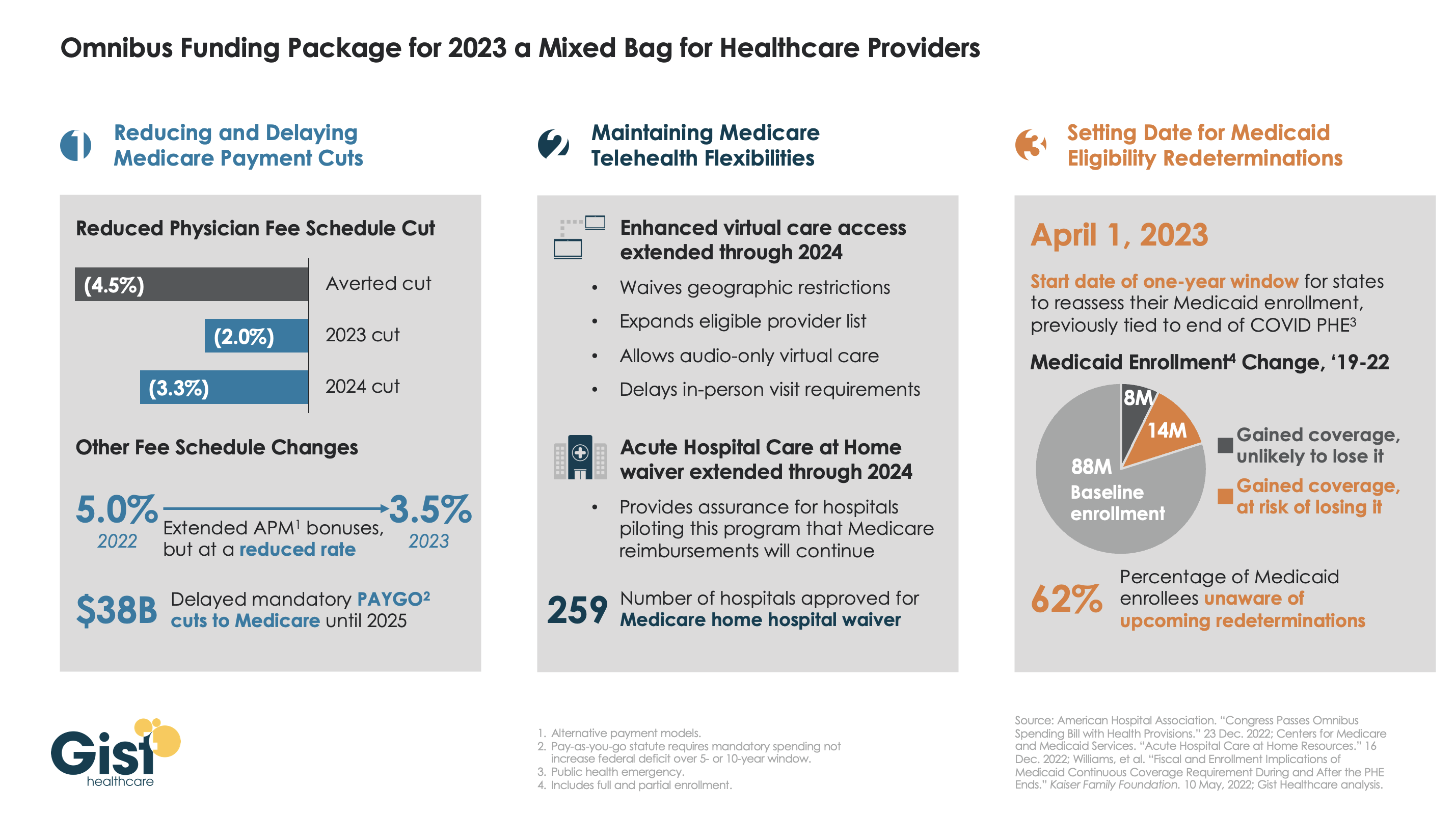
While healthcare wasn’t a top priority for lawmakers hammering out the Omnibus bill aimed at keeping the government open through next September, the graphic above outlines the bill’s three greatest areas of impact for providers.

The package reduces the planned 4.5 percent 2023 physician fee schedule cut to two percent, while also extending value-based care bonuses in alternative payment models (albeit at 3.5 percent, instead of five percent). It also delays the $38B Medicare spending cut required by the PAYGO sequester, pushing that cut out two years.

On the telehealth front, the bill extends Medicare’s pandemic-era virtual care flexibilities through 2024, including the “hospital at home” waiver. It also sets April 1, 2023 as the start date of a one-year window for states to reassess Medicaid enrollment, decoupling the start of eligibility redeterminations from the end of the federal COVID public health emergency. Medicaid enrollment grew by 25 percent over the course of the pandemic, but around two-thirds of new enrollees may lose eligibility after redeterminations. 

Overall, the legislation is a mixed bag for providers. The uninsured population is expected to grow, at least in the short term. Physician groups had hopes for a complete reprieve from Medicare pay cuts, and the fact that they didn’t get it may signal growing Congressional hesitancy to intervene with the Medicare physician fee schedule in the future. But the telehealth extensions may encourage other wider adoption of reimbursement by private insurers, bolstering providers’ long-term virtual care investments.

Biden signs omnibus bill into law, reducing physician pay cut

https://mailchi.mp/ad2d38fe8ab3/the-weekly-gist-january-6-2023?e=d1e747d2d8

Late last week, President Biden signed a $1.7T spending package to fund the federal government through next September. While around half the funds are dedicated to defense, some important healthcare items made it into the bill, including a reduction in planned Medicare physician pay cuts and a two-year postponement of the $38B Medicare spending cut required by the PAYGO sequester.

The law also decoupled several measures from the end of the federal COVID public health emergency (PHE), setting April 1st as the start date for states to begin Medicaid eligibility redeterminations, and extending Medicare’s telehealth flexibilities and the Acute Hospital Care at Home waiver program through the end of 2024. For more details on these changes, see our graphic below.

The Gist: Medical groups were hoping for more of a reprieve from the Medicare physician fee schedule cuts, but Congress proved unwilling to address concerns over rising practice costs. We’re relieved that Medicare’s new telehealth and hospital at home policies will continue beyond the PHE, given the early interest we’ve seen from the provider community in embracing these new, more consumer-friendly care models.

Once the new Congress finally gets underway, we’re expecting this to be an uneventful two years for federal healthcare legislation, with the emphasis of health policy likely to shift toward states, federal agency rulemaking, and judicial activity.