About 99.999% of fully vaccinated Americans have not had a deadly Covid-19 breakthrough case, CDC data shows

https://www.cnn.com/2021/07/31/health/fully-vaccinated-people-breakthrough-hospitalization-death/index.html?fbclid=IwAR0zCYf_qFiMcaHs0D0HbdHNrWkHzt4j6mmxWgfDD_-r5GkmJA9tm-MgaAU

About 99.999% of fully vaccinated Americans have not had a deadly Covid-19  breakthrough case, CDC data shows

More than 99.99% of people fully vaccinated against Covid-19 have not had a breakthrough case resulting in hospitalization or death, according to the latest data from the US Centers for Disease Control and Prevention.The data highlights what leading health experts across the country have highlighted for months: Covid-19 vaccines are very effective at preventing serious illness and death from Covid-19 and are the country’s best shot at slowing the pandemic down and avoiding further suffering.The CDC reported 6,587 Covid-19 breakthrough cases as of July 26, including 6,239 hospitalizations and 1,263 deaths. At that time, more than 163 million people in the United States were fully vaccinated against Covid-19.

Divide those severe breakthrough cases by the total fully vaccinated population for the result: less than 0.004% of fully vaccinated people had a breakthrough case that led to hospitalization and less than 0.001% of fully vaccinated people died from a breakthrough Covid-19 case.

Most of the breakthrough cases — about 74% — occurred among adults 65 or older.

Since May, the CDC has focused on investigating only hospitalized or fatal Covid-19 cases among people who have been fully vaccinated. The agency says the data relies on “passive and voluntary reporting” and is a “snapshot” to “help identify patterns and look for signals among vaccine breakthrough cases.”

“To date, no unexpected patterns have been identified in the case demographics or vaccine characteristics among people with reported vaccine breakthrough infections,” according to the CDC.

The agency shared a study this week that showed the Delta variant produced similar amounts of virus in vaccinated and unvaccinated people if they get infected. Experts continue to say that vaccination makes it less likely you’ll catch Covid-19 in the first place. But for those who do, the findings suggest they could have a similar tendency to spread it as unvaccinated people. That study also convinced CDC leaders to update the agency’s mask guidance on Tuesday, recommending that fully vaccinated people also wear masks indoors when in areas with “substantial” and “high” Covid-19 transmission to prevent further spread of the Delta variant. Guidance for unvaccinated people remains to continue masking until they are fully vaccinated. Beyond severe cases, an analysis of official state data from the Kaiser Family Foundation showed that breakthrough cases of any kind are also extremely rare.vAbout half of states report data on Covid-19 breakthrough cases, and in each of those states, less than 1% of fully vaccinated people had a breakthrough infection, ranging from 0.01% in Connecticut to 0.9% in Oklahoma.

The KFF analysis also found that more than 90% of cases — and more than 95% of hospitalizations and deaths — have been among unvaccinated people. In most states, more than 98% of cases were among the unvaccinated.

Pace of vaccinations is going up
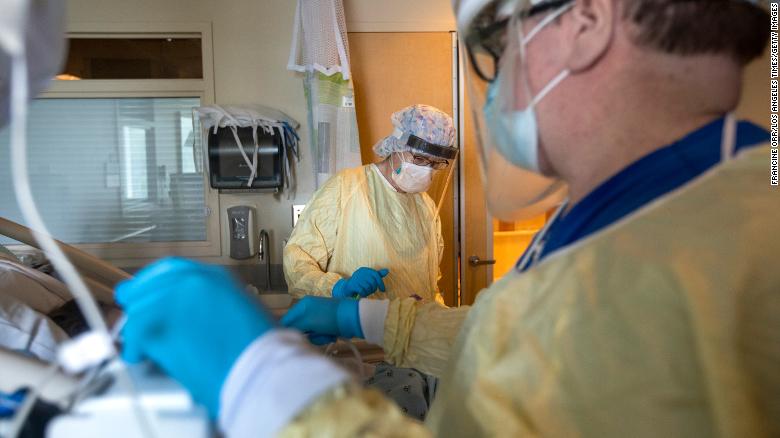
Health care workers assist a patient in the ICU inside Little Company of Mary Medical Center on July 30, 2021 in Torrance, California

But experts say those vaccinated, while they may be able to transmit the virus, remain very well protected against getting seriously ill. Amid the latest surge of Covid-19 cases nationwide fueled by the Delta variant, local leaders across the US are reporting that the majority of new infections and hospitalizations are among unvaccinated people. The Delta variant is now so contagious, one former health official recently warned that people who are not protected — either through vaccination or previous infection — will likely get it. Amid concerns over the rising cases and the dangerous strain, the country has seen a steady rise in the pace of vaccinations in the past three weeks — and an even sharper increase in states that had been lagging the most, according to a CNN analysis of CDC data.

The seven-day average of new doses administered in the US is now 652,084, up 26% from three weeks ago. The difference is even more striking in several southern states: Alabama’s seven-day average of new doses administered is more than double what it was three weeks ago. The state has the lowest rate of its total population fully vaccinated in the US, at roughly 34%. Arkansas, with just 36% of its population fully vaccinated, has also seen its average daily rate of doses administered double in the last three weeks. Louisiana, which had by far the most new Covid-19 cases per capita last week and has only fully vaccinated 37% of its population, saw daily vaccination rates rise 111% compared to three weeks ago.

Meanwhile, Missouri, which has been among the hardest-hit states in the latest Covid-19 surge, now has a daily average of new vaccinations 87% higher than three weeks ago.

Roughly 57.5% of the US population has received at least one Covid-19 vaccine dose and about 49.5% is fully vaccinated, CDC data shows.
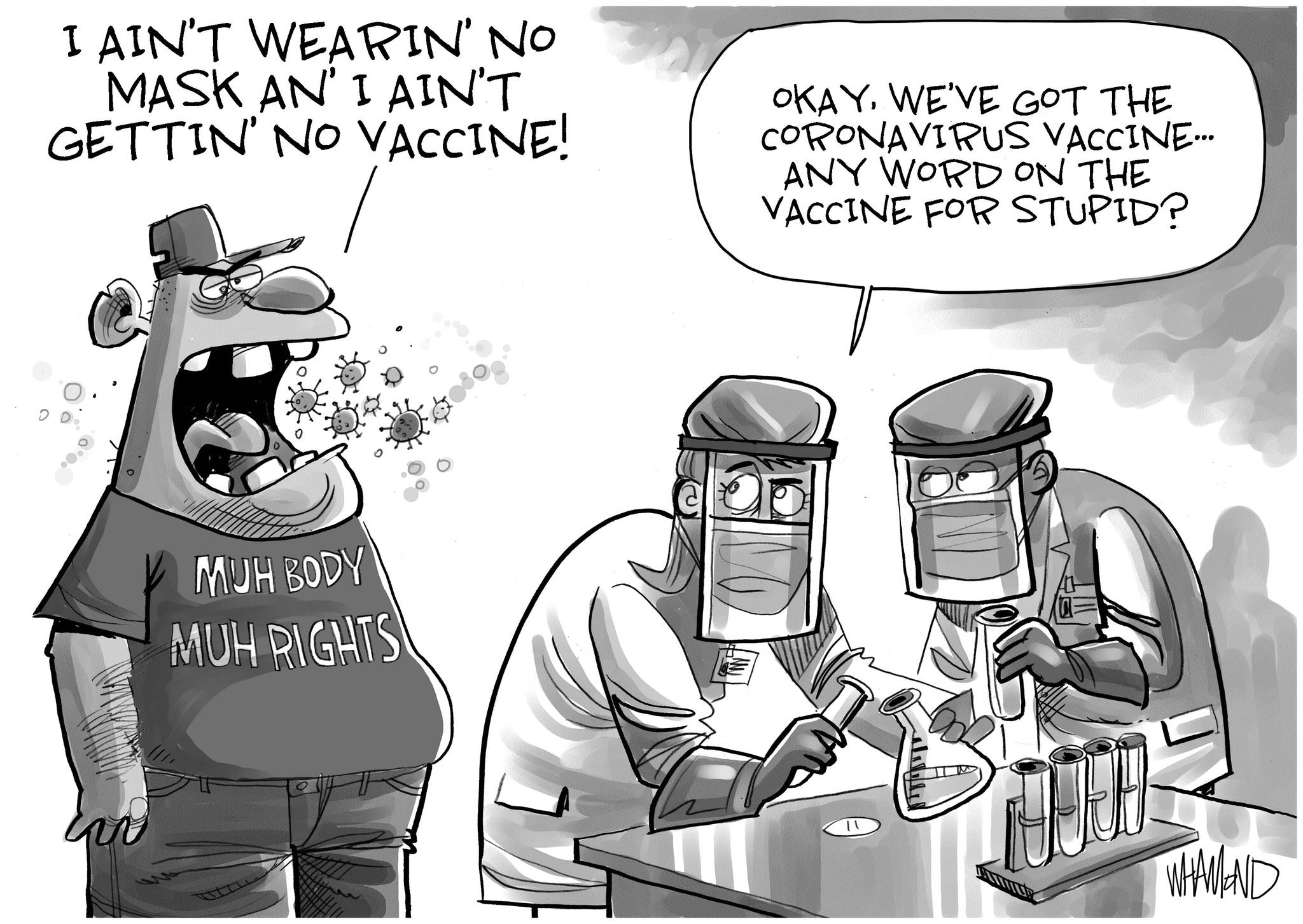
Cartoon – Vaccine for Stupidity

Commentary: Half of Republican men say they don't want the vaccine. They're  mooching off the rest of us | The Daily World

Cartoon – Covid Brain Fog Logic

Covid-19 Ward' | Kaiser Health News

Cartoon – Typhoid Marty

Mike Luckovich's Editorial Cartoons at www.cartoonistgroup.com - Cartoon  View and Uses

Cartoon – Fire Fauci!

Mike Luckovich's Editorial Cartoons at www.cartoonistgroup.com - Cartoon  View and Uses

Cartoon – Something to Smile About

Mike Luckovich's Editorial Cartoons at www.cartoonistgroup.com - Cartoon  View and Uses

The Southern Pandemic

https://view.newsletters.time.com/?qs=b30eec7a6d02a7e20c01aca4b8e56821af061113f7bf190d94622834c95fdc029a33b175fe02efd0b70cadd267cdc0e72ee0db92cafa93af6570013e356c664dc1c4170d6dba1f77fb29dee1f7b89d3a

Any COVID-19 uptick is a tragedy, but the first major U.S. surge since the start of the vaccination rollout has been uniquely painful to watch because it likely could have been prevented. The Delta variant has driven up cases across the country, with the worst outbreaks in southern states where vaccination rates fall far short of that of the country as a whole, which is nearly half vaccinated. A few examples:

  • In Louisiana, 37.1% of the population is fully vaccinated and the seven-day average of new cases is 4,622, up from 1,426 two weeks ago.
  • In Arkansas, 36.6% of the population is fully vaccinated and the seven-day average of new cases has nearly doubled over the last two weeks to 1,900 new cases a day.
  • In Alabama, 34.4% of the population is fully vaccinated and the seven-day average for daily cases has tripled over the last two weeks to 2,400 new cases a day.
  • In Mississippi—which has the country’s lowest vaccination rate, at 34.5%—the number of new cases has nearly tripled in the last two weeks; it’s now reporting a seven-day average of nearly 1,700 daily cases.

These surges have left many people scrambling to protect themselves, with several hard-hit states reporting an increase in vaccine uptake. In Louisiana, for example, about 52,000 doses were administered during the week ending July 31, compared to about 20,000 the week ending July 10. Unfortunately, people getting vaccinated now won’t be fully protected for another two to four weeks, depending on the shot they receive, meaning the virus will likely continue to spread for some time.

At least some southern governors are taking steps to prevent that, turning to tried and true methods like masking to contain viral spread. Louisiana governor John Bel Edwards (D), for instance, issued an order yesterday mandating face masks in many indoor public settings, including businesses, schools and churches. “I cannot in good conscience sit by while our hospitals lose the capacity to deliver life-saving care to COVID patients and non-COVID patients alike,” Edwards said when announcing the new rules, which begin tomorrow and are currently set to expire Sept. 1.

However, the leaders of other badly hit states are not following suit. Mississippi governor Tate Reeves (R), for instance, has rejected the U.S. Centers for Disease Control and Prevention’s (CDC) updated guidance calling for indoor masking in areas with substantial viral spread, calling it “foolish.” The state may continue to pay the price; Mississippi hospitals are reportedly struggling to find enough nurses to care for patients, even as the state health officer warned last week that new hospitalizations are “skyrocketing” (as of July 27, Mississippi’s seven-day average for new hospitalizations was 126, compared to about 20 on July 1).

The best anyone can do in these states now is get vaccinated, mask up, and socially distance whenever possible. Delta burned hot but fast in India and the United Kingdom, and it’s possible it will do the same in the States as well.


TODAY’S CORONAVIRUS OUTLOOK

Over 400.6 million doses of the COVID-19 vaccine have been shipped to various U.S. states as of this afternoon, of which some 347 million doses had been administered, according to TIME’s vaccine tracker. About 49.7% of Americans had been completely vaccinated.

Nearly 198.9 million people around the world had been diagnosed with COVID-19 as of 1 a.m. E.T. today, and more than 4.2 million people have died. On August 2, there were 556,672 new cases and 7,784 new deaths confirmed globally.

Here’s how the world as a whole is currently trending:

Here’s where daily cases have risen or fallen over the last 14 days, shown in confirmed cases per 100,000 residents:

And here’s every country that has reported over 3 million cases:

The U.S. had recorded more than 35.1 million coronavirus cases as of 1 a.m. E.T. today. Nearly 614,000 people have died. On August 2, there were 127,976 new cases and 451 new deaths confirmed in the U.S.

Here’s how the country as a whole is currently trending:

Here’s where daily cases have risen or fallen over the last 14 days, shown in confirmed cases per 100,000 residents:

Exactly How Many People Have Long Covid?

Exactly How Many People Have Long Covid? | WIRED

BEFORE THE PANDEMIC, Lyth Hishmeh—a 26-year-old living in Camberley, England—was always looking for something to keep himself busy. He was working as a software engineer and doing research into AI on the side while making plans to start a new company. He was juggling four to five textbooks at once. “I could not sit still,” he says. 

All that came to a halt on March 13, 2020, when he was sent home from work with a suspected case of Covid-19. His symptoms were mild but familiar: a cough, fever, shortness of breath. Within two weeks, they had subsided, and so Hishmeh went to buy groceries. At the shop, his heart began racing; he felt dizzy and out of breath. “It felt like some sort of heart attack.” He ignored it and boarded the bus home. But the same feeling came back again, this time worse. He stopped the bus, got off, and flagged down a police car before falling to the ground. He was brought to the hospital, where he had an ultrasound, which indicated Covid-19 pneumonia. The consultant said he was fine, and he was discharged. 

But Hishmeh wasn’t fine. Over the next few months, he developed all the strange and debilitating symptoms that have come to characterize the condition known as long Covid: brain fog, severe fatigue, heart palpitations. Just going to the bathroom was a struggle. Hishmeh was housebound for months, until October 2020. In the worst days of his long Covid, he couldn’t even watch a film all the way through. He went to the emergency room more than 10 times. “I would cry and beg, ‘Just fix me—do something,’” he says. 

Today, 16 months after being infected, Hishmeh can leave the house, but he still isn’t fully recovered. He hasn’t been able to return to work, and he has new food allergies. He also has postural tachycardia syndrome, where his heart races when he stands up. “I’m nowhere near fully recovered,” he says. “It was so awful that where I am now is a huge improvement. But where I am now to a normal person would probably be the end of the world.” 

Hishmeh is one of the estimated millions of people around the world who have long Covid. They’re stuck in a life-limiting limbo while scientists scramble to understand the mysterious condition. But as long Covid patients like Hishmeh continue to struggle with their illness, health authorities are struggling with some of the most basic questions about long Covid.  

To get a grasp on how big a problem long Covid is, we need to know how many people out there are stuck in situations like Hishmeh’s. That number is surprisingly difficult to pin down. The figures mentioned in the media vary wildly, depending on which study is cited. So what is the real figure?

Some estimates have ranged on the more conservative side. One data set, collected as part of the Covid Symptom Study using the app ZOE Covid from researchers at King’s College London, took a survey of 4 million people between March 25, 2020, and June 30, 2020. The results indicated that 4.5 percent of people with Covid-19 reported symptoms after 8 weeks, and only 2.3 percent of people after 12 weeks—a pretty low estimate. However, the study has faced criticism from long Covid sufferers and researchers alike. There are a few reasons why this estimate might be on the low side. First, the study most likely missed out on a number of long Covid sufferers who were too fatigued to log all their symptoms on the app on a regular basis. Also, if the patient had fewer than five symptoms on the last day they used the app, it counted them as recovered. 

This study was deliberately designed to give a conservative estimate, says Claire Steves, one of the authors. Because they wanted to establish without doubt that long Covid existed, they purposefully took a skeptic’s eye, applying stringent criteria; it included only people whose positive test for Covid-19 was confirmed by a PCR test. “I wouldn’t say that the Covid Symptom Study gives you the most accurate definition of everybody who might have this syndrome,” she admits. 

Other studies returned much higher numbers. One report from Imperial College London, called React-2, gives a much higher estimate of the prevalence of long Covid. The study surveyed over 500,000 participants between September 2020 and February 2021, asking them whether they thought they had had Covid-19, whether they had any symptoms from a list of 29, and if so, for how long. It estimated that almost 40 percent of people who definitely had or thought they had Covid-19 still had at least one symptom lasting 12 weeks or more. That’s an estimated 2 million people in England living with the condition between those two dates. 

Asking people to retrospectively count symptoms isn’t a fool-proof method, however. The study may overestimate the prevalence of long Covid, Steves says, as it doesn’t account for other conditions that can cause similar symptoms, such as diabetes and heart disease, not to mention the stress of living through a global pandemic. And the symptoms that respondents could select range widely, from a blocked nose or a hoarse voice to severe fatigue. But in fact, the varying symptomatology of long Covid is a big problem in itself. Devising diagnostic criteria is complicated by the sheer number and diversity of symptoms that sufferers report. One study into Covid-19 came back with a range of over 200 symptoms, including memory loss, menstrual cycle disruptions, and hallucinations. 

To rectify this, a review by the UK’s National Institute for Health Research (NIHR) proposes that long Covid could be subdivided into at least four different syndromes. These included post-intensive-care syndrome, long-term organ damage, post-viral fatigue syndrome, and a novel one: a long-term syndrome caused by a continuation of Covid-19 symptoms. It may also be that some people are suffering from more than one of these syndromes. 

Even defining exactly what long Covid is is a tough undertaking. There’s no universally accepted definition; even the name differs from country to country. Health authorities don’t agree on what specific conditions would merit a long Covid diagnosis. According to NICE guidelines, a patient should have symptoms persisting 4 to 12 weeks after the start of acute Covid-19 that can’t be explained by an alternative diagnosis, or symptoms that have not resolved 12 weeks after the start of acute Covid-19. The cutoff point for which week an acute case of Covid-19 becomes a case of long Covid remains controversial. “The time point at which you estimate the prevalence is really important,” says Elaine Maxwell, the lead author of the NIHR review. “I’m not sure it’s particularly helpful to be looking at it before 12 weeks.” 

Falling somewhere in between the big figures from the React-2 study and the more modest number from the King’s College London study is the data from the UK’s Office of National Statistics. The ONS estimates that 13.7 percent of a sample of over 20,000 people who had tested positive for Covid-19 still reported symptoms after at least 12 weeks. They then were compared against a control group of a similar size to make sure that this didn’t include people who had symptoms that weren’t related to Covid. This is the number that Maxwell backs most, but the ONS warns that these figures are just experimental and may not be final.

Working out the prevalence of long Covid is also a moving target. New variants and mass vaccination will inevitably have some effect on the condition that could muddle the numbers. “What’s true for the first and second wave may not be true for Delta, and certainly won’t be true in the context of vaccination,” says Steves. 

It’s easy to get caught up with the limitations of each study and survey, but we still know so little about the condition that, at this point, the more research we have, the better. “We’re at the stage of understanding long Covid, where it is more important to be open-minded, because we don’t know what we don’t know,” says Maxwell. “We need to keep looking at some of these smaller self-reported studies, because otherwise, we won’t know what to look for in the bigger, more controlled studies.”

Hishmeh just wants some answers, and some relief. “I’m 26—these are supposed to be my golden years. And I feel like I’m 80,” he says. “It really feels like at some point, the pandemic is going to end, and the world is going to move on. And we’re just going to be stuck here.”

Healthcare will expand and deal with the fallout of COVID-19 for decades, says Fitch

https://www.healthcarefinancenews.com/news/healthcare-will-expand-and-deal-fallout-covid-19-decades-says-fitch

The U.S. may have entered into a new phase of the COVID-19 pandemic, but the public health crisis is far from over. The nation’s hospitals and health systems will likely be dealing with its after effects for decades, according to new findings from Fitch Ratings.

Specifically, health implications related to the coronavirus will drive elevated health system utilization long after the acute phase of the pandemic has ended, likely leading to increasing costs and higher insurance premiums for years to come. 

These costs will emerge from the necessary addition to outpatient capacity to deal with the ongoing treatment of chronic conditions related to what may be permanent damage caused by the virus.

WHAT’S THE IMPACT?

It’s nigh impossible to determine the magnitude of these effects, said Fitch. It will be dependent on tangential health issues related to deferred diagnostic testing and treatment during the pandemic. Since related conditions are likely to develop over time, Fitch doesn’t anticipate these issues to directly affect the credit profile of issuers in the U.S. healthcare system.

In the near term, health insurers have been able to incorporate expanding COVID-19 claims data, estimates of infection trends and pent-up demand for previously deferred care into 2021 premium rates, which should benefit cost management and pricing this year and next. 

However, for healthcare providers, the expansion of the healthcare system over the long term will likely exacerbate traditional pressures on operating performance, such as tight labor and wage markets for experienced staff, rising pharmaceutical expenses and supply costs in general.

Although the U.S. has glimpsed signs of the pandemic’s potential end over the past couple of months, the ultimate story of the pandemic is still being told. 

The infection rate is once again trending up, presumably due to a combination of factors, including a dramatic reduction in demand for new vaccinations, the rapid spread of the more infectious Delta variant and the reduction in mitigation measures.

THE LARGER TREND

The rising numbers of COVID-19 infections in the U.S. are occurring mostly in communities with low rates of vaccinations, with Centers for Disease Control and Prevention Director Dr. Rochelle Walensky saying in July that “This is becoming a pandemic of the unvaccinated.” 

Data published by USA Today shows that cases are rising in all 50 states, with some startling increases in certain areas. Rhode Island, for example, saw cases almost triple in a one-week period, with Maine and Vermont following closely behind. Massachusetts, Alaska and Kentucky have seen their cases more than double in that time, followed by Minnesota, Florida and Texas.

Cases are rising fastest in Arkansas, Florida, Missouri and Nevada, all of which have low vaccination rates, according to Market Watch. In all four of those states, less than half of residents are fully vaccinated.

Vaccine hesitancy remains a problem, with many Americans reluctant to get their shots or unwilling to do so. In May, a Sermo poll showed that more than 72% of physicians surveyed said that patients continue to voice concerns over vaccine side effects.

Still others have reported ongoing misinformation discouraging people from getting vaccines. And close to 30% of physicians reported encountering patients who have skipped their second dose due to unpleasant side effects from the first dose, or concerns over side effects.

How a Vaccine Slowed the Spread of Chicken Pox

How a Vaccine Slowed the Spread of Chicken Pox - HISTORY
The highly contagious disease dates to ancient times and spread easily in households and classrooms—until the development of a vaccine.

Chickenpox is a highly contagious disease caused by the varicella-zoster virus that leads to itchy skin eruptions, which are sometimes compared to a “dew drop on a rose petal.” 

Until the development of a chickenpox vaccine in the late 20th century, the disease was a common childhood illness that could cause serious health problems in people who didn’t contract the disease until adulthood. More than four million people got chickenpox every year in the United States, resulting in more than 10,000 hospitalizations and 100 deaths. Since vaccinations began, those numbers dropped significantly.

The CDC reports that fewer than 350,000 people contract the disease per year, and that there are fewer than 1,700 hospitalizations and 20 deaths annually from chickenpox.

Where Did Chicken Pox Come From?

There’s evidence of chickenpox dating back to ancient times, and the earliest known use of the term “chickenpox” dates to 1691—although it’s not clear how it got this name. It’s believed the disease was brought to the Americas in the 15th century by European explorers and settlers. Once on the continent, it (and other diseases) spread among Native Americans since Indigenous people had not previously been exposed to the virus.

Before the 18th century, diseases that appeared to produce “pox,” or skin eruptions, were commonly lumped together. This included chickenpox, smallpox and syphilis, which was known as “large pox” or the “great pox.” The first scientist to provide a detailed description of chickenpox differentiating it from smallpox was the English physician William Heberden. In 1767, he noted the physical differences between the two diseases, and also recorded that people who’d had chickenpox “were not capable of having it again.”

It wasn’t until later that scientists realized chickenpox was related to shingles. In the late 19th and early 20th centuries, Hungarian pediatrician James von Bokay observed several instances in which younger people seemed to contract chickenpox after being exposed to someone with shingles, a disease that can cause nerve damage if not treated properly. This led him to suggest that there was a link between the two diseases.

Scientists later confirmed this theory by discovering that after a person recovers from chickenpox, the varicella-zoster virus stays in his or her body, and can cause the person to develop shingles later on. 

Chicken Pox Virus Is ID’d in the 1950s

In the 1950s, scientists isolated the varicella-zoster virus for the first time, paving the way for efforts to vaccinate against chickenpox and shingles. After that, it took several decades to develop and distribute vaccines for these illnesses. The U.S. Food and Drug Administration approved the first chickenpox vaccine in 1995 and the first shingles vaccine in 2006.

Compared to other childhood vaccines, the chickenpox vaccine was a relatively late development. Maurice Hilleman, who helped develop a measles vaccine in the 1960s, had also tried to push for a chickenpox vaccine around that time. However, diseases ended up receiving higher priority depending on the rate of death and disability associated with them, writes epidemiologist René Najera, editor of The History of Vaccines, an online resource by The College of Physicians of Philadelphia, in an email to HISTORY.

“As a result, chickenpox fell toward the bottom of the list because it is a relatively mild disease in children,” he says. As new vaccines helped control more severe childhood diseases, chickenpox moved higher up on the list.

Contagiousness of Chickenpox

The CDC estimates that a person with chickenpox can spread it to up to 90 percent of the people with whom they come into contact who haven’t previously had chickenpox or the vaccine. In addition, the period in which a person is contagious lasts for several days. It begins one or two days before the chickenpox eruptions begin to show, and lasts until all the fluid-filled skin lesions have scabbed over. Typically, chickenpox lasts for 4 to 7 days.

Before the vaccine, chickenpox spread easily in households and classrooms, and was especially dangerous for adults who had never had it. Both children and adults may experience fever, fatigue and body aches with chickenpox, but in adults these symptoms can be more severe. Adults are 25 percent more likely than children to die from chickenpox, according to the National Foundation for Infectious Diseases. The disease can lead to health complications like bacterial infections, swelling of the brain and pneumonia.

Although the chickenpox vaccine has greatly slowed the spread of the disease in schools, outbreaks occur in some parts of the United States where parents have declined to vaccinate their children. This is similar to the way that childhood diseases like measles, which went from common to uncommon in the late 20th century, began to break out in schools again in the 21st century.

Still, with the widespread adoption of the chickenpox vaccine, the disease “has joined polio and measles in the list of infectious diseases that are candidates for eradication,” Najera says. So far, the only human disease that vaccines have globally eradicated is smallpox, but scientists and doctors hope to one day add more to the list of diseases that have been vanquished by vaccines.