The United States on Friday surpassed 300,000 daily coronavirus cases, the second alarming record this week. The number, which roughly equates to the population of St. Louis, Pittsburgh or Cincinnati, comes about two months after the country reported 100,000 coronavirus cases a day for the first time, and one day after more than 4,000 people died from the virus, also a record.
The United States has reported 21.8 million infections and 367,458 deaths.
Wednesday’s storming of the U.S. Capitol did not just overshadow one of the deadliest days of the coronavirus pandemic — it could have contributed to the crisis as a textbook potential superspreader, health experts warn.
Thousands of Trump supporters dismissive of the virus’s threat packed together with few face coverings — shouting, jostling and forcing their way indoors to halt certification of the election results, many converging from out of town at the president’s urging. Police rushed members of Congress to crowded quarters where legislators say some of their colleagues refused to wear masks as well.
“This was in so many ways an extraordinarily dangerous event yesterday, not only from the security aspects but from the public health aspects, and there will be a fair amount of disease that comes from it,” said Eric Toner, senior scholar at the John Hopkins Center for Health Security.
Experts said that resulting infections will be near-impossible to track, with massive crowds fanning out around the country and few rioters detained and identified. They also wondered if even a significant number of cases would register in a nation overwhelmed by the coronavirus. As Americans shared their shock and anger at the Capitol breach Thursday, the United States reported more than 132,000 people hospitalized with the virus, and more than 4,000 deaths from covid-19, the disease caused by the coronavirus — making it the highest single-day tally yet.
“It is a very real possibility that this will lead to a major outbreak but one that we may or may not be able to recognize,” Toner said. “All the cases to likely derive from this event will likely be lost in the huge number of cases we have in the country right now.”
Trump devotees who flocked to the capital this week said they were unconcerned by the virus, belittling common precautions known to slow its spread and echoing the president’s dismissive attitude toward rising case counts. Trump had encouraged them to gather in defiance of his election loss: “Big protest in D.C. on January 6th,” he tweeted last month. “Be there, will be wild!”
Mike Hebert, 73, drove two days from Kansas to participate. Marching toward the Capitol on Wednesday with an American flag, he said he did not feel the need to wear a face covering.
“I am as scared of the virus as I am of a butterfly,” said Hebert, adding that he is a veteran who was shot twice in Vietnam.
Sisters Courtney and Haley Stone left New York at 11 p.m. to make it to the Capitol by morning so they could quietly counterprotest, draped in Biden gear. “Do you want a mask? I have one,” Haley, 22, asked a Trump supporter, only to be rebuffed.
“Oh, you believe in the mask hoax?” the woman replied.
Health experts predicted Wednesday’s events will contribute to an ongoing case surge in the greater Washington region. The average number of daily new infections in Virginia, Maryland and the District of Columbia reached a record high Thursday, and current covid-19 hospitalizations in the District have risen 19 percent in the past week.
They also noted differences with other large gatherings such as Black Lives Matter protests. Fewer people wore masks during the Capitol protests and riot, they said, and crowds were indoors.
“If you wanted to organize an event to maximize the spread of covid it would be difficult to find one better than the one we witnessed yesterday,” said Jonathan Fielding, a professor at the schools of Public Health and Medicine at UCLA.
“You have the drivers of spreading at a time when we are bearing the heaviest burden of this terrible virus and terrible pandemic,” he said.
Calling in to CBS News Wednesday, Rep. Susan Wild (D-Pa.) described her evacuation to a “crowded” undisclosed location with 300 to 400 other people.
“It’s what I would call a covid superspreader event,” she said. “About half the people in the room are not wearing masks, even though they’ve been offered surgical masks. They’ve refused to wear them.”
She did not identify the lawmakers forgoing face coverings beyond saying they were Republicans, including some freshmen. The Committee on House Administration says it is a “critical necessity” to mask up while indoors at the Capitol, and D.C. has a strict mask mandate.
“It’s certainly exactly the kind of situation that we’ve been told by the medical doctors not to be in,” Wild said.
“We weren’t even allowed to get together with our families for Thanksgiving and Christmas,” she said, “and now we’re in a room with people who are flaunting the rules.”
At least one member of Congress has tested positive since the mob spurred an hours-long lockdown. Newly elected Rep. Jacob LaTurner (R-Kan.) tested positive for the coronavirus late Wednesday evening, according to a statement posted on his Twitter account. It said he is not experiencing symptoms.
“LaTurner is following the advice of the House physician and CDC guidelines and, therefore, does not plan to return to the House floor for votes until he is cleared to do so,” the statement said.
Luke Letlow, a 41-year-old congressman-elect from Louisiana, died of covid-19 last month.
Any infections among members of Congress and their staff will be far easier to contact-trace than those among rioters, said Angela Rasmussen, an affiliate at the Center for Global Health Science and Security at Georgetown University.
“It certainly would have been easier if they were detained by Capitol police and identified, but testing suspects may be something to consider as law enforcement begins to identify them,” Rasmussen said in an email.
She noted that some may try to evade identification and criminal charges, and said she is deeply concerned for the households and communities they might expose.
“I think really rigorous contact tracing of people who are not identified as being present on Capitol grounds will not be possible,” she said.
People with COVID-19 who don’t exhibit symptoms may transmit 59 percent of all virus cases, according to a model developed by CDC researchers and published Jan. 7 in JAMA Network Open.
Since many factors influence COVID-19 spread, researchers developed a mathematical approach to assess several scenarios, varying the infectious period and proportion of transmission for those who never display symptoms according to published best estimates.
In the baseline model, 59 percent of all transmission came from asymptomatic transmission. That includes 35 percent of new cases from people who infect others before they show symptoms and 24 percent from people who never develop symptoms at all. Under a broad range of values for each of these assumptions, at least 50 percent of new COVID-19 infections were estimated to have originated from exposure to asymptomatic individuals.
The more contagious variant first identified in the U.K. and since found in six states underscores the importance of the model findings, said Jay Butler, MD, CDC deputy director for infectious diseases and a co-author of the study.
“Controlling the COVID-19 pandemic really is going to require controlling the silent pandemic of transmission from persons without symptoms,” Dr. Butler told The Washington Post. “The community mitigation tools that we have need to be utilized broadly to be able to slow the spread of SARS-CoV-2 from all infected persons, at least until we have those vaccines widely available.”
Whether vaccines stop transmission is still uncertain and was not a scenario addressed in the model.
England will enter a national lockdown until at least mid-February to stem the spread of the coronavirus, Prime Minister Boris Johnson announced Monday, as the so-called U.K. variant continues to spread throughout the country.
KEY FACTS
Coronavirus is again surging in the U.K. because of a new, more transmissible mutation of Covid-19 called B.1.1.7.
The lockdown will close all non-essential businesses and restaurants will be required to limit service to takeout orders.
Schools will be closed to all students except for the children of essential workers.
Johnson’s announcement comes after Scotland imposed a similar lockdown earlier Monday.
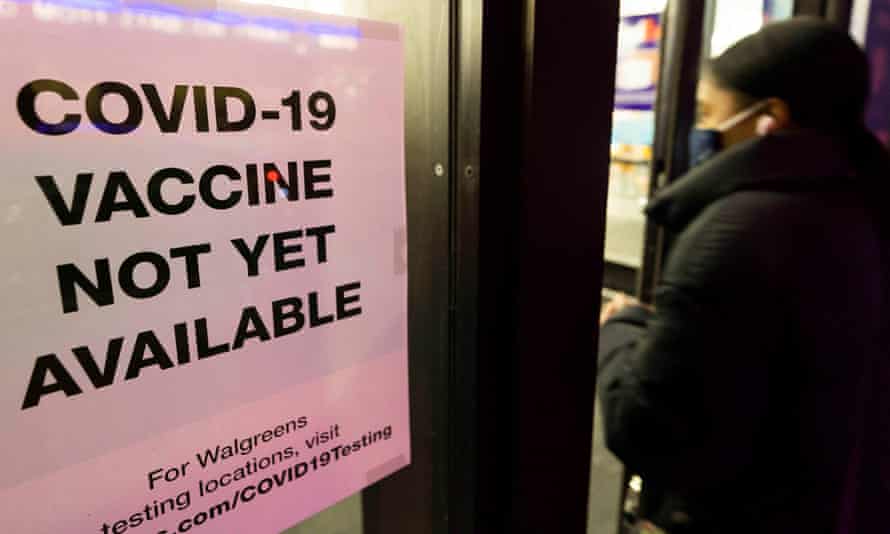
Around half a million Americans are now getting a coronavirus vaccine shot every day. But that pace must accelerate considerably if the United States has any hope of quashing the virus in 2021.
Public health experts differ on how quickly that might happen — and when things might start to feel “normal” again around the country.
To inaugurate our first Health 202 of the new year, we asked eight experts for their predictions.
After all, we all want to know when we can go to concerts and ballgames again. Or even just go to the office. (Let’s start small.)
We asked two questions. The first has to do with when the United States will reach “herd immunity” — the point at which enough people are immune to a virus, either by recovering from it or getting vaccinated against it. Herd immunity generally kicks in when about 70 percent of people are immune, although experts differ on the precise threshold.
To reach herd immunity with the coronavirus, approximately 230 million Americans would need the vaccine. As of yesterday, just 4 million had gotten the first of two shots. Daily immunizations have increased considerably over the past few days, with about 500,000 people getting the shot each day, but experts say that number needs to at least double and ideally quadruple.
We also asked these experts when they personally expect their lives to return to normal.
Here are their responses, edited lightly for clarity and brevity.
When will enough Americans be vaccinated for the U.S. to reach herd immunity, based on how things look right now?
Carlos del Rio, professor of medicine and global health at Emory University:
“At the current pace it will take a really long time. … I think if we can get our act together and start vaccinating 1 million people a day like President-elect Biden is promising, then we can get to 260 million people getting at least one dose … more or less or by late August or early September.If we really scale up and get to 3 million per day, then we can get to 260 million people in [less than] 100 days or three months. Can we do it? Yes! But it will require coordination, leadership and funding. So, as you see, my answer is: It depends.”
Eric Topol, director and founder of Scripps Research Translational Institute:
“I think by July, if we get 2 to 3 million people vaccinated per day, and even sooner, if we have a rapid neutralization antibody assay to be able to defer those who have had a prior infection and mounted a durable immune response. Yes, that is optimistic, but it can be done.”
Jay Bhattacharya, professor of medicine at Stanford University:
“There is a lot of disagreement in the scientific literature about the herd immunity threshold, which is certain to vary from place to place. I don’t think anyone responsible would confidently say what it is, and would never put forward a single number for the U.S. as a whole. Rather, the key question is how rapidly we inoculate people who have a high risk of mortality conditional on infection — most older folks and some late middle-aged folks with severe chronic conditions. Prioritizing them for vaccination will yield the greatest benefit in reducing covid-19-related mortality, regardless of when herd immunity is hit.”
Jesse Goodman, professor of medicine and infectious diseases at Georgetown University:
“I am not sure that in the near future we will reach a level of population immunity where the virus will be virtually shut down, as we are accustomed to with measles. Through immunity due to vaccination, combined, unfortunately, with infections in the unvaccinated, we should reach a state where the risk of exposure is reduced due to a mostly immune population. While cases will still occur, our health system will no longer be stressed and large outbreaks should be less common.
“I am hopeful we can get to such a situation in the last quarter of this year, provided vaccine production, access and acceptance go well and no mutant viruses arise that gain the ability to escape current vaccines.”
Kimberly Powers, associate professor of epidemiology at the University of North Carolina at Chapel Hill:
“That question is difficult to answer, as there is considerable uncertainty around the level of immunity we would need in the population to achieve herd immunity, along with the speed with which we can expect widespread vaccine uptake to occur.”
Leana Wen, public health professor at George Washington University and former Baltimore health commissioner:
“Right now, vaccine distribution is progressing at an unacceptably slow speed, and at this current rate, it will take years to reach herd immunity — if ever. If we are able to pick up speed by many times in January, there is still a chance we could substantially slow down the infection and perhaps approach herd immunity in 2021.”
Marc Lipsitch, professor of epidemiology at Harvard University:
“I think you mean ‘will enough Americans be vaccinated to reach the herd immunity threshold?’ My answer is possibly not because we don’t know if the vaccines protect enough against transmission for the threshold to be achievable, and because the new variant may increase that threshold substantially.”
Michael Osterholm, chairman of the Center for Infectious Disease Research and Policy at the University of Minnesota:
“There are three factors that will independently determine when enough Americans will either be protected from covid-19 via vaccination or development of antibody following actual infection.
“First, when will there be sufficient vaccine produced and distributed so everyone can receive their two doses? This includes vaccinating those who may have immune protection from actual infection but are vaccinated anyway to increase durable protection. Second, will enough people agree to be vaccinated? And finally, what is the durability of vaccine-induced protection over time?
“Each of these factors will play a role in achieving local, regional or national herd immunity protection. I feel confident we can achieve the first factor of sufficient vaccine by the late summer or early fall. But ultimately, the second two factors, how many will be vaccinated and how durable is immune protection will determine the answer to this question. I hope, when considering all three factors, it will be late summer or early fall, but we all realize hope is not a strategy.”
When do you expect your own daily life to feel similar to pre-pandemic times?
Carlos del Rio:
“I am hoping to be ‘close to normal’ by December 2021 more or less. However, as a physician seeing patients, I will probably continue to wearing a face mask and goggles for much longer.”
Eric Topol:
“In 2022.”
Jay Bhattacharya:
“Given the changes that the previous year has had on my professional and personal life, I do not expect my daily life to ever feel similar to pre-pandemic times. More broadly though and given the disappointingly slow roll out of the vaccine to the vulnerable in many states, I anticipate that American society will start to feel more like normal by April 2021.”
Jesse Goodman:
“Hopefully late this year, life should begin to feel similar to pre-pandemic times. However, it is likely that both great vigilance and some social distancing will still be needed, particularly if the population is not nearly all vaccinated. In addition, we may well require periodic immunization against the current and, possibly, other emerging coronavirus variants.”
Kimberly Powers:
“I expect daily life to feel more normal by sometime this summer, but I think it will be 2022 before some mitigation measures can be fully relaxed. And I expect that our society will feel ongoing consequences of this pandemic — physical, mental, emotional, and economic — for years to come.”
Leana Wen:
“I don’t know. I was much more optimistic a few weeks ago. But given the lag in vaccine rollout thus far and how under-resourced our public health systems are, I am concerned things for much of 2021 will feel more like 2020 than 2019.”
Marc Lipsitch:
“I think that sometime in the second half of the yearthere will be enough vaccination in the U.S. and some other countries that we will begin to treat covid-19 more like seasonal flu, which is deadly to large numbers of people but does not overwhelm health care and does not cause us to curtail normal social contact. This is because with enough vaccine in those at high risk of death and hospitalization, transmission may continue (at a reduced level thanks to some immunity in the population from prior infection and vaccine) but the outcomes will be less severe.”
Michael Osterholm:
“I’m not sure it ever will. We will not go back to a pre-covid-19 normal. We will instead exist in world with a new normal. And even that will in part be determined by the availability of adequate vaccine supply to cover everyone in high, middle and low income countries. I look forward to the day when my office hours are as they were pre-covid-19.”
Anthony Fauci, the nation’s top infectious diseases expert, said Sunday he did not expect the death toll from the coronavirus to be so high in the U.S.
“There is no running away from the numbers,” Fauci told guest host Martha Raddatz on ABC’s “This Week.”
“It’s something that we absolutely have got to grasp and get our arms around and turn that, turn that inflection down by very intensive adherence to the public health measures uniformly throughout the country with no exceptions,” he added.
Statistics held by John Hopkins University show that 350,215 deaths have been recorded in the United States so far, a number that has been quickly growing over the last two months.
“I did not” expect the death toll to reach the recent milestone of 350,000 in the U.S., Fauci said.
“But, you know, that’s what happens when you’re in a situation where you have surges related to so many factors inconsistent adhering to the public health measures, the winter months coming in right now with the cold allowing people or essentially forcing people to do most of their things indoors as opposed to outdoors.”
Raddatz asked Fauci how effective he thought proposals by President-elect Joe Biden would be, such as a 100-day mask mandate and a target of 100 million vaccinations.
“The goal of vaccinating 100 million people in the first 100 days is a realistic goal. We can do 1 million people per day,” Fauci said. “You know we’ve done massive vaccination programs, Martha, in our history. There’s no reason why we can’t do it right now.”
More than 350,000 people have died of the coronavirus in the U.S., with another surge of cases and deaths expected in the coming weeks as a result of smaller holiday gatherings.
The country reached the grim milestone early Sunday morning, according to data compiled by Johns Hopkins University. More than 20 million people have been infected since the pandemic began nearly one year ago, according to the tally.
Public health experts attributed a nationwide spike in cases, hospitalizations and deaths in early December to a large number of Americans traveling over the Thanksgiving holiday, and pleaded with citizens to stay home for Christmas and New Year’s celebrations.
Multiple states have reported a record number of cases, including North Carolina and Arizona, according to the Associated Press. New York hit 1 millions cases total as of Saturday, becoming the fourth state to do so along with Texas, Florida and California.
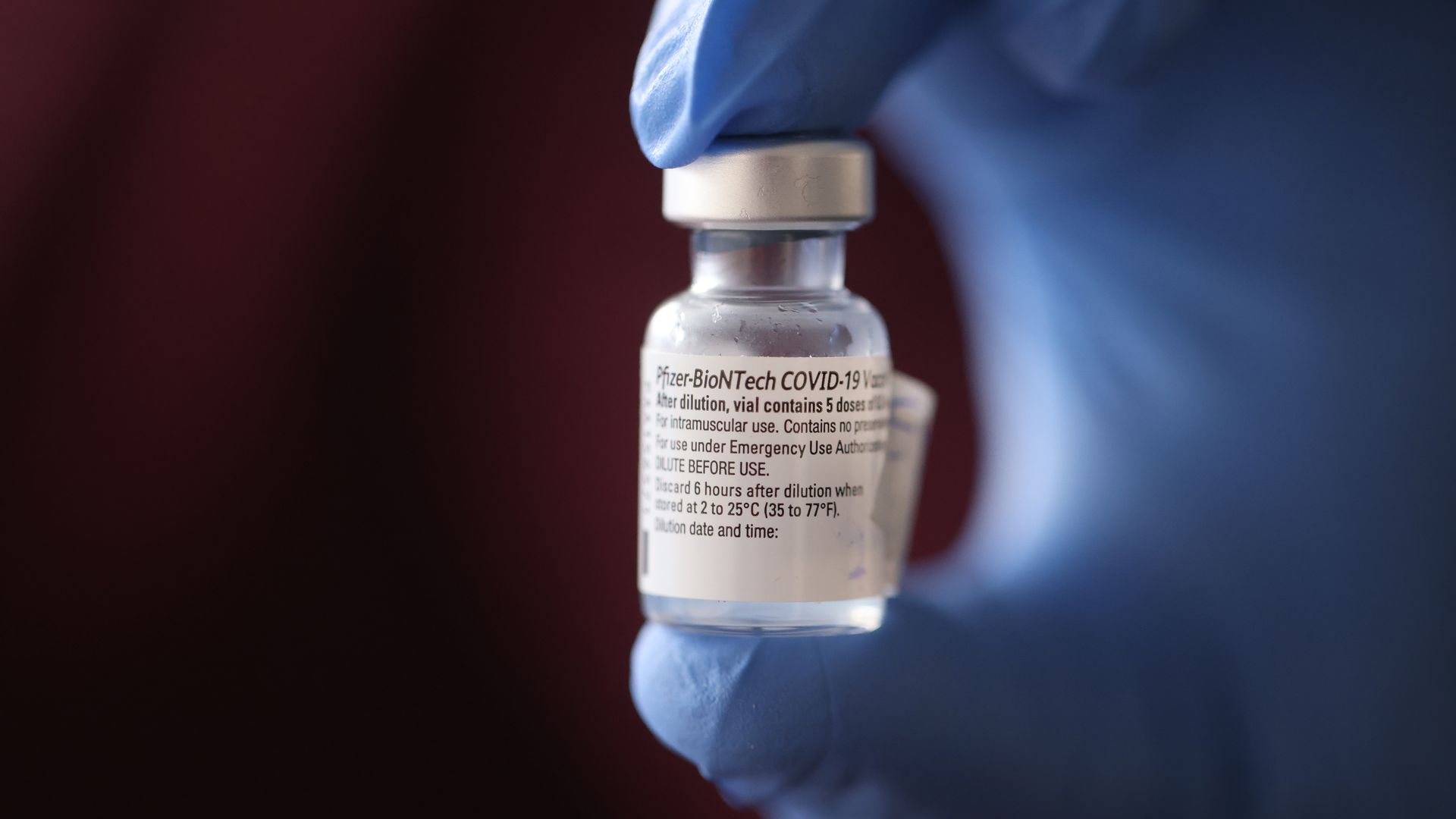
Last month, federal officials approved two vaccines by Pfizer and Moderna for emergency use. The first round of doses have been administered to doctors, nurses and other front line healthcare workers as well as nursing home residents.
The elderly and other patients deemed “high risk” are the next group of Americans slated to receive vaccines with public health officials estimating younger and healthy citizens can expect to be eligible for vaccination toward the middle to end of spring.
The Centers of Disease Control and Prevention last week reported more than 2 million people in America have been vaccinated, far short of the 20 million figure the federal government initially said it hoped to top by this time. That number has since grown to 4.2 million as of Sunday.
“We would have liked to have seen it run smoothly and have 20 million doses into people today by the end of the 2020, which was the projection,” saidDr. Anthony Fauci, the nation’s leading infectious disease doctor. “Obviously, it didn’t happen, and that’s disappointing.”
Fauci said a targeted approach in assisting local governments in vaccine rollout programs is the best way for the federal government to make up for lost time.
“There really has to be a lot more effort in the sense of resources for the locals, namely, the states, the cities, the counties, the places where the vaccine is actually going into the arms of individuals,” Fauci said.
California reported its first case of a new variant of the coronavirus that may be more transmissible, AP reports.
The big picture:California is the second state to document a confirmed case of the variant — which originated in the United Kingdom — after Colorado reported the first case in the United States on Tuesday.
California Gov. Gavin Newsom announced the infection during an online conversation with Anthony Fauci, head of the National Institute of Allergy and Infectious Diseases, according to AP.
The governor said the case was located in Southern California, but he did not provide any other details about the person who was infected.
“I don’t think Californians should think that this is odd. It’s to be expected,” Fauci said Wednesday, per AP.
Of note:There is thus far no evidence that the new variant is more deadly — only that it appears more transmissible. There is also no evidence that COVID-19 vaccines will be less effective against the new variant.
A non-peer reviewed study by the Centre for Mathematical Modelling of Infectious Diseases at the London School of Hygiene and Tropical Medicine found that the variant is 56% more transmissible than other strains.
The British government previously warned that a new variant could be up to 70% more transmissible.
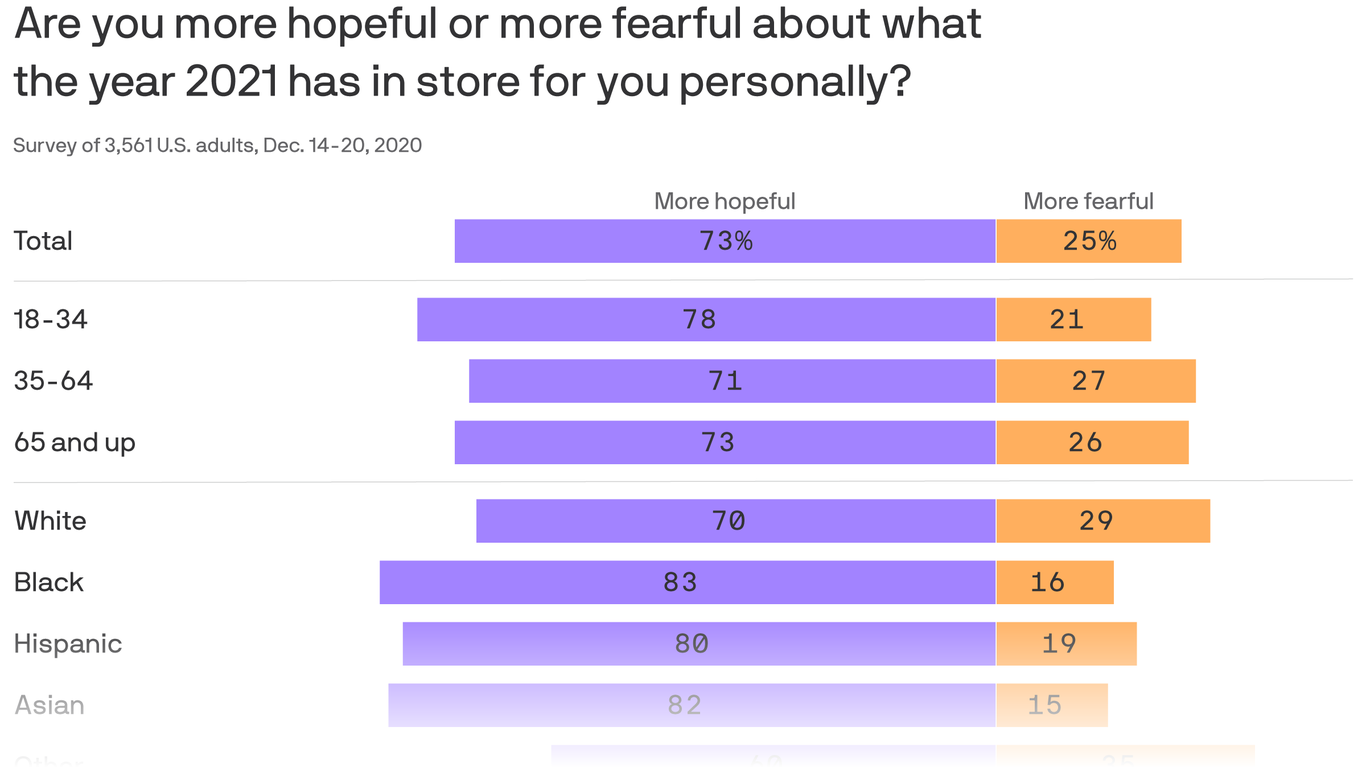
More than six out of 10 Americans are hopeful about what 2021 has in store for the world, according to a new Axios/SurveyMonkey poll.
The big picture:After a year dominated by the pandemic and a seemingly endless presidential election, Americans are overwhelmingly hopeful that things will get better with the pandemic — and more narrowly hopeful about Joe Biden’s presidency.
By the numbers:63% of poll respondents said they’re more hopeful than fearful about what 2021 holds in store for the world, while 36% said they’re more fearful.
That’s a jump in optimism compared to the same poll heading into 2019, when just 51% said they were hopeful and 48% said they were fearful.
The only group that wasn’t optimistic about 2021 was Republicans: 41% said they were more hopeful, while 58% said they were more fearful.
Between the lines:Americans were even more optimistic about the year ahead for them personally — mostly driven by the hopes of young adults, people of color and Democrats.
The coronavirus was the one issue that united most people in optimism. Overall, 76% were more hopeful than fearful about the pandemic next year — a view that held across most age groups, racial and ethnic groups, and parties.
82% of Democrats, 72% of Republicans, and 73% of independents said they were more hopeful than fearful.
The Biden presidency was more divisive. Overall, 56% were more hopeful about his presidency, while 42% were more fearful.
Not surprisingly, Republicans are the most pessimistic: 82% said they’re more fearful than hopeful about his presidency.
By contrast, 59% of independents said they’re more hopeful about it — and 92% of Democrats said the same.
And while Republicans are ready for President Trump to take on a big leadership role in the Republican Party after his presidency ends, that’s not true of everyone else.
75% of Republicans said they’re more concerned that Trump will play too small a role in the future of the GOP rather than too big a role — while 51% of all respondents said they’re more concerned that he’ll play too big a role.
And more than half of Republicans (52%) said they believe Trump will have a major role in the Republican Party, while 30% said they think he’ll have a minor role.
By contrast, just 34% of all respondents expect him to play a major role, while 32% think he’ll have a minor role and 31% think he’ll have no role at all.
Pfizer said in a statement that there are “no data” to demonstrate that a single dose of its coronavirus vaccine will provide protection from infection after 21 days.
Why it matters: The U.K. announced on Wednesday that it would shift its vaccination strategy “to give as many people in at-risk groups their first dose, rather than providing the required two doses in as short a time as possible.” Some provinces in Canada are doing the same.
Pfizer confirmed in response that although some protection appears to begin as early as 12 days after the first dose, two doses of the vaccine — separated by three weeks — is the only regimen that proved to be 95% effective in Phase 3 trials.
“Everyone will still receive their second dose and this will be within 12 weeks of their first,” the U.K. government added in a statement. “The second dose completes the course and is important for longer term protection.”
The big picture: Pfizer’s warning comes as many countries, including the U.S., debate how to rapidly deploy the vaccines in the most effective way possible. The U.S. is on pace to fall far below its target of vaccinating 20 million people by the end of 2020, with only 3 million single-doses administered as of Wednesday night.






 HENRY KOTULA