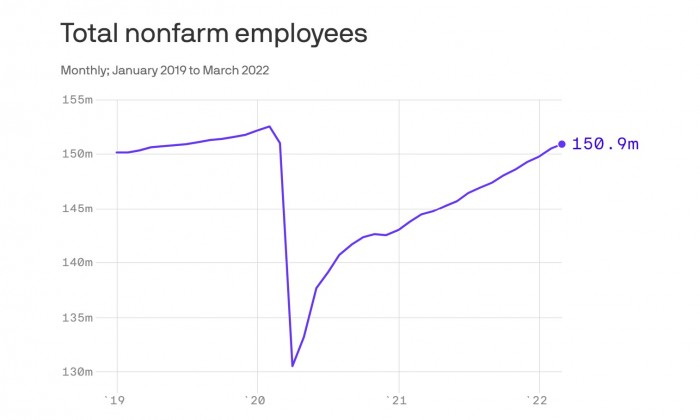
Employers added a stunning 528,000 jobs in July, while the unemployment rate ticked down to 3.5%, the lowest level in nearly 50 years, the Labor Department said on Friday.
Why it matters: It’s the fastest pace of jobs growth since February as the labor market continues to defy fears that the economy is heading into a recession.
Economists expected the economy to add roughly 260,000 jobs in July.
Job gains in May and June were a combined 28,000 higher than initially estimated.
The backdrop: The data comes at a delicate time for the U.S. economy. Growth has slowed as the Federal Reserve raises interest rates swiftly in an attempt to contain soaring inflation.
Many economists and Fed officials alike are pointing to the ongoing strength of the labor market as a sign the economy has not entered a recession.
Policymakers want to see some heat come off the labor market. They are hoping to see more moderate job growth as the economy cools, in order to ease inflation pressures.
As companies navigate having both in-office and at-home workers, the role of the traditional office is being reconsidered.
Having less people in an office every day could mean cutting space, but those spaces need to better suit the workforce of today, executives say.
How that experience evolves could be the difference between workers coming back to the office smoothly or leaving their jobs.
As companies and workers continue to try to figure out where and how work will take place in a hybrid environment, the costs being spent on existing office spaces previously built around the 9-to-5, five-day workweek are being closely examined.
Flexibility has become the buzzword for both sides of the employee-employer power dynamic. Workers have been leveraging the empowerment gains they’ve made amid the pandemic and a tight labor market to maintain the personal time that has come with working from home. Companies, many fearful of eroding culture that could increase turnover as well as stifling innovation by having a mostly remote workforce, have tried to meet workers somewhere in the middle by gently prodding, not pushing, workers back to the office.
The question becomes then, how does that impact budgeting and spending on typically costly workspaces when a large portion of your workforce won’t be there every day, if it all? Is there an opportunity to cut costs, or do those spaces now require additional investment to try to draw workers who are at home back into the office?
Scott Dussault, the CFO of HR tech company Workhuman and himself a pandemic-era hire, is seeing the change firsthand.
“I always quote Larry Fink’s [2022] letter [to CEOs] where he said no relationship has been changed more by the pandemic than the one between employer and employee; that’s never going to change and we’re never going back,” Dussault, a member of the CNBC CFO Council, said. “The concept of 9-to-5 in the office five days a week is gone – the keyword is going to be flexibility.”
For many companies that means retrofitting offices to meet this new normal and employee demands, while also investing in other tools to make sure connections are still being made efficiently – efforts that could mean spending more money even if square footage or leases are adjusted.
“I’m not so sure it’s going to be a cost negative,” Dussault said. “I’m not sure if people are going to take less real estate; they’re just going to change the way that real estate works.”
Workhuman is currently coming towards the end of its lease in its Boston-area headquarters, and Dussault said the company is considering expanding its space, which would provide a “clean slate” to adjust to this new working environment.
He recalled his time at a job in the 1990s where it was a “football field of cubicles” – the kind of situation where you could “go to work and sit in a cube all day and never interact with anybody – you truly could lose that connection.”
Dussault said he sees the office becoming what he calls a “collaboration destination,” part of a hybrid environment where while you might work from home on days where you’re catching up on work or emails, the office can serve as a space that is “all about connection.”
“You’re going to see a lot more open spaces, collaboration spaces, conference rooms, meeting rooms, break areas where people can sit and get together,” he said. “It’s going be focused on connection which I think frankly is positive and it is evolution – it’s going to be about making those connections more meaningful.”
That would mean investing more in things like a gym, where employees could take a physical break, or other spaces that would provide a place to take an emotional break or meditate, Dussault said, something he said results in costs shifting “from one bucket to another.”
“We need to understand and recognize that when employees are home and productive, they have those things, and we need to try to make sure that those things exist in the office as well,” he said.
That also puts a further onus on the investment in digital tools, because there still needs to be ways for workers to connect with peers even when they’re not in person.
“Companies always talk about how important employees are and how employees are the most important investment – they haven’t always acted that way,” he said. “This is a good thing that’s come out of the pandemic.”
Neal Narayani, chief people officer at fintech company Brex, noted that in 2019 the company had people coming into offices five days a week in San Francisco, New York, Vancouver, and Salt Lake City. At that time, “nobody worked from home, because it was seen as a negative,” Narayani said. But as the pandemic forced employees to work from home, where they successfully took on several large projects, that view shifted.
“We recognized very quickly that we were able to actually work more productively and faster, and that video collaboration is a very productive tool when you don’t have to commute somewhere to search the office for a conference room,” he said.
With a belief that a remote-first approach was the future of work, Brex leaned in. Of the company’s more than 1,200 employees, 45% are fully remote. The company still maintains those four office location hubs where workers can go if they want, but the company has altered its approach so that every process is designed for remote workers.
That also changed the thinking that went into those spaces as Brex planned out its growth.
“When you unwind the real estate costs, we were able to look at how many people would come into an office if we were to make it fully optional, and it was about 10%,” Narayani said. “So, we were able to move into a 10%, maybe even less, real estate option, and then take the rest of those dollars and repurpose that towards travel, towards talent development, towards diversity and inclusion efforts, and towards anything else that makes the employee experience better.”
“It turns out to be a much better experience for us because that real estate cost was very high, and those markets are very expensive,” he added.
Roughly a third of the cost of the company’s previous real estate strategy has been put into the company’s new off-site strategy, Narayani said, with other portions of that being used to pay for the four office spaces and other co-working spaces.
Larry Gadea, CEO of workplace technology company Envoy, said that he thinks many companies are looking at ways they can reduce costs right now, with office space spending as one area potentially ripe for cuts.
However, Gadea warns that “people need to be together with each other, they need to know each other.”
“They need to have a sense of purpose that’s unified, and you need to bring people together for that,” he said. “How are you going to bring people together when they’re all around the country? I think that there is a substantial amount of people thinking they’re going to be saving money on real estate, but United and other airlines and Hilton and other hotels are getting it instead.”
Gadea said that as companies try to manage a tight labor environment as well as other market challenges, more time needs to be spent on “thinking about how to bring teams together.”
“The number one reason that most people stick with a company is that they love the people they work with,” he said. “It can be a lot harder to love those people if you don’t ever see them because they turned off their video on Zoom or if they don’t even know them at all.”
As employers plan for 2023, attracting and retaining talent is top of mind amid a competitive U.S. labor market. That’s led to over two-thirds of companies planning to enhance employee health and benefit offerings next year, according to survey results from Mercer published July 6.
The survey was conducted April 26 to May 13. In total, 708 organizations participated, from all industries and of all sizes ranging from fewer than 500 employees to more than 5,000.
Nine things to know:
Among large employers, 70 percent are planning to enhance health and benefit offerings in 2023.
Among all employers, 61 percent are conducting surveys on employee benefit preferences.
Among large employers, 41 percent currently provide a plan option with a low deductible or none at all, and 11 percent are considering it.
Over half of employees say no remote or hybrid work is a deal breaker when considering to join or stay with an organization. Among all employers, 78 percent now allow employees to work from home regularly, compared to 26 percent in 2021.
Among large employers, 52 percent will offer virtual behavioral healthcare in 2023, and 40 percent will offer a virtual primary care physician network or service.
Though 64 percent of employers are not prioritizing a single employee group for benefit enhancements, 35 percent say they are focusing on hourly and low-wage employees.
Nearly one-third of employers will offer benefits such as fertility treatment coverage and adoption and surrogacy benefits by 2023, and almost another third are considering it.
Among all employers, 70 percent currently offer or plan to offer paid parental leave in 2023.
Among all employers, 75 percent offer or plan to offer tuition reimbursement in 2023.
U.S.-based employers announced 32,517 cuts in June 2022, a 58.8 percent increase from 20,476 cuts announced in the same month last year, according to a new job report from Challenger, Gray & Christmas.
June marks the highest month since February 2021, when 34,531 cuts were announced. It is the second time this year that cuts were higher in 2022 than the corresponding month a year earlier.
Healthcare/products manufacturers and providers announced the most job cuts this year with 19,390, which is up 54 percent from the 12,620 announced through June 2021. The automotive industry posted the second-highest cuts with 15,578, a number that is up from the 6,111 cuts in the previous year.
Andrew Challenger, senior vice president of executive search firm Challenger, Gray & Christmas, said the numbers demonstrate increasing economic strain.
“Employers are beginning to respond to financial pressures and slowing demand by cutting costs. While the labor market is still tight, that tightness may begin to ease in the next few months,” Mr. Challenger said.
Locations suffering the highest losses include California with 28,692, New York at 15,952, and Pennsylvania at 9,310.
Job seeking is a grueling process, but it is also an opportunity to put your best foot forward in order to find a company that is the best fit for you.
Although it can be nerve wracking to sit through one interview after another, candidates should remind themselves that these interactions are a two-way street, and they have every right to ask challenging questions to make a decision, should the offer come.
Here are the critical questions you as a candidate must ask during a job interview—because remember, you’re interviewing the employer, too.
QUESTIONS TO ASK YOURSELF BEFORE APPLYING FOR THE JOB
Before setting off on your job search, make a list of the types of companies you’re interested in.
Is this a place you see yourself thriving in?
Do you believe in the mission?
Why do you want to work at this place?
What attracts you about the organization?
Oftentimes, our current situations dictate how we go about making our next move. Perhaps you’re working in an environment that you find suffocating and want out, or you’re seeking more responsibilities, or are looking to become a people manager.
Whatever the case, be sure to keep in mind that in every new workplace, there will be pros and cons, no matter the salary or job description. So be cognizant of all the aspects of a new role that are truly important to you; also, be mindful of what your personal dealbreakers are.
PREPARE A LIST OF STRATEGICALLY PLANNED QUESTIONS
Interviewing is a two-way exchange. While candidates are being scrutinized by the potential employer, the skilled candidate will have an opportunity to evaluate the company based on the flow of the conversation.
Typically, candidates aren’t given the opportunity to ask questions until the very end of the interview. That’s not to say there aren’t ways to integrate specific queries into the conversation, as long as you remember that you’ll get full control of the floor in the grand finale.
In a previous Fast Company story, Patrick Mullane, executive director of Harvard Business School Online, shares how interviewees often will drop the ball when the interviewer tosses out the famous line, “Do you have any questions for me?”
“Candidates forget that when they’re given control of the discussion, it’s an opportunity to do two very important things. First, it’s a chance to learn something genuinely useful about the firm you might be joining. Second, you get to show that you’re thoughtful and conscientious,” he said. “Both are hugely important as you look to make a change. Don’t waste the opportunity.”
When it comes to the questions candidates typically ask companies during an interview, the “big three” revolve around corporate culture, the interviewer’s personal experience (“How have you liked working here?”), and growth.
Rather than default on these inquiries (which interviewers likely receive quite often and may respond in kind with generic answers), Mullane challenged candidates to take these questions and reframe them in a more thoughtful, strategic way:
Culture questions: Rather than asking, “What’s the culture like here,” ask something along the lines of, “Can you share a time when the company’s culture made you excited to work here or helped you during a challenging time?” This bypasses a typical answer like “It’s collaborative,” and dives into the intersection of employees and culture, offering an in-depth look into a specific, and perhaps relatable, scenario.
Personal experience questions: Instead of “How do you like working here?” try, “I noticed you left X company for this one. What convinced you to make the jump?” This reframing achieves two things: It shows the interviewer you did your research and gives you insight into their decision-making, which may help you make your own.
Company growth questions: A question like, “I noticed the company is growing rapidly. Do you expect that to continue?” will often bear a generic, dead-end answer. To get additional, more useful information, put a spin on it. Ask something like, “I noticed the company is expanding rapidly. Is this putting a strain on your customer service team?” Getting information on a company’s financials is not particularly difficult, especially if it is already publicly traded. But asking a question of this nature is especially useful if you are interviewing for a role like Customer Success Manager, as it allows you to get a better sense of how growth impacts the day-to-day of the team.
Overall, it will only work in your favor when you do your due diligence in gathering intelligence on the company you are interviewing for; also, you’ll be setting yourself up for success by having prepared questions that lead to a conversation and present yourself as a thoughtful and conscientious candidate.
“In a hot job market, it’s tempting to be lazy when doing the upfront work to prepare for an interview,” said Mullane. “It’s easy to figure that the interview is over when the person interviewing you gives you the floor. But it’s not. Asking better questions in the right way can significantly increase the chances you’ll not only impress the interviewer, but also gain valuable insights that can help you decide if the position is right for you.”
COVER THE BASICS
It can be easy to get caught up in nerves when interviewing for a company you are extremely attracted to—or even in general. Interviewing is a lot of pressure!
However, when preparing to ask your questions, the areas that you as a candidate must focus on should give you a well-rounded perspective on multiple aspects of the company, not just the specific job description.
This Fast Company article shared a roundup of all the pertinent focus areas that your questions should fall under to get you the best answers, which include:
The specific role you are interviewing for
The management style of your would-be boss or team
Company culture and reputation
What performance metrics look like
What kind of colleagues you can expect to work with
Opportunities for growth
ASK TOUGH BUT FAIR HIGH-LEVEL QUESTIONS
Sometimes it’s not enough to consider the high-level questions, such as salary and work culture. Many of us are in a unique position in life, whether that involves our personal situations, families, health, or other concerns.
When considering your interest in a company, it’s helpful to understand how they can help or support you as an individual beyond your contributions to the job.
On the flip side, you’ll want to know other aspects of internal support for employees. How does this company support internal mobility? How do managers deliver feedback? In other words, what will a day in the life of this role really be like?
Prepare to ask the employer a series of questions tailored to your situation. FlexJobs’ team of career coaches offers guidance in this Fast Company story, including specific inquiries to ask your interviewer, such as:
Why is this position available? This can give you some insight into the way things are handled at the company. Was someone fired? Are they unable to keep the position filled because of the workload?
What makes it a great day at work, and what makes it a challenging day? Answers to this question can vary depending on the personal experience of the interviewer, but it’s good to get a sense of how they approach the question.
How are criticism and feedback handled within the team? Mistakes can happen, and knowing that managers on the team can handle employee errors with grace will offer a sense of relief rather than unnecessary conflict when they do occur.
Do you have any Employee Resource Groups (ERGs)? How do they support the company’s DEI plans? This question gives you an opportunity to understand where the company stands in terms of diversity, equity, and inclusion (DEI) and how well they support the objectives of ERGs, as well as pushing forward their higher-level strategy.
How does the company approach salary differences? This can highlight whether the company pays people differently based on location, if they work remotely, in-office, or hybrid. It can also shed light on whether the company has done a pay audit to achieve equity, especially for women and underrepresented groups.
What’s the company’s approach to supporting work-life balance? Many companies have put forth specific benefits and incentives to support employees in the past two years, including mental health initiatives, fitness classes, therapy, and flexibility. This critical question will help you determine just how the company views employees as individuals and not just by their work output.
An example of a tough conversation to navigate can pertain to how the organization supports employees in specific work situations. If this particular job requires you to relocate, an example of how to navigate the question of moving-cost accommodations might go something like this:
Candidate (C): I noticed this position is based in San Francisco. Is there an option for potential hires to work remotely?
Interviewer (I): I’m afraid our new company policy is to operate on a hybrid schedule. This particular role is based in the Bay Area and requires the individual to come into work three times a week.
C: I understand. Sometimes companies need to make tough decisions based on their needs.
I: Do you think you would be willing to relocate, should we decide to move forward with your application?
C: I think this role is a wonderful opportunity for me, and I truly believe my personal values align with those of this company and its culture. If all goes well, I’d like to learn what the company’s budget is in regards to supporting moving and transition costs.
In this scenario, the interviewer is honest about the new hybrid model their company has adopted. If you, the candidate, are first learning about this aspect during the interview, it’s important to ask direct questions about how the company plans to support potential moving costs, rather than framing the question in a way that offers a loophole or an out.
Organizations are aware that with the plentiful options of remote jobs, finding talent willing to relocate or adopt a hybrid work life will be tougher. Know that the ball is in your court and be straightforward about expensed costs if you are willing to relocate.
WRAP UP THE INTERVIEW WITH THESE KEY QUESTIONS
This will likely be the last time you interact with this team member before either moving onto the next stage or the decision-making process.
In a prior Fast Company story, the founder of executive search firm The Mullings Group shares the best questions to ask when wrapping up.
Don’t let the conversation end without answers to the following questions, so you have enough information to help you reflect on and assess your experience and understanding of the company.
Am I a good fit for this company? The feeling needs to be mutual. Be sure to determine whether your skills, interests, personality, and goals align with the direction of the company.
What are the expected deliverables for this role over the next three months to a year? Depending on the role of the person you are interviewing with, you may get different answers. This is a good question to ask to get a sense of the priorities as it relates to different stakeholders.
How will we both know that I have succeeded in this role? This is another question in which the answers may vary, but it will be helpful for you as a candidate to understand how to work toward specific goals and measure your own impact so that, when it comes time for a raise or promotion in the future, you have the evidence to back it up.
What are the growth opportunities in this role, and what important skills will I learn? It’s not enough to make a lateral move. You need to know how will working for this company enable you to grow and thrive.
Who will I become? Your environment and the people you work with will directly influence your work output, ethic, and your future values. Asking questions about the kind of people you will interact with regularly will help you get a sense of what your day-to-day experiences will look like.
Getting a new job is a big deal. You will be working 40 hours a week in a specific environment that supports a certain culture and hires a certain type of colleague. It’s not just the job description that matters, nor the skill set the company requires to perform in that role. A new job is a combination of your livelihood, a commitment to learn and grow, and contribute.
Remember to be selective in your process because you’re interviewing your next employer, too.
Hospitals are feeling an enduring consequence of experienced employees’ early retirements and resignations: collective knowledge loss.
“Even when missing people can be replaced, missing knowledge cannot,” Ed Yong wrote for The AtlanticMay 18.
Beyond hospitals’ challenges in recruiting and retaining employees are the stubborn and sometimes subtle problems resulting from decreasing median tenure within their organizations. The ripple effects of losing older, seasoned employees to resignations or early retirements can be harder to quantify, but are nonetheless felt by colleagues who stay, newcomers to the organization, and patients and their families.
Team tenure is a significant determinant to the cost and quality of hospital care. For example, a one-year increase in the average tenure of registered nurses on a hospital unit was associated with a 1.3 percent decrease in length of stay, a 2014 study from researchers at Columbia University School of Nursing and Columbia Business School found.
“I don’t think the public really understands how great the loss of this generational knowledge is,” Kelley Cabrera, a nurse based in New York, told Mr. Yong. She described the six-week orientation for her current job, led by some people who had been in the ER for less than a year, as “shockingly short.”
“When inexperienced recruits are trained by inexperienced staff, the knowledge deficit deepens, and not just in terms of medical procedures,” Mr. Yong wrote. “The system has also lost indispensable social savvy — how to question an inappropriate decision, or recognize when you’re out of your depth — that acts as a safeguard against medical mistakes. And with established teams now ruptured by resignations, many healthcare workers no longer know — or trust — the people at their side.”
National data on average tenure in healthcare has not yet caught up to compare with pre-pandemic longevity numbers. The median years of tenure with current employers for healthcare practitioners and technical occupations was 4.7 years in 2020, according to the most recent data from the U.S. Bureau of Labor Statistics, ticking up to five years for workers in hospitals.
The benefits of lengthy tenures are felt at the front lines as well as hospitals’ most senior levels. Marc Boom, MD, CEO of Houston Methodist, told Becker’s this year the cumulative tenure of the health system’s executive team was a game changer throughout the pandemic. At the start of the pandemic, Dr. Boom had been CEO for more than eight years and at the institution for almost 22. The executive team of nine leaders, including him, collectively shared more than 150 years of tenure with Houston Methodist. The team had worked together without any changes for about seven years, when the most recent person joined.
This longevity lends itself to major systemwide decisions almost feeling instinctive due to their familiarity working together. “I had a team that was very tenured,” Dr. Boom said. “To work with people who you’ve known for a long period of time — you know the ins and outs, the strengths and weaknesses. You have almost an understood language. You can talk in five-word sentences, move on and everyone goes and does their thing. There are a lot of advantages to that.”
Corporate America is facing a flurry of questions about how it provides health benefits in the wake of a leaked U.S. Supreme Court draft that indicates the federal right to abortion could be overturned.
Why it matters: Businesses hoping to use reproductive health benefits as part of efforts to recruit and retain employees would have to be careful not to run afoul of laws should states be allowed to ban abortions.
The balancing act over the next several months could get messy, experts warn.
What they’re saying: “It’s a serious issue for employers,” said Candice Sherman, the CEO of the Northeast Business Group on Health. The group represents roughly 80 large companies such as American Express, Colgate, Moderna and Pfizer.
Limits on abortion coverage have the potential to impact the physical and mental health of the workforce and could come as many employers are addressing equity and inclusion for women, people of color and LGBTQ employees, Sherman said.
That is often communicated by companies through benefit design.
State of play: Some large companies like Amazon, Apple and Lyft have already announced plans to provide workarounds in those states with abortion restrictions.
But many others are still on the sidelines as they tease out employees’ priorities on abortion-related benefits, as well as the potential costs and legal risks.
Eleven states restrict insurance coverage of abortion in all private insurance plans written in the state, including those offered through Affordable Care Act markets, according to the Guttmacher Institute. Six other states require abortion coverage in private health insurance plans.
Zoom in: One of the most immediate questions is what kind of employer-sponsored abortion coverage — as well as enhanced benefits like travel stipends — might create legal liabilities for companies in states that ban abortion.
“There’s a question as to whether providing transportation benefits could be construed, or at least alleged by the states in enforcement, as aiding and abetting,” said Garrett Hohimer, director of policy and advocacy for the Business Group on Health. That group counts corporations like The Walt Disney Co., Walmart and General Motors among its members.
Yes, but: In the case of a challenge, companies would have a strong argument that federal protections for providing abortion care benefits preempt state laws, Emily Dickens, the head of government affairs for the Society for Human Resource Management, told Axios.
Dickens pointed specifically to the Pregnancy Discrimination Act which specifically says an employer is permitted to provide health insurance coverage for abortion, as well as protections under ERISA law.
But, but, but: It’s not a sure thing. For instance:“ERISA is not a get out of jail free card,” Hohimer warned, saying there is some question about how the law would be interpreted.
While experts largely believe the Affordable Care Act would provide protections for birth control coverage, it’s unclear how fertility benefits such as egg freezing, surrogacy or in vitro fertilization might be affected, Sherman said.
What to watch: Many large companies already offer health benefits allowing workers to travel to Centers of Excellence for procedures like joint replacements or cancer care.
Those kinds of benefits will likely gain more attention because of the attention surrounding reproductive health, Hohimer said.
Sherman said this may also raise questions about whether there’s flexibility in the tax code to expand the scope of Flexible Spending Accounts or Health Savings Accounts to cover travel for any health care issues.
The bottom line: “Assuming this discussion comes down the way we think it may, organizations are going to have to work very hard,” Sherman said.
Organizations should prepare themselves for a continuation of quits as a new culture of quitting becomes the norm as the annual quit rate stands to jump up nearly 20 percent from annual pre pandemic levels, according to Gartner.
The pre pandemic average for quits stood at 31.9 million, but that figure could rise to 37.4 million this year, said executive consultancy Gartner in an April 28 news release.
“An individual organization with a turnover rate of 20 percent before the pandemic could face a turnover rate as high as 24 percent in 2022 and the years to come,” Piers Hudson, senior director in the Gartner HR practice said in the news release. “For example, a workforce of 25,000 employees would need to prepare for an additional 1,000 voluntary departures.”
The reason for the likely increase in quits is new flexibility in work arrangements and employees’ higher expectations, according to Gartner. A misalignment between leaders and workers is also contributing to the attrition.
“Organizations must look forward, not backward, and design a post-pandemic employee experience that meets employees’ changing expectations and leverages the advantages of hybrid work,” said Mr. Hudson.









 HENRY KOTULA