Cartoon – What does your mask say about you?

Jim Morrissey: What does your coronavirus mask say about you ...

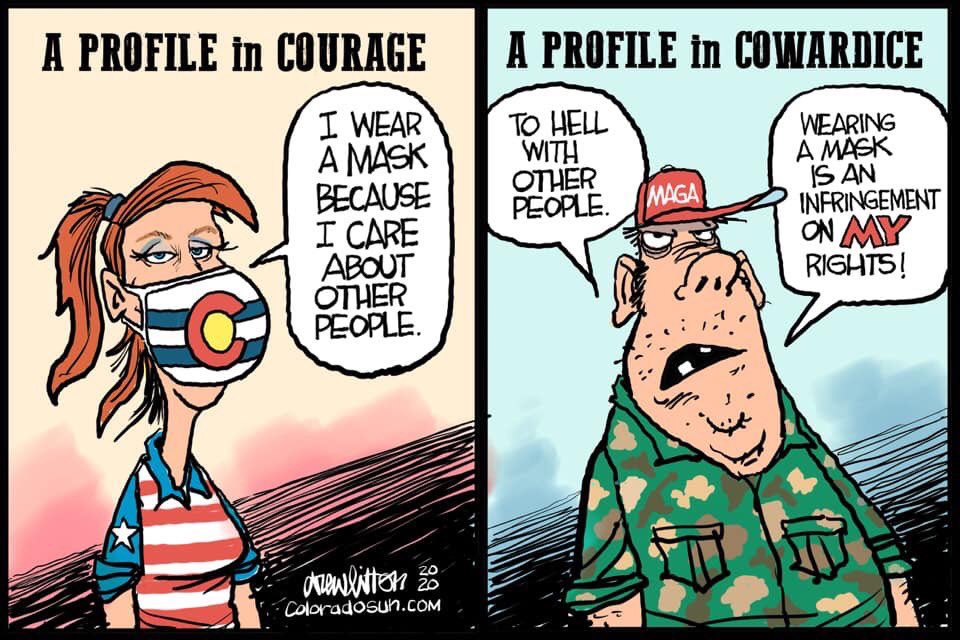
Cartoon – Profile in Courage vs. Cowardice

COVID-19 News - Updated Daily

Prosecuting the case against the COVID response

https://mailchi.mp/647832f9aa9e/the-weekly-gist-august-14-2020?e=d1e747d2d8

Bruce Plante Cartoon: Corona virus denial

This week, in her debut as running mate to presidential candidate Joe Biden, California Sen. Kamala Harris gave a preview of one of the Democratic ticket’s key arguments for the fall campaign, making a full-throated, prosecutorial case against the Trump administration’s handling of the coronavirus pandemic.

“The virus has impacted almost every country,” Harris said, “but there’s a reason it has hit America worse than any other advanced nation. It’s because of Trump’s failure to take it seriously from the start.

After receiving a briefing from public health experts on Thursday, Biden and Harris argued for a more comprehensive, aggressive national strategy to battle the virus, including major federal investment in contact tracing, a national mask mandate, and guaranteed free access to a COVID vaccine when it becomes available.

The remarks came as the US experienced the deadliest day of the summer so far, with nearly 1,500 COVID fatalities on Wednesday, and a seven-day rolling average of over 1,000 deaths per day for the last 17 days. Meanwhile, a new analysis by the New York Times, using data from the Centers for Disease Control and Prevention (CDC), indicated that the true US death toll from COVID may be as much as 35 percent higher than the reported total of 167K—a finding based on “excess deaths” above normal levels since March.

As President Trump continued to urge schools to reopen for in-person instruction nationwide, the White House released new guidance for ensuring students’ safe return to school. The guidance encouraged social distancing, frequent handwashing, better ventilation of school facilities, and the use of outdoor settings wherever possible.

Despite the President’s claim last week that children are “virtually immune” from the virus, a new analysis from the American Academy of Pediatrics and the Children’s Hospital Association showed that 97,000 children tested positive for COVID in the last two weeks of July alone, a 40 percent increase in the total number of known cases over that period.

About 340,000 children have tested positive so far, representing about 9 percent of all US cases. As schools face pressure to reopen, those numbers are likely to mount, and early-opening school districts in Georgia, Tennessee, Indiana, and Mississippi are already struggling to keep schools open amid rising cases.

Federal assistance to help schools deal with what seems like inevitable rounds of positive cases and closures is not forthcoming, however: after failing to reach a deal on another round of COVID relief, lawmakers have left Washington until September.

US coronavirus update: 5.2M cases; 167K deaths; 64.6M tests conducted.


U.S. records deadliest coronavirus day of the summer

https://www.axios.com/1485-us-coronavirus-death-record-5ee493cc-df91-4549-8c9d-43a5fee0bd87.html

U.S. records deadliest coronavirus day of the summer - Axios

The U.S. reported 1,485 deaths due to the coronavirus on Wednesday, COVID Tracking Project data shows.

Why it matters: It’s the highest single-day COVID-19 death toll since May 15, when the country reported 1,507 deaths. The U.S. has seen a total of 157,758 deaths from the virus.

The big picture: Georgia reported 109 deaths on Wednesday — its second triple-digit day in a row.

Go deeper: 5 states set single-day coronavirus case records last week


The two sides of America’s coronavirus response

https://www.axios.com/us-coronavirus-vaccine-testing-science-b656e905-67d1-4836-863e-c91f739cfd1e.html

The two sides of America's coronavirus response - Axios

America’s bungled political and social response to the coronavirus exists side-by-side with a record-breaking push to create a vaccine with U.S. companies and scientists at the center.

Why it matters: America’s two-sided response serves as an X-ray of the country itself — still capable of world-beating feats at the high end, but increasingly struggling with what should be the simple business of governing itself.

What’s happening: An index published last week by FP Analytics, an independent research division of Foreign Policy, ranked the U.S. 31st out of 36 countries in its assessment of government responses to COVID-19.

  • That puts it below developed countries like New Zealand and Denmark, and also lower than nations with fewer resources like Ghana, Kenya and South Africa.
  • The index cited America’s limited emergency health care spending, insufficient testing and hospital beds and limited debt relief.

By the numbers: As my Axios colleague Jonathan Swan pointed out in an interview with President Trump, the U.S. has one of the worst per-capita death rates from COVID-19, at 50.29 per 100,000 population.

Yes, but: Work on a COVID-19 vaccine is progressing astonishingly fast, with the Cambridge-based biotech company Moderna and the National Institutes of Health announcing at the end of July that they had begun Phase 3 of the clinical trial.

  • Their efforts are part of a global rush to a vaccine, and while companies in the U.K. and China are jockeying for the lead, U.S. companies and the NIH’s resources and expertise have been key to the effort.
  • Anthony Fauci has said he expects “tens of millions” of doses to be available by early 2021, a little over a year after the novel coronavirus was discovered.
  • If that turns out to be the case, “the Covid-19 vaccine could take a place alongside the Apollo missions as one of history’s greatest scientific achievements,” epidemiologist Michael Kinch recently wrote in STAT.

So which is the real American response to COVID-19? The bungled testing policies, the politically driven rush to reopen, the tragic racial divide seen in the sick and the dead? Or the warp-speed work to develop a vaccine in a year when most past efforts took decades?

Be smart: It’s both.

The bottom line: It can often feel as if there are two Americas, and not even a virus that has spread around the world seems capable of bridging that gap.


U.S. doing a lot less coronavirus testing

https://www.axios.com/newsletters/axios-vitals-32689a40-e409-4547-8468-b03dc589c082.html

The two sides of America's coronavirus response - Axios

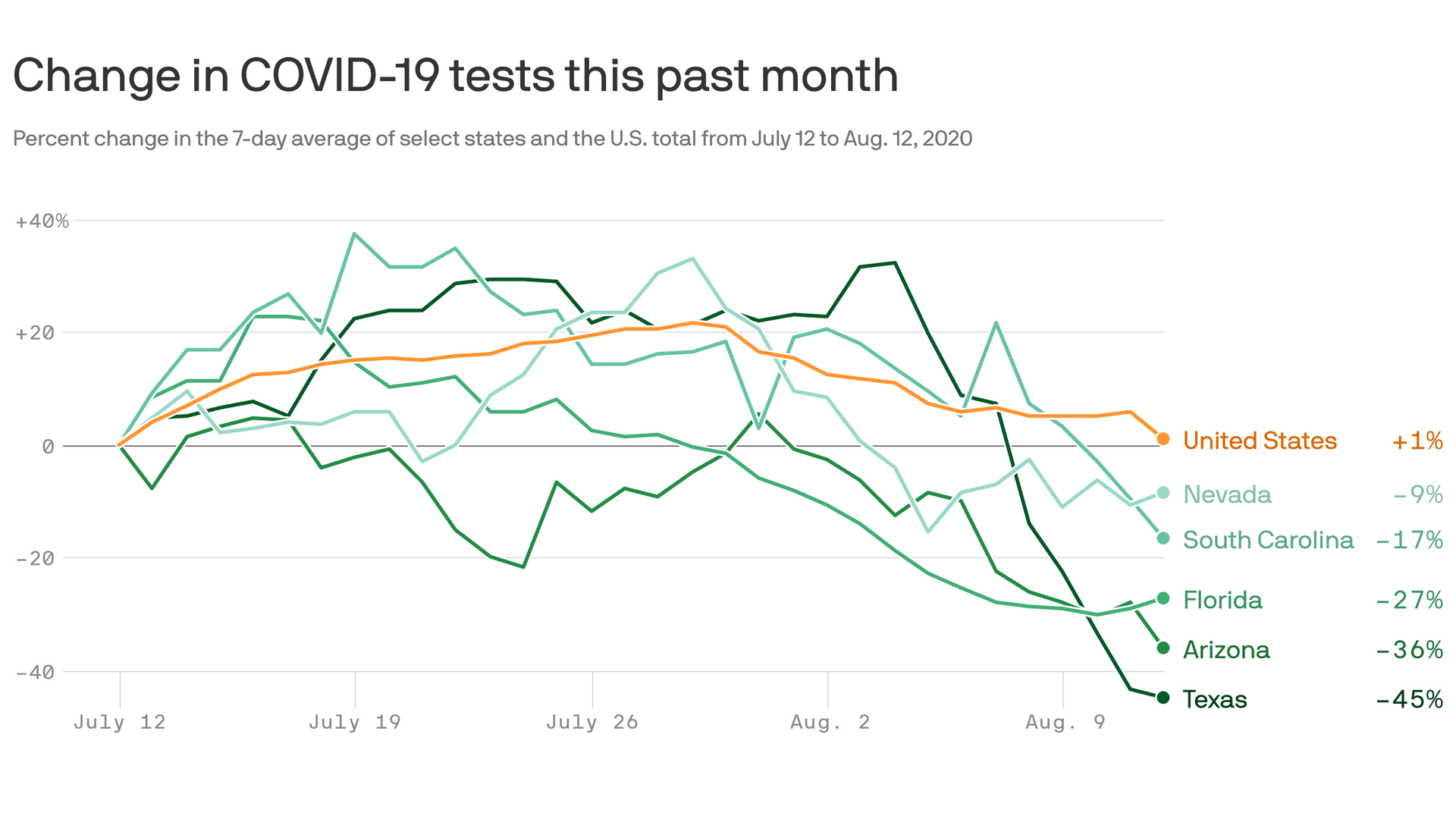
The U.S. is cutting back on coronavirus testing. Nationally, the number of tests performed each day is about 17% lower than it was at the end of July, and testing is also declining in hard-hit states.

Why it matters: This big reduction in testing has helped clear away delays that undermined the response to the pandemic. But doing fewer tests can also undermine the response to the pandemic.

By the numbers: At the end of July, America was doing more than 800,000 tests a day. This week, it’s hovered around 715,000.

  • Even as states with particularly bad outbreaks pull back on their testing, the proportion of tests coming back positive is still high — which would normally be an indication that they need to be doing more tests.
  • In Texas, 19% of tests are coming back positive, according to Nephron Research. In Florida, the rate of positive tests is 18%, and in Nevada, 17%.

Yes, but: Experts have said reducing the demand for testing may be the best way to alleviate long delays, which made tests all but useless. And that appears to be working.

Driving the news: The Department of Health and Human Services estimated this week that nearly 90% of all tests are being completed within three days — a big improvement from turnaround times that had been stretching well over a week.

  • Quest Diagnostics says its expected turnaround time is now 2–3 days, and less for priority patients. LabCorp announced a similar turnaround time last week.

The bottom line: The U.S. is averaging 50,000 new cases a day, and that high caseload is ultimately why the demand for testing is more than the system can handle.

  • We can’t get our caseload under control without fast, widespread testing, but we can’t achieve fast, widespread testing with such a high caseload.


Rely on the science and avoid the politics, Fauci says

https://www.cnn.com/2020/08/12/health/us-coronavirus-wednesday/index.html?utm_source=nl&utm_brand=wired&utm_mailing=WIR_Science_081220&utm_campaign=aud-dev&utm_medium=email&utm_term=WIR_Science&bxid=5db707423f92a422eaeaf234&cndid=54318659&esrc=bounceX&source=EDT_WIR_NEWSLETTER_0_SCIENCE_ZZ

Science Day

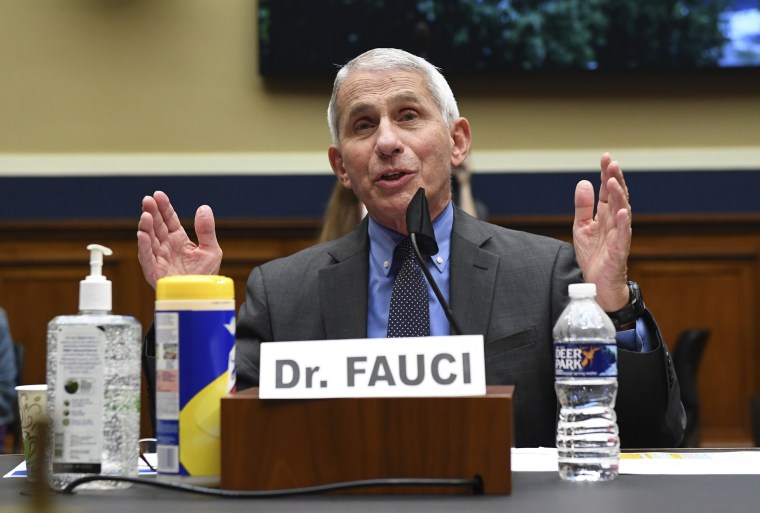
Although practices like wearing face coverings have been politicized, Dr. Anthony Fauci said Tuesday he has learned that in order to be a good public health leader in a crisis, you have to divorce yourself from politics, rely on science and be as transparent as possible.

“Completely divorce yourself from the kind of political undertones that sometimes go into an important outbreak like this,” Fauci, director of the National Institute of Allergy and Infectious Diseases, said as he was honored with a 2020 Citizen Leadership Award on Tuesday night by the Aspen Institute.
“You’ve got to stay away from that, lead by example, be perfectly honest and don’t be afraid to say you don’t know something when you don’t know it. I find that to be a very good formula when you’re dealing in a crisis.”
Even with the polarization, every state in the US passed at least one physical distancing measure in March to slow the spread, researchers from Harvard University and University College London said. Those measures worked, a new study found.
Physical distancing resulted in a reduction of more than 600,000 cases within just three weeks, according to the study, published Tuesday in the journal PLOS. Had there not been preventative interventions, the models suggest up to 80% of Americans would have been infected with Covid-19.
“In short, these measures work, and policy makers should use them as an arrow in their quivers to get on top of local epidemics where they are not responding to containment measures,” said the study’s co-author Dr. Mark J. Siedner in a news release.


US has averaged over 1,000 coronavirus deaths per day for 16 straight days

https://www.cnn.com/2020/08/12/health/us-coronavirus-wednesday/index.html?utm_source=nl&utm_brand=wired&utm_mailing=WIR_Science_081220&utm_campaign=aud-dev&utm_medium=email&utm_term=WIR_Science&bxid=5db707423f92a422eaeaf234&cndid=54318659&esrc=bounceX&source=EDT_WIR_NEWSLETTER_0_SCIENCE_ZZ

CCR - Who'll Stop The Rain song lyrics music lyrics | Great song ...

Coronavirus continues to spread at high rates across the US South, Midwest and West, even as the total number of new Covid-19 cases has declined since a summer surge.

Nationally, over the last seven days, the US is averaging just under 53,000 new cases of Covid-19 per day, down 11% from the week prior.
As a result of all those cases, deaths from the virus have remained high. The seven-day average of daily coronavirus deaths was just over 1,000 on Tuesday, the 16th consecutive day the US averaged over 1,000 deaths per day.
Adjusting for population, states in the Southeast are seeing the most new cases. Georgia and Florida — states led by Republican governors who have not issued face mask requirements — have the highest per capita new cases over the last seven days, followed by Alabama and Mississippi.
On Wednesday, Florida reported more than 8,000 new cases and 212 new deaths, according to data released by the Florida Department of Health.
Covid-19 causes worse outcomes for older people, but young people are not immune. In Florida, people under 44 make up about 57% of the state’s 545,000 cases, 20% of the state’s 31,900 hospitalizations, and 3% of the state’s 8,765 deaths, according to state data.
Robert Ruiz, 31 and the father of a 3-year-old, was one of the 265 people under 44 who died from coronavirus in Florida.
His sister, Chenique Mills, told CNN he was overweight and had seasonal asthma but otherwise did not smoke or drink and had no underlying health conditions.
“This is all really sudden, unexpected,” she said. “I (saw) him on Friday. I (saw) him on Saturday. He was fine, to say that he was up, and he was walking and he was eating. He was functioning. So for him to be gone on Sunday? It’s just a lot to take in.
“This virus is so serious. It really really is. And I think people (won’t) understand until it hits home, because I would be one to say that I took it really lightly until it hit home.”
The virus’s ongoing spread around the country has frustrated plans to safely reopen schools, forced college football conferences to postpone the lucrative fall season, and caused vast medical and economic pain.
And it will continue to rattle American society until people more seriously adopt recommended public health measures: social distancingavoiding large indoor gatheringshand-washingmask-wearingrapid testing and quarantining the sick.
“We have to figure out how to deal with this as a whole country because as long as there are cases happening in any part, we still have transit, especially now we have students going back to college,” said Dr. Michael Mina, assistant professor of epidemiology at Harvard T.H. Chan School of Public Health. “Any cases anywhere really keep risk pretty high all across the entirety of the United States.”


Fauci: ‘I seriously doubt’ Russia’s coronavirus vaccine is safe and effective

https://thehill.com/policy/healthcare/511615-fauci-seriously-doubt-russias-coronavirus-vaccine-is-safe-and-effective?utm_source=Sailthru&utm_medium=email&utm_campaign=Issue:%202020-08-12%20Healthcare%20Dive%20%5Bissue:29035%5D&utm_term=Healthcare%20Dive

The White House has pushed Fauci into a little box on the side

Anthony Fauci, the nation’s top infectious diseases expert, said Tuesday that he has serious doubts about Russia’s announcement that it has a vaccine ready to be used for the novel coronavirus.

“Having a vaccine and proving that a vaccine is safe and effective are two different things,” Fauci said during a panel discussion with National Geographic.

The comments came just hours after Russian President Vladimir Putin said that the country had become the first in the world to gain regulatory approval for a COVID-19 vaccine.

Putin said that the vaccine went through clinical testing and that it had proven to offer immunity to the deadly disease, which has infected more than 20 million people worldwide, according to a Johns Hopkins University database.

However, phase three trials for the drug have reportedly not been completed, triggering skepticism from international health experts about its usefulness. 

Fauci, the director of the National Institute of Allergy and Infectious Diseases and a key member of the White House coronavirus task force, said that he had seen no evidence supporting Putin’s position. 

“I hope that the Russians have actually, definitively proven that the vaccine is safe and effective. I seriously doubt that they’ve done that,” he said, adding that Americans need to understand that the process for gaining vaccine approval requires safety and efficacy. 

More than 100 possible vaccines are being developed around the world as part of efforts to offer immunity protection for the coronavirus. Moderna, in collaboration with the National Institutes of Health, launched a phase three trial for a vaccine in July, making it the first U.S. candidate to reach that stage.

Fauci has said that he’s “cautiously optimistic” that a COVID-19 vaccine will be ready by the end of the year. He told a House committee on July 31 that he was encouraged by everything he’s seen in the early data but that “there’s never a guarantee that you’re going to get a safe and effective vaccine.”

The World Health Organization said Tuesday that it was monitoring Russia’s progress in developing a COVID-19 vaccine. Progress in combating the virus “should not compromise safety,” the health agency said.

Former Food and Drug Administration Commissioner Scott Gottlieb echoed Fauci’s skepticism earlier Tuesday, noting in a tweet that Russia has been behind disinformation campaigns related to the pandemic. 

“Today’s news that they ‘approved’ a vaccine on the equivalent of phase 1 data may be another effort to stoke doubts or goad U.S. into forcing early action on our vaccines,” he said.

Russia is reportedly planning to offer its COVID-19 vaccine to medical personnel as soon as this month. It will be made available to the general public in October, according to Reuters


‘A Smoking Gun’: Infectious Coronavirus Retrieved From Hospital Air

A Smoking Gun': Infectious Coronavirus Retrieved From Hospital Air ...

Airborne virus plays a significant role in community transmission, many experts believe. A new study fills in the missing piece: Floating virus can infect cells.

Skeptics of the notion that the coronavirus spreads through the air — including many expert advisers to the World Health Organization — have held out for one missing piece of evidence: proof that floating respiratory droplets called aerosols contain live virus, and not just fragments of genetic material.

Now a team of virologists and aerosol scientists has produced exactly that: confirmation of infectious virus in the air.

“This is what people have been clamoring for,” said Linsey Marr, an expert in airborne spread of viruses who was not involved in the work. “It’s unambiguous evidence that there is infectious virus in aerosols.”

A research team at the University of Florida succeeded in isolating live virus from aerosols collected at a distance of seven to 16 feet from patients hospitalized with Covid-19 — farther than the six feet recommended in social distancing guidelines.

The findings, posted online last week, have not yet been vetted by peer review, but have already caused something of a stir among scientists. “If this isn’t a smoking gun, then I don’t know what is,” Dr. Marr tweeted last week.

But some experts said it still was not clear that the amount of virus recovered was sufficient to cause infection.

The research was exacting. Aerosols are minute by definition, measuring only up to five micrometers across; evaporation can make them even smaller. Attempts to capture these delicate droplets usually damage the virus they contain.

“It’s very hard to sample biological material from the air and have it be viable,” said Shelly Miller, an environmental engineer at the University of Colorado Boulder who studies air quality and airborne diseases.

“We have to be clever about sampling biological material so that it is more similar to how you might inhale it.”

Previous attempts were stymied at one step or another in the process. For example, one team tried using a rotating drum to suspend aerosols, and showed that the virus remained infectious for up to three hours. But critics argued that those conditions were experimental and unrealistic.

Other scientists used gelatin filters or plastic or glass tubes to collect aerosols over time. But the force of the air shrank the aerosols and sheared the virus. Another group succeeded in isolating live virus, but did not show that the isolated virus could infect cells.

In the new study, researchers devised a sampler that uses pure water vapor to enlarge the aerosols enough that they can be collected easily from the air. Rather than leave these aerosols sitting, the equipment immediately transfers them into a liquid rich with salts, sugar and protein, which preserves the pathogen.

“I’m impressed,” said Robyn Schofield, an atmospheric chemist at Melbourne University in Australia, who measures aerosols over the ocean. “It’s a very clever measurement technique.”

As editor of the journal Atmospheric Measurement Techniques, Dr. Schofield is familiar with the options available, but said she had not seen any that could match the new one.

The researchers had previously used this method to sample air from hospital rooms. But in those attempts, other floating respiratory viruses grew faster, making it difficult to isolate the coronavirus.

This time, the team collected air samples from a room in a ward dedicated to Covid-19 patients at the University of Florida Health Shands Hospital. Neither patient in the room was subject to medical procedures known to generate aerosols, which the W.H.O. and others have contended are the primary source of airborne virus in a hospital setting.

The team used two samplers, one about seven feet from the patients and the other about 16 feet from them. The scientists were able to collect virus at both distances and then to show that the virus they had plucked from the air could infect cells in a lab dish.

The genome sequence of the isolated virus was identical to that from a swab of a newly admitted symptomatic patient in the room.

The room had six air changes per hour and was fitted with efficient filters, ultraviolet irradiation and other safety measures to inactivate the virus before the air was reintroduced into the room.

That may explain why the researchers found only 74 virus particles per liter of air, said John Lednicky, the team’s lead virologist at the University of Florida. Indoor spaces without good ventilation — such as schools — might accumulate much more airborne virus, he said.

But other experts said it was difficult to extrapolate from the findings to estimate an individual’s infection risk.

“I’m just not sure that these numbers are high enough to cause an infection in somebody,” said Angela Rasmussen, a virologist at Columbia University in New York.

“The only conclusion I can take from this paper is you can culture viable virus out of the air,” she said. “But that’s not a small thing.”

Several experts noted that the distance at which the team found virus is much farther than the six feet recommended for physical distancing.

“We know that indoors, those distance rules don’t matter anymore,” Dr. Schofield said. It takes about five minutes for small aerosols to traverse the room even in still air, she added.

The six-foot minimum is “misleading, because people think they are protected indoors and they’re really not,” she said.

That recommendation was based on the notion that “large ballistic cannonball-type droplets” were the only vehicles for the virus, Dr. Marr said. The more distance people can maintain, the better, she added.

The findings should also push people to heed precautions for airborne transmission like improved ventilation, said Seema Lakdawala, a respiratory virus expert at the University of Pittsburgh.

“We all know that this virus can transmit by all these modes, but we’re only focusing on a small subset,” Dr. Lakdawala said.

She and other experts noted one strange aspect of the new study. The team reported finding just as much viral RNA as they did infectious virus, but other methods generally found about 100-fold more genetic matter.

“When you do nasal swabs or clinical samples, there is a lot more RNA than infectious virus,” Dr. Lakdawala said.

Dr. Lednicky has received emails and phone calls from researchers worldwide asking about that finding. He said he would check his numbers again to be sure.

But ultimately, he added, the exact figures may not matter. “We can grow the virus from air — I think that should be the important take-home lesson,” he said.