Sturgis Motorcycle Rally Is Now Linked to More Than 250,000 Coronavirus Cases

Sturgis Motorcycle Rally Is Now Linked to More Than 250,000 Coronavirus Cases

Sturgis Motorcycle Rally Is Now Linked to More Than 250,000 Coronavirus  Cases – Mother Jones

One study estimates the public health cost of the super-spreading event is near $12 billion.

The inevitable fallout from last month’s Sturgis Motorcycle Rally, an annual event that packed nearly 500,000 people into a small town in South Dakota, is becoming clear, and the emerging picture is grim.

According to a new study, which tracked anonymized cellphone data from the rally, over 250,000 coronavirus cases have now been tied to the 10-day event, one of the largest to be held since the start of the pandemic. It drew motorcycle enthusiasts from around the country, many of whom were seen without face coverings inside crowded bars, restaurants, and other indoor establishments.

The explosion in cases, the study from the Germany-based IZA Institute of Labor Economics finds, is expected to reach $12 billion in public health costs.

“The Sturgis Motorcycle Rally represents a situation where many of the ‘worst-case scenarios’ for super-spreading occurred simultaneously,” the researchers wrote, “the event was prolonged, included individuals packed closely together, involved a large out-of-town population, and had low compliance with recommended infection countermeasures such as the use of masks.”

The conclusion, while staggering, is unlikely to surprise to public health officials who warned that proceeding with the rally could be disastrous, particularly given the region’s relaxed attitude towards social distancing guidelines and some of the attendees’ mockery of the pandemic. “Screw COVID. I went to Sturgis,” read one t-shirt from the rally, where overwhelming support for President Trump was the norm.

The study comes on the heels of the first reported death from the event, a Minnesota man in his 60’s who attended the rally who died last week. South Dakota now has one of the country’s highest rates of coronavirus cases. 


US surpasses 6 million coronavirus cases nationwide

https://thehill.com/policy/healthcare/public-global-health/514364-us-passes-6-million-coronavirus-cases-nationwide

US surpasses 6 million coronavirus cases nationwide | TheHill

The United States has passed six million confirmed cases of the coronavirus since the beginning of the pandemic, according to Johns Hopkins University.

The country has also passed 183,000 deaths nationwide.

President Trump and his 2020 Democratic opponent, former Vice President Joe Biden, have battled for months over the U.S.’s coronavirus response, with allies of the Democratic nominee hammering the administration over the U.S.’s status as the country with the most confirmed COVID-19 cases in the world.

In July, Biden accused Trump of giving up on the U.S.’s efforts to control the disease’s spread, claiming that the president “raised the white flag.”

“He has no idea what to do. It’s zero. It’s only one thing he has in mind — how does he win reelection? And it doesn’t matter how many people get COVID and or die from COVID because he fears that if the economy is strapped as badly as it is today that, in fact, he is going to be in trouble,” the former vice president told MSNBC.

Trump, meanwhile, has struck an optimistic tone on the virus when addressing it in recent months and claimed that he believes a vaccine could be available before the election. He also claimed in a recent Axios interview that the virus is “under control as much as you can control it” in the U.S.

“They are dying, that’s true. And you have — it is what it is,” Trump said earlier in August. “But that doesn’t mean we aren’t doing everything we can. It’s under control as much as you can control it. This is a horrible plague.”


Cartoon – Covid Dining

Political Cartoon on Twitter: "Dave Brown's @Independent cartoon...  #RishiSunak #SummerStatement #EatOutToHelpOut #COVID19 #Coronavirus # SuperSpreader - political cartoon gallery in London  https://t.co/dePcTdnXF6… https://t.co/XDxWE1jDGh"

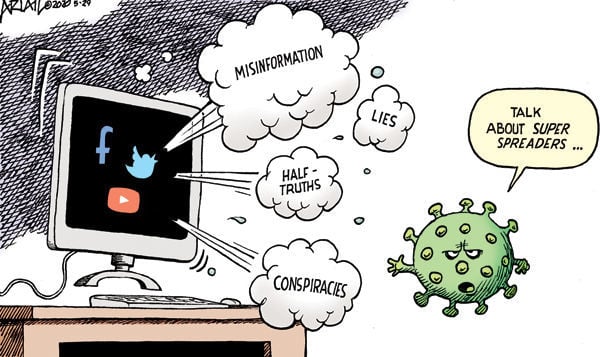
Cartoon – Talk About Super Spreaders

6-02 cartoon | Cartoons | heraldandnews.com

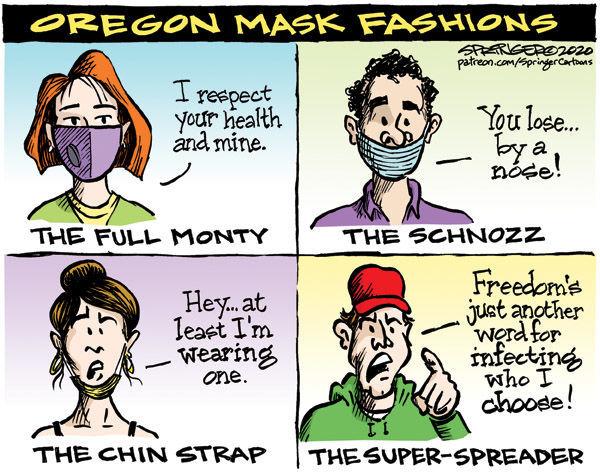
Cartoon – Coronavirus Mask Fashions

5-27 cartoon | Cartoons | heraldandnews.com

A single conference may have seeded 20,000 COVID cases

https://mailchi.mp/95e826d2e3bc/the-weekly-gist-august-28-2020?e=d1e747d2d8

COVID-19 'superspreaders' behind most new cases, researchers say | wcnc.com

A conference bringing together 175 Biogen leaders in Boston during the last week of February demonstrated the anatomy of a superspreader event: attendees from all over the world working, eating and drinking together, at a time when little was known about COVID-19 and few precautions were taken.

A new study reveals the magnitude of spread of this single event: 20,000 COVID infections may have been linked to the conference by early May, orders of magnitude greater than the previously reported 99 cases. A group of researchers evaluated the viral genomes from 772 patients across the greater Boston area, finding over 80 separate introductions of the virus, primarily from Western Europe or elsewhere in the US.

But the Biogen event was far and away the largest source of infections, accounting for 37 percent of investigated cases, which extrapolates to an estimated 20,000 cases across the area (the event also seeded clusters in several states and overseas).

Many patients with the Biogen virus had no direct connection with the event, including a large number of homeless individuals.

As college campuses reopen and states flirt with allowing larger gatherings, the study provides an important lesson of the potential for exponential spread of the virus when left unchecked by preventive measures, and the need for testing and contact tracing to quickly stop the chain of transmission. 


COVID-related controversy and hope amid a week of politics

https://mailchi.mp/95e826d2e3bc/the-weekly-gist-august-28-2020?e=d1e747d2d8

Democracy vs. disease: the role of freedom in facing pandemics | University  of Nevada, Reno

Week two of the 2020 Pre-Recorded Virtual Presidential Convention-thon wrapped up Thursday night, albeit with a decidedly less Zoom-Webex-FaceTimey feel for this week’s Republicans compared to last week’s Democrats. As delegates and VIPs sat cheek-by-jowl at several in-person events, with scarce masking and plenty of loud cheering, the viewer was left hoping that a rigorous attendee COVID testing protocol was being used.

That hope may have been dashed by a significant change to testing guidelines from the Centers for Disease Control and Prevention (CDC), which reversed course on Monday by recommending asymptomatic people who have been exposed to the coronavirus should no longer be tested.

The altered guidance drew sharp rebukes from doctors and infectious disease experts, who worried that it would undermine the ability to track the spread of the virus, which has now claimed more than 181,000 American lives. The flap over testing guidelines came at the same time as Food and Drug Administration (FDA) commissioner Stephen Hahn was forced to apologize for misleading claims he made over the weekend about the efficacy of convalescent plasma in treating COVID patients. In announcing an Emergency Use Authorization (EUA) for the treatment, Hahn dramatically overstated evidence supporting the lifesaving ability of the therapy. The missteps by CDC and FDA officials were undoubtedly an unwelcome distraction for the Trump administration, overshadowing the president’s bold promise in his acceptance speech that a COVID vaccine would be available before the end of the year.

There was hopeful news on the COVID front this week as well. In what was quickly hailed as a “game changer” in solving the nation’s faltering ability to deliver timely test results, Abbott Laboratories was granted its own EUA for a 15-minute, $5 rapid antigen test, which does not require laboratory analysis. The company plans to produce tens of millions of the new BinaxNOW test kits in the next month, and the US government has agreed to acquire nearly all of the 150M tests the company will produce by the end of the year, at a $760M purchase price. Although some antigen tests have been cited for accuracy problems, the FDA said that the new Abbott test delivers correct positive tests 97.1 percent of the time, and correct negative tests 98.5 percent of the time.

Rapid, reliable point-of-care testing could allow for safer return to schools, workplaces, and public gatherings, and if successfully deployed will be an essential tool in managing the impact of the virus until effective vaccines are fully developed, launched, and administered. A genuine ray of hope as the nation looks ahead to the fall and winter.

US coronavirus update: 5.9M cases; 181K deaths; 81.8M tests conducted.


Patchwork approach to contact tracing hampers national recovery

Patchwork approach to contact tracing hampers national recovery

Patchwork approach to contact tracing hampers national recovery | TheHill

A patchwork approach to contact tracing across state health departments is making it increasingly difficult to know where people are getting exposed to COVID-19.

While some states like Louisiana and Washington state publicly track detailed data related to COVID-19 cases in bars, camps, daycares, churches, worksites and restaurants, most states do not, creating obstacles to preventing future cases.

The extensive spread of the virus, combined with the country’s 50-state approach to pandemic response, has led to a dearth of information about where transmissions are occurring. Those shortcomings are in turn complicating efforts to safely open the economy and to understand the risks associated with certain activities and settings.

Experts know COVID-19 spreads in crowded indoor spaces, but more specifics could help state and local lawmakers strike a better balance between public health needs and those of the economy.

“If you want to take a more targeted approach to public health measures, the more information you have the better,” said Joshua Michaud, an associate director for global health policy at the Kaiser Family Foundation and an infectious disease epidemiologist.

“Rather than have a blunt, close-everything-down approach, you could be a bit more targeted and surgical about how you implement certain measures,” he added.

The Hill asked every state for information about the data they collect and share as part of their contact tracing programs, one of the main tools public health officials have to slow the spread of COVID-19.

Most states release information about outbreaks and cases at congregate settings like nursing homes, meatpacking plants, and prisons, which comprise the majority of cases. But there is less information publicly available about the numbers of cases or outbreaks tied to other settings commonly visited by people.

A handful of states including ArkansasColoradoKansasLouisianaMaryland, Michigan, Ohio, Rhode Island and Washington track and publicly release data on the settings where COVID-19 outbreaks are occurring, according to responses from state health departments.

For example, Louisiana has tied 468 cases to bars in the state, but most of the new cases in the past week have been tied to food processing plants.

In The Hill’s review of publicly available state data, other settings for COVID-19 transmission include restaurants, childcare centers, gyms, colleges and schools, churches, retailers, weddings and other private social events. It is not clear how widely those settings contributed to infections because widespread transmission of the virus means many people who get sick do not get interviewed by contact tracers — over the past week, there has been an average of 42,000 confirmed cases, though many more are likely going undetected.

State health departments in Idaho, Illinois, Massachusetts, Mississippi, Missouri, New Hampshire, North Carolina, South Carolina, Tennessee, Texas, Vermont, Virginia and West Virginia told The Hill they don’t track location data.

Utah tracks outbreaks and cases tied to workplaces and schools, but not restaurants or bars.

Arizona, California, Delaware, Indiana, Oregon and Pennsylvania track infection locations, but don’t release it to the public.

“The number of people getting COVID-19 from isolated, identifiable outbreaks, such as those in long term care facilities, is decreasing, and more people are contracting COVID-19 from being out and about in their community, such as when visiting restaurants and bars,” said Maggi Mumma, a spokeswoman for the Pennsylvania Department of Health.

Bars, indoor dining and gyms are still closed in most of New York and New Jersey, so there is no current data to track for those settings.

But the state health departments also don’t release data on outbreaks or cases tied to other settings like childcare or retail stores.

MinnesotaMontanaNorth Dakota and Wisconsin release the number of cases tied to outbreaks in the community but do not go into specifics about possible transmission sites.

For example, Minnesota lists nearly 7,000 cases as being tied to “community” exposure, but that includes settings like restaurants, bars and workspaces.

In Iowa, a state health department spokesperson said the agency is working on extracting and sharing this type of data on its website, while Maine would not say if they track by specific location.

The remaining state health departments did not respond to multiple requests for comment from The Hill and don’t have information about outbreaks or exposure settings on their websites.

Several states said local health departments may be tracking infection locations even if the state is not.

Experts said such a decentralized approach can miss outbreaks if local departments aren’t communicating with each other, meaning any data should be public.

“I do think it would be very valuable for states to make that information public,” said Crystal Watson, assistant professor at Johns Hopkins Bloomberg School of Public Health.

“It helps us collectively get a better understanding as policymakers, as people trying to help in the response. It can also help with personal decision making for people to understand … where it’s most dangerous to go related to getting infected,” Watson said.

The disparities between state health departments are partially due to a lack of federal guidance.

There are no federal requirements on the information contact tracers collect; guidelines vary from state to state, and sometimes from county to county.

Tracking data about where people are getting sick would allow states to take a “cluster busting” approach, experts said, by working backwards from confirmed cases to find where patients might have first contracted the disease, potentially stopping future outbreaks.

That approach requires a change in mindset for contact tracers, who typically focus on reaching close contacts of confirmed cases who might have been exposed to the virus. But research shows between 10 and 20 percent of people are responsible for about 80 percent of new infections, mostly through so-called super-spreader events.

“We know that the way this virus has transmitted is highly clustered groups and anytime you have settings where a lot of people are together in one place,” said Kaiser’s Michaud.

“Collecting good information on this — the cluster busting approach — is a good way to find out where your prevention efforts can have the best bang for your buck,” he said.

At the same time, some state programs are still not operating at full force and are struggling to keep up with widespread infections.

“I think that many parts of the country, especially outside of the Northeast … simply have too many cases to use contact tracing as the primary public health measure to control cases,”  said Stephen Kissler, a research fellow at the Harvard T.H. School of Public Health.

“It’s just not enough,” he said. “We just don’t have enough resources, and in a lot of these places enough contact tracers, to follow up on all of the cases.”


Identifying “triple-threat” counties at higher risk of COVID outbreaks

https://mailchi.mp/9f24c0f1da9a/the-weekly-gist-june-5-2020?e=d1e747d2d8

“Superspreader facilities”—nursing homes, correctional facilities, and meatpacking plants—have become major COVID hotspots across the US. Many counties are dealing with a large outbreak in one type of tightly-packed facility or another.

Case in point: the outbreak at Cook County Jail in Chicago, which now accounts for a whopping 15.7 percent of all COVID cases in the state of Illinois. Some places, like Colorado’s Weld County, are managing outbreaks across all three types of superspreader facilities.

The graphic above highlights the nearly 260 counties that we’ve termed “triple-threat counties”: those which have all three types of superspreader facilities. The counties are mapped using our Gist Healthcare COVID-19 Risk Factor Index, which identifies particularly vulnerable populations using chronic disease, demographic, and acute care access variables.

The top 10 “triple-threat counties” by risk index score are all in more rural areas of the country with limited acute care access and more vulnerable populations—places where a COVID outbreak is likely to be particularly devastating. Seven of the 10 have a high percentage of African-American or Hispanic/Latino residents, groups with a an outsized burden of COVID-19 illness and death. These risk factors are intersectional; for example, food processing plants employ twice as many Hispanic workers as the national average, and a disproportionate share of long-term care workers are black.

[Click here for more information and interactive data from our analysis of the risk impact of these superspreader facilities.]