Expect More Hunger in America with Big New Rips to the Safety Net

https://healthcareuncovered.substack.com/p/expect-more-hunger-in-america-with

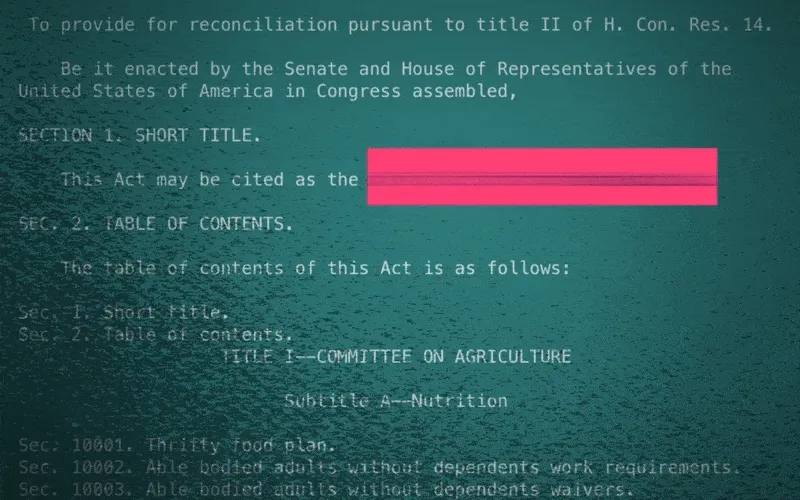
The recently passed One Big Beautiful Bill Act, which makes deep cuts to the Medicaid program, also puts the food assistance that 41 million low-income Americans rely on in jeopardy. Many of the families currently getting food provided by  the Supplemental Nutrition Assistance Program (SNAP) stand to lose that support.  

SNAP may well disappear for some families as the federal government moves to trim it. “The cuts are massive and extremely cruel when families need more support, not less,” says Signe Anderson, senior director of nutrition advocacy, at the Tennessee Justice Center in Nashville. 

Government food assistance was established during the Great Depression, but it wasn’t until 1977 that the program became more accessible when the requirement that recipients had to pay for a portion of their food stamps was ended. Throughout its history, foes of the program have tried to dismantle it and may have succeeded as a result of provisions in the bill President Trump signed on July 4. 

The new legislation calls for cutting spending for food stamps by $186 billion through 2034. “Everyone on food stamps will be affected in some way, and many will lose benefits,” Anderson says. “I don’t think the Congress understands the level of necessity in the community for food, health care and mental health treatment, some for the rest of their lives.” 

One major change is being made to work requirements that have historically been part of the Medicaid program, which is administered and partially funded by the states. Anderson points out that under the new arrangements, participants may find the task of enrolling and staying enrolled more onerous. “We see a lot of people cut off already because too many life circumstances make it difficult for them to meet work requirements.”  

Indeed when you look at the changes to SNAP, the first word that might come to mind is ‘draconian.’

To receive benefits those new to the program, and those already on it who are between 55 and 64 and do not have dependent children or who have children 14 and older, will have to prove they work. Or they will have to volunteer at least 20 hours a week or enroll in training programs. Parents of school-aged children will now be required to work.

Some five million people, including about 800,000 children and about a half million adults who are 65 and older, could lose their food benefits.  

The programs the new law targets have been a lifeline for some. Nikole Ralls, a 43-year-old woman in Nashville, who was once a drug addict but now counsels others who need help, says, “I got my life turned around because of Medicaid and SNAP.”  

In a recent memo to state agencies administering the SNAP program, Agriculture Secretary Brooke Rollins said she was concerned about what was described as abuse of the waiver system by states, noting that the new approach for the SNAP program would prioritize work, education and volunteering over what the department characterized as “idleness and excessive spending.” 

Anderson said, “The public doesn’t understand what hunger looks like and are misinformed about how well-run and streamlined the SNAP program is.”   

“Most of the people who can, do work.  We have parents working two and three jobs,” Anderson said. For families in this predicament food banks, which have become default grocery stores, may be of little help.  They, too, are stretched thin. The Wall Street Journal reported food banks across the country are already straining under rising demand, and some worry there won’t be enough food to meet demand.

A Self-Inflicted Wound: The Looming Loss of Coverage

https://www.medpagetoday.com/opinion/second-opinions/101004?trw=no

Millions are about to lose Medicaid while still eligible.

President Biden recently said that the pandemic is “over.” Regardless of how you feel about that statement or his clarification, it is clear that state and federal health policy is and has been moving in the direction of acting as if the pandemic is indeed over. And with that, a big shoe yet to drop looms large — millions of Americans are about to lose their Medicaid coverage, even though many will still be eligible. This amounts to a self-inflicted wound of lost coverage and a potential crisis for access to healthcare, simply because of paperwork.

An August report from HHS estimated that about 15 million Americans will lose either Medicaid or Children’s Health Insurance Program (CHIP) coverage once the federal COVID-19 public health emergency (PHE) declaration is allowed to expire. Of these 15 million, 8.2 million are projected to be people who no longer qualify for Medicaid or CHIP — but nearly just as many (6.8 million) will become uninsured despite still being eligible.

Why Is This Happening?

This Medicaid “cliff” will happen because the extra funding states have been receiving under the Families First Coronavirus Response Act (FFCRA) since March 2020 was contingent upon keeping everyone enrolled by halting all the bureaucracy that determines whether people are still eligible. Once all the processes to redetermine eligibility resume, the lack of up-to-date contact information, requests for documentation, and other administrative burdens will leave many falling through the cracks. A wrong addressone missed letter, and it all starts to unravel. This will have potentially devastating implications for health.

When Will This Happen?

HHS has said they will provide 60 days’ notice to states before any termination or expiration of the PHE — and they haven’t done so yet. It also seems incredibly unlikely that they would announce an end date for the PHE before the midterm elections, as that would be a major self-inflicted political wound. So, odds are that we are safe until at least January 2023 — but extensions beyond that feel less certain.

What Are States Doing to Prepare?

CMS has issued a slew of guidance over the past year to help states prepare for the end of the PHE and minimize churn, another word for when people lose coverage. Some of this guidance has included ways to work with managed care plans, which deliver benefits to more than 70% of Medicaid enrollees, to obtain up-to-date beneficiary contact information, and methods of conducting outreach and providing support to enrollees during the redetermination process.

However, the end of the PHE and the Medicaid redetermination process will largely be a state-by-state story. Georgetown University’s Center for Children and Families has been tracking how states are preparing for the unwinding process. Unsurprisingly, there is considerable variation between states’ plans, outreach efforts, and the types of information accessible to people looking to renew their coverage. For example, less than half of all states have a publicly available plan for how the redetermination process will occur. While CMS has encouraged states to develop plans, they are not required to submit their plans to CMS and there is no public reporting requirement.

Who Will Be Hurt Most?

If you dig into the HHS report, you will see that the disenrollment cliff will likely be a disaster for health equity — as if the inequities of the pandemic itself weren’t enough.majority of those projected to lose coverage are non-white and/or Latinx, making up 52% of those losing coverage because of changes in eligibility and 61% among those losing coverage because of administrative burdens. Only 17% of white non-Latinx are projected to be disenrolled inappropriately, compared to 40% of Black non-Latinx, 51% of Asian American, Native Hawaiian, and Pacific Islander, and 64% of Latinx people — a very grim picture. This represents a disproportionate burden of coverage loss, when still eligible, among those already bearing inequitable burdens of the pandemic and systemic racism more generally.

Another key population at risk are seniors and people with disabilities who have Medicaid coverage, or those who aren’t part of the Modified Adjusted Gross Income (MAGI) population. Under the Affordable Care Act, states are required to redetermine eligibility at renewal using available data. This process, known as ex parte renewal, prevents enrollees from having to respond to, and potentially missing, onerous re-enrollment notifications and forms. Despite federal requirements, not all states attempt to conduct ex parte renewals for seniors and people with disabilities who have Medicaid coverage, or those who aren’t qualifying based on income. Excluding these groups from the ex parte process has important health equity implications, leaving already vulnerable groups more exposed and at risk for having their coverage inappropriately terminated.

What Can Be Done?

There are ways to mitigate some of this coverage loss and ensure people have continued access to care. HHS recently released a proposed rule that would simplify the application for Medicaid by shifting more of the burden of the application and renewal processes onto the government as opposed to those trying to enroll or renew their coverage. We could also change the rules to allow states to use more data, like information collected to verify eligibility for the Supplemental Nutrition Assistance Program (SNAP), in making renewal decisions, rather than relying so much on income. The Biden administration also made significant investments into navigator organizations, which can help those who are no longer eligible for Medicaid transition to marketplace coverage. Furthermore, states should use this as an opportunity to determine the most effective ways to reach Medicaid enrollees by partnering with researchers to test different communication methods surrounding renewals and redeterminations.

As the federal government and state Medicaid agencies continue to prepare for the end of the PHE, it is critical that they consider who these burdensome processes will affect the most and how to improve them to prevent people from falling through the cracks. More sick Americans without access to care is the last thing we need.

Perspective: The Pandemic Has Created a Food Insecurity Crisis. The Federal Response Has Been Swift, but Is it Enough?

https://altarum.org/news/pandemic-has-created-food-insecurity-crisis-federal-response-has-been-swift-it-enough?utm_source=Altarum+Updates&utm_campaign=05b6c1511b-EMAIL_CAMPAIGN_2020_05_20_07_13&utm_medium=email&utm_term=0_4220252dfe-05b6c1511b-347615961

The Pandemic Has Created a Food Insecurity Crisis. The Federal ...

Our ability to access nutritious food is a critical factor to our health and well-being, which is why it has been alarming to see images in recent weeks of cars lining up by the thousands at food banks across the country. Indeed, a university survey taken since the onset of the crises found nearly 4 in 10 Americans reported having moderate to high levels of food insecurity, compared to 11 percent of households who were food insecure in 2018, according to the USDA Economic Research Service.

In response, the federal government has given states administrative relief and funding through various Covid-19 response packages. USDA also has authorized temporary waivers that grant states greater flexibility to address the increased demands and to align with shelter-in-place and social-distancing orders.

USDA also created two new programs: the Pandemic EBT (P-EBT) and the Coronavirus Food Assistance Program (CFAP). P-EBT allows states to issue eligible households an EBT card, a type of debit card used to purchase food, with the value of the free school breakfast and lunch reimbursement rates for the number of weekdays that schools are closed due to Covid-19 (estimated to be around $5.70 per day).

As of the first week of May, 18 states have been approved to provide benefits through P-EBT and 20 additional states have submitted plans for approval. CFAP aims not only to assist families in accessing food but also ranchers and farmers who have an excess supply. Through CFAP, the USDA will procure an estimated $100 million per month of fresh fruits and vegetables and $300 million per month in dairy and meat products for food banks and other nonprofits providing food to Americans in need.

Are these measures enough? Let’s examine the changes, particularly the USDA waivers for the federal food assistance programs.

The Supplemental Nutrition Assistance Program (SNAP), formerly known as food stamps, provides financial support to supplement the food budget of needy families. USDA waivers that increased flexibility in the administration of SNAP include:

  • waived the requirements for in-person interviews during the SNAP enrollment process,
  • provided emergency supplementary benefits up to the maximum benefit a household can receive for up to two months,
  • removed the requirement for SNAP recipients to re-certify midway through their participation,
  • provided flexibility for jobless workers to remain eligible, and
  • expanded the SNAP online grocery purchase pilot from the original eight states adding an additional 12 states and the District of Columbia.

These efforts are a step in the right direction to ease family burdens, but the supplemental benefits and program flexibilities are time-limited by the federal public health emergency declaration for Covid-19. Also, the 40 percent of SNAP households who already receive the maximum benefit are excluded from the supplemental benefits. Especially as we are experience the sharpest increase in food costs in decades, we need to provide additional support to the lowest income SNAP recipients. To assist families during the longer economic recovery, advocates and policy experts are calling for the following expansions to ensure these benefits cover a larger share of the people who need them:

  • boost the benefit for households by 15 percent (an additional $25 per person per month),
  • increase the minimum benefit per month from $16 to $30, and
  • suspend implementation of all administrative rules that restrict access for millions of Americans.

The Supplemental Nutrition Program for Women Infants and Children (WIC), a public health nutrition program that provides nutrition education, breastfeeding support and nutritious foods to low-income pregnant women and mothers of small children, has been providing services remotely. USDA waivers that increased flexibility in the administration of WIC include:

  • waived requirements for the physical presence for certification,
  • waiver for deferment of measurements and blood tests,
  • ability to issue benefits remotely, and
  • food package substitutions.

That’s a good start and more can be done. The Center on Budget and Policy Priorities recommends temporarily extending WIC certification periods for infants to two years as well as extending WIC eligibility from age five to age six. The National WIC Association is also advocating for an increase in the Cash Value Benefit to enhance fruit and vegetable purchases by WIC families.

The National School Lunch Program (NSLP) and Breakfast Programs, Summer Food Service Program, and the Child and Adult Care Food Program (CACFP), which serve low-income school children, quickly revamped and developed innovative ways to distribute meals to families, often expanding their regular productions. USDA waivers that increased flexibility to help better serve families during the pandemic include:

  • ability to serve non-congregate meals,
  • allowing for pick-up and delivery of meals,
  • allowing modification in the meals components requirements,
  • waiving time elements and meal spacing requirements,
  • allowing virtual desk enrollment of new CACFP providers, and
  • waive requirement that afterschool meals and snacks be accompanied by educational activities.

CACFP provides meals to preschool-aged children in Child Care Centers and licensed child care family homes.  During the pandemic, most centers have been closed, while a majority of family homes remained open and provided services for essential workers.

According to Paula James, director of child health and nutrition at CocoKids in northern California, about 68 percent of the Contra Costa county’s family homes participating in CACFP remained open in April, and these waivers were helpful. Moving forward, she believes CACFP should continue the allowance of virtual enrollment and expand the use of that technology to regular monitoring site visits, specifically in rural areas or locations where safety could be a concern.  While the pandemic has provided the opportunity to test technological advances that could streamline program operations in the future, it also revealed some systemic weaknesses, including that CACFP has no centralized database system, which is needed at the state level and requires federal guidance. Lack of technology throughout the program was a hinderance to providing additional services to families during COVID-19.  “Continued use of technology into the future will be very important,” said James.

What more can be done? The federal government should extend COVID-19 related waivers for all nutrition programs until September 30, the date provided by congressional authority. While the public health restrictions may be lifting across the states, the economic fallout will likely be felt by families for many months to come.

In addition, states should leverage communication, technology, all federal supports, and evaluation to ensure they are successfully reaching as many in need as possible. This includes:

  • conducting a public information campaign to alert newly unemployed families in need about available food assistance programs and how to apply and access benefits;
  • utilizing technology solutions to provide remote program services and enrollment including mobile uploading of required documents;
  • taking advantage and apply for all available waiver options from the federal government; and
  • evaluating the revised work systems and if appropriate, take actions to allow for permanent program changes.

This week House Democrats passed the Health and Economic Recovery Omnibus Emergency Solutions (HEROES) Act, the fifth Covid-related legislative package, which includes a boost in funding for SNAP, WIC, and Child Nutrition Programs. The bill also provides support to local food banks and emergency food providers. Any bill that goes to the president should include these food access supports.

It is critical to strengthen federal food assistance programs and the social safety net while working to address the root causes of poverty to reduce health and social disparities. To learn how Altarum can assist your state in program assessment, planning, evaluation, training and analytic support for quality services, contact Tara Fowler, PhD, director of the Center for Healthy Women and Children, at tara.fowler@altarum.org.