As employers plan for 2023, attracting and retaining talent is top of mind amid a competitive U.S. labor market. That’s led to over two-thirds of companies planning to enhance employee health and benefit offerings next year, according to survey results from Mercer published July 6.
The survey was conducted April 26 to May 13. In total, 708 organizations participated, from all industries and of all sizes ranging from fewer than 500 employees to more than 5,000.
Nine things to know:
Among large employers, 70 percent are planning to enhance health and benefit offerings in 2023.
Among all employers, 61 percent are conducting surveys on employee benefit preferences.
Among large employers, 41 percent currently provide a plan option with a low deductible or none at all, and 11 percent are considering it.
Over half of employees say no remote or hybrid work is a deal breaker when considering to join or stay with an organization. Among all employers, 78 percent now allow employees to work from home regularly, compared to 26 percent in 2021.
Among large employers, 52 percent will offer virtual behavioral healthcare in 2023, and 40 percent will offer a virtual primary care physician network or service.
Though 64 percent of employers are not prioritizing a single employee group for benefit enhancements, 35 percent say they are focusing on hourly and low-wage employees.
Nearly one-third of employers will offer benefits such as fertility treatment coverage and adoption and surrogacy benefits by 2023, and almost another third are considering it.
Among all employers, 70 percent currently offer or plan to offer paid parental leave in 2023.
Among all employers, 75 percent offer or plan to offer tuition reimbursement in 2023.
Columbus-based OhioHealth is eliminating 637 jobs, its biggest layoff ever, according to The Columbus Dispatch. The move is part of a plan to engage external partners to provide some services the system currently provides in house.
Over the next three to five months, the system will eliminate those jobs in information technology and revenue cycle management. Of those, 567 are in information technology. It informed workers of the cuts on July 7.
“We are committed to providing a high-level of support to all associates affected by this change,” Colin Yoder, director of media and public relations at OhioHealth, told Becker’s in a statement. “This includes outplacement support, a job fair specifically for those displaced, temporary salary and benefits continuation after their OhioHealth employment ends and upskill training for those in Information Technology.”
OhioHealth said the IT work will be handled by the professional services company Accenture, and AGS Health will handle the revenue cycle business.
The layoffs, according to OhioHealth, are intended to improve patient care and services and position the healthcare system for a future where patients rely more on telemedicine and cellphones to obtain their healthcare.
“This strategy will enable us to secure the skills, technology, expertise and innovation required to deliver a best-in-class, patient-centric, personalized healthcare experience without taking away from investments we are already making at the bedside,” Mr. Yoder said.
The IT workers will remain on payroll until Jan. 3 and will be given the opportunity for training that could make them eligible for other jobs at the company. The other workers will be laid off Nov. 4.
Job openings fell slightly in May as demand for workers remained near record highs, according to data released Wednesday by the Labor Department, even amid growing concerns of a potential recession.
The number of open jobs listed in the U.S. on the final business day of May totaled 11.3 million, dropping from 11.7 million in April after seasonal adjustments. Though job openings fell in May, hires, layoffs and quits stayed roughly even with their April numbers, according to the May Job Openings and Labor Turnover Survey (JOLTS) report.
The JOLTS report showed a labor market still stacked strongly for workers in May, a month when the U.S. added 390,000 jobs and saw the jobless rate hold strong at 3.6 percent. Despite the decline in job openings, there were still almost two open gigs for each unemployed American.
That mismatch can give workers many opportunities to find new jobs with better compensation and career opportunities than their current ones.
“This is not what a recession looks like. The May 2022 JOLTS data obviously lags what’s happening in the labor market presently, but all signs are that it remains strong,” wrote Nick Bunker, research director at Indeed.com, in a Wednesday analysis.
“If the labor market were quickly and suddenly taking a downturn, we would see employers’ demand for new hires drop and their willingness to let workers go increase. For now, we aren’t seeing a sudden move in either direction.”
Businesses hired roughly 6.5 million workers and lost 6 million in May, both in line with April totals. The percentage of the workers who quit their jobs in May fell to 2.8 percent, just 0.1 percentage points from a record high of 2.9 percent set earlier this year.
With ample jobs available and people still eager to leave in search of better work, businesses have avoided laying off employees over fears they could be hard to replace. Roughly 1.4 million workers were laid off in May, slightly higher than April’s total of 1.3 million. But the percentage of the workforce laid off by their employers held even at 0.9 percent, which is below pre-pandemic levels.
“Despite continued headlines about layoffs, particularly in the tech sector, the layoff rate remains low,” Bunker explained. “This is the 15th straight month that the layoff rate has been below its pre-pandemic bottom.”
The steady strength of the U.S. job market helped propel a rapid recovery from the depths of the COVID-19 recession through much of 2020 and 2021. The U.S. is fewer than 1 million new jobs away from replacing the 21 million jobs lost to the onset of the pandemic, and the speed of the pandemic recovery has helped fuel rapid wage growth, particularly for low-earning workers.
Even so, many economists — including Federal Reserve officials — fear the strength of the job market could add further fuel to inflation already at four-decade highs. While steady job gains are good for the economy, the intense competition for workers has made it difficult for many firms to stay adequately staffed and keep up with both higher wage demands and rising prices.
Fed Chairman Jerome Powelland many economists are hopeful that higher interest rates and the fading effects of fiscal stimulus can help reduce job openings — and the pressure they put on wages — without wiping out job gains.
The Fed has boosted its baseline interest rate range by 1.5 percentage points from near-zero levels in January and is expected to hike by another 2 percentage points by the end of the year. Higher interest rates are meant to reduce inflation by slowing the economy enough to force businesses to stop raising prices and wages.
Even so, he has acknowledged it will be difficult for the Fed to avoid slowing down the labor market into a standstill as the central bank boosts interest rates to fight inflation.
“The labor market conditions [Powell] has described as ‘extremely, historically’ tight and ‘unsustainably hot’ persisted in May,” wrote Julia Pollak, chief economist at ZipRecruiter, in a Wednesday analysis.
“Employers are hanging onto the workers they have in a tight labor market where replacing them is unusually costly.”
The June jobs report, set to be released Friday, will give a most recent view into how well the labor market has held up amid Fed rate hikes. Economists expect the U.S. to have added roughly 268,000 jobs last month, according to consensus estimates.
“There will be a time when the US labor market takes a downturn, jobs are shed at a higher rate, and workers stop quitting their jobs. But that time has yet to come. The labor market remains very tight and very hot. That may change, but it hasn’t yet,” Bunker wrote.
U.S.-based employers announced 32,517 cuts in June 2022, a 58.8 percent increase from 20,476 cuts announced in the same month last year, according to a new job report from Challenger, Gray & Christmas.
June marks the highest month since February 2021, when 34,531 cuts were announced. It is the second time this year that cuts were higher in 2022 than the corresponding month a year earlier.
Healthcare/products manufacturers and providers announced the most job cuts this year with 19,390, which is up 54 percent from the 12,620 announced through June 2021. The automotive industry posted the second-highest cuts with 15,578, a number that is up from the 6,111 cuts in the previous year.
Andrew Challenger, senior vice president of executive search firm Challenger, Gray & Christmas, said the numbers demonstrate increasing economic strain.
“Employers are beginning to respond to financial pressures and slowing demand by cutting costs. While the labor market is still tight, that tightness may begin to ease in the next few months,” Mr. Challenger said.
Locations suffering the highest losses include California with 28,692, New York at 15,952, and Pennsylvania at 9,310.
The pressure is on for boards to hold onto chief financial officers as firms face the prospect of an economic slowdown and intense competition for talent.
Demand for finance chiefs continues to be high in U.S. businesses, according to a July 4 report from The Wall Street Journal. Data from Russell Reynolds Associates indicates that CFO turnover at companies in the S&P 500 rose to 18 percent in 2021, compared to 15 percent in 2020 and 14 percent in 2019.
Some new strategies call for broadening CFO responsibilities or elevating their positions altogether to retain top executives, according to Joel von Ranson, head of recruitment firm Spencer Stuart’s global functional practices.
“Companies create these broader roles and titles to engage and recognize and motivate the very best of the best,” Mr. von Ranson said.
CFOs at companies in the S&P 500 and Fortune 500 average about five years in their job, according to executive search firm Crist Kolder Associates. Expanding the CFO role allows organizations to create opportunities to retain key talent past the five-year mark.
In 2021, just under 8 percent of chief executive officers at companies in the S&P 500 and Fortune 500 came from the CFO seat.
Jamie Dimon, chief executive officer of JPMorgan Chase & Co.
According to Jamie Dimon, chairman and CEO of JPMorgan Chase, the most successful leaders have certain key traits.
″[H]umility, openness, fairness [and] being authentic” are most important – “not [being] the smartest person in the room or the hardest working person in the room,” Dimon, who runs the nation’s largest bank and oversees more than 250,000 employees globally, told LinkedIn editor in chief Daniel Roth in a recent video.
“Management is: Get it done, follow-up, discipline, planning, analysis, facts, facts, facts. It’s [getting] the right people in the room, kill the bureaucracy, all of these various things,” Dimon told Roth. “But the real keys to leadership aren’t just doing that.”
It’s about having “respect for people,” not about having “charisma” or “brain power,” he said.
Having these traits also increases your productivity, along with your success, Dimon said. If you’re “selfish” or “take the credit” when it isn’t warranted, others are “not going to want to work,” which will impact efficiency on the job.
Dimon also looks for these things when hiring, he said in July. When interviewing or assessing a promotion, Dimon asks himself a few questions about the candidate, including, “Would you work for that person? Would you want your kid to work for that person?”
He also considers whether they “take the blame” or “how they act anytime something goes wrong.”
In his role as CEO, Dimon said he tries to practice what he preaches.
“No one would say Jamie Dimon is humble,” he said in July, “but I treat everyone the same, and I expect the same thing. You’d want to work for me if you think I give a s—, if I treat you fairly, if I treat everyone equally.”
To achieve success, “treat people the way you want to be treated,” Dimon told Roth. “Have respect for people.”
Job seeking is a grueling process, but it is also an opportunity to put your best foot forward in order to find a company that is the best fit for you.
Although it can be nerve wracking to sit through one interview after another, candidates should remind themselves that these interactions are a two-way street, and they have every right to ask challenging questions to make a decision, should the offer come.
Here are the critical questions you as a candidate must ask during a job interview—because remember, you’re interviewing the employer, too.
QUESTIONS TO ASK YOURSELF BEFORE APPLYING FOR THE JOB
Before setting off on your job search, make a list of the types of companies you’re interested in.
Is this a place you see yourself thriving in?
Do you believe in the mission?
Why do you want to work at this place?
What attracts you about the organization?
Oftentimes, our current situations dictate how we go about making our next move. Perhaps you’re working in an environment that you find suffocating and want out, or you’re seeking more responsibilities, or are looking to become a people manager.
Whatever the case, be sure to keep in mind that in every new workplace, there will be pros and cons, no matter the salary or job description. So be cognizant of all the aspects of a new role that are truly important to you; also, be mindful of what your personal dealbreakers are.
PREPARE A LIST OF STRATEGICALLY PLANNED QUESTIONS
Interviewing is a two-way exchange. While candidates are being scrutinized by the potential employer, the skilled candidate will have an opportunity to evaluate the company based on the flow of the conversation.
Typically, candidates aren’t given the opportunity to ask questions until the very end of the interview. That’s not to say there aren’t ways to integrate specific queries into the conversation, as long as you remember that you’ll get full control of the floor in the grand finale.
In a previous Fast Company story, Patrick Mullane, executive director of Harvard Business School Online, shares how interviewees often will drop the ball when the interviewer tosses out the famous line, “Do you have any questions for me?”
“Candidates forget that when they’re given control of the discussion, it’s an opportunity to do two very important things. First, it’s a chance to learn something genuinely useful about the firm you might be joining. Second, you get to show that you’re thoughtful and conscientious,” he said. “Both are hugely important as you look to make a change. Don’t waste the opportunity.”
When it comes to the questions candidates typically ask companies during an interview, the “big three” revolve around corporate culture, the interviewer’s personal experience (“How have you liked working here?”), and growth.
Rather than default on these inquiries (which interviewers likely receive quite often and may respond in kind with generic answers), Mullane challenged candidates to take these questions and reframe them in a more thoughtful, strategic way:
Culture questions: Rather than asking, “What’s the culture like here,” ask something along the lines of, “Can you share a time when the company’s culture made you excited to work here or helped you during a challenging time?” This bypasses a typical answer like “It’s collaborative,” and dives into the intersection of employees and culture, offering an in-depth look into a specific, and perhaps relatable, scenario.
Personal experience questions: Instead of “How do you like working here?” try, “I noticed you left X company for this one. What convinced you to make the jump?” This reframing achieves two things: It shows the interviewer you did your research and gives you insight into their decision-making, which may help you make your own.
Company growth questions: A question like, “I noticed the company is growing rapidly. Do you expect that to continue?” will often bear a generic, dead-end answer. To get additional, more useful information, put a spin on it. Ask something like, “I noticed the company is expanding rapidly. Is this putting a strain on your customer service team?” Getting information on a company’s financials is not particularly difficult, especially if it is already publicly traded. But asking a question of this nature is especially useful if you are interviewing for a role like Customer Success Manager, as it allows you to get a better sense of how growth impacts the day-to-day of the team.
Overall, it will only work in your favor when you do your due diligence in gathering intelligence on the company you are interviewing for; also, you’ll be setting yourself up for success by having prepared questions that lead to a conversation and present yourself as a thoughtful and conscientious candidate.
“In a hot job market, it’s tempting to be lazy when doing the upfront work to prepare for an interview,” said Mullane. “It’s easy to figure that the interview is over when the person interviewing you gives you the floor. But it’s not. Asking better questions in the right way can significantly increase the chances you’ll not only impress the interviewer, but also gain valuable insights that can help you decide if the position is right for you.”
COVER THE BASICS
It can be easy to get caught up in nerves when interviewing for a company you are extremely attracted to—or even in general. Interviewing is a lot of pressure!
However, when preparing to ask your questions, the areas that you as a candidate must focus on should give you a well-rounded perspective on multiple aspects of the company, not just the specific job description.
This Fast Company article shared a roundup of all the pertinent focus areas that your questions should fall under to get you the best answers, which include:
The specific role you are interviewing for
The management style of your would-be boss or team
Company culture and reputation
What performance metrics look like
What kind of colleagues you can expect to work with
Opportunities for growth
ASK TOUGH BUT FAIR HIGH-LEVEL QUESTIONS
Sometimes it’s not enough to consider the high-level questions, such as salary and work culture. Many of us are in a unique position in life, whether that involves our personal situations, families, health, or other concerns.
When considering your interest in a company, it’s helpful to understand how they can help or support you as an individual beyond your contributions to the job.
On the flip side, you’ll want to know other aspects of internal support for employees. How does this company support internal mobility? How do managers deliver feedback? In other words, what will a day in the life of this role really be like?
Prepare to ask the employer a series of questions tailored to your situation. FlexJobs’ team of career coaches offers guidance in this Fast Company story, including specific inquiries to ask your interviewer, such as:
Why is this position available? This can give you some insight into the way things are handled at the company. Was someone fired? Are they unable to keep the position filled because of the workload?
What makes it a great day at work, and what makes it a challenging day? Answers to this question can vary depending on the personal experience of the interviewer, but it’s good to get a sense of how they approach the question.
How are criticism and feedback handled within the team? Mistakes can happen, and knowing that managers on the team can handle employee errors with grace will offer a sense of relief rather than unnecessary conflict when they do occur.
Do you have any Employee Resource Groups (ERGs)? How do they support the company’s DEI plans? This question gives you an opportunity to understand where the company stands in terms of diversity, equity, and inclusion (DEI) and how well they support the objectives of ERGs, as well as pushing forward their higher-level strategy.
How does the company approach salary differences? This can highlight whether the company pays people differently based on location, if they work remotely, in-office, or hybrid. It can also shed light on whether the company has done a pay audit to achieve equity, especially for women and underrepresented groups.
What’s the company’s approach to supporting work-life balance? Many companies have put forth specific benefits and incentives to support employees in the past two years, including mental health initiatives, fitness classes, therapy, and flexibility. This critical question will help you determine just how the company views employees as individuals and not just by their work output.
An example of a tough conversation to navigate can pertain to how the organization supports employees in specific work situations. If this particular job requires you to relocate, an example of how to navigate the question of moving-cost accommodations might go something like this:
Candidate (C): I noticed this position is based in San Francisco. Is there an option for potential hires to work remotely?
Interviewer (I): I’m afraid our new company policy is to operate on a hybrid schedule. This particular role is based in the Bay Area and requires the individual to come into work three times a week.
C: I understand. Sometimes companies need to make tough decisions based on their needs.
I: Do you think you would be willing to relocate, should we decide to move forward with your application?
C: I think this role is a wonderful opportunity for me, and I truly believe my personal values align with those of this company and its culture. If all goes well, I’d like to learn what the company’s budget is in regards to supporting moving and transition costs.
In this scenario, the interviewer is honest about the new hybrid model their company has adopted. If you, the candidate, are first learning about this aspect during the interview, it’s important to ask direct questions about how the company plans to support potential moving costs, rather than framing the question in a way that offers a loophole or an out.
Organizations are aware that with the plentiful options of remote jobs, finding talent willing to relocate or adopt a hybrid work life will be tougher. Know that the ball is in your court and be straightforward about expensed costs if you are willing to relocate.
WRAP UP THE INTERVIEW WITH THESE KEY QUESTIONS
This will likely be the last time you interact with this team member before either moving onto the next stage or the decision-making process.
In a prior Fast Company story, the founder of executive search firm The Mullings Group shares the best questions to ask when wrapping up.
Don’t let the conversation end without answers to the following questions, so you have enough information to help you reflect on and assess your experience and understanding of the company.
Am I a good fit for this company? The feeling needs to be mutual. Be sure to determine whether your skills, interests, personality, and goals align with the direction of the company.
What are the expected deliverables for this role over the next three months to a year? Depending on the role of the person you are interviewing with, you may get different answers. This is a good question to ask to get a sense of the priorities as it relates to different stakeholders.
How will we both know that I have succeeded in this role? This is another question in which the answers may vary, but it will be helpful for you as a candidate to understand how to work toward specific goals and measure your own impact so that, when it comes time for a raise or promotion in the future, you have the evidence to back it up.
What are the growth opportunities in this role, and what important skills will I learn? It’s not enough to make a lateral move. You need to know how will working for this company enable you to grow and thrive.
Who will I become? Your environment and the people you work with will directly influence your work output, ethic, and your future values. Asking questions about the kind of people you will interact with regularly will help you get a sense of what your day-to-day experiences will look like.
Getting a new job is a big deal. You will be working 40 hours a week in a specific environment that supports a certain culture and hires a certain type of colleague. It’s not just the job description that matters, nor the skill set the company requires to perform in that role. A new job is a combination of your livelihood, a commitment to learn and grow, and contribute.
Remember to be selective in your process because you’re interviewing your next employer, too.
There’s been some speculation in the news lately that wage growth in the United States might be topping out. This could be the case for some employers, especially smaller companies that don’t have much more give in their current staffing budget. However, don’t think for a moment that compensation is suddenly losing its power as a tool to help secure top talent in a market where unemployment is low, the quits rate is high, and there are nearly twice as many open jobs as there are available workers.
The suggestion that employers are becoming more conservative in their salary offers also might be hopeful thinking for those trying to control rising inflation. Federal Reserve Chair Jerome Powell, for example, recently referred to the labor market as “unsustainably hot.”
The takeaway for chief financial officers (CFOs) is that you can’t afford to sit back and wait on wages. You can never really be sure when or if it will “top out,” especially in this unusual economy and candidate-driven hiring market. Your business needs to be prepared to provide standout compensation packages to hire stellar candidates — and keep your best people, too.
Compensation remains the not-so-secret weapon for besting competitors targeting the same talent, including the high performers who are already part of your organization. The trick is to use compensation as an offensive strategy that gives you more control. Following are three ways to help your organization make that pivot:
1. Review Current Employees’ Compensation Levels Now
While its name has been overexposed in the media, the Great Resignation is real and still in motion. Some are even referring to the phenomenon now as the “Forever Resignation”— a cycle of voluntary turnover that may never end. Buzzy labels aside, the pandemic has fundamentally changed the way people look at work, and what it means to them. They aren’t as willing to put up with things they don’t like about their job — like a low rate of pay. They know they have options, and they will seek them out.
Nearly two-thirds of U.S. workers who left their jobs in 2021 cited insufficient compensation as a reason for quitting, according to a Pew Research Center survey. To avoid turning your company’s valued staff into part of the “Class of 2022,” don’t wait for them to ask for a raise. Make sure to review their current compensation and if needed, bump it up, or extend another financial perk, like a spot bonus or paid time off.
And, if you find that employees are beating you to the punch, encourage an open discussion about pay. For example, if this person’s job responsibilities recently expanded or they’ve gained new skills, an immediate raise (or the promise of one soon) may be in order. If the employee is just feeling the crunch from inflation, offering a flexible work arrangement to reduce the burden of a costly commute might be an alternative solution for in-office workers.
2. Designate an Expert to Oversee the Compensation Process
In addition to taking stock of staff compensation levels as soon as possible, consider putting a formal process in place to ensure these levels will be monitored and adjusted proactively.
Compensation analysis will require, among other things, keeping tabs on the latest salary research and market trends, analyzing and updating job descriptions, and setting pay ranges and communicating them to staff. Look for someone in your human resources organization who could take the lead on managing this critical process. Because the market has changed so fast, it’s critical to keep continual tabs on what’s happening with pay rates and hiring dynamics for your company’s most mission-critical roles.
3. Watch Out for Pay Compression
The need to pay higher salaries to top candidates is in many cases resulting in new hires earning more than existing staff. Even small differences in pay between employees who are performing the same job, regardless of their skills or experience, can turn into big staffing headaches — namely, turnover. Feelings of resentment and disengagement can especially rise in the workforce when new hires with less experience are paid the same as, or more than, tenured employees in the same positions, or when individual contributors are paid more than their managers.
Inflation, competition for in-demand talent and the company’s failure to keep up with current market rates for compensation can all lead to pay compression. Conducting regular pay audits as described above and quickly bringing up the base salary of underpaid employees are solutions for resolving and, ideally, preventing, pay compression.
When raises aren’t an option, consider offering compelling non-monetary perks such as upskilling opportunities, better benefits, health and wellness programs, a more welcoming corporate culture, or all of the above.
That said, you can be sure that, no matter what, leading employers will continue to pay salaries that will attract the top talent they need to drive innovation and stay competitive.
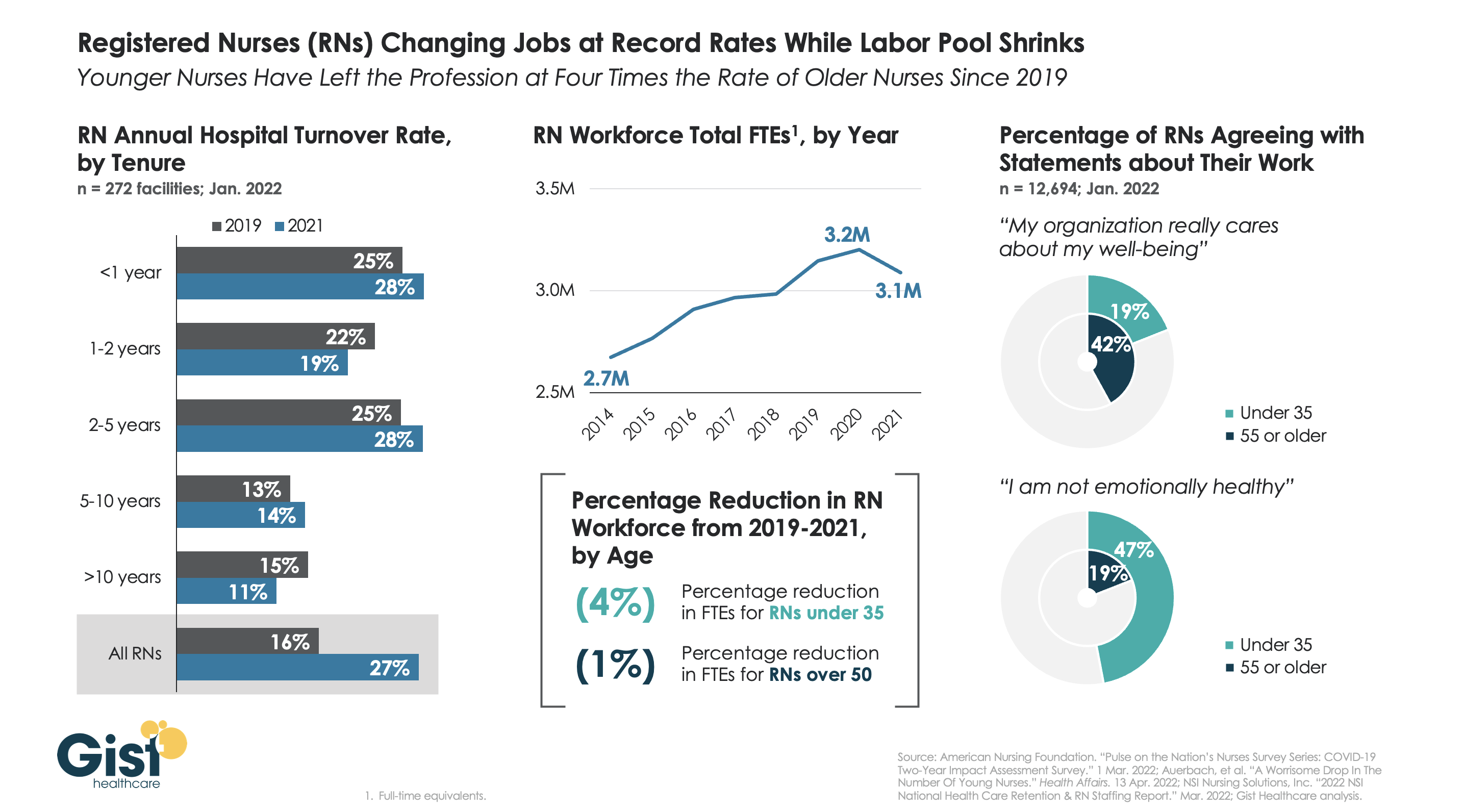
The prevailing opinion earlier this year was that the hospital registered nurse (RN) shortage was being driven by older nurses retiring early or leaving hospital employment for less-demanding care settings during the pandemic. However, recent data shown in the graphic below paint a different picture.
Hospital RNs with over ten years of tenure actually turned over at lower rates in 2021, compared to 2019. Meanwhile, the turnover rate for nurses with less tenure (who are typically younger) increased in 2021. While less-tenured nurses have always turned over at higher rates, we are seeing a new uptick in younger RNs leaving the profession.
The size of the total RN workforce decreased by 1.8 percent between 2019 and 2021—and the decline was twice as steep for hospital-employed RNs. Younger RNs disproportionately drove this decline: nurses under age 35 left the nursing workforce at four times the rate of those over age 50.
A recent survey suggestsyounger RNs are less likely to feel their well-being is supported by their organization, and more likely to define themselves as “emotionally unhealthy.” To keep younger nurses in the profession, hospitals must increase the support available to them. Investments might include expanding preceptorship and mentorship programs, many of which were cut during the pandemic, and increasing behavioral health support and job flexibility.
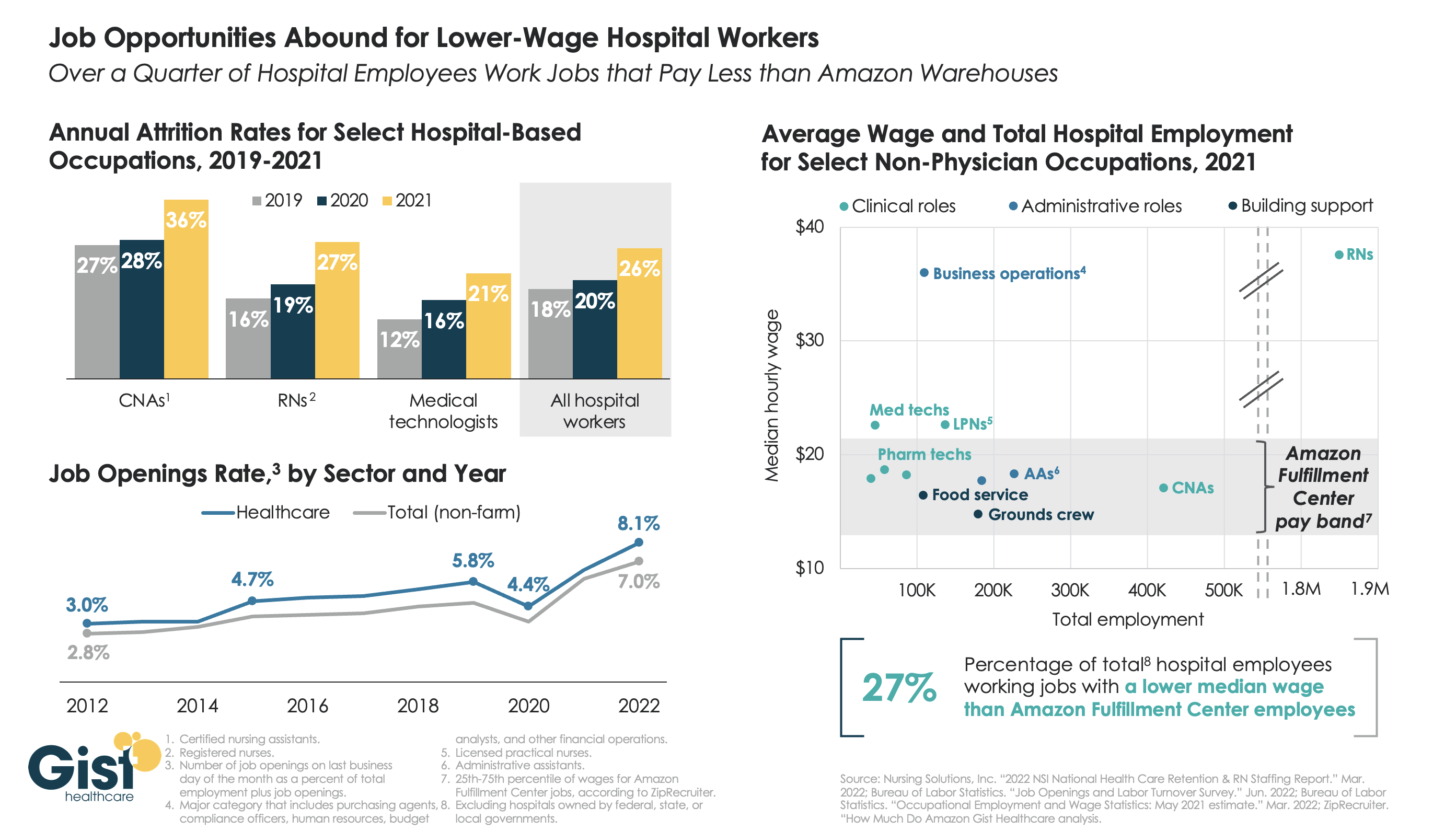
Although the nursing shortage has attracted much attention in recent months, the healthcare workforce crisis is hitting at all levels of the labor force. As the graphic above shows, the attrition rate for all hospital workers in 2021 was eight percentage points higher than in 2019.
Among clinicians and allied health professionals, certified nursing assistants (CNAs) have the highest turnover levels. Given the demands of the job and relatively low pay, CNA openings have been consistently difficult to fill. But it’s become even harder to hire for the role in today’s labor market as job openings near an all-time high.
Although labor force participation rates have rebounded to 2019 levels, pandemic-induced economic shifts have led to a boom in lower-wage jobs. In 2021 alone, Amazon opened over 250 new fulfillment centers and other delivery-related work sites. The company is competing directly with hospitals and nursing facilities for the same pool of workers at many of these new sites.
In fact, our analysis shows that more than a quarter of hospital employees currently work in jobs with a lower median wage than Amazon warehouses. Health systems have historically relied on rich benefits packages and strong career ladder opportunities to attract lower-wage employees, but that’s no longer enough—Amazon and other companies have ramped up their benefits, such that they now meet, or even surpass, what many hospitals are providing.
The time has come for health systems to reevaluate their position in local labor markets, and better define and promote their employee value proposition.








 HENRY KOTULA