

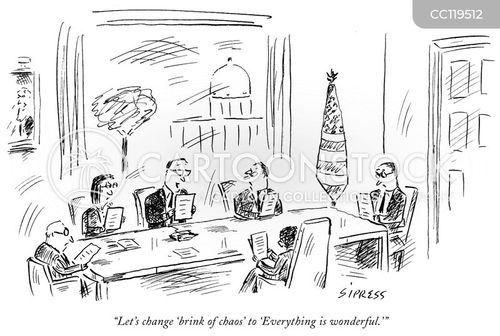
Cartoon – Living in Fantasy Land


A number of interactions over the past two weeks have convinced me that the political debate over M4A in Congress, amplified by Presidential candidates jockeying for favor with primary voters, is beginning to seriously spook executives across healthcare.
At a health system board meeting in the Southwest last week, a number of physician leaders and board members had questions about the possible timing and dimensions of a shift to “single payer”, clearly convinced that M4A is an inevitability if Democrats take over in 2020. And two separate inbound calls this week, one from the CEO of a regional health system, and the other from a health plan executive, were both sparked by the hearings on M4A in Congress.
Again, the implicit assumption in their questions about timing and impact was the same: M4A, or something like it, is sure to happen if the 2020 elections favors Democrats. My response to all of them: keep an eye on the politics, but don’t get overly distracted. There’s little chance that “single payer” healthcare will come to the US—industry lobbies are simply too powerful to let that happen.
Even if Democrats do win the Senate and the White House in 2020, they’ll have to “govern to the center” to hold onto their majorities, and any major policy shifts will have to be negotiated across the various interests involved. Most likely: measures to strengthen provisions of the ACA, and perhaps a “public option” in the ACA exchanges.
As to Medicare expansion, I believe the most we’d see in a Democratic administration would be a compromise allowing 55- to 65-year-olds to buy into Medicare Advantage plans.
But for now, M4A’s biggest risk to hospitals and doctors is that it becomes a paralyzing distraction, keeping provider organizations from making the strategic and operational changes needed to re-orient care delivery around value.
Regardless of the politics, a focus on delivering value to the consumers of care will prove to be a no-regrets position for providers.
Now that former Vice President Joe Biden has thrown his hat in the ring for the 2020 Presidential race, the healthcare policy differences between moderate and progressive factions of the Democratic party are becoming clearer. On Monday, Biden revealed the broad outlines of his healthcare platform, coming out in favor of a “public option” that would allow Americans to buy into the Medicare program, but would leave the existing employer-sponsored insurance framework largely intact. “If the insurance company isn’t doing right by you, you should have another choice,” Biden said in a campaign rally in Pittsburgh. Although his campaign did not announce details of the proposal, Biden seems to support the idea of offering a Medicare plan to employers and individuals through the Affordable Care Act (ACA) marketplaces.
As the frontrunner in the primary race, Biden’s support for this more moderate approach to coverage expansion will surely make him the favored candidate of healthcare industry interests, who have come out swinging hard against “Medicare for All” (M4A) proposals.
But his position earned him a swipe from progressive candidate Sen. Bernie Sanders (I-VT), who’s running second among Democrats in early polling. “It doesn’t go anywhere near far enough,” said Sanders of Biden’s proposal, “it will be expensive, [and] it will not cover a whole lot of people.” Sanders instead favors eliminating private insurance altogether and moving quickly toward a single-payer system built around universal Medicare coverage.
As the Presidential race takes shape, expect candidates to orient around one of these two poles: Biden’s moderate approach (O’Rourke, Buttigieg, Klobuchar); and Sanders’s more aggressive position (Warren, Harris, Booker).
Either position will present a stark contrast in the general election, as the Trump administration looks to reinvigorate the effort to strike down the ACA entirely. The 2020 elections are shaping up to be a pivotal moment for healthcare.

With all of the focus on M4A recently, in its many permutations, we’re hearing a growing concern among hospital executives and physician leaders that their economics could be in serious peril. (For more on this, see the below anecdote from “on the road”.) That concern is justified, as you can see from the graphic below.
On the left, we show data on payment-to-cost ratio for hospitals since the start of the 2000s. As you can see, hospitals rely heavily on a cross-subsidy model—Medicare and Medicaid reimbursement covers only 86 to 88 percent of the total cost of inpatient care delivery. Hospitals make up this difference, and generate a positive margin, by negotiating rates for commercially-insured patients that cover almost 145 percent of costs. As health systems have consolidated and built negotiating leverage, that percentage has steadily risen over the past several years, more than offsetting losses on publicly-insured patients.
The problem? Those lucrative commercial patients only account for a third of admissions, as shown at the bottom right. And across the past decade and a half, commercial admissions have dropped by more than 20 percent. In other words, hospitals have been consolidating and raising commercial rates on a declining book of business in order to compensate for underpayment on a growing volume of government-paid cases.
Now imagine that the commercial business disappeared entirely, and you can see what would happen—hospital finances would crater. Under M4A, Medicare rates would have to go up substantially to make up for the lost margin on commercial cases. Even if M4A turned out to be “Medicare Advantage for More”, trading commercial admissions (say, for the 55-65 population) for MA admissions (which are generally paid at Medicare FFS rates), this would create a difficult situation for hospitals.
In our view, this economic reality is not getting discussed enough in the current debate over M4A.
Click to access 55150-singlepayer.pdf

Digging into the details of single-payer healthcare
Lawmakers on Capitol Hill rolled up their sleeves this week and began to explore what a shift to Bernie Sanders-style “single payer” healthcare would really mean. In a hearing before the House Rules Committee on Tuesday, Congress heard from proponents of M4A and policy experts about the implications of single-payer health coverage, at least as envisioned by a recent bill authored by Rep. Pramila Jayapal (D-WA).
Although the committee does not have direct jurisdiction over Medicare, and Jayapal’s bill may never be introduced onto the floor of the House (since it lacks support from the Democratic leadership there), the hearing gave lawmakers their first chance to publicly probe the proposal, with predictable positions staked out by Democrats and Republicans on the committee.
More hearings are likely later this year, including by the House Budget Committee, which this week received a report it requested from the Congressional Budget Office (CBO) on the topic of single-payer healthcare. While the report does not address specific details about the cost or tax implications of a shift to single payer, it nonetheless provides an outstanding primer on the key questions that will have to be answered as part of any serious attempt to pursue M4A.
The graphic below, taken from the CBO document, poses those questions in a clear and helpful way, and the full report lays out a framework for approaching them. It’s a sober look at the hard problems that need to be faced: provider payment levels, increased wait times, public vs. private financing, access to unproven treatments.
Whatever your view on the topic, we’d highly recommend reading the CBO report in full.


The Trump administration formally declared its opposition to the entire Affordable Care Act on Wednesday, arguing in a federal appeals court filing that the signature Obama-era legislation was unconstitutional and should be struck down.
Such a decision could end health insurance for some 21 million Americans and affect many millions more who benefit from the law’s protections for people with pre-existing medical conditions and required coverage for pregnancy, prescription drugs and mental health.
In filing the brief, the administration abandoned an earlier position — that some portions of the law, including the provision allowing states to expand their Medicaid programs, should stand. The switch, which the administration disclosed in late March, has confounded many people in Washington, even within the Republican Party, who came to realize that health insurance and a commitment to protecting the A.C.A. were among the main issues that propelled Democrats to a majority in the House of Representatives last fall.
The filing was made in a case challenging the law brought by Ken Paxton, the attorney general of Texas, and 17 other Republican-led states. In December, a federal judge from the Northern District of Texas, Reed O’Connor, ruled that the law was unconstitutional.
A group of 21 Democratic-led states, headed by California, immediately appealed, and the case is now before the Fifth Circuit Court of Appeals in New Orleans. The House of Representatives has joined the case as well to defend the law.
Democrats wasted no time responding to the filing Wednesday. Xavier Becerra, the attorney general of California, a Democrat, said: “The Trump administration chose to abandon ship in defending our national health care law and the hundreds of millions of Americans who depend on it for their medical care. Our legal coalition will vigorously defend the law and the Americans President Trump has abandoned.”
The government’s brief did not shed light on why it had altered its earlier position, referring only to “further consideration and review of the district court’s opinion.”
Oral arguments in the appeals court are expected in July, with a possible decision by the end of the year, as the 2020 presidential campaign gets going in earnest. Whichever side loses is expected to appeal to the Supreme Court.
The Justice Department’s request to expedite oral arguments, granted last month, suggests that the administration is eager for a final ruling. In its application, it said that “prompt resolution of this case will help reduce uncertainty in the health care sector, and other areas affected by the Affordable Care Act.”
Democrats, seizing on the health law’s popularity and its decisive role in their winning the House last fall, are already using the case as a cudgel against President Trump as his re-election campaign gets started. The law’s guarantee of coverage for people with pre-existing medical conditions, in particular, remains very popular with voters in both parties as well as independents.
But Mr. Trump has appeared undaunted, tweeting in April that “Republicans will always support Pre-Existing Conditions” and that a replacement plan “will be on full display during the Election as a much better & less expensive alternative to Obamacare.”
Instead of providing specifics, though, Mr. Trump, members of his administration and other Republicans have focused on attacking the Medicare for All plans that some Democratic presidential candidates have sponsored or endorsed as a dangerous far-left idea that would, as Mr. Trump tweeted, cause millions of Americans “to lose their beloved private health insurance.”
As the administration and Texas noted in their briefs, Judge O’Connor’s ruling turned on the law’s requirement that most people have health coverage or be subject to a tax penalty.
But in the 2017 tax legislation, Congress reduced that penalty to zero, effectively eliminating it. Judge O’Connor, the plaintiff states, and now the Trump administration reasoned that, like a house of cards, when the tax penalty fell, the so-called individual mandate became unconstitutional and unenforceable. Therefore, the entire law had to fall as well.
Mr. Paxton, the Texas attorney general, whose office also filed a brief on Wednesday, said: “Congress meant for the individual mandate to be the centerpiece of Obamacare. Without the constitutional justification for the centerpiece, the law must go down.”
Whether that position will survive judicial scrutiny is another question. Nicholas Bagley, who teaches health law at the University of Michigan Law School, noted that only two lawyers signed the brief. That is highly unusual in a case with such a high profile, he said.
“This is a testament to the outrageousness of the Justice Department position, that no reasonable argument could be made in the statute’s defense,” Mr. Bagley said. “It is a truly indefensible position. This is just partisan hardball.”
Many legal scholars have also said that even before appellate judges wade into the more obscure pools of legal reasoning, they could reach a decision by addressing the question of congressional intent. If Congress had meant the erasure of the tax penalty to wipe out the entire act, such an argument goes, it would have said so.
If the Fifth Circuit overturns the O’Connor decision, there is no guarantee that the Supreme Court would take an appeal. The court has ruled on two earlier A.C.A. challenges, finding in favor of the act, although narrowing it.
Of course, the composition of the Supreme Court has since changed.


 HENRY KOTULA