Nearly 396 million doses of the COVID-19 vaccine have been shipped to various U.S. states as of this afternoon, of which some 343.4 million doses had been administered, according to TIME’s vaccine tracker. About 49.3% of Americans had been completely vaccinated.
More than 195.3 million people around the world had been diagnosed with COVID-19 as of 1 a.m. E.T. today, and nearly 4.2 million people have died. On July 27, there were 614,584 new cases and 9,937 new deaths confirmed globally.
Here’s how the world as a whole is currently trending:
And here’s every country that has reported over 3 million cases:
The U.S. had recorded more than 34.6 million coronavirus cases as of 1 a.m. E.T. today. More than 611,000 people have died. On July 27, there were 70,740 new cases and 462 new deaths confirmed in the U.S.
Here’s how the country as a whole is currently trending:
Here’s where daily cases have risen or fallen over the last 14 days, shown in confirmed cases per 100,000 residents:
All numbers unless otherwise specified are from the Johns Hopkins University Center for Systems Science and Engineering, and are accurate as of July 28, 1 a.m. E.T. To see larger, interactive versions of these maps and charts, click here.
State governments, private businesses and even part of the federal government are suddenly embracing mandatory coronavirus vaccinations for their employees.
Why it matters:Vaccine mandates have been relatively uncommon in the U.S. But with vaccination rates stagnating and the Delta variant driving yet another wave of cases, there’s been a new groundswell of support for such requirements.
Driving the news: Monday was a turning point.
The VA became the first federal agency to require its employees to be vaccinated.
More than 50 medical groups called for mandatory vaccinations of all health care workers, WaPo first reported.
California announced that state employees and health care workers must show proof of vaccination or get tested regularly.
New York City brought all municipal workers — including teachers and police officers — under a vaccine requirement that had previously only applied to health workers.
Even the SF Bar Owner Alliance hopped onboard, announcing that the 500 San Francisco bars it represents will require indoor customers to show proof of vaccination or a negative test.
The big picture: Vaccine requirements are also gaining steam internationally.
France has required health workers to get vaccinated. Members of the public must also have a vaccine or a negative test to enter most indoor venues.
Although the measure has sparked protests, it’s also encouraged millions of people to get vaccinated, per the NYT.
The bottom line:Vaccine mandates have been unpopular in part because they’ll inevitably create a backlash.
But the vaccination effort seems to have run out of carrots to incentivize more people to get a shot, and with rates remaining as low as they are in light of a worsening domestic situation, resorting to sticks has clearly become a more attractive option.
Experts are warning that the greatest threat to the pandemic recovery in the United States are the large swaths of Americans who remain unvaccinated.
Over the past few weeks, the U.S. has seen a surge of coronavirus cases across the country in the wake of the highly infectious delta variant. The new strain has particularly wreaked havoc in states with low vaccination rates.
The state of Missouri has recently become a U.S. hot spot, averaging more than 2,100 cases per day over the last seven-day period, according to data from The New York Times. About 41 percent of the state population is fully vaccinated.
Florida, Arkansas, Louisiana and Nevada have also seen an increase in coronavirus cases.
The nationwide vaccination rate has also dropped following the mad dash for the vaccine earlier in the year. Health experts warn that unvaccinated individuals pose a risk to the country, and could spread the disease until other, vaccine-resistant strains arise.
Some say the U.S. has missed its chance at outrunning the delta strain.
“I think we probably could have done that here in the U.S., if we hadn’t slowed our vaccination rates so much,” Andy Pekosz, professor of molecular microbiology and immunology at Johns Hopkins University, told The Hill.
“But I think it’s important also to emphasize that variants will emerge anywhere the virus is replicating in people to a great degree. And globally, there are so many places where this virus is just freely infecting people and replicating and it’s those situations that are going to be generating variants at a higher frequency.”
The delta variant isn’t even the only variant to worry about.
The lambda strain, first detected in Peru, is now present in the U.S. The World Health Organization (WHO) has designated this strain as a “variant of interest,” the designation beneath that of a “variant of concern,” like that of the delta variant.
Jen Kates, director of global health and HIV policy for the Kaiser Family Foundation, and Pekosz told The Hill that data on the lambda variant is limited at the moment, but what information is available suggests that it is similar to delta in that it is more transmissible than previously dominant strains like the alpha and beta variants. They added that vaccines should still offer protection against it.
At the same time, the lambda variant is not spreading as quickly as the delta variant.
“There’s a lot that we do not yet know about the lambda variants, including compared to the delta,” said Leana Wen, an emergency physician and public health professor at George Washington University.
“Is it more contagious? This is a really important question, because when there is a new variant, and it’s more contagious, it displaces the previous variant. But if there is already a very contagious variant and you have other variants that are appearing as they are all the time, they probably are not going to take over,” Wen said.
Wen, who previously served as Baltimore’s health commissioner, expressed frustration that vaccinations have not been properly incentivized even when she warned earlier in May that the window for intervention was quickly narrowing.
“If we had tied vaccinations to reopening policy, we had a much higher chance of achieving the kinds of immunity that we needed,” Wen said.
Pekosz opined that if the U.S. had reached a 90 percent vaccination rate earlier this year, the nation could have avoided the current situation.
“We stalled at a place where essentially half the population has immunity and half doesn’t and that’s a really awful place to be from a vaccine perspective,” Pekosz said.
According to the most recent data from the Centers for Disease Control and Prevention, around 69 percent of adults in the U.S. have received at least one dose. The country has still yet to reach President Biden‘s 70 percent vaccination goal, weeks after his initial July 4 deadline.
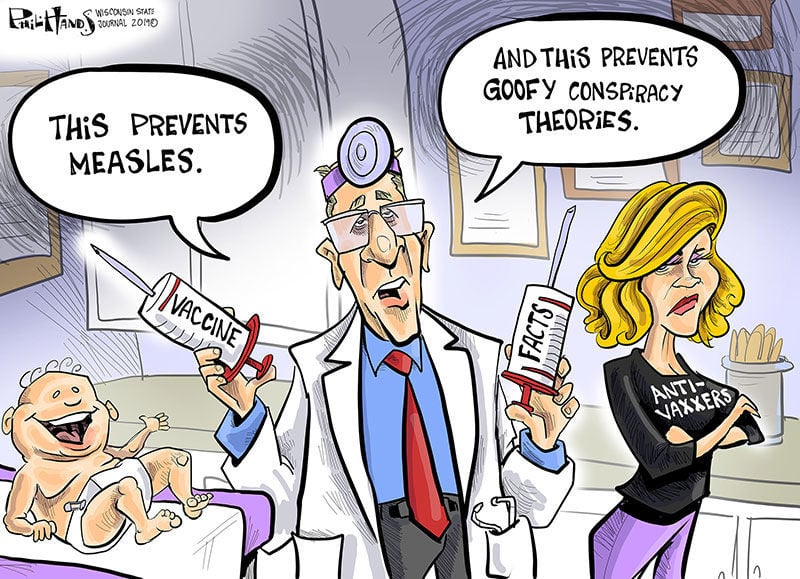
All health experts who spoke with The Hill agreed that the biggest challenge that the U.S. faces to overcome the pandemic is vaccine hesitancy.
The large groups of people holding out from vaccinations pose a significant threat because they are not immune, and are still capable of spreading COVID-19 and new variants. They added another major issue is that unvaccinated people are behaving as though they were vaccinated, going without masks in public and attending large indoor and outdoor gatherings that they should avoid.
However, Pekosz added that the progress that has been made is substantial.
“I always want to emphasize the positive, which is right now the vaccine seems to be working well against the delta variant. And that should be something that people are using to get motivated to get the vaccine,” he said. “I think that’s the critical thing to get across to everybody.”
With the Delta variant now accounting for more than 83 percent of all new COVID cases in the US, daily new case counts more than quadrupling across the month of July, and hospitalizations—particularly in states with low vaccination rates—beginning to climb significantly, we appear to have entered a new and uncertain phase of the pandemic, now being dubbed a “pandemic of the unvaccinated”.
Welcome news, then, that this week the American Hospital Association (AHA) publicly encouraged its members to put in place vaccine mandates for their employees. While several large health systems have taken the lead in implementing vaccine mandates, including Trinity Health, the Livonia, MI-based Catholic system that operates hospitals across 22 states, Phoenix, AZ-based Banner Health, Houston Methodist in Texas, and the academic giant NewYork-Presbyterian, others have been more reticent to compel employees to get vaccinated, citing concerns over employee privacy and the potential for workforce backlash.
The New York Timesreports that a quarter of all hospital employees remain unvaccinated nationwide, with many facilities reporting that more than half of their healthcare workers have not gotten the COVID vaccine. In our discussions with health system executives, one consideration frequently cited is the desire for full Food and Drug Administration (FDA) approval of the new vaccines before mandates are put in place.
In a CNN town hall meeting this week, President Biden suggested that approval could come as soon as the end of August, although other reports point to likely approval much later, potentially not until January of next year. Facing a new variant of the virus that is much more transmissible and possibly more virulent than earlier strains, hospitals—and their patients—can’t afford to wait that long.
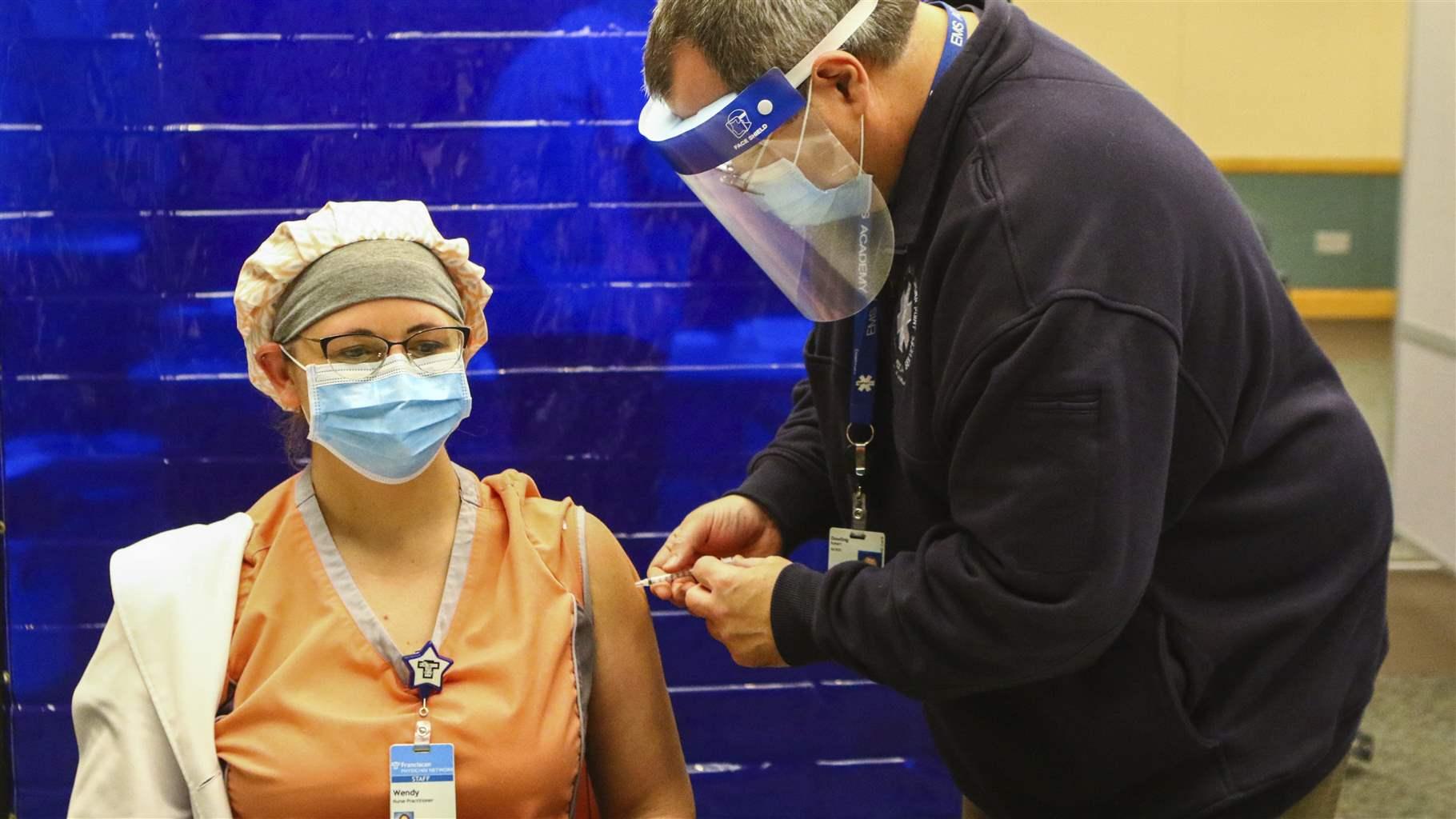
For safety’s sake, hospitals should quickly put in place vaccine mandates, with appropriate exceptions.







 HENRY KOTULA