

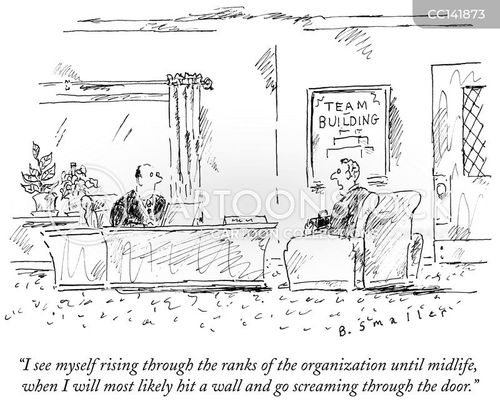
Cartoon – Where I see my self in the Ranks of the Organization

Just days after a landslide election victory for the Conservative Party, Britain’s Prime Minister Boris Johnson just made a massive and bold announcement: He’ll get laws passed to guarantee plenty of cash for the state-run healthcare system.
The official announcement will likely come Thursday when the Queen, who is the official head of state, will reopen Parliament and outline the coming legislative agenda. Tucked within her speech will be a call for £34 billion ($45 billion) in annual taxpayer money for the National Health Service (NHS).
While other countries embrace their private health systems, the British love their publicly funded NHS, an employer of 1.5 million people, which services the population of 66 million. In general, the people are concerned about the quality of care provided by the NHS and look to the government for solutions, says Mary Macleod, a senior client partner for Korn Ferry’s Board and CEO Services practice and a former Conservative Party MP. “The NHS does become a bit of a political football,” she says. “And to a large extent, everyone in the UK feels that they are stakeholders in it.”
The pledge to secure NHS money will likely bolster Johnson’s political leadership versus the opposition Labour Party. And the move also neutralizes critics that have barraged the Conservative Party with allegations that it would sell parts of the NHS to foreign investors. In other words, pushing a new funding law through Parliament could partially neutralize political opponents.
But the politics of the matter is only part of the announcement’s strength, Macleod says. Promising the NHS years of generous financing will allow the organization to develop a strategy for how it will care for the country’s population for years into the future. In short, Macleod says, it sends a message to the NHS leadership: You can get busy now. “If you now know you are getting the funding, you can plan ahead,” she says.
Johnson’s lack of specifics about how the NHS should spend the money could be a strength. In a sense, he has empowered the organization’s leadership to make the decisions that they deem suitable. “What the prime minister is not doing is defining the solutions,” Macleod says. But she also notes that he will want results in the form of improved service from the organization. “He will hold them accountable,” she says.
While there are benefits when leaders take bold steps, there are also risks, says Christina Harrington, Korn Ferry’s head of advisory services in Stockholm, Sweden. She says it is good for leaders to act quickly and with conviction, as the public expects that of its leaders. But that alone isn’t enough. She says the problem comes when there’s too much ego involved. “You need an egoless conviction to drive a decision making the greater good,” she says.
Ideally, the driver of proposed changes needs to have a long-term vision of something better than the current situation. If that vision is lacking, then the leader may lack the required stamina to get the job done. Indeed, if headline-grabbing is all that the boss wants, then he or she might wind up doing a U-turn. “If there isn’t a long-term vision, then another fast decision may come in the other direction,” Harrington says. “And that’s what we see a lot of.”

On his first day as CEO of the Carlsberg Group, a global brewery and beverage company, Cees ‘t Hart was given a key card by his assistant. The card locked out all the other floors for the elevator so that he could go directly to his corner office on the 20th floor. And with its picture windows, his office offered a stunning view of Copenhagen. These were the perks of his new position, ones that spoke to his power and importance within the company.
Cees spent the next two months acclimating to his new responsibilities. But during those two months, he noticed that he saw very few people throughout the day. Since the elevator didn’t stop at other floors and only a select group of executives worked on the 20th floor, he rarely interacted with other Carlsberg employees. Cees decided to switch from his corner office on the 20th floor to an empty desk in an open-floor plan on a lower floor.
When asked about the changes, Cees explained, “If I don’t meet people, I won’t get to know what they think. And if I don’t have a finger on the pulse of the organization, I can’t lead effectively.”
This story is a good example of how one leader actively worked to avoid the risk of insularity that comes with holding senior positions. And this risk is a real problem for senior leaders. In short, the higher leaders rise in the ranks, the more they are at risk of getting an inflated ego. And the bigger their ego grows, the more they are at risk of ending up in an insulated bubble, losing touch with their colleagues, the culture, and ultimately their clients. Let’s analyze this dynamic step by step.
As we rise in the ranks, we acquire more power. And with that, people are more likely to want to please us by listening more attentively, agreeing more, and laughing at our jokes. All of these tickle the ego. And when the ego is tickled, it grows. David Owen, the former British Foreign Secretary and a neurologist, and Jonathan Davidson, a professor of psychiatry and behavioral sciences at Duke University, call this the “hubris syndrome,” which they define as a “disorder of the possession of power, particularly power which has been associated with overwhelming success, held for a period of years.”
An unchecked ego can warp our perspective or twist our values. In the words of Jennifer Woo, CEO and chair of The Lane Crawford Joyce Group, Asia’s largest luxury retailer, “Managing our ego’s craving for fortune, fame, and influence is the prime responsibility of any leader.” When we’re caught in the grip of the ego’s craving for more power, we lose control. Ego makes us susceptible to manipulation; it narrows our field of vision; and it corrupts our behavior, often causing us to act against our values.
Our ego is like a target we carry with us. And like any target, the bigger it is, the more vulnerable it is to being hit. In this way, an inflated ego makes it easier for others to take advantage of us. Because our ego craves positive attention, it can make us susceptible to manipulation. It makes us predictable. When people know this, they can play to our ego. When we’re a victim of our own need to be seen as great, we end up being led into making decisions that may be detrimental to ourselves, our people, and our organization.
An inflated ego also corrupts our behavior. When we believe we’re the sole architects of our success, we tend to be ruder, more selfish, and more likely to interrupt others. This is especially true in the face of setbacks and criticism. In this way, an inflated ego prevents us from learning from our mistakes and creates a defensive wall that makes it difficult to appreciate the rich lessons we glean from failure.
Finally, an inflated ego narrows our vision. The ego always looks for information that confirms what it wants to believe. Basically, a big ego makes us have a strong confirmation bias. Because of this, we lose perspective and end up in a leadership bubble where we only see and hear what we want to. As a result, we lose touch with the people we lead, the culture we are a part of, and ultimately our clients and stakeholders.
Breaking free of an overly protective or inflated ego and avoiding the leadership bubble is an important and challenging job. It requires selflessness, reflection, and courage. Here are a few tips that will help you:
https://cvshealth.com/newsroom/press-releases/cvs-health-outlines-strategy-accelerate-growth

In a presentation to investors this week, retail pharmacy giant CVS Health announced plans to expand its “HealthHUB” store concept, first launched at three store locations in Houston, to 1,500 stores in the next three years.
The new store concept, built to take advantage of CVS’s 2018 acquisition of health insurer Aetna, is centered around providing more extensive care management and wellness services than traditionally available at the chain’s Minute Clinics. In addition to Houston, the company is targeting Atlanta, Philadelphia, and Tampa, all in states where Aetna’s existing insurance footprint and the new care offerings can be combined to create new benefit designs and consumer engagement approaches.
In a wide-ranging discussion of the company’s future strategies, CVS executives also outlined plans for delivering home-based dialysis, expanded in-store primary care services, and further expansion of virtual care. In sum, CVS is banking on its ability to lower care costs for health plan enrollees and increase use of its clinic services to grow incremental revenue by $850M in the next three years, and $2.5B longer term.
We continue to view CVS as an entirely new kind of healthcare delivery company, bringing together convenient, lower-acuity care services and a risk model that will allow it to prosper by reducing the cost of care and building consumer loyalty. The speed of CVS’s rollout of this new value proposition should be a wake-up call to traditional healthcare providers everywhere.
 HENRY KOTULA