


Cartoon – Project Status Report

— 2020 drug price increases unlikely to catalyze cost-cutting action, say experts.
Both House Speaker Nancy Pelosi and Republican Sen. Chuck Grassley cited the initial wave of drug price hikes as examples of why their respective bills tackling the cost of pharmaceuticals should move forward. But when Prescription PULSE spoke with a half dozen experts tracking the industry, not one believed the hikes — which averaged around 5 percent across more than 470 drugs — would sway Congress or the administration to drug pricing reform.
“The increases are a persistent reminder that Congress and the administration have done nothing to reduce drug prices. But the increases also happen so regularly that it’s probably unrealistic to think they’ll spur any action this time around,” said Rob Smith, who tracks the political and policy outlook of the drug industry for Capital Alpha Partners.
“I don’t necessarily think the increases themselves improve or diminish the odds of material drug pricing legislation getting across the finish line,” said John Leppard of Washington Analysis.
Of the 471 drugs whose prices have increased, 466 were brand-name medicines, according to GoodRx, which tracks where consumers can get lower-priced medicines. GoodRx doesn’t track doctor-administered drugs so there were likely other increases not captured by their analysis. Other companies are expected to announce price increases as the month goes on.
Despite the focus on drug costs, companies are continuing their habit of regularly raising the prices, often multiple times a year, said Anna Kaltenboeck, a program director and senior health economist at Memorial Sloan Kettering Cancer Center. “This is the starting volley for the year so to speak,” she said.
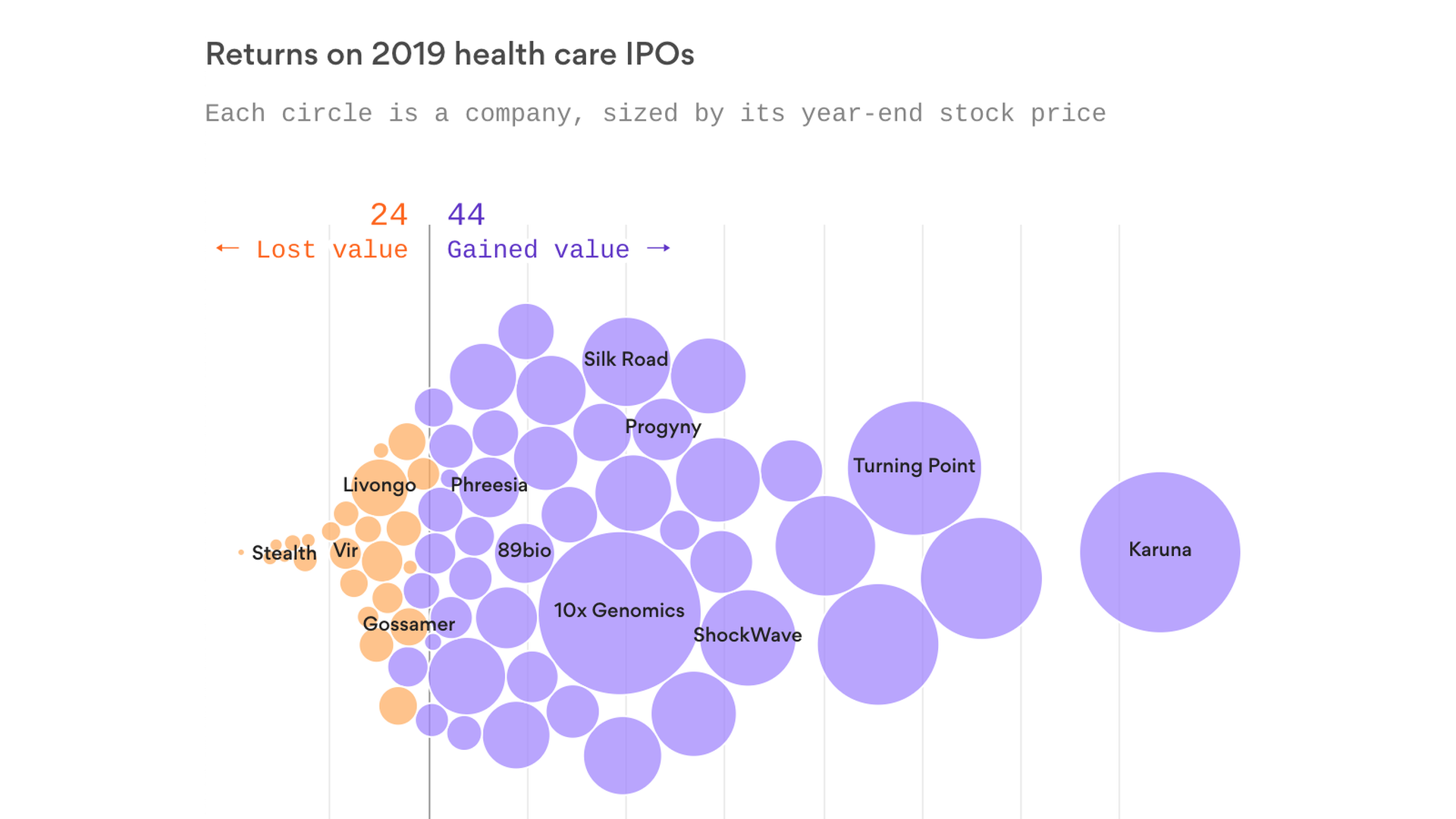
Two-thirds of the 68 health care companies that went public in 2019 traded above their IPO price by the end of year — many of which provided huge initial returns to owners and outside investors, Axios’ Bob Herman reports.
The big picture: The vast majority of health care companies that go public are biotechnology firms. Several of those biotechs in the 2019 class benefited from some promising, but extremely early, clinical trial data.
By the numbers: If you bought an equal amount of shares of every health care company that went public last year and then sold before the calendar flipped, you would have gotten a 47% return on your money.
Winners: Karuna Therapeutics made the biggest leap, as the biotech company’s stock price almost quintupled by the end of the year. Early clinical trial data showed that Karuna’s schizophrenia drug relieved many symptoms, Stat reported.
Losers: SmileDirectClub, which mails teeth-straightening kits, and a handful of biotech startups like Stealth BioTherapeutics saw their stock prices fall by more than half from their IPOs.
The bottom line: Biotech stocks are notoriously fickle. Poor clinical trial data can derail an entire company, and some of these firms inevitably will fail, given the nature of science.
Go deeper: One Medical was one of the first health care IPOs of 2020

Providing close follow-up care from a team of clinical and social workers to the sickest, most vulnerable patients does not reduce hospital readmissions, a new study in the New England Journal of Medicine concludes.
Why it matters: Many doctors and scholars viewed this approach as a promising way to improve care and save money, but it doesn’t appear to do either, Bob writes.
What happened: Unexpected life changes or holes in social programs derailed the lives of many patients who were getting the extra help, and forced them to put their health needs on the back burner.
The bottom line: Giving extra health care support to patients who are struggling with poverty, addiction, hunger and other issues is still the right thing to do.
Go deeper: There is an important difference between “social needs” and “social determinants of health,” health economist Austin Frakt wrote last year.

Some local and state officials want Medicaid to start picking up the tab for inmates’ health care, Stateline reports.
How it works: Medicaid beneficiaries lose their coverage while they’re incarcerated — including pretrial detention for people who can’t make bail — and county governments are generally responsible for providing their care, Axios’ Marisa Fernandez writes.
State and local officials want Medicaid to start paying those bills. A single seriously ill inmate — someone with HIV, for example — can quickly strain county budgets, they said.
40 states have already changed their rules so that Medicaid coverage kicks back in more quickly once people are released from jail.


Despite branching out through nearly 60 outpatient clinics, the University of Iowa Hospitals & Clinics in Iowa City — which includes the only comprehensive university medical center in the state — by and large remains a healthcare destination.
As such, demand for inpatient services hasn’t waned, but has kept on par with the surge in outpatient demand that the entire industry is seeing, Suresh Gunasekaran, the CEO of University of Iowa Hospitals & Clinics and associate vice president for the University of Iowa Health Care, told Becker’s Hospital Review.
That’s not to say strategic threats don’t exist. The biggest ones threatening the University of Iowa Hospitals & Clinics are retail medicine providers that cherry-pick services but aren’t able to provide coordinated care, Mr. Gunasekaran said.
“It’s great that today there’s more convenient care being provided by retail providers. The biggest threat, though, is if healthcare consumers start believing that getting disconnected care is worth it,” he said. “We’re in the business of connected care.”
Tackling this challenge will require input from all parties, not just the hospital CEO, he said. Here, Mr. Gunasekaran expands on how University of Iowa Hospitals & Clinics is facing the threat of uncoordinated retail medicine, and answers questions on board oversight and the changing role of the hospital CEO.
Question: What do you consider your biggest strategic threat?
Suresh Gunasekaran: Major threats are those healthcare services that don’t believe in team-based care, that focus on cherry-picking a corridor of healthcare without thinking about the health of the whole person.
There’s unmet demand in communities for [accessible healthcare]. If Walmart is willing to offer a clinic, they may be the only clinic for 20 miles. What I’d hope is these kinds of Walmart and CVS providers look at how they partner with players like us. In that sense, we don’t view retail medicine as a threat as much as an opportunity. But when they’re not collaborative, that’s a threat to us. It’s only good if the care is coordinated.
Q: U of Iowa Hospitals & Clinics has its own retail clinics. How do they play into the larger consumerism trend healthcare is seeing?
SG: We’re in our fifth year of offering retail urgent care clinics. We offer a setting that’s lower cost and very competitive with other retail clinics. We’ve seen a lot of uptake and growth within this model, but it’s our ability to say: Hey, urgent care and retail healthcare absolutely have a place, but they need to be connected to our lab in radiology and to our specialists.
The next frontier for us is how to partner with other retail clinics. It’s easy to partner with yourself, but it’s more challenging to make it work with others.
Q: U of Iowa Hospitals & Clinics is a state agency, so your board is really the board of regents of the state of Iowa. Have you faced increased pressure from the board to take up any initiatives?
SG: The board of regents has asked we keep a couple issues front and center. There continues to be inadequate maternal healthcare resources for the young moms of Iowa, with more and more hospitals unable to recruit staff to deliver babies. Data shows maternal death is increasing in Iowa, which is a very, very troubling statistic. So we are bringing the full strength of the University of Iowa together on this. We just got a huge research grant from the federal government to create better models for maternal health across the state.
Mental health is another area, and a huge area of priority for our governor. We are looking at expanding our residency program to rural areas that are underserved for mental health. Other things we’re looking at is the workforce shortage and social determinants of health.
Q: How do you think the CEO role will evolve over the next decade? Will we see more hospital CEOs take stances on bigger public issues?
SG: Hospitals within the healthcare industry have [historically] been very insular. You almost could run your business without worrying about the rest of the system. Now with healthcare reform and greater governmental and employer scrutiny of healthcare costs, folks are asking hospital systems to answer for what’s going on in a broader industry. And of course, CEOs have to embrace that journey.
Are we going to get involved in those multiple different steps? Not just access to care, not just the pricing of care, not just care coordination, not just how to get the community to get engaged in their own health. The CEO of the future has to have a stance on all of these, because it’s impossible to go where we need to go without being involved.
Perhaps the CEO is not that important. At the end of the day when you look at these issues, it’s important that we’re at the table, but the community needs to come first. It’s an opportunity for employers to take the lead. It’s an opportunity for the government to take a lead. Everything in healthcare doesn’t need to be done by a hospital CEO, and in the future, probably isn’t best done by a hospital CEO. We need to be one part of the team.
Q: You’ve been leading the University of Iowa Hospitals & Clinics for a little over a year now. Is there any piece of advice you would go back and give yourself on day one?
SG: Never lose the voice of the patient. I got that at the end of my first year, and I think that beginning with the voice of the patient would’ve been very, very powerful. It’s somewhat impractical that you show up to a new job, and of course, you’re going to meet the people within your organization first. But never forgetting the voice of the patient and being able to hear who you are in their eyes and in their words would have been very powerful [on day one]. But I’m making up for lost time.

