Bipartisan ACA bill gets a challenge from the right

https://www.axios.com/bipartisan-aca-bill-gets-a-challenge-from-the-right-2500833570.html?stream=health-care&utm_source=alert&utm_medium=email&utm_term=alerts_healthcare

Image result for Bipartisan ACA bill

Two prominent Republicans have come up with a more conservative alternative to the Senate’s bipartisan Affordable Care Act bill. The new proposal, from Sen. Orrin Hatch and Rep. Kevin Brady, would waive the ACA’s individual and employer mandates in exchange for temporarily funding its cost-sharing subsidies.

Why it matters: This proposal would be harder to pass than the one that’s already on the table. But it’s a sign that conservatives aren’t willing to sit on the sidelines on a process that, so far, has not given them much of what they want.

The details: Hatch and Brady’s proposal, which hasn’t yet been translated into legislative text, is largely in line with what the White House has said it wants. Their proposal would:

  • Fund the ACA’s cost-sharing subsidies for two years
  • Attach new abortion-related conditions on those funds
  • Waive the individual mandate for five years
  • Retroactively waive the employer mandate for two years
  • Expand health savings accounts

The alternative: The bill sponsored by Sens. Lamar Alexander and Patty Murray, by contrast, would fund the cost-sharing subsidies for two years; allow more people to buy cheaper, less comprehensive coverage; and make it easier for states to seek waivers from some of the ACA’s regulatory requirements.

The bottom line: Few, if any, Democrats could support Hatch-Brady — and that gives it much longer odds than Alexander-Murray, which already has the 60 votes it would need to pass the Senate. The question is whether GOP leaders will try to find a middle ground — and whether the presence of an alternative will stop Alexander-Murray from gaining more GOP support, especially in the House.

Gallup: Uninsured rate climbs to 12.3% in Q3

http://www.healthcaredive.com/news/gallup-uninsured-rate-climbs-to-123-in-q3/507951/

Related image


Dive Brief:

  • The share of U.S. adults who lack health insurance inched up 0.6 percentage points to 12.3% in the third quarter of 2017 over the previous quarter, a new Gallup poll shows.
  • The uninsured rate — 1.4 points higher than at the end of last year (3.5 million more Americans) — is now the largest since the 2014 fourth quarter when it was 12.9%.
  • The biggest decline is among individuals with self-paid plans, which fell 1.3 points to 21.3% since the end of 2016. The poll — part of the Gallup-Sharecare Well-Being Index — draws on interviews with 45,000 U.S. adults between July 1 and Sept. 30.

Dive Insight:

The numbers are somewhat alarming given the record low 10.9% uninsured rate in the second half of last year. Still, the current rate is well below the 18% high seen in Q3 2013, before the Affordable Care Act’s (ACA) insurance exchanges and individual mandate took effect.

After adults with self-paid plans, the biggest change is among Americans with Medicare coverage, down 0.5 percentage points to 7.1%.

Factors contributing to the recent rise in uninsured, according to Gallup, include the lack of competition and rising premiums as payers exit the exchanges, and uncertainty about the ACA’s future.

With President Donald Trump and Republican lawmakers attempting to sabotage the ACA, the number of uninsured is likely to continue to rise. Earlier this month, Trump signed an executive order loosening health plan benefit requirements and said he would discontinue cost-sharing paymentsto insurers. The combined moves will undermine the exchanges and allow payers to offer skimpier plans with more out-of-pocket costs.

Congress also let pass it Sept. 30 deadline for reauthorizing the Children’s Health Insurance Program (CHIP), which provides coverage for nearly 9 million children. While Congress has vowed to pursue legislation, states are concerned a delay in reauthorization could cause federal funds, which pay for most of the program, to run dry.

The Gallup findings are somewhat in line with a recently released National Center for Health Statistics survey, which found the percentage of all uninsured Americans dropped to 8.8% in the first quarter of this year versus a year ago. Among adults between 18 and 64, the uninsured rate was 12.1%, 5.3% of children were uninsured.

Hospitals, many of them already struggling, are bracing for more uncompensated care as Trump and Republicans angle to roll back Medicaid expansion. A new formula for calculating uncompensated care payments is also fueling industry concerns. The formula, part of the Medicare Inpatient Prospective Payment System, would increase disproportionate share hospital payments to $6.8 billion, or about $800 million more than in fiscal year 2017, but the American Hospital Association has called the worksheet used to calculate the payments confusing and not always accurate.

In addition, the CMS has said FY2018 uncompensated care payments for all hospitals will be $2 billion below the current level. Between 2018 and 2025, uncompensated care payments are expected to decline by $43 billion.

Top 5 Concerns of Healthcare CFOs

http://www.healthleadersmedia.com/finance/top-5-concerns-healthcare-cfos#

Planning for a HealthLeaders Media gathering of hospital and health system chief financial officers reveals the weightiest issues on their minds.

Preoccupying the minds of healthcare financial executives are prevailing problems engulfing the industry’s business climate: uncertainty about healthcare reform, declining public and private reimbursement, accelerating operating expenses, and access to capital.

This August, 50 healthcare finance leaders will collaborate on fortifying their organizations’ fiscal health at the 2017 HealthLeaders CFO Exchange in La Jolla, CA.

In pre-event planning calls, CFO Exchange attendees, representing integrated health systems, academic medical centers, community hospitals, and safety net providers, have mentioned some of the struggles they’d like to know how others are tackling.

During the two-day event, a series of moderated, peer-to-peer roundtables will explore how organizations are addressing the top five issues.
1. Dismantling of the Affordable Care Act

CFOs foresee the negative financial impact a repeal will generate and are interested in knowing how others are preparing for anticipated changes in Medicaid for expansion and non-expansion states.

2. Enhancing and Supporting Population Health

CFOs are concerned about building the right infrastructure to support population health, including integrating physicians, retooling their workforce, realigning the financial tracking of population health efforts, incorporating behavioral health in primary care, and determining how much payer risk to assume.

Executives expressed their concerns about knowing how and when to invest resources in a relatively uncharted path.

In addition, they are interested in how to bring disparate goals together to align with population health efforts.

3. Curtailing Clinician Costs

Optimizing access and productivity to ensure profitability among acquired physician practices, reducing clinical practice variation and cost-per-case, and lowering costs associated with filling in with agency labor due to the nursing shortage are challenges for senior executives.

Organizations will be requesting and sharing strategies for seizing the reigns on clinician expenses.

4. Increasing Revenue

Overcoming reimbursement struggles, uncovering innovative ways to cut costs, and ascertaining solutions to avoiding readmission penalties are common goals for CFOs.

5. Determining Gaps and Opportunities

Another goal shared by CFOs is the desire to share the most useful data analytics and business intelligence platforms for improving quality-of-care and outcomes.

In addition to their larger concerns, participants at the invitation-only event will talk about consumerism, direct contracting for healthcare with employers, charting a financial strategy on value-based care, and ideas about what competition will look like in the future.

Keeping the Alexander-Murray health care bill in context

https://www.axios.com/keeping-the-alexander-murray-health-care-bill-in-context-2498670199.html

Image result for Keeping the Alexander-Murray health care bill in context


As debate continues about a bipartisan fix for the Affordable Care Act marketplaces, Drew Altman’s latest Axios column describes the scale of the problems in the ACA marketplaces and the public’s confusion about whether they are impacted. He says that the news media, experts and policy makers can do more to put the marketplace problems and fixes in context as debate evolves.

As the debate unfolds about the bipartisan bill by Senators Lamar Alexander and Patty Murray to repair the Affordable Care Act marketplaces, the public could be just as confused as they have been about the ACA’s marketplaces. That’s why it’s important to debate it in the right context: It’s aimed at an urgent problem affecting a relatively small sliver of the health insurance system, not all of the ACA and not the entire health system.

The bottom line: It’s a limited measure that will never give conservatives or liberals everything they want.

Reality check: Many people will think it affects their insurance when, in actuality, it will have no impact on the vast majority of Americans who get their coverage outside of the relatively small ACA marketplaces.

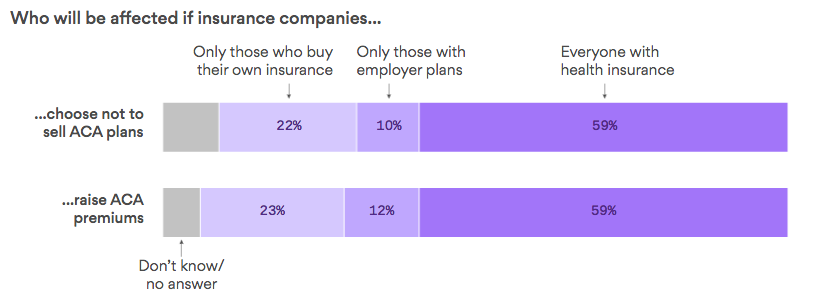
The chart based on our new Kaiser Tracking Poll shows the confusion. Just 23% of the American people know that rising premiums in the ACA marketplaces affect only people who buy their own insurance. More than seven out of 10 wrongly believe rising premiums in the marketplaces affect everyone or people who get coverage through their employer.

The public will be susceptible to spin and misrepresentation of the limited goals of Alexander-Murray: a bipartisan effort to stabilize the marketplaces by funding the cost-sharing reduction subsidies, providing more resources for open enrollment outreach, and expediting state waivers.

President Trump has added to the confusion. He recently pronounced the ACA “dead”, adding, “there is no such thing as Obamacare anymore.” Possibly that’s because he wishes it was dead. More likely, he was referring to the problems in the ACA marketplaces, which he has exaggerated.

Like thinking your whole house is falling down when just a part of the foundation needs shoring up, both he and the American people have an inaccurate picture of where the marketplaces fit in the ACA and where the ACA fits in the health system.

A few facts:

  • There are just 10 million people enrolled in the ACA marketplaces.
  • The law’s larger Medicaid expansion and consumer protections are popular and working well.
  • The far larger Medicare and Medicaid programs and employer based health system combined cover more than 250 million people, and are largely unaffected by developments in the ACA marketplaces.
  • Premiums for the 155 million people who get coverage through their employers rose a very modest 3% in 2017.

Some conservatives in Congress will hold out for repeal, and they’ll resist any legislation that they view as propping up Obamacare. But for everyone else, it’s important to understand the problem and get the facts.


A New Plan To Rescue The ACA: Medicare-At-55

http://healthaffairs.org/blog/2017/10/16/a-new-plan-to-rescue-the-aca-medicare-at-55/

On October 12, 2017, the Trump Administration announced that it would end subsidies that reduce out-of-pocket payments for low-income individuals. This action might drive insurers out of the exchanges and might encourage younger people to drop their individual insurance plans — thereby destabilizing the individual insurance market.

Extending Medicare to the 55-64 age group—who have relatively high health care costs—is a potential fix that could insure the near-elderly and provide stability to the marketplaces. It would remove expensive individuals and families from coverage by private insurance companies, who could in turn reduce premiums for individuals and families below the age of 55.

Under this proposal, Medicare-at-55 would be universal for people in the 55-64 age group and they would leave their current private insurance. It would require an increase in the Medicare payroll tax contribution which has not increased proportionately to increases in Medicare spending; other countries sustain their health insurance programs by gradually increasing their payroll tax contributions. To make this plan fiscally sustainable, the United States would need to do the same.

The Problem With Making Medicare-At-55 Optional

Medicare-at-55 is quite different from proposals suggested by Democrats in 2009 and 2017, which allowed people aged 55-64 to voluntarily buy into Medicare as an alternative to private insurance. The problem with the idea of Medicare buy-in is that relatively few of the near-elderly would choose it. Medicare premiums for this age group—about $8,200 per year for an individual—would be significantly higher than what they currently pay with employer-sponsored insurance and with individual insurance subsidized under the Affordable Care Act (ACA).

In addition, under an optional buy-in there would be confusion among potential enrollees on whether to use the buy-in and person-by-person enrollment would be administratively complex. Moreover, the buy-in would raise vexing legislative questions around premium levels, Medigap and Medicare Advantage policies, and whether people could buy-in to Parts A, B, and D separately.

Automatic Enrollment, Just Ten Years Earlier

 The better approach would be to implement a Medicare-at-55 concept in which everyone would be automatically enrolled in Medicare — just like the current system does for those 65 and above. Upon reaching the age of 55, eligible individuals (almost everyone in the 55-64 age group) would simply receive their red-white-and-blue Medicare card. Private insurers and employers would no longer be responsible for this age group, which would allow private insurers to reduce premiums on younger families because they would have a younger, and typically healthier, pool of people to cover. In 2015, per capita health care costs for people between 55 and 64 years of age were $9,707 compared with $6,637 for the 45-54 age group, $4,442 for the 26-44 cohort, and $2,915 for those between 19 and 25.

Once on Medicare at the age of 55, people could choose to get a Medicare supplement through their previous insurer or join a Medicare Advantage plan. While the 55-64 age group has higher health care costs than younger people, they have lower costs than current Medicare beneficiaries, which in 2015 incurred per capita spending of $11,904.

Keep in mind that this is not small group to be adding to Medicare’s risk pool. In 2015, there were 41.1 million people in the 55-64 age group. 24 million have access to employer-sponsored insurance, 3 million have subsidized individual insurance under the ACA, 2 million purchase unsubsidized individual insurance, and 3.4 million are uninsured. This leaves an estimated 8 to 9 million already on Medicare and/or Medicaid.

How Would We Pay For Medicare-At-55?

First, it is noteworthy that from 2010 to 2016, per capita Medicare spending growth was 1.3% compared with 3.5% for private insurance. Second, it would be impossible for most people in the 55-64 age group to pay for their Medicare plan and—given the high per capita costs of this age group—it would be very expensive for the federal government to subsidize their plan. The costs of Medicare-at-55 would have to be borne by the younger population, who would benefit greatly as they reached 55.

The best revenue source for Medicare-at-55 is the current Medicare financing model: payroll tax for Medicare Part A, individual premiums and general federal revenues for Medicare Part B, and Part D through general federal revenues and out-of-pocket costs. The same model could be extended to the 55-64 age group, with an increase in the payroll tax, for example, from 2.9% (half from employers and half from employees) to 3.9% and an increase in the higher-income payroll tax from 2.35% to 3.35%. The precise increases would have to be calculated by federal actuaries and these increases could also be used to extend Medicare’s life from the current date of 2029.

To add to these Medicare revenues, which are distributed throughout the entire population, the new 55-64 beneficiaries would still pay their Part B premiums ($134 per month for incomes of $85,000 or less, more for higher incomes) and Part D (prescription drugs) premiums. Their out-of-pocket costs would depend on whether they have a Medicare supplement or Medicare Advantage plan. The 55-64 population would be subject to the same Medicare rules as the over 65 Medicare population.

To pay for the 55-64 age group to be folded into Medicare, not only the payroll tax, but the portion of Medicare financing provided by general federal revenues, needs to increase. Employers that insure their employees would be required to contribute through Medicare-earmarked payments. Otherwise these employers would receive a windfall since they would no longer be responsible for the health care costs of their 55-64 year-old employees.

Medicare-at-55 is a reasonable proposal to stabilize the ACA while providing reliable health insurance for the 55-64 age group. As the most expensive group insured through the ACA marketplaces moves to Medicare, insurers could reduce premiums for the remaining younger and healthier age groups. The transfer of the 55-64 cohort from employer-sponsored insurance to Medicare would allow insurers to also moderate their premiums in the employer market.

Many questions have yet to be answered in developing the concept of Medicare-at-55, but the idea deserves to be added to the mix of proposals designed to extend our nation’s insurance coverage and repair the ACA marketplaces.


ACA Repeal Votes Defy Preferences Of Constituents

http://healthaffairs.org/blog/2017/10/16/aca-repeal-votes-defy-preferences-of-constituents/

Despite repeatedly failing to advance legislation through the Senate, Republicans in Congress have not abandoned their goal of repealing and replacing the Affordable Care Act (ACA). The latest attempt at repeal in the form of the Graham-Cassidy bill would have established a per capita cap on federal Medicaid financing, eliminated the individual mandate, and undermined protections for older adults and people with preexisting conditions, by allowing states to opt out of key ACA insurance regulations. It would also have eliminated funding for the ACA’s Marketplace premium and cost-sharing subsidies and Medicaid expansion, and redirected some of that funding toward block grants to states.

One puzzling aspect of this and previous repeal efforts is that they nearly succeeded in spite of widespread public support for the core elements of the ACA that would have been overturned. Although almost 80 percent of nonelderly adults favor keeping the Medicaid expansion and nearly 70 percent favor keeping the premium subsidies, previous legislation eliminating or weakening these provisions passed the House by a vote of 217–213 (with House votes by district shown in Exhibit 1) and fell just a few votes short of passing the Senate. ACA protections for people with preexisting conditions—including guaranteed issue, community rating, and essential health benefits—are even more popular, eliciting support of 80 percent to 90 percent of nonelderly adults, and age rating limits are supported by three-quarters of adults.

A possible explanation for the perseverance toward repeal despite its unpopularity is that residents in districts and states where members of Congress voted for repeal may exhibit less support for key ACA provisions compared to those living in districts and states where members voted against repeal. If favorability toward these provisions varies widely across politically polarized Congressional districts and states, voting patterns in Congress may simply reflect legislators’ responsiveness to the preferences of their constituents. In contrast, if favorability toward ACA provisions is high across districts and states, it would indicate that the push for repeal is motivated by factors beyond constituent demands.

Most Nonelderly Adults Support Keeping Core ACA Provisions In Districts Where Members Of The House Voted For Repeal

To understand the link between congressional votes and public opinion on ACA repeal, we used data from the Urban Institute’s March 2017 Health Reform Monitoring Survey to examine public support for keeping or repealing core ACA provisions among a sample of more than 9,500 nonelderly adults—and the potential impact of repeal on coverage—based on how their member of the US House of Representatives voted for the American Health Care Act (AHCA) last May and how their senators voted for the Better Care Reconciliation Act (BCRA) and Obamacare Repeal and Reconciliation Act (ORRA) last July. Senators voted on a third repeal bill, the Health Care Freedom Act, that would have eliminated the individual mandate without directly targeting other core coverage provisions described in the survey.

We found that although support was somewhat lower in House districts where representatives voted for the AHCA, 75.2 percent of adults in these districts supported keeping the Medicaid expansion and 64.3 percent of them supported keeping the premium subsidies (Exhibit 2). In districts where representatives voted against AHCA, support was 81.0 percent for Medicaid expansion and 72.6 percent for the premium subsidies. There were no differences by districts’ House votes in support for the ACA’s guaranteed issue and community rating provisions, and only slightly higher support for essential health benefit requirements and age rating limits in districts where representatives voted against the AHCA.

Little Or No Variation Across States In Support For Core ACA Provisions

Support for Medicaid expansion did not vary across states. In states where at least one senator voted for either the BCRA or the ORRA, 77.5 percent of adults supported keeping the Medicaid expansion, which is not significantly different from the 79.1 percent supporting Medicaid expansion in states where both senators voted against both repeal bills (Exhibit 3). Support for keeping premium subsidies was somewhat lower in states where a senator voted for repeal (65.7 percent versus 71.9 percent). In states where both senators voted against both repeal bills, adults were only 2.2 percentage points more likely to support guaranteed issue, 2.0 percentage points more likely to support community rating, and 4.3 percentage points more likely to support age rating limits relative to adults in states where at least one senator voted for repeal. Support for essential health benefits was similar in each state group.

It is possible that members of Congress are more responsive to certain segments of their districts and states, including those individuals who are most likely to vote or those who participate in primary elections. However, we found that in districts where representatives voted for the AHCA, support for most core ACA provisions was high among those who either self-identify as Republicans or lean toward the Republican Party platform, including those who refer to themselves as “strong” Republicans (Exhibit 4). Majorities of both groups supported keeping the Medicaid expansion and consumer protections. About half of those who identify as Republican or lean Republican and 41 percent of strong Republicans supported keeping the premium subsidies. Similar patterns were found among Republicans in states where at least one senator voted for repeal. We also found widespread support across all districts and states among groups with high voter participation rates, including those ages 50–64 and those with high levels of education and income (data not shown).

Repeal Would Jeopardize Coverage And Benefits Of Adults Across House Districts

Adults with Marketplace coverage or Medicaid—including the Medicaid expansion population and those enrolled in Medicaid under pre-ACA eligibility rules—could be affected by repeal of Medicaid expansion, benefit cuts resulting from the establishment of per capita caps on Medicaid funding, elimination of premium subsidies, and/or loss of consumer protections. The share of adults with these types of coverage is larger in House districts where representatives voted against the AHCA. However, these changes would still affect many adults in districts where representatives voted for the AHCA. About 1 in 5 adults (19.5 percent) in House districts where members voted against repeal were enrolled in Medicaid or Marketplace coverage, compared to about 1 in 6 adults (16.3 percent) in House districts where members voted for repeal (Exhibit 5). These differences were driven by the higher Medicaid enrollment in states expanding Medicaid, where representatives were more likely to vote against the AHCA; there were no significant differences in Marketplace enrollment. An additional 3 percent of adults were enrolled in non-Marketplace nongroup coverage both in districts where representatives voted for the AHCA and in districts where they did not. These adults are not eligible for premium subsidies but could lose protections against discrimination by age or health status. Nearly two-thirds (63.3 percent) of adults with Marketplace plans with a premium reported that their premium was subsidized (data not shown). Another 18.5 percent of Marketplace enrollees with a premium did not know whether they received a subsidy, indicating that the 63.3 percent reporting a subsidy represents a lower bound on the share with subsidized coverage.

In States Where Senators Voted For Repeal, A Larger Share Of The Population Would Be At Risk Of Losing Marketplace Coverage

Although adults were more likely to be enrolled in Medicaid in states where both senators voted against both repeal bills (which were generally Medicaid expansion states) than in states where at least one senator voted for repeal (14.8 percent versus 10.7 percent), Marketplace coverage was slightly higher in states where a senator voted for repeal (6.0 percent versus 4.6 percent) (Exhibit 5). The difference in Marketplace enrollment is likely due in part to eligibility for Marketplace subsidies for adults with incomes between 100 percent and 138 percent of the federal poverty level in states that did not expand Medicaid.

Limitations To The Analysis

One limitation to this analysis is that our sample is only adults ages 18–64, and there may be more variation in public opinion toward the ACA across districts and states among the elderly population. However, we found similar patterns across states and districts when we limited our sample to adults ages 60–64, suggesting levels of support across districts and states may be consistent for older age groups as well. In addition, public opinion toward the ACA has changed since March 2017, although most polls have shown a rise in support for the ACA, and growing opposition to repeal legislation would suggest an even larger gap between congressional efforts and constituent preferences.

Without A Strategy For Protecting Coverage, Repealing Core ACA Provisions Threatens Recent Gains In Health Care Access

These findings suggest that congressional votes to repeal the ACA’s core financial assistance provisions and consumer protections are not aligned with the preferences of constituents. Moreover, the potential loss of coverage and benefits from repealing these provisions and transforming Medicaid financing is high in both areas where members of Congress are pursuing repeal and areas where members have opposed repeal. Public opinion and concern for those who would be harmed may have helped derail repeal efforts thus far, but Republicans have come close to securing a legislative majority that is not deterred by these factors. If legislation modeled on Graham-Cassidy or previous repeal bills succeeds without a clear strategy for sustaining coverage, it is likely to reverse the recent gains in health care access and affordability in districts and states across the country.


The President’s Executive Order: Less Than Meets The Eye?

http://healthaffairs.org/blog/2017/10/20/the-presidents-executive-order-less-than-meets-the-eye/

Image result for less than meets the eye

The executive order (EO) signed by President Donald Trump on October 12 directs the Departments of Health and Human Services (HHS), Labor, and Treasury to develop federal regulations that could allow new and less expensive health insurance options for employers and consumers.

The EO marks a shift in the administration’s strategy on health care. After failing to get legislation through Congress to repeal and replace the Affordable Care Act (ACA), the administration is now attempting to move away from the ACA’s heavily-regulated markets through changes that can be implemented without a change in the law.

The executive order does not itself change any federal regulations. Instead, it sets into motion a policy development process that could lead to new regulations or regulatory guidance within the confines of current law. Although the EO gives general policy direction, the specific content of future regulations depends on legal and technical analysis to be conducted by the agencies.

The policy themes are familiar: expand access to lower-cost insurance outside of the ACA’s exchange mechanism and enhance the use of financing vehicles to help workers pay for their care. The extent of possible changes is limited. For example, the EO seeks to allow the sale of insurance across state lines, but relies on potentially expanding the ability of employers to form Association Health Plans (AHPs) under the Employee Retirement Income Security Act (ERISA). Individuals purchasing their own insurance would continue to be subject to federal and state insurance market rules.

An Uncertain And Potentially Lengthy Timeline

The timeline for producing rule changes is uncertain. The EO gives the agencies 60 days to “consider proposing regulations or revising guidance” without specifying the date when a proposed rule would be released. It typically takes months, and sometimes years, to put a new federal regulation into effect.

The Administrative Procedures Act specifies that agencies must follow an open public process when they issue regulations. Following an often-lengthy internal clearance process, a proposed rule is issued that invites public comments. The final rule taking those comments into consideration must be developed and cleared before publication. Less time is required if an agency determines that it can issue an interim final rule without first publishing a proposed rule. Interim final rules generally take effect immediately.

Even if the federal agencies move expeditiously, it is unlikely that new regulations could affect the marketplace for health insurance in 2018. ACA exchange plans have been finalized in time for this year’s open enrollment period, starting November 1. Most employers will have signed contracts for their insurance plans for next year well before the end of 2017 as well. Most Americans will be required to select next year’s coverage before the end of this year. Realistically, any new rules are likely to be effective starting in 2019 or later.

Major Policy Areas

The EO targets three policy areas for change.

Association Health Plans (AHPs)

Republicans have long supported the use of AHPs to give small employers some of the advantages that large employers have in purchasing insurance for their workers. AHPs potentially could allow small firms to operate as one large employer plan, giving them scale economies and greater market power than they have purchasing insurance as separate companies. In addition, AHPs could be exempted from some of the ACA’s requirements (including essential health benefits and community-rated premiums). However, as the law is now interpreted, AHPs are subject to the same state and federal regulations that apply to the small group and individual insurance markets, largely eliminating their usefulness.

The EO directs the Labor Department, which oversees the regulation of employer plans, to look for ways to make it easier for small businesses to join AHPs. The existing rules for multi-employer insurance plans are complex, but it may be possible that ERISA could be reinterpreted to make AHPs more effective and attractive than they are today. The EO raises the possibility that AHPs could be formed among employers operating in the same geographic area or industry. Details may not be available for some time.

Whatever changes are pursued will be heavily scrutinized and likely challenged in court. Insurers selling in ACA-regulated markets might oppose the new regulations if they expect AHPs to attract healthier individuals from more comprehensive (and more expensive) exchange plans.

It is not clear that AHPs would be a better option for small employers than they have today. Forming larger groups can help spread insurance risk and administrative costs. Larger plans can also use their leverage to push better managed care protocols into their insurance plans, and thus cut costs. However, the voluntary nature of AHPs could result in plans competing for healthier groups of workers rather than investing the resources necessary to make health care more efficient and effective.

Small employers may have the option of joining more than one AHP or staying in the regulated market. Competing AHPs might structure their coverage to attract firms with younger, healthier workers. The press statement accompanying the EO states that employers would not be allowed to discriminate among workers based on their health status. But small employers would not be forced to join AHPs, and the rules for joining might be written in ways that implicitly and subtly target firms with healthier workers.

AHPs could add value to the health system if they moved people out of expensive, unmanaged fee-for-service insurance with high administrative costs into better-run managed care plans that cut expenses through economies of scale and elimination of unnecessary use of services. The Trump administration might find a way within current law to make these kinds of AHPs available without shifting higher premiums onto less healthy workers. But the history of AHPs and related types of organizations is not promising. Many previous multi-employer plans have suffered from undercapitalization, and have gone insolvent. It will not be easy to secure the necessary capital to build a viable AHP in a market in which small employers may have several insurance options.

Short-Term, Limited Duration Insurance (STLDI)

Short-term health insurance policies offer coverage to individuals who are unable to obtain other forms of health insurance but want to be protected for a specific period of time. STDLI plans are not subject to the ACA’s insurance rules. They do not have to cover the ACA’s essential health benefits, they do not cover pre-existing conditions, and they are not required to cover people in poor health. One study found that STDLI plans are one-third the price of exchange plans. These plans have generally been viewed as niche products, sold primarily to people who are between jobs.

The EO calls on HHS, Labor, and Treasury to reverse decisions of the Obama administration that restricted the availability of STLDI plans. A regulation issued on October 31, 2016 limits their duration to no more than three months, and the plans are not renewable. Moreover, enrollment in an STLDI plan does not constitute coverage under the ACA’s individual mandate. It seems likely that the agencies have the authority under current law to allow STLDI plans to cover an individual for up to one year and to be renewable.

STLDI plans are clearly not for everyone but could prove attractive to some customers. Low-cost coverage should be made available to individuals who change jobs and those who are unable to buy exchange coverage after the open season has ended. Consumers enrolled in STLDI plans who develop a serious medical condition would probably not be able to renew their coverage but would have access to higher-premium plans offered on the ACA-regulated marketplace.

An open question is whether the Trump administration will also attempt to exempt STLDI enrollees from the individual mandate’s tax penalties. That would make short-term plans more attractive for healthy people and thus exacerbate the adverse selection that is already driving up premiums for ACA-compliant plans.

Health Reimbursement Arrangements (HRAs)

HRAs allow employers to reimburse workers for their families’ medical expenses, including deductibles and other cost-sharing payments and health items not covered by insurance. Unlike health savings accounts, workers do not contribute to HRAs. Payments made by an employer through an HRA are not treated as taxable income for the worker. The Obama administration required HRAs to be used solely in conjunction with ACA-compliant health plans.

The EO directs the agencies to propose ways to expand the availability and use of HRAs. The EO specifically states an intention to allow HRAs to be used for workers purchasing their own non-group coverage. The administration may be planning to allow HRA funds to be used to pay premiums and cost-sharing in the individual insurance market, including plans that are not ACA-compliant. Those plans might include AHP plans and STDLI, depending on other regulatory changes that might result from the EO.

For some small employers, an expanded role for HRAs may be an attractive way to help pay insurance premiums for their workers without sponsoring an insurance plan themselves. But it is far from clear how much authority there is under current law to make this kind of change. Moreover, even if the administration were able to create a larger role for HRAs, workers in small firms may not be eager to get their insurance through the ACA exchanges instead of through their place of work.

Premature Predictions

Several commentators have said that the Trump administration’s EO would result in risk segmentation that would drive up premiums and could eventually lead to dismantling the ACA exchanges. That prediction seems premature. AHPs as they exist today do not pose a threat to the ACA. It remains to be seen if the administration can make room for a viable AHP option, and whether or not that option will adversely affect the ACA exchanges. The STLDI plans are a niche market today. While it is possible their role could expand, their value is limited and attractive to only a small segment of the market. The administration’s vision for HRAs is not clear enough to predict how any changes would affect the existing ACA markets.

Each of the changes contemplated by the Trump EO would take time to put into effect. Once the rules are changed, the private sector would need to make investments to change their business practices. It is doubtful there would be a rapid transition.

Millions of consumers are enrolled in ACA-compliant plans today. The ACA exchanges face an elevated level of adverse selection. But those markets remain the only real game in town primarily because the ACA’s generous premium subsidies are only available through the exchanges. The President’s EO cannot change this reality. Whatever is done in response to the EO is likely to have a less dramatic effect on the market than some in the administration now hope, and others now fear.


ACA Waiver Changes

Waiver changes

Image result for aca waivers

In broad strokes, the bipartisan deal from Senators Alexander and Murray would restore cost-sharing payments through 2019 in exchange for some amendments to the rules governing ACA waivers. Now that we have the bill text, we can start to wrap our hands around the practical effects of those waiver changes.

Most importantly, the bill would relax one of the guardrails governing state waivers. In its current form, section 1332 of the ACA requires any waiver to include cost-sharing protections that are “at least as affordable” as those in the ACA. Under the new bill, the waiver would just have to provide “cost sharing protections against excessive out-of-pocket spending that are of comparable affordability, including for low-income individuals with serious health needs, and other vulnerable populations.”

To my eyes, that’s a pretty modest change. The category of waivers with cost-sharing protections that are “of comparative affordability” to those in the ACA, but are not “at least as affordable,” is tiny. The new language may signal that HHS could approve waivers where the states would offer protections are slightly less robust than what we’ve already got under the ACA. But that’s it.

There’s been some talk that the language change might allow the approval of Iowa’s waiver. I don’t see it. As I understand it, Iowa wants to undo cost-sharing protections for its residents.* [See the update below; Iowa’s position has softened from its original waiver proposal.] How is an absence of cost-sharing protections the same as “cost sharing protections … that are of comparable affordability” to those in the ACA? I’ve explained before that the decision to grant a waiver can be challenged in court. If Iowa’s waiver wasn’t viable before, it won’t be viable even if the Alexander-Murray bill becomes law.

Apart from the guardrail change, the bill would require HHS to decide on waivers within 90 days, not 180 days, which should speed processing. Of particular relevance to Iowa’s waiver, the bill also creates an expedited approval pathway of 45 days for “urgent situations.”

What’s an urgent situation? It’s one where the Secretary determines that all or part of a State is “at risk for excessive premium increases or having no health plans offered.” But there’s less than meets the eye here. An urgent waiver isn’t automatically granted when that time has elapsed: the Secretary still has to approve an urgent waiver before it can take effect. The default is still “no.”

Of perhaps greater significance, the bill would prohibit HHS from yanking a state waiver for six years “unless the Secretary determines that the State materially failed to comply with the terms and conditions of the waiver.” That last clause means that, if a state’s waiver is approved, the next Secretary of HHS can’t terminate the waiver—even if it turns out that the waiver doesn’t comply with the guardrails.

It’s not hard to see how that change might make a difference if a Democrat takes office in 2020. Still, it’s a far cry from changes to the waiver rules in previous Republican bills, which would have outright prohibited HHS from terminating waivers for eight years, however recklessly or foolishly states spent their ACA money.

Finally, the legislation would undo HHS guidance and regulations pertaining to waivers. The Obama administration, for example, declined to allow states to package their 1332 waivers with Medicaid waivers, and use savings from one waiver to offset an increase in spending from the other. The field would be clear for the Trump administration could revisit that. Then again, the Trump administration could have revisited those Obama-era rules anyhow, so I can’t see why vacating the regulations and guidance makes much of a difference.

All in all, the changes to the waiver rules are real but minor. To borrow from Hamilton, it looks like Senator Murray got more than she gave, and wanted what she got.

* Update: David Anderson has pointed me to an October 5 revision that Iowa made to its waiver request that would extend cost-sharing protections to individuals up to 200% of the poverty line (the ACA affords protection up to 250%). With those protections in place, Iowa says that people up to 150% of poverty “will not see an increase in their out-of-pocket costs,” and that people between 150% and 200% of poverty will have a “lower average total cost of care,” taking into account premiums and out-of-pocket spending. Those in the 200% to 250% range won’t receive out-of-pocket protections.

Are Iowa’s revised cost-sharing protections comparably affordable to those under the ACA? The protections are certainly thinner, and for people in the 200% to 250% range, nonexistent. Whether that package as a whole is “comparable” is a question of degree: I can see an argument either way. Which is to say that the revised Iowa waiver might be approved under the new standard, but I wouldn’t be surprised to see a lawsuit over any such approval.

ACA Alterations Will Jolt Health Exchanges for 2018

http://www.healthleadersmedia.com/health-plans/aca-alterations-will-jolt-health-exchanges-2018?spMailingID=12171449&spUserID=MTY3ODg4NTg1MzQ4S0&spJobID=1261586415&spReportId=MTI2MTU4NjQxNQS2#

Image result for wrecking ball hospital

The end of cost sharing reductions has insurers trying to raise premiums even higher than planned. Those high premiums and other changes to the Affordable Care Act may drive consumers away from the exchanges.

The loss of cost sharing reductions (CSR) and the presidential executive order altering the Affordable Care Act will combine to significantly shake up the insurance market for 2018, one analyst says.

The effect is likely to include raising rates so high that the number of healthcare consumers who do not purchase coverage will skyrocket.

Health plans are scrambling to raise their rates even higher than already planned, responding to President Donald Trump’s announcement that insurers will no longer receive the subsidies.

Insurers were forced to submit rates for next year while the fate of CSRs was still uncertain—one set of rates is for if the subsidies continued and the second is for a higher rate to be used if they did not.

Some insurers are asking for a chance to revise the rates already submitted, says Julius W. Hobson Jr., an attorney and healthcare analyst with the Polsinelli law firm in Washington, D.C.

The CSR termination comes right after President Trump issued a new executive order he says is designed to increase competition and choice. Critics say it would seriously weaken the ACA, and some say that’s intentional.

President Trump says the order will give millions of Americans more access to affordable coverage and make it easier for people to obtain large-group coverage. Others worry that it could lure healthy young Americans away from the ACA exchanges, leaving those who remain to pay higher premiums.

“The combination of the executive order and the CSR termination wreaks havoc on the health insurance market for all of 2018,” Hobson says. “This also comes just before the open enrollment and with cutting back money for the patient navigators who help people sign up, and with reduced access to the website. That all means there are going to be fewer people who sign up.”

Higher premiums and deductibles already were driving some consumers away from purchasing individual healthcare plans, Hobson notes, and more will follow when the CSR loss forces insurers to raise rates even higher.

If the Trump administration stops enforcing the individual mandate, as it has said it might, that would make even more consumers forgo coverage, he says.

Fewer consumers buying insurance on the ACA exchanges intensifies their existing problems, Hobson says.

Premiums and deductibles will continue to rise as insurers struggle to remain profitable with a smaller pool of older, sicker patients driving high utilization costs. More and more consumers will leave the exchanges if they can, he says.

“People are going to be looking at premium increases they just can’t afford,” Hobson says. “The individual market will take a big hit, but the impact on the group market is harder to predict. We don’t know yet whether the increases in the individual market will bleed over into the group market.”

The recent changes are intended to weaken the ACA, Hobson says.

“The administration has said the ACA is imploding, but also that they’re going to do everything they can to wreck it. It’s not imploding on its own, it’s being shoved down the trash chute,” Hobson says.

“Losing the CSR payments is critical and, at this point, it’s unlikely that even if Congress acted they could do anything in time to affect 2018. There’s no way of looking at this other than it having a negative outcome,” he says.

Trump Flip-Flops on Senate Health Care Deal

http://www.rollcall.com/news/politics/trump-wont-sign-alexander-murray-health-care-deal?utm_source=rollcallafternoon&utm_medium=email&utm_campaign=newsletters&utm_source=rollcallafternoon&utm_medium=email&utm_campaign=newsletters

Related image

President opposes bipartisan deal he supported the day before.

President Donald Trump reversed gears on a bipartisan Senate health care deal Wednesday, saying he would not sign the pact reached by Sens. Lamar Alexander and Patty Murray less than 24 hours after he signaled support for it in a public appearance in the Rose Garden.

Trump “supports the process” of trying to find a short-term fix to the 2010 health care law, but he “doesn’t support the result,” a White House official said of the efforts by the chairman and ranking member of the Senate Health, Education, Labor and Pensions Committee.

The opposition comes just after Trump tweeted Wednesday morning he could not “support bailing out ins co’s who have made a fortune w/ O’Care.”

That came after Trump said in a speech to the Heritage Foundation Tuesday that he opposed continuing cost-sharing subsidy payments that help low-income people pay for health insurance on the exchange, the crux of the Alexander-Murray deal and something state insurance officials and insurance companies say is essential to the markets not collapsing. Trump last week said he would end the administration’s practice of making those payments.

That move has not resonated with the public. Fifty-three percent of respondents to an Economist/YouGov survey conducted Oct. 15 and 16 said they disapproved of the executive move, compared to 31 percent who were in favor. Sixteen percent declined to give an opinion.

“While I commend the bipartisan work done by Senators Alexander and Murray — and I do commend it — I continue to believe Congress must find a solution to the Obamacare mess instead of providing bailouts to insurance companies,” Trump said.

That speech came just a few hours after he said in the Rose Garden that administration officials have been involved in the Alexander-Murray talks and signaled he supported what he described as a one- or two-year package.

In that White House appearance, Trump called the Alexander-Murray move a “short-term deal” that is needed to “get us over this hump” until Republicans might find a way to send him a measure to partially or completely repeal the Obama-era law.

During a HELP Committee hearing that wrapped up just after Trump’s tweet Wednesday, Alexander said he and Murray, along with several co-sponsors, would present the plan on the Senate floor.

Murray ruled out major changes to the plan after Trump’s newfound position.

“This is our bipartisan agreement. We’ve agreed on it, and it’s a good compromise, both of us had to give and that’s what we have,” the Washington Democrat said.

Alexander said the president had encouraged senators to keep working toward a deal.

“The president called me this morning, which is the third time he’s called me about this. I appreciate his encouragement of the process,” the Tennessee Republican said. “He asked me to do it, to work with Sen. Murray on the project. He said he would review the legislation, which is what I would expect a president to do. So we will keep working on it.”

Alexander said Tuesday he briefed Senate Republicans on the temporary plan that would provide funding through 2019 for cost-sharing reduction subsidies that help lower-income consumers. It would also give states more flexibility to seek waivers to bypass the law under certain conditions.

Requirements for certain health benefits and banning insurers from charging more would stay in place, Alexander said.

House Speaker Paul D. Ryan’s position remains that the Senate should focus on repeal and replace efforts, a spokesman said.