Are healthcare jobs safe from AI? More so than many might think

https://www.healthcarefinancenews.com/news/are-healthcare-jobs-safe-ai-more-so-many-might-think?mkt_tok=eyJpIjoiT0RJNU16UTNOakl4WlRFNCIsInQiOiJ1WHRTRHREbE5rM1hkZmc1QnRcL3JCSjdxMWdtXC9weGE1OE4yT0tMZ2d0eGVCYnlXbkVDSmVtU09UTzZDaUVSTmE2aVRpT1YzSklCVmVsZ3VaMWVyMDlNa1Z2b25DbXZ2QnpxSUpySWluXC8zSDRoTmkya2JCMU53b1h5YkRQUDlNcyJ9

No occupation will be unaffected by the technology, but healthcare will be affected less than other industries, owing much to its inherent complexity

Across the country and across industries, workers are nervous that automation and artificial intelligence will eventually take over their jobs. For some, those fears may be grounded in reality.

Healthcare, however, looks like it will be largely safe from that trend, a new report from the Brookings Metropolitan Policy Program finds.

Examining a chunk of time from the 1980s to 2016, the piece tracks the historical evolution of the technology and uses those findings to project forward to 2030.

The verdict? AI will replace jobs in various industries, but not so much in healthcare.

IMPACT

AI is projected to be an increasingly common form of automation, and the report claims the effects should be manageable in the aggregate labor market. Uncertainty remains, of course, and the effects will vary greatly — across geography, demographics and occupations.

Overall, though, only about 25 percent of U.S. jobs are at a high risk of replacement by automation. That translates to about 36 million jobs, based on 2016 data.

A higher percentage, 36 percent, are at medium risk (52 million jobs) while the largest group is the low-risk group, at 39 percent (57 million jobs).

Most of healthcare belongs in the medium-to-low categories, largely driven by the complexity of healthcare jobs. Still, the risk varies wildly. Medical assistants have what the report calls “automation potential” of 54 percent, but home health aids have just an 8 percent automation potential. Registered nurses sit somewhere in between, at 54 percent.

For healthcare support occupations, the number is closer to 49 percent; healthcare practitioners and technical jobs have 33 percent automation potential.

TREND

The report emphasizes that while some occupations will be safer from automation than others, no industry will be unaffected totally. Mundane tasks will be the most vulnerable.

Fortunately for those in the industry, there’s little in healthcare that’s mundane. AI and machine learning algorithms tend to rely on large quantities of data to be effective, and that data needs human hands to collect it and human eyes to analyze it.

And since AI in healthcare is currently utilized mainly to aggregate and organize data — looking for trends and patterns and making recommendations — a human component is very much needed, an opinion shared by several experts, who point out that empathy are reasoning skills are required in the field.


The No. 1 takeaway from the 2019 JP Morgan Healthcare Conference: It’s the platform, stupid

https://www.beckershospitalreview.com/hospital-management-administration/the-no-1-takeaway-from-the-2019-jp-morgan-healthcare-conference-it-s-the-platform-stupid.html

If you want to understand the shifting sands of healthcare, you’ll find no better place than the nonprofit provider track during the infamous JP Morgan Healthcare Conference that took place this week in San Francisco.

Over 40,000 players were in town from every corner of the healthcare ecosystem. However, if you want to hear the heartbeat of what’s happening at ground level, you needed to literally squeeze into the standing room only nonprofit provider track where the CEOs and CFOs of 25 of the most prominent hospitals and healthcare delivery systems in the country shared their perspectives in rapid-fire 25 minute presentations.

This year those presenters represented over $300 billion, or close to 10 percent of the annual healthcare spend in U.S. healthcare. These organizations play a truly unique role in this country as they are integrated into the very fabric of the communities that they serve and are often the single largest employer in their respective regions. In other words, if you work in or care about healthcare, understanding their perspective is a must.

Every year I take a shot at condensing all of these presentations into a set of takeaways so healthcare providers who aren’t in the room can share something with their teams to help inform their strategy. So what do you need to know? Glad you asked, here you go.

Shift Happens — Moving from Being a Healthcare Provider to Creating a Platform for Health and Healthcare in Your Community

Trying to synthesize 25 presentations into a single punch line is pretty stressful. I listened to every presentation, debriefed with other healthcare providers in the audience afterwards and then spent the next 48 hours trying to process what I heard. I was stumped.

But then, finally, it hit me. To take a new spin on an old phrase, “It’s the platform, stupid.” To be clear, even though I’ve been in healthcare for close to 30 years, “stupid” in that sentence is absolutely referring to me.

So the No. 1 takeaway from the 2019 JP Healthcare Conference is this — for healthcare providers, there is a major shift taking place. They are moving from a traditional strategy of buying and building hospitals and simply providing care into a new and more dynamic strategy that focuses on leveraging the platform they have in place to create more value and growth via new and often more profitable streams of revenue. Simply stated, the healthcare delivery systems of today will increasingly leverage the platform and resources that they have in place to become a hub for both health and healthcare in the future. There is a level of urgency to move quickly. Many feel that if they don’t expand the role that they play in both health and healthcare in their community, someone else will step in.

Folks in tech would think of this as the difference between a “product” strategy (old school) and a “platform” strategy (new school). Think of this as the difference from cell phones (Blackberry) to smartphones (iPhone and Android devices). One was a product, the other was a platform. Common platforms that we’re all familiar with such as Facebook, Amazon, Google, Apple and even Starbucks have always 1) started with a very small niche, 2) built an audience, 3) built trust and 4) then added other offerings on top of that platform. By now there is no need for a “spoiler alert.” We all know that this strategy works and these companies have created a breathtaking amount of value. The comforting news for hospitals and healthcare delivery systems is that many have already completed the first three steps and have many of the building blocks they need to leverage a “platform” as a business strategy. The presentations at the JP Morgan Healthcare Conference made it clear that most are now actually taking that fourth step to separate themselves from the pack.

There is enormous upside to those who understand this pivot and take advantage of this change in the market. Dennis Dahlen, CFO of Mayo Clinic, shared his perspective on this: “Thinking differently in the future is essential. In many ways, at Mayo, we are already operating as a platform today, but we have to continue to leverage this approach to uncover additional ways that we can be a hub for both health and healthcare in our community.” Mayo’s platform includes leveraging research, big data, expert clinic insights and artificial intelligence to create new value for Mayo’s clinical practice as well as new opportunities for Mayo’s partners.

To be clear, the mental shift here is massive. It’s the difference of being on defense (where most healthcare providers are) to be being on offense (which is where they know they need to be). Executive teams have focused their time, energy and resources on driving and supporting inpatient admissions via a traditional bricks and mortar presence coupled with the acquisition of physician practices. The difficulty of thinking through what it means to truly be “asset light” and taking a different approach shouldn’t be underestimated. The good news is that the recent financial results of many health systems have improved, providing a little breathing room for investments to enable this shift in strategy. Those who don’t may fall way behind.

A New Way of Thinking — What it Means to be a Hub

Being a hub is essentially bringing together people with common interests to spark innovation and facilitate work getting done more efficiently. Examples include Silicon Valley as a “tech hub,” Los Angeles as an “entertainment hub,” New York as a “financial hub,” Washington, D.C. as a “hub for politics” and how essentially every college town is or can become a “research hub.”

Given that hospitals and health systems are the largest employers in their community, they are already set up to become a hub. In the past, they leveraged that position to simply care for the sick. Increasingly in the future, these organizations will be health and healthcare hubs for innovation and building new companies, for bringing the community together to tackle issues like hunger and homelessness, for education and training, for research and development partnerships, for coordinated, compassionate and longitudinal care delivery for treatment, for support groups for specific chronic conditions, for digital and virtual care, and for thoughtful and effective support for mental and behavioral health. Changes in the care delivery market over the last 10 years have put the right building blocks in place to make this happen.

Hiding in Plain Sight — The Single Biggest Change in Healthcare We May Ever See Has Already Happened

Taking advantage of becoming a hub and leveraging the strategic concept of being a platform requires new thinking, new structures and new skill sets. The great news for healthcare providers is they have already made the toughest move of all in order to set this in motion.

Over the last decade, there has been a massive level of consolidation with hundreds of hospitals and thousands of physician practices being acquired every year. While more mergers and acquisitions will still happen, this stunning and fundamental restructuring of healthcare delivery has taken place and there is no turning back. This is likely the single biggest shift relative to how healthcare is structured in this country that will take place during our lifetime, and it barely gets mentioned. The strategy many were chasing was primarily being driven by a “heads in beds” pay-off that was both based on offense (“an easier way to grow”) and defense (“we better buy them before someone else does”). That said, as this consolidation happened most healthcare delivery systems were really just an amalgamation of stand-alone hospitals set up as a holding company that provided no real leverage other than more top-line revenue.

During the JP Morgan Healthcare Conference, it was clear that most have made the shift from a holding company into a single operating entity. Chicago-based Northwestern Medicine shared a very refined playbook for quickly bringing acquisitions onto their “platform,” and the results are pretty stunning as they have transformed from a $1 billion academic medical center into a $5 billion regional healthcare hub in a handful of years.

And over the last few years, these organizations have gotten super serious about making the toughest decisions right away. The mega-merger of Advocate Health and Aurora Health, the largest healthcare delivery systems in Illinois and Wisconsin respectively, was accompanied by a gutsy decision to fast-track the implementation of Epic at Advocate to get the leverage of a single EHR platform across the system. While many focus on the cost of the transition and the shortcomings of some of the applications, what gets missed is the enormous long-term leverage this provides regarding communication, integration, continuity of care and, of course, access to data and the potential to improve clinical and financial performance. This creates a “platform-like” experience for both employees and customers. 

So, the twist in the story is that the pay-off for consolidation will likely be very different and perhaps much better than many had originally intended. They have the building blocks in place to be a health and healthcare platform for their community. But now they need to figure out how to truly take advantage of it.

Your Action Plan — 6 Ideas from 25 Healthcare Delivery Systems on How to Leverage Your “Platform”

During their presentations the 25 non-profit provider organizations opened up their playbooks on how others can leverage their platforms and the idea of becoming the hub for health and healthcare in their respective communities. Here is what they shared.

1. Create the Digital Front Door — or Someone Else Will

The big shift in play right now is the moving away from traditional reliance on transactional face-to-face interactions with individual providers. Building relationships and trust is something that has been a core competency and core strategic asset for hospitals in the past. In the future, this simply won’t be possible without leveraging digital platforms as we do in every other aspect of our lives today. As Stephen Klasko, MD, CEO of Philadelphia-based Jefferson Health, shared, the real strategy will be to deliver “health and healthcare with no address.”

Many provider organizations are moving aggressively to create digital front doors. Kaiser Permanente delivered 77 million virtual visits last year. Intermountain introduced a virtual hospital that provides over 40 services and has delivered over 500,000 interactions. Nearly every health system leverages MyChart or a similar personal health record platform. There is an enormous amount of risk for hospitals and health systems that don’t take action here, as traditional healthcare providers will be competing with more mainstream and polished consumer brands for the relationships and trust of the folks in their community.

As the team from Spectrum Health shared, “87 percent of Americans measure all brands against a select few — think Amazon, Netflix and Starbucks.” Google, Apple and Facebook as well as Walgreens or CVS are all going after this “digital handshake,” and are big threats to healthcare providers. There is no question that some of these organizations will be “frenemies,” where they are both competing and collaborating. Healthcare organizations will need to approach any partnerships mindful of that risk.

2. Drive Affordability and Reduce Cost — or Risk Being the Problem

As the burden of the cost of care increasingly shifts to the patient’s wallet, healthcare providers will need to play in driving affordability. Coupled with the recent federal requirement to post prices online, there is a great deal of visibility around the price of care, even if the numbers are way off the mark. Understanding and reducing the total cost of care is now viewed as a requirement. As legacy cost accounting applications relied on charges as a proxy for cost and were limited to the acute care setting, most provider organizations have or are now in the process of deploying advanced cost accounting applications with time-driven and activity-based costing capabilities including a number that presented during the conference, such as Advocate Aurora Health, Bon Secours Mercy, Boston Children’s Hospital, Hospital for Special Surgery, Intermountain Healthcare, Northwestern Medicine, Novant Health, Spectrum Health and Wellforce.

This was one of the hottest topics during the conference, and there was significant buzz regarding having a single source of truth for the cost of care across the continuum. Vinny Tammaro, CFO of Yale New Haven Health, commented, “We need to align with the evolution of consumerism and help drive affordability in healthcare. How we leverage data is mission critical to making this concept a reality. Bringing clinical and financial data together provides us with a source of truth to help both reduce the cost of care as well as reallocate our finite resources to high impact initiatives in our community.” Organizations like Intermountain Healthcare, which implemented a 2.7 percent price reduction in exchange pricing, are taking the next step in translating cost reduction into lower prices for consumers. And now healthcare systems are starting to work together to create additional leverage via Civica Rx, which now includes 750 hospitals joining forces to help lower the cost of generic drugs.

3. Tackle Social Determinants of Health — or You Won’t Be the Hub for Health in Your Community

It is always less expensive to prevent a problem than it is to fix it. The good news is that the economic incentives for hospitals and healthcare delivery systems to both think and act that way are beginning to line up. They are certainly there already for providers that are also health plans such Intermountain, Kaiser Permanente, Providence St. Joseph Health, Spectrum Health and UPMC. They are also in place for providers that have aggressively taken on population-based risk contracts such as Advocate Aurora Health. With that said, it feels like every health system is starting to lean in here — and they should.

Being the central community hub for these issues makes a ton of sense. The way that Kaiser framed it is that while they have 12 million members, there are 68 million people in the communities they serve. Taking that broader lens both allows them to make a bigger impact but also broaden their market. Many organizations, such as Henry Ford Health System, are taking on hunger via fresh food pharmacies. Geisinger shared how a 2.0 reduction in Hemoglobin A1c reduction leads to a $24,000 cost reduction per participant in their fresh food “farmacy.” So while hospitals are perfectly positioned, have the resources and know it’s the right thing to do, they are now also beginning to understand the business model tied to targeting the social determinants of health. There is also strong strategic rationale associated with taking on a broader role of driving health versus only providing healthcare.

4. Create Partnerships for Healthcare Innovation — or Lose the Upside

Spectrum Health has a $100 million venture fund. Providence St. Joseph’s Health announced a second $150 million venture capital and growth equity fund. Mayo Clinic Ventures has returned over $700 million to their organization. Jefferson Health has a 120-person innovation team focused on digital innovation and the consumer experience, partnering with companies to build solutions. These are all variations on a theme as virtually every organization that presented is leveraging their resources to make a bigger impact and drive additional upside from their platform. “We have close to 900 agreements with over 500 partners,” stated Sanda Fenwick, CEO of Boston Children’s Hospital. “Our strategy is to be a hub for research, innovation and education in order to help evolve how care is delivered. This can only be done by collaborating with others.”

5. Become the Hub for Targeted Services and Chronic Conditions — or They Will Go Elsewhere

Perhaps the best example here is the work of Hospital for Special Surgery, the largest orthopedics shop in the world. It is has become a destination for good reason — fewer complications, fewer infections, a higher discharge rate to home and fewer readmissions. The most compelling data point is that when patients come to HSS for a second opinion, one-third of the time they receive a non-surgical recommendation. The same type of shopping is increasingly going to happen for chronic conditions.

Healthcare delivery systems that take a more holistic yet targeted approach have significant potential. They will need to think more deeply about the end-to-end experience and become immersed within the community outside of the four walls of the hospital. Other players in the community, such as CVS Health and Walgreens, would say they have a platform — and they would be right. The platform that healthcare providers have built and are building will absolutely be competing against other care delivery platforms.

6. Leverage Applied Analytics — or You’ll Lose Your Way

In order to enable everything listed above, the lifeline for every health and healthcare hub will be actionable data. Applied analytics is a boring term that is actually gaining traction and starting to dislodge buzzwords like big data, machine learning and artificial intelligence relative to its importance to healthcare providers.

Similar to how analytics are being used in a practical way in baseball to determine where to throw a pitch to a batter or position players in the field, healthcare providers are pushing for practical data sets presented in a simple, actionable framework. That may seem obvious, but it is simply not present in many healthcare organizations that have been focused on building data warehouse empires without doors to let anyone in. Many organizations, such as Advocate Aurora Health, Bon Secours Mercy and Spectrum Health, have deployed more dynamic business decision support solutions to access better insight into performance and care variation. This allows them to assess opportunities to reallocate resources to invest in more productive ways to leverage their platform.

While leveraging a platform as a business strategy is new to healthcare providers, the good news is that building blocks are already in place. It’s time to leverage that platform to drive better outcomes and more affordable care in the community. And now is the time to get started.


The Top 10 Talent Trends of 2019

https://www.kornferry.com/institute/talent-trends-2019?mkt_tok=eyJpIjoiWkRZM01tWTVORFE0TVdKaSIsInQiOiJGZG1ZRUdOQm1OOVlLS1IwUUpzU1o4ZzkwS3ZjakdIc3RQTldhYkFVQUVkcWZBT3RWTXZTQ0I4bzB1SXQ1MFZkR1RmMlNjUjlKbHBlM1drXC95UUkxWlc2b2pFU2U4ZXlFZGR0aWh2ZWYxSWdoZzFFM2E1MXRCOCtLYXNIR2E2RVIifQ%3D%3D

If 2018 was about who was getting jobs, 2019 may be about how jobs work. Indeed, this may be the year that organizations start retooling how they find, evaluate, and even pay employees. Chalk the shifts up to, among several factors, the tight labor market and a massive influx of data, says Jeanne MacDonald, global co-operating executive and president of global talent solutions for Korn Ferry’s RPO and Professional Search business. “To succeed in attracting, developing, and retaining top talent as we head into another year, it’s critical to be agile and forward thinking,” she says.

Korn Ferry canvassed talent acquisition specialists, compensation experts, and HR professionals from around the world to identify 10 emerging talent trends in 2019.

(Don’t) Mind the Gap!

It has always been a red flag—the “hole” in a candidate’s resume, a period of time where a candidate wasn’t working. But an increasing number of organizations are realizing that those holes are there for very legitimate reasons, such as taking time off to care for children or aging loved ones. Many firms are now actively seeking out people with these types of gaps, MacDonald says. Firms are using workshops, customized landing pages and microsites, and other means to find these people.

Making Artificial Intelligence More “Intelligent”

Artificial intelligence (AI) has been touted as the new holy grail in recruiting. However, experts worry that its “intelligence” could create a lack of focus on diversity and inclusion. Even when resumes are anonymized by removing candidate names, AI often can figure out a candidate’s gender by analyzing the phrases used. For instance, “takes charge” and “tough task master” are often associated with men, while “leads persuasively” and “committed to understanding” are often used by women.

One way to help alleviate the issue is to feed the artificial intelligence with non-partial data, such as talent assessment data, that highlights success factors. The AI also needs to be trained to look more for the skills needed for a specific role instead of focusing on subjective modifiers, says George Vollmer, Korn Ferry’s vice president of global account development.

Personalized Pay: Go Ahead, We’re Listening

There are four generations now in the workforce, each with different expectations when it comes to pay and rewards packages. Forward-thinking firms are using social listening, focus groups, and surveys to figure out what each generation actually wants. With that information, they are able to tailor rewards packages, offering different mixes of pay, flextime, paid time off, international assignments, student loan repayment, and other benefits. This is turning the pay and rewards discussion from a company talking to the entire employee population to a one-to-one discussion with employees.

Rethinking the Annual Performance Review

In the United States, the average job tenure is a little more than four years. Experts say that with such short tenures, annual reviews are no longer the primary way to help employees develop professionally. Many employees already recognize this. In a recent Korn Ferry survey of professionals, 30% said their annual review had no impact or was ineffective at improving their performance, and 43% said it had no impact or was unhelpful at making them understand what to do to improve future performance.

Firms are starting to consider real-time feedback as, at a minimum, a supplement to annual reviews, if not a substitute. Ongoing feedback can help employees learn and stay engaged.

Digging Deeper into the Diversity and Inclusion Pipeline

Around the world, there have been growing mandates for more women on boards and other senior leadership positions. While that’s a good development, firms need to maintain focus across all levels of an organization to create an ongoing pipeline of diverse talent, including women, people of color, disabled persons, and LGBTQ employees. To measure their progress, many organizations have begun using applicant tracking systems to find out what percentage of minority applicants were hired.

How Are We Doing?

For years, consumer product companies and retailers have been surveying customers about their experiences with the brand. Increasingly, that practice is becoming part of the recruiting process. Technology is allowing for real-time feedback from candidates about their experiences during the recruiting cycle. The survey tools seek feedback at all points within the process, which gives recruiters and hiring managers data-driven insights and intelligence.

With the data, they can amend recruiting practices, including specific job requirements and interactions with candidates, to successfully hire the best people.

That’s Really a Title?

Chief happiness officer. Data wrangler. Legal ninja. They may sound like off-the-wall job titles, but roles like these are emerging across many industries to meet the changing strategies of organizations.

For example, healthcare, finance, and other firms are increasingly looking to hire a chief experience officer. These businesses realize that the need is stronger than ever for customers to have positive experiences at every touchpoint, MacDonald says. Another emerging C-suite role is chief transformation officer, who is usually tasked with change-management initiatives, often during times of mergers and acquisitions.

Some names are also popping up to attract younger employees. For instance, data wranglers are responsible for organizing and interpreting mounds of data, and legal ninjas are the new generation of legal aides.

Talent Analytics Is Becoming Just as Important as Business Analytics

Traditionally, business leaders set their strategy by analyzing business analytics to determine cost and operational effectiveness. However, experts say they may fail because they don’t find the right type of talent. Increasingly, firms are incorporating talent analytics into the mix. This data measures things such as competition for qualified talent in a region and compensation norms.

Talking Talent Holistically, From Hire to Retire

With the massive influx of data, one would assume organizations would have an integrated way to analyze all elements of talent decisions, including recruiting, compensation, and development. Unfortunately, in many organizations, each of these functions is operating under a different “language,” often unable to talk with one another.

Experts say there is a trend toward a more foundational, data-centric approach that creates insights from organizational, team, and individual perspectives. That allows for a calibrated approach to talent that is tightly linked to business outcomes. For example, the data garnered during the recruitment process can be used to help create a customized development program once the candidate is hired.

Managing Short-Term Hiring Needs with Long-Term Business Goals

The speed of technological advances and changing business priorities makes knowing what’s going to happen next year—or even next month—extremely difficult. In fact, in a recent Korn Ferry survey of talent acquisition professionals, 77% say they are hiring for roles today that didn’t even exist a year ago.

Leading organizations are taking a holistic approach to talent acquisition. In the short term, they are speeding up hiring by figuring out the right mix of short-term contractors, gig workers, and full-time employees to do the work that currently needs to be done. At the same time, they are focusing on a longer-term approach by taking a deep dive into business imperatives to create a total strategic plan that has clearly defined goals, but one that can be amended as needs change.


Optum a step ahead in vertical integration frenzy

https://www.healthcaredive.com/news/optum-unitedhealth-vertical-integration-walmart/520410/

Vertical integration is all the rage in healthcare these days, with Aetna, Cigna and Humana making notable plays. 

If the proposed CVS-AetnaCigna-Express Scripts and Humana-Kindred deals are cleared by regulators, the tie-ups will have to immediately face UnitedHealth Group’s Optum, which has been ahead of the curve for years and built out a robust pharmacy benefit manager (PBM) business already along with a care services unit, employing about 30,000 physicians and counting.

UnitedHealth formed Optum by combining existing pharmacy and care delivery services within the company in 2011. Michael Weissel, Group EVP at Optum, told Healthcare Dive the company began by focusing on three core trends in the industry: data analytics, value-based care and consumerism.

Since then, the company has been on an acquisition spree to position itself as a leader in integrated services.

“For the longest time, the market assumed that they were building the Optum business [to spin it out] and what is interesting in the evolution of the industry is that that combination has now set a trend,” Dave Windley, managing director at Jefferies, told Healthcare Dive.

“United has now set the industry standard or trend … to be more vertically integrated and it seems less likely now that United would spin this out … because many of their competitors are now mimicking their strategy by trying to buy into some of the same capabilities,” he said.

Weissel said Optum will continue to push on the three identified trends in the next three to five years, with plans to invest heavily in machine learning, AI and natural language processing.

The question will be whether and how the company can keep its edge.

What Optum is

Optum is a company within UnitedHealth Group, a parent of UnitedHealthcare. Optum’s sister company UnitedHealthcare is perhaps more well known within the industry and with consumers.

However, Optum, a venture that encompasses data analytics, a PBM and doctors, has been gradually building its clout at UnitedHealth Group.

In 2017, the unit accounted for 44% of UnitedHealth Group’s profits.

In 2011, UnitedHealth Group brought together three existing service lines under one master brand. Services are delivered through three main businesses within a business within a business:

  • OptumHealth – the care delivery and ambulatory care capabilities of OptumCare, as well as the care management, behavioral health, and consumer offerings of Optum;
  • OptumInsight – the data and analytics, technology services and health care operations business; and
  • OptumRx – its pharmacy benefit service.

The company focuses on five core capabilities, including data and analytics, pharmacy care services, population health, healthcare delivery and healthcare operations. Services include but are certainly not limited to OptumLabs (research), OptumIQ (data analytics), Optum360 (revenue cycle management), OptumBank (health savings account) and OptumCare (care delivery services).

The Eden Prairie, MN-headquartered company has recently expanded its care delivery services, with much of the growth coming from acquisitions. The past two years have seen Optum expand its footprint into surgical care (Surgical Care Affiliates), urgent care (MedExpress) and primary care (DaVita Medical Group).

It’s a wide pool, but the strategy affords UnitedHealth the opportunity to grab more revenue by expanding its market presence. For example, the DaVita acquisition, which is still pending, allows OptumCare to operate in 35 of 75 local care delivery markets the company has targeted for development, Andrew Hayek, OptumHealth CEO, said on an earnings call in January.

Optum’s strategy of meeting patients where they are and deploying more ambulatory, preventative care services works in concert with its sister company UnitedHealthcare’s goal of reducing high-cost, unnecessary care services, when applicable. If Optum succeeds in creating healthier populations that use lower levels of care more often, that benefits the parent company UnitedHealth Group as UnitedHealthcare spends less money and time on claims processing/payout.

The strategy has been paying off so far.

Three charts that show UnitedHealth’s financial health as it relates to Optum

Optum’s presence has grown as it has steadily increased its percentage of profits for UnitedHealth Group.

Credit: Healthcare Dive / Jeff Byers

In 2011, the first year Optum was configured as it looks today, the company contributed 14.8% of total earnings through operations to UnitedHealth Group with $1.26 billion. That’s about 29 percentage points lower than in 2017, when Optum brought in $6.7 billion in profits on $83.6 billion in revenue.

Broken down, it’s clear that pharmacy services make up the lion’s share of the company’s revenue. In 2017, OptumRx earned $63.8 billion in revenue, fulfilling 1.3 billion prescriptions. OptumRx’s contributions to the company took off in 2015 when Optum acquired pharmacy benefit manager Catamaran.

Credit: Healthcare Dive / Jeff Byers

In recent years, OptumHealth has grown due to expansion in care delivery services, including consumer engagement and behavioral and population health management. The care delivery arm served 91 million people last year, up from 60 million in 2011.

OptumInsight has grown largely due to an increase in revenue cycle management and operations services in recent years.

On Wall Street, UnitedHealth Group is performing well and has seen healthy growth since 2008. The stock peaked in January and took a dive when Amazon, J.P. Morgan and Berkshire Hathaway — industry outsiders yet financial giants — announced they would create a healthcare company.

Credit: Healthcare Dive / Jeff Byers

While these charts suggest a dominant force, the stock activity shows that investors believe there’s still more room for competition, if the new entrants play their cards right.

Where Optum could lock out and rivals could cut in on competition

UnitedHealth started down this strategic path many years ago and the rest of the industry just now seems to be catching up.

“Optum’s been the leader in showing how a managed care organization with an ambulatory care delivery platform and a pharmacy benefit manager all in house can lower or maintain and bend cost trend and then drive better market share gains in their health insurance business,” Ana Gupte, managing director of healthcare services at Leerink, told Healthcare Dive. “I think they have been the impetus in the large space for the Aetna-CVS deal.”

Because the company is multi-dimensional, Optum’s competition will be varied. If all the mergers making news — including the Walmart’s rumored buyout of Humana — close, here’s what competition could look like:

Perhaps oddly, its largest revenue contributor, OptumRx, seems to have the largest vulnerability for competition in the coming years.

Optum’s competitive advantage in the PBM space is driven largely by already realized integration. Merging data across IT systems is no easy task, and Optum has spent years harmonizing pharmacy data across platforms to assist care managers in OptumCare to see medical records for United members.

Anyone with experience implementing EHR systems can tell you such integration doesn’t happen over night.

If the Cigna-Express Scripts deal closes, the equity can compete with OptumRx, but the technology investment needed to harmonize data and embed Cigna’s service and pharmacy information into Express Scripts servers will take time, Windley said. Optum, on the other hand, has invested in the effort and integration for years.

Gupte says the encroaching organizations in the PBM space have the ability to realize the efficiencies and savings and the integrated medical that Optum has been realizing across OptumRx and the managed care organization.

Optum’s leg up in PBM space could last two to three years over the competition, she said.

On the care delivery side, OptumHealth has been purchasing large physician groups for a variety of services. There are only so many large physician groups putting themselves on the market, and Optum has been making bids for them.

There’s still a bit of white space to fill in its 75 target markets, but analysts note Optum may have the competition on lock in this space

Even if CVS-Aetna closes, OptumCare is a $12 billion business with many urgent and surgery care access points. If CVS-Aetna is finalized, the company will have about 1,100 MinuteClinics capable of realizing efficiencies with Aetna, but, as Windley notes, they likely won’t have primary care or surgery care elements.

There’s also a lot of time and capital needed for building out and retrofitting retail space to medical areas.

On the surgical care services, “I don’t see either Cigna, Aetna or Humana getting into that business,” Gupte said. “That will be one element of their footprint on care delivery that will be unique and differentiated for them.”

Urgent care has the potential for outsider competition, she added. However, Optum is using its MedExpress business to treat higher acuity conditions and have an ER doctor on staff in each center. Compared to the typical types of conditions treated in retail clinics or those that would be feasible over time, Gupte believes services that could be seen in CVS or Walmart would be lower acuity, chronic care management services.

“[Optum has] been so proactive and so strategic I don’t think there’s going to be a lot of reactive catchup they have to do,” Gupte said. “I think it’s going to be hard for the other entities to play catch up, outside of the PBM.”

One potential issue will be harmonizing the disparate businesses so patients can be effectively managed across the various organizations, Trevor Price, founder and CEO of Oxean Partners, told Healthcare Dive.

“I think the biggest challenge for Optum is operationalizing the combined platform,” Price said. “The biggest question is do they continue to operate as individual businesses or do they merge into one.”

What’s next?

Optum will continue to explore ground in the three core trends it has identified.

Out of the three, consumerism has the longest path to maturity in healthcare, Weissel said, adding he believes consumerism is going to change healthcare more than any other trend over the next decade.

“There is a wave coming, and this expectation that we will move there,” he said. “Increasingly, this aging of people who become very comfortable in a different modality is going to tip the balance with how people will want to interact with healthcare. I know there’s pent up demand already.”

That means the company is putting bets into the marketplace around consumer building and segmentation models as well as thinking about how to connect data to allow patients to schedule appointments, view health records, sign up for insurance, search for providers or renew prescriptions online.

Consumer-centric projects currently underway include digital weight loss programs — including streaming fitness classes — and maternity programs to track pregnancy. The company is also experimenting with remote patient monitoring to understand the impacts on those with heart disease or asthma and to search for service opportunities.

Optum will pursue investments as well as acquisitions to push into the consumer space.

“When it comes to acquisitions to Optum overall, we’re always in the marketplace looking to extend our capabilities, to extend our reach in the care management space to fill in holes or gaps that we have,” Weissel said. “That’s a constant process in our enterprise.”


5-Hour Rule: If you’re not spending 5 hours per week learning, you’re being irresponsible

View at Medium.com

“In my whole life, I have known no wise people (over a broad subject matter area) who didn’t read all the time — none. Zero.”
— Charlie Munger, Self-made billionaire & Warren Buffett’s longtime business partner

Why did the busiest person in the world, former president Barack Obama, read an hour a day while in office?

Why has the best investor in history, Warren Buffett, invested 80% of his time in reading and thinking throughout his career?

Why has the world’s richest person, Bill Gates, read a book a week during his career? And why has he taken a yearly two-week reading vacation throughout his entire career?

Why do the world’s smartest and busiest people find one hour a day for deliberate learning (the 5-hour rule), while others make excuses about how busy they are?

What do they see that others don’t?

The answer is simple: Learning is the single best investment of our time that we can make. Or as Benjamin Franklin said, “An investment in knowledge pays the best interest.”

This insight is fundamental to succeeding in our knowledge economy, yet few people realize it. Luckily, once you do understand the value of knowledge, it’s simple to get more of it. Just dedicate yourself to constant learning.

Knowledge is the new money

“Intellectual capital will always trump financial capital.” — Paul Tudor Jones, self-made billionaire entrepreneur, investor, and philanthropist

We spend our lives collecting, spending, lusting after, and worrying about money — in fact, when we say we “don’t have time” to learn something new, it’s usually because we are feverishly devoting our time to earning money, but something is happening right now that’s changing the relationship between money and knowledge.

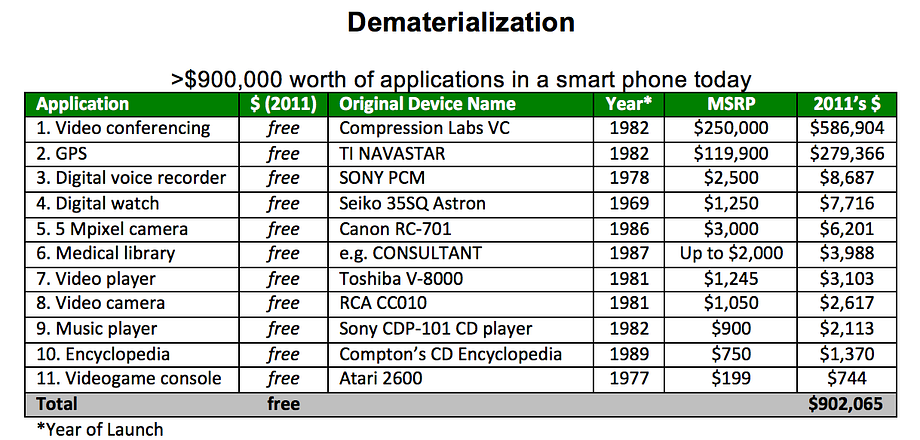
We are at the beginning of a period of what renowned futurist Peter Diamandis calls rapid demonetization, in which technology is rendering previously expensive products or services much cheaper — or even free.

This chart from Diamandis’ book Abundance shows how we’ve demonetized $900,000 worth of products and services you might have purchased between 1969 and 1989.

This demonetization will accelerate in the future. Automated vehicle fleets will eliminate one of our biggest purchases: a car. Virtual reality will make expensive experiences, such as going to a concert or playing golf, instantly available at much lower cost. While the difference between reality and virtual reality is almost incomparable at the moment, the rate of improvement of VR is exponential.

While education and health care costs have risen, innovation in these fields will likely lead to eventual demonetization as well. Many higher educational institutions, for example, have legacy costs to support multiple layers of hierarchy and to upkeep their campuses. Newer institutions are finding ways to dramatically lower costs by offering their services exclusively online, focusing only on training for in-demand, high-paying skills, or having employers who recruit students subsidize the cost of tuition.

Finally, new devices and technologies, such as CRISPR, the XPrize Tricorder, better diagnostics via artificial intelligence, and reduced cost of genomic sequencing will revolutionize the healthcare system. These technologies and other ones like them will dramatically lower the average cost of healthcare by focusing on prevention rather than cure and management.

While goods and services are becoming demonetized, knowledge is becoming increasingly valuable.

The central event of the twentieth century is the overthrow of matter. In technology, economics, and the politics of nations, wealth in the form of physical resources is steadily declining in value and significance. The powers of mind are everywhere ascendant over the brute force of things.” —George Gilder (technology thinker)

Perhaps the best example of the rising value of certain forms of knowledge is the self-driving car industry. Sebastian Thrun, founder of Google X and Google’s self-driving car team, gives the example of Uber paying $700 million for Otto, a six-month-old company with 70 employees, and of GM spending $1 billion on their acquisition of Cruise. He concludes that in this industry, “The going rate for talent these days is $10 million.”

That’s $10 million per skilled worker, and while that’s the most stunning example, it’s not just true for incredibly rare and lucrative technical skills. People who identify skills needed for future jobs — e.g., data analyst, product designer, physical therapist — and quickly learn them are poised to win.

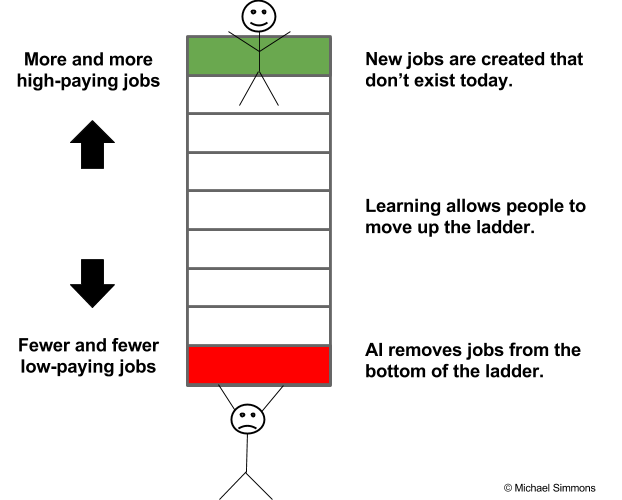
Those who work really hard throughout their career but don’t take time out of their schedule to constantly learn will be the new “at-risk” group. They risk remaining stuck on the bottom rung of global competition, and they risk losing their jobs to automation, just as blue-collar workers did between 2000 and 2010 when robots replaced 85 percent of manufacturing jobs.

Why?

People at the bottom of the economic ladder are being squeezed more and compensated less, while those at the top have more opportunities and are paid more than ever before. The irony is that the problem isn’t a lack of jobs. Rather, it’s a lack of people with the right skills and knowledge to fill the jobs.

An Atlantic article captures the paradox: “Employers across industries and regions have complained for years about a lack of skilled workers, and their complaints are borne out in U.S. employment data. In July [2015], the number of job postings reached its highest level ever, at 5.8 million, and the unemployment rate was comfortably below the post-World War II average. But, at the same time, over 17 million Americans are either unemployed, not working but interested in finding work, or doing part-time work but aspiring to full-time work.”

In short, we can see how at a fundamental level knowledge is gradually becoming its own important and unique form of currency. In other words, knowledge is the new money. Similar to money, knowledge often serves as a medium of exchange and store of value.

But, unlike money, when you use knowledge or give it away, you don’t lose it. In fact, it’s the opposite. The more you give away knowledge, the more you:

  • Remember it
  • Understand it
  • Connect it to other ideas in your head
  • Build your identity as a role model for that knowledge

Transferring knowledge anywhere in the world is free and instant. Its value compounds over time faster than money. It can be converted into many things, including things that money can’t buy, such as authentic relationships and high levels of subjective well-being. It helps you accomplish your goals faster and better. It’s fun to acquire. It makes your brain work better. It expands your vocabulary, making you a better communicator. It helps you think bigger and beyond your circumstances. It connects you to communities of people you didn’t even know existed. It puts your life in perspective by essentially helping you live many lives in one life through other people’s experiences and wisdom.

Former President Obama perfectly explains why he was so committed to reading during his Presidency in a recent New York Times interview:

“At a time when events move so quickly and so much information is transmitted,” he said, reading gave him the ability to occasionally “slow down and get perspective” and “the ability to get in somebody else’s shoes.” These two things, he added, “have been invaluable to me. Whether they’ve made me a better president I can’t say. But what I can say is that they have allowed me to sort of maintain my balance during the course of eight years, because this is a place that comes at you hard and fast and doesn’t let up.”

6 essentials skills to master the new knowledge economy

The illiterate of the 21st century will not be those who cannot read and write, but those who cannot learn, unlearn, and relearn.” — Alvin Toffler

So, how do we learn the right knowledge and have it pay off for us? The six points below serve as a framework to help you begin to answer this question. I also created an in-depth webinar on Learning How To Learn that you can watch for free.

  1. Identify valuable knowledge at the right time. The value of knowledge isn’t static. It changes as a function of how valuable other people consider it and how rare it is. As new technologies mature and reshape industries, there is often a deficit of people with the needed skills, which creates the potential for high compensation. Because of the high compensation, more people are quickly trained, and the average compensation decreases.
  2. Learn and master that knowledge quickly. Opportunity windows are temporary in nature. Individuals must take advantage of them when they see them. This means being able to learn new skills quickly. After reading thousands of books, I’ve found that understanding and using mental models is one of the most universal skills that EVERYONE should learn. It provides a strong foundation of knowledge that applies across every field. So when you jump into a new field, you have preexisting knowledge you can use to learn faster.
  3. Communicate the value of your skills to others. People with the same skills can command wildly different salaries and fees based on how well they’re able to communicate and persuade others. This ability convinces others that the skills you have are valuable is a “multiplier skill.” Many people spend years mastering an underlying technical skill and virtually no time mastering this multiplier skill.
  4. Convert knowledge into money and results. There are many ways to transform knowledge into value in your life. A few examples include finding and getting a job that pays well, getting a raise, building a successful business, selling your knowledge as a consultant, and building your reputation by becoming a thought leader.
  5. Learn how to financially invest in learning to get the highest return. Each of us needs to find the right “portfolio” of books, online courses, and certificate/degree programs to help us achieve our goals within our budget. To get the right portfolio, we need to apply financial terms — such as return on investment, risk management, hurdle rate, hedging, and diversification — to our thinking on knowledge investment.
  6. Master the skill of learning how to learn. Doing so exponentially increases the value of every hour we devote to learning (our learning rate). Our learning rate determines how quickly our knowledge compounds over time. Consider someone who reads and retains one book a week versus someone who takes 10 days to read a book. Over the course of a year, a 30% difference compounds to one person reading 85 more books.

To shift our focus from being overly obsessed with money to a more savvy and realistic quest for knowledge, we need to stop thinking that we only acquire knowledge from 5 to 22 years old, and that then we can get a job and mentally coast through the rest of our lives if we work hard. To survive and thrive in this new era, we must constantly learn.

Working hard is the industrial era approach to getting ahead. Learning hard is the knowledge economy equivalent.

Just as we have minimum recommended dosages of vitamins, steps per day, and minutes of aerobic exercise for maintaining physical health, we need to be rigorous about the minimum dose of deliberate learning that will maintain our economic health. The long-term effects of intellectual complacency are just as insidious as the long-term effects of not exercising, eating well, or sleeping enough. Not learning at least 5 hours per week (the 5-hour rule) is the smoking of the 21st century and this article is the warning label.

Don’t be lazy. Don’t make excuses. Just get it done.

“Live as if you were to die tomorrow. Learn as if you were to live forever.” — Mahatma Gandhi

Before his daughter was born, successful entrepreneur Ben Clarke focused on deliberate learning every day from 6:45 a.m. to 8:30 a.m. for five years (2,000+ hours), but when his daughter was born, he decided to replace his learning time with daddy-daughter time. This is the point at which most people would give up on their learning ritual.

Instead of doing that, Ben decided to change his daily work schedule. He shortened the number of hours he worked on his to do list in order to make room for his learning ritual. Keep in mind that Ben oversees 200+ employees at his company, The Shipyard, and is always busy. In his words, “By working less and learning more, I might seem to get less done in a day, but I get dramatically more done in my year and in my career.” This wasn’t an easy decision by any means, but it reflects the type of difficult decisions that we all need to start making. Even if you’re just an entry-level employee, there’s no excuse. You can find mini learning periods during your downtimes (commutes, lunch breaks, slow times). Even 15 minutes per day will add up to nearly 100 hours over a year. Time and energy should not be excuses. Rather, they are difficult, but overcomable challenges. By being one of the few people who rises to this challenge, you reap that much more in reward.

We often believe we can’t afford the time it takes, but the opposite is true: None of us can afford not to learn.

Learning is no longer a luxury; it’s a necessity.

Start your learning ritual today with these three steps

The busiest, most successful people in the world find at least an hour to learn EVERY DAY. So can you!

Just three steps are needed to create your own learning ritual:

  1. Find the time for reading and learning even if you are really busy and overwhelmed.
  2. Stay consistent on using that “found” time without procrastinating or falling prey to distraction.
  3. Increase the results you receive from each hour of learning by using proven hacks that help you remember and apply what you learn.

Over the last three years, I’ve researched how top performers find the time, stay consistent, and get more results. There was too much information for one article, so I spent dozens of hours and created a free masterclass to help you master your learning ritual too!


PwC names 6 healthcare issues to watch in 2019

https://www.beckershospitalreview.com/hospital-management-administration/pwc-names-6-healthcare-issues-to-watch-in-2019.html?origin=ceoe&utm_source=ceoe

Image result for 2019 healthcare trends

PwC’s Health Research Institute believes 2019 is the year the “New Health Economy” will finally become a reality.

The past year marked record interest in the healthcare industry, especially from outside forces like venture capitalists and business giants like Amazon, Berkshire Hathaway and JP Morgan Chase. PwC believes forces like these mean healthcare will no longer be an “outlier” industry that operates in its own world outside the greater U.S. economy.

In its 13th annual report, PwC’s HRI identified the following six healthcare trends to watch in 2019:

1. With an injection of $12.5 billion from investors over the past two years, PwC expects connected health devices and digital therapies to become integrated into care delivery and the regulatory process for drug and device approvals. PwC expects several new products to come to market in this category in 2019. What does this mean for providers? They will need to find a way to integrate this data into the EHR so it can be used to maximize the patient visit.  

2. Artificial intelligence and automation will require healthcare organizations to invest in and train their workforce to succeed in a digital economy. Almost half (45 percent) of executives surveyed by PwC’s HRI said skill deficiencies among their workforce are holding their organization back, yet few employers are offering training in AI, robotics and automation or data analytics.

3. The 2017 Tax Cuts and Jobs Act will continue to create tax savings for healthcare organizations while creating new challenges. Providers are likely to feel the biggest challenges via changes to unrelated business taxable income, which could create new expenses. Academic medical centers may also feel minor negative pressure from the net investment excise tax on educational foundations.

4. The healthcare industry is ready for its own budget airline provider. It needs a disruptor that is low-cost, transparent, informed by technology and “laser-focused on the consumer” like Southwest Airlines, according to PwC. Organizations that answer this call are starting to emerge — like a profitable, Medicaid-focused, walk-in-only family medicine practice in Denver — but progress is slow and there isn’t one simple formula to follow. PwC advises healthcare organizations to look for patient segments that need a “budget airline” and determine how to meet those needs.

5. The pace of private equity investment is expected to accelerate as healthcare companies continue to divest noncore business units to investors next year. It also expects PE-healthcare partnerships to evolve, with some healthcare companies co-investing in their own spinoffs. PwC suggested healthcare organizations pursue PE partnerships not only for financing, but also for PE firms’ ability to provide strategic views of trends across their portfolio of investments.

6. Republican changes to the ACA will shift the law’s winners and losers. Providers are on the losing end of most of these changes, including softened insurance mandates, short-term health insurance plans, less federal support for ACA exchanges and reduced federal Medicaid spending, according to the report.

Download the report here.


What goes into a CFO’s dashboard for artificial intelligence and machine learning

https://www.healthcarefinancenews.com/news/what-goes-cfos-dashboard-artificial-intelligence-and-machine-learning?mkt_tok=eyJpIjoiWVdZeU9ETTJaR1ZqWWpJNSIsInQiOiJZYWlKXC9DcnN5YitocXRMMXIxb1VJdXdLVGNoRWgwXC83cm15ZzlGbmR5SGNRZ3A5MHRaVHl4OXZCbUVRWHdLcXhUOU45bU5KVXhzMVFTV3Qyd3RkS1pZWGFRNzFlbVEzaFNvVHZHQ2I2VmhUY0NQeWdUR0dHZTBjbkpMZm9nQ05HIn0%3D

Artificial intelligence and machine learning can be leveraged to improve healthcare outcomes and costs — here’s how to monitor AI.

The use of artificial intelligence in healthcare is still nascent in some respects. Machine learning shows potential to leverage AI algorithms in a way that can improve clinical quality and even financial performance, but the data picture in healthcare is pretty complex. Crafting an effective AI dashboard can be daunting for the uninitiated.

A balance needs to be struck: Harnessing myriad and complex data sets while keeping your goals, inputs and outputs as simple and focused as possible. It’s about more than just having the right software in place. It’s about knowing what to do with it, and knowing what to feed into it in order to achieve the desired result.

In other words, you can have the best, most detailed map in the world, but it doesn’t matter if you don’t have a compass.

AI DASHBOARD MUST HAVES

Jvion Chief Product Officer John Showalter, MD, said the most important thing an AI dashboard can do is drive action. That means simplifying the outputs, so perhaps two of the components involved are AI components, and the rest is information an organization would need to make a decision.

He’s also a proponent of color coding or iconography to simplify large amounts of information — basic measures that allow people to understand the information very quickly.

“And then to get to actionability, you need to integrate data into the workflow, and you should probably have single sign-on activity to reduce the login burden, so you can quickly look up the information when you need it without going through 40 steps.”

According to Eldon Richards, chief technology officer at Recondo Technology, there have been a number of breakthroughs in AI over the years, such that machine learning and deep learning are often matching, and sometimes exceeding, human capability for certain tasks.

What that means is that dashboards and related software are able to automate things that, as of a few years ago, weren’t feasible with a machine — things like radiology, or diagnosing certain types of cancer.

“When dealing with AI today, that mostly means machine learning. The data vendor trains the model on your needs to match the data you’re going to feed into the system in order to get a correct answer,” Richards said. “An example would be if the vendor trained the model on hospitals that are not like my hospital, and payers unlike who I deal with. They could produce very inaccurate numbers. It won’t work for me.”

A health system would also want to pay close attention to the ways in which AI can fail. The technology can still be a bit fuzzy at times.

“Sometimes it’s not going to be 100 percent accurate,” said Richards. “Humans wouldn’t be either, but it’s the way they fail. AI can fail in ways that are more problematic — for example, if I’m trying to predict cancer, and the algorithm says the patient is clean when they’re not, or it might be cancer when it’s not. In terms of the dashboard, you want to categorize those types of values on data up front, and track those very closely.”

KEY PERFORMANCE INDICATORS FOR AI AND ML

Generally speaking, you want a key performance indicator based around effectiveness. You want a KPI around usage. And you want some kind of KPI that tracks efficiency — Is this saving us time? Are we getting the most bang for the buck?

The revenue cycle offers a relevant example, where the dashboard can be trained to look at something like denials. KPIs that track the efficiency of denials, and the total denials resolved with a positive outcome, can help health systems determine what percentage of the denials were fixed, and how many they got paid for. This essentially tracks the time, effort, and ultimately the efficacy of the AI.

“You start with your biggest needs,” said Showalter. “You talk about sharing outcomes — what are we all working toward, what can we all agree on?”

“Take falls as an example,” Showalter added. “The physician maybe will care about the biggest number of falls, and the revenue cycle guy will care about that and the cost associated with those falls. And maybe the doctors and nurses are less concerned about the costs, but everybody’s concerned about the falls, so that becomes your starting point. Everyone’s focused on the main outcome, and then the sub-outcomes depend on the role.”

It’s that focus on specific outcomes that can truly drive the efficacy of AI and machine learning. Dr. Clemens Suter-Crazzolara, vice president of product management for health and precision medicine at SAP, said it’s helpful to parse data into what he called limited-scope “chunks” — distinct processes a provider would like to tackle with the help of artificial intelligence.

Say a hospital’s focus is preventing antibiotic resistance. “What you then start doing,” said Suter-Crazzolara, “is you say, ‘I have these patients in the hospital. Let’s say there’s a small-scale epidemic. Can I start collecting that data and put that in an AI methodology to make a prediction for the future?’ And then you determine, ‘What is my KPI to measure this?’

“By working on a very distinct scenario, you then have to put in the KPIs,” he said.

PeriGen CEO Matthew Sappern said a good litmus test for whether a health system is integrating AI an an effective way is whether it can be proven that its outcomes are as good as those of an expert. Studies that show the system can generate the same answers as a panel of experts can go a long way toward helping adoption.

The reason that’s so important, he said, is that the accuracy of the tools can be all over the place. The engine is only as good as the data you put into it, and the more data, the better. That’s where electronic health records have been a boon; they’ve generated a huge amount of data.

Even then, though, there can be inconsistencies, and so some kind of human touch is always needed.

“At any given time, something is going on,” said Sappern. “To assume people are going to document in 30-second increments is kind of crazy. So a lot of times nurses and doctors go back and try to recreate what’s on the charts as best they can.

“The problem is that when you go back and do chart reviews, you see things that are impossible. As you curate this data, you really need to have an expert. You need one or two very well-seasoned physicians or radiologists to look for these things that are obviously not possible. You’d be surprised at the amount of unlikely information that exists in EMRs these days.”

Having the right team in place is essential, all the more so because of one of the big misunderstandings around AI: That you can simply dump a bunch of data into a dashboard, press a button, and come back later to see all of its findings. In reality, data curation is painstaking work.

“Machine learning is really well suited to specific challenges,” said Sappern. “It’s got great pattern recognition, but as you are trying to perform tasks that require a lot of reasoning or a lot of empathy, currently AI is not really great at that.

“Whenever we walk into a clinical setting, a nurse or a number of nurses will raise their hands and say, ‘Are you telling me this machine can predict the risk of stroke better than I can?’ And the immediate answer is absolutely not. Every single second the patient is in bed, we will persistently look out for those patterns.”

Another area in which a human touch is needed is in the area of radiological image interpretation. The holy grail, said Suter-Crazzolara, would be to have a supercomputer into which one could feed an x-ray from a cancer patient, and which would then identify the type of cancer present and what the next steps should be.

“The trouble is,” said Suter-Crazzolara, “there’s often a lack of annotated data. You need training sets with thousands of prostate cancer types on these images. The doctor has to sit down with the images and identify exactly what the tumors look like in those pictures. That is very, very hard to achieve.

“Once you have that well-defined, then you can use machine learning and create an algorithm that can do the work. You have to be very, very secure in the experimental setup.”

HOW TO TELL IF THE DASHBOARD IS WORKING

It’s possible for machine learning to continue to learn the more an organization uses the system, said Richards. Typically, the AI dashboard would provide an answer back to the user, and the user would note anything that’s not quite accurate and correct it, which provides feedback for the software to improve going forward. Richards recommends a dashboard that shows failure rate trends; if it’s doing its job, the failure rate should improve over time.

“AI is a means to an end,” he said. “Stepping back a little bit, if I’m designing a dashboard I might also map out what functions I would apply AI to, and what the coverage looks like. Maybe a heat map showing how I’m doing in cost per transaction.”

Suter-Crazzolara sees these dashboards as the key to creating an intelligent enterprise because it allows providers to innovate and look at data in new ways, which can aid everything from the diagnosis of dementia to detecting fraud and cutting down on supply chain waste.

“AI is at a stage that is very opportune,” he said, “because artificial intelligence and machine learning have been around for a long time, but at the moment we are in this era of big data, so every patient is associated with a huge amount of data. We can unlock this big data much better than in the past because we can create a digital platform that makes it possible to connect and unlock the data, and collaborate on the data. At the moment, you can build very exciting algorithms on top of the data to make sense of that information.”

MARKETPLACE

If a health system decides to tap a vendor to handle its AI and machine learning needs, there are certain things to keep in mind. Typically, vendors will already have models created from certain data sets, which allows the software to perform a function that was learned from that data. If a vendor trained a model with a hospital whose characteristic differ from your own, there can be big differences in the efficacy of those models.

Richards suggested reviewing what data the vendor used to train its model, and to discuss with them how much data they need in order to construct a model with the utmost accuracy. He suggests talking to vendor to understand how well they know your particular space.

“In most cases I think they’ve got a good handle on the technology itself, but they need to know the space and the nuances of it,” said Richards. He would interview them to make sure he was comfortable with their depth of knowledge.

That will ensure the technology works as effectively as possible — an important consideration, since AI likely isn’t going away anytime soon.

“We’re seeing not just the hype, but we’re definitely seeing some valuable results coming,” said Richards. “We’re still somewhat at the beginning of that. Breakthroughs in the space are happening every day.”

Alternative Payment Models: Unintended Consequences

https://www.medpagetoday.com/blogs/ap-cardiology/76490?xid=nl_mpt_DHE_2018-11-24&eun=g885344d0r&pos=&utm_source=Sailthru&utm_medium=email&utm_campaign=Daily%20Headlines%202018-11-24&utm_term=Daily%20Headlines%20-%20Active%20User%20-%20180%20days

Image result for Alternative Payment Models: Unintended Consequences

The way we pay for medical care is changing. In this second episode of a two-part podcast series with Karen Joynt Maddox, MD, MPH, of Washington University in St. Louis, she delves into the unintended consequences of alternative payment models. She has also written in the New England Journal of Medicine on the topic here.

A transcript of the podcast follows:

Perry: … In your editorial, you mentioned that some of these quality metrics can have the unintended side effects of resulting in underutilization for vulnerable populations. Can you elaborate on that?

Maddox: Yeah, so there’s a couple different ways that policies can have negative impacts, and actually, harkening back to a prior question about “Did we roll these out in a systematic fashion and study their effect?” No. When policies are rolled out, we sometimes look for efficacy, we rarely look for unintended consequences, which we’d never do with a drug or a device or something else we were putting out into the ether. If you imagine that every policy is going to have both positive and negative effects just like a drug would or a device would, you would never approve … a medication that reduced heart attacks if it increased bleeding by six times the amount it reduced heart attacks or increased mortality.

We don’t actually hold policies to those same standards. We don’t even measure the positive and negative effects. What are the negative effects of policy? I think there are a few. First, there’s risk aversion. That can be seen in a number of ways. Your example of having a sick patient who was having these complications raises questions of risk aversion. Would that person even have gotten access to a cardiac procedure if someone was very worried about what adverse outcomes were going to be tracked and then paid on?

The concern would be that if we put a lot of money behind PCI [percutaneous coronary intervention] outcomes, mortality after PCI, and we don’t adequately account for how sick or how poor or how vulnerable certain patients are, hospitals are going to look bad, lose money, have negative billboards about them on public reporting for no fault of their own. It’s just not going to be fair, and it will create risk aversion. But then someone is going to say, “We really shouldn’t be doing caths on high-risk patients because we’re just going to get in trouble for it. We really shouldn’t be taking on these people who are going to bleed, because if we have to give them a transfusion, our quality is going to look bad.” That means you’re closing off access to an entire group of people who very well could benefit from a procedure. That’s an obvious unintended consequence, so risk aversion is a big one.

Closely linked to that is the consequences of taking care of very sick patients and then being penalized. If risk adjustment is inadequate, then hospitals that take care of really sick patients are going to look a lot worse than they really are, and hospitals that take care of a lot of really simple patients are going to look better than they are, and you’re going to move money all over the country based on severity of illness as opposed to quality of care.

Perry: Could we actually spend a minute and maybe dig into some of the minutia on that, because I think that’s an important point about different hospitals, different locations, serving different risk populations. How does CMS [the Centers for Medicare and Medicaid] currently adjust for risk currently, because my impression is that the attempt to adjust for your baseline risk is, perhaps, insufficient as how it currently stands?

Maddox: I would agree. Now when you think about the things that we measure hospitals on, some things shouldn’t be risk adjusted. Those are the easy ones. Aspirin for a heart attack. I keep going back to that one because it’s just such a basic quality of care element. It doesn’t matter if you’re poor. It doesn’t matter if you’re black or Hispanic. It doesn’t matter if you’re frail. If you don’t have a contraindication to aspirin and you are having a heart attack, you should receive aspirin. We don’t have to risk adjust that. You can exclude people who have just had a bleeding ulcer. But if you qualify for the measure, you should receive the quality measure. That’s standard care and there we don’t need to adjust. We just need to hold people to high standards.

Perry: Okay.

Maddox: When you move one notch down the line, now let’s think about something we consider an intermediate outcome, so diabetes control, hypertension control. Clearly that, to some degree, is controlled by the clinician. I decide whether or not I recommend someone get insulin or I titrate up their calcium channel blocker or I add on some other agent. It’s also under control of the patient, and it’s also partly determined by how sick the patient is to begin with. It’s pretty easy for me to control high blood pressure in someone who started out with a systolic pressure of 142. I have many, many choices. Almost no matter what I do, I can get that person under better control.

That’s very different than a dialysis patient who’s had 15 years of persistent resistant hypertension like the gentleman I admitted this afternoon who comes in with a blood pressure of 260 systolic. Me getting that guy down to a controlled blood pressure would take probably some sort of divine intervention.

Perry: Yeah.

Maddox: In addition to a whole lot of hard work on his part and his dialysis facility. It’s a complex undertaking. Now we should all be working together to do it, but if we don’t take into consideration the fact that treating those two people was very, very different, we are going to not really be looking at quality. We’re just looking at how sick the patient is. If you take that one step farther to something like readmissions, which is largely a product of what happens to someone outside the hospital walls and has a ton to do with social determinants of health and access to care and access to exercise and food and the ability to afford medications, you can sort of see how the farther away from a clean process measure you get, the more the ultimate outcome is driven by things out of your control.

If we don’t take into account the things that make those patients different, then we’re not really measuring quality. Right now, CMS does, I think, a reasonable starting point job of trying to control for risk. When they look at a patient, they have claims. They don’t go talk to the patient. They don’t know where they live. They don’t know if they can read. They don’t know if they speak English. They have claims, and so they use the claims to try to adjust to the degree they can for outcome measures. They don’t actually adjust process measures or those intermediate measures, but for outcome measures, they do. If you take something like readmission, they make a logistic regression model and it has patient characteristics on it. Age, gender, whether or not there’s a history of kidney problems, whether or not there’s any history of liver disease, sort of a list of things. There’s somewhere between 70 and 80, depending on which list you’re using, which year. Those elements all go into a risk-adjustment model.

With something like in-hospital mortality, you can actually do a pretty good job of risk adjusting. We think about C-statistics and we think about logistic-regression models. You can get a C-statistic in sort of the 0.8 range. 0.5 would be a coin flip. You’re right half the time. The C-statistic basically compares the probability that your model said something would happen with whether it did or didn’t. 0.5 would be coin flip — model didn’t do anything beyond random. Under 0.5 would be the models worse than random. 0.8 is pretty good. You get some ability to differentiate. For readmissions, the models are closer to 0.6, so just better than a coin flip — probably because so much of what matters to readmission is things that we’re not measuring and whether or not someone has kidney or liver disease, but it’s where they live, do they have access to care, all the things that we just talked about.

You can also imagine that the models work pretty well for people in the middle of the distribution. They do not work well for people who are very sick. A yes/no diabetes, a yes/no kidney function is only going to predict a certain level of risk. We both know from rounding in the hospital that you have people who are at exorbitant risk. They have really poor functional status. They have comorbid substance abuse disorder. They have extreme frailty. They’re institutionalized, whatever the stuff is. Or they’ve had seven admissions this year already for heart failure. The models don’t account for that. What the models typically fail to do is account for that type of risk.

If you had two 75-year-old men, one with diabetes and one not and they otherwise looked the same, the models would be completely adequate. That’s not who we serve, and so right now the models do a reasonable starting point job, but they’re, I don’t think, anywhere near where we need to be if we’re going to actually predicate millions of dollars moving around the country based on them.

We’re really lacking sort of the basic science of risk adjustments in some ways. We’re running logistic regression models because they were the height of technology in the early 2000s. We’ve not moved forward with this data management and data use and modeling in the same speed with which we’re moving forward in devices and cloud-based technologies. We can do crazy things for people, but we can’t systematically measure hospital quality well, yet. I think we really need this sort of big data movement that’s happening. There’s a lot of hype around artificial intelligence and natural language processing and these sort of buzzwords, but somewhere in that hype is real improvement in how we manage data and how we measure quality and how we measure patients, how we compare them to each other and how we use what we know about patients to measure quality and ultimately to incent quality, right? This shouldn’t all be about being punitive. It should be eventually about feedback and improvement and let’s get everyone high-quality care.

I hope we’re going to move into quality measurement 2.0 or 3.0 or whatever we are as we move into these payment models, because the more money we put on the line, the more important it is that we avoid unintended consequences and the bigger those unintended consequences are ultimately going to be if we don’t start doing this a little better.

Perry: Gotcha, okay. Thanks. Now I think I had interrupted you when we were discussing about how these bodies measuring quality outcomes have kind of led to an underutilization. There was one paper that you had cited in your editorial about I think it was specifically about myocardial infarctions in New York and I think they used PCI during that time. Could you give us a summary of what that study showed?

Maddox: Yep, so when someone is coming in for a PCI, it’s a decision whether or not to give them or not give them the procedure. It’s not like when someone gets admitted for heart failure. They kind of show up and they get admitted and that’s that. You have to select into getting a PCI. Someone has to give it to you. In the mid-2000s in Massachusetts, earlier than that in New York and Pennsylvania, there was a big public reporting push. This is actually pre pay-for-performance. This is all just public reporting.

Perry: Okay.

Maddox: Hospital performance, and in some cases, individual interventional cardiologist performance was posted on a website for PCI. We did a research project looking at over time in Massachusetts when this program went into place, and then looking cross-sectionally in New York, Massachusetts, and Pennsylvania versus other states, what did people do in response to that program? What we found is that people got risk averse. The rates of use of PCI for people having heart attacks dropped off significantly in Massachusetts when they started publicly reporting performance. The people who stopped getting the access were the sicker ones.

I think it’s hard to think about how as a physician you would turn away someone who needs something. Certainly, my experience in seeing that and coming to Massachusetts as a fellow from North Carolina as a resident where there were no such pressures was what led us to start thinking about this project, because it really was pretty emotionally striking to see that people weren’t getting access to this procedure because of the concern about their publicly-reported performance.

But then I saw on the front page of the Boston Globe, Massachusetts General cath lab closed because of performance report. Then BI, Beth-Israel, cath lab closed because of performance report. In both of those cases, once they did the deep-dive into why the mortality rates had exceeded their threshold for saying that there was bad things going on, it was because they had accepted very sick patients as salvage from other hospitals who had tried to save them and had been unable to do so. Those deaths counted against them and their cath labs were then shut down for quality-improvement purposes.

They were ultimately found to have no wrongdoing, but it was extremely disruptive, canceled our cases. You’re on the front page of the Boston Globe being outed as this low-quality program when, in fact, that wasn’t true in either case. But that is the effect of making even very, very good people very risk averse. Massachusetts has actually done a lot of good work in trying to make their risk adjustment models better and in trying to carve people out of those programs, so if someone is coding, they’re no longer counted against you. Things like that to really try to be thoughtful about how we can use these programs to measure quality but try to reduce the unintended consequences that goes along with them. They have seen the rates start to go back up. New York has done some similar stuff with shock, having shock as a separate category and not counting folks in shock against you for doing PCIs. And they’re seeing a rebound in the proportion of patients having access to that procedure.

In public reporting, in this case, I think was so dangerous because it was so specific. It was a single procedure. It was attributed to either a hospital or even a person. Many of the other pay-for-performance programs are so broad, I think they are probably both less powerful in incenting change and less dangerous. If you’re looking at a hospital program, value-based purchasing, for example, it’s got multiple domains. It’s looking at multiple different conditions. It’s got 26 measures or something like that. No one of those measures is going to be driving someone’s behavior to try to keep someone out of the hospital or to try to be sort of guarding against performance, whereas a very targeted program like public reporting and public shaming for PCI, I think, really probably had some pretty profound negative consequences. It also really drove people to work on quality. It was a program that terrified lots of people, so that’s the tradeoff.

It’s where do you draw the line between trying to incent quality and doing things that are really going to change access and hurt patients. What ultimately should be the goals underpinning every single one of these programs should be how can we use these financial incentives to drive better outcomes for patients? If we don’t look for the unintended consequences, we’re going to miss that. If you don’t give PCI to sick people, your mortality for PCI looks great.

These are not easy things to think through. For a bunch of policymakers in D.C. or Boston or Jefferson City or wherever, who are not clinicians, it’s not easy. Health care is complicated as we learned. It’s actually not easy to think through what the best way to design these programs is to really try to move the needle on quality and say, “We do not accept substandard care,” while at the same time not hurting providers that care for vulnerable populations or those patients themselves.

Perry: I’m going to ask, probably, an impossible question, but if you could rewrite how hospitals are reimbursed starting from scratch, throw away everything that we have now and just say, “Some magical person is going to reimburse the hospital to ensure the best quality,” how would you write that? How would you design that? Then maybe later we’ll talk about what things are being done now on a local and national level.

Maddox: I’ll give you two scenarios. One scenario under our current health care system, meaning that hospitals have all the money and the power, and most decision-making around healthcare that really impacts healthcare dollar is still directed at hospitals and one scenario in which we would actually rethink the system entirely.

Conditional on the current system, I think we could do a lot with the quality programs to make them more equitable and to make them have stronger positive effect and weaker negative effect by doing things like rewarding improvement, which is done in some programs, but not all, by judging hospitals against their peer groups as opposed to assuming that we can judge large economic centers against small rural centers against small safety net hospitals in the south versus big urban centers. Those are not all the same. The patients are not all the same. We don’t have the data, as we discussed, to adequately risk adjust, so we need to make some decisions about what fair comparison would look like. Within the current system, I think we could make things better just by being more thoughtful about how we make comparisons and how we drive quality, and then putting money behind that to incent people to actually do something about it.

But ultimately, why do we care about readmissions and not admissions? Why do we care about bleeding after a PCI and not whether or not someone had a heart attack in the first place? The reset to how we really ought to be trying to do this is incenting more care out of the hospital. We should be trying to keep people out of the hospital, for one thing. There’s no reimbursement for the kinds of sort of multidisciplinary team-based care that we know can help people who are chronically ill. Until recently, there was almost no reimbursement for telehealth. We sort of grossly underutilized community health workers and other low-cost ways that we could really start to improve health in the community to keep people out of the hospital.

A payment program that focuses on a hospital is never going to succeed in keeping people out of the hospital. You wouldn’t pay Apple to not sell people iPhones, right? That’s both odd and actually highly economically inefficient. You’re paying to not do something. Many of these programs that start to shift towards alternative payment models are functionally saying we’re going to pay you not to do things. That doesn’t make a ton of sense to me.

Perry: No.

Maddox: But reimagining the system as one that rewards health is not so simple because it probably involves taking a lot of things out of the hospitals. Why does someone have to come to the hospital and stay in the hospital when they have heart failure? In Australia and in a few other countries, there’s a lot of use of what they call it hospital at home. When you think about our heart failure patients that we see for 5 minutes every morning, and then they diurese all day long, and we check a lab in the afternoon, and then we see them for 5 minutes the next morning. There is no reason they couldn’t be doing that in the comfort of their own home with some sort of a patch taped to their chest that gives us their telemetry monitoring with labs being drawn a couple times a day, with the nurse visiting to help out.

That would be fundamentally disruptive to the system in the kind of way that would promote all sorts of cost reductions and probably much happier patients and better outcomes, certainly a lot less of in-hospital infectious disease transmission. But there’s absolutely no reason that a hospital would ever sign up for that program unless we change how they’re paid.

Perry: It’s because it’s eliminating the cost for the bed in the hospital itself is the most expensive thing. The nebulous bed, whatever it is so magical about that really uncomfortable, poorly-functioning bed.

Maddox: What if you have a heart failure, I keep using heart failure as an example. I should think of something else. Let’s say you’re a dialysis facility. Why do you not have a monitor at every patient’s home on their scale or something that tells you when people are missing dialysis or when their weight starts to go up or if their potassium is 6 and lets you do something about it, that lets you get people in early if you need to or postpone? Maybe not everyone needs exactly the same amount of dialysis three times a week.

Why when we’re monitoring our diabetics do we say, “Come back in a year or come back in 6 months?” There’s no basis for come back in a year or come back in 6 months. This is an incredibly diverse group of people that need different management strategies. Some need intensive weight loss. Some need counseling on nutrition. Some need a ton of insulin. Figuring out how to sort of manage people to keep something bad from happening requires a total rethinking of how we actually deploy health resources. It’s probably not a lot of doctor time, for one thing, which is obviously the most highly reimbursed thing. It’s probably not as much hospital time as we have right now.

I think the industry is moving in that direction, so if you follow the JP Morgan health conferences and the Amazons of the world and the business side of the world is coming out and saying, “This is crazy. This system is insane.” We’re paying just absurd amounts of money to support this infrastructure that for a lot of what we do isn’t necessary. Every time someone comes to the emergency department and gets treated for something that doesn’t need to be in an emergency department just gets paid.

Part of that payment is going to the fact that there’s an ECMO team on call, right? That’s part of the fixed cost of maintaining a big academic medical center. There’s a helicopter. All these costs are built in to so much that we do that the hospital, then, is sort of required to pay for all of that fixed cost to provide a set of services that are essential. But somewhere in there is a real loss of efficiency, because we’re no longer connecting services to cost to prices to people. It’s all just sort of the system we have built right now, and it doesn’t make a ton of sense.

Dismantling that is not straightforward and I think the kind of disruptions that are going to really change things are not going to come from the hospitals. They’re probably going to come from insurers and I include in insurers the self-insured large companies. Most large companies self-insure, meaning that rather than pay for a plan, rather than pay for everyone to get Blue Cross and then Blue Cross assume all the risk…

Perry: They just pay the cost of the hospitalization themselves.

Maddox: They just pay for what happens, so they’re essentially acting as the insurer and they have a middleman processing claims, but they essentially take on all the financial risk. It makes more sense for most big companies to do that. Their incentives are therefore in line to keep people out of the hospital and to say, “You can have your MRI at a community-based MRI building that will charge you $500 instead of $3,500 to go have it in the hospital where all these extra sort of fixed costs are built in to the payment for that.” That kind of disruption is not going to come from payment models from Medicare, ultimately. It’s going to come from disruptions in industry and in innovation from some of the payers and potentially from patients who are increasingly recognizing this is not a very patient-centered system, and I think appropriately demanding a more holistic patient-centered approach to how this is all going to work.

But that’s the many years down the road of how a health system could be better, and in the short term, we’re living with the system that we’re living with, so we need to work on this one while we look toward the future for someone to really dismantle it.

Perry: What are things that are being done now?

Maddox: Some of it I mentioned. Some of the real innovative, some of the real disruptive stuff, who knows what Amazon and Berkshire Hathaway or whoever else will do. I think Medicare is in a bit of a holding pattern right now. They had been pushing towards more alternative payment models. They have now more and more financial incentives for people that get into these alternative payment models. That would be something like a bundle or an accountable care organization where you’re on the hook for spending for a year, which then gives you incentive, obviously, to reduce spending. They had planned to push out a lot of experimental models from the innovation center, from the Center for Medicare and Medicaid Innovation, or CMMI. A lot of that got put on hold when we had a secretary of HHS [Health and Human Services] who then was no longer the secretary of HHS, and the initial secretary under this administration, Tom Price, as the surgeon, had been a very outspoken opponent of essentially meddling with the doctor-patient relationship. He had done all these payment models, all these changes, anything that gets in the way of doctors making decisions independently about what they’re going to do is not okay. His big thing was to rollback a lot of this type of stuff.

The good thing that comes out of that is that people are thinking a little more consciously about burden and about the burden that we’re putting onto clinicians by all these measures and payment models and all this sort of stuff, when most people just want to take care of patients. But the bad thing that came out of it was a real slowdown in what was coming out of CMMI around testing some of these things.

In contrast to what a lot of the policies have been in the early 2000s and through the early teens, the last administration put a big push over the last term, basically, around trying to use this innovation center as a test ground, so to do what you had suggested. Let’s roll this out in a limited sense. Let’s learn. Let’s figure out what works and what doesn’t, and if things work, then let’s push them out more broadly. A lot of that stuff has slowed down. The ones that had already started in the prior administration are still running, so there’s some neat models for cancer care, for dialysis, but we haven’t seen much new coming out of them. There’s now a new head of HHS who has actually been quite outspoken about the need to keep moving toward value in health care. Also pushing burden reduction, which I think is good, and a new CMMI director was just named. We’ll see in the next year whether or not we start to see more of these experimental kind of models coming online.

I think one thing that has been really lacking in the development of these models is the engagement of the physician community, I should say not just the clinician community, not just physicians, but also nurses, therapists, all the sort of people that make up the clinician community have really not been involved in developing most of these models. We can sit here and say, “That model sounds crazy,” but if clinicians haven’t sort of stepped up to be part of it, it’s not clear why a policymaker would know that sounds crazy.

I hope that as things start ramping back up there’s more attention paid to finding models that people can agree on, that a group of cardiologists could come together and say:”Yeah, actually, as a profession, we think that anticoagulation for atrial fibrillation, that appropriate secondary preventative medications for coronary disease, that this bundle of medications for heart failure, reducing admissions for heart failure, and I don’t know, reducing admissions for stroke are our core goals. We, as a clinical community, are going to put financial incentives in place or we’re going to accept risk or do whatever, but we agree that these things we all ought to be working on together. Let’s grow in the same direction and let’s improve cardiovascular care. Here’s a way we can design reimbursement to help reward that.”

That, to me, sounds much, much more reasonable than some of the stuff that has come out policy-wise that basically says here’s a Frankenstein payment model that’s going to pay you 1% more for sending in data on one of 270 quality measures, which is what the current outpatient payment program is. I think getting clinicians involved in actually designing things that incent innovation, that free up money to invest in monitoring or nurses or whatever we think as a group will make our patients better would be good. I just don’t know if this next year will show us moving in that direction or not. We’ll have to see what this group decides to do.

Perry: A lot of interesting ideas and things to chew on. I appreciate it. I want to be respectful of your time. Thank you so much for meeting with me.

Maddox: Sure, I always glad to talk about this stuff. Sometimes I wish it were less of what we had to deal with when we’re rounding or when we’re in the hospital or when we’re seeing patients in clinic, but ultimately, this stuff really does impact clinical care, so I feel lucky that I get the chance to work on it and think about it and hopefully help be part of the solution.

Perry: Thank you so much.

Maddox: Thank you.

Perry: To recap from today, we learned about how quality payment models have had an unintended consequence of limiting access to care for some vulnerable populations. Specifically, we discussed about the example of cardiac cath in Boston in the 1990s, when after quality measures had been reported publicly, it then resulted in hesitancy from providers to offer cardiac caths to their sickest patients. I think this is an important issue and I’m glad I was able to have the time to discuss with Dr. Maddox about some of the details of this. I hope you found it as useful and as interesting as I did. Thank you for listening to today’s episode and we’ll see you next time.