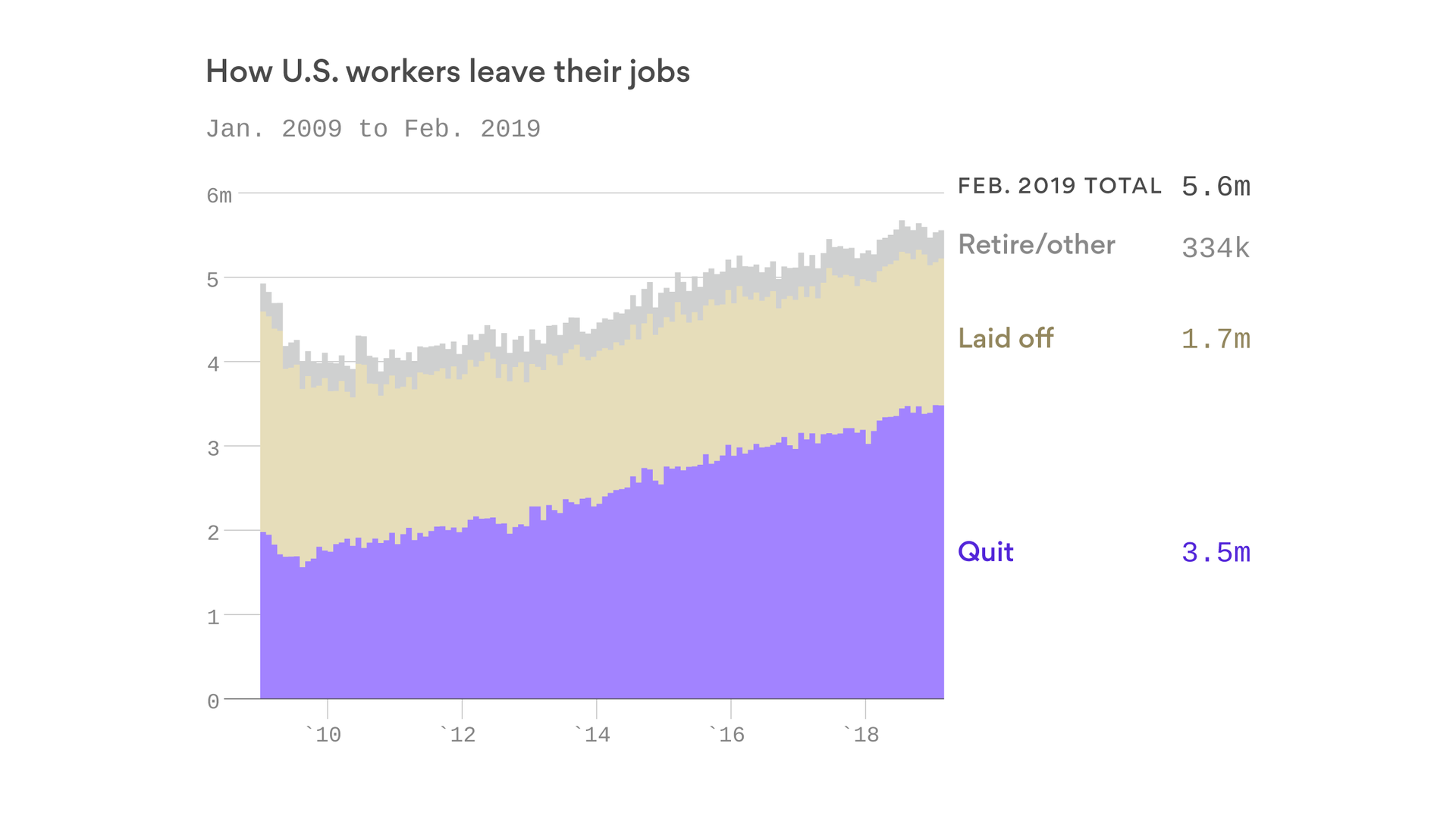
Millions already lose or change health plans every year

https://www.axios.com/newsletters/axios-vitals-1ef6e02e-18e5-4a57-9dd2-891aadfbcaf1.html

Image result for Millions already lose or change health plans every year

Millions of Americans lose their health insurance plans every month, by leaving the job through which they got that coverage, Axios’ Bob Herman reports.

Why it matters: Critics and skeptics of “Medicare for All” worry about eliminating people’s existing coverage because most people are relatively satisfied with their employer-based plans.

  • But millions of workers and their families already switch or lose their insurance from their jobs.

By the numbers: More than 66 million Americans voluntarily quit their jobs, were laid off or otherwise separated from their employers in 2018, and that high turnover rate has continued into 2019, according to data from the Bureau of Labor Statistics.

Details: The BLS data does not measure whether separated jobs offered health insurance.

  • However, close to half of all private employers provide coverage to their workers, and more than 90% of companies with at least 100 employees offer health benefits.
  • It’s therefore reasonable to estimate that at least 2 million workers and their families lose or transfer to new commercial health plans every month.

The bottom line: Behavioral economics teaches that people don’t like to lose what they have, a concept known as “loss aversion.”

Go deeper:


Court: Trump can’t let companies deny birth control coverage

https://www.apnews.com/15851f17cb164b89a4fa3d8be33e156b

Image result for Click to copyhttps://apnews.com/15851f17cb164b89a4fa3d8be33e156b RELATED TOPICS Health Birth control North America Courts U.S. News Barack Obama Court: Trump can’t let companies deny birth control coverage

A divided U.S. appeals court Thursday blocked rules by the Trump administration that allowed more employers to opt out of providing women with no-cost birth control.

The ruling, however, may be short lived because the administration has adopted new rules on contraceptive coverage that are set to take effect next month and will likely prompt renewed legal challenges.

Thursday’s ruling by a three-judge panel of the 9th U.S. Circuit Court of Appeals concerned changes to birth control coverage requirements under President Barack Obama’s health care law that the U.S. Department of Health and Human Services issued in October 2017.

States were likely to succeed on their claim that those changes were made without required notice and public comment, the appeals court panel said in a 2-1 decision.

The majority upheld a preliminary injunction against the rules issued by U.S. District Judge Haywood Gilliam last year. It, however, limited the scope of the injunction, applying it only to the five states in the lawsuit and not the entire country.

Another federal judge also blocked the rules, and her nationwide injunction remains in place.

An email to the Justice Department seeking comment was not immediately returned.

Obama’s health care law required most companies to cover birth control at no additional cost, though it included exemptions for religious organizations. The new policy allowed more categories of employers, including publicly traded companies, to opt out of providing free contraception to women by claiming religious objections. It also allowed any company that is not publicly traded to deny coverage on moral grounds.

The Department of Justice said in court documents that the rules were about protecting a small group of “sincere religious and moral objectors” from having to violate their beliefs. The changes were favored by social conservatives who are staunch supporters of President Donald Trump.

California filed a lawsuit to block the changes that was joined by Delaware, Maryland, New York and Virginia.

“Today’s decision is an important step to protect a woman’s right to access cost-free birth control and make independent decisions about her own reproductive health care,” California Attorney General Xavier Becerra said in a statement.

The states argued that the changes could result in millions of women losing free birth control services, forcing them to seek contraceptive care through state-run programs or programs that the states had to reimburse.

The states show with “reasonable probability” that the new rules will lead women to lose employer-sponsored contraceptive coverage, “which will then result in economic harm to the states,” 9th Circuit Judge J. Clifford Wallace, a nominee of Republican President Richard Nixon, wrote for the majority.

In a dissent, 9th Circuit Judge Andrew Kleinfeld said the economic harm to the states was “self-inflicted” because they chose to provide contraceptive coverage to women. The states, therefore, did not have the authority to bring the lawsuit, Kleinfeld, a nominee of Republican President George H.W. Bush, said.

The case became more complicated after the Trump administration last month issued new birth control coverage rules that are set to supersede those at issue in the lawsuit before the 9th Circuit. Under the new rules, large companies whose stock is sold to investors won’t be able to opt out of providing contraceptive coverage.

Wallace said the new rules did not make the case before the 9th Circuit moot because they are not set to take effect until January.


HEALTH PLAN COSTS ROSE SIGNIFICANTLY FOR SMALL EMPLOYERS IN 2017

https://www.healthleadersmedia.com/finance/health-plan-costs-rose-significantly-small-employers-2017

Image result for higher premiums


Employers across the board saw health plan costs rise for a variety of reasons, but employers with less than 500 workers were especially vulnerable to cost effects, according to a national survey from last year.

Most small employers have faced increasing costs associated with their health plans, while suffering from a lack of leverage and resources to manage the costs.

Though health benefit cost growth has remained steady at 3% annually, a survey of employer-sponsored health plans conducted by Mercer, a healthcare consulting firm, found that employers of varying sizes faced a wide range of health plan cost increases during 2017.

EMPLOYERS WITH 10-499 EMPLOYEES:

  • 34% saw costs increase by more than 10%
  • 29% saw no change
  • 19% saw costs increase 5% or less
  • 18% saw costs increase 6 to 10%

EMPLOYERS WITH MORE THAN 500 EMPLOYEES:

  • 31% saw no change
  • 28% saw costs increase 5% or less
  • 22% saw costs increase 6 to 10%
  • 19% saw costs increase more than 10%

EMPLOYERS WITH MORE THAN 20,000 EMPLOYEES:

  • 50% saw costs increase 5% or less
  • 36% saw no change
  • 14% saw costs increase 6 to 10%
  • 11% saw costs increase more than 10%

The survey attributed the cost increases to a number of factors, namely expensive new treatment options and a rapidly aging population. A new cost driver is the slow rise of uninsured patients, which ticked up in 2017 and is likely to lead to providers shifting the costs of uncompensated care onto employer health plans, according to Mercer. The firm highlighted the importance of maintaining a vibrant workforce in order to counter the effects of rising costs associated with uninsured populations.

“Employers need to manage benefit cost and help employees thrive,” the study read. “These two goals may sound as if they are in opposition – but they don’t have to be.  Employers can slow cost growth while helping their employees to receive better care and a better patient experience.”


Study: Americans using less health care, but paying more for it

Study: Americans using less health care, but paying more for it

Study: Americans using less health care, but paying more for it


Health-care spending has increased because prices are rising, not because Americans are using more health care, according to a new study released Tuesday.

The report from the Health Care Cost Institute (HCCI) showed that total health-care spending grew by 4.6 percent per person from 2015 to 2016 even as utilization of services remained steady, or declined in some cases.

As a result, health-care spending per person reached a new high of $5,407 in 2016.

“It is time to have a national conversation on the role of price increases in the growth of health care spending,” said Niall Brennan, president of the HCCI.

“Despite the progress made in recent years on value-based care, the reality is that working Americans are using less care but paying more for it every year. Rising prices, especially for prescription drugs, surgery, and emergency department visits, have been primary drivers of faster growth in recent years.”

The study focused on people under the age of 65 with employer-sponsored health insurance.

Spending on brand named prescription drugs grew by 110 percent between 2012 and 2016, but utilization dropped 38 percent.

According to the report, the average price for an emergency room visit went up 31.5 percent between 2012 and 2016, but the number of visits only increased slightly.

The average price for surgical admissions increased by 30 percent between that five-year period, but there was a 16 percent drop in utilization.


Healthcare: It’s complicated

http://www.theactuary.com/features/2017/07/its-complicated/

Istock_america_health

It has been a little over seven years since the US began implementing healthcare reform at the national level, following the passage of the Patient Protection and Affordable Care Act (ACA), also known as Obamacare. However, the future of the law’s programmes has never seemed more uncertain now that the United States House of Representatives has passed legislation repealing and replacing many of the ACA’s key provisions.

While the ACA and the proposed replacement legislation are fundamentally different in their approaches to financing and regulating healthcare, they do have one thing in common: both are extraordinarily complicated.

Actuaries have had a front-row seat as healthcare reform has unfolded, and they are in a unique position to help address the challenges our complex system presents – whether that involves setting premium rates, calculating reserves, or just trying to explain healthcare policy to their Facebook friends. After all, actuaries were working to promote the financial stability of our complex healthcare system long before the ACA came along.

Even so, one might ask: Why is the American healthcare system so complicated? Does it have to be that way? Most stakeholders acknowledge that our current system has room for improvement, although opinions vary widely on what to do about that. In part, the complexity of our system is rooted in our history.

The healthcare system that we have today wasn’t formed in one fell swoop. Instead, it has been stitched together gradually over the past century by policymakers working to meet the challenges of their times. For example, the prevalence of employer-sponsored insurance was at least partly driven by price-wage controls implemented by the federal government in the 1940s during the Second World War, together with very favourable tax treatment. When the employer-sponsored market began to flourish, healthcare coverage became unaffordable for the non-working population – in particular, low-income workers, seniors, and disabled individuals – and the Medicare and Medicaid programmes were born. Currently, healthcare in the US is provided and funded through a variety of sources:

  • Employer-sponsored insurance – either self-funded by the employer or insured through a carrier
  • Individual major medical insurance – currently subsidised by the federal government for many individuals under the ACA
  • Medicare, Medicaid, and military health coverage – subsidised by federal and state governments and increasingly administered by privately managed care organisations
  • Other – for instance, the Indian Health Service, care provided to correctional populations, and uncompensated care provided to the uninsured.


It’s therefore not surprising that the policies being proposed today are an attempt to fix the problems we currently face, such as expanding access to affordable healthcare, reducing the cost of healthcare, or improving the quality of care received by patients.

However, our system has evolved in such a way that trying to implement a solution is like trying to solve a Rubik’s Cube – it is hard to make progress on one side without introducing new problems into other parts of the puzzle. For a Rubik’s Cube, successful solvers focus on both the local and global picture, and sometimes must make short-term trade-offs to achieve a longer-term solution. Unfortunately, the short-term nature of political pressures make it difficult to implement longer-term strategies for healthcare. Yet, we see many areas where actuaries can be instrumental in addressing the challenges presented by our complex healthcare system.

Complex times call for complex models

The ACA made sweeping changes that impacted almost every source of coverage listed above. The most profound changes, besides the expansion of Medicaid coverage, were the changes made to the individual and small employer health insurance markets. These already small markets were fractured into several separate pieces (grandfathered business from before the ACA became law, ‘transitional’ business issued before 2014, and ‘ACA-compliant’ business issued in 2014 and beyond). The only constant has been change, with many regulatory changes occurring each year (often after premium rates were set by insurers) and with the stabilisation programmes intended to mitigate risk during this time of change often paradoxically increasing uncertainty. This led some to question whether these markets were inherently too unpredictable to be viable, whereas others felt that the markets were finally starting to stabilise before the election changed everything.

Besides predictability problems caused by regulatory or political factors, two challenges facing health actuaries during these transitional years have been (1) the lag between when market changes are implemented and when data on policies subject to the new rules becomes available, and (2) the difficulty in predicting consumer behaviour in reaction to major changes in market rules such as guaranteed issue and community rating. How many of the uninsured would sign up? How price-sensitive would members be when they renewed their coverage each year? How will changes in other sources of coverage (such as Medicaid expansion) impact the individual market? How will potential actions by competitors affect an insurer’s risk?

Despite the daunting nature of these challenges, actuaries have, out of necessity, found ways to try to address them. For example, faced with the data lag problem, they explored ways to augment traditional claim and enrollment data with new data sources such as marketing databases or pharmacy history data available for purchase. Such sources can be used to develop estimates of the health status of new populations not previously covered by an insurer. Many actuaries also developed agent-based stochastic simulation models that attempted to model the behaviour of consumers, insurers and other stakeholders in these new markets. Such models continue to be used to evaluate the potential outcomes of future changes to the healthcare system, and will probably be essential should efforts to repeal and replace the ACA prove successful.

Information problems: what is a rational actor to do?

Most goods and services in the US have a price tag that consumers can use to ‘shop’ for the option that they feel gives them the best value for their dollar. Healthcare is different. If you ask how much a healthcare service will cost in the US, the answer is “it depends”. List prices such as billed charges for hospitals and physicians and average wholesale prices for pharmaceuticals are increasingly meaningless, given the enormous contractual discounts and rebates that typically apply. The same service may have wildly different prices depending on who is paying for it, and prices may not correlate well with either the clinical value the service provides to the patient or the actual cost to the healthcare provider who renders it. Layered on top of this complex foundation are the often arcane policy provisions that determine a member’s ultimate cost for a claim.

Moreover, even if a patient can determine the cost of treatment at different healthcare providers, making an informed choice often requires clinical knowledge the average person is unlikely to possess. Also, many of the most costly services are non-discretionary and often emergent in nature. In other words, even if a consumer wanted to shop they would be hard-pressed to do so.

All of this means that it is exceedingly hard for various stakeholders – patients, doctors, even insurers – to know the true cost of a service at the point of care, much less manage it. Yet a lot of effort has been spent in trying to better align cost incentives for providers and patients. Past efforts have often used crude methods, such as high deductibles paired with health savings accounts, to create incentives. Current efforts such as value-based insurance designs, which vary cost sharing based on a patient’s clinical profile, use more nuanced approaches to encourage patients to use high-value care. Moving from fee-for-service to value-based payment models for reimbursing healthcare providers has been a focus of both private and public payers in the US.

While such initiatives show promise, they come at the price of even more complexity – and it isn’t always clear that this price is worth paying. The proliferation of more complex benefit designs and provider contracting arrangements can exacerbate the price transparency problems that existed even in the relatively simple fee-for-service world.

Actuaries are well equipped to help insurers, providers and consumers navigate these waters. For example, repricing healthcare claims in an equitable way using actuarial techniques, such as comparing reimbursement rates with a standard fee schedule, is

an efficient way for providers and payers to evaluate cost levels consistently across contracts that may use very different reimbursement methodologies.

Actuaries also have a role to play in developing tools to support clinicians and consumers in understanding the financial dimensions of their healthcare decisions.

Technology: the cause of, and solution to, all our cost problems?

For better or worse, Americans seem determined to seek technological solutions to our health problems, even when lifestyle changes in diet and exercise habits might be just as effective.

Technological advances drive a significant portion of healthcare cost increases, and while many do result in profoundly valuable new therapies, some provide only marginal benefit over existing options at a significantly higher cost. Finding ways to leverage our love of technology to achieve health outcomes more cheaply would be a worthy goal, and one where an actuary could make a difference. Work to use machine learning (for example, in radiology), smarter medical devices, and other data-intensive methods to improve healthcare are still in their infancy, but show promise. From a policy perspective, actuaries could assist in designing novel approaches toward rethinking the incentives for clinical innovation, such as linking payment for new therapies to their clinical value relative to alternatives.

Will the US ever change its relationship status with healthcare from “it’s complicated” to something less ambiguous? In the near term, the answer seems to be “no.” But perhaps we can hope that – with a little help from actuaries – even a complicated relationship can be a good one.

Taking A U-Turn On Benefits, Big Employers Vow To Continue Offering Health Insurance

http://khn.org/news/big-employers-embrace-health-plan-status-quo/

The shrinking unemployment rate has been a healthy turn for people with job-based benefits.

Eager to attract help in a tight labor market and unsure of Obamacare’s future, large employers are newly committed to maintaining coverage for workers and often their families, according to new research and interviews with analysts.

Two surveys of large employers — one released Aug. 2 by consultancy Willis Towers Watson and the other out Tuesday from the National Business Group on Health, show companies continue to try to control costs while backing away from shrinking or dropping health benefits. NBGH is a coalition of large employers.

“The extent of uncertainty in Washington has made people reluctant to make changes to their benefit programs without knowing what’s happening,” said Julie Stone, a senior benefits consultant with Willis Towers Watson. “They’re taking a wait-and-see attitude.”

That’s a marked change from three years ago, when many big employers — those with 1,000 employees or more — contemplated ending medical benefits and shifting workers to the Affordable Care Act’s marketplaces.

In 2014, only 25 percent of big companies were “very confident” they would have a job-based health plan for employees in 10 years, according to the Willis Towers Watson survey.

This year, 65 percent expected to offer health benefits in a decade. And 92 percent said they were very confident a company-based health plan would exist in five years.

Many managers once eyed Obamacare marketplaces as workable coverage alternatives despite the law’s requirement that employers offer health insurance, analysts said.

But problems with marketplace plans, including fewer offerings, rising premiums and shrinking medical networks, have made employers think twice, they said.

Another big reason to maintain rich coverage is “the strength of the economy,” said Paul Fronstin, director of health research at the Employee Benefit Research Institute, an industry group. “Employers are doing what they have to do to get the right workers.”

Unemployment has fallen from 9.9 percent when Obamacare became law in 2010 to 4.3 percent last month, which equaled a 16-year low reached in May.

With such a steep decline, he added, “employers are thinking, ‘We need to offer this benefit for recruitment and retention.’”

Second Thoughts On High-Deductible Plans

Companies are even rethinking the long-standing expedient of shifting a portion of rising medical costs to employees through high-deductible plans and a greater share of the premium bill, other research shows.

“Employers are beginning to recognize that cost sharing has its limits,” said a June report from PwC, a multinational professional services network. Low unemployment and competition for workers mean “employers have less appetite for scaling back benefits and continuing with a plan design that has proven largely unpopular.”

At Fidelity Investments, a Boston-based financial firm with more than 45,000 employees, worker contributions have grown to about 30 percent of total health costs.

Jennifer Hanson, the company’s benefits chief who sits on NBGH’s board, doesn’t see that continuing.

As costs grow, “if you continue to shift more of a bigger number to employees, health care becomes unaffordable,” she said in an interview. “As employers, we really do need to pay attention less to who’s paying for what and more to how much everything costs.”

More than half of Americans with job-based insurance face deductibles — out-of-pocket costs for most care before insurance kicks in — of more than $1,000 for single-person coverage. Family deductibles can be much higher.

High On The To-Do List: Controlling Drug Costs

Big employers’ planned changes for next year focus on controlling drug costs and improving health results through telemedicine and steering patients to efficient, high-quality hospitals, noted the Willis Towers Watson report and the NBGH survey.

Employer health costs continue to rise, but not at the double-digit clip seen for many plans sold to individuals and families through the ACA marketplaces.

Employers expect health costs to increase 5.5 percent next year, up from 4.6 percent in 2017, according to the Willis Towers Watson report.

Companies in the NBGH survey predicted health costs will rise 5 percent next year, up from an average 4.1 percent increase for 2016.

That’s still far faster than inflation, which is less than 3 percent, and overall wage growth.

By many accounts, soaring costs for specialty pharmaceuticals used to treat cancer, rheumatoid arthritis, hemophilia and other complex conditions are the biggest factor.

“These are very expensive drugs,” said Brian Marcotte, NBGH’s CEO. “They cost thousands or tens of thousands per treatment.”

Often these drugs require infusion into the blood in a clinical setting, which can drive up their price tag.

For instance, hospital-based infusions have been found to cost as much as seven times more than those performed in, say, a doctor’s office.

Employers are working hard to steer patients to the least expensive, appropriate site, Marcotte said.

Big employers are also offering more on-site nurses and doctors; setting up accountable care organizations with incentives for doctors and hospitals to control costs; and striking deals with particular hospitals for high-cost operations such as transplants and joint replacements, the NBGH survey found.

Job-based insurance covers some 160 million people younger than 65, according to Census and Labor Department data, far more than the 10 million or so insured by plans sold through Obamacare marketplaces.

Government employers and companies with at least 500 workers, which historically have been more likely to offer health benefits than smaller employers, cover more than 90 million employees and dependents.

Willis Towers surveyed 555 large employers with about 12 million workers and dependents. NBGH surveyed 148 large companies with more than 15 million employees and dependents.

Healthcare Triage News: Many with Employer Insurance Still Need CHIP to Insure Their Kids

Healthcare Triage News: Many with Employer Insurance Still Need CHIP to Insure Their Kids

Image result for Healthcare Triage News: Many with Employer Insurance Still Need CHIP to Insure Their Kids

As employer-sponsored insurance becomes more expensive for children, public programs are picking up the slack. This is Healthcare Triage News.

Incomes Aren’t Keeping up with Employees’ Health Plan Costs

http://www.commonwealthfund.org/interactives-and-data/infographics/2016/incomes-arent-keeping-up-with-employees-health-plan-costs

Premium Trends


Get Health Insurance Through Your Employer? ACA Repeal Will Affect You, Too

http://healthaffairs.org/blog/2017/01/11/get-health-insurance-through-your-employer-aca-repeal-will-affect-you-too/

Close-up photograph of an employee group health insurance application form.

Much of the recent attention on the future of the Affordable Care Act (ACA) has focused on the fate of the 22.5 million people likely to lose insurance through a repeal of Medicaid expansion and the loss of protections and subsidies in the individual insurance market. Overlooked in the declarations of who stands to lose under plans to “repeal and replace” the ACA are those enrolled in employer-sponsored health plans — the primary source of coverage for people under 65.

Job-based plans offered to employees and their families cover 150 million people in the United States. If the ACA is repealed, they stand to lose critical consumer protections that many have come to expect of their employer plan.

It’s easy to understand the focus on the individuals who gained access to coverage thanks to the health reform law. ACA drafters targeted most of the law’s insurance reforms at the individual and small-group markets, where consumers and employers had the greatest difficulty finding affordable, adequate coverage prior to health reform. The ACA’s market reforms made coverage available to those individuals with pre-existing conditions who couldn’t obtain coverage in the pre-ACA world, and more affordable for those low- and moderate-income families who couldn’t afford coverage on their own.

Less noticed, but no less important, the ACA also brought critical new protections to people in large employer plans. Although most large employer plans were relatively comprehensive and affordable before the ACA, some plans offered only skimpy coverage or had other barriers to accessing care, leaving individuals—particularly those with costly, chronic health conditions—with big bills and uncovered medical care. For that reason, the ACA extended several meaningful protections to employees of large businesses.