The fight over preexisting conditions is back. Here’s why the Obamacare battle won’t end.

https://www.vox.com/policy-and-politics/2018/6/11/17441858/obamacare-repeal-debate-lawsuit


There is a persistent divide in the US: Is insurance a privilege to be earned through hard work? Or is it a right?

President Trump and Republicans are so committed to killing Obamacare they’ve decided, just months before the midterm elections, to take aim at the most popular part of the law: coverage for preexisting conditions.

The Trump administration signed on to a long-shot lawsuit this week that would overturn the parts of the law that require insurers to cover preexisting conditions and not charge more for them.

The lawsuit, which you can read more about from Vox’s Dylan Scott, is, in some ways, a perplexing move mere months before midterm elections. Polling finds that both Democrats and Republicans think it’s a good idea to ensure that sick people have access to health insurance.

Politically, though, Republicans spent eight years campaigning on a promise to repeal Obamacare. They believe they have a responsibility to do something, even if the something doesn’t poll well.

But after eight years of covering the Affordable Care Act, I think there is a much deeper tension that keeps the fight over Obamacare alive. It is a persistent, unresolved split in how we think about who deserves health insurance in the United States: Is insurance a privilege to be earned through hard work? Or is it a right?

The United States hasn’t decided who deserves health insurance

Since World War II, the United States has had a unique health insurance system that tethers access to medical care to employment. Changes to the tax code created strong incentives for companies to provide health coverage as a benefit to workers. Now most Americans get their insurance through their employer, and, culturally, health insurance is thought of as a benefit that comes with a job.

Over time, the government did carve out exceptions for certain categories of people. Older Americans, after all, wouldn’t be expected to work forever, so they got Medicare coverage in 1965. Medicaid launched the same year, extending benefits to those who were low-income and had some other condition that might make it difficult to work, such as blindness, a disability, or parenting responsibilities.

Then the Affordable Care Act came along with a new approach. The law aimed to open up the insurance market to anybody who wanted coverage, regardless of whether he or she had a job.

It created a marketplace where middle-income individuals could shop on their own for private health coverage without the help of a large company. It expanded Medicaid to millions of low-income Americans. Suddenly, a job became a lot less necessary as a prerequisite for gaining health insurance.

This, I think, is the divide over health insurance in America. It’s about whether we see coverage as part of work. In my reporting and others’, I’ve seen significant swaths of the country where people push back against this. They see health as something you ought to work for, a benefit you get because of the contribution you make by getting up and going to a job each day.

This came out pretty clearly in an interview I did in late 2016 with a woman I met on a reporting trip to Kentucky whom I’ll call Susan Allen. (She asked me not to use her real name because she didn’t want people to know that she uses the Affordable Care Act for coverage.)

Allen used to do administrative work in an elementary school but now is a caregiver to her elderly mother. Her husband has mostly worked in manual labor jobs, including the coal industry.

Allen told me a story about when she worked in the school. At Christmas, there would be a drive to collect present for the poorest families, presents she sometimes couldn’t afford for her own kids. It made her upset.

”These kids that get on the list every year, I’d hear them saying, ‘My mom is going to buy me a TV for Christmas,’” Allen says. “And I can’t afford to buy my kid a TV, and he’s in the exact same grade with her.”

Allen saw her health insurance as the same story: She works really hard and ends up with a health insurance plan that has a $6,000 deductible. Then there are people on Medicaid who don’t work and seem to have easier access to the health care system than she does.

”The ones that have full Medicaid, they can go to the emergency room for a headache,” she says. “They’re going to the doctor for pills, and that’s what they’re on.”

Is health insurance a right or a privilege?

More recently, Atul Gawande wrote a piece for the New Yorker exploring whether Americans view health care as a right or a privilege.

He reported the story in his hometown in Appalachian Ohio, where he kept running into this same idea: that health insurance is something that belongs to those who work for it.

One woman he interviewed, a librarian named Monna, told him, “If you’re disabled, if you’re mentally ill, fine, I get it. But I know so many folks on Medicaid that just don’t work. They’re lazy.”

Another man, Joe, put it this way: “I see people on the same road I live on who have never worked a lick in their life. They’re living on disability incomes, and they’re healthier than I am.”

As Gawande noted in his piece, “A right makes no distinction between the deserving and undeserving.” But he often found this to be the key dividing line when he asked people whether everyone should have health coverage. Often, it came down to whether that person was the type who merited such help.

This isn’t a debate that happens in most other industrialized countries. If you asked a Canadian who deserves health care, you’d probably get a baffled look in return. Our northern neighbors decided decades ago that health insurance is something you get just by the merit of living in Canada. It’s not something you earn; it’s something you’re entitled to.

But in the United States, we’ve never resolved this debate. Our employer-sponsored health care system seems to have left us with some really deep divides over the fundamental questions that define any health care systems.

Those are the questions we’ll need to resolve before the debate over Obamacare ever ends.


An Estimated 52 Million Adults Have Pre-Existing Conditions That Would Make Them Uninsurable Pre-Obamacare

An Estimated 52 Million Adults Have Pre-Existing Conditions That Would Make Them Uninsurable Pre-Obamacare

Image result for pre existing conditions

In Eleven States, 3 in 10 Non-Elderly Adults Would Likely Be Denied Individual Insurance Under Medical Underwriting Practices.

A new Kaiser Family Foundation analysis finds that 52 million adults under 65 – or 27 percent of that population — have pre-existing health conditions that would likely make them uninsurable if they applied for health coverage under medical underwriting practices that existed in most states before insurance regulation changes made by the Affordable Care Act.

In eleven states, at least three in ten non-elderly adults would have a declinable condition, according to the analysis: West Virginia (36%), Mississippi (34%), Kentucky (33%), Alabama (33%), Arkansas (32%), Tennessee (32%), Oklahoma (31%), Louisiana (30%), Missouri (30%), Indiana (30%) and Kansas (30%).

States with the most people estimated to have the conditions include: California (5,865,000), Texas (4,536,000), and Florida (3,116,000).

Using data from two large government surveys, the analysis estimates the total number of nonelderly adults in each state with a health condition that could lead to a denial of coverage in the individual insurance market, based on pre-ACA field underwriting guides for brokers and agents. The results are conservative because the data don’t include some declinable conditions. The estimates also don’t include the number of people with other health conditions that wouldn’t necessarily cause a denial, but could lead to higher insurance costs based on underwriting.


Trump’s Justice Department says the ACA is unconstitutional

https://www.axios.com/trumps-justice-department-says-aca-is-unconstitutional-06f8714d-7606-4104-9982-f057786828a7.html?stream=top-stories&utm_source=alert&utm_medium=email&utm_campaign=alerts_all

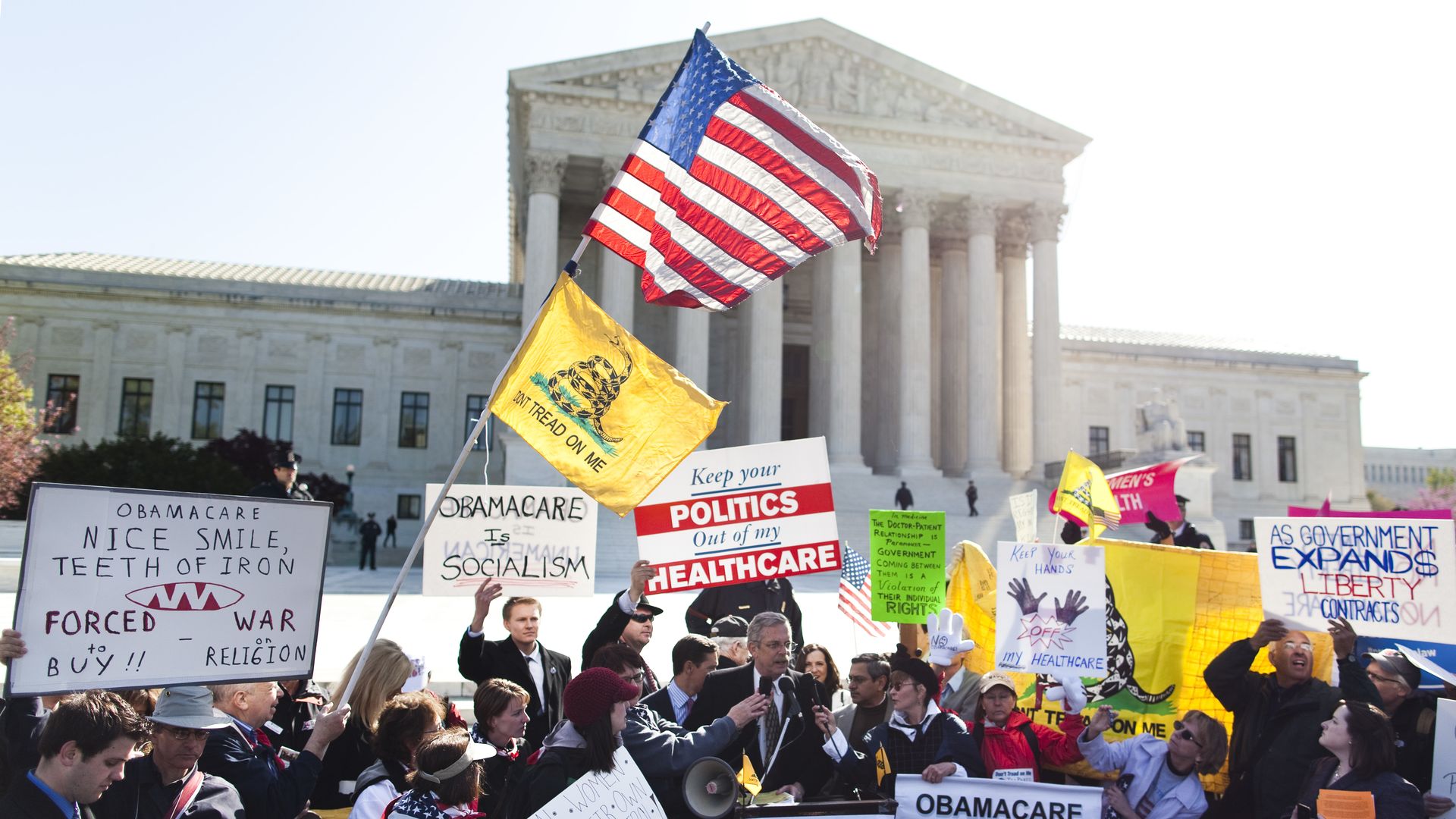
Affordable Care Act protesters in front of the Supreme Court


The Justice Department will not defend the Affordable Care Act in court, and says it believes the law’s individual mandate — the provision the Supreme Court upheld in 2012 — has become unconstitutional.

Why it matters: The Justice Department almost always defends federal laws when they’re challenged in court. Its departure from that norm in this case is a major development — career DOJ lawyers removed themselves from the case as the department announced this shift in its position.

The details: The ACA’s individual mandate requires most people to buy insurance or pay a tax penalty. The Supreme Court upheld that in 2012 as a valid use of Congress’ taxing power.

  • When Congress claimed it repealed the individual mandate last year, what it actually did was drop the tax penalty to $0.
  • So the coverage requirement itself is still technically on the books. And a group of Republican attorneys general, representing states led by Texas, say it’s now unconstitutional — because the specific penalty the Supreme Court upheld is no longer in effect.
  • The Justice Department agreed with that position in a brief filed Thursday night.
  • DOJ said the courts should strike down the coverage requirement, as well as the provision of the law that forces insurance companies to cover people with pre-existing conditions.

Between the lines: For the Justice Department to stop defending a federal law is not unprecedented — the Obama administration did it with the Defense of Marriage Act. But it is exceptionally rare.

Yes, but: A group of Democratic attorneys general has been granted permission to defend the ACA in this case, so someone will be in its corner.

What to watch: The argument against it is by no means a slam dunk. For starters, critics — now including the Justice Department — will have to prove that people are still being injured by the remaining shell of the individual mandate, even without a penalty for non-compliance.

Justice Dept. argues key parts of ObamaCare are unconstitutional

Justice Dept. argues key parts of ObamaCare are unconstitutional

Image result for aca challenge

The Department of Justice (DOJ) argued in court Thursday that key parts of ObamaCare are now unconstitutional, siding in large part with a conservative challenge to the law.

The move is a break from the norm of the DOJ to defend federal laws when they are challenged in court. Under President Trump, the department has opted not to defend a law that it strongly opposes.

Attorney General Jeff Sessions acknowledged in a letter to Speaker Paul Ryan (R-Wis.) that the DOJ has a “longstanding tradition” of defending federal laws, but argued that this is “a rare case where the proper course is to forgo defense” of the law.

The lawsuit in question was filed in February by Texas and 19 other GOP-led states, arguing that ObamaCare is unconstitutional and should be overturned.

Legal experts are deeply skeptical the challenge can succeed, and 17 Democratic-led states have already intervened to defend the law in the absence of DOJ action.

The DOJ argues that ObamaCare’s protections against people with pre-existing conditions being denied coverage or charged more should be invalidated, maintaining that the individual mandate that people have insurance or face a tax penalty is now unconstitutional.

The conservative states and DOJ point to the Supreme Court’s 2012 ruling that upheld ObamaCare’s individual mandate under Congress’s taxing power. Now that Congress has repealed the mandate penalty as part of last year’s tax bill – while technically keeping the mandate itself in place – they argue the mandate is no longer a tax and is now invalid.

They also argue that the key pre-existing condition protections cannot be separated from the mandate and should be invalidated. The DOJ argues the remainder of the law can stay.

The chances for that argument succeeding are viewed with deep skepticism by legal experts, in part because Congress itself indicated that the rest of ObamaCare could still stand without the mandate when it moved to repeal the tax penalty last year.

The case is currently before a federal district court judge in Texas, Reed O’Connor, who was appointed by former President George W. Bush.

Some supporters of ObamaCare view the DOJ’s move more as a damaging break from precedent rather than an actual serious legal threat to ObamaCare, since the lawsuit is unlikely to succeed.


Short-Term Plans Could Bring Long-Term Risks to California’s Individual Market

Short-Term Plans Could Bring Long-Term Risks to California’s Individual Market

Image result for short term health insurance risks


The Trump administration is considering changes to federal rules regulating short-term, limited-duration insurance (“short-term plans”) that could result in the expansion of these plans in California.

This report, written by Georgetown University’s Center on Health Insurance Reforms, provides an overview of short-term plans and the current market for these plans in California. It explains how changes to federal policy around short-term plans might affect California’s individual health insurance market and describes policies that various states are pursuing in response to these changes.

Key points include:

  • Short-term plans are exempt from the Affordable Care Act’s consumer protections. Insurers can deny coverage based on preexisting conditions, not cover certain services, and limit what they will pay for services. For example, many short-term plans currently available in California do not cover maternity and newborn care, mental health and substance use services, and outpatient prescription drugs. They also limit the total amount that plans will pay per day in the hospital and for particular services, such as surgeon fees, in addition to imposing a maximum the plan will spend toward claims covered by the policy.
  • Short-term plans are rare right now in California, but that could change. There is only one insurer currently selling approved short-term plans in California, and fewer than 10,000 policies in effect across the state. But if the Trump administration changes federal rules, and there is no change in California law, enrollment in short-term plans is likely to grow. Under these conditions, the Urban Institute projects that over 600,000 Californians would enroll in short-term plans in 2019.
  • Enrollment in short-term plans could contribute to destabilizing Covered California and increasing premiums. Short-term plans are likely to siphon off healthier and younger consumers from Covered California, which would increase premiums for those remaining in the ACA-compliant market.
  • States are taking action. Colorado, Massachusetts, Michigan, New Jersey, New York, and Rhode Island have taken steps to ensure that short-term plans don’t destabilize their individual health insurance markets. A bill is currently pending in the California legislature banning short-term plans altogether.

The full report is available under Related Materials below.


Americans’ Confidence in Their Ability to Pay for Health Care Is Falling

http://www.commonwealthfund.org/publications/blog/2018/may/americans-confidence-paying-health-care-falling?omnicid=CFC1404232&mid=henrykotula@yahoo.com

President Trump is expected to soon address the nation about the rising cost of prescription drugs. But Americans are worried about more than drug prices. New findings from the Commonwealth Fund Affordable Care Act Tracking Survey show that consumers’ confidence in their ability to afford all their needed health care continues to decline.

Last week, we reported that the survey indicated a small but significant increase in the uninsured rate among working-age adults since 2016. In this post, we look at people’s views of the affordability of their health care. The Affordable Care Act Tracking Survey is a nationally representative telephone survey conducted by SSRS that tracks coverage rates among 19-to-64-year-olds, and has focused in particular on the experiences of adults who have gained coverage through the marketplaces and Medicaid. The latest wave of the survey was conducted between February and March 2018.1

Findings

Confidence in Ability to Afford Health Care Continues to Decline

In each wave of the survey, we’ve asked respondents whether they have confidence in their ability to afford health care if they were to become seriously ill. In 2018, 62.4 percent of adults said they were very or somewhat confident they could afford their health care, down from a high of nearly 70 percent in 2015 (Table 1). Only about half of people with incomes less than 250 percent of poverty ($30,150 for an individual) were confident they could afford care if they were to become very sick, down from 60 percent in 2015 and about 20 percentage points lower than the rate for adults with higher incomes. There were also significant declines in confidence among young adults, those ages 50 to 64, women, and people with health problems. Declines were significant among both Democrats and Republicans.

People in Employer Plans Have the Greatest Confidence in Their Insurance

We asked people with health insurance how confident they were that their current insurance will help them afford the health care they need this year. Majorities of adults were somewhat or very confident in their coverage; those with employer coverage were the most confident. More than half (55%) of adults insured through an employer were very confident their coverage would help them afford their care compared to 31 percent of adults with individual market coverage and 41 percent of people with Medicaid (Table 2). The least confident were adults enrolled in Medicare. Working-age adults enrolled in Medicare were the sickest among insured adults and the second-poorest after those covered by Medicaid (data not shown).2

One-Quarter of Adults Said Health Care Became Harder to Afford

We asked people whether, over the past year, their health care, including prescription drugs, had become harder for them to afford, easier to afford, or if there had been no change. The majority (66%) said there had been no change, one-quarter (24%) said it had become harder to afford, and 8 percent said it had become easier (Table 3). People with individual market coverage were significantly more likely than those with employer coverage or Medicaid to say health care had become harder to afford. About one-third of adults with deductibles of $1,000 or more said health care had become harder to afford, twice the share of those who had no deductible. About one-third of those enrolled in Medicare and 41 percent who were uninsured also reported that their health care had become harder to afford.

Only About Half of Americans Would Have Money to Pay for an Unexpected Medical Bill

Accidents and other medical emergencies can leave both uninsured and insured people with unexpected medical bills, which usually require prompt payment. We asked people if they would have the money to pay a $1,000 medical bill within 30 days in the case of an unexpected medical event. Nearly half (46%) said they would not have the money to cover such a bill in that time frame (Table 4). Women, people of color, people who are uninsured, those covered by Medicaid or Medicare, and those with incomes under 250 percent of poverty were among the most likely to say they couldn’t pay the bill.

Health Care Is Among People’s Top Four Greatest Personal Financial Concerns

Fourteen percent of adults said that health care was their biggest personal financial concern, after mortgage or rent (23%), student loans (17%), and retirement (17%) (Table 5). Those most likely to cite health care as their greatest financial concern were people who could potentially face high out-of-pocket costs because they were uninsured or had high-deductible health plans.

Policy Implications

Uninsured adults are the least confident in their ability to pay medical bills. But the risk of high out-of-pocket health care costs doesn’t end when someone enrolls in a health plan. The proliferation and growth of high-deductible health plans in both the individual and employer insurance markets is leaving people with unaffordable health care costs. Many adults enrolled in Medicare for reasons of disability or serious illness also report unease about their health care costs. An estimated 41 million insured adults have such high out-of-pocket costs and deductibles relative to their incomes that they are effectively underinsured. As this survey indicates, the nation’s health care cost burden is felt disproportionately by people with low and moderate incomes, people of color, and women.

The ACA’s reforms to the individual insurance market have doubled the number of people who now get insurance on that market to an estimated 17 million, with approximately half receiving subsidies through the ACA marketplaces. The ACA also has made it possible for people who were regularly denied coverage by insurers — older Americans and those with health problems — to get insurance. They are now entitled by law to an offer should they want to buy a plan.

But as this survey suggests, the ACA’s reforms did not fully resolve the individual market’s relatively higher costs for all those enrolled, compared to employer coverage or Medicaid. Moreover, recent actions by Congress and the Trump administration, including the repeal of the individual mandate penalty and loosened restrictions on plans that don’t comply with the ACA, are expected to exacerbate those costs for many. In the survey, people with individual market coverage are more likely than those with employer coverage or Medicaid to say that their health care, including prescription drugs, has become harder to afford in the past year. They express less confidence than those with employer coverage that their insurance will help them afford their care this year. As explained in the first post, there are a number of policy options that Congress can pursue that would improve individual market insurance’s affordability and cost protection. In the absence of bipartisan Congressional agreement on legislation, several states are currently pursuing their own solutions. But if current trends continue, the federal government will likely confront growing pressure to provide a national solution to America’s incipient health care affordability crisis.


Premium hikes reignite the ObamaCare wars

Premium hikes reignite the ObamaCare wars

Image result for aca higher premiums

The ObamaCare premium wars are back.

The cost of health insurance plans on the ObamaCare exchanges could jump in the coming weeks, some by double digits, inflaming the issue ahead of the midterm elections.

Democrats argue the price increases are the result of what they refer to as “Republican sabotage.” They contend that, since the GOP controls Congress and the White House, the price hikes are their responsibility — and that’s the message they plan to take into the fall campaign.

“If these early states are any indication, health insurance companies are going to ask for huge hikes in the wake of President Trumpand congressional Republicans’ repeated efforts to sabotage our health-care system,” Senate Minority Leader Charles Schumer (D-N.Y.) said at a press conference last week. “And we Democrats are going to be relentless in making sure the American people exactly understand who is to blame for the rates.”

Republicans counter that it was Democrats who passed the law, enacted in 2010, in the first place and without any GOP votes. And they blame Democrats for the failure to pass a bill that was aimed at shoring up ObamaCare’s exchanges.

Democrats wrote the Affordable Care Act, so “they should look in the mirror,” Sen. Lamar Alexander (R-Tenn.), chairman of the Senate Health Committee, said last week on the Senate floor.

“And this is the very worst. When Republicans were prepared one month ago to stabilize these markets — and according to the Oliver Wyman health-care experts, to lower rates by up to 40 percent over three years — the Democrats said no,” he said.

For years, Republicans had the upper hand on health care, with the backlash to the Affordable Care Act helping them win the House in 2010, the Senate in 2014 and the White House in 2016.

During the Obama administration, Republicans railed against ObamaCare premium hikes while pledging to repeal and replace the law.

But that repeal push ended in failure last year, and Democrats say the political winds have shifted in their favor.

Democrats argue that any higher premiums this year will be a direct result of the Republican Congress and the Trump administration. They refer to certain actions by the GOP — such as the repeal of the individual mandate to have health insurance — as acts of “sabotage” that will siphon healthy people out of the ObamaCare insurance markets, leading to sicker people on the plans and higher costs.

“Thus far, Democrats have been on the defensive about premium increases,” said Cynthia Cox, a health insurance expert with the Kaiser Family Foundation. “Now they’re starting to play offense, and from our polling we’ve seen that a lot of the public now feels that the Trump administration and Congress are responsible for any problems with the [Affordable Care Act] going forward, so it may be that the politics of premium increases has changed.”

Protect Our Care, a pro-ObamaCare group, launched “Rate Watch” on Tuesday, a media campaign and website aimed at getting out the Democrat’s message that Republicans are to blame for rate hikes.

Only a handful of states have released proposed premiums for next year, as insurers are largely still hammering out what their preliminary rates are going to be.

In Maryland, the average proposed increase among insurers and plans was 30 percent. CareFirst BlueCross BlueShield, for example, requested an 18.5 percent hike for its HMO plans and 91.4 percent for its PPO plans.

In Virginia, proposed rate hikes varied widely, from 15 percent to 64 percent. Vermont’s proposed premium increases were more modest.

It’s too early to know the full picture for what premiums will look like around the country for 2019. Insurers tend to file proposed rates in the late spring and early summer, and they’re generally not finalized until early fall — a little more than a month before the ObamaCare exchanges open for business on Nov. 1.

“It’s hard to come up with a general impression … but I think what we can expect is probably another year of double-digit rate increases driven in large part by the individual mandate repeal and the expansion of short-term health plans and association health plans,” Cox said.

The Trump administration proposed a rule to increase the length of time a consumer can keep a plan that doesn’t comply with ObamaCare’s insurance regulations from three months to nearly a year. Democrats deride those plans as “junk insurance.”

Association health plans would let small businesses and self-employed individuals band together to buy coverage that doesn’t comply with ObamaCare’s rules.

Republicans say the rules will expand choice and allow people to buy cheaper alternatives to ObamaCare plans.

Some insurers have cited the repeal of the individual mandate as a factor in their decision to propose rate hikes, and at least one also included the proposed regulations from the administration as a factor.

Some insurance commissioners across the country are approaching the open enrollment period with a level of “concern and a bit of trepidation,” said Julie Mix McPeak, Tennessee’s insurance commissioner who serves as the president of the National Association of Insurance Commissioners.

In McPeak’s home state, she’s hopeful that signs are pointing to rates beginning to plateau and that Tennessee won’t see the large hikes of years past.

“My experience in Tennessee … is not typical for all of the states in the United States,” said McPeak, who was appointed to run the state’s insurance department by Gov. Bill Haslam (R.).

“I’m hearing from some of my colleagues from the national perspective that they are looking at significant rate increases,” she said.

Dave Jones, California’s Democratic insurance commissioner, said he’s worried that some insurers may leave parts of the state.

“We’re working closely with our exchange and other California agencies to do everything we can to encourage insurers to stay and to create as much stability as we can, not withstanding all of the rocks that the Trump administration is throwing at health-care reform,” he said.

If the short-term and association health plan rules are implemented, Jones said he’s prepared to file litigation aimed at stopping the regulations.

In North Dakota, the state’s Republican insurance commissioner is more optimistic.

Jon Godfread said he expects North Dakota’s marketplace will consist of three carriers selling plans across the state — an increase from last year, when areas had only one or two insurers to choose from.

As for rate hikes, he’s hoping in the low double-digits or, worst case, in the 18 percent to 22 percent range. He believes the repeal of the individual mandate won’t have much impact on consumer behavior in North Dakota because people who couldn’t afford insurance have likely already left the marketplace in the state.

“Health insurance and health care by its very nature is demographic,” Godfread said. “We may be leading into a somewhat calm year — in North Dakota, at least that’s what we’re hoping for. But that doesn’t mean my colleagues in Iowa and Nebraska and other places aren’t facing some pretty significant challenges, and we very well, that could be us next year, or it could be us this year still, too. There’s a lot of time between now and open enrollment.”


Gubernatorial Hopefuls Look To Health Care For Election Edge

Gubernatorial Hopefuls Look To Health Care For Election Edge


California’s leading gubernatorial candidates agree that health care should work better for Golden State residents: Insurance should be more affordable, costs are unreasonably high, and robust competition among hospitals, doctors and other providers could help lower prices, they told California Healthline.

What they don’t agree on is how to achieve those goals — not even the Democrats who represent the state’s dominant party.

“Health care gives them the perfect chance to crystalize that divide” between the left-wing progressives and the “moderate pragmatists” of the Democratic Party, said Thad Kousser, a political science professor at the University of California-San Diego.

Consider the top two Democratic candidates, who both aim to cover everyone in the state, including immigrants living here without authorization.

Lt. Gov. Gavin Newsom — billed as a liberal Democrat — supports a single-payer health care system. That means gutting the health insurance industry to create one taxpayer-funded health care program for everyone in the state.

But former Los Angeles Mayor Antonio Villaraigosa has called single-payer “unrealistic.” He advocates achieving universal health coverage through incremental changes to the current system.

Under California’s “top-two” primary system, candidates for state or congressional office will appear on the same June 5 ballot, regardless of party affiliation. The top two vote-getters advance to the November general election.

A poll in late April by the University of California-Berkeley Institute of Governmental Studies puts Newsom in first place with the support of 30 percent of likely voters, followed by Republicans John Cox, with 18 percent, and Travis Allen with 16 percent. Trailing behind were Democrats Villaraigosa, with 9 percent, John Chiang with 7 percent and Delaine Eastin with 4 percent. Thirteen percent of likely voters remained undecided.

Health care is in the forefront of this year’s gubernatorial campaign because of recent federal attempts to repeal the Affordable Care Act, which would have threatened the coverage of millions of Californians, said Kim Nalder, professor of political science at California State University-Sacramento. California has pushed back hard against Republican efforts in Congress to dismantle the law.

“There’s more energy in California around the idea of universal coverage than you see in lots of other parts of the country,” Nalder said. Democrats and those who indicate no party preference make up almost 70 percent of registered voters. Those voters care more about health coverage than Republicans, she said.

“Whoever is most supportive [of universal health care] is likely to win the votes,” she said.

The top Republican candidates, Cox and Allen, are not fans of increased government involvement, however. They favor more market competition and less regulation to lower costs, expand choice and improve quality.

“Governments make everything more expensive,” said Cox, a former adviser to former House Speaker Newt Gingrich during his presidential run. “The private sector looks for efficiencies.”

California Healthline reached out to the top six candidates based on the institute’s poll, asking about their positions on health insurance, drug prices, the opioid epidemic and hospital consolidation.

Let the ACA rate hikes begin

Image result for ACA Rate Hikes

Get ready for about six more months of headlines like this: Insurers in Maryland are proposing premium hikes as high as 91% for coverage sold through the Affordable Care Act.

This will keep happening, nationwide. Proposed increases have been steep in Maryland and Virginia, the first two states to release them. But all signs point to steep hikes across the country, especially in rural areas. Some insurers also will likely decide to simply quit offering coverage in some parts of the country.

The latest: Insurers in Maryland’s individual market are seeking rate hikes for next year that range from 18% (for the biggest plan in the state) to 91% (for the smallest). They average out to roughly 32%.

  • These rates are still preliminary — Maryland can approve or reject proposed increases, and it’s also pursuing a reinsurance program that would help bring these increases down.

Why you’ll hear about this again: More preliminary rates will trickle out until the summer, as will any insurers’ decisions to pull up stakes in some markets. After negotiations with state regulators, rates will be finalized a few weeks before the midterms.

  • Expect to hear Democrats making hay of these increases as they accuse Republicans of “sabotaging” the ACA.
  • There’s really no denying that the repeal of the ACA’s individual mandate, coupled with some of the Trump administration’s regulatory moves, is a big driver — though not the only driver — of these staggering increases.

The other side: Expect the Trump administration to cite these same figures as it finalizes regulations that would loosen access to options outside the ACA’s exchanges, saying they’re providing new options to people who simply can’t afford ACA coverage.

  • Don’t forget, though, that some of those options would only benefit the healthiest consumers.

Medicare Beneficiaries Feel The Pinch When They Can’t Use Drug Coupons

https://khn.org/news/medicare-beneficiaries-feel-the-pinch-when-they-cant-use-drug-coupons/

This week, I answered a grab bag of questions about drug copay coupons and primary care coverage on the health insurance marketplace.

Q: My doctor wants me to take Repatha for my high cholesterol, but my Medicare drug plan copayment for it is $618 a month. Why can’t I use a $5 drug copay coupon from the manufacturer? If I had commercial insurance, I could. I’m on a fixed income. How is this fair?

The explanation may offer you little comfort. Under the federal anti-kickback law, it’s illegal for drug manufacturers to offer people any type of payment that might persuade them to purchase something that federal health care programs like Medicare and Medicaid might pay for. The coupons can lead to unnecessary Medicare spending by inducing beneficiaries to choose drugs that are expensive.

“The law was intended to prevent fraud, but in this case it also has the effect of prohibiting Part D enrollees from using manufacturer copay coupons … because using the coupon would be steering Medicare’s business toward a particular entity,” said Juliette Cubanski, associate director of the Program on Medicare Policy at the Kaiser Family Foundation. (Kaiser Health News is an editorially independent program of the foundation.)

The coupons typically offer patients with commercial insurance a break on their copayment for brand-name drugs, often reducing their out-of-pocket costs to what they would pay for inexpensive generic drugs. The coupons help make expensive specialty drugs more affordable for patients. They can also increase demand for the drugmaker’s products. If patients choose to use the coupons to buy a higher-cost drug over a generic, the insurer’s cost is likely to be more than what it would otherwise pay.

In addition, consumers should note that the copay cards often have annual maximums that leave patients on the hook for the entire copayment after a certain number of months, said Dr. Joseph Ross, associate professor of medicine and public health at Yale University who has studied copay coupons.

The coupons may discourage patients from considering appropriate lower-cost alternatives, including generics, said Leslie Fried, a senior director at the National Council on Aging.

According to a 2013 analysis co-authored by Ross and published in the New England Journal of Medicine, 62 percent of 374 drug coupons were for brand-name drugs for which there were lower-cost alternatives available.

Q: Last year, my marketplace plan covered five primary care visits at no charge before I paid down my $2,200 deductible. This year, it doesn’t cover any appointments before the deductible, and I had to pay $80 out-of-pocket when I went to the doctor. Is that typical now? It makes me think twice about going.

Under the Affordable Care Act, marketplace plans are required to cover many preventive services, including an annual checkup, without charging consumers anything out-of-pocket. Beyond that, many marketplace plans cover services such as some primary care visits or generic drugs before you reach your deductible.

The likelihood of having a plan that offers some cost sharing for primary care before you reach your deductible (rather than requiring you to pay 100 percent of the cost until you hit that amount) varies significantly depending on whether you’re in a bronze, silver or gold plan, according to a recent analysis by the Robert Wood Johnson Foundation.

In 2018, 77 percent of silver-level plans offered some cost sharing for primary care visits before enrollees had paid off their typical deductible of $3,800, the analysis found. In most cases, that means people owe a copayment or coinsurance charge for each visit until they reach their deductible. A small number of plans offered a limited number of no-cost or low-cost visits first, and then people using more services either had to pay the full charge for each visit or owed cost sharing until the deductible was met.

Bronze plans were much stingier in what they offered for primary care before people reached their deductible, which was $6,400 or higher in half of plans. Only 38 percent of bronze plans offered any primary care coverage before the deductible, and generally patients still had to pay a copayment or coinsurace. A smaller percentage of bronze plans offered limited visits at no cost or low cost before the deductible.

The share of people who chose bronze plans grew from 23 percent in 2017 to 29 percent this year, said Katherine Hempstead, a senior policy adviser at the Robert Wood Johnson Foundation. While premiums are typically significantly lower in bronze plans than other “metal”-level plans, it can be worthwhile to check out how plans handle primary care services before the deductible, she said.