The U.S. Health Disadvantage And The Role Of Spending

http://healthaffairs.org/blog/2016/06/01/the-u-s-health-disadvantage-and-the-role-of-spending/

Blog_supportive-housing

Each week it seems, more evidence emerges regarding the poor health of Americans. We first documented a “U.S. health disadvantage” as chair and study director of the panel on understanding cross-national health differences among high-income countries at the National Academies in 2013.

Our panel’s report Shorter Lives, Poorer Health showed that, as long ago as 1980, the United States began to take a different path in terms of the health and survival of its population. We found evidence that the U.S  health disadvantage compared to other countries existed among Americans at every age below 75, among all races/ethnicities, and among both men and women—but especially among women. We even found evidence of a health disadvantage among white, college-educated, non-obese, non-smoking, and health-insured Americans.

‘Value Creation’ And ‘Value Shifting’ In Health Care

http://healthaffairs.org/blog/2016/06/01/value-creation-and-value-shifting-in-health-care/

Reinhardt_Exhibit1


The whole industry seems to be reading from the same playbook: Pair up with a company that makes the same product to become a leading provider, and thus gain more clout to negotiate business with hospitals and health insurers. There is ample empirical research in health economics showing that consolidation on the supply side of the health care sector has served to drive up prices. It is another way of saying that it supports value shifting, rather than value creation.

My gratuitous advice to the drug industry, and to the health care industry in general, is to be very mindful of the distinction between value creation and value shifting in their pricing policies, lest they eventually invoke the wrath of the losers in that game, with dire consequences.

The next stage in health reform

http://www.brookings.edu/blogs/health360/posts/2016/05/26-next-stage-health-reform-aaron?utm_campaign=Brookings+Brief&utm_source=hs_email&utm_medium=email&utm_content=30041023&_hsenc=p2ANqtz-_AGn4Thn8Inuyc_igk7tSjtVMCb-JaqXsYBkb7NQyhEedpzf3Z1b_iYA3tbVpbHWqABocRNpikaooKtyt-j38BLbyOQA&_hsmi=30041023

health-care-reform-logo-001

Health reform (aka Obamacare) is entering a new stage. The recent announcement by United Health Care that it will stop selling insurance to individuals and families through most health insurance exchanges marks the transition. In the next stage, federal and state policy makers must decide how to use broad regulatory powers they have under the Affordable Care Act (ACA) to stabilize, expand, and diversify risk pools, improve local market competition, encourage insurers to compete on product quality rather than premium alone, and promote effective risk management. In addition, insurance companies must master rate setting, plan design, and network management and effectively manage the health risk of their enrollees in order to stay profitable, and consumers must learn how to choose and use the best plan for their circumstances.

The End of Antibiotics? Drug-Resistant Superbug Reaches the US

http://www.thefiscaltimes.com/2016/05/26/End-Antibiotics-Drug-Resistant-Superbug-Reaches-US?utm_campaign=541c47950e351dbe08037e5f&utm_source=boomtrain&utm_medium=email&bt_alias=eyJ1c2VySWQiOiJjNmQ1ZmRkOC03N2RkLWFjOWUtZWQyZC0zYmZmN2E3ODZjZjcifQ%3D%3D

For the first time, researchers have found a person in the United States carrying bacteria resistant to antibiotics of last resort, an alarming development that the top U.S. public health official says could mean “the end of the road” for antibiotics.

The antibiotic-resistant strain was found last month in the urine of a 49-year-old Pennsylvania woman. Defense Department researchers determined that she carried a strain of E. coli resistant to the antibiotic colistin, according to a study published Thursday in Antimicrobial Agents and Chemotherapy, a publication of the American Society for Microbiology. The authors wrote that the discovery “heralds the emergence of a truly pan-drug resistant bacteria.”

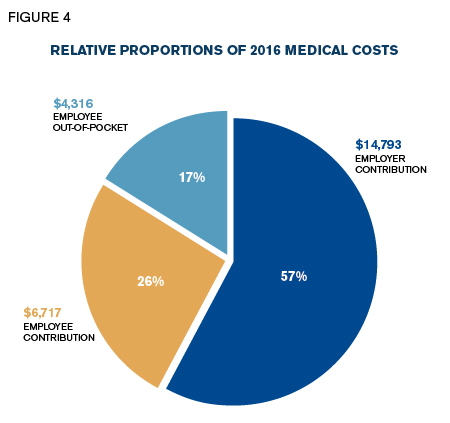
Health Care Costs for Average American Family Now Exceed $25,000 a Year

http://www.thefiscaltimes.com/2016/05/24/Cost-Health-Care-Average-American-Family-Now-Exceed-25000-Year?utm_campaign=541c47950e351dbe08037e5f&utm_source=boomtrain&utm_medium=email&bt_alias=eyJ1c2VySWQiOiJkYzYxNmI4YS03YTE4LTYyZjAtZWI5Ni02Mzk3ZDdkNDM4YWMifQ%3D%3D

Payer Consolidation Expected to Roll on Over Next Decade

http://www.healthleadersmedia.com/health-plans/payer-consolidation-expected-roll-over-next-decade?spMailingID=8976156&spUserID=MTMyMzQyMDQxMTkyS0&spJobID=922552058&spReportId=OTIyNTUyMDU4S0

Health Insurer Consolidation

Senior-level healthcare industry stakeholders believe that consolidation in the payer space is likely to continue over the next ten years—and not to the benefit of consumers.

The imposing cost of a single opioid overdose

http://www.metrowestdailynews.com/article/20160521/NEWS/160528946

Framingham firefighter Joe Sylvester, left, holds a Narcan nasal spray as  firefighter Jose Funes looks on at the Loring Street station Tuesday.   (Daily News and Wicked Local Staff Photo/Ken McGagh)

A five- or six-figure bill that doesn’t even include the hospital stay.

http://www.fiercehealthfinance.com/story/imposing-cost-single-opioid-overdose/2016-05-23?utm_medium=nl&utm_source=internal&mrkid=959610&mkt_tok=eyJpIjoiWWpCalpUWXpNREJtWkRjMiIsInQiOiIxSmJGXC9ScEZZSU5icXBzQ2FpYjNER0ljaVV0VGFIRHBVd2RRaEcxNU56elwvbkw5aHkwYTZNaHppSDFlOUlDSndYS1N4dDAzN3l0N0hZbUlMWnh6ZWUyUllqRFhPTHJ1TWxRNUh0bzRCMDBrPSJ9

How Health Care Factors Into the Presidential Campaign

http://blogs.wsj.com/washwire/2016/04/06/how-health-care-factors-into-the-presidential-campaign/?utm_campaign=KFF-2016-Drew-WSJ-April-6-health-presidential-campaign&utm_medium=email&_hsenc=p2ANqtz-_jUVxiLFykqI9M8jDv5Egwn6DLgLg0exdZlssEVDrrjrflOw4n1yiezfjQ19MmdVixjXyflQ8-vsKKmjB4zlsq1x0Zlg&_hsmi=28151425&utm_content=28151425&utm_source=hs_email&hsCtaTracking=0e6c294a-87bf-418b-9e9b-27c7bd1c5e89%7C19877ff1-2138-41ce-953d-d8c504e9aee8

Healthcare Voter Poll

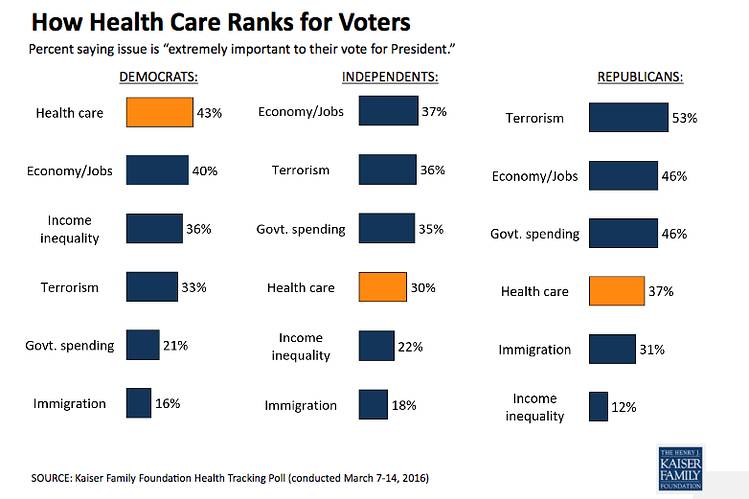
Health care has faded into the background of the election campaign as Donald Trump himself has become the issue on the Republican side and the debate between Hillary Clinton and Bernie Sanders over health care has shifted to other topics. This doesn’t mean that health will be the No. 1 or No. 4 factor when Democrats and Republicans vote in November. As the chart also shows, issue priorities are closely bunched, and my experience has been that voters cast ballots in presidential elections on the basis of their overall views of the candidates rather than candidates’ specific positions on issues.

When people say health care is an extremely important voting issue, they aren’t always thinking of the ACA. Among Republicans who say health is “extremely important” to their vote, about equal shares are thinking about the ACA as are thinking about issues such as access to care and health-care costs. Nor are Democrats always intending to support the ACA when they cite health as a voting issue. They are more likely to cite improving access or addressing costs generally as their reason for naming health a top voting issue.

What to Look for in 2017 ACA Marketplace Premium Changes

What to Look for in 2017 ACA Marketplace Premium Changes

Health Insurance Exchanges2

Why Today’s Poll Numbers on Health Proposals Are Bound to Change

http://blogs.wsj.com/washwire/2016/05/24/why-todays-poll-numbers-on-health-proposals-are-bound-to-change/?utm_campaign=2016-Drew-WSJ-May-24-polls-ideas-legislation&utm_medium=email&_hsenc=p2ANqtz-99JEsdv7eJnUdzjj2w7ZbRJN7Wd9noBGIThqhMyBOHKlc-5lBAWltURMs3EdIT4gYqj_TLYI4KhLxHcSg4KZfO1-ag1w&_hsmi=29882227&utm_content=29882227&utm_source=hs_email&hsCtaTracking=7c94cb34-47b8-4e25-8c1c-cc32f0f28b54%7Cb5c82547-560b-4700-814f-11ce1ecc8232

Single Payer Health Poll

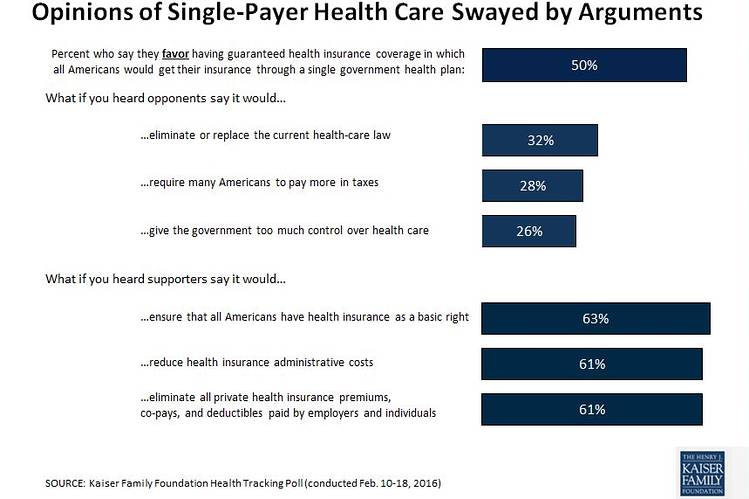
Gallup polling released last week showed majority support–58%–for replacing the Affordable Care Act with a federally funded health system. The same poll found 51% support for repealing the ACA. There is a basic point that often gets lost in reaction to poll findings like these: They measure the public’s initial response to ideas and words, and proposals such as single payer or ACA repeal that people associate with candidates–but they don’t tell us much about the likely level of support for a policy if there is a real debate about legislation before Congress, with winners and losers laid bare.

It’s always a fair bet that support would decline for big changes that come with big trade-offs–whether it is single-payer health care or ACA repeal or something else–but there is no way to know those levels in advance, and support could rise or fall depending on how a legislative debate plays out. Consider single-payer health care as an example. In February, the Kaiser Family Foundation monthly tracking poll simulated some of the arguments the public might hear in a debate about single payer.