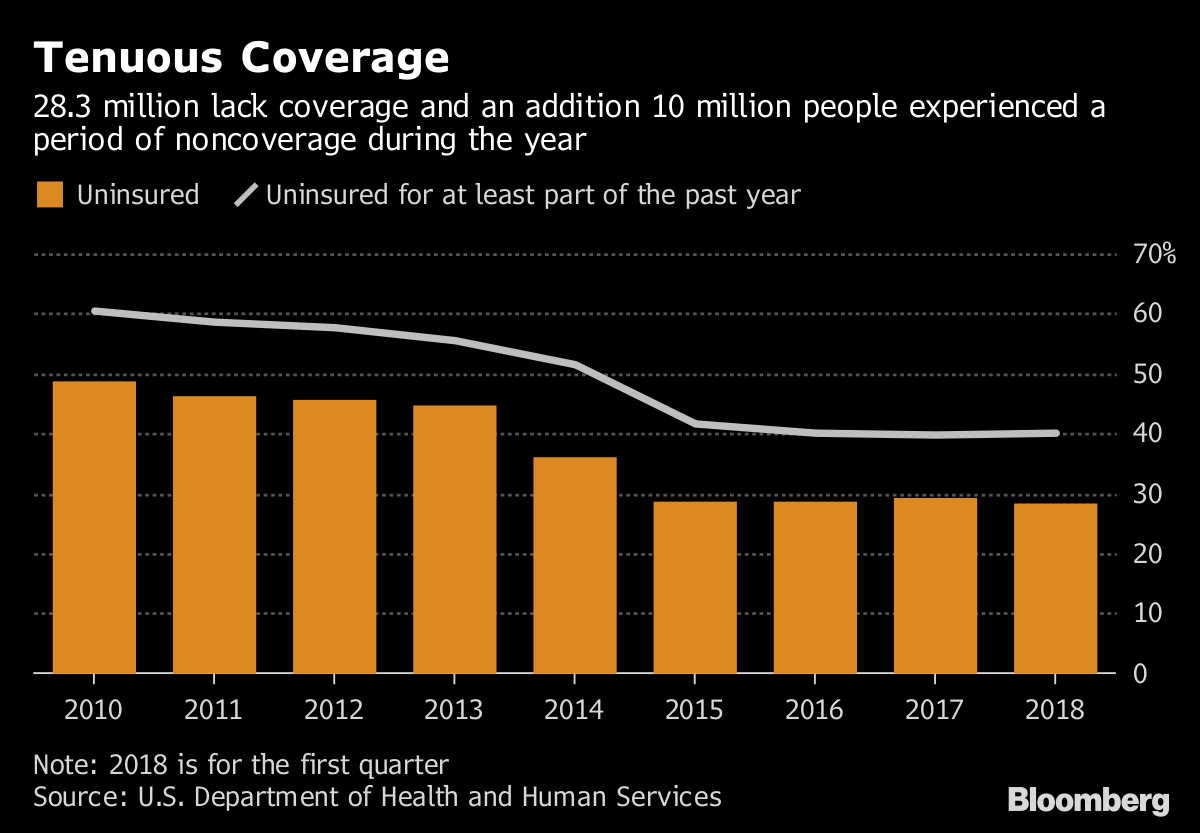
Fewer Americans Without Health Plans Since Obamacare Debut

https://www.bloomberg.com/news/articles/2018-08-29/fewer-americans-without-health-insurance-since-obamacare-debut

Image result for Fewer Americans Without Health Plans Since Obamacare Debut

Fewer Americans lack health insurance — but the gap remains wide, especially in some pro-Trump states.

The number of uninsured declined to 28.3 million in the first quarter, down from 29.3 last year — and 48.6 million in 2010, the year the Affordable Care Act was signed into law by then-President Barack Obama, according to data from the federal Centers for Disease Control and Prevention.

The distribution, however, is uneven with data for south central states — Arkansas, Louisiana, Oklahoma and Texas — showing almost a quarter of adults lacking health care coverage. President Donald Trump, who has opposed Obamacare, won those four states in the 2016 presidential election.

The CDC data also show:

  • Even with the reduction, one in eight Americans between 18 to 64 remained uninsured.
  • Of those with insurance, about one in five were covered by public plans and seven in ten were covered by private plans. Children fared better, with more than 95 percent covered by public or private plans.
  • About one in four Hispanics lacked coverage while 14.1 percent of non-Hispanic blacks, 8.9 percent of non-Hispanic whites and 6.1 percent of non-Hispanic Asians lacked coverage.
  • The number of people under age 65 covered under the Health Insurance Marketplace declined by about 1 million to 9.7 million.
  • The number of adults who lacked health insurance for more than one year declined from 32 million in 2010 to 14.9 million in the first quarter of this year.


ACA court case causing jitters in D.C. and beyond

http://www.modernhealthcare.com/article/20180831/NEWS/180839976

Image result for 2018 midterm elections


For months, congressional Republicans have ignored the Texas-led lawsuit seeking to overturn the Affordable Care Act. With the midterm elections looming, talk of the case threatened to reopen wounds from failed attempts to repeal the law. Not to mention that legal experts have been panning the basis of the suit.

But that’s all changing as the ACA faces its day in court … again. The queasy feeling of uncertainty that surrounded the law just one year ago is back. The level of panic setting in for the industry and lawmakers is pinned to oral arguments set for Sept. 5 in Texas vs. Azar. Twenty Republican state attorneys general, led by Ken Paxton of Texas, are seeking a preliminary injunction to halt enforcement of the law effective Jan. 1. Their argument is built around the Supreme Court’s 2012 ruling in which Chief Justice John Roberts said the law is constitutional because it falls under Congress’ taxing authority. The AGs have seized on the congressional GOP’s effective elimination of the individual mandate penalty in the 2017 tax overhaul as grounds to invalidate the law. 

They have the Trump administration on their side, in part. The Justice Department in June filed a brief arguing that the individual mandate as well as such consumer protection provisions as barring insurance companies from denying coverage to people with pre-existing conditions are unconstitutional. But the department stopped short of suggesting that the entire law be vacated.

Conservative U.S. District Judge Reed O’Connor will hear the case in Austin, Texas. O’Connor has already ruled against an ACA provision that prohibited physicians from refusing to perform abortions or gender-assignment surgery based on religious beliefs, and he is considered a wild card.

Even ACA supporters who downplay the legal standing of the case are bracing for the possibility that O’Connor will side with the plaintiffs, who ultimately see a path to the Supreme Court.

Republicans, meanwhile, are trying to head off a potential political storm. A coalition of Senate Republicans led by Sen. Thom Tillis of North Carolina introduced a bill to codify guaranteed issue for people with pre-existing conditions into HIPAA laws. But they left out the key mandate that insurers can’t exclude coverage of treatment for pre-existing conditions. That omission left health insurers scratching their heads and Democrats came out swinging, with Democratic Sen. Claire McCaskill of Missouri dubbing the measure “a cruel hoax.”

The politics around coverage protections will really start to matter for Republicans should O’Connor signal support for the plaintiff states, according to Rodney Whitlock, a Washington healthcare strategist and former GOP Senate staffer. “It ups the pressure considerably,” he said. “There’s no question it complicates things for Republicans if a decision comes down in October.”

Insurers are on the lookout for signs of what could happen next. If O’Connor’s decision comes down before open enrollment starts on Nov. 1, the GOP will feel increasing pressure to do something substantive, according to an industry official who asked not to be identified.

Although a ruling striking down the law wouldn’t necessarily impact the individual market in 2019, it would spark the kind of massive uncertainty that insurers hate and complained of last year during the GOP repeal-and-replace efforts.

America’s Health Insurance Plans filed an amicus brief urging the court to deny the request for a preliminary injunction, citing the massive impact such a move would have on insurers in the individual market, Medicaid managed care and Medicare Advantage plans.

“It creates a lot of impetus for federal or state action,” the insurance official said, noting that insurers would have to rely on HHS to interpret how the law’s regulations would apply going forward. If mounting court decisions start to drastically affect the law’s mandates, it would fall to HHS how to manage complicated questions around how to follow ACA rules.

HHS and Justice Department officials declined to comment. CMS Administrator Seema Verma in August told McCaskill when pressed at a Senate committee hearing that she would support legislation to protect pre-existing conditions, but she declined to specify how the CMS would respond administratively if the suit succeeds.

For now, lawmakers aren’t showing any willingness to take a bipartisan approach. The House GOP plans to introduce a companion bill to the Senate measure, Tillis told Modern Healthcare last week. Meanwhile Democrats have made hay over the fact that the protections in his legislation are incomplete. Tillis said leaving out the prohibition of coverage exclusions was not intentional and GOP senators would look again at the bill if the lawsuit advances.

He added that he envisions the legislation as just one piece that could build into a bigger overhaul effort, and wants to see protections of other popular provisions such as allowing people up to age 26 to stay on their parents’ health insurance.

“It’s similar to what we talked about last year,” Tillis said, referencing the 2017 repeal-and-replace efforts. “Any sort of court challenge that would cause a precipitous voiding of Obamacare would leave a lot of people in the lurch, and one of those areas is pre-existing conditions.”

Sen. Bill Cassidy (R-La.), who spearheaded the last major GOP effort to repeal and replace the ACA last year, also said he would want to look at more comprehensive legislation if the lawsuit advances. “I certainly would,” Cassidy said. “I can’t speak for all, but I do think there would be a drive to.”

How Republicans will move past messaging and into action remains to be seen, Whitlock said.

“If you think of the seminal moments of 2017, you think of pre-existing conditions and the Jimmy Kimmel test,” Whitlock said, referencing the talk show host’s attack on the repeal-and-replace effort following emergency heart surgery for his newborn son. “This was a big deal because people were concerned. It is a very important issue, and it’s also one that Republicans have tried to say in every bill that they’re trying to protect. They have been successful to varying degrees in making that case. But with the Texas lawsuit, there’s no protecting it. It says, throw out the entire ACA root and branch.”

And as nomination hearings for Supreme Court nominee Brett Kavanaugh get underway Sept. 4, Democrats will keep using the GOP’s dilemma as a cudgel. McCaskill, for instance, is leveraging the issue in her neck-and-neck race against Missouri Attorney General Josh Hawley, who is part of the lawsuit.

“How do you have a pre-existing conditions bill that says we’re not going to protect someone with a pre-existing condition?” she told reporters last week. “It’s embarrassing, it’s the Potomac two-step. Do they think nobody’s paying attention? They’re just trying to cover themselves politically, isn’t it obvious?”

And then there’s the other political dilemma for Republicans who want to show they can secure Obamacare’s protections: convincing their base that they still fundamentally oppose Obamacare even if they don’t want to talk about repeal-and-replace anymore.

“You can be sure there are folks out there who really desperately don’t want to see the Texas side laughed out of court,” Whitlock said. “It destroys the whole narrative about the lawsuit. It’s this bizarre dynamic where an obscure lawsuit that has no legal basis whatsoever leaves the opportunity to talk about” repeal.

He added: “There are people who are flat-earthers on ACA, still preaching complete and total repeal.”


How the Midterms Could Impact Medicaid

http://www.governing.com/topics/health-human-services/gov-medicaid-expansion-election-midterms-november-2018.html

Image result for 2018 midterm elections


The fate of Medicaid expansion, a central tenet of President Obama’s signature health-care legislation, is in the hands of the people in several states.

In Idaho, Nebraska and Utah, voters will decide whether to make more low-income people, those up to 138 percent of the federal poverty line, eligible for Medicaid, the government-run health insurance program. In most of the other states, who voters elect as governor and to the legislature will influence the direction of this health-care policy for years to come.

Since the Affordable Care Act passed in 2010, 33 states have expanded Medicaid, largely along partisan lines, with Republicans leading the holdout movement. But in some cases, Republican governors tried for years to convince their GOP legislatures to expand.

Health policy experts say that, generally, a state’s status of expansion guides which races are most important to watch in the midterms.

“For a state that hasn’t yet expanded, the governor can’t do it all, so you have to watch what happens with the legislature,” says David Jones, associate professor of health law at Boston University who recently examined where Medicaid expansion appears more vulnerable. “But for states that have already expanded, the legislature doesn’t matter as much” because the governor has authority to tweak the current law or to end expansion in some cases.

The midterms come at a crucial time for health care. The Trump administration gave states the greenlight to adopt new rules for Medicaid that the Obama administration rejected. For instance, Arkansas, Kentucky, Indiana and New Hampshire have been approved to add work requirements, and several other states have applied. In July, a federal judge struck down Kentucky’s work requirements plan, putting the rest of the states’ policies into legal jeopardy. Despite the ruling, the Trump administration has signaled that it plans to proceed with work requirements.

Michigan is one expansion state where health policy could veer far to the right if the Republican nominee for governor, ‎Bill Schuette, wins what is considered a tossup race. Schuette, the state’s attorney general, leans more conservative than term-limited Republican Gov. Rick Snyder. On the campaign trail, Schuette has supported repealing and replacing the Affordable Care Act.

“He talks a lot about what he doesn’t like [about the ACA], but he has yet to say what he’d do that’s positive,” says Marianne Udow-Phillips, executive director of the Center for Healthcare Research and Transformation based in Ann Arbor, Mich. “I see him being in the mold of Scott Pruitt at the Environmental Protection Agency, doing a lot of rolling back of regulations.”

In Michigan, 680,000 people gained coverage under Medicaid expansion, and 350,000 could lose it if work requirements are put in place. Snyder signed a bill in June to submit a waiver to the federal government that, if approved, would require Medicaid recipients in the state to have a job.

“We’ve gotten used to thinking that Michigan is a moderate state because they have Democratic senators and sometimes go blue in presidential elections,” says Jones, “but … it’s a pretty conservative group of senators in the statehouse,” and a more conservative governor might be able to drum up support for far-right Medicaid changes.

Schuette’s Democratic opponent, Gretchen Whitmer, supports Medicaid expansion and opposes the work requirements waiver, according to a spokesperson in her campaign office.

In Ohio, another expansion state, GOP Gov. John Kasich is term-limited. While he is one of the staunchest defenders of Medicaid expansion, he did pass off a waiver request for work requirements to the feds. Republican Attorney General Mike DeWine and Democrat Richard Cordray, the former head of the Consumer Financial Protection Bureau, are in a tossup race to succeed him.

DeWine leans more pragmatic in general, so John Corlette, executive director of the Center for Community Solutions based in Cleveland, says “I would expect his approach would be closer to Kasich.” DeWine has said he supports expansion with a work component, while Cordray supports expansion with no work requirements.

In Ohio, work requirements threaten coverage for 36,000 adults.

If any states elect governors who are more conservative than their predecessors, “Kentucky is a good example of what a change in leadership can mean for Medicaid expansion,” says Jones. There, a Democratic governor expanded Medicaid to 500,000 Kentuckians. When Republican Matt Bevin was elected in 2015, he added work requirements, along with premiums and reporting income changes.

A governor’s authority, however, isn’t limitless. Since residents in Maine voted in favor of expansion last year, GOP Gov. Paul LePage has refused to enact the policy. The state’s Supreme Court last week ordered him to move forward with expansion.

Implementation of it, though, will likely fall to his successor. LePage is term-limited. Running to take his place is Democratic Attorney General Janet Mills, who supports expansion. Republican challenger Shawn Moody, a business owner, is following LePage’s lead and opposing it. If the state expands Medicaid per the court’s orders, 70,000 people would gain coverage.

Among states that haven’t expanded Medicaid, Jones says the state to watch is Kansas. In 2017, the legislature passed a Medicaid expansion bill, but then-GOP Gov. Sam Brownback vetoed it. The legislature narrowly missed getting enough votes to override him.

While it’s unlikely that the legislature in a state that deep red would flip Democrat, “the state seems to be treading more moderate,” says Jones. On a recent trip to Topeka, he says “many Republicans were willing to say they would support Medicaid expansion. They saw it as a way to save their rural hospitals.”

The governor’s race in the state is a matchup between hardline conservative Secretary of State Kris Kobach and Democratic state Sen. Laura Kelly. Kobach has a slight edge. Kelly has vowed to expand Medicaid, and Kobach is opposed to it.

While it’s a wild card, the political landscape in Florida has the potiential to completely shift in November, laying the groundwork for the state to expand Medicaid. Despite support from GOP Gov. Rick Scott, who is running for U.S. Senate, the GOP-controlled legislature has rebuffed all expansion efforts over the years.

Now, Democrats have a real shot at taking control in the Senate. While it’s unlikely they’ll take control of the House, they are expected to gain ground. The governor’s race is between Tallahassee Mayor Andrew Gillum, who supports the Democratic Socialist platform of “Medicare for all.” His opponent, Republican Congressman Ron DeSantis, is against expanding Medicaid.

“Supporters of the ACA think of Florida as the holy grail in terms of expansion,” says Jones.

KAVANAUGH CONFIRMATION HEARINGS COMMENCE: WHAT ARE THE HEALTHCARE STAKES?

https://www.healthleadersmedia.com/strategy/kavanaugh-confirmation-hearings-commence-what-are-healthcare-stakes

Image result for supreme court nomination healthcare

The nominee’s approach to politically charged healthcare topics, such as the ACA and abortion, are among the items at issue in the debate.

Confirmation hearings for U.S. Supreme Court nominee Judge Brett Kavanaugh began with fireworks Tuesday morning before the Senate Judiciary Committee.

Democrats and protestors alike interrupted Chairman Chuck Grassley, R-Iowa, repeatedly in apparent attempts to block the hearing from proceeding. The episode reflects a high-stakes and largely partisan debate that could dramatically impact U.S. healthcare for decades to come.

Kavanaugh, 53, would be the second-youngest member on the court if confirmed, resulting in a 5–4 reliably conservative majority, as NPR reported. His approach to hot-button healthcare topics, such as abortion and the Affordable Care Act, have received particular scrutiny.

On the presidential campaign trail, then-candidate Donald Trump promised to nominate only justices who would overturn Roe v. Wade. Kavanaugh reportedly told one senator that he views Roe as “settled law.” But that doesn’t necessarily mean he believes Roe can’t be overturned, as The Atlantic’s Garrett Epps wrote.

Kanaugh dissented in an opinion last year, writing that the government has “permissible interests in favoring fetal life, protecting the best interests of a minor, and refraining from facilitating an abortion,” and it “may further those interests so long as it does not impose an undue burden on a woman seeking an abortion.”

Another healthcare-related decision by Kavanaugh likely to come up is his 2011 dissent holding that the ACA’s individual mandate was legal as a tax authorized by the Commerce Clause.

Kavanaugh’s reading could come full circle, if a legal challenge launched by conservative states progresses to the Supreme Court. The states argue that the entire ACA was rendered unconstitutional when Congress zeroed out the tax penalty tied to the individual mandate, canceling its status as a tax. In response to the lawsuit, the Trump administration abandoned its defense of key ACA provisions.

It’s worth noting, though, as Bloomberg’s Sahil Kapur did, that Kavanaugh’s 2011 ACA ruling effectively “ducked the issue,” enabling him to avoid ruling on the ACA’s merits. That’s significant because some senators have said Kavanaugh’s views on the ACA will affect how they vote on his nomination.

While liberals fear that Kavanaugh could contribute to the ACA’s dismantling, some conservatives worry he’s too moderate on the ACA. Kavanaugh himself has reportedly signaled in private meetings with Democrats that that he’s skeptical of certain claims in the current Republican-led effort to overturn the Obama-era law.

How to Tame Health Care Spending? Look for One-Percent Solutions

The health care system in the United States costs nearly double that of its peer countries, without much better outcomes. Many scholars and policymakers have looked at this state of affairs and dreamed big. Maybe there’s some broad fix — high deductibles, improvements in end-of-life care, a single-payer system — that can make United States health care less expensive.

But what if the most workable answer isn’t something big, but hosts of small tweaks? A group of about a dozen health economists has begun trying to identify policy adjustments, sometimes in tiny slices of the health care system, that could produce savings worth around 1 percent of the country’s $3.3 trillion annual health spending. If you put together enough such fixes, the group points out, they could add up to something more substantial.

This is a shift from the kind of research that is typically rewarded by big journal editors and tenure committees, but it could turn out to have a crucial role in understanding why our health care system is so expensive, and so unusual.

“I think focusing on the forest misses the fact that there are trees encroaching out of the forest,” said Fiona Scott Morton, a health economist at the Yale School of Management. “And we need to start cutting them down.”

A working paper published Monday proposes one possible fix. In the 1980s, Congress carved out a small group of hospitals from its normal rules for payment. These “long-term care hospitals,” which treated patients with tuberculosis and chronic diseases, could earn far more money than traditional hospitals and nursing homes if they cared for patients who stayed with them for an average of 25 days. Since then, the number of these hospitals has mushroomed, from a few dozen to more than 400, most run by two for-profit chains.

For years, analysts and policymakers have wondered about the value of these hospitals, which tend to treat very sick patients who need a lot of care, such as mechanical ventilation or dialysis. Several analyses have suggested that Medicare may be overpaying for their services. And Congress has made some small changes to limit the number of patients who are eligible for such care.

The new paper, from researchers at the Massachusetts Institute of Technology, Stanford University, and the University of Chicago, took a close look at what happened to patients as new long-term care hospitals opened around the country in places that had none.

The study, covering 1990 to 2014, found that when such a hospital opened, the odds increased that very sick patients leaving a normal hospital would end up going next to a long-term care hospital, generating a growing bill for both Medicare and the patients themselves. But the researchers found no benefit when it came to patients’ chances of dying or going home within 90 days.

The researchers concluded that the health care system could probably save a lot of money — around $5 billion a year — by paying the long-term care hospitals the same prices that are paid to skilled nursing facilities, the places that most long-term patients end up in when there is no long-term care hospital nearby.

The hospital industry disagrees with the paper’s conclusion and disputes the notion that the extra money they get is wasteful. The American Hospital Association noted that since the study ended, Congress has changed the rules for long-term care hospitals so that fewer of their patients qualify for the highest payment rates. That means that the study results might be different if they looked at long-term hospital care in more recent years.

Select Medical, one of the large chains of long-term care hospitals, said in a statement that measuring only whether the long-term care patients died or went home did not capture other, more subtle health benefits that the hospitals provided compared with other options. But the industry does not collect such measures of quality in a standardized way, making that theory hard to test.

The National Association of Long Term Hospitals, a trade group, also noted that the paper’s policy proposals were more extreme than those from other critics, who had suggested more minor changes to how the hospitals should be paid.

Neale Mahoney, a health economist at the University of Chicago Booth School of Business, who was one of the working paper’s co-authors, said the history of long-term care hospitals fit together with the economic analysis to suggest that the special hospital payment probably wasn’t appropriate.

“What’s convinced me that these institutions are a source of waste is a constellation of evidence rather than one piece of evidence,” he said.

Dr. Jeremy Kahn, a critical care physician and professor of health policy at the University of Pittsburgh, who has studied long-term care hospitals extensively, said there are some patients with particular ailments who benefit from the setting, but agreed with the economists that the hospitals are a historical accident, defined more by payment rules than patient needs.

“Long-term care hospitals aren’t to blame here,” he said. “If you see a dollar on the ground, you will pick it up, and that’s what’s going on here.”

Mr. Mahoney said the economics profession is fond of broad conclusions. The typical paper takes a narrow case and tries to draw a broader conclusion about how the world works. But he increasingly thinks that there may be value in thinking small, doing more of what he calls “forensic economics.”

One of his co-authors, Amy Finkelstein, says she has been inspired by a colleague who works in development economics, Esther Duflo, who recently delivered a speech titled The Economist as Plumber,” arguing that her colleagues should not look down on tinkering as unworthy of the profession.

“We may need to do more health care plumbing rather than health care big theories,” said Ms. Finkelstein, a health economist at M.I.T. “The history of long-term care hospitals suggests the industry will always innovate ahead of you, and you may actually have to roll up your sleeves and find these pockets of waste.”

The researchers have begun to chat during coffee breaks at conferences and in long phone conversations. Small possible sources of inefficiency, like drug co-payment coupons for generic drugs or high out-of-network payments for emergency room care, could start to add up.

The scholars involved in the project know that they are not the first group to think small. The sort of deep and narrow investigations they are undertaking have long been the focus of groups like the Medicare Payment Advisory Commission, a group that recommends changes to Congress and that had even flagged long-term care hospitals for overhaul years ago. Washington policymakers and think tanks have long assembled briefing books of options to help them nip and tuck dollars out of government health programs.

But the new effort by academics may expand the impact of such suggestions. New data about not just government spending but also private insurance has enabled researchers to examine spending and inefficiency in the health care system more broadly than ever before. After all, the health care system is much bigger than just Medicare.

“I think people say that’s too small — it’s not going to change the trajectory — therefore we shouldn’t spend time on it,” said Ms. Morton, the Yale economist. “And they are forgetting how many dollars there are.”


New Accumulator Adjustment Programs Threaten Chronically Ill Patients

https://www.healthaffairs.org/do/10.1377/hblog20180824.55133/full/?utm_term=Read%20More%20%2526gt%3B%2526gt%3B&utm_campaign=Health%20Affairs%20Sunday%20Update&utm_content=email&utm_source=Act-On_2018-08-05&utm_medium=Email&cm_mmc=Act-On%20Software-_-email-_-Individual%20Mandate%20Litigation%3B%20Housing%20And%20Equitable%20Health%20Outcomes%3B%20Simplifying%20The%20Medicare%20Plan%20Finder%20Tool-_-Read%20More%20%2526gt%3B%2526gt%3B

Related image

For too many Americans with chronic illnesses, such as HIV, arthritis, and hemophilia, insurance companies and their pharmacy benefit managers (PBMs) are erecting access barriers to innovative and life-saving prescription medicines. A new and growing trend—called accumulator adjustment programs—threatens to exacerbate the problem by significantly increasing out-of-pocket spending for patients. On top of it, patients are not even aware of this sudden and very costly change.

Patients with chronic illnesses already jump through hoops to receive their drugs. First, they have to ensure that their medicines are covered by their plan. Then they often have to work through a series of utilization management steps, such as prior authorization and step-therapy.

On top of those hurdles, more and more patients are facing high deductibles for prescription drugs or are being asked to pay a percentage of the cost of a drug, which is called coinsurance, instead of a nominal copayment. Coinsurance and deductibles often require patients to pay cost sharing based on the list price, which does not reflect the rebates that the PBMs receive from the drug companies.

When patients are still satisfying their deductible or are paying high coinsurance, they can face out-of-pocket spending of thousands of dollars to fill one prescription. If they cannot afford these costs, they will leave the pharmacy counter empty-handed and risk becoming sick or getting sicker. Drug manufacturers offer coupons to prevent this and make cost sharing for these drugs affordable. Historically, commercial insurance plans have applied the value of these coupons to a patient’s annual deductible and out-of-pocket maximum; reaching these limits translates into lower out-of-pocket spending for the rest of the year.

Now, however, accumulator adjustment programs are currently being pushed by PBMs, such as Express Scripts and CVS Caremark, to insurers including United HealthcareMolina, and BlueCross BlueShield of Texas and Illinois, and to large employers such as WalmartHome Depot, and Allstate. These programs change the calculus for patients by no longer applying the copay coupons to patient deductibles and out-of-pocket maximums. Patients must spend more out of pocket to reach their deductible; sometimes thousands of dollars more. For too many patients, this makes the drugs they depend on unaffordable.

While there has been an ongoing debate between the insurance industry and the drug companies regarding who is responsible for the high cost of some medications, this new practice has nothing to do with the actual cost of the drug. The only thing that has changed is how much the insurance company, employer, or PBM is requiring patients to pay for their drug. And these entities are beginning to implement accumulator adjustment programs without adequately informing beneficiaries, who will be shocked to learn that the cost-sharing assistance they have been relying on no longer applies toward their deductible or out-of-pocket costs.

People living with HIV and hepatitis have long relied on these copay coupons to afford the cost of their medications. The impact on a countless number of peoples’ lives has been profound. But this new practice will increase patient out-of-pocket spending, leaving patients at risk of hitting a “cost cliff” mid-year. This cliff could cause disruptions to patients’ care as medication becomes prohibitively expensive. For people living with HIV, hepatitis, and so many other health conditions, the resulting decision can literally mean life or death.

While some may claim that coupons are being used to incentivize brand-name drugs over generics, the fact is 87 percent of the coupons are for drugs that have no generic equivalent. The 13 percent of branded drugs programs in which generic equivalent products are available accounted for only 0.05 percent of all prescriptions filled.

There is a relatively new drug regimen, known as pre-exposure prophylaxis (or PrEP), that when taken regularly, prevents HIV. Because there is no generic alternative, most patients can’t afford the high coinsurance and rely on manufacturer copay assistance to reach their deductible and lighten the burden. This new practice of no longer applying the copay coupons to patient deductibles and out-of-pocket maximums by the insurance companies and PBMs are making access to this remarkable treatment more difficult and will have a significant impact on our efforts to prevent HIV in the United States.

But it does not have to be like this. The growing practice of not counting copay coupons toward a beneficiary’s deductible most likely stems from PBMs, insurers, and human resources professionals, who sign off on these plans, failing to fully comprehend the impact these programs will have on vulnerable patient populations and the overall health care system.

Patient groups and employees across the country should reach out to their health insurance providers and workplace plan managers to check whether their plan is implementing this new troubling practice. And if they are, people need to speak up and push back. These new insurance practices are not acceptable and bad for the health of our country.


What Have We Learned About Bundling Medical Conditions?

https://www.healthaffairs.org/do/10.1377/hblog20180828.844613/full/?utm_term=Read%20More%20%2526gt%3B%2526gt%3B&utm_campaign=Health%20Affairs%20Sunday%20Update&utm_content=email&utm_source=Act-On_2018-08-05&utm_medium=Email&cm_mmc=Act-On%20Software-_-email-_-Individual%20Mandate%20Litigation%3B%20Housing%20And%20Equitable%20Health%20Outcomes%3B%20Simplifying%20The%20Medicare%20Plan%20Finder%20Tool-_-Read%20More%20%2526gt%3B%2526gt%3B

Image result for bundled payments

As an alternative payment model, bundled payments hold the potential to improve the value of care by holding clinicians and organizations accountable for episode-specific quality and costs. Medicare has scaled bundled payments nationwide via several programs that define episodes based on hospitalization and up to 90 days of post-acute care.

However, the impact of bundled payments appears to differ between surgical and medical episodes. On one hand, Medicare has achieved promising results from bundling surgical care for lower extremity joint replacement. Medicare’s evaluation of its largest national bundled payment program, the Bundled Payments for Care Improvement (BPCI) initiative, has demonstrated that participation in joint replacement bundles is associated with a 3.8 percent decrease in per-episode spending with stable-to-improved quality. Other work evaluating the experience of high performers in BPCI demonstrates that bundled payments may reduce the costs of joint replacement episodes by up to 20 percent, with sizeable bonuses to physicians and hospitals and small improvements in quality – outcomes that, if scalable, would represent a win for patients, clinicians, organizations, and Medicare alike. On the other hand, recent evidence corroborates analyses conducted by Medicare and its contractor, suggesting that as designed, bundles for medical conditions such as congestive heart failure (CHF) and chronic obstructive pulmonary disease (COPD) are not associated with significant changes in quality or Medicare spending.

Therefore, one critical aspect of understanding the impact of bundled payments is evaluating how and why it differs for surgical versus medical care. This insight is particularly important given that surgical and medical episodes will be further expanded at a national scale in the forthcoming Bundled Payments for Care Improvement Advanced (BPCI-Advanced) program. In this post, we describe why the lack of episode savings in Medicare’s medical bundles may not be unexpected, why policymakers should not abandon medical bundles, and why existing evidence poses three important policy implications for the future of medical bundles.

Why Results May Differ For Surgical Versus Medical Bundles

By designing bundles that span hospitalization and post-acute care, Medicare has emphasized reductions in post-acute utilization and spending as major financial savings opportunities. While this approach suits surgical care in which a procedure triggers a cascade of acute and post-acute care, it may pose several challenges for episodes related to medical conditions. First, spending patterns for surgical versus medical care differ, more predictably spiking after surgical procedures but adopting a more cyclical pattern for chronic medical conditions. Accordingly, hospitalization may be more appropriate as an episode trigger for surgical episodes than for medical ones.

In surgical care such as joint replacement, hospitalization is a clear, distinct trigger before which there would be no expected episode-related utilization (e.g., little to no joint replacement-associated services prior to the surgery) and after which there is a distinct cascade of related utilization (e.g., physical rehabilitation, wound care, and post-surgical follow-up). In contrast, hospitalization only represents one aspect and phase of management for medical conditions such as CHF and COPD, which span outpatient, inpatient, emergency department, and post-acute settings over longer periods.

Second, physicians’ and hospitals’ ability to impact post-acute care utilization and spending may differ between surgical and medical episodes. This difference is not simply a reflection of the proportion of total episode spending paid to institutional post-acute care providers. For example, spending on skilled nursing facilities and inpatient rehabilitation facilities was only marginally higher for joint replacement compared with five medical conditions (26 versus 24 percent, respectively).

Rather, differences in the ability to impact post-acute care utilization may relate to the types of services provided in institutional post-acute settings for surgical versus medical patients. For surgical episodes, care at skilled nursing facilities often involves discrete, time-limited activities such as physical rehabilitation to achieve post-surgical recovery (e.g., strengthening, functional improvement). In contrast, given the natural history of diseases such as CHF and COPD, institutional post-acute care services for medical patients generally involve complex tasks such as medication management(e.g., diuretics) and multifaceted occupational therapy to promote self-care and activities of daily living. Consequently, hospitals in surgical bundles have achieved savings without compromising quality by shifting discharges from skilled nursing facilities and inpatient rehabilitation facilities towards home, with either home health or self-care. However, it remains unclear if similar efforts are possible or appropriate for the types of post-acute care that are often required as part of medical bundles. In turn, discharge patterns in medical bundles may reflect the less predictably defined roles of institutional post-acute care providers.

Another reason that shifting discharges away from institutional post-acute care providers may prove challenging under medical bundles is that they involve different types of patients than those often involved in surgical bundles. As noted recently, patients in medical bundles tend to be older and at higher risk for poverty and disability than patients in joint replacement bundles. In turn, patients receiving care for medical conditions may have greater clinical needs during and after hospitalization than patients undergoing surgical procedures.

Implications For The Design Of Medical Bundles

Collectively, these dynamics offer insight into why clinicians bundling care for medical conditions have not achieved savings in BPCI. They also have implications for the design of medical bundles going forward.

First, Medicare could consider modifying when and how medical episodes begin. Rather than being a necessary pre-condition for an episode, hospitalization itself may be a modifiable element of variation in medical conditions. Consequently, unlike in surgical procedures, using hospitalization as a medical episode trigger may miss the opportunity to include cost and utilization variation across the care continuum. As an alternative, if medical episodes were triggered in the outpatient setting – for example, after two specialty office visits within one month — provides might be better able to coordinate medical bundles with other efforts to improve value (e.g., payment models such as accountable care organizations and policies such as the Hospital Readmissions Reduction Program).

Second, Medicare could design medical bundles so that the emphasis on improvement is not restricted to care delivered in the post-discharge period. While variation reduction is not an absolute requisite for performance in bundled payments, care standardization remains an important organizational strategy for improving episode-based care. Creating incentives to focus on outpatient and pre-discharge elements may be particularly fruitful for medical bundles given the complexities of ongoing (in the ambulatory setting) and acute (in the hospital setting) management, and the possibility that practice redesign may require more time and greater effort than in surgical episodes.

Third, more data are needed to understand the impact of medical bundles and how best to design them in the future. To date, we have only early evidence about the impact of medical bundles in BPCI (the mean number of months of BPCI participation was 7 months for these hospitals). Given that other alternative payment models such as accountable care organizations have required three or more years before participants achieved savings, medical bundled payment policy should be guided by longer-term evaluations. Such evaluations should also closely monitor the programs for unintended effects: while it may be reassuring that medical bundles have not appeared to inadvertently lead to more readmissions or emergency department visits, vigilance is nonetheless required given the history of racial disparities in access that stem from quality- and value-based policies. Finally, future work can speed progress towards improvement by providing more detailed descriptions of the utilization and spending patterns of patients involved in medical bundles, as well as highlighting the experiences of high-performing providers.

Looking Ahead

While existing evidence suggests that medical bundles may not improve the value of care, these findings are not necessarily unexpected, and policymakers should not abandon the effort to bundle the care of medical conditions. Instead, in addition to more long-term evaluations, the design of medical bundles may be improved in the future by modifying how they are triggered and which phases of care they capture.


Senators Consider Dueling Bills Over Texas Individual Mandate Litigation

https://www.healthaffairs.org/do/10.1377/hblog20180828.283008/full/?utm_term=Read%20More%20%2526gt%3B%2526gt%3B&utm_campaign=Health%20Affairs%20Sunday%20Update&utm_content=email&utm_source=Act-On_2018-08-05&utm_medium=Email&cm_mmc=Act-On%20Software-_-email-_-Individual%20Mandate%20Litigation%3B%20Housing%20And%20Equitable%20Health%20Outcomes%3B%20Simplifying%20The%20Medicare%20Plan%20Finder%20Tool-_-Read%20More%20%2526gt%3B%2526gt%3B

Litigation in Texas over the constitutionality of the individual mandate and, with it, the entire Affordable Care Act (ACA) is receiving more and more attention in Congress. On August 23, 2018, Republican Senators released new legislation that they believe would help blunt the impact of a ruling for the plaintiffs in Texas v. United States. The stated aim of the bill is to “guarantee” equal access to health care coverage regardless of health status or preexisting conditions. However, in the event that the court agrees with the plaintiffs—or even just the Trump administration—the legislation leaves significant gaps.

At the same time, Democratic Senators had their efforts to potentially intervene in the litigation rebuffed during the debate over a recent appropriations bill for the Departments of Labor, Health and Human Services (HHS), Education, and Defense. With a hearing on Texas scheduled for September 5, 2018—the same time as hearings are set to begin in Congress over the confirmation of D.C. Circuit Judge Brett Kavanaugh to the Supreme Court—attention on the case is only likely to increase.

Brief Background On Texas

In Texas, 20 Republican state attorneys general and two individual plaintiffs challenge the constitutionality of the individual mandate, which was zeroed out by Congress beginning in 2019. Without the penalty, the plaintiffs argue that the mandate is unconstitutional. Because the mandate cannot be severed from the rest of the law, they believe the entire ACA should also be struck down.

In June, the Department of Justice (DOJ) declined to defend the constitutionality of the individual mandate alongside the ACA’s provisions on guaranteed issue (42 U.S.C. §§ 300gg-1, 300gg-4(a)), community rating (42 U.S.C. §§ 300gg(a)(1), 300gg-4(b)), and the ban on preexisting condition exclusions and discrimination based on health status (42 U.S.C. § 300gg-3). These provisions collectively ensure that individuals with preexisting conditions cannot be charged more for their coverage or denied coverage or benefits based on health status or other factors.

The plaintiffs have asked Judge Reed O’Connor of the federal district court in the Northern District of Texas to enjoin HHS and the Internal Revenue Service (IRS) from enforcing the ACA and its implementing regulations—or, at a minimum, to strike down the law’s guaranteed issue and community rating provisions alongside the mandate. Judge O’Connor is considering ruling on the merits of the case (instead of issuing a preliminary injunction) and has scheduled a hearing on the motion for a preliminary injunction for September 5.

As noted above, the hearing will coincide with confirmation hearings for Judge Kavanaugh. Texas will likely be a focal point in the Kavanaugh proceedings because of the possibility that the case will reach the Supreme Court and because previous decisions suggest that Judge Kavanaugh believes that a President can decline to enforce laws that he or she believes to be unconstitutional.

The New Republican Legislation

Recognizing the potential impact of the Texas lawsuit, 10 Republican Senators released new legislation on August 23. The bill is sponsored by Senators Thom Tillis (NC), Lamar Alexander (TN), Chuck Grassley (IA), Dean Heller (NV), Bill Cassidy (LA), Lisa Murkowski (AK), Joni Ernst (IA), Lindsey Graham (SC), John Barrasso (WY), and Roger Wicker (MS). It is tied directly to the Texas litigation: Press releases acknowledge the September 5 hearing and state that “protections for patients with pre-existing conditions could be eliminated” if Judge O’Connor rules in favor of the plaintiffs.

The legislation would amend the Health Insurance Portability and Accountability Act of 1996 (HIPAA). Although HIPAA offered significant new protections at the time it was passed, these protections were limited in terms of ensuring that people with preexisting conditions could access affordable, comprehensive coverage, particularly in the individual market. HIPAA established a minimum set of federal protections for certain consumers—for example, those who lost their group coverage—facing certain situations, such as job lock because of a new preexisting condition exclusion period. HIPAA also required guaranteed issue in the small group market and guaranteed renewability in the individual and group markets.

As mentioned, the DOJ has declined to defend the ACA’s provisions on guaranteed issue (42 U.S.C. §§ 300gg-1, 300gg-4(a)) and community rating (42 U.S.C. §§ 300gg(a)(1), 300gg-4(b)), and the ban on preexisting condition exclusions and discrimination based on health status (42 U.S.C. § 300gg-3). Thus, their position in the lawsuit implicates parts of four provisions of federal law: 42 U.S.C. §§ 300gg, 300gg-1, 300gg-3, and 300gg-4.

The legislation introduced by Republican Senators would restore only two of the four provisions that stand to be invalidated in Texas: 42 U.S.C. § 300gg-1 (guaranteed issue) and most of § 300gg-4 (guaranteed issue and rating based on health status). So the bill would prohibit the denial of coverage and rating based on health status, but it would not prohibit preexisting condition exclusions or rating based on other factors, such as age, gender, tobacco use, or occupation. This means that many individuals, including those with preexisting conditions, could still face higher premiums, higher out-of-pocket costs, and the denial of benefits because of a preexisting condition even after paying premiums for many months.

Implications 

The protections offered by the restoration of the two provisions included in the Senate GOP bill, § 300gg-1 and most of § 300gg-4, are largely illusory without the other parts of the ACA—community rating and the ban on preexisting condition exclusions—that are at risk in the lawsuit. Assuming the at-risk provisions are struck down and the new legislation is adopted, consumers would still face significant gaps. For instance, a woman with a history of cancer could purchase a policy under the new bill, but she could be charged more based on her gender and age, potentially pricing her out of the market. In addition, her policy could have a preexisting condition exclusion, meaning that any recurrence of cancer—or any other health condition—might not be covered at all; this could lead to much higher out-of-pocket costs and far less financial protection.

If Congress were to enact this bill today, it would largely be duplicative of existing law (and would do nothing to disturb the ACA). If Congress were to enact this bill in response to the Texas litigation, its effect would depend on how (if at all) a court would invalidate the ACA provisions in Texas. Would a court strike the entire provisions, including what was adopted under HIPAA and other federal laws? Or would a court simply strike the amendments that were made by the ACA?

If the latter, the new legislation might do even less than its authors think, because much of the bill is, in fact, devoted to readopting existing federal law that may not be at issue in Texas. These provisions were adopted before the ACA and touch on, for instance, genetic information nondiscrimination and long-standing exceptions to guaranteed issue.

No Vote On Manchin Resolution To Potentially Intervene In Texas

In July, Democratic Senators led by Joe Manchin (WV) introduced a resolution with the goal of intervening in Texas to defend the ACA’s protections for people with preexisting conditions. The resolution would authorize the Senate Legal Counsel to move to intervene in the case on behalf of the Senate and defend the ACA. During last week’s debate over an HHS appropriations bill, Senate leadership blocked a vote on the amendment.


‘Death Certificate Project’ Terrifies California Doctors

https://www.medpagetoday.com/painmanagement/painmanagement/74856?xid=nl_mpt_morningbreak2018-08-31&eun=g885344d0r&utm_source=Sailthru&utm_medium=email&utm_campaign=MorningBreak_083118&utm_term=Morning%20Break%20-%20Active%20Users%20-%20180%20days

Related image

Hundreds threatened with disciplinary action for opioid scripts to patients who overdosed.

Brian Lenzkes, MD, got a letter last December from the Medical Board of California that left him shocked and scared.

The licensing agency told him it had received a “complaint filed against you” regarding a patient who died of a prescription overdose in May 2013 — four and a half years earlier.

In stern bold type, the letter’s second paragraph said the man “died from an overdose of hydrocodone, oxycodone, and zolpidem.” The state’s prescription drug database, CURES(California Controlled Substance Utilization Review and Evaluation System), showed that “Dr. Brian J. Lenzkes had been prescribing long-term excessive amounts of these, including benzos,” and that “it is unknown what conditions the patient suffered from which required such medication.”

The San Diego internist told MedPage Today he’d tried since 2006 to help this complex patient manage pain related to his many problems — so severe they at one point caused him to be admitted to hospice – including diabetic ulcers, congestive heart failure, severe neuropathy, bone infections, and a below-knee amputation, to name a few, he said.

He’d tapered dosages, changed drugs, and tried many other approaches. Though the patient was challenging, he’d “experienced a strong bond” with him, and “he would often bring me homemade barbecue sauce as a thank-you.”

He knew of no complaints about his care of this man. Lenzkes said the patient’s friend told him the man “would have died years earlier if it were not for my encouragement and support.”

If the medical board was after his license, well, the term “witch hunt” crossed Lenzkes’ mind. “I don’t prescribe inappropriately,” he said.

In fact, no patient or family member had filed a complaint against him.

Hundreds threatened

Rather, Lenzkes is one of hundreds of California physicians caught up so far in the medical board’s aggressive “Death Certificate Project,” a program that attempts to stop the epidemic of accidental deaths from prescription opioid overdoses.

The California project takes death certificates in which prescription opioids are listed as a cause, then matches each with the provider — sometimes more than one — who prescribed any controlled substance to that patient within 3 years of death, regardless of whether the particular drug caused the death or whether that doctor prescribed the lethal dose.

At the project’s launch in late 2015, board staff began reviewing 2,694 certificates of death filed in 2012 and 2013 and found 2,256 matches in CURES, showing each provider who wrote an opioid prescription filled by those deceased patients.

Those reports went to medical peer reviewers who, after extensive review, selected 522 prescribers as warranting an investigation of the patients’ files. They included including 450 allopathic physicians against whom the board has opened formal complaints along with 12 osteopathic physicians and 60 nurse practitioners or physician assistants, who were referred to their respective licensing boards. Of the 12 osteopath referrals, seven were closed for insufficient evidence; the other five remain open for investigation.

Of the nearly 450 MDs like Lenzkes who received letters notifying them of a “complaint,” the state Attorney General has filed opioid-related prescribing accusations against nine physicians, Kirchmeyer said. Four of those nine already faced possible disciplinary action on unrelated charges, and saw their accusations amended with new charges regarding opioid prescribing.

For one physician, the accusation referenced deaths of three patients under his care.

The board said 216 cases involving those 450 MDs have now been closed for insufficient evidence or no violation, or the license had already been revoked or surrendered, or the physician had died. As of last week, 38 still await further review of their cases before proceeding; the rest await completion of an investigation.

“Our goal is consumer protection,” the board’s executive director Kimberly Kirchmeyer told MedPage Today. The board wants to “identify physicians who may be inappropriately prescribing to patients and to make sure that those individuals are educated (about opioid guidelines), and where there are violations of the Medical Practices Act, the board takes (disciplinary) action.”

Addressing her board during its quarterly meeting a year ago, Kirchmeyer described the project as an “invaluable” and proactive way to prevent future opioid overdoses by revealing overprescribers — “rather than have to wait for specific complaints to come in,” which are few and far between.

Coroners are required by law to report pathologist findings indicating a death was due to a physician’s gross negligence or incompetence, but the board had received only nine such reports in the prior 2 years, she said.

The board’s project is using death certificates and the CURES database to go beyond the individual fatality and examine a physician’s overall prescribing practices, Kirchmeyer said.

In some cases, investigations triggered by a death certificate identified other, living patients for whom that provider had possibly inappropriately prescribed, she said. That has resulted in a different letter sent directly to such patients saying that the board “is reviewing the quality of care provided to you by Dr. — ” and asking the patient to promptly authorize the doctor to turn over that patient’s medical records to the board. It also threatens to subpoena the records if the patient refuses.

Asked to address physicians’ concerns that these letters could erode patients’ confidence in their doctors, Kirchmeyer reiterated the goal to improve patient safety and said it only sends such letters to patients after a medical consultant “indicated that a physician may be inappropriately prescribing.”

It’s unclear to what extent other states may be targeting putative overprescribers in this way. A California board spokesman said their program was unique, but North Carolina’s medical board also initiates investigations based on patient fatalities involving opioids.

Specifically, North Carolina’s Safe Opioid Prescribing Initiative probes clinicians who’ve had at least two opioid-related patient deaths in the preceding 12 months and who prescribed at least 30 tablets within 60 days of the patient’s death, or when licensees have large numbers of patients on 100 milligrams of morphine equivalents (MME) per patient per day.

Letter ‘changed my practice’

On that December day, Lenzkes gathered his patient’s thick file and spent the next nights carefully writing six pages of the summary the board expected from him. Finally, nearly 3 months later, board analyst Erika Calderon exonerated him with a terse letter saying the review was complete: “No further action is anticipated and the file has been closed.”

Lenzkes was lucky. He’d kept good notes and was cleared. But, he said, “it changed my practice of medicine.” From now on, he’s referring patients like that one to pain specialists. “I’m not taking any more. That’s just how I feel.”

One physician who knows others who received these letters described it as “terrifying.” A typical response is to immediately contact an attorney and the malpractice insurance carrier.

Many doctors interviewed who received these letters say it has riddled their lives with stress and self-doubt, and then anger when they wait as long as 9 months, or longer, to hear they’ve been cleared.

Ako Jacintho, MD, a family medicine physician and addiction medicine specialist in San Francisco got a similar letter Dec. 11 about his patient who died on March 21, 2012, from “acute combined methadone and diphenhydramine intoxication.” He’d refilled the patient’s prescription for methadone 10 mg the day before, Jacintho said, but never prescribed diphenhydramine, the antihistamine sold as Benadryl.

“Back when my patient died, there was little warning on the dangers of prescribed opioids, and the Medical Board supported the treatment of intractable pain with prescription narcotics…. pharmaceutical companies said prescribed opioids were safe,” Jacintho said. “Methadone was in vogue for treating pain.”

He’s been waiting to hear back now going on 9 months of silence, despite several requests for a determination. It’s caused him loss of sleep and made it difficult for him to focus.

“I feel like I’ve been shamed,” Jacintho said. He started advising physician colleagues to stop prescribing opioids as he considered getting out of medicine altogether. He also hired an attorney.

“If they can’t see that this was me as a physician doing the best job that I could to help this patient with intractable pain, what am I supposed to do?” he asked.

Physician flight

“You can’t even begin to understand how disruptive and upsetting this is,” said Paul Speckart, MD, another San Diego internist who in March received a similar board letter about his patient who died in late 2012. The cause, Calderon’s letter said, in boldface type, was “carisoprodol, lorazepam, oxycodone, zolpidem and trazodone toxicity. Coronary artery atherosclerosis was the only medical condition noted…. Three providers prescribed heavily to this patient and one of them was noted to have been you.”

Speckart’s eight-page response went back to 1998 in which he documented his many refusals to give the patient scheduled drugs and his efforts to refer her to a pain specialist. In July, Calderon wrote Speckart “there was no problem” with his treatment of that patient, but “your overall pattern of prescribing opioids looks excessive.” He was told to read the guidelines issued by the board in 2014 and the CDC in 2016 and on prescribing controlled substances for pain, which he did.

He does not overly prescribe, he said. The few for whom he does prescribe opioids genuinely need pain relief for their multiple conditions.

As chair of a San Diego County Medical Society’s Emergency Medicine Oversight Commission, emergency room doctor Roneet Lev, MD, heard the physicians’ outcries. “We’ve definitely heard physicians say, ‘I’m done. I’m not going to see these patients; I don’t need this headache.’ And that’s left California without the doctors we need to treat these patients,” Lev said.

Her own study, published earlier this month in the journal Science, tested a gentler approach — a letter directly from the San Diego County medical examiner notifying physicians that a patient they treated died of an opioid overdose, rapidly informing them what happened to their patients. It served as an informed warning, unlike the medical board’s implied threat of disciplinary action.

Lev’s study found that within 3 months of receiving those letters, those physicians prescribed nearly 10% fewer opioid drugs compared with physicians in a control group who were not sent a medical examiner’s letter.

She said the medical board’s approach is “alarming” for several reasons. For starters, most physicians did not have easy access to the CURES database before 2014 to see what other drugs their patients had been prescribed by other providers, a concern since most patients who overdosed did not do so on one drug alone. Mandatory reporting for the system does not start until Oct. 1, 2018.

Second, at the time, there was no uniform standard on the total morphine equivalent dosage doctors should be prescribing, or how much is too much had been in dispute.

Third, the medical board’s approach is simply unrealistic, she said. “You have to remember, there’s still thousands of Americans who are on high-dose opioids, and you can’t just cut them off. They need to be weaned. Our job is to taper them to be safe.”

Lev said she reached out to Ted Mazer, MD, California Medical Association president, and Kelly Pfeifer, director of the California Health Care Foundation’s High-Value Care staff. She hoped to persuade the board to restructure the Death Certificate Project as an educational tool. Otherwise they worry that physicians will fear disciplinary action so much they feel they must hire lawyers, decide to stop taking patients, or refuse to prescribe pain relief.

The California Academy of Family Physicians declined to comment on the board’s project when approached by MedPage Today, but its web page sternly advises doctors to protect themselves by consulting and retaining an attorney “immediately upon contact” from the board regarding a patient who overdosed. “At no point during an investigation should a family physician be without legal counsel,” the organization said.

The California Medical Association’s associate director, Charlie Lawlor, said his group “remains committed to our continued work on effective policies that increase access to proven treatments for patients with addiction and dependency,” but is still reviewing the board’s program and wouldn’t comment on the merits of the project.

Kirchmeyer sought to refute arguments against the program’s tactics. She said all prescribers were held to the standard of care that was in place in 2012 and 2013. The medical board believes in its current approach because the CURES database shows that many deceased patients had received controlled substances from more than one prescriber, she said, and “it’s unclear whether any of these providers were actually aware that their patients were using multiple prescribers.”

Letter toned down

One criticism of the program, that the letters to physicians were far too threatening and inaccurately implied a family member had filed a “complaint,” has resulted in a major rewording, “based on feedback we received from doctors and consumers,” Kirchmeyer said.

Instead of telling them the board received a “complaint,” new letters sent this summer specify the source — records from the state Department of Public Health — and explain that the inquiry is meant to reduce “the alarming number of overdose deaths.”

It specifies that the review is “routine,” and stresses that “just because a patient death occurred, it does not automatically mean the physician deviated from the standard of care.”

Lenzkes, Jacintho, and Speckart said in separate interviews that the board is right to be concerned about overprescribing. “There’s a lot of abuse, we all agree,” Speckart said.

Added Lenzkes: “When you hear a bunch of doctors all at the same time all getting the same letter, and you realize they’re going through the same thing, you see why some are saying [to patients], ‘Sorry, if you have a lot of medical conditions, we’re not going to take care of you.'”