Cassidy-Graham’s Waiver Authority Would Gut Protections for People with Pre-Existing Conditions

https://www.cbpp.org/blog/cassidy-grahams-waiver-authority-would-gut-protections-for-people-with-pre-existing-conditions

Image result for Cassidy-Graham Waiver Authority Would Gut Protections for People with Pre-Existing Conditions


The revised Affordable Care Act (ACA) repeal plan from Senators Bill Cassidy and Lindsey Graham, which is also backed by Senators Dean Heller and Ron Johnson, would give states broad waiver authority to eliminate the ACA’s core protections for people with pre-existing health conditions. These waivers would come on top of the proposal’s elimination of the ACA’s marketplace subsidies and Medicaid expansion, its radical restructuring of the rest of the Medicaid program, and its large cuts to total federal funding for health insurance coverage.

Specifically, a little-noticed provision of the block grant funding states would receive under the plan would let them obtain waivers of ACA pre-existing conditions protections and benefit standards for any insurance plan subsidized by block grant funding. For example, a state that used a small portion of its block grant funding to provide even tiny subsidies to all individual market plans could then waive these protections for its entire individual market. Likewise, states that used block grant funding to offer or subsidize coverage for low-income people could offer plans with large gaps in benefits. States seeking waivers would have to explain how they “intend” to maintain access to coverage for people with pre-existing conditions, but they wouldn’t have to prove that their waivers would actually do so.

In particular, states could waive the ACA’s:

  • Prohibitions against insurance companies charging people higher premiums based on their health status. While insurers would still be required to offer coverage to people with pre-existing conditions, they could offer them plans with unaffordable premiums of thousands or tens of thousands of dollars per month. For consumers, an offer like that is no different than a coverage denial.
  • Requirements that plans cover “essential health benefits.” Before the ACA introduced the requirement that all plans cover a defined set of basic services, 75 percent of individual market plans excluded maternity coverage, 45 percent excluded substance use treatment, and 38 percent excluded mental health care, according to analysis by the Kaiser Family Foundation. Under the Cassidy-Graham proposal, states could let insurers restore these exclusions, leaving many people — especially those with pre-existing conditions — without access to the health services they need.

The waiver authority included in the Cassidy-Graham plan is similar to the so-called “MacArthur amendment” waivers that were included in the House-passed ACA repeal bill. Analyzing those waivers, the Congressional Budget Office concluded:

  • States accounting for one-sixth of the nation’s population would choose to let insurers charge higher premiums based on health status. In those states, “less healthy individuals (including those with preexisting or newly acquired medical conditions) would be unable to purchase comprehensive coverage with premiums close to those under current law and might not be able to purchase coverage at all [emphasis added].”
  • States accounting for half of the nation’s population would choose to let insurers exclude essential health benefits. In those states, “services or benefits likely to be excluded … include maternity care, mental health and substance abuse benefits, rehabilitative and habilitative services, and pediatric dental benefits.” People needing these services “would face increases in their out-of-pocket costs. Some people would have increases of thousands of dollars in a year.”

Announcing their revised plan, Senators Cassidy and Graham explained that they sought to revise their prior legislation to accomplish the goal of letting states waive the ACA’s core consumer protections. Apparently, they largely succeeded: if their bill were adopted, millions of people with pre-existing conditions would lose access to these protections, and, as a result, would lose access to needed coverage and care.

5 Ways the Graham-Cassidy Proposal Puts Medicaid Coverage At Risk

5 Ways the Graham-Cassidy Proposal Puts Medicaid Coverage At Risk

Image result for 5 Ways the Graham-Cassidy Proposal Puts Medicaid Coverage At Risk


The Graham-Cassidy proposal to repeal and replace the Affordable Care Act (ACA) is reviving the federal health reform debate and could come up for a vote in the Senate in the next two weeks before the budget reconciliation authority expires on September 30. The Graham-Cassidy proposal goes beyond the American Health Care Act (AHCA) passed by the House in May and the Better Care Reconciliation Act (BCRA) that failed in the Senate in July. The Graham-Cassidy proposal revamps and cuts Medicaid, redistributes federal funds across states, and eliminates coverage for millions of poor Americans as described below:
  1. Ends federal funding for current ACA coverage and partially replaces that funding with a block grant that expires after 2026. The proposal ends both the authority to cover childless adults and funding for the ACA Medicaid expansion that covers 15 million adults. Under Graham-Cassidy, a new block grant, the “Market-Based Health Care Grant Program,” combines federal funds for the ACA Medicaid expansion, premium and cost sharing subsidies in the Marketplace, and states’ Basic Health Plans for 2020-2026. Capped nationally, the block grant would be lower than ACA spending under current law and would end after 2026. States would need to replace federal dollars or roll back coverage. Neither the AHCA nor the BCRA included expiration dates for ACA-related federal funds or eliminated the ability for states to cover childless adults through Medicaid.
  2. Massively redistributes federal funding from Medicaid expansion states to non-expansion states through the block grant program penalizing states that broadened coverage. In 2020, block grant funds would be distributed based on federal spending in states for ACA Medicaid and Marketplace coverage. By 2026, funding would go to states according to the states’ portion of the population with incomes between 50% and 138% of poverty; the new allocation is phased in over the 2021-2025 period. The Secretary has the authority to make other adjustments to the allocation. This allocation would result in a large redistribution of ACA funding by 2026, away from states that adopted the Medicaid expansion and redirecting funding to states that did not. No funding is provided beyond 2026.
  3. Prohibits Medicaid coverage for childless adults and allows states to use limited block grant funds to purchase private coverage for traditional Medicaid populations. States can use funds under the block grant to provide tax credits and/or cost-sharing reductions for individual market coverage, make direct payments to providers, or provide coverage for traditional Medicaid populations through private insurance. The proposal limits the amount of block grant funds that a state could use for traditional Medicaid populations to 15% of its allotment (or 20% under a special waiver). These limits would shift coverage and funds for many low-income adults from Medicaid to individual market coverage. Under current law, 60% of federal ACA coverage funding is currently for the Medicaid expansion (covering parents and childless adults). Medicaid coverage is typically more comprehensive, less expensive and has more financial protections compared to private insurance. The proposal also allows states to roll back individual market protections related to premium pricing, including allowing premium rating based on health status, and benefits currently in the ACA.
  4. Caps and redistributes federal funds to states for the traditional Medicaid program for more than 60 million low-income children, parents, people with disabilities and the elderly. Similar to the BCRA and AHCA, the proposal establishes a Medicaid per enrollee cap as the default for federal financing based on a complicated formula tied to different inflation rates. As a result, federal Medicaid financing would grow more slowly than estimates under current law. In addition to overall spending limits, similar to the BCRA, the proposal would give the HHS Secretary discretion to further redistribute capped federal funds across states by making adjustments to states with high or low per enrollee spending.
  5. Eliminates federal funding for states to cover Medicaid family planning at Planned Parenthood clinics for one year. Additional funding restrictions include limits on states’ ability to use provider tax revenue to finance Medicaid as well as the termination of the enhanced match for the Community First Choice attendant care program for seniors and people with disabilities. Enrollment barriers include the option for states to condition Medicaid eligibility on a work requirement and to conduct more frequent redeterminations.
Much is at stake for low-income Americans and states in the Graham-Cassidy proposal. The recent debate over the AHCA and the BCRA has shown the difficulty of making major changes that affect coverage for over 70 million Americans and reduce federal funding for Medicaid. Medicaid has broad support and majorities across political parties say Medicaid is working well. More than half of the states have a strong stake in continuing the ACA Medicaid expansion as it has provided coverage to millions of low-income residents, reduced the uninsured and produced net fiscal benefits to states. Graham-Cassidy prohibits states from using Medicaid to provide coverage to childless adults. With regard to Medicaid financing changes, caps on federal funding could shift costs to states and result in less fiscal flexibility for states. States with challenging demographics (like an aging population), high health care needs (like those hardest hit by the opioid epidemic), high cost markets or states that operate efficient programs may have the hardest time responding to federal caps on Medicaid spending. Faced with substantially reduced federal funding, states would face difficult choices: raise revenue, reduce spending in other areas, or cut Medicaid provider payments, optional benefits, and/or optional coverage groups.

Like Other ACA Repeal Bills, Cassidy-Graham Plan Would Add Millions to Uninsured, Destabilize Individual Market

https://www.cbpp.org/research/health/like-other-aca-repeal-bills-cassidy-graham-plan-would-add-millions-to-uninsured

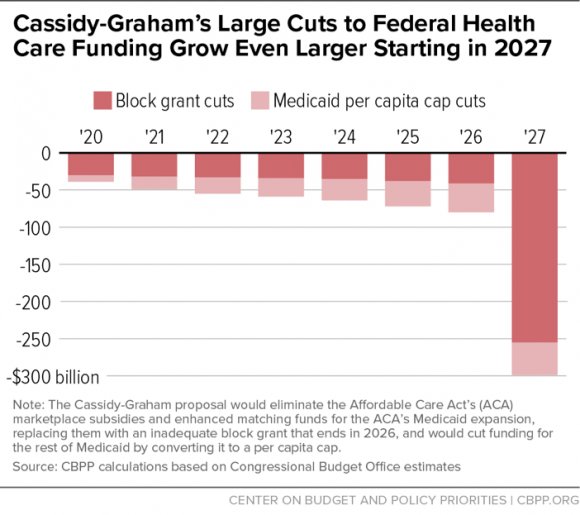
Cassidy-Graham's Large Cuts to Federal Health Care Funding Grow Even Larger Starting in 2027

In releasing a revised version of their legislation to repeal and replace the Affordable Care Act (ACA), Senators Bill Cassidy and Lindsey Graham, along with co-sponsors Dean Heller and Ron Johnson, claimed that their bill isn’t a “partisan” approach and doesn’t include “draconian cuts.” In reality, however, the Cassidy-Graham bill would have the same harmful consequences as those prior bills. IT WOULD CAUSE MANY MILLIONS OF PEOPLE TO LOSE COVERAGE, RADICALLY RESTRUCTURE AND DEEPLY CUT MEDICAID, AND INCREASE OUT-OF-POCKET COSTS FOR INDIVIDUAL MARKET CONSUMERS. It would cause many millions of people to lose coverage, radically restructure and deeply cut Medicaid, eliminate or weaken protections for people with pre-existing conditions, and increase out-of-pocket costs for individual market consumers.

Cassidy-Graham would:

  • Eliminate the ACA’s marketplace subsidies and enhanced matching rate for the Medicaid expansion and replace them with an inadequate block grant. Block grant funding would be well below current law federal funding for coverage, would not adjust based on need, would disappear altogether after 2026, and could be spent on virtually any health care purpose, with no requirement to offer low- and moderate-income people coverage or financial assistance.
  • Convert Medicaid’s current federal-state financial partnership to a per capita cap, which would cap and cut federal Medicaid per-beneficiary funding for seniors, people with disabilities, and families with children.
  • Eliminate or weaken protections for people with pre-existing conditions by allowing states to waive the ACA’s prohibition against charging higher premiums based on health status and the requirement that insurers cover essential health benefits including mental health, substance abuse treatment, and maternity care.
  • Destabilize the individual insurance market in the short run — by eliminating the ACA’s federal subsidies to purchase individual market coverage and eliminating the ACA’s individual mandate to have insurance or pay a penalty —and risk collapse of the individual market in the long run.
  • Eventually result in larger coverage losses than under proposals to repeal ACA’s major coverage provisions without replacement.  The Congressional Budget Office (CBO) has previously estimated that repeal-without-replace would cause 32 million people to lose coverage.  The Cassidy-Graham bill would likely lead to greater numbers of uninsured after 2026, however, because it would not only entirely eliminate its block grant funding — effectively repealing the ACA’s major coverage expansions — but also make increasingly severe federal funding cuts to the rest of the Medicaid program (outside of the expansion) under its per capita cap.

By attempting to push this bill forward now, Senators Cassidy and Graham are reverting to a damaging, partisan approach to repealing the ACA that would reverse the historic coverage gains under health reform and end Medicaid as we know it — even as other members of Congress, with the help of governors and insurance commissioners of both parties, are making progress in crafting bipartisan legislation to strengthen the individual market.

Last-Ditch Effort By Republicans To Replace ACA: What You Need To Know

http://khn.org/news/last-ditch-gop-effort-to-replace-aca-5-things-you-need-to-know/

Related image

Republican efforts in Congress to “repeal and replace” the federal Affordable Care Act are back from the dead. Again.

While the chances for this last-ditch measure appear iffy, many GOP senators are rallying around a proposal by Sens. Lindsey Graham (R-S.C.) and Bill Cassidy (R-La.), along with Sens. Dean Heller (R-Nev.) and Ron Johnson (R-Wis.)

They are racing the clock to round up the needed 50 votes — and there are 52 Senate Republicans.

An earlier attempt to replace the ACA this summer fell just one vote short when Sens. Susan Collins (R-Maine), Lisa Murkowski (R-Alaska) and John McCain (R-Ariz.) voted against it. The latest push is setting off a massive guessing game on Capitol Hill about where the GOP can pick up the needed vote.

After Sept. 30, the end of the current fiscal year, Republicans would need 60 votes ­— which means eight Democrats — to pass any such legislation because special budget rules allowing approval with a simple majority will expire.

Unlike previous GOP repeal-and-replace packages that passed the House and nearly passed the Senate, the Graham-Cassidy proposal would leave in place most of the ACA taxes that generated funding to expand coverage for millions of Americans. The plan would simply give those funds as lump sums to each state. States could do almost whatever they please with them. And the Congressional Budget Office has yet to weigh in on the potential impact of the bill, although earlier estimates of similar provisions suggest premiums would go up and coverage down.

“If you believe repealing and replacing Obamacare is a good idea, this is your best and only chance to make it happen, because everything else has failed,” said Graham in unveiling the bill last week.

Here are five things to know about the latest GOP bill: 

1. It would repeal most of the structure of the ACA.

The Graham-Cassidy proposal would eliminate the federal insurance exchange, healthcare.gov, along with the subsidies and tax credits that help people with low and moderate incomes — and small businesses — pay for health insurance and associated health costs. It would eliminate penalties for individuals who fail to obtain health insurance and employers who fail to provide it.

It would eliminate the tax on medical devices. 

2. It would eliminate many of the popular insurance protections, including those for people with preexisting conditions, in the health law.

Under the proposal, states could “waive” rules in the law requiring insurers to provide a list of specific “essential health benefits” and mandating that premiums be the same for people regardless of their health status. That would once again expose people with preexisting health conditions to unaffordable or unavailable coverage. Republicans have consistently said they wanted to maintain these protections, which polls have shown to be popular among voters.

3. It would fundamentally restructure the Medicaid program.

Medicaid, the joint-federal health program for low-income people, currently covers more than 70 million Americans. The Graham-Cassidy proposal would end the program’s expansion under the ACA and cap funding overall, and it would redistribute the funds that had provided coverage for millions of new Medicaid enrollees. It seeks to equalize payments among states. States that did not expand Medicaid and were getting fewer federal dollars for the program would receive more money and states that did expand would see large cuts, according to the bill’s own sponsors. For example, Oklahoma would see an 88 percent increase from 2020 to 2026, while Massachusetts would see a 10 percent cut.

The proposal would also bar Planned Parenthood from getting any Medicaid funding for family planning and other reproductive health services for one year, the maximum allowed under budget rules governing this bill. 

4. It’s getting mixed reviews from the states.

Sponsors of the proposal hoped for significant support from the nation’s governors as a way to help push the bill through. But, so far, the governors who are publicly supporting the measure, including Scott Walker (R-Wis.) and Doug Ducey (R-Ariz.), are being offset by opponents including Chris Sununu (R-N.H.), John Kasich (R-Ohio) and Bill Walker (I-Alaska).

On Tuesday 10 governors — five Democrats, four Republicans and Walker — sent a letterto Senate leaders urging them to pursue a more bipartisan approach. “Only open, bipartisan approaches can achieve true, lasting reforms,” said the letter.

Bill sponsor Cassidy was even taken to task publicly by his own state’s health secretary. Dr. Rebekah Gee, who was appointed by Louisiana’s Democratic governor, wrote that the bill “uniquely and disproportionately hurts Louisiana due to our recent [Medicaid] expansion and high burden of extreme poverty.”

5. The measure would come to the Senate floor with the most truncated process imaginable.

The Senate is working on its Republican-only plans under a process called “budget reconciliation,” which limits floor debate to 20 hours and prohibits a filibuster. In fact, all the time for floor debate was used up in July, when Republicans failed to advance any of several proposed overhaul plans. Senate Majority Leader Mitch McConnell (R-Ky.) could bring the bill back up anytime, but senators would immediately proceed to votes. Specifically, the next order of business would be a process called “vote-a-rama,” where votes on the bill and amendments can continue, in theory, as long as senators can stay awake to call for them.

Several senators, most notably John McCain, who cast the deciding vote to stop the process in July, have called for “regular order,” in which the bill would first be considered in the relevant committee before coming to the floor. The Senate Finance Committee, which Democrats used to write most of the ACA, has scheduled a hearing for next week. But there is not enough time for full committee consideration and a vote before the end of next week.

Meanwhile, the Congressional Budget Office said in a statement Tuesday that it could come up with an analysis by next week that would determine whether the proposal meets the requirements to be considered under the reconciliation process. But it said that more complicated questions like how many people would lose insurance under the proposal or what would happen to insurance premiums could not be answered “for at least several weeks.”

That has outraged Democrats, who are united in opposition to the measure.

“I don’t know how any senator could go home to their constituents and explain why they voted for a major bill with major consequences to so many of their people without having specific answers about how it would impact their state,” said Senate Minority Leader Chuck Schumer (D-N.Y.) on the Senate floor Tuesday.

No doubt you’ve been hearing about Cassidy-Graham, the GOP’s last-ditch effort to repeal the ACA. See this informative tweetstorm from Edwin Park of the Center on Budget and Policy Priorities to learn about the bill.


Senate GOP Has 12 Days to Repeal Obamacare and No Room for Error

https://www.bloomberg.com/news/articles/2017-09-19/senate-gop-has-12-days-to-repeal-obamacare-and-no-room-for-error

Image result for time running out

Senate Republicans making one last-ditch effort to repeal Obamacare have the daunting task of assembling 50 votes for an emotionally charged bill with limited details on how it would work, what it would cost and how it would affect health coverage — all in 12 days.

They need to act by Sept. 30 to use a fast-track procedure that prevents Democrats from blocking it, but the deadline doesn’t leave enough time to get a full analysis of the bill’s effects from the Congressional Budget Office. The measure would face parliamentary challenges that could force leaders to strip out provisions favored by conservatives. Several Republicans are still withholding their support or rejecting it outright.

And even if Republicans manage to get it through the Senate by Sept. 30, the House would have to accept it without changing a single comma.

Most Senate Republicans are still trying to figure out what it’s in the bill, which was authored by Republicans Lindsey Graham of South Carolina and Bill Cassidy of Louisiana. Until the past few days, most assumed that GOP leaders had no interest in reviving the Obamacare repeal effort after their high-profile failure to pass a measure this summer.

Republican Senator Steve Daines of Montana said he’s still trying to figure out how the bill will affect his state and wants to hear what GOP leaders say at a closed-door lunch Tuesday.

‘Active Discussion’

“It will be a very active discussion,” he said.

The new repeal bill would replace the Affordable Care Act’s insurance subsidies with block grants to states, which would decide how to help people get health coverage. The measure would end Obamacare’s requirements that individuals obtain health insurance and that most employers provide it to their workers, and it would give states flexibility to address the needs of people with pre-existing medical conditions.

But lawmakers won’t have much more information about the legislation by the time the Senate would have to vote. The CBO said Monday it will offer a partial assessment of the measure early next week, but that it won’t have estimates of its effects on the deficit, health-insurance coverage or premiums for at least several weeks. That could make it hard to win over several Republicans who opposed previous versions of repeal legislation.

So far, President Donald Trump has suggested he’d support the bill, but he hasn’t thrown his full weight behind it.

Majority Leader Mitch McConnell has told senators he would bring up the bill if it had 50 votes, and under fast-track rules he could do so at any time before Sept. 30. That’s the end of the government’s fiscal year, when the rules expire and the GOP would have to start over.

Several Holdouts

Republicans can only lose two votes in the 52-48 Senate and still pass the measure, with Vice President Mike Pence’s tie-breaker. There are at least four holdouts, and getting any of them to back the measure would require the senators to change their past positions. Pence, who would cast the potentially deciding vote, will return to Washington from New York Tuesday, where he’s been taking part in United Nations General Assembly events, to attend Senate GOP lunches.

Republican Rand Paul of Kentucky said Monday he’s opposed to the Graham-Cassidy bill, saying it doesn’t go far enough. John McCain of Arizona said he’s “not supportive” yet, citing the rushed legislative process.

Two other Republicans — Susan Collins of Maine and Lisa Murkowski of Alaska — have voted against every repeal bill considered this year in the Senate, citing cuts to Medicaid and Planned Parenthood as well as provisions that would erode protections for those with pre-existing conditions. The Graham-Cassidy bill contains similar provisions on those three areas.

“I’m concerned about what the effect would be on coverage, on Medicaid spending in my state, on the fundamental changes in Medicaid that would be made,” Collins told reporters Monday evening.

She said that Maine’s hospital association has calculated the state would lose $1 billion in federal health spending over a decade compared to current law.

“That’s obviously of great concern to me,” she added.

Hard Sell

Murkowski is getting a hard sell from Republican backers of the bill.

“What I’m trying to figure out is the impact to my state,” Murkowski told reporters Monday. “There are some formulas at play with different pots of money with different allocations and different percentages, so it is not clear.”

McCain, who is close friends with Graham, cast the deciding vote to sink an earlier repeal bill in late July when he made a dramatic return to the Senate after a brain cancer diagnosis. At the time, he made an eloquent plea for colleagues to work with Democrats and use regular legislative procedures instead of trying to jam it through on a partisan basis.

John Weaver, a former top adviser to McCain, said supporting Graham-Cassidy would require the Arizona senator to renege on his word.

‘Fair Process’

“I cannot imagine Senator McCain turning his back not only on his word, but also on millions of Americans who would lose health care coverage, despite intense lobbying by his best friend,” Weaver said in an email. “Graham-Cassidy, if truly attempted to pass, will bypass every standard of transparency and inclusion important to people who care about fair process.”

Despite the obstacles, the bill’s backers are putting on a good face about the prospects.

“We’re making progress on it,” said Republican Senator Ron Johnson of Wisconsin. “I’m still cautiously optimistic, but there are a lot of moving parts.” Johnson is planning a Sept. 26 hearing on the measure in the Homeland Security and Governmental Affairs Committee, which he leads. The Senate Finance Committee is planning its own hearing Sept. 25 on the measure.

“There’s a lot of interest,” Senator Pat Toomey of Pennsylvania said Monday. “Those guys have done some very good work.”

A number of Republicans are still pushing for changes to the bill, so the final version may evolve. It’s also subject to parliamentary challenges under the reconciliation process being used to circumvent the 60-vote threshold in the Senate. That could allow Democrats to strike provisions that take aim at Obamacare’s regulatory structure.

Last Chance

If it passed the Senate, the House would have to pass the bill without any changes. House Speaker Paul Ryan said Monday that the measure is Republicans’ last best chance to repeal Obamacare.

“We want them to pass this, we’re encouraging them to pass this,” Ryan told reporters at a news conference in Wisconsin. “It’s our best, last chance of getting repeal and replace done.”

But that won’t be easy either. The measure strives to equalize Medicaid funding between states, which means that some House Republicans from Medicaid expansion states could find it hard to support. That includes states like New York and California, which stand to lose federal funds under Graham-Cassidy. Those states have only Democratic senators, but have some GOP House members.

Another Run

In some ways, it’s remarkable that Republicans are mounting another run at repeal.

Two months ago, Majority Leader Mitch McConnell’s effort to pass a replacement with only Republican support suffered a spectacular defeat in the Senate. When members of the Senate health committee then began working on a bipartisan plan to shore up Obamacare, Graham and Cassidy revved up a new bid to get their GOP-only bill to the Senate floor.

Graham and Cassidy are hoping to channel the GOP’s embarrassment at failing to repeal Obamacare this summer after seven years of promising to do so. But Paul said Monday this legislation shouldn’t be treated like a “kidney stone” you pass “just to get rid of it.”

Despite all the obstacles, Democrats quickly geared up for another campaign against repeal, warning that the latest bill is a serious threat.

“This bill is worse than the last bill,” Senate Democratic leader Chuck Schumer of New York told reporters Monday. “It will slash Medicaid, get rid of pre-existing conditions. It’s very, very bad.”

Healthcare: It’s complicated

http://www.theactuary.com/features/2017/07/its-complicated/

Istock_america_health

It has been a little over seven years since the US began implementing healthcare reform at the national level, following the passage of the Patient Protection and Affordable Care Act (ACA), also known as Obamacare. However, the future of the law’s programmes has never seemed more uncertain now that the United States House of Representatives has passed legislation repealing and replacing many of the ACA’s key provisions.

While the ACA and the proposed replacement legislation are fundamentally different in their approaches to financing and regulating healthcare, they do have one thing in common: both are extraordinarily complicated.

Actuaries have had a front-row seat as healthcare reform has unfolded, and they are in a unique position to help address the challenges our complex system presents – whether that involves setting premium rates, calculating reserves, or just trying to explain healthcare policy to their Facebook friends. After all, actuaries were working to promote the financial stability of our complex healthcare system long before the ACA came along.

Even so, one might ask: Why is the American healthcare system so complicated? Does it have to be that way? Most stakeholders acknowledge that our current system has room for improvement, although opinions vary widely on what to do about that. In part, the complexity of our system is rooted in our history.

The healthcare system that we have today wasn’t formed in one fell swoop. Instead, it has been stitched together gradually over the past century by policymakers working to meet the challenges of their times. For example, the prevalence of employer-sponsored insurance was at least partly driven by price-wage controls implemented by the federal government in the 1940s during the Second World War, together with very favourable tax treatment. When the employer-sponsored market began to flourish, healthcare coverage became unaffordable for the non-working population – in particular, low-income workers, seniors, and disabled individuals – and the Medicare and Medicaid programmes were born. Currently, healthcare in the US is provided and funded through a variety of sources:

  • Employer-sponsored insurance – either self-funded by the employer or insured through a carrier
  • Individual major medical insurance – currently subsidised by the federal government for many individuals under the ACA
  • Medicare, Medicaid, and military health coverage – subsidised by federal and state governments and increasingly administered by privately managed care organisations
  • Other – for instance, the Indian Health Service, care provided to correctional populations, and uncompensated care provided to the uninsured.


It’s therefore not surprising that the policies being proposed today are an attempt to fix the problems we currently face, such as expanding access to affordable healthcare, reducing the cost of healthcare, or improving the quality of care received by patients.

However, our system has evolved in such a way that trying to implement a solution is like trying to solve a Rubik’s Cube – it is hard to make progress on one side without introducing new problems into other parts of the puzzle. For a Rubik’s Cube, successful solvers focus on both the local and global picture, and sometimes must make short-term trade-offs to achieve a longer-term solution. Unfortunately, the short-term nature of political pressures make it difficult to implement longer-term strategies for healthcare. Yet, we see many areas where actuaries can be instrumental in addressing the challenges presented by our complex healthcare system.

Complex times call for complex models

The ACA made sweeping changes that impacted almost every source of coverage listed above. The most profound changes, besides the expansion of Medicaid coverage, were the changes made to the individual and small employer health insurance markets. These already small markets were fractured into several separate pieces (grandfathered business from before the ACA became law, ‘transitional’ business issued before 2014, and ‘ACA-compliant’ business issued in 2014 and beyond). The only constant has been change, with many regulatory changes occurring each year (often after premium rates were set by insurers) and with the stabilisation programmes intended to mitigate risk during this time of change often paradoxically increasing uncertainty. This led some to question whether these markets were inherently too unpredictable to be viable, whereas others felt that the markets were finally starting to stabilise before the election changed everything.

Besides predictability problems caused by regulatory or political factors, two challenges facing health actuaries during these transitional years have been (1) the lag between when market changes are implemented and when data on policies subject to the new rules becomes available, and (2) the difficulty in predicting consumer behaviour in reaction to major changes in market rules such as guaranteed issue and community rating. How many of the uninsured would sign up? How price-sensitive would members be when they renewed their coverage each year? How will changes in other sources of coverage (such as Medicaid expansion) impact the individual market? How will potential actions by competitors affect an insurer’s risk?

Despite the daunting nature of these challenges, actuaries have, out of necessity, found ways to try to address them. For example, faced with the data lag problem, they explored ways to augment traditional claim and enrollment data with new data sources such as marketing databases or pharmacy history data available for purchase. Such sources can be used to develop estimates of the health status of new populations not previously covered by an insurer. Many actuaries also developed agent-based stochastic simulation models that attempted to model the behaviour of consumers, insurers and other stakeholders in these new markets. Such models continue to be used to evaluate the potential outcomes of future changes to the healthcare system, and will probably be essential should efforts to repeal and replace the ACA prove successful.

Information problems: what is a rational actor to do?

Most goods and services in the US have a price tag that consumers can use to ‘shop’ for the option that they feel gives them the best value for their dollar. Healthcare is different. If you ask how much a healthcare service will cost in the US, the answer is “it depends”. List prices such as billed charges for hospitals and physicians and average wholesale prices for pharmaceuticals are increasingly meaningless, given the enormous contractual discounts and rebates that typically apply. The same service may have wildly different prices depending on who is paying for it, and prices may not correlate well with either the clinical value the service provides to the patient or the actual cost to the healthcare provider who renders it. Layered on top of this complex foundation are the often arcane policy provisions that determine a member’s ultimate cost for a claim.

Moreover, even if a patient can determine the cost of treatment at different healthcare providers, making an informed choice often requires clinical knowledge the average person is unlikely to possess. Also, many of the most costly services are non-discretionary and often emergent in nature. In other words, even if a consumer wanted to shop they would be hard-pressed to do so.

All of this means that it is exceedingly hard for various stakeholders – patients, doctors, even insurers – to know the true cost of a service at the point of care, much less manage it. Yet a lot of effort has been spent in trying to better align cost incentives for providers and patients. Past efforts have often used crude methods, such as high deductibles paired with health savings accounts, to create incentives. Current efforts such as value-based insurance designs, which vary cost sharing based on a patient’s clinical profile, use more nuanced approaches to encourage patients to use high-value care. Moving from fee-for-service to value-based payment models for reimbursing healthcare providers has been a focus of both private and public payers in the US.

While such initiatives show promise, they come at the price of even more complexity – and it isn’t always clear that this price is worth paying. The proliferation of more complex benefit designs and provider contracting arrangements can exacerbate the price transparency problems that existed even in the relatively simple fee-for-service world.

Actuaries are well equipped to help insurers, providers and consumers navigate these waters. For example, repricing healthcare claims in an equitable way using actuarial techniques, such as comparing reimbursement rates with a standard fee schedule, is

an efficient way for providers and payers to evaluate cost levels consistently across contracts that may use very different reimbursement methodologies.

Actuaries also have a role to play in developing tools to support clinicians and consumers in understanding the financial dimensions of their healthcare decisions.

Technology: the cause of, and solution to, all our cost problems?

For better or worse, Americans seem determined to seek technological solutions to our health problems, even when lifestyle changes in diet and exercise habits might be just as effective.

Technological advances drive a significant portion of healthcare cost increases, and while many do result in profoundly valuable new therapies, some provide only marginal benefit over existing options at a significantly higher cost. Finding ways to leverage our love of technology to achieve health outcomes more cheaply would be a worthy goal, and one where an actuary could make a difference. Work to use machine learning (for example, in radiology), smarter medical devices, and other data-intensive methods to improve healthcare are still in their infancy, but show promise. From a policy perspective, actuaries could assist in designing novel approaches toward rethinking the incentives for clinical innovation, such as linking payment for new therapies to their clinical value relative to alternatives.

Will the US ever change its relationship status with healthcare from “it’s complicated” to something less ambiguous? In the near term, the answer seems to be “no.” But perhaps we can hope that – with a little help from actuaries – even a complicated relationship can be a good one.

Centrist Democrats Turn to Pragmatism, Seek Bipartisan ACA Fixes

https://morningconsult.com/2017/09/15/centrist-dems-seek-bipartisan-aca-fixes-not-single-payer-plan/

Click to access attachment-1.pdf

Image result for healthcare policy

While some progressives campaigned this week for “Medicare for all,” a group of moderate House Democrats aligned themselves with a more modest push to stabilize the Affordable Care Act, arguing that it could spur broader health care reforms in the future.

Thirty-eight of the 61 members of the New Democrat Coalition sent a letterFriday urging the leaders of the Senate Health, Education, Labor and Pensions Committee to agree on a bipartisan bill to keep premiums from rising further for Obamacare enrollees next year.

The letter outlines five short-term proposals agreed to by the group — several of which are likely to be included in the Senate bill, such as the extension of key insurer payments known as cost-sharing reductions.

New Democrat Coalition Chair Rep. Jim Himes (D-Conn.) said that while some Democrats and Republicans continue to push polarizing health care plans after the July collapse of Senate Republicans’ Obamacare repeal push, some lawmakers of both parties are ready to try bipartisanship.

“There’s a pretty substantial group of Democrats and Republicans who are ready to work together and get some things done on this most politically charged of topics,” Himes said in an interview Thursday.

Only three of the 38 Democrats who signed the letter are co-sponsors of a single-payer health care bill introduced by Rep. John Conyers (D-Mich.) that has been endorsed by approximately 60 percent of the House Democratic caucus; Sen. Bernie Sanders (I-Vt.) introduced similar legislation in the Senate on Wednesday.

But the progressive single-payer legislation has almost no chance of passing the Republican-led Congress, and members of the New Democrat Coalition are taking a more pragmatic approach: While “Medicare for all” proponents support placing nearly all Americans on a government plan, the New Democrat Coalition is backing reforms to improve private health insurance coverage and reduce health care costs.

“We believe these ideas provide a framework to reduce health care costs for families and seniors, increase choices for consumers, and encourage participation by the young and healthy,” the Democrats wrote in the letter.

Some members of the New Democrat Coalition are also in the House Problem Solvers Caucus, which consists of centrist GOP and Democratic lawmakers and sent its own letter Wednesday urging the Senate HELP and Finance committees to move toward a bill as a crucial Sept. 27 deadline for insurers approaches.

HELP Committee Chairman Lamar Alexander hopes to reach an agreement on the legislation by early next week, the Tennessee Republican said at a hearing on Thursday.


Bill Gates thinks an infectious disease outbreak could kill 30 million people at some point in the next decade — here’s how worried you should be

http://www.businessinsider.com/pandemic-risk-to-humanity-2017-9

http://www.globalgoals.org/goalkeepers/datareport/

bill gates

As hurricanes and other natural disasters ravage the world and the threat of nuclear war looms, it’s hard to assess which risks for humanity are really the scariest right now.

But one of the biggest threats out there is one of the oldest: infectious disease, which can emerge naturally or be human-made, as in a case of bioterrorism.

As Bill and Melinda Gates wrote in their recently released “Goalkeepers” report, disease — both infectious and chronic — is the biggest public health threat the world faces in the next decade. And although Gates said on a press call that “you can be pretty hopeful there’ll be big progress” on chronic disease, we are still unprepared to deal with the infectious variety.

Gates has repeatedly stated that he sees a pandemic as the greatest immediate threat to humanity on the planet.

“Whether it occurs by a quirk of nature or at the hand of a terrorist, epidemiologists say a fast-moving airborne pathogen could kill more than 30 million people in less than a year,” Gates wrote in an op-ed for Business Insider earlier this year. “And they say there is a reasonable probability the world will experience such an outbreak in the next 10-15 years.”

Gates is right about the gravity of that threat, according to experts in the field.

George Poste is an ex officio member of the Blue Ribbon Study Panel on Biodefense, a group created to assess the state of biodefense in the US,.

“We are coming up on the centenary of the 1918 influenza pandemic,” he told Business Insider. “We’ve been fortunately spared anything on that scale for the past 100 years, but it is inevitable that a pandemic strain of equal virulence will emerge.”

The 1918 pandemic killed approximately 50 million people around the globe, making it one of the deadliest events in human history.

David Rakestraw, a program manager overseeing chemical, biological and explosives security at Lawrence Livermore National Laboratory, and Tom Slezak, the laboratory’s associate program leader for bioinformatics, also agree with Gates.

“Both natural and intentional biological threats pose significant threats and merit our nation’s attention to mitigate their impact,” they told Business Insider in an email.

It’s possible that a major outbreak could be intentionally created as the result of a biological weapon, but Poste thinks a serious bioterrorism attack is unlikely due to the complexity of pulling something like that off.

It’s very likely, however, that a highly dangerous disease would naturally emerge — and the consequences of that pandemic would be just as severe.

Regardless of how a disease starts to spread, preparedness efforts for pandemics are the same, according to Poste. And the recent outbreaks of Zika and Ebola have highlighted the need for more heightened disease surveillance capabilities. We’re still getting a handle on the health effects of Zika — and it seems like the mosquito-borne disease may be even more severe than we thought.

Experts have long advocated for better ways to recognize emerging threats before they become epidemics or pandemics. Poste also said we need to improve rapid diagnostic tests and get better at developing new therapeutics and vaccines — something Gates highlighted as a weakness in the “Goalkeepers” report as well.

Until that happens, that threat remains far more real than many of us realize.


The Best Health Care System in the World: Which One Would You Pick?

“Medicare for all,” or “single-payer,” is becoming a rallying cry for Democrats.

This is often accompanied by calls to match the health care coverage of “the rest of the world.” But this overlooks a crucial fact: The “rest of the world” is not all alike.

The commonality is universal coverage, but wealthy nations have taken varying approaches to it, some relying heavily on the government (as with single-payer); some relying more on private insurers; others in between.

Experts don’t agree on which is best; a lot depends on perspective. But we thought it would be fun to stage a small tournament.

We selected eight countries, representing a range of health care systems, and established a bracket by randomly assigning seeds.

To select the winner of each matchup, we gathered a small judging panel, which includes us:

  • Aaron Carroll, a health services researcher and professor of pediatrics at Indiana University School of Medicine
  • Austin Frakt, director of the Partnered Evidence-Based Policy Resource Center at the V.A. Boston Healthcare System; associate professor with Boston University’s School of Public Health; and adjunct associate professor with the Harvard T.H. Chan School of Public Health

and three economists and physician experts in health care systems:

  • Craig Garthwaite, a health economist with Northwestern University’s Kellogg School of Management
  • Uwe Reinhardt, a health economist with Princeton University’s Woodrow Wilson School of Public and International Affairs
  • Ashish Jha, a physician with the Harvard T.H. Chan School of Public Health and the director of the Harvard Global Health Institute

A summary of our worldviews on health care is at bottom.

So that you can play along at home and make your own picks, we’ll describe each system along with our choices (the experts’ selections will decide who advances). When we cite hard data, they come from the Commonwealth Fund’s International Country Comparison in 2017.

But enough talk. Let’s play.