
Doctors Are Fed Up With Being Turned Into Debt Collectors

https://www.bloomberg.com/news/articles/2018-11-15/doctors-are-fed-up-with-being-turned-into-debt-collectors

Highlighting a key implication of the rise in high-deductible health plans, both on the ACA exchanges and in employer-sponsored insurance, the article describes a question now commonly faced by doctors and hospitals—how best to collect their patients’ portion of the fees they charge? As one Texas doctor tells Bloomberg, reflecting the experience of the Maldonados from the other side of the equation, “If [patients] have to decide if they’re going to pay their rent or the rest of our bill, they’re definitely paying their rent.” He reports that the number of people dodging his calls to discuss payment has increased “tremendously” since the passage of the ACA. Another Texas doctor reports that his small practice had to add an additional full-time staff member just to collect money owed by patients, adding further overhead to his practice’s costs and making it more likely that he, like many other doctors, will eventually seek shelter by being employed by a larger delivery organization. That trend, as has been repeatedly shown, further increases the cost of care, exacerbating the increase in insurance costs for families like the Maldonados. This Gordian knot of increasing costs, rising deductibles, and growing premiums has left us with a healthcare system that’s forcing difficult decisions at every turn, for patients and providers.

Physicians, hospitals and medical labs are grappling with the rise in high-deductible insurance.

Doctors, hospitals and medical labs used to be concerned about patients who didn’t have insurance not paying their bills. Now they’re scrambling to get paid by the ones who do have insurance.

For more than a decade, insurers and employers have been shifting the cost of care onto their workers and customers, tamping down premiums by raising patients’ out-of-pocket costs. Last year, almost half of privately insured Americans under age 65 had annual deductibles ranging from $1,300 to as high as $6,550, government data show.

Now, instead of getting paid by insurance companies on a predictable schedule, health-care providers have to engage in an awkward dance. One moment they’re removing a pre-cancerous skin mole. The next, they’re haranguing patients to pay what’s become a growing portion of the total medical bill.

“It’s harder to collect from the patient than it is from the insurance,” said Amy Derick, a doctor who heads a dermatology practice outside Chicago. “If the plans change to a higher deductible, it’s harder to get the patients to pay.”

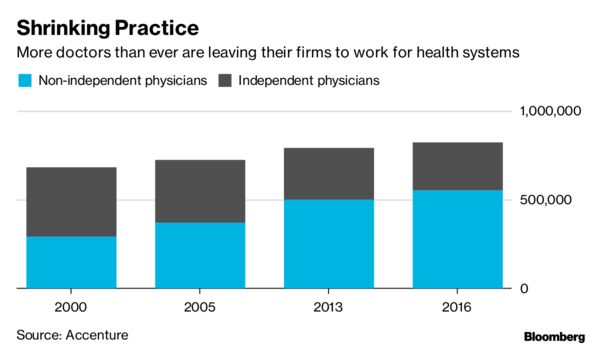
Independent physicians cited reimbursement pressures as their biggest concern for staying in business, according to a report by Accenture Plc in 2015.

“If they have to decide if they’re going to pay their rent or the rest of our bill, they’re definitely paying their rent,” said Gerald “Ray” Callas, president of the Texas Society of Anesthesiologists, whose Beaumont, Texas, practice treats about 40,000 people annually. “We try to work with the patient, but on the other hand, we can’t do it for free because we still maintain a small business.”
Accenture

In 2016, Callas introduced payment options that allow patients with expensive plans to pay a portion of the bill upfront or on a monthly basis over several years. Even so, Callas said the number of people avoiding his calls after surgery has increased “tremendously” each year since the Affordable Care Act passed in 2010.

Derick instituted a “time-out” option a few years back that gives patients the billing codes before a procedure, allowing them to call their insurance companies for estimates. Even with the program, collection rates are slower, especially at the beginning of the year when insurance plan deductibles reset.

Even large medical companies with national operations are facing the problem. Quest Diagnostics Inc., the lab-testing giant, said 20 percent of services billed to patients in the third quarter of this year went unpaid, costing the company about $80 million in lost revenue.

“We certainly have a high bad-debt rate for the uninsured,” Chief Financial Officer Mark Guinan said in a telephone interview. “But really the biggest driver is people with insurance. It’s their coinsurance and their high deductibles, and they don’t always pay their bills.”

Another testing company, Laboratory Corp. of America Holdings, reported its first year-over-year uptick in unpaid bills in the first quarter of 2016. At the time, Chief Executive Officer David King said high-deductible plans, higher copays and greater incidences of non-covered services led to more dollars being shifted to patients. LabCorp declined requests for comment.

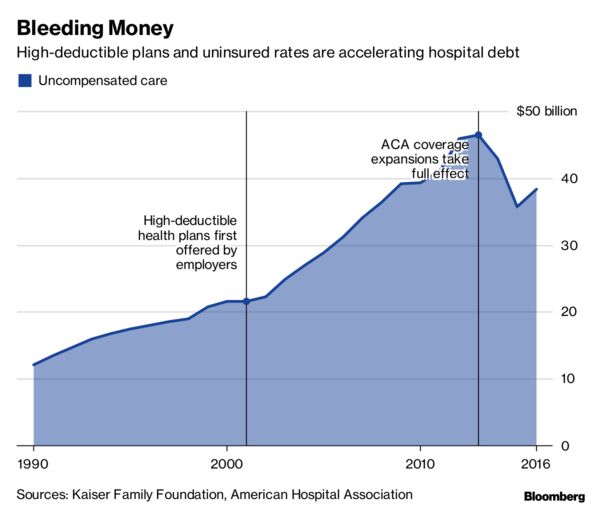
Northwell Healthcare Inc., a network of more than 700 hospitals and outpatient facilities, lost $106.9 million to unpaid services in 2015. Others have reported the same: Acute-care and critical-access hospitals reported$55.9 billion in bad debt for 2015, according to data compiled by the American Hospital Directory Inc. 

“High-deductible plans have had a very big impact,” said Richard Miller, Northwell’s chief business strategy officer.
Kaiser Family Foundation, American Hospital Association

When it comes to reimbursement, a common denominator across the health-care industry is the archaic process through which bills are processed — a web of medical records, billing systems, health insurers and contractors.

High deductibles only add to the red tape. Providers don’t have real-time, fully accurate information on patient deductibles, which fluctuate based on how much has already been paid. That forces providers to constantly reach out to insurance companies for estimates.

Tarek Fakhouri, a Texas surgeon specializing in skin cancer, had to hire an additional staff member just to reason through bills with patients and their insurers, a big expense for an office of six or seven employees. About 10 percent of Fakhouri’s patients need payment plans, delay their skin-cancer surgeries until they’ve met their deductibles, or have to choose an alternative treatment.

According to a study earlier this year by the Journal of American Medical Association, primary-care physicians at academic health-care systems lose about 15 percent of their revenue to billing activities like calling insurance companies for estimates.

“It’s an unnecessary added cost to the health-care system to have to hire staff just to sit there on hold with insurance companies to find out what a patient’s deductible status is,” said Fakhouri.

Callas, Derick, and Fakhouri said they all know physicians who have left private practice altogether, some for the sole purpose of ending their dual roles as bill collectors. According to a study by the American Medical Association, less than half of doctors were self-employed as of 2016 — the lowest total ever. Many left their own practices in favor of hospitals and large physician groups with more resources.

To cope with the challenge, labs and hospitals are investing millions in programs designed to help patients understand what they owe at the point of care. Northwell has been implementing call centers and facilities where patients can ask questions about their bills.

“There’s a burden on both sides,” said Callas. “But health-care providers get caught in the middle.”


 

Health Systems Need to Completely Reassess How They Manage Costs

https://hbr.org/2018/11/health-systems-need-to-completely-reassess-how-they-manage-costs

A recent Navigant survey found that U.S. hospitals and health systems experienced an average 39% reduction in their operating margins from 2015 to 2017. This was because their expenses grew faster than their revenues, despite cost-cutting initiatives. As I speak with industry executives, a common refrain is “I’ve done all the easy stuff.” Clearly, more is needed. Cost reduction requires an honest and thorough reassessment of everything the health system does and ultimately, a change in the organization’s operating culture.

When people talk about having done “the easy stuff,” they mean they haven’t filled vacant positions and have eliminated some corporate staff, frozen or cut travel and board education, frozen capital spending and consulting, postponed upgrades of their IT infrastructure, and, in some cases, launched buyouts for the older members of their workforces, hoping to reduce their benefits costs.

These actions certainly save money, but typically less than 5% of their total expense base. They also do not represent sustainable, long-term change. Here are some examples of what will be required to change the operating culture:

Contract rationalization. Contracted services account for significant fractions of all hospitals’ operating expenses. The sheer sprawl of these outsourced services is bewildering, even at medium-size organizations: housekeeping, food services, materials management, IT, and clinical staffing, including temporary nursing and also physician coverage for the ER, ICU and hospitalists. More recently, it has come in the form of the swarms of “apps” sold to individual departments to solve scheduling and care-coordination problems and to “bond” with “consumers.” There is great dispersion of responsibility for signing and supervising these contracts, and there is often an unmanaged gap between promise and performance.

An investor-owned hospital executive whose company had acquired major nonprofit health care enterprises compared the proliferation of contracts to the growth of barnacles on the bottom of a freighter. One of his company’s first transition actions after the closure of an acquisition is to put its new entity in “drydock” and scrape them off (i.e., cancel or rebid them). Contractors offer millions in concessions to keep the contracts, he said. Barnacle removal is a key element of serious cost control. For the contracts that remain, and also consulting contracts that are typically of shorter duration, there should be an explicit target return on investment, and the contractor should bear some financial risk for achieving that return. The clinical-services contracts for coverage of hospital units such as the ER and ICU are a special problem, which I’ll discuss below.

Eliminating layers of management. One thing that distinguishes the typical nonprofit from a comparably-sized investor-owned hospital is the number of layers of management. Investor-owned hospitals rarely have more than three or four layers of supervision between the nurse that touches patients and the CEO. In some larger nonprofit hospitals, there may be six. The middle layers spend their entire days in meetings or on conference calls, traveling to meetings outside the hospital, or negotiating contracts with vendors.

In large nonprofit multi-hospital systems, there is an additional problem: Which decisions should be made at the hospital, multi-facility regional, and corporate levels are poorly defined, and as a consequence, there is costly functional overlap. This results in “title bloat” (e.g., “CFOs” that don’t manage investments and negotiate payer or supply contracts but merely supervise revenue cycle activities, do budgeting, etc.). One large nonprofit system that has been struggling with its costs had a “president of strategy,” prima facie evidence of a serious culture problem!

Since direct caregivers are often alienated from corporate bureaucracy, reducing the number of layers that separate clinicians from leadership — reducing the ratio of meeting goers to caregivers — is not only a promising source of operating savings but also a way of letting some sunshine and senior-management attention reach the factory floor.

However, doing this with blanket eliminations of layers carries a risk: inadvertently pruning away the next generation of leadership talent. To avoid this danger requires a discerning talent-management capacity in the human resources department.

Pruning the portfolio of facilities and services. Many current health enterprises are combinations of individual facilities that, over time, found it convenient or essential to their survival to combine into multi-hospital systems. Roughly two-thirds of all hospitals are part of these systems. Yet whether economies of scale truly exist in hospital operations remains questionable. Modest reductions in the cost of borrowing and in supply costs achieved in mergers are often washed out by higher executive compensation, more layers of management, and information technology outlays, leading to higher, rather than lower, operating expenses.

A key question that must be addressed by a larger system is how many facilities that could not have survived on their own can it manage without damaging its financial position?  As the U.S. savings and loan industry crisis in the 1980s and 1990s showed us, enough marginal franchises added to a healthy portfolio can swamp the enterprise. In my view, this factor — a larger-than-sustainable number of marginal hospital franchises — may have contributed to the disproportionate negative operating performance of many multi-regional Catholic health systems from 2015 to 2017.

In addition to this problem, many regional systems comprised of multiple hospitals that serve overlapping geographies continue to support multiple, competing, and underutilized clinical programs (e.g., obstetrics, orthopedics, cardiac care) that could benefit from consolidation. In larger facilities, there is often an astonishing proliferation of special care units, ICUs, and quasi-ICUs that are expensive to staff and have high fixed cost profiles.

Rationalizing clinical service lines, reducing duplication, and consolidating special care units is another major cost-reduction opportunity, which, in turn, makes possible reductions in clinical and support personnel. The political costs and disruption involved in getting clinicians to collaborate successfully across facilities sometimes causes leaders to postpone addressing the duplication and results in sub-optimal performance.

Clinical staffing and variation. It is essential to address how the health system manages its clinicians, particularly physicians. This has been an area of explosive cost growth in the past 15 years as the number of physicians employed by hospitals has nearly doubled. In addition to paying physicians the salaries stipulated in their contracts, hospitals have been augmenting their compensation (e.g., by paying them extra for part-time administrative work and being on call after hours and by giving them dividends from joint ventures in areas such as imaging and outpatient surgery where the hospital bears most of the risk).

The growth of these costs rivals those of specialty pharmaceuticals and the maintenance and updating of electronic health record systems. Fixing this problem is politically challenging because it involves reducing physician numbers, physician incomes, or both. As physician employment contracts come up for renewal, health systems will have to ask the “why are we in this business” and “what can we legitimately afford to pay” questions about each one of them. Sustaining losses based on hazy visions of “integration” or unproven theories about employment leading to clinical discipline can no longer be justified.

But this is not the deepest layer of avoidable physician-related cost. As I discussed in this HBR article, hospitals’ losses from treating Medicare patients are soaring because the cost of treating Medicare patient admission is effectively uncontrolled while the Medicare DRG payment is fixed and not growing at the rate of inflation. The result: hospitals lost $49 billion in 2016 treating Medicare patients, a number that’s surely higher now.

The root cause of these losses is a failure to “blueprint,” or create protocols for, routine patient care decisions, resulting in absurd variations in the consumption of resources (operating room time; length of stay, particularly in the ICU; lab and imaging exams per admissions, etc.).

The fact that hospitals have outsourced the staffing of the crucial resource-consuming units such as the ICU and ER makes this task more difficult. Patients need to flow through them efficiently or the hospital loses money, often in large amounts. How many of those contracts obligate the contractual caregivers to take responsibility for managing down the delivered cost of the DRG and reward them for doing so? Is compensation in these contracts contingent on the profit (or loss avoidance) impact of their clinical supervision?

These are all difficult issues, but until they are addressed, many health systems will continue to have suboptimal operating results. While I am not arguing that health systems abandon efforts to grow, unless those efforts are executed with strategic and operational discipline, financial performance will continue to suffer.  A colleague once said to me that when he hears about someone having picked all the low-hanging fruit, it is really a comment on his or her height. Given the escalating operating challenges many health systems face, it may be past time for senior management to find a ladder.


‘It remains to be seen’ whether acute care, nonprofit hospital profitability has peaked, Fitch says

https://www.beckershospitalreview.com/finance/it-remains-to-be-seen-whether-acute-care-nonprofit-hospital-profitability-has-peaked-fitch-says.html?origin=cfoe&utm_source=cfoe

Fitch Ratings has released a new report in response to questions from U.S. investors about whether acute care, nonprofit hospitals’ operating profitability has peaked or can be improved.

Four takeaways:

1. Fitch said acute care, nonprofit hospitals experienced across-the-board deterioration of operating margins in 2017, and the trend is expected to repeat this year. But acute care, nonprofit hospitals’ balance sheet metrics, such as days cash on hand, cash to debt and debt to capitalization, are at an all-time high.

2. Amid declining operating margins, large system providers plan to reduce costs and inefficiencies and are rethinking care delivery, according to Fitch Senior Director Kevin Holloran. He said smaller providers face greater challenges because they “are characteristically less able to trim expenses and typically unable to negotiate higher rates from commercial insurers in their markets.”

3. Fitch concluded: “It remains to be seen whether we are at a peak or if there is further room to improve.”

4. However, the ratings agency is certain of one thing: Nonprofit hospital systems will continue to consolidate. Fitch said investors have asked it whether increased size and scale through consolidation is advantageous as far as credit ratings.

“Size and scale are ‘better’ for a hospital’s rating if its enhanced size and scale means improved operations, stronger balance sheets and more market essentiality,” said Mr. Holloran.”Conversely, a hospital getting bigger just for the sake of getting bigger at times can lead to an initial dip in operating profitability as the two or more organizations come together.”

Access the full report here.


CHI, Dignity unveil name for combined system

https://www.beckershospitalreview.com/hospital-transactions-and-valuation/chi-dignity-unveil-name-for-combined-system.html?origin=cfoe&utm_source=cfoe

Image result for commonspirit health

CHI CEO Kevin Lofton, left, and Dignity CEO Lloyd Dean

Englewood, Colo.-based Catholic Health Initiatives and San Francisco-based Dignity Health have picked a name for the combined system their proposed mega-merger will create: CommonSpirit Health.

“CommonSpirit Health was chosen because of its strong association with the two systems’ missions of service and positive resonance with the diversity of people served,” the systems said in a joint press release. “It evokes the strategic vision and aspiration of the new ministry to advance health for all and make a positive change for the people and communities served; a belief that all people deserve access to high-quality health and healthcare; and a passion to serve those who are sick and injured, including those who are most vulnerable.”

The systems evaluated more than 1,200 names before landing on CommonSpirit Health.

CHI and Dignity signed a definitive agreement to merge in December 2017, and the organizations expect to complete the transaction by the end of this year. The new $28.4 billion health system will include more than 700 care sites and 139 hospitals.


15 hospital, health system construction projects worth $300M or more

https://www.beckershospitalreview.com/facilities-management/15-hospital-health-system-construction-projects-worth-300m-or-more.html?origin=cfoe&utm_source=cfoe

Image result for hospital construction


Below are 15 hospitals or health systems that recently announced or completed construction projects worth more than $300 million in the last three months, reported by Becker’s Hospital Review.  

1. Georgia approves $1.5B Children’s Healthcare of Atlanta hospital: 3 notes
Georgia approved Children’s Healthcare of Atlanta’s certificate of need application to replace the 325-bed children’s hospital in Atlanta with a larger one containing 446 beds, also in Atlanta.

2. California hospital opens $340M emergency pavilion
Washington Hospital in Fremont, Calif., opened its $340 million emergency and critical care pavilion Nov. 12.

3. Banner University Medical Center opens 16-story tower 
Phoenix-based Banner University Medical Center opened its 16-story, $417.9 million patient tower Nov. 6.

4. Hackensack University Medical Center to break ground on $714M expansion next year
Hackensack (N.J.) University Medical Center is on track to begin its $714 million expansion in the first quarter of 2019.

5. City approves part of UPMC’s $2B expansion plan
The Pittsburgh Planning Commission approved on Oct. 23 UPMC’s plan to build a vision and rehabilitation hospital in Pittsburgh as part of the system’s $2 billion expansion.

6. Santa Barbara hospital completes $820M renovation
Santa Barbara (Calif.) Cottage Hospital completed a series of renovations Oct. 10 that totaled more than $820 million.

7. U of Maryland Shore Regional Health plans $350M replacement hospital
Baltimore-based University of Maryland Shore Regional Health filed a certificate of need for a $350 million hospital to replace Shore Medical Center in Easton (Md.)

8. $738M Coney Island Hospital renovation advances
Brooklyn, N.Y.-based NYC Health + Hospitals-Coney Island’s $738 million renovation plan will move forward after receiving a key approval from the state.

9. Maine Medical Center advances $525M expansion project
Portland-based Maine Medical Center is moving forward with the final phase of its $525 million expansion project, a six-story building with 64 inpatient beds.

10. Mayo Clinic invests nearly $800M to expand in Florida, Arizona
In an effort to meet rising patient demand, Mayo Clinic will invest nearly $800 million to expand its campuses in Arizona and Florida.

11. New York health system gets $180M loan for $480M expansion
Utica, N.Y.-based Mohawk Valley Health System secured the last piece of funding to finance its $480 million expansion project.

12. University Health System advances plans for $452M expansion
San Antonio-based University Health System is moving forward with its $452 million hospital expansion, which includes building a 302-bed tower.

13. Essentia Health seeks bonds for $800M campus upgrade
Duluth, Minn.-based Essentia Health is looking to secure $800 million in bonds to fund its campus upgrade.

14. Rural South Carolina hospital fears nearby $325M facility will wipe it out: 5 things to know
The Medical University of South Carolina, based in Charleston, got the greenlight from regulators to build a $325 million hospital in Berkeley County — an approval Orangeburg, S.C.-based Regional Medical Center says will threaten its viability as a rural healthcare provider.

15. JPS Health Network seeks $800M toward $1.2B in campus upgrades
Fort Worth, Texas-based Tarrant County Hospital District, which does business as JPS Health Network, is seeking voter approval for an $800 million bond proposal that would fund more than $1.2 billion in hospital upgrades.


When Hospitals Merge to Save Money, Patients Often Pay More

Image result for hospital mergers


Georgia approves $1.5B Children’s Healthcare of Atlanta hospital: 3 notes

https://www.beckershospitalreview.com/facilities-management/georgia-approves-1-5b-children-s-healthcare-of-atlanta-hospital-3-notes.html?origin=cfoe&utm_source=cfoe

Related image

Georgia approved Children’s Healthcare of Atlanta’s certificate-of-need application to replace the 325-bed children’s hospital in Atlanta with a larger one containing 446 beds, also located in Atlanta, according to Georgia Health News.

Here are three things to know:

1. Children’s Healthcare of Atlanta received the approval in early November after filing the CON in June. No other hospital system opposed the construction. The $1.5 billion project is the largest in Georgia’s CON program history. 

2. Children’s Healthcare of Atlanta’s CEO Donna Hyland said in a statement to Georgia Health News the hospital is “pleased that the Department [of Community Health] recognized the long-term value of this new hospital for Georgia’s current and future generations of children. We remain laser-focused on top-quality patient care and operational excellence at all of our facilities as we plan to start construction on the new hospital in early 2020.”

3. To meet growing demand, Children’s Healthcare of Atlanta announced plans for its new hospital in November 2017. The proposal includes an advanced pediatrics center, support buildings, over 20 acres of green space, walking trails, a central energy plant, parking decks and funding for nearby road improvements.


Ex-revenue cycle director gets prison time for embezzling from Delaware hospital

https://www.beckershospitalreview.com/legal-regulatory-issues/ex-revenue-cycle-director-gets-prison-time-for-embezzling-from-delaware-hospital.html?origin=cfoe&utm_source=cfoe

Image result for refund checks embezzlement


Hope Abram, a former revenue cycle director at Lewes, Del.-based Beebe Healthcare, has been sentenced to prison for embezzling more than $100,000 from Beebe Healthcare, according to the Salisbury Daily Times.

Ms. Abram was arrested earlier this year after Beebe Healthcare officials alerted police of a potential internal embezzlement. A standard audit of receivables and payments pointed to several irregularities tied to Ms. Abram. She recently pleaded guilty to theft of greater than $100,000 in connection with the incidents.

Between February and May of 2017, Ms. Abram requested refund checks for fictitious people. When the checks were returned, she deposited them into her personal account.

Ms. Abram was sentenced to 25 years in prison, but much of it was suspended. She will serve two years in federal prison followed by home confinement. In addition to the prison term, Ms. Abram was ordered to pay $201,451 in restitution, according to the report.

9 hospitals with strong finances

https://www.beckershospitalreview.com/finance/9-hospitals-with-strong-finances-110818.html

Here are nine hospitals and health systems with strong operational metrics and solid financial positions, according to recent reports from Moody’s Investors Service, Fitch Ratings and S&P Global Ratings.

1. Wausau, Wis.-based Aspirus has an “AA-” rating and stable outlook with S&P. The health system has solid debt and liquidity metrics, according to S&P.

2. Charlotte, N.C.-based Atrium Health has an “AA-” rating and stable outlook with S&P. The health system has a strong operating profile, favorable payer mix, healthy financial performance and sustained volume growth, according to S&P.

3. St. Louis-based Mercy Health has an “Aa3” rating and stable outlook with Moody’s. The health system has favorable cash flow metrics, a solid strategic growth plan, a broad service area and improving operating margins, according to Moody’s.

4. Traverse City, Mich.-based Munson Healthcare has an “AA-” rating and positive outlook with Fitch. The health system has a leading market share in a favorable demographic area and a healthy net leverage position, according to Fitch.

5. Parkview Regional Medical Center in Fort Wayne, Ind., has an “AA-” rating and stable outlook with S&P. The hospital is executing on its strategic plan, and S&P expects it to maintain its balance sheet metrics.

6. Vancouver, Wash.-based PeaceHealth has an “AA-” rating and stable outlook with Fitch. The health system has a leading market position, robust reserves and strong cash flow, according to Fitch.

7. Baltimore-based Johns Hopkins Health System has an “Aa2” rating and stable outlook with Moody’s. The health system has favorable liquidity metrics, strong fundraising capabilities, a healthy market position and regional brand recognition, according to Moody’s.

8. Madison-based University of Wisconsin Hospital and Clinics has an “Aa3” rating and stable outlook with Moody’s. The hospital has an integral relationship with the University of Wisconsin-Madison and is a major academic medical center and quaternary referral center for the region and state, according to Moody’s.

9. Willis-Knighton Medical Center in Shreveport, La., has an “AA-” rating and positive outlook with Fitch. The hospital has a leading inpatient market share, favorable payer mix and healthy operating margins, according to Fitch.


CEO of Louisiana hospital’s fundraising arm fired after embezzlement probe

https://www.beckershospitalreview.com/legal-regulatory-issues/ceo-of-louisiana-hospital-s-fundraising-arm-fired-after-embezzlement-probe.html

Related image

The long-time president and CEO of Our Lady of the Lake Foundation, the fundraising arm that supports Baton Rouge, La.-based Our Lady of the Lake Regional Medical Center, was fired after a third-party investigation revealed “a pattern of forgery and embezzlement of funds,” according to The Advocate.

John Paul Funes, who led several multimillion-dollar fundraising campaigns for the hospital, headed the foundation for more than 10 years.

“We are shocked and appalled at what we have learned,” Our Lady of the Lake Regional Medical Center said in a statement. “Our Lady of the Lake Foundation is integral to our healing ministry and helped us reach so many important goals that would have been unattainable otherwise.”

The hospital declined to release additional details pending the criminal investigation, according to the report.

“Mr. Funes’ actions in no way represent the values and mission of the Our Lady of the Lake and the Foundation, and the hundreds of volunteers and donors who have given so much over the years,” the hospital’s statement reads.