High Deductibles Aren’t Working

High Deductibles Aren’t Working

Image result for high deductibles

Each year, for well over a decade, more people have faced higher health insurance deductibles. The theory goes like this: The more of your own money that you have to spend on health care, the more careful you will be — buying only necessary care, purging waste from the system.

But that theory doesn’t fully mesh with reality: High deductibles aren’t working as intended.

A body of research — including randomized studies — shows that people do in fact cut back on care when they have to spend more for it. The problem is that they don’t cut only wasteful care. They also forgo the necessary kind. This, too, is well documented, including with randomized studies.

People don’t know what care they need, which is why they consult doctors. There’s nothing inherently wrong with relying on doctors for medical advice. They’re trained experts, after all. But it runs counter to the growing trend to encourage people to make their own judgments about which care, at what level of quality, is worth the price — in other words, to shop for care.

Shopping for health care may sound ludicrous on its face — and sometimes is. People don’t have time, let alone the cognitive focus, to shop for treatments while having a heart attack, or during any other emergency.

But not all care we need is related to an emergency. Some care is elective, and so potentially “shoppable.” Scholars have estimated that as much as 30 or 40 percent of care falls into this category. It includes things like elective joint replacements and routine checkups.

And yet very few people shop for this type of care, even when they’re on the hook for the bill. Maybe it’s just too complex. Even when price transparency tools are offered to consumers to make it easier, almost nobody uses those them.

A National Bureau of Economic Research working paper published Monday adds a lot more to the story. The study team from Yale, Harvard and Columbia considered a health care service that should be among the easiest to shop for: nonemergency, outpatient, lower-limb M.R.I.s.

This is the kind of imaging you might get if you’re having some trouble with a knee or ankle, but not bad enough to need the image right away.

The study, which focused on more than 50,000 adults between 19 and 64, strongly suggests that people get their M.R.I.s wherever their doctors advise, with little regard to price. The authors didn’t eavesdrop on patients, so they don’t know exactly what the doctors said about where to get M.R.I.s.

But the identity of a patient’s orthopedist explains a lot more about where he or she got her M.R.I. than any other factor considered, including price and distance. Less than 1 percent of patients in the study sample availed themselves of a price comparison tool to shop for M.R.I.s before receiving one.

By this reasoning, the authors concluded that doctors sent people to more expensive locations than they had to. On the way to their M.R.I., patients drove by an average of six other places where the procedure could have been done more cheaply.

“Many patients are going to very expensive providers when lower-price options with equal quality are available,” said Zack Cooper, a health economist at Yale and a co-author of the study. Though patients seem to follow the advice of their doctors on where to go, their doctors don’t have all the information on hand to make the best decisions for the patient either.

There are over 15 M.R.I. locations within a half-hour drive for most patients. As with many health care services, there is a large variation of prices across these locations, which means a tremendous opportunity to save money by selecting lower-priced ones. In one large, urban market, prices for the procedure are as low as about $280 and as high as about $2,100.

If patients went to the lowest-cost M.R.I. that was no farther than they already drove, they’d save 36 percent. Savings rise if they’re willing to travel farther. Within an hour’s drive, for example, savings of 55 percent are available. Savings are split between patient and insurer, depending on cost sharing. On average, patients pay just over $300 toward the cost of the procedure.

There is no evidence that the quality of low- and high-priced M.R.I.s differs, at least enough to be clinically meaningful. The study found that virtually none of the M.R.I.s at any price level had to be repeated — strong evidence that the doctors relying on them are satisfied even with the lower-priced images.

At almost $1,500, the average price of a hospital M.R.I. is more than double that of one at an imaging center. The study found that doctors who work for hospitals (rather than independently) are more likely to send their patients for more expensive hospital-based imaging. Just getting all patients to use M.R.I.s that are no farther away and not in a hospital could save 16 percent.

What this latest study suggests, in the context of other studies, is that if people can’t shop for elective M.R.I.s, there’s hardly a chance they are going to do so with other health care procedures that are more complicated and variable.

Even if 40 percent of health care is shoppable, people are not shopping. What seems likelier to work is doing more to influence what doctors advise.

For example, we could provide physicians with price, quality and distance information for the services they recommend. Further, with financial bonuses, we could give physicians (instead of, or in addition to, patients) some incentive to identify and suggest lower-cost care. An alternative approach is for insurers to refuse to pay more than a reasonable price — like the market-average — for a health care service, though patients could pay the difference if they prefer a higher-priced provider.

Leaving decisions solely to patients, and just making them spend more of their own money, doesn’t work.


States sue Trump administration over AHP expansion

https://www.healthcaredive.com/news/states-sue-trump-administration-over-ahp-expansion/528875/

Dive Brief:

  • Attorneys general from 11 states and Washington, D.C. are suing the Trump administration in hopes of putting the brakes on association health plan expansion.
  • Expanding AHPs is a key plank in President Donald Trump’s healthcare platform, but critics call the plans “junk insurance” that will sidestep Affordable Care Act regulations.
  • Meanwhile, the House of Representatives passed two bills last week that look to lower restrictions on health savings accounts (HSAs).

Dive Insight:

Trump, who repeatedly calls the ACA a “disaster,” said AHPs and allowing anyone to get catastrophic health insurance will offer flexibility and reduce health insurance costs.

In announcing the final rule last month, the Department of Labor said the regulation included anti-discrimination protections similar to those for large employers. It also allows states to regulate AHPs.

Though supportive of those protections, AHP critics are still concerned about the plans. They charge that AHPs will offer fewer consumer protections, lead to higher premiums in individual and small-group markets and result in fraudulent companies in the AHP market.

Tempting people with lower-cost offerings, AHPs and catastrophic plans could cause millions to flee the ACA exchanges. A recent report from the Society of Actuaries predicted between 3% and 10% of those in ACA marketplace plans will leave for AHPs. Those people are more likely to be young and healthy. Leaving the marketplace plans will result in an unstable risk pool with higher premiums in the exchanges.

A recent report from Avalere predicted individual rates would increase by between 2.7% and 4% and small group by between 0.1% and 1.9% with AHP expansion. Avalere said 130,000 to 140,000 more people will become uninsured because of the premium increases in the individual market by 2022.

Millions of people and small employers once got coverage through AHPs. However, the ACA instituted consumer protections for AHPs and said they should be regulated the same as individual and small-group market plans, such as requiring them to cover people with pre-existing conditions. The consumer protections increased the costs of AHPs, and many of them folded. The Kaiser Family Foundation said only 6% of employers with fewer than 250 employees offered health insurance through AHPs in 2017.

The Trump administration wants to make AHPs a low-cost solution with fewer regulations and consumer protections. However, the lawsuit involving 11 states and Washington, D.C. alleges the Department of Labor’s rule to expand AHPs violates the Administrative Procedures Act. The suit said that allowing for more AHPs “increases the risk of fraud and harm to consumers, requires states to redirect significant enforcement resources to curb those risks and jeopardizes state efforts to protect their residents through stronger regulation. The rule is unlawful and should be vacated.”

Meanwhile, the Republican-led House of Representatives is promoting more use of health savings accounts, which are a crucial part of high-deductible health plans and the drive toward consumerism.

One bill the House passed would allow members more flexibility to use their HSA until meeting their deductible. It also lets spouses contribute to an HSA and loosens restrictions on how members can use the account. The second piece of legislation would let people set aside more money for their HSA. That bill would also reduce the health insurance tax for two years, a change supported by the insurance lobby. The ACA created the tax as a way to pay for coverage improvements, but payers say it increases premiums.


CMS Adminstrator dismisses Affordable Care Act

CMS Adminstrator dismisses Affordable Care Act

Image result for 2018 midterm elections


About 1.4 million Californians buy coverage through the state’s Obamacare exchange, Covered California, and nearly 4 million have joined Medicaid as a result of the program’s expansion under the law.

Stepping into the land of the Trump resistance, Seema Verma flatly rejected California’s pursuit of single-payer health care as unworkable and dismissed the Affordable Care Act as too flawed to ever succeed.

Speaking Wednesday at the Commonwealth Club here, the administrator of the Centers for Medicare & Medicaid Services said she supports granting states flexibility on health care but indicated she would not give California the leeway it would need to spend federal money on a single-payer system.

“I think a lot of the analysis has shown it’s unaffordable,” Verma said during a question-and-answer session following her speech. “It doesn’t make sense for us to waste time on something that’s not going to work.”

During her speech, Verma issued a broader warning to advocates pushing for a Medicare-for-all program nationally. She said that “socialized” approach to medicine would endanger the program and the health care it provides for millions of older Americans.

“We don’t want to divert the purpose and focus away from our seniors,” Verma said in the address before more than 200 people. “In essence, Medicare for all would become Medicare for none.”

Single-payer has emerged as a key issue in the California governor’s race this year. The current front-runner for governor, Gavin Newsom, a Democrat and the current lieutenant governor, has vowed to pursue a state-run, single-payer system for all Californians if elected in November. Many California lawmakers have endorsed that idea as the next step toward achieving universal coverage and to tackling rising costs.

California has enthusiastically embraced the Affordable Care Act, and state leaders have struggled with — and even bucked — the Trump administration on a variety of health-policy fronts. The state stands to lose more than any other if the Trump administration is successful in further dismantling the ACA.

About 1.4 million Californians buy coverage through the state’s Obamacare exchange, Covered California, and nearly 4 million have joined Medicaid as a result of the program’s expansion under the law.

Verma wields enormous power as head of CMS, overseeing a $1 trillion budget. The agency sets policy for Medicare, Medicaid and the federal insurance exchanges under the ACA.

The landmark health law, she said, was so flawed it could not work without further action from Congress.

“It wasn’t working when we came into office and it continues not to work,” Verma said, responding to a question from moderator Mark Zitter, founder of the Zetema Project, a nonprofit organization that promotes debate on health care across partisan lines. “The program is not designed to be successful.”
Zitter billed the event as a rare chance for Californians to hear directly from a top Trump administration official, although Verma’s remarks broke little new ground, he said.

Trump health care policies figure into many of California’s congressional races this fall in which incumbent Republicans are fending off Democratic challengers. And in court, California Attorney General Xavier Becerra is leading a coalition of attorneys general who are defending the constitutionality of the ACA in a Texas case with national implications.

The Trump administration has sided with the officials waging the lawsuit, choosing not to defend the health law’s protections for people with preexisting conditions. Separately, the administration has backed work requirements for many people on Medicaid.

Short
California’s state Senate passed a law in May banning such requirements as a condition for eligibility in Medi-Cal, the state’s Medicaid program. The bill is pending in the state Assembly.

“Making health insurance coverage contingent on work requirements goes against all we’ve worked for here in California,” state Sen. Ed Hernandez (D-West Covina), author of SB 1108, said in May.

State lawmakers also are considering bills that would limit the GOP-backed sale of short-term health policies and prevent people from joining association health plans that don’t have robust consumer protections.

In an interview after the speech, Verma criticized those legislative efforts in California because they would limit consumer choice.
“Any efforts to thwart choice and competition and letting Americans make decisions about their health care is bad health policy,” she said.

Peter Lee, executive director of Covered California, the state’s ACA marketplace, has criticized the Trump administration for promoting those cheaper, skimpier policies as an alternative to ACA-compliant plans. He said he fears consumers will be harmed by “bait-and-switch products” that don’t provide comprehensive benefits.

“There have been a series of policies from Washington that have the effect of raising costs, particularly for middle-class Americans, and pricing them out of coverage,” Lee said in an interview last week. “This is not a failure of the ACA. This is entirely happening since the new administration.”

Most of Verma’s speech in San Francisco focused on Medicare. She outlined a number of initiatives designed to strengthen the program and protect taxpayers from ballooning costs. After the speech, CMS announced proposed changes to Medicare payment policies for outpatient care that could yield savings for the government and patients.

In her remarks, Verma reiterated the Trump administration’s efforts to reduce prescription drug prices, improve patients’ access to their own medical records and eliminate burdensome regulations on doctors and other medical providers.

Verma received a polite round of applause at the beginning and end of her appearance.


House passes bills to expand HSAs, delay health insurance tax

https://www.fiercehealthcare.com/payer/house-passes-bills-to-expand-hsas-delay-health-insurance-tax?mkt_tok=eyJpIjoiTldSak16YzRNMk16WkRReiIsInQiOiJxSDc3cTV3bUNJbkxxOW5yVlBob2FOcEhOUFlnZkxoRHVaSFgyZ1RHZWs5K0V1S2hWYVZtRFJqSnBXcURCeDhKVWU1OEYxTHZUQ2d4ajdUQU9pRlZmYzNmNmJmUzFPMGVtb21jT1wvbnl0clNHRERaTUh4U0dTNTVzQTY4SXJ3c2QifQ%3D%3D&mrkid=959610

congress

The House of Representatives passed a pair of bills on Wednesday that would loosen regulations around health savings accounts and delay the health insurance tax for two years.

The Restoring Access to Medication and Modernizing Health Savings Accounts Act (H.R. 6199) passed 277-142. The legislation would give plans additional flexibility to cover services before a deductible is met. It would also permit spouses to contribute to an HSA and allow members to purchase over-the-counter drugs.

The Increasing Access to Lower Premium Plans and Expanding Health Savings Accounts Act of 2018 (H.R. 6311), which passed 242-176, would increase the amount beneficiaries can contribute to an HSA. But it also includes provisions to add catastrophic or “copper” plans to the ACA exchanges.

Additional solutions to strengthen Health Savings Accounts will provide Americans with more choices, more control and better flexibility to invest their healthcare dollars in ways that best fit their personal needs,” AHIP president and CEO Matt Eyles said in a statement.

H.R. 6311 also includes a two-year delay on the health insurance tax, something insurers have pushed against for some time. In an earnings call last week, UnitedHealth Group CEO David Wichmann said the insurer was advocating for a “delay or outright repeal of the insurance tax” which he claimed would drive up premiums.

In 2015, the most recent year the tax was in effect, insurers lost about $11 billion.

“Providing another temporary reprieve, as work continues to fully repeal this harmful tax, will help reduce premiums for families, small business owners, seniors and states,” Eyles said.

HSAs have been largely supported by Republicans, although some bipartisan bills have sought to use high-deductible plans and HSAs to improve chronic disease treatment. HSAs combined with high-deductible plans have seen steady growth over the last several years, increasing more than 400% since 2007, according to AHIP.

Critics have pointed out that HSAs don’t work well for low-income individuals who don’t have the money to put into an HSA.
On Thursday, following a speech at the Heritage Foundation, Department of Health and Human Services Secretary Alex Azar lauded the use of HSAs as a way to involve consumers in their care.

“We are very supportive of efforts to strengthen HSAs to allow more money to be put in there, to enable the HSA money to be used for more preventive services, and to expand the reach of those,” he said. “I think it’s a critical counterpart to high-deductible plans and a critical element to how we bring that kind of consumerism to a third-party payer system.”


Health Insurance Startups Bet It’s Time for a Nineties Revival

https://www.bloomberg.com/news/features/2018-07-24/health-insurance-startups-bet-it-s-time-for-a-nineties-revival

Image result for Health Insurance Startups Bet It’s Time for a Nineties Revival


As high health costs squeeze employers, managed care is making a comeback.

Nineties throwbacks have swept through music, television and fashion. Some startups want to bring a bit of that vintage feel to your workplace health insurance plan.

Health maintenance organizations drove down costs but were painted as villains in that decade for limiting patient choice, rationing care and leaving consumers to grapple with high bills for out-of-network services. But some features of the plans are regaining currency. Companies reviving the model say that new technology and better customer service will help avoid the mistakes of the past.

Rising health-care costs and dissatisfaction with high-deductible plans that ask workers to shoulder more of the burden are pushing employers to consider new ways of controlling spending—and to rethink the trade-offs they’re willing to make to save money.

Medical costs have increased roughly 6 percent a year for the past half-decade, according to PwC’s Health Research Institute, outpacing U.S. economic growth and eroding workers’ wage gains. Some employers, such as Amazon.com Inc.Berkshire Hathaway Inc. and JPMorgan Chase & Co.—wary of asking workers to pay even more—are trying to rebuild their health programs.

Barry Rose, superintendent of the Cumberland School District in northern Wisconsin, went shopping recently for a new health plan for the district’s 290 employees and family members after its annual coverage costs threatened to top $2 million.

“How do we provide quality, affordable and usable health care for employees,” said Rose. “I can’t keep taking money out of their paychecks to spend on health insurance.”

The company he picked, called Bind, is part of a new generation of health plans putting a tech-savvy spin on cost controls pioneered by HMOs.

Bind, started in 2016, ditches deductibles in favor of fixed copays that consumers can look up on a mobile app or online before heading to the doctor. Another upstart, Centivo, founded in 2017, uses rewards and penalties to nudge workers to get most of their care and referrals for specialists from primary-care doctors.

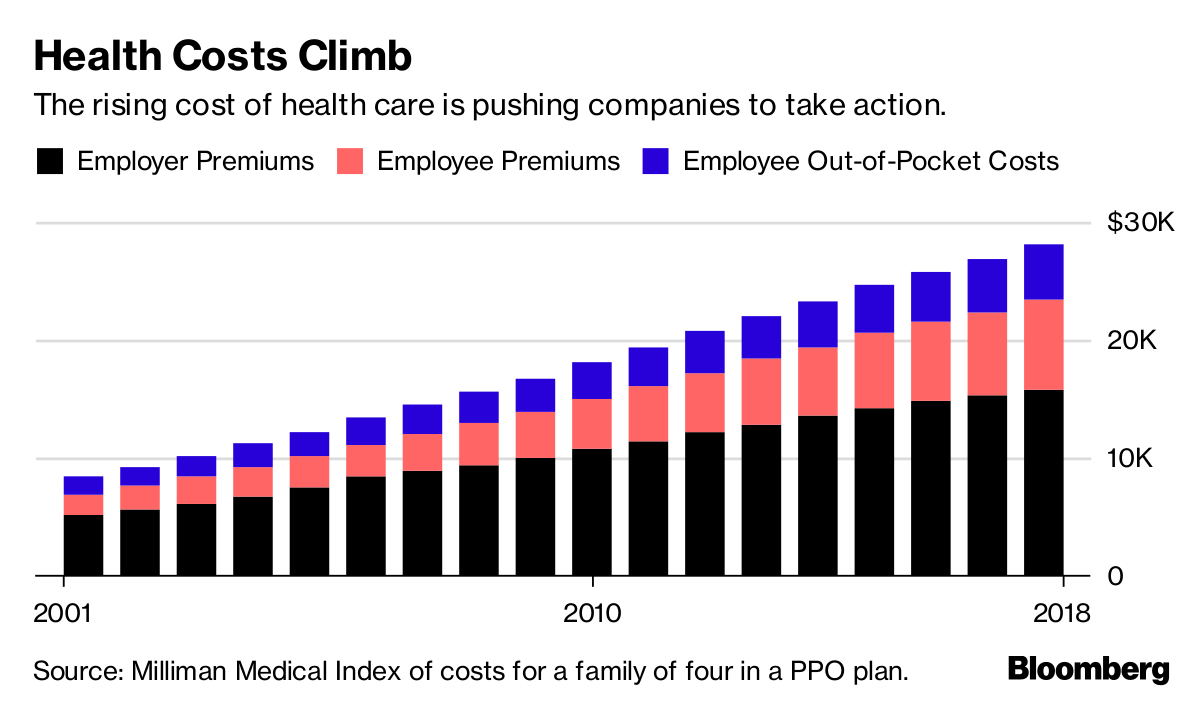
Health Costs Climb

The rising cost of health care is pushing companies to take action.

For many years, employers offered health plans that paid the bills when workers went to see just about any doctor, imposing few limits on care. The companies themselves usually paid much or all of the premiums.

Confronted with rising costs in the 1990s, many employers switched to HMOs or other forms of what became known as managed care. The switch worked, helping hold health costs down for much of the decade.

Soon, however, consumer and physician opposition grew amid horror stories of mothers pushed out of the hospital soon after childbirth, or patients denied cancer treatments. States and the federal government passed laws to protect consumers, and, in 1997, then-President Bill Clinton appointed a panel to create a health consumers’ Bill of Rights.

“The causes of the backlash are much deeper than the specific irritations or grievances we hear about,” Alain Enthoven, the Stanford health economist who helped pioneer the idea of managed care, said in a 1999 lecture. “They are first, that the large insured employed American middle class rejects the very idea of limits on health care because they don’t see themselves as paying for the cost.”

Workers would soon bear the cost, though. By the end of the decade, employers had moved away from these limited health plans. In their wake, costs skyrocketed, giving rise to a new cost-containment tool: high deductibles.

Centivo co-founder Ashok Subramanian spent the past decade trying to figure out how to offer better health insurance at work. His first startup, Liazon, helped workers pick from a big menu of coverage options. He sold it for some $215 million to Towers Watson in 2013, but he said it didn’t fix the bigger problem: Workers had lots of options, but none of them were very good.

“Yes, we were increasing choice, yes we were enabling personalization, but the choices themselves were not that good,” Subramanian said in an interview. “The choices themselves were predicated on a system in which the fundamental incentives in health care are broken.”

Tony Miller, Bind’s founder, helped give rise to health plans with high out-of-pocket costs. He sold a company called Definity Health that combined health plans with savings accounts to UnitedHealth Group Inc. for $300 million in 2004. He now says high-deductible plans failed to deliver on their promises.

“There’s a fever pitch of frustration at employers,” he said. “They’re tired of using the same levers that they’ve been using for the past 20 years.”

UnitedHealth, the biggest U.S. health insurer, helped create Bind with Miller’s venture capital firm and is an investor in the company, which has raised a total of $82 million. Bind is also using UnitedHealth’s network of doctors and hospitals as well as some of its technology.

Centivo has raised $34 million from investors including Bain Capital Ventures.

Centivo and Bind both promise to reduce costs for patients and employers while making it easier to find doctors and check coverage. They say they’ll reduce costs by making sure patients get the care they need, keeping them healthy and avoiding emergencies or unnecessary treatment.

Covered?

The proportion of Americans under 65 in health plans with high deductibles continues to increase.

In most cases, workers who follow the rules of Centivo’s plans won’t face a deductible. When signing up, employees pick a primary-care doctor, who’s responsible for managing their care and making decisions on whether they need to see a specialist. Care provided or directed by that primary physician is free, as is some treatment for chronic diseases such as diabetes, depending on how employers choose to set up the coverage.

The goal is to ensure workers get the care they need, while avoiding low-value treatments. Those who go to an emergency department in cases that aren’t true emergencies, for example, could face high costs.

“The big question is: Is the market ready for it?” said Mike Turpin, who advises employers on their health benefits as an executive vice president at USI Insurance Services. “The American consumer just has it built into their head that access equals quality.”

Bind bundles its coverage so consumers don’t get billed for lots of charges for services that are part of the same treatment. In Rose’s district, the copay for an emergency room visit is $250, while the cost of a hospital stay is capped at $1,000. Office visits are $35; preventive care is free.

Bind also offers what it calls on-demand insurance. Coverage for planned procedures such as knee surgery, tonsil removal or bariatric surgery must be purchased before the operation. That gives Bind a chance to push customers toward a menu of lower-cost alternatives or cheaper providers.

A patient who looks up knee arthroscopy, for instance, would also be offered physical therapy. The patient’s cost for the surgery ranges from $800 at an outpatient center to more than $6,000, in an example used by Miller. Surgeries in hospitals are typically more costly. Bind also charges more for providers who tend to be less efficient or have worse outcomes.

The ability to view costs upfront is part of what appealed to Rose, the Wisconsin superintendent. “Each of my employees knows exactly what they’re paying for, and they have choice in it,” he said.

Rose said the switch to Bind will save his district several hundred thousand dollars, depending on how much health care his workers need over the next year.

Lawton R. Burns, director of the Wharton Center for Health Management and Economics at the University of Pennsylvania, recently authored a paper with his colleague Mark Pauly arguing that it’s probably impossible to simultaneously improve quality, lower costs and achieve better health outcomes. The ideas now being pushed forward, he writes, are similar to ideas tested in the 1990s.

“It’s deja vu all over again,” he said. “It’s not clear to me, this is just me talking, that people have learned the lessons of the 1990s.”


Kavanaugh Supreme Court Fight Will Be All About Health Care

https://www.thefiscaltimes.com/2018/07/10/Kavanaugh-Supreme-Court-Fight-Will-Be-All-About-Health-Care

Image result for supreme court


he fight over President Trump’s pick of Appeals Court Judge Brett Kavanaugh to the Supreme Court is on, with Democrats launching what The Washington Post called “an all-out blitz” to defeat the nomination.

So get ready to hear a lot about health care in the coming days.

The Washington Post’s Dana Milbank notes that former Republican senator Jon Kyl, now a lobbyist for the pharmaceuticals industry, has been tapped to guide Kavanaugh’s path through the Senate. Why? Because by picking Kavanaugh, “Trump has guaranteed that health care will be at the center of the confirmation fight,” Milbank says.

Democrats welcome that fight, even if they have little chance of actually blocking the nomination. “The liberal base is fired up about abortion rights, but Senate Democratic Leader Charles Schumer (N.Y.) will seek to emphasize access to affordable health care as much as Roe v. Wade in the battle over the Supreme Court,” The Hill’s Alexander Bolton reports.

Focusing on health care might make sense for Democrats in a number of ways:

  • It reinforces the party’s preferred midterm election messaging in an area where voters say they trust Democrats more than Republicans.
  • Framing women’s reproductive rights as a matter of access to health care will be less polarizing in red states where seats are at stake in November, Bolton writes.
  • Playing up access to affordable health care may also put more pressure on Republican Sens. Susan Collins of Maine and Lisa Murkowski of Alaska, both of whom voted against Obamacare repeal last year.

If confirmed, Kavanaugh may get to weigh in on any of a number of cases with the potential to reshape health policy well beyond abortion rights. Despite his long legal record, “many of his health-related decisions are open to parsing from either side of the aisle and don’t actually provide a clear insight into where he’d stand on the Supreme Court,” The Washington Post’s Colby Itkowitz says.

Here are some key issues and cases that could be decided by the Supreme Court and Kavanaugh:

Obamacare’s protections for people with pre-existing medical conditions: Americans overwhelmingly support keeping these protections in place, according to a Kaiser Family Foundation poll from last month, but Trump’s Justice Department has asked a federal court to rule that those provisions of Obamacare are invalid. The case will soon be heard in a district court in Texas and could make its way to the Supreme Court before long. Sen. Joe Manchin of West Virginia, one of the few Democrats who might back Kavanaugh, said in a statement that he wants to hear where the judge stands on the ACA protections for those with pre-existing conditions before deciding whether to confirm him.

Medicaid: A federal court late last month blocked Kentucky’s plan to introduce work requirements for Medicaid recipients. The Trump administration is likely to appeal the ruling. Other states are also implementing work requirements. “As more states experiment with these programs and the cases wind their way through the courts, the Supreme Court may weigh in and shape how low-income Americans access Medicaid across the country,” Arielle Kane, director of health care at the Progressive Policy Institute, writes at the New York Daily News. The high court could also be asked to consider whether private health care providers can sue over Medicaid reimbursement rates, a question that could open the door to state funding cuts.

Risk adjustment payments to insurers: The Trump administration just froze billions of dollars of payments to insurers who enroll costlier-than-expected patients. The payments come from money collected from other insurers in the individual market. Legal challenges involving these payments are making their way through the courts. In the meantime, “the insurers in the individual market must manage uncertainty and constant change — resulting in higher prices for health care consumers,” Kane writes.

Industry consolidation: “Last year, four of the largest insurers tried, and failed, to merge into two. This year, CVS has proposed merging with Aetna, Amazon has acquired PillPack, and Walmart is seeking to combine with Humana,” Kane writes. “This so called ‘vertical integration’ raises questions about monopolies, competition and health-care pricing. It is likely that at some point courts will weigh in.”


Five Worrisome Trends in Healthcare

https://www.medpagetoday.com/publichealthpolicy/healthpolicy/72001?pop=0&ba=1&xid=fb-md-pcp&trw=no

Image result for five worrisome trends in healthcare

A reckoning is coming, outgoing BlueCross executive says.

A reckoning is coming to American healthcare, said Chester Burrell, outgoing CEO of the CareFirst BlueCross BlueShield health plan, here at the annual meeting of the National Hispanic Medical Association.

Burrell, speaking on Friday, told the audience there are five things physicians should worry about, “because they worry me”:

1. The effects of the recently passed tax bill. “If the full effect of this tax cut is experienced, then the federal debt will go above 100% of GDP [gross domestic product] and will become the highest it’s been since World War II,” said Burrell. That may be OK while the economy is strong, “but we’ve got a huge problem if it ever turns and goes back into recession mode,” he said. “This will stimulate higher interest rates, and higher interest rates will crowd out funding in the federal government for initiatives that are needed,” including those in healthcare.

Burrell noted that 74 million people are currently covered by Medicaid, 60 million by Medicare, and 10 million by the Children’s Health Insurance Program (CHIP), while another 10 million people are getting federally subsidized health insurance through the Affordable Care Act’s (ACA’s) insurance exchanges. “What happens when interest’s demand on federal revenue starts to crowd out future investment in these government programs that provide healthcare for tens of millions of Americans?”

2. The increasing obesity problem. “Thirty percent of the U.S. population is obese; 70% of the total population are either obese or overweight,” said Burrell. “There is an epidemic of diabetes, heart disease, and coronary artery disease coming from those demographics, and Baby Boomers will see these things in full flower in the next 10 years as they move fully into Medicare.”

3. The “congealing” of the U.S. healthcare system. This is occurring in two ways, Burrell said. First, “you’ll see large integrated delivery systems [being] built around academic medical centers — very good quality care [but] 50%-100% more expensive than the community average.”

To see how this affects patients, take a family of four — a 40-year-old dad, 33-year-old mom, and two teenage kids — who are buying a health insurance policy from CareFirst via the ACA exchange, with no subsidy. “The cost for their premium and deductibles, copays, and coinsurance [would be] $33,000,” he said. But if all of the care were provided by academic medical centers? “$60,000,” he said. “What these big systems are doing is consolidating community hospitals and independent physician groups, and creating oligopolies.”

Another way the system is “congealing” is the emergence of specialty practices that are backed by private equity companies, said Burrell. “The largest urology group in our area was bought by a private equity firm. How do they make money? They increase fees. There is not an issue on quality but there is a profound issue on costs.”

4. The undermining of the private healthcare market. “Just recently, we have gotten rid of the individual mandate, and the [cost-sharing reduction] subsidies that were [expected to be] in the omnibus bill … were taken out of the bill,” he said. And state governments are now developing alternatives to the ACA such as short-term duration insurance policies — originally designed to last only 3 months but now being pushed up to a year, with the possibility of renewal — that don’t have to adhere to ACA coverage requirements, said Burrell.

5. The lackluster performance of new payment models. “Despite the innovation fostering under [Center for Medicare & Medicaid Innovation] programs — the whole idea was to create a series of initiatives that might show the wave of the future — ACOs [accountable care organizations] and the like don’t show the promise intended for them, and there is no new model one could say is demonstrably more successful,” he said.

“So beware — there’s a reckoning coming,” Burrell said. “Maybe change occurs only when there is a rip-roaring crisis; we’re coming to it.” Part of the issue is cost: “As carbon dioxide is to global warming, cost is to healthcare. We deal with it every day … We face a future where cutbacks in funding could dramatically affect accessibility of care.”

“Does that mean we move to move single-payer, some major repositioning?” he said. “I don’t know, but in 35 years in this field, I’ve never experienced a time quite like this … Be vigilant, be involved, be committed to serving these populations.”


This Tweet Captures the State of Health Care in America Today

Image result for This Tweet Captures the State of Health Care in America Today

A nightmarish accident on a Boston subway platform on Friday — described in gory detail by a local reporter, Maria Cramer, as it unfolded and quickly retweeted by thousands — is one you might expect to see in an impoverished country.

In the face of a grave injury, a series of calculations follow: The clear and urgent need for medical attention is weighed against the uncertain and potentially monumental expense of even basic services, like a bandage or a ride to the hospital, and that cost, in turn, weighed against all the known expenses of living that run through any given head on any given day.

This discord, between agony and arithmetic, has become America’s story, too.

The United States spends vastly more on health care than other industrialized countries, nearly 17 percent of the nation’s gross domestic product in 2014, according to a report by the Commonwealth Fund, compared with just 10 percent of G.D.P. in Canada and Britain. But that disparity is not because Americans use more medical services — it’s because health care is far more expensive here than in other countries. One 2010 study by the Organization for Economic Cooperation and Development found that hospital costs were 60 percent higher in the United States than in 12 other nations.

And that cost is often passed on to patients, either in the form of deductibles and other out-of-pocket expenses or through ever-soaring insurance premiums.

The Affordable Care Act has improved access to health care, especially for lower-income families that now qualify for Medicaid or subsidies to buy private health insurance. Wider access, however, has not come cheaply for most people. As a result, many Americans, including those who are insured, have determined that they must avoid going to the hospital, visiting doctors or filling prescriptions that they need. A 2017 Kaiser Family Foundation survey found that 43 percent of people with insurance said that they struggled affording their deductibles, and 27 percent said that they put off getting care because of cost. Turning to GoFundMe and other crowdsourcing websites has become the norm in medical crises.

Whether the woman on the train platform received the medical attention she needed is unknown. Ms. Cramer said on Monday that she had not been able to get an update on the woman’s condition yet. Ms. Cramer went on to tweet that after several minutes had passed, an ambulance still had not arrived. Instead, fellow passengers tried to help. “One man stood behind her so she could lean against him,” she wrote. “Another pressed cold water bottles to her leg.”

Health care is a complicated problem, one exacerbated by the gridlock in Washington. But the trade-offs that everyday people are being asked to make, the calculations they are being forced to undertake in the scariest of situations, suggest that far too many of America’s politicians have placed too little value on the well-being of its citizens. Nothing will change until their fellow citizens step into the ballot box and insist on something better.


More Americans Paid for ACA Plans This Year — and More Are Getting Priced Out

https://www.thefiscaltimes.com/2018/07/03/More-Americans-Paid-ACA-Plans-Year-and-More-Are-Getting-Priced-Out


President Trump has declared that Obamacare is finished, dead, gone, essentially repealed. And yet, despite the administration’s efforts to undermine the law’s marketplaces, the number of Americans who enrolled in and started paying for Affordable Care Act plans grew slightly this year, according to reports released Monday by the Centers for Medicare and Medicaid Services (CMS).

At the same time, rising premiums are taking a toll, forcing many middle-income Americans — individuals making more than about $48,000 a year, or families of four making more than about $100,000 — to drop coverage. “Taken together, these reports show that state markets are increasingly failing to cover people who do not qualify for federal subsidies even as the Exchanges remain relatively stable,” CMS said.

Here’s a look at what the new reports show:

* While the total number of people who picked a plan for 2018 fell, the number of people who paid for coverage rose from 10.3 million in February 2017 to 10.6 million this past February, an increase of about 3 percent. “The increase is striking because it happened even though federal health officials last year slashed ACA funding to grass-roots groups that help consumers sign up for coverage, cut advertising and other outreach activities by 90 percent, and shortened the enrollment period by half,” writes Amy Goldstein at The Washington Post.

* CMS argued that, based on historical trends, a “significant number” of people will wind up dropping coverage during the year even after making their initial payments. Of the 10.3 million who paid for their plans as of March 15, 2017, only 8.9 million were still in those plans by the end of the year. “This is likely caused by consumers struggling to pay premiums as costs continue to increase,” the CMS report said.

* A larger share of enrollees has been getting federal subsidies. In 2014, the first year Affordable Care Act plans became available, 55 percent of those enrolled in individual market plans on or off the new Obamacare exchanges got financial help, according to Bloomberg. Last year, 62 percent did. In all, more than 8 million people got subsidies last year, while 5 million bought individual plans without financial help. “When premiums rise a lot, a lot more people become eligible for subsidies,” Matthew Fiedler, a fellow at the U.S.C.-Brookings Schaeffer Initiative for Health Policy, told The New York Times.

* As insurance prices rose by an average of 21 percent last year, signups among people who did not qualify for subsidies fell by 1.3 million — a drop of 20 percent compared with 2016. Subsidized enrollees fell by just 3 percent. “These reports show that the high-price plans on the individual market are unaffordable and forcing unsubsidized middle-class consumers to drop coverage,” CMS Administrator Seema Verma said in a statement. Trump administration policies may have played a part in the decline, too, and some people may have stopped buying their own insurance because they found jobs with employer coverage. “But it’s reasonable to think that most of the attrition can be attributed to the spike in prices, as the Trump administration concludes,” writes Margot Sanger-Katz of The New York Times.

What it all means: “The individual health insurance market under the ACA is financially sustainable as subsidies rise to match premium increases,” Larry Levitt of the Kaiser Family Foundation tweeted. “However, the lack of affordable insurance for middle-class people ineligible for subsidies does not seem politically sustainable.”