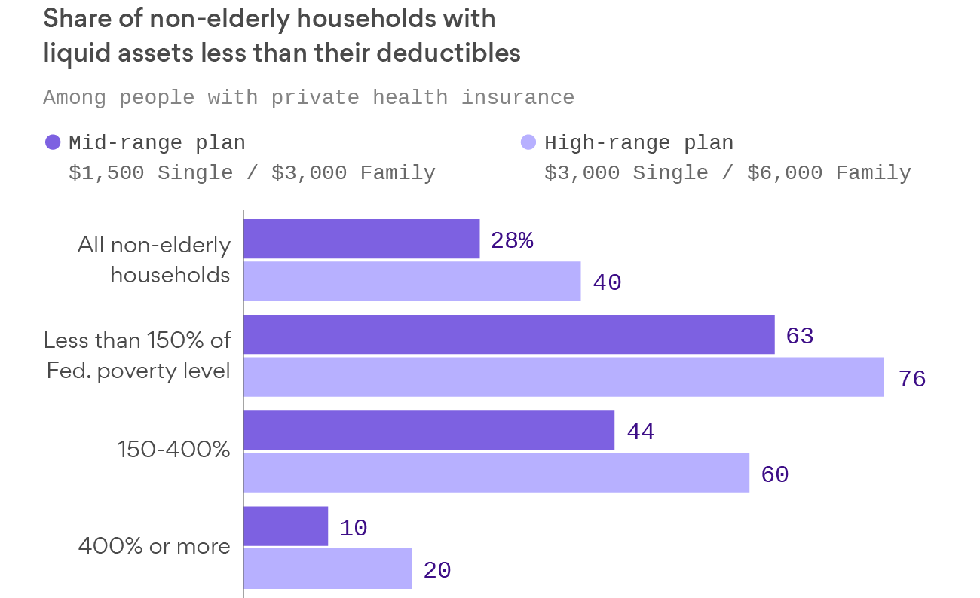
​Many families can’t afford even moderate deductibles

Reproduced from Kaiser Family Foundation analysis of the 2016 Survey of Consumer Finance; Note: Liquid assets include the sum of checking and saving accounts, money market accounts, certificates of deposit, savings bonds, non-retirement mutual funds, stocks and bonds; Chart: Axios Visuals

A lot of low-income families can’t afford even a moderate deductible, yet deductibles continue to rise in almost all forms of insurance, Kaiser Family Foundation president Drew Altman writes in his latest Axios column.

  • Roughly 40% of all non-elderly households don’t have enough liquid assets to cover a high deductible ($3,000 for an individual or $6,000 for a family).
  • Among families whose income makes them eligible for the ACA’s premium subsidies, 60% don’t have enough liquid assets to cover a high deductible and 44% couldn’t cover the deductible for a mid-range plan ($1,500 for an individual or $3,000 for a family).

Why it matters: High deductibles are everywhere, and they’re only getting higher. Many ACA plans have relatively big deductibles and Republicans’ alternatives would push them higher. They’ve been getting bigger and bigger in employer plans, too.

  • “For many families, even if they have insurance, any significant illness could wipe out all their savings, making impossible to fix a broken car to get to work, or pay for school, or make a rent or mortgage payment,” Altman says.

The biggest health issue we aren’t debating

https://www.axios.com/the-biggest-health-issue-we-arent-debating-2511098849.html

Image result for The biggest health issue we aren’t debating


Thanksgiving is always a time to think about those in need. How about, then, a group we don’t worry about enough: the many lower and moderate income Americans who can’t cover their cost sharing if they get sick? It raises the question: How much cost sharing is too much?

The bottom line: High deductible plans, which require people to pay large amounts out of pocket before their medical bills are covered, are a good deal for some middle and upper income people. But many lower and moderate income Americans simply don’t have $1,500 to $3,000 to pay for the colonoscopy that might save their life, or a stress test that might reveal the heart disease which is the cause of their chest discomfort.

The details: The chart, drawn from a new study, tells the tale: More than four in in 10 households with private coverage and incomes between 150% and 400% of the federal poverty line do not have enough liquid assets to cover a deductible of $1,500 for single people and $3,000 for families.

  • That’s not a high deductible plan, but about the average in an employer-provided insurance plan.
  • Sixty percent couldn’t cover deductibles double those amounts, which are not uncommon, especially in the individual insurance market.
  • Ninety percent of insured households with incomes of 400% of poverty or more could meet a typical employer insurance deductible, but just 37% of lower income household with incomes under 150% of the poverty level could.

For many families, even if they have insurance, any significant illness could wipe out all their savings, making impossible to fix a broken car to get to work, or pay for school, or make a rent or mortgage payment.

Congress has passed no law declaring that the country will go with high deductible coverage as its main approach to health insurance. There has been no meaningful debate about its pros and cons. But as deductibles and other forms of cost sharing have inched up year by year, the nature of insurance has changed.

The people to worry about most are the ones who are least equipped to deal with that change. There may be someone who fits that bill around your Thanksgiving table.


Hospital revenue cycles improving, but denials are up

https://www.healthcaredive.com/news/hospital-revenue-cycles-improving-but-denials-are-up/511014/

Image result for insurance denials

Dive Brief:

  • Recycle cycle performance for hospitals and health systems is improving, but there are still major risks. These risks include increased denial write-offs, bad debt and inefficiencies, such as the costs associated with collecting from patients, according to Advisory Board’s recent Revenue Cycle Survey.
  • A median 350-bed hospital lost $3.5 million in increased denial write-offs from payers over the past four years, according to the report.
  • Jim Lazarus, national partner of technology at Advisory Board, said revenue cycle benchmarks are “encouraging,” but they also show “the risks of complacency.”

Dive Insight:

Advisory Board’s biennial survey reviewed four critical performance indicators. The researchers found mixed results. Denials remain an issue for hospitals, which wrote off 90% more uncollectable denials compared to six years ago.

The report also highlights downstream challenges. The median hospital successful denial appeals rate over the past two years:

  • Dropped from 56% to 45% for commercial payers
  • Fell from 51% to 41% for Medicaid
  • Increased from 50% to 64% for Medicare and Medicare Advantage

Advisory Board predicted that denials will remain an issue as an increasing number of them “are based on medical necessity rather than technical or demographic error.”

James Green, national partner of consulting at Advisory Board, said hospitals and health systems need strategies to address denials proactively.  “The wide range of denials performance among health systems — spanning 3% of net patient revenue between high and low performers — amounts to a $10 million swing for a median 350-bed hospital. Appeals are becoming increasingly difficult, so health systems should focus on approaches such as improved documentation and authorization processes,” said Green.

Another issue for health systems and hospitals is cash flow. In a bit of good news, the median performance for net accounts receivable days improved 8% between 2015 and 2017. However, Advisory Board warned the gains may be partially caused by write-offs and other factors, which can reduce accounts receivable and pose other challenges.

In another bit of good news, expanded coverage via the Affordable Care Act reduced hospital bad debt. However, that is offset by more and higher patient deductibles. Hospitals in Medicaid expansion states performed better regarding less bad debt, but high-deductible health plans (HDHP) increased unpaid patient obligations across all states regardless of whether they expanded Medicaid.

A recent Kaiser Family Foundation study found that the average deductible for people with employer-based health insurance increased from $303 in 2006 to $1,505 in 2017.

Advisory Board said the increase of HDHPs shows hospitals and health systems need to focus on patient collections, particularly at the point of service (POS). The report said a median 350-bed hospital could increase collections from $800,000 to nearly $3 million by improving POS collections. Advisory Board added that systems that collect upfront often give patients discounts, which result in a 90% increase in POS collections compared to those that do not offer discounts.

The cost of collections is an issue that continues to plague health systems. The median cost to collect has remained at 3% over the past four years, but that is higher than what it cost a decade ago. Advisory Board said reducing those costs are critical given the softening hospital margin trends in the past year. Health systems have also not realized cost improvements despite consolidation and centralized revenue cycle functions.

“While, for example, patient access is difficult to centralize, other functions present good opportunities, such as coding, billing, collections, denials and payer contracting, especially given their high operational costs for these functions,” said Christopher Kerns, executive director of research at Advisory Board.

Lower reimbursements and inpatient services coupled with a payer push for more outpatient services and patients taking on more responsibility for out-of-pocket costs is causing hospitals and health systems to figure out ways to survive. While Advisory Board mentioned suggestions to improve revenue cycle, some systems have instead decided mergers and acquisitions and divestitures are a better way to go.

Going those routes to improve financial footing has their own set of barriers. For instance, mergers and acquisitions reduce expenses for hospitals, but they can also cut revenue and hurt margins in the first two years, according to a recent report by the Deloitte Center for Health Solutions, in collaboration with Healthcare Financial Management Association.

As the Advisory Board report shows, there is some good news concerning hospital revenue cycles. However, hospitals must continue to improve patient collections as well as reduce payer denials — in a cost-effective manner — if they can expect to remain viable.


Insurers Can Bend Out-Of-Network Rules For Patients Who Need Specific Doctors

https://khn.org/news/insurers-can-bend-out-of-network-rules-for-patients-who-need-specific-doctors/?utm_campaign=KHN%3A%20Topic-based&utm_source=hs_email&utm_medium=email&utm_content=58529177&_hsenc=p2ANqtz-85eIov6h_xyFiUgaAQ4fPQfmFKIGc3Hy-dk3J1iXBI7lQ6d8lPFgPXXyeWrMceH2mGmhwxT0ZSLJVK3aeIMHcE7YGtbg&_hsmi=58529177

The Affordable Care Act has so far survived Republican attempts to replace it, but many people still face insurance concerns. Below, I answer three questions from readers.

Q: I have a rare disease, and there is literally only one specialist in my area with the expertise needed to treat me. I am self-employed and have to buy my own insurance. What do I do next year if there are zero insurance plans available that allow me to see my specialist? I cannot “break up” with my sub-specialty oncologist. I must be able to see the doctor that is literally saving my life and keeping me alive.

If the plan you pick covers out-of-network providers, you can continue to see your cancer specialist, although you’ll have to pay a higher percentage of the cost than if you were seeing someone in your plan’s network.

But many plans these days don’t provide any out-of-network coverage. This is certainly true of plans sold on the health insurance exchanges.

The situation you’re concerned about — that a specialist you consider crucial to your care isn’t in a plan’s provider network — isn’t uncommon, said Sabrina Corlette, a research professor at Georgetown University’s Center on Health Insurance Reforms.

If this happens, you can contact your plan and make the case that this particular provider is the only one who has the expertise to meet your needs. (Unfortunately, you probably can’t get this coverage assurance before you sign up.) Then ask your plan to make an exception and treat the out-of-network specialist as if she were in network for cost-sharing purposes. So, if in your plan an in-network specialist visit requires a $250 copayment, for example, the plan would agree that’s what you’d be charged to see your out-of-network specialist.

Or not. It’s up to the plan officials, and they may argue that someone in network has the expertise you need. If you disagree, you can appeal that decision.

But it may not come to that, said Corlette.

“Plans are prepared for this — the good ones are, anyway,” she said. “My understanding is that it’s pretty routine to grant exceptions for narrow subspecialties.”

Q: My company has asked employees to pay the Cadillac tax rather than putting the burden  on the company. They are also telling us not to worry because it will never happen, but want us to agree that if it does we will take on the cost. Can they do that?

Let’s step back for a minute. The so-called Cadillac tax is a 40 percent surcharge on the value of health plans above the thresholds of $10,200 for single coverage and $27,500 for family plans.

A few months ago when it looked as if the ACA was going to be replaced, many employers believed, as yours apparently still does, that the Cadillac tax would never become effective. Both the House and Senate bills delayed the tax until 2026, and a lot can happen between now and then. With the collapse of efforts to repeal the ACA, however, the tax is on the front burner once again, said J.D. Piro, who leads the health and law group at benefits consultant Aon Hewitt. It’s set to take effect in 2020.

Under the law, insurers or employers would be responsible for paying the tax, but experts say the costs would likely be passed through to enrollees (whether or not you explicitly agree to absorb them). So it may not matter how you respond to your employer.

Also, employers who don’t want to pay the surcharge might sidestep the issue by reducing the value of the plans they offer, said Piro. For example, they could increase employee deductibles and other cost-sharing, make coverage less generous or shrink the provider network.

“That’s simplest way to avoid the tax,” he said.

Q: I need to purchase affordable health insurance for my two daughters who are 19 and 17. Is Trump insurance available yet? I need something I can afford and everything is so expensive.

President Donald Trump never put forward a proposal to replace the ACA. Instead, he backed the House and Senate replacement versions, which ultimately failed. But those versions might not have addressed your concerns, and you could have several options through the ACA.

“Coverage wouldn’t necessarily have been cheaper,” said Judith Solomon, vice president for health policy at the Center on Budget and Policy Priorities.

Under the Senate bill, for example, the nonpartisan Congressional Budget Office predicted that average 2018 premiums for single coverage would be 20 percent higher than this year’s. In 2020, however, premiums would be 30 percent lower than under current law, on average. But deductibles and other out-of-pocket costs would be higher for most people under the Senate bill, according to the CBO.

Premiums for young people would generally have declined. The bill would have allowed insurers to vary rates to a greater degree based on age, resulting in lower premiums for young people. In addition, premium tax credits generally would have increased for young people with incomes above 150 percent of the poverty level.

Your current coverage options under the ACA depend on your family situation. If you have coverage available to you through your employer, you can keep your daughters on your plan until they turn 26. For many parents, this is the most affordable, comprehensive option.

If that’s not a possibility, assuming the three of you live together and you claim them as dependents on your taxes, you may qualify for subsidized coverage on the health insurance marketplace next year. Your household income would need to be no more than 400 percent of the federal poverty level (about $82,000 for a family of three). You can apply for that coverage in the fall.

If you live in one of the 31 states plus the District of Columbia that have expanded Medicaid coverage to adults with incomes below 138 percent of the poverty level (about $28,000 for a family of three), you could qualify for that program. You don’t have to wait for open enrollment to sign up for Medicaid.


Trump and the Essential Health Benefits

Trump and the Essential Health Benefits

Image result for essential health benefits

On Friday, HHS released a proposed rule that would make a number of adjustments to the rules governing insurance exchanges for 2019. The rule is long and detailed; there’s a lot to digest. Among the most noteworthy changes, however, are those relating to the essential health benefits. They’re significant, and I’m not convinced they’re legal.

By way of background, the ACA requires all health plans in the individual and small-group markets to cover a baseline roster of services, including services falling into ten broad categories (e.g., maternity care, prescription drugs, mental health services). Taken as a whole, the essential health benefits must be “equal to the scope of benefits provided under a typical employer plan, as determined by the Secretary.”

The ACA’s drafters anticipated that HHS would establish a national, uniform slate of essential health benefits. Instead, the Obama administration opted to allow the states to select a “benchmark plan” from among existing plans in the small group market (or from plans for state employees). The benefits covered under the benchmark were then considered “essential” within the state.

At the time, Helen Levy and I concluded that HHS’s approach brushed up against the limits of what the law allowed. We noted, among other things, that the ACA tells HHS to establish the essential health benefits—not the states. And it’s black-letter administrative law that an agency can’t subdelegate its powers to outside entities, states included.

At the end of the day, however, Helen and I concluded that the Obama-era regulation passed muster. Our rationale bears repeating:

Although a federal agency cannot delegate its powers to the states, it “may turn to an outside entity for advice and policy recommendations, provided the agency makes the final decisions itself.” Here, the secretary gave the states a constrained set of options (e.g., choose a benchmark plan from among the three largest small-group plans in the state) and retained the authority to select a benchmark for any state that either does not pick a benchmark or chooses an inappropriate one. As such, the secretary remains firmly in control. Nothing in the ACA prevents her from deferring to states that select benchmark plans from among the few options she has provided. That choice to defer is itself an exercise of her delegated powers.

The Trump administration’s proposed rule would vastly enlarge this Obama-era subdelegation. For starters, the rule would allow a state to adopt another state’s benchmark, or part of a state’s benchmark, as its own. Michigan, for example, could borrow Alabama’s benchmark plan wholesale, or it could incorporate Alabama’s benchmark for mental health and substance use disorder treatment. More significantly, the rule would allow a state to “selec[t] a set of benefits that would become the State’s EHB-benchmark plan.”

You read that right: if the rule is adopted, each state can pick whatever essential health benefits it likes. No longer will it be choosing from a preselected menu; it’ll be picking the essential benefits out of a hat. In so doing, the proposed rule looks like it would unlawfully cede to the states the power to establish the essential benefits.

This extraordinary subdelegation of regulatory authority is subject only to the loosest of constraints: benefits can’t be “unduly weighted” toward any one benefit category or another, and the benchmark must “[p]rovide benefits for diverse segments of the population, including women, children, persons with disabilities, and other groups.” The selected benefits also can’t be more generous than the state’s 2017 benchmark (or any of the plans the state could have selected as its benchmark), but that’s a ceiling, not a floor, so states have lots of room to pare back.

The only meaningful constraint is that the benefits covered by the state’s benchmark must be “equal to the scope of benefits provided under a typical employer plan.” But another portion of the proposed rule would hollow out that requirement:

[W]e propose to define a typical employer plan as an employer plan within a product (as these terms are defined in §144.103 of this subchapter) with substantial enrollment in the product of at least 5,000 enrollees sold in the small group or large group market, in one or more States, or a self-insured group health plan with substantial enrollment of at least 5,000 enrollees in one or more States.

In other words, HHS is saying it will treat as “typical” any employer plan, in any state, that covers more than 5,000 people.

This looks like an innocuous change. It’s not. If the rule is adopted, it means that a single outlier plan can now count as typical, even if it’s way stingier than any other plan in the market. It also makes me wonder if HHS already has in mind some large employer with an unusually narrow health plan—maybe some hospital-based “administrative services only” plan, as Dave Anderson speculates. If so, voilá, the states can all ratchet down their essential benefits to that plan’s level.

I don’t think that’s legal. To know if a slate of health benefits is typical, you have to know something about how many health plans cover those benefits and how many don’t. The proposed rule eschews that comparative inquiry, and instead defines typicality with reference to the number of people who are covered by a single plan. Some random self-insured plan that excludes appendectomies could be treated as typical, even if it’s the only plan in the nation that does so.

In other words, HHS wants to define a “typical employer plan” to include atypical plans—which the agency emphatically cannot do. Yes, plans that enroll 5,000+ people are less likely to be outliers than smaller ones. But in a country as big and complicated as ours, there are bound to be some idiosyncratic quirks even in large plans. Those quirks would all be considered typical under HHS’s rule.

This definitional change, combined with the choose-your-own-adventure option to devise a benchmark, means that states will have wide authority to water down the essential health benefits requirement. Whether that’s good or bad is hard to say. Requiring plans to cover lots of services assures comprehensive coverage, but it also raises the cost of insurance. Because there’s no single “best” way to strike the balance, I think there’s a lot to be said for giving states the freedom to choose for themselves.

Wise or not, however, I’m skeptical that the Trump administration’s effort to hollow out the rule governing essential health benefits is legal. If HHS presses ahead with the rule, it could face tough sledding in the courts.

Trump suggests repealing ObamaCare mandate in tax bill

Trump suggests repealing ObamaCare mandate in tax bill

Related image

President Trump on Wednesday suggested using the GOP tax bill to repeal ObamaCare’s individual mandate.

“Wouldn’t it be great to Repeal the very unfair and unpopular Individual Mandate in ObamaCare and use those savings for further Tax Cuts,” Trump tweeted.

The idea is being pushed by Sen. Tom Cotton (R-Ark.) and also has the backing of House Freedom Caucus Chairman Mark Meadows (R-N.C.).

Meadows said Wednesday he supports repealing the mandate in tax reform and thinks “ultimately” it will be included because he is going to push for it. He said he has been talking to Cotton about it.

A Cotton spokeswoman told The Hill that Cotton and Trump spoke by phone about the idea over the weekend and “the President indicated his strong support.”

Senate Finance Committee Chairman Orrin Hatch (R-Utah) this week said that he wouldn’t rule out including repeal of the mandate in the tax legislation.

But other top Republicans have rejected the idea, including House Ways and Means Committee Chairman Kevin Brady (R-Texas), Senate Majority Whip John Cornyn (R-Texas) and Sen. John Thune (R-S.D.). They fear adding the ObamaCare change would jeopardize tax reform.

“Look, I want to see that individual mandate repealed,” Brady said during an interview with radio host Hugh Hewitt on Tuesday. “I just haven’t seen, no one has seen, 50 votes in the Senate to do it.”

Brady added that he would be open to adding a repeal of the mandate to the House bill if the Senate passed it first.

Asked Wednesday about the president’s tweet, Senate Majority Whip John Cornyn (R-Texas) threw cold water on the idea.

“I think tax reform is complicated enough without adding another layer of complexity,” Cornyn told The Hill.

Thune, meanwhile, said mandate repeal is “not currently a part of our deliberations.”

But Thune added that some members have expressed interest in the idea and said he was “somewhat” interested in it because of the revenue implications.

Sen. Mike Rounds (R-S.D.) on Tuesday also dismissed adding a repeal of the mandate to tax reform.

“If there was a way to do it, I’d be open to it, but I’m not going to pitch it because I want to focus on taxes in the tax reduction plan,” Rounds told reporters.

The Congressional Budget Office has estimated that repealing the mandate would save the government $416 billion over a decade.

The mandate requires people, with some exceptions, to pay a fine to the IRS if they do not have health insurance.

Experts have said repealing the mandate would result in massive premium spikes and a major increase in the number of uninsured people.

It could also send ObamaCare exchanges into a “death spiral” because it would discourage healthy younger individuals to sign up for insurance.

Asked about it on Wednesday after Trump’s tweet, Hatch again did not rule out the move, but cautioned that he wants to keep health care separate from tax reform, a point echoed by GOP aides.
“I think we ought to do tax reform. If they want to do something on health care they can do that separate,” Hatch said. It was not clear who “they” referred to.
“I’d have to really look at all sides of that. I’ve never been very excited about the individual mandate,” Hatch said.

CMS to allow states to define essential health benefits

http://www.modernhealthcare.com/article/20171027/NEWS/171029872/cms-to-allow-states-to-define-essential-health-benefits

Image result for end run

The CMS proposed a rule late Friday aimed at giving states more flexibility in stabilizing the Affordable Care Act exchanges and in interpreting the law’s essential health benefits as a way to lower the cost of individual and small group health plans.

In the 365-page proposed rule issued late Friday, the agency said the purpose is to give states more flexibility and reduce burdens on stakeholders in order to stabilize the individual and small-group insurance markets and improve healthcare affordability.

The CMS said the rule would give states greater flexibility in defining the ACA’s minimum essential benefits to increase affordability of coverage. States would play a larger role in the certification of qualified health plans offered on the federal insurance exchange. And they would have more leeway in setting medical loss ratios for individual-market plans.

“Consumers who have specific health needs may be impacted by the proposed policy,” the agency said. “In the individual and small group markets, depending on the selection made by the state in which the consumer lives, consumers with less comprehensive plans may no longer have coverage for certain services. In other states, again depending on state choices, consumers may gain coverage for some services.”

However, the CMS acknowledged it’s unclear how much money the new state flexibility will save. States are not required to make any changes under the policy.

The CMS urged states to consider the so-called spillover effects if they choose to pick their own benefits. These include increased use of other services, such as increased used of emergency services or increased use of public services provided by the state or other government entities.

The agency in 2017 proposed standardized health plan options as a way to simplify shopping for consumers on the federally run marketplaces. The CMS said it would eliminate standardized options for 2019 to maximize innovation. “We believe that encouraging innovation is especially important now, given the stresses faced by the individual market,” the proposed rule states.

The CMS proposes to let states relax the ACA requirement that at least 80% of premium revenue received by individual-market plans be spent on members’ medical care. It said states would be allowed to lower the 80% medical loss ratio standard if they demonstrate that a lower MLR could help stabilize their individual insurance market.

The CMS also said it intended to consider proposals in future rulemaking that would help cut prescription drug costs and promote drug price transparency.

The Trump administration hopes to relax the ACA’s requirements and provide as much state flexibility as possible through administrative action, following the collapse of congressional Republican efforts this year to make those changes legislatively.

The proposed rule comes after months of calls from health insurers and provider groups for the federal administration to help stabilize the struggling individual insurance market. The fifth ACA open enrollment is slated to begin Nov. 1, and experts have predicted fewer sign-ups in the wake of a series of actions by the Trump administration to undercut the exchanges.

In the proposed rule, the CMS also proposes to exempt student health insurance from rate reviews for policies beginning on or after Jan. 1, 2019. The CMS said student health insurance coverage is written and sold more like group coverage, which is already exempt from rate review, and said the change would reduce regulatory burden on states and insurance companies.

The ACA requires that insurers planning to increase premiums by 10% or more submit their rates to regulators for review. The CMS proposed to increase the rate review threshold to 15% “in recognition of significant rate increases in the past number of years.”

The rule also tweaks a requirement that enrollees need to have prior coverage before attempting to get coverage via special enrollment after moving to a new area. Under the proposal, a person who lived in an area with no exchange qualified health plans will be able to obtain coverage.

Trump tells Senate to fix taxes — not Obamacare

https://www.politico.com/story/2017/10/24/trump-obamacare-taxes-senate-republicans-244124

Image result for ACA

The bipartisan effort to stabilize insurance markets gets pushed to the end of the year.

President Donald Trump on Tuesday steered Senate Republicans toward tax reform and away from health care, pushing off any deal to fund controversial Obamacare subsidies to the end of the year at best.

Trump joined Senate Republicans at their weekly policy lunch but gave no direction on what he wants to see in a health care bill. He praised Sen. Lamar Alexander’s (R-Tenn.) work on a bipartisan deal meant to stabilize the Obamacare markets, but his emphasis on taxes led senators in the room to believe Trump doesn’t want a stand-alone Obamacare vote anytime soon.

“There isn’t anything else other than taxes,” said Sen. John Cornyn (R-Texas).

A filibuster-proof majority backs the bipartisan deal Alexander brokered with Sen. Patty Murray (D-Wash.), but conservatives and the White House oppose it, meaning it won’t even come up for a vote in the Senate.

Without a clear directive from the president, Republicans are still debating whether to work with Democrats to fund Obamacare’s “cost-sharing” program, which helps low-income people pay their out-of-pocket medical bills. Trump abruptly cut off the subsidies — the subject of a court battle — earlier this month. Insurers still have to make the payments, and many boosted their premiums for 2018 to take those costs into account.

Alexander’s stabilization bid got even more muddled when a pair of top Republicans said they would release a different bill — rivaling the bipartisan proposal — to fund the subsidies. But their version would neuter the individual mandate for five years, a nonstarter for Democrats who would be needed to get a bill through the Senate.

The new version “proves that we should be focused on tax reform right now, because obviously we haven’t gotten our act together on health care,” said Sen. John Thune (R-S.D.).

Republicans are increasingly confident that the subsidies will get rolled into a large, year-end bill to fund the government and raise the nation’s debt limit. But there is no agreement on what exactly that will look like, and leadership-level negotiations on the year-end bill are weeks away.

The lack of clarity left Senate Republicans with enough wiggle room to interpret Trump’s Obamacare comments as they see politically fit.

Cornyn saw a “shoutout” by Trump to Alexander as encouragement for his bill. “He wasn’t specific, but that’s the way I interpreted it,” he said.

But Sen. Ted Cruz (R-Texas) — an Alexander-Murray skeptic — said Trump didn’t offer any clear support for the proposal over the GOP’s competing ideas.

“There was not significant discussion on Alexander-Murray,” Cruz said.

Sen. Orrin Hatch (R-Utah), another foe of Alexander-Murray, walked away with the same conclusion.

“He didn’t get into that in great depth — put it that way,” Hatch said. “All I can say is that he wasn’t too definitive.”

During the lunch meeting, Trump focused more on getting tax reform done so that the GOP can take another shot at repealing Obamacare in the future, instead of what should be done to stabilize the health care law in the interim.

“If we get taxes done, we’ll have momentum for health care,” said Sen. Lindsey Graham (R-S.C.), summing up Trump’s position. “He talked a lot about doing health care again.” Trump has repeatedly stated recently that the GOP now has the votes for repeal in the Senate — but senators say that’s not the case, that no one has flipped.

The meeting marked Trump’s first visit to the Senate GOP’s weekly policy lunch as president, and it came amid a rift with Sen. Bob Corker (R-Tenn.) and growing concern within the GOP that lawmakers will go into the 2018 midterm election without a legislative accomplishment. That’s amped up the pressure in the GOP to do tax reform.

But many Republican senators said after the lunch meeting that there was no discussion of petty politics and that Trump was focused on notching some GOP wins.

“It was the complete opposite of what I thought it would be — the atmosphere in the room and his complete focus,” said one senator.

The conservative Obamacare bill introduced Tuesday came from Hatch, the chairman of the Senate Finance Committee, and House Ways and Means Chairman Kevin Brady.

That bill, which would fund the cost-sharing program for two years, is designed to appeal to Republicans who want to fund the Obamacare program but feel that Alexander didn’t get enough conservative concessions in his negotiations with Murray.

It would eliminate Obamacare’s individual mandate penalties through 2021 and expand the use of health savings accounts. The Hatch-Brady bill would also exempt businesses from the employer mandate for 2015 through 2017 and apply certain “pro-life protections” to the cost-sharing funding.

“We must include meaningful structural reforms that provide Americans relief,” Hatch said. “This agreement addresses some of the most egregious aspects of Obamacare.”

Some of the provisions in the proposal — like the expansion of HSAs and employer mandate exemption — mirror the changes that the White House requested be made to the Alexander-Murray bill.

Alexander said he was encouraged by a growing consensus Congress should fund the payments to insurers for two more years.

“We’ve gone from a position where everybody was saying we can’t do cost sharing to responsible voices like Sen. Hatch and Chairman Brady saying we should,” he said.

But any cost-sharing bill will need 60 votes to get through the Senate, meaning Republicans will have to get at least eight Democrats to sign on. Undoing the mandates in the future would be a nonstarter for many Democrats.

“If it were just a matter of getting Republicans to agree with each other, we would have repealed and replaced Obamacare by now,” said a Senate GOP aide.

How Premiums Are Changing In 2018

How Premiums Are Changing In 2018

Related image

The premiums for 2018 Marketplace plans were recently released to give consumers a chance to look at their plan options before open enrollment begins on November 1. Premiums are rising significantly in many counties across the country, in part due to the decision of the Trump Administration to cease payments to insurers for cost-sharing reductions. Insurer participation also declined in many areas, leaving more counties with only one insurer, which likely contributed to the high rate of premium growth.

The map below illustrates how premiums changed for 2018 by looking at the change in the lowest-cost bronze, silver and gold plans by county in states participating in the federal Marketplace. Results are shown for a 40-year-old paying the full premium and for a 40-year old with an income of $25,000 (207% of poverty), $30,000 (249% of poverty), $35,000 (290% of poverty), and $40,000 (332% of poverty), who would be eligible for a premium tax credit.

Percent Change in Lowest-Cost Metal Plan Before and After Tax Credit, 2017-2018

Nationally, the unsubsidized premium for the lowest-cost bronze plan in the federal Marketplace is increasing an average of 17% between 2017 and 2018, the lowest-cost silver plan is increasing an average of 35%, and the lowest-cost gold plan is increasing an average of 19% (Table 1). These average increases are weighted by the number of plan selections by county in 2017 (see Methods). Premiums for silver plans are rising much more than those for bronze or gold plans because in many states insurers loaded the cost from the termination of the cost-sharing reduction payments entirely on the silver tier.

For consumers who receive premium tax credits, the amounts that they will have to pay will often be lower in 2018 (Table 2). The particularly large increase in premiums for silver plans means that tax-credit-eligible Marketplace enrollees will see much higher premium tax credits (which are calculated based on the second-lowest-cost silver plan in each area). These large credits make gold plans more easily attainable and make bronze plans much cheaper (or even available at no additional premium). In fact, after these increases, the lowest-cost gold premium is lower than the lowest-cost silver premium in 459 counties.

For example, a 40-year-old individual making $35,000 (249% of poverty) and eligible for a tax credit will on average pay 39% less in 2018 for their share of the premium for the lowest-cost bronze plan, 7% less for the lowest-cost silver plan, and 13% less for the lowest-cost gold plan. The savings are greater for subsidized enrollees with lower incomes and less for those with higher incomes (Table 2). The premiums for bronze plans may be particularly attractive to many people eligible for premium tax credits. For example, the tax credit for a 40-year-old individual making $25,000 covers the full cost of the premium for the lowest-cost bronze plan in 1,540 counties.

Counties Where the Lowest-Cost Bronze Plan Premium Costs Zero Dollars After the Tax Credit in 2018

The map below shows counties where the unsubsidized premium for the lowest-cost gold plan has a lower or comparable premium to the lowest-cost silver plan in 2018.

Counties Where the Lowest-Cost Gold Plan Costs Less than the Lowest-Cost Silver Plan

Discussion

The differences in premium changes across plan types and the peculiar effect these differences have on plan costs for both unsubsidized and subsidized enrollees makes it important that consumers shop around and carefully consider their options. Although CMS will no longer be paying insurers for reducing the cost sharing for lower-income enrollees, insurers remain obliged to provide the reduced cost sharing policies to eligible Marketplace enrollees. These policies generally have higher actuarial values than gold plans for enrollees with incomes below 200% of poverty so consumers will need to carefully consider whether it makes sense to switch even though gold-plan premiums may be comparable or less than silver plans. Consumers eligible for cost sharing reductions also will need to weigh the much lower premiums they would pay for a bronze plan with the much higher cost sharing they could encounter if they need care.