​Let’s see what the ACA’s subsidies can do

It sure looks like Congress is about to repeal the Affordable Care Act’s individual mandate, which will put a lot of pressure on the law’s premium subsidies. What was once a “three-legged stool” — consumer protections, the mandate and premium subsidies — is down to two legs, and subsidies are the only remaining tool to try to attract the people who weren’t already inclined to seek health insurance.

What’s happening: When President Trump cut off federal payments for the ACA’s cost-sharing subsidies, insurers responded by increasing their premiums in a way that also bumped up the law’s premium subsidies — a bit of gamesmanship that few experts had fully anticipated, and which leveraged the structure of the premium subsidies to make up for the effects of political chaos.

The big question: Would something like that work again? Can subsidies make up the difference if the mandate goes away?

The answer: Probably not, policy analysts told my colleague Caitlin Owens and me.

  • “Mandate repeal could quite likely be the last straw for some insurers, and we are likely to see more bare counties for 2019, possibly bare states, as well as higher premiums as remaining insurers take advantage of their market power to raise premiums,” says Washington & Lee University professor Tim Jost, a vocal ACA supporter.

The bottom line: As premiums go up, subsidies go up. So subsidies would help shield the lowest-income consumers from the cost increases caused by the loss of the individual mandate.

Yes, but: The people who don’t receive subsidies will just have to bear the brunt of those costs. And it won’t be easy to concentrate premium hikes onto a specific set of plans, with the goal of increasing subsidies as much as possible, the way insurers did when Trump cut off cost-sharing payments.

  • “I don’t think there’s the same opportunity to play arithmetic games. Insurers will have to raise premiums across the board,” Kaiser Family Foundation’s Larry Levitt says.

Image result for axios

GOP may have no choice but to try health care again after taxes

https://www.axios.com/gop-may-have-no-choice-but-to-try-health-care-again-after-taxes-2513940879.html

Image result for market instability and uncertainty


Republicans have been asking themselves what they’ll turn to next, after their tax overhaul wraps up. If they repeal the Affordable Care Act’s individual mandate, there’s a good chance the answer will be health care — whether they like it or not.

What they’re saying: President Trump has said several times that he wants to take another crack at repeal-and-replace after the tax bill. GOP leaders in the House and Senate have not echoed that plan. But if Republicans do end up repealing the individual mandate, Insurance markets will begin to feel the effects quickly, leading to almost immediate nationwide upheaval that will be impossible to ignore — especially in an election year.

  • This year saw a lot of chaos — insurers pulling out of markets, coming back in, changing their premiums at the last minute — due in large part to changes that would pale in comparison to something on the scale of repealing the individual mandate.
  • “I think next year will be even crazier” if the coverage requirement goes away, the Kaiser Family Foundation’s Larry Levitt says.

The timing: The disruption caused by repealing the individual mandate would start early next year and intensify again just before next year’s midterm elections.

  • The Senate’s tax bill would eliminate the ACA’s penalty for being uninsured, starting on Jan. 1, 2019. That might seem like a long way away, but it’s not.
  • Insurers will start deciding this coming spring whether they want to participate in the exchanges in 2019 — and if so, where. Without the mandate, insurers would likely begin to pull back from state marketplaces early next year, likely leaving many parts of the country with no insurance plans to choose from.
  • Insurers will then have to finalize their 2019 premiums next fall. Those rates would likely be substantially higher (10% higher, on average, according to the Congressional Budget Office) without the mandate in place — and that news would hit just before next year’s midterms.

The bottom line: All this fallout would be impossible to ignore, putting more pressure on Congress to return to health policy whether it wants to or not — and reopening all the same internal divisions that have stymied every other health care bill.

Flashback: “You can make an argument that Obamacare is falling of its own weight — until we repeal the individual mandate,” Sen. Lindsey Graham said two weeks ago. “Then there is absolutely no excuse for us not to replace Obamacare because we changed a fundamental principle of Obamacare. So I hope every Republican knows that when you pass repeal of the individual mandate, it’s no longer their problem, it becomes your problem.”

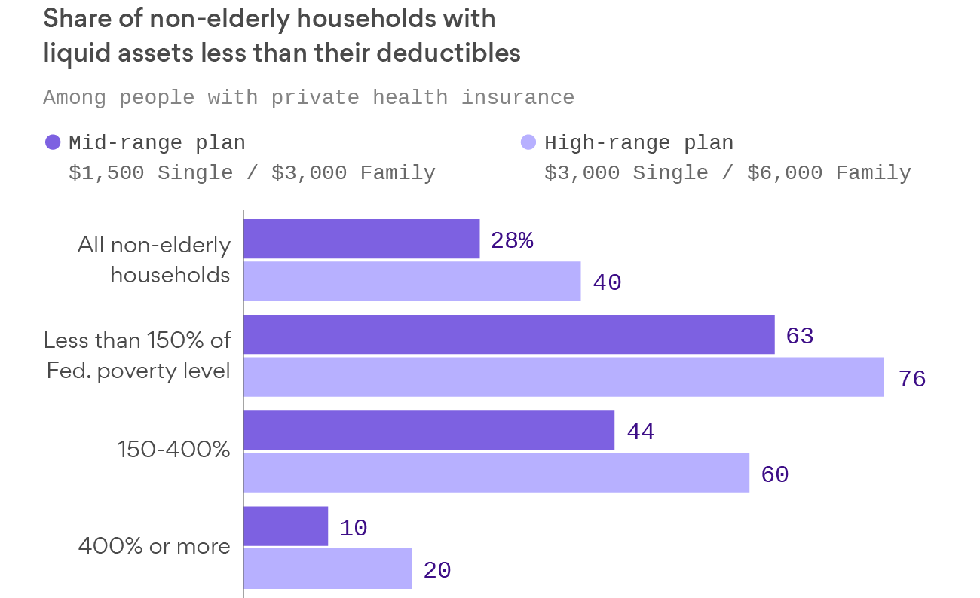
​Many families can’t afford even moderate deductibles

Reproduced from Kaiser Family Foundation analysis of the 2016 Survey of Consumer Finance; Note: Liquid assets include the sum of checking and saving accounts, money market accounts, certificates of deposit, savings bonds, non-retirement mutual funds, stocks and bonds; Chart: Axios Visuals

A lot of low-income families can’t afford even a moderate deductible, yet deductibles continue to rise in almost all forms of insurance, Kaiser Family Foundation president Drew Altman writes in his latest Axios column.

  • Roughly 40% of all non-elderly households don’t have enough liquid assets to cover a high deductible ($3,000 for an individual or $6,000 for a family).
  • Among families whose income makes them eligible for the ACA’s premium subsidies, 60% don’t have enough liquid assets to cover a high deductible and 44% couldn’t cover the deductible for a mid-range plan ($1,500 for an individual or $3,000 for a family).

Why it matters: High deductibles are everywhere, and they’re only getting higher. Many ACA plans have relatively big deductibles and Republicans’ alternatives would push them higher. They’ve been getting bigger and bigger in employer plans, too.

  • “For many families, even if they have insurance, any significant illness could wipe out all their savings, making impossible to fix a broken car to get to work, or pay for school, or make a rent or mortgage payment,” Altman says.

Repealing the individual mandate would do substantial harm

https://www.brookings.edu/blog/up-front/2017/11/21/repealing-the-individual-mandate-would-do-substantial-harm/?utm_campaign=Brookings%20Brief&utm_source=hs_email&utm_medium=email&utm_content=58686618

Related image

he tax legislation reported by the Senate Finance Committee last week included repeal of the individual mandate, which was created by the Affordable Care Act (ACA) and requires individuals to obtain health insurance coverage or pay a penalty. The Congressional Budget Office (CBO) has estimated that this proposal would cause large reductions in insurance coverage, reaching 13 million people in the long run.

Supporters of repealing the individual mandate have argued that the resulting reductions in insurance coverage are not a cause for concern because they would be voluntary. Rigorous versions of this argument acknowledge that individuals who drop coverage would lose protection against high medical costs, find it harder to access care, and likely experience worse health outcomes, but assert that the very fact that these individuals would choose to drop insurance coverage shows that they will be better off on net. On that basis, advocates of repealing the mandate claim that its repeal would do no harm. However, this argument suffers from two serious flaws.

The first flaw in this argument is that it assumes individuals bear the full cost of their decisions about whether to obtain insurance coverage; in fact, one person’s decision to go without health insurance coverage shifts costs onto other people. Notably, CBO has estimated that the departure of healthy enrollees from the individual market spurred by repeal of the individual mandate will increase individual market premiums by 10 percent, causing some in that market to involuntarily lose coverage and causing those who remain to bear higher costs. In addition, many of those who become uninsured will end up needing health care but not be able to pay for it, imposing costs on other participants in the health care system. Because individuals who choose to become uninsured do not bear the full cost of that decision, they may choose to do so even in circumstances where the benefits of coverage—accounting for its effects on both the covered individual and the rest of society—exceed its costs.

The second flaw in this argument is that it assumes individual decisions about whether to purchase health insurance coverage reflect a fully informed, fully rational weighing of the cost and benefits. In fact, there is strong reason to believe that many individuals, particularly the healthier individuals most affected by the mandate, are likely to undervalue insurance coverage. This likely reflects a variety of well-documented psychological biases, including a tendency to place too much weight on upfront costs of obtaining coverage (including the “hassle costs” of enrolling) relative to the benefits insurance coverage would provide if the individual got sick and needed care at some point in the future. It is therefore likely that many people who would drop insurance coverage due to repeal of the individual mandate would end up worse off, even solely considering the costs and benefits to the individuals themselves.

The considerations described above mean that, in the absence of subsidies, an individual mandate, or some combination of the two, many people will decline to obtain insurance coverage despite that coverage being well worth society’s cost of providing it. Furthermore, unless the current subsidies and individual mandate penalty provide too strong an incentive to obtain coverage that results in too many people being insured—a view that appears inconsistent with the available evidence—then reductions in insurance coverage due to repealing the individual mandate would do substantial harm.

The remainder of this analysis takes a closer look at the two flaws in the argument that reductions in insurance coverage caused by repeal of the individual mandate would do no harm. The analysis then discusses why these considerations create a strong case for maintaining an individual mandate.

INDIVIDUAL DECISIONS TO DROP INSURANCE COVERAGE IMPOSE SUBSTANTIAL COSTS ON OTHER PEOPLE

As noted above, supporters of repealing the individual mandate have often argued that the resulting reductions in insurance coverage would do no harm because they are the outcome of voluntary choices. One major flaw in this argument is that one person’s decision to drop insurance coverage imposes costs on other people through a pair of mechanisms: increases in individual market premiums and increases in uncompensated care. I discuss each of these mechanisms in greater detail below.

Increases in individual market premium reduce coverage and increase others’ costs

Repealing the individual mandate would reduce the cost of being uninsured and, equivalently, increase the effective cost of purchasing insurance coverage. That increase in the effective cost of insurance coverage would, in turn, cause many people to drop coverage. Because individuals with the most significant health care needs are likely to place the highest value on maintaining insurance coverage, the people dropping insurance coverage would likely be relatively healthy, on average. In the individual market, those enrollees’ departure would raise average claims costs, requiring insurers to charge higher premiums to the people remaining in the individual market.[1]

CBO estimates that, because of this dynamic, repealing the individual mandate would increase individual market premiums by around 10 percent. Those higher premiums would push some enrollees who are not eligible for subsidies out of the individual market. Higher premiums would impose large costs on unsubsidized enrollees who remained in the ACA-compliant individual market—around 6 million people—while increasing federal costs for subsidized enrollees who remain insured.[2]

CBO’s estimates are at least qualitatively consistent with empirical evidence on the effects of the individual mandate. Perhaps the best evidence on this point comes from Massachusetts health reform. Research examining the unsubsidized portion of Massachusetts’ individual market estimated that Massachusetts’ individual mandate increased enrollment in the unsubsidized portion of its individual market by 38 percent, reducing average claims costs by 8 percent and premiums by 21 percent. Similarly, research focused on the subsidized portion of Massachusetts’ market found that the mandate appears to have been an important motivator of enrollment, particularly among healthier enrollees.

Direct evidence on the effects of the ACA’s mandate is relatively scant because it is challenging to disentangle the effect of the mandate from the effect of other policy changes implemented by the ACA. However, it is notable that the uninsured rate among people with incomes above 400 percent of the federal poverty level fell by almost one-third from 2013 to 2015. This trend is consistent with the view that the ACA’s individual mandate has increased insurance coverage since these individuals are not eligible for the ACA’s subsidies, and implementation of the ACA’s bar on varying premiums or denying coverage based on health status, taken on its own, would have been expected to actually reduce insurance coverage in this group. Because this estimate applies to only a relatively small slice of the population, it cannot easily be used to determine the total effect of the individual mandate on insurance coverage, but it does suggest that the mandate has had meaningful effects.

Repealing the individual mandate could also cause broader disruptions in the individual market for some period of time. Insurers would find it challenging to predict exactly what the individual market risk pool would look like after repeal of the mandate. Some insurers might elect to limit their individual market exposure until that uncertainty is resolved, particularly since the Trump Administration has signaled an intent to pursue other significant policy changes affecting the individual market. That uncertainty could cause some insurers to withdraw from the market, potentially leaving some enrollees without any coverage options. Alternatively, insurers could elect to raise premiums by even more than they expect to be necessary (e.g., by more than the CBO 10 percent estimate cited above) to ensure that they are protected in all scenarios, with significant costs to both individuals and the federal government. It is uncertain how widespread these types of broader disruptions would be in practice, but they are possible.

It is important to note that one person’s decision about whether to purchase individual market coverage affects the premiums faced by others because of a conscious policy choice: the decision to bar insurers from varying premiums or denying coverage based on health status. Without those regulations, individual coverage decisions would have little or no effect on the premiums charged to others. But policymakers and the public have, appropriately in my view, concluded that these regulations perform a valuable social function by ensuring that health care cost burdens are shared equitably between the healthy and the sick. Having made that decision, other aspects of public policy must take account of the fact that one person’s decision to go uninsured has consequences for the market as a whole.

Some newly uninsured individuals would need care, but be unable to pay for it

Dropping insurance coverage also allows individuals to shift a portion of the cost of the care they receive onto others in the form of uncompensated care. Even in the group of comparatively healthy individuals who elect to drop their coverage, some will get sick and need health care. Some of these individuals might be able to pay for that care out of pocket, but others—particularly those who get seriously ill—would likely be unable to pay for it. In some cases, that would cause these individuals to forgo needed care, but in other cases they would receive care without paying for it, either due to the legal requirement that hospitals provide care in emergency situations or through various other formal and informal mechanisms. (Although individuals would often still be able to access care without paying for it, they would frequently still be billed for that care, with potential downstream consequences for their ability to access credit.)

Uninsured individuals receive large quantities of uncompensated care in practice. Estimates based on the Medical Expenditure Panel Survey indicate that a non-elderly individual uninsured for the entire year received $1,700 in uncompensated care, on average, during 2013. Consistent with that fact, increases in the number of uninsured individuals increase the amount of uncompensated care. In the context of the Oregon Health Insurance Experiment, a randomized controlled trial of the effects of expanded Medicaid coverage, having Medicaid coverage was estimated to reduce the amount of uncompensated care an individual receives by almost $2,200 per year, on average. Quasi-experimental research has similarly found that increases in the number of uninsured individuals in a hospital’s local area increase the amount of uncompensated care a hospital delivers and that the expansion in insurance coverage achieved by the ACA substantially reduced hospitals’ uncompensated care burdens.

Precisely who bears the cost of uncompensated care, particularly in the long run, is not entirely clear. A portion of uncompensated care costs are borne by federal, state, and local government programs and, therefore, are ultimately borne by taxpayers. In 2013, around three-fifths of uncompensated care was financed by federal, state, and local government programs explicitly or implicitly aimed at this purpose. Increases in uncompensated care burdens are likely to lead to increases in spending on these programs. In some cases, those increases will happen automatically. For example, CBO finds that repealing the individual mandate will increase federal spending on the Medicare Disproportionate Share Hospital (DSH) program, which is intended to defray uncompensated care costs, by $44 billion over the next ten years because the formula for determining DSH payments depends on the uninsured rate. In other cases, changes may occur more indirectly, perhaps because higher uncompensated care burdens create political pressure to expand these programs (or make it harder to cut them).

The impact of uncompensated care therefore depends to a significant degree on how non-profit hospitals cope with reduced operating margins. Evidence on this point is relatively limited. However, in instances where increases in uncompensated care burdens cause providers to incur outright losses, they are likely to ultimately force facilities to close, which could reduce access to care or increase prices charged to those enrolled in private insurance by reducing competition. In instances where increases in uncompensated care burdens merely trim positive operating margins, lower margins presumably force hospitals to reduce capital investments or to reduce cross-subsidies to other activities such as medical education or research.Recent research focused on the hospital sector, which accounts around three-fifths of all uncompensated care, suggests that providers also bear a significant portion of uncompensated care costs in the form of lower operating margins. However, this does not imply that uncompensated care costs are ultimately borne by hospitals’ owners. Indeed, this research finds that reductions in operating margins in response to increases in uncompensated care occur almost exclusively among non-profit hospitals, plausibly because for-profit hospitals are adept at locating in geographic areas where the demand for uncompensated care is relatively low. (Greater distortions where providers choose to locate and what services they choose to offer may be an important cost of increased uncompensated care.)

INDIVIDUAL DECISIONS TO DROP INSURANCE COVERAGE MAY HARM THE INDIVIDUALS THEMSELVES

The argument that reductions in insurance coverage due to repeal of the individual mandate do no harm because they are voluntary has a second important flaw; specifically, this argument assumes that individual decisions about whether to obtain health insurance coverage reflect a fully informed, fully rational weighing of the costs and benefits. There is strong reason to doubt that assumption.

Economists commonly note that many people decline to take-up health even in settings where that coverage is free or nearly so. For example, analysts at the Kaiser Family Foundation (KFF) have estimated that, in 2016, there were 6.8 million people who were eligible for Medicaid or the Children’s Health Insurance Program, but not enrolled in those programs, despite the fact that these programs had negligible premiums. Similarly, for this year’s Marketplace open enrollment period, analysts at KFF estimated that among uninsured individuals eligible to purchase Marketplace coverage, around two-fifths could obtain a bronze plan for a premium of zero, but few expect all of these individuals to enroll.

This type of behavior is very challenging to explain as the outcome of a fully informed, fully rational decision-making process. The fact that individuals who do not purchase insurance coverage can shift significant costs to others, as discussed above, can help explain why some individuals value insurance at less than the cost of providing it. But these factors cannot explain why enrollees would decline to obtain coverage that is literally free to them. In principle, “hassle costs” of enrolling in coverage could explain decisions to forgo coverage in these instances, but those hassle costs would need to be implausibly large to explain a decision to forgo an offer of free insurance coverage.

Precisely why individuals decline to take up insurance coverage even in settings where it seems clearly in their interest to do so is not fully understood. This review article catalogues a wide variety of psychological biases that may play a role, but three seem particularly important in this context:

  • Present bias: Economists have documented that individuals generally exhibit “present bias,” meaning that they place a large weight on current costs and benefits relative to similar costs and benefits in the future. In the context of insurance coverage, this type of bias is likely to cause individuals, particularly those who are currently healthy, to place too much weight on the upfront premium and hassle costs required to enroll in health insurance relative to the benefit of having insurance coverage if they get sick at some point in the future. This may cause individuals to decline to obtain insurance coverage even when it is in their economic interest, including in instances where the premium required to enroll is literally zero.

Overweighting of small up front hassle costs appears to lead suboptimal decisions in many economic settings, but the retirement saving literature provides a particularly striking example. Simply being required to return a form to enroll in an employer’s retirement plan has been documented to sharply reduce take-up of that plan, even in circumstances where employees forgo hundreds or thousands of dollars per year in employer matching contributions by declining to participate.

  • Overoptimistic perceptions of risk: One core function of health insurance is to provide protection against relatively rare, but very costly, illnesses. Indeed, a large fraction of the total value of a health insurance contract is delivered in those states of the world. In 2014, around 5 percent of the population accounted for around half of total health care spending.[3] But because these events are comparatively rare, many individuals, particularly healthier individuals, may have difficulty forming accurate perceptions of the risks they face. Research on Medicare Part D has found that individuals tend to place too much weight on premiums relative to expected out-of-pocket costs when choosing plans, providing some evidence that individuals do indeed underestimate risk (although research focused on insurance products other than health insurance has concluded that individuals may sometimes overestimate risk). Like present bias, misperceptions of risk can cause hassle or premium costs to receive too much weight relative to the actual benefits of coverage.
  • Inaccurate beliefs about affordability: Enrollees could also have inaccurate information about the availability of coverage. Survey evidence has suggested that, as of early 2016, almost 40 percent of uninsured adults were unaware of the existence of the ACA’s Health Insurance Marketplaces. Additionally, approximately two-thirds of those who were aware of the Marketplaces had not investigated their coverage options, with most saying that they had not done so because they did not believe that they could afford coverage. Individuals’ beliefs about whether coverage is affordable may be accurate in some instances, but it is likely that they are not accurate in many other cases. Inaccurate beliefs may cause many individuals to fail to investigate their coverage options, including some who are eligible for free or very-low-cost coverage.

REDUCTIONS IN INSURANCE COVERAGE FROM REPEALING THE INDIVIDUAL MANDATE WOULD DO SUBSTANTIAL HARM

The factors identified above provide strong economic rationale for implementing some combination of subsidies and penalties to strengthen the financial incentive to obtain health insurance coverage. These policy tools can compensate for the fact that individual decisions to go without coverage do not account for the ways in which those decisions increase costs for others. Similarly, in many (though not all) instances, financial incentives can help counteract psychological biases that cause individuals to go without insurance coverage even when it is against their own economic interest.

This discussion does not, of course, speak directly to how large subsidies and penalties should be. At least in theory, it is possible to overcompensate for the factors catalogued in the preceding section by creating too large an incentive to obtain coverage and thereby causing too many people to become insured. This occurs if the cost of the additional health care individuals receive when they become insured plus the administrative costs of providing that coverage exceeds the health benefits of the additional health care and the improved protection against financial risk.

Estimating the optimal size of subsidies and penalties is beyond the scope of this analysis. However, it is notable that virtually no one in the current policy debate is arguing that the United States insures too many individuals. Furthermore, there is reason to doubt that this is an empirically relevant concern. For example, the research on Massachusetts health reform by Hackmann, Kolstad, and Kowalski that was discussed earlier used their estimates to calculate the “optimal” mandate penalty to apply to unsubsidized enrollees. They conclude that just offsetting adverse selection justifies a mandate penalty similar in size to the one included in the ACA; also accounting for either uncompensated care or imperfections in consumer decision making could justify a considerably larger penalty.

It therefore seems difficult to justify repealing the individual mandate on the grounds that current policies provide an excessive overall incentive to obtain insurance coverage. Of course, policymakers might believe that it would be preferable to swap the mandate for larger subsidies, perhaps because they believe that it is inappropriate to penalize individuals for not obtaining coverage. In principle, sufficiently large increases in subsidies could offset the reduction in insurance coverage that repealing the individual mandate would cause. But such an approach would require large increases in federal spending since it would keep insurance enrollment at its current level by providing larger subsidies to each enrolled individual. In any case, the Senate Finance Committee bill does not take this approach. Rather than increasing spending on insurance coverage programs to mitigate coverage losses, the bill uses the reduction in spending on coverage programs caused by repealing the mandate (which results from lower enrollment in those programs) to finance tax cuts.


Podcast: ‘What The Health?’ Tax Bill Or Health Bill?

https://khn.org/news/podcast-what-the-health-tax-bill-or-health-bill/?utm_campaign=KFF-2017-The-Latest&utm_source=hs_email&utm_medium=email&utm_content=58570997&_hsenc=p2ANqtz-90FnDooDrGIdtTTHP8VfZovw1vS_Y_js4RdDwCCIwslKGDgrqu1yZ6bbcLJ5AbWfyJaM2B3HhQ9fR9txLD5dY-TnO3HA&_hsmi=58570997

Image result for kaiser podcast what the health?


Republican efforts to alter the health law, left for dead in September, came roaring back to life this week as the Senate Finance Committee added a repeal of the “individual mandate” fines for not maintaining health insurance to their tax bill.

In this episode of “What the Health?” Julie Rovner of Kaiser Health News, Sarah Kliff of Vox.com, Joanne Kenen of Politico and Alice Ollstein of Talking Points Memo discuss the other health implications of the tax bill, as well as the current state of the Affordable Care Act.

Among the takeaways from this week’s podcast:

  • The tax bill debate proves that Republicans’ zeal to repeal the Affordable Care Act is never dead. The new congressional efforts to kill the penalties for the health law’s individual mandate could seriously wound the ACA since the mandate helps drive healthy people to buy insurance.
  • One of the most overlooked consequences of the tax debate is that it could trigger a substantial cut in federal spending on Medicare.
  • A $25,000 MRI? That’s what one family paid to go out of their plan’s network to get the hospital they wanted for the procedure for their 3-year-old. Such choices are again drawing complaints about narrow networks of doctors and hospitals available in some health plans.
  • Although they don’t likely say it in front of cameras, many Democrats are relieved at President Donald Trump’s choice to head the Department of Health and Human Services, former HHS official Alex Azar.
  • Federal officials have given 10 states and four territories extra money to keep their Children’s Health Insurance Programs running but it’s not clear what couch they found the money hidden in.
  • And in remembrance of Uwe Reinhardt, a reminder that he always stressed that a health care debate was about more than money — it was about real people.

Plus, for “extra credit,” the panelists recommend their favorite health stories of the week they think you should read, too.

Poll: Ahead of House Tax Reform Vote, Americans are More Likely to Rank Children’s Health Care, Hurricane Relief and Other Issues as Top Priorities for Washington

http://connect.kff.org/poll-ahead-of-house-tax-reform-vote-americans-are-more-likely-to-rank-childrens-health-care-hurricane-relief-and-other-issues-as-top-priorities-for-washington?ecid=ACsprvumAORaSTpZGqmqhYQaXpeqtZoXjMxf6lbzmdUaIsV8vQ82Gwn_2PBBsI5zIiSuUzZ5w8-C&utm_campaign=KFF-2017-November-Poll-Tax-Reform-Vote&utm_source=hs_email&utm_medium=email&utm_content=58466081&_hsenc=p2ANqtz-8Cag0QgNSRgFKsxX_UJAz_sPw8ZG2hIH2l7nv8vGW9Dn5a8w_Mcy5njs5Hwf79zPT3e9Z8cecPnIWqwTXGvfb_qKXqRg&_hsmi=58466081

tax reform poll chart 2.png

Controlling Immigration Tops Republicans’ Priority List, With Tax Reform among a Number of Second-Tier Issues Including Hurricane Relief and ACA Repeal

Most of the Public Initially Favors Getting Rid of the ACA’s Individual Mandate As Part of Tax Reform, But Some Become Opponents When Presented with Facts and Arguments for Keeping the Mandate

As the House prepares to vote Thursday on its tax reform bill, a new Kaiser Family Foundation poll finds almost three in 10 Americans (28%) view tax reform as a top priority for President Trump and Congress.

That’s significantly fewer than the share that say the same about reauthorizing funding for the Children’s Health Insurance Program (62%), hurricane recovery funding (61%), stabilizing the Affordable Care Act’s insurance marketplaces (48%) and addressing the prescription painkiller epidemic (43%).  Two immigration-related issues – strengthening controls to limit who enters the country (35%) and passing legislation to allow the Dreamers to legally stay (34%) – also rank higher, while a similar share (29%) say repealing the Affordable Care Act is a top priority.

Among Republicans, half (51%) say reforming the tax code is a top Washington priority, behind strengthening immigration controls (69%) but similar to the share who consider hurricane recovery funding (52%), repealing the Affordable Care Act (50%), stabilizing the insurance marketplaces (46%) and reauthorizing CHIP funding (46%) to be top priorities.

In a tweet Monday, President Trump called on Congress to end the Affordable Care Act’s individual mandate, which requires most Americans to have health insurance or pay a tax penalty and has long been the least popular provision in the law. While the House tax reform bill does not currently address the mandate, key Republican senators said Tuesday that they will include such a provision in their version of the bill.

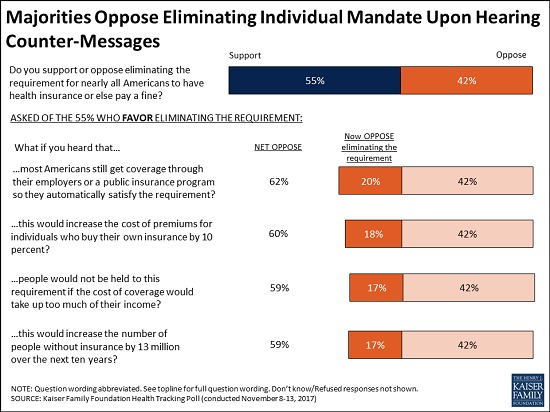
The new poll finds that most Americans (55%) initially support eliminating the mandate as part of tax reform, while four in 10 (42%) oppose it. Most Republicans (73%) and independents (58%) support ending the mandate, while most Democrats (59%) oppose it.

These views are malleable, with about a third of supporters (representing a fifth of the public overall) switching to oppose the mandate’s repeal when presented with facts and arguments about who is impacted and potential consequences of its repeal.

For example, the share who oppose eliminating the mandate can rise as high as 62 percent when initial supporters hear that most Americans get coverage through their employers or government programs that meets the mandate’s requirements. Similar majorities ultimately oppose eliminating the mandate when presented with other arguments against it, including that premiums for people who buy their own health insurance would go up, that people are exempted from the mandate if the cost of coverage takes up too much of their income and that getting rid of the mandate would result in 13 million more people being uninsured over the next 10 years, as the Congressional Budget Office has estimated.

One provision in the House bill would eliminate a tax deduction that allows people with high medical costs to deduct any medical and dental expenses that exceed 10 percent of their income.  A majority (68%) of the public – including majorities of Democrats (77%), independents (66%), and Republicans (61%) oppose eliminating the tax deduction for individuals who have high health care costs.

More than four in 10 (44%) of the public think eliminating the deduction for high medical costs will affect them and their families, though in reality a much smaller share of the public uses that deduction in any given tax year. According to the Internal Revenue Service, about 17 percent of taxpayers who file itemized deductions use this deduction (approximately 6% of all taxpayers and 3% of the public).

Looking ahead to the 2018 midterm elections, the public is divided over whether not passing a tax reform plan or not repealing the ACA would be a bigger deal for President Trump and Republicans. Nearly half of the public say it will be a bigger problem if the president and Republicans are unable to pass their tax reform plan (47%), similar to the share who say it will be a bigger problem if they are unable to revive a repeal of the ACA (44%). Republicans are also divided, with similar shares saying   it would be a bigger deal if President Trump and Republicans are unable to repeal the ACA (50%) and if they are unable to pass tax reform (45%).

Designed and analyzed by public opinion researchers at the Kaiser Family Foundation, the poll was conducted from November 8 – 13, 2017 among a nationally representative random digit dial telephone sample of 1,201 adults. Interviews were conducted in English and Spanish by landline (415) and cell phone (786). The margin of sampling error is plus or minus 3 percentage points for the full sample. For results based on subgroups, the margin of sampling error may be higher.

Blue Cross Blue Shield insurers are still doing well

https://www.axios.com/the-blue-cross-blue-shield-insurers-are-still-doing-well-2507217868.html

 Blue Cross Blue Shield health insurance companies have more than quintupled their net profits in the first half of this year compared with the same six months of 2016, according to an analysis of financial records by Fitch Ratings.

The bottom line: We reported over the summer that the Blues, which have the most exposure to the Affordable Care Act marketplaces, are making a lot of money despite the Trump administration’s threats and actions against the ACA. Why are profits still growing for the Blues? They raised premiums a lot, people are not going to the doctor or hospital as much, and the federal government modified some enrollment policies to the benefit of insurers.

The details: Fitch analyzed the first-half financial documents of 34 Blue Cross Blue Shield companies, including the publicly traded Anthem as well as other large Blues brands such as Health Care Service Corp. and Blue Shield of California. Almost every company improved its finances year over year, leading to the following aggregate financial data for the first six months of 2017:

  • $135 billion of revenue (up 7%)
  • $7.7 billion underwriting profit, or the amount of money made after subtracting medical costs from premiums paid (up 194%)
  • $6.5 billion net profit (up 441%)
  • 85.9% medical loss ratio, which reflects how much of the premium dollar is spent on medical care (down 0.8 percentage points)

What was true previously is still true now: Most health insurers are not currently losing their shirts on the ACA’s individual marketplaces, although next year could be different depending on what happens to the law’s cost-sharing subsidies. While the higher premium rates have not harmed people who get federal subsidies, they have caused more financial pain for middle-class people who have to pay the full cost of their health insurance.

Looking ahead: Congress delayed the ACA’s health insurer tax throughout 2017 — another reason why companies have done so much better this year. Insurers have conducted a lobbying blitz to get Congress to repeal or delay that fee again, and legislation that would delay the tax for another two years could be folded into a year-end package.

Trump and the Essential Health Benefits

Trump and the Essential Health Benefits

Image result for essential health benefits

On Friday, HHS released a proposed rule that would make a number of adjustments to the rules governing insurance exchanges for 2019. The rule is long and detailed; there’s a lot to digest. Among the most noteworthy changes, however, are those relating to the essential health benefits. They’re significant, and I’m not convinced they’re legal.

By way of background, the ACA requires all health plans in the individual and small-group markets to cover a baseline roster of services, including services falling into ten broad categories (e.g., maternity care, prescription drugs, mental health services). Taken as a whole, the essential health benefits must be “equal to the scope of benefits provided under a typical employer plan, as determined by the Secretary.”

The ACA’s drafters anticipated that HHS would establish a national, uniform slate of essential health benefits. Instead, the Obama administration opted to allow the states to select a “benchmark plan” from among existing plans in the small group market (or from plans for state employees). The benefits covered under the benchmark were then considered “essential” within the state.

At the time, Helen Levy and I concluded that HHS’s approach brushed up against the limits of what the law allowed. We noted, among other things, that the ACA tells HHS to establish the essential health benefits—not the states. And it’s black-letter administrative law that an agency can’t subdelegate its powers to outside entities, states included.

At the end of the day, however, Helen and I concluded that the Obama-era regulation passed muster. Our rationale bears repeating:

Although a federal agency cannot delegate its powers to the states, it “may turn to an outside entity for advice and policy recommendations, provided the agency makes the final decisions itself.” Here, the secretary gave the states a constrained set of options (e.g., choose a benchmark plan from among the three largest small-group plans in the state) and retained the authority to select a benchmark for any state that either does not pick a benchmark or chooses an inappropriate one. As such, the secretary remains firmly in control. Nothing in the ACA prevents her from deferring to states that select benchmark plans from among the few options she has provided. That choice to defer is itself an exercise of her delegated powers.

The Trump administration’s proposed rule would vastly enlarge this Obama-era subdelegation. For starters, the rule would allow a state to adopt another state’s benchmark, or part of a state’s benchmark, as its own. Michigan, for example, could borrow Alabama’s benchmark plan wholesale, or it could incorporate Alabama’s benchmark for mental health and substance use disorder treatment. More significantly, the rule would allow a state to “selec[t] a set of benefits that would become the State’s EHB-benchmark plan.”

You read that right: if the rule is adopted, each state can pick whatever essential health benefits it likes. No longer will it be choosing from a preselected menu; it’ll be picking the essential benefits out of a hat. In so doing, the proposed rule looks like it would unlawfully cede to the states the power to establish the essential benefits.

This extraordinary subdelegation of regulatory authority is subject only to the loosest of constraints: benefits can’t be “unduly weighted” toward any one benefit category or another, and the benchmark must “[p]rovide benefits for diverse segments of the population, including women, children, persons with disabilities, and other groups.” The selected benefits also can’t be more generous than the state’s 2017 benchmark (or any of the plans the state could have selected as its benchmark), but that’s a ceiling, not a floor, so states have lots of room to pare back.

The only meaningful constraint is that the benefits covered by the state’s benchmark must be “equal to the scope of benefits provided under a typical employer plan.” But another portion of the proposed rule would hollow out that requirement:

[W]e propose to define a typical employer plan as an employer plan within a product (as these terms are defined in §144.103 of this subchapter) with substantial enrollment in the product of at least 5,000 enrollees sold in the small group or large group market, in one or more States, or a self-insured group health plan with substantial enrollment of at least 5,000 enrollees in one or more States.

In other words, HHS is saying it will treat as “typical” any employer plan, in any state, that covers more than 5,000 people.

This looks like an innocuous change. It’s not. If the rule is adopted, it means that a single outlier plan can now count as typical, even if it’s way stingier than any other plan in the market. It also makes me wonder if HHS already has in mind some large employer with an unusually narrow health plan—maybe some hospital-based “administrative services only” plan, as Dave Anderson speculates. If so, voilá, the states can all ratchet down their essential benefits to that plan’s level.

I don’t think that’s legal. To know if a slate of health benefits is typical, you have to know something about how many health plans cover those benefits and how many don’t. The proposed rule eschews that comparative inquiry, and instead defines typicality with reference to the number of people who are covered by a single plan. Some random self-insured plan that excludes appendectomies could be treated as typical, even if it’s the only plan in the nation that does so.

In other words, HHS wants to define a “typical employer plan” to include atypical plans—which the agency emphatically cannot do. Yes, plans that enroll 5,000+ people are less likely to be outliers than smaller ones. But in a country as big and complicated as ours, there are bound to be some idiosyncratic quirks even in large plans. Those quirks would all be considered typical under HHS’s rule.

This definitional change, combined with the choose-your-own-adventure option to devise a benchmark, means that states will have wide authority to water down the essential health benefits requirement. Whether that’s good or bad is hard to say. Requiring plans to cover lots of services assures comprehensive coverage, but it also raises the cost of insurance. Because there’s no single “best” way to strike the balance, I think there’s a lot to be said for giving states the freedom to choose for themselves.

Wise or not, however, I’m skeptical that the Trump administration’s effort to hollow out the rule governing essential health benefits is legal. If HHS presses ahead with the rule, it could face tough sledding in the courts.

Trump suggests repealing ObamaCare mandate in tax bill

Trump suggests repealing ObamaCare mandate in tax bill

Related image

President Trump on Wednesday suggested using the GOP tax bill to repeal ObamaCare’s individual mandate.

“Wouldn’t it be great to Repeal the very unfair and unpopular Individual Mandate in ObamaCare and use those savings for further Tax Cuts,” Trump tweeted.

The idea is being pushed by Sen. Tom Cotton (R-Ark.) and also has the backing of House Freedom Caucus Chairman Mark Meadows (R-N.C.).

Meadows said Wednesday he supports repealing the mandate in tax reform and thinks “ultimately” it will be included because he is going to push for it. He said he has been talking to Cotton about it.

A Cotton spokeswoman told The Hill that Cotton and Trump spoke by phone about the idea over the weekend and “the President indicated his strong support.”

Senate Finance Committee Chairman Orrin Hatch (R-Utah) this week said that he wouldn’t rule out including repeal of the mandate in the tax legislation.

But other top Republicans have rejected the idea, including House Ways and Means Committee Chairman Kevin Brady (R-Texas), Senate Majority Whip John Cornyn (R-Texas) and Sen. John Thune (R-S.D.). They fear adding the ObamaCare change would jeopardize tax reform.

“Look, I want to see that individual mandate repealed,” Brady said during an interview with radio host Hugh Hewitt on Tuesday. “I just haven’t seen, no one has seen, 50 votes in the Senate to do it.”

Brady added that he would be open to adding a repeal of the mandate to the House bill if the Senate passed it first.

Asked Wednesday about the president’s tweet, Senate Majority Whip John Cornyn (R-Texas) threw cold water on the idea.

“I think tax reform is complicated enough without adding another layer of complexity,” Cornyn told The Hill.

Thune, meanwhile, said mandate repeal is “not currently a part of our deliberations.”

But Thune added that some members have expressed interest in the idea and said he was “somewhat” interested in it because of the revenue implications.

Sen. Mike Rounds (R-S.D.) on Tuesday also dismissed adding a repeal of the mandate to tax reform.

“If there was a way to do it, I’d be open to it, but I’m not going to pitch it because I want to focus on taxes in the tax reduction plan,” Rounds told reporters.

The Congressional Budget Office has estimated that repealing the mandate would save the government $416 billion over a decade.

The mandate requires people, with some exceptions, to pay a fine to the IRS if they do not have health insurance.

Experts have said repealing the mandate would result in massive premium spikes and a major increase in the number of uninsured people.

It could also send ObamaCare exchanges into a “death spiral” because it would discourage healthy younger individuals to sign up for insurance.

Asked about it on Wednesday after Trump’s tweet, Hatch again did not rule out the move, but cautioned that he wants to keep health care separate from tax reform, a point echoed by GOP aides.
“I think we ought to do tax reform. If they want to do something on health care they can do that separate,” Hatch said. It was not clear who “they” referred to.
“I’d have to really look at all sides of that. I’ve never been very excited about the individual mandate,” Hatch said.