Opioid Commission Unveils Blueprint To Fight Crisis, But Passes Funding Buck To Congress

Image result for show me the money

The group’s 56 recommendations include tightening prescription practices and expanding drug courts, prevention efforts, treatment access and law enforcement tactics.

President Trump’s bipartisan commission on the opioid crisis made dozens of final recommendations on Wednesday to combat a deadly addiction epidemic, ranging from creating more drug courts to vastly expanding access to medications that treat addiction, including in jails.

The commissioners did not specify how much money should be spent to carry out their suggestions, but they pressed Congress to “appropriate sufficient funds” in response to Mr. Trump’s declaration last week of a public health emergency.

The 56 recommendations — which covered opioid prescribing practices, prevention, treatment, law enforcement tactics and funding mechanisms — did not so much advocate a new approach as expanding strategies already being used.

Reaction from treatment advocates was mixed, with many expressing frustration that the commission had not called for a specific level of funding. Chuck Ingoglia, a senior vice president at the National Council for Behavioral Health, which represents treatment providers, said that his group agreed with many of the recommendations, but that the report “starves the country for the real resources it needs to save American lives.”

Although the commission did not put a dollar amount on its recommendations, it had specific ideas for how federal money should be funneled to states. Its top recommendation was to streamline “fragmented” federal funds for addiction prevention and treatment into block grants that would require each state to file only a single application instead of seeking grants from dozens of programs scattered across various agencies.

The commission also appealed to the Trump administration to track more carefully the huge array of interdiction, prevention and treatment programs it is funding and to make sure they are working. “We are operating blindly today,” its report said.

Regina LaBelle, who was chief of staff in the White House Office of National Drug Control Policy under President Barack Obama, said the recommendations recognized “the importance of proper and appropriate treatments” for addiction, particularly medications that help people avoid cravings and symptoms of withdrawal. But, she added, “There needs to be more funding for this.”

The head of the commission, Gov. Chris Christie of New Jersey, a Republican, suggested in a television interview Sunday that Mr. Trump would soon ask Congress to allocate far more money for fighting the nation’s addiction problem. “I would say that you’re going to see this president initially ask for billions of dollars to deal with this,” he said on ABC’s “This Week.”

The White House issued a statement thanking the commission and saying it would review the recommendations.

It is hard to determine how much money is truly needed. When Senate Republicans added $45 billion in addiction treatment funds to an Obamacare repeal bill that ultimately failed, Gov. John Kasich of Ohio, a Republican, said that amount was akin to “spitting in the ocean.”

Richard Frank, a health economics professor at Harvard Medical School who worked in the Obama administration, estimated that it could cost roughly $10 billion a year to provide medication and counseling to everyone with opioid use disorder who is not already in treatment. Treating opioid-dependent newborns, meeting the needs of children in foster care because of their parents’ addiction and treating hepatitis C and other illnesses common among opioid addicts would cost “many billions more,” Mr. Frank said.

Mr. Frank also cautioned that block grants would not work if the administration decided to include federal Medicaid funding for addiction treatment in them. “When one starts to carve out certain services as grants, as opposed to insurance funding, one undermines the insurance,” he said. “It is a method of killing Medicaid with 1,000 nicks.”

Some of the commission’s other recommendations included making it easier for states to share data from prescription drug monitoring programs, which are electronic databases that track opioid prescriptions, and requiring more doctors to check the databases for signs of “doctor shopping” before giving a patient opioids.

The commission encouraged the federal Centers for Medicare and Medicaid Services to review policies that it claimed discouraged hospitals and doctors from prescribing alternatives to opioids, especially after surgery. According to the commission’s report, C.M.S. pays a flat, “bundled” payment to hospitals after patients undergo surgery, which includes treatment for pain. Because they get a flat fee, hospitals are encouraged to use cheap products – and most opioid medications are generic and inexpensive.

“Purchasing and administering a non-opioid medication in the operating room increases the hospital’s expenses without a corresponding increase in reimbursement payment,” the report said.

More broadly, the report said the federal government as well as private insurers should do a better job of covering a range of pain-management and treatment services, such as non-opioid medications, physical therapy and counseling. And it recommended that the Department of Health and Human Services and other federal agencies eliminate any reimbursement policies that limit access to addiction medications and other types of treatment, including prior authorization requirements and policies that require patients to try and fail with one kind treatment before getting access to another.

One prevention measure the commission did not embrace is expanding syringe exchange programs, which public health experts say save money and lives by reducing the spread of H.I.V. and hepatitis C with contaminated syringes.

“I was hoping to see that in this report,” Ms. LaBelle said.

The commission’s members – Mr. Christie, Gov. Charlie Baker of Massachusetts, a Republican; Gov. Roy Cooper of North Carolina, a Democrat; Pam Bondi, the Republican attorney general of Florida; Patrick Kennedy, a former Democratic congressman from Rhode Island and Bertha Madras, a Harvard professor – all voted for the final recommendations, which came about a month later than expected.

His voice quaking with emotion, Mr. Kennedy said during the commission’s meeting Wednesday that Congress needed to appropriate sufficient funds for the initiative, suggesting at least $10 billion.

”This town doesn’t react unless it hears from real people“ who will vote in the next election, he said, nodding to guests who had testified about their families’ searing experiences with addiction, stigma, lack of treatment options and the refusal of insurance companies to cover treatment.

Mr. Kennedy also noted that insurance coverage is crucial to fighting addiction; in another commission meeting earlier this year, he took Republicans to task for working to repeal the Affordable Care Act and cut Medicaid.


Trump suggests repealing ObamaCare mandate in tax bill

Trump suggests repealing ObamaCare mandate in tax bill

Related image

President Trump on Wednesday suggested using the GOP tax bill to repeal ObamaCare’s individual mandate.

“Wouldn’t it be great to Repeal the very unfair and unpopular Individual Mandate in ObamaCare and use those savings for further Tax Cuts,” Trump tweeted.

The idea is being pushed by Sen. Tom Cotton (R-Ark.) and also has the backing of House Freedom Caucus Chairman Mark Meadows (R-N.C.).

Meadows said Wednesday he supports repealing the mandate in tax reform and thinks “ultimately” it will be included because he is going to push for it. He said he has been talking to Cotton about it.

A Cotton spokeswoman told The Hill that Cotton and Trump spoke by phone about the idea over the weekend and “the President indicated his strong support.”

Senate Finance Committee Chairman Orrin Hatch (R-Utah) this week said that he wouldn’t rule out including repeal of the mandate in the tax legislation.

But other top Republicans have rejected the idea, including House Ways and Means Committee Chairman Kevin Brady (R-Texas), Senate Majority Whip John Cornyn (R-Texas) and Sen. John Thune (R-S.D.). They fear adding the ObamaCare change would jeopardize tax reform.

“Look, I want to see that individual mandate repealed,” Brady said during an interview with radio host Hugh Hewitt on Tuesday. “I just haven’t seen, no one has seen, 50 votes in the Senate to do it.”

Brady added that he would be open to adding a repeal of the mandate to the House bill if the Senate passed it first.

Asked Wednesday about the president’s tweet, Senate Majority Whip John Cornyn (R-Texas) threw cold water on the idea.

“I think tax reform is complicated enough without adding another layer of complexity,” Cornyn told The Hill.

Thune, meanwhile, said mandate repeal is “not currently a part of our deliberations.”

But Thune added that some members have expressed interest in the idea and said he was “somewhat” interested in it because of the revenue implications.

Sen. Mike Rounds (R-S.D.) on Tuesday also dismissed adding a repeal of the mandate to tax reform.

“If there was a way to do it, I’d be open to it, but I’m not going to pitch it because I want to focus on taxes in the tax reduction plan,” Rounds told reporters.

The Congressional Budget Office has estimated that repealing the mandate would save the government $416 billion over a decade.

The mandate requires people, with some exceptions, to pay a fine to the IRS if they do not have health insurance.

Experts have said repealing the mandate would result in massive premium spikes and a major increase in the number of uninsured people.

It could also send ObamaCare exchanges into a “death spiral” because it would discourage healthy younger individuals to sign up for insurance.

Asked about it on Wednesday after Trump’s tweet, Hatch again did not rule out the move, but cautioned that he wants to keep health care separate from tax reform, a point echoed by GOP aides.
“I think we ought to do tax reform. If they want to do something on health care they can do that separate,” Hatch said. It was not clear who “they” referred to.
“I’d have to really look at all sides of that. I’ve never been very excited about the individual mandate,” Hatch said.

Top 5 Concerns of Healthcare CFOs

http://www.healthleadersmedia.com/finance/top-5-concerns-healthcare-cfos#

Planning for a HealthLeaders Media gathering of hospital and health system chief financial officers reveals the weightiest issues on their minds.

Preoccupying the minds of healthcare financial executives are prevailing problems engulfing the industry’s business climate: uncertainty about healthcare reform, declining public and private reimbursement, accelerating operating expenses, and access to capital.

This August, 50 healthcare finance leaders will collaborate on fortifying their organizations’ fiscal health at the 2017 HealthLeaders CFO Exchange in La Jolla, CA.

In pre-event planning calls, CFO Exchange attendees, representing integrated health systems, academic medical centers, community hospitals, and safety net providers, have mentioned some of the struggles they’d like to know how others are tackling.

During the two-day event, a series of moderated, peer-to-peer roundtables will explore how organizations are addressing the top five issues.
1. Dismantling of the Affordable Care Act

CFOs foresee the negative financial impact a repeal will generate and are interested in knowing how others are preparing for anticipated changes in Medicaid for expansion and non-expansion states.

2. Enhancing and Supporting Population Health

CFOs are concerned about building the right infrastructure to support population health, including integrating physicians, retooling their workforce, realigning the financial tracking of population health efforts, incorporating behavioral health in primary care, and determining how much payer risk to assume.

Executives expressed their concerns about knowing how and when to invest resources in a relatively uncharted path.

In addition, they are interested in how to bring disparate goals together to align with population health efforts.

3. Curtailing Clinician Costs

Optimizing access and productivity to ensure profitability among acquired physician practices, reducing clinical practice variation and cost-per-case, and lowering costs associated with filling in with agency labor due to the nursing shortage are challenges for senior executives.

Organizations will be requesting and sharing strategies for seizing the reigns on clinician expenses.

4. Increasing Revenue

Overcoming reimbursement struggles, uncovering innovative ways to cut costs, and ascertaining solutions to avoiding readmission penalties are common goals for CFOs.

5. Determining Gaps and Opportunities

Another goal shared by CFOs is the desire to share the most useful data analytics and business intelligence platforms for improving quality-of-care and outcomes.

In addition to their larger concerns, participants at the invitation-only event will talk about consumerism, direct contracting for healthcare with employers, charting a financial strategy on value-based care, and ideas about what competition will look like in the future.

Keeping the Alexander-Murray health care bill in context

https://www.axios.com/keeping-the-alexander-murray-health-care-bill-in-context-2498670199.html

Image result for Keeping the Alexander-Murray health care bill in context


As debate continues about a bipartisan fix for the Affordable Care Act marketplaces, Drew Altman’s latest Axios column describes the scale of the problems in the ACA marketplaces and the public’s confusion about whether they are impacted. He says that the news media, experts and policy makers can do more to put the marketplace problems and fixes in context as debate evolves.

As the debate unfolds about the bipartisan bill by Senators Lamar Alexander and Patty Murray to repair the Affordable Care Act marketplaces, the public could be just as confused as they have been about the ACA’s marketplaces. That’s why it’s important to debate it in the right context: It’s aimed at an urgent problem affecting a relatively small sliver of the health insurance system, not all of the ACA and not the entire health system.

The bottom line: It’s a limited measure that will never give conservatives or liberals everything they want.

Reality check: Many people will think it affects their insurance when, in actuality, it will have no impact on the vast majority of Americans who get their coverage outside of the relatively small ACA marketplaces.

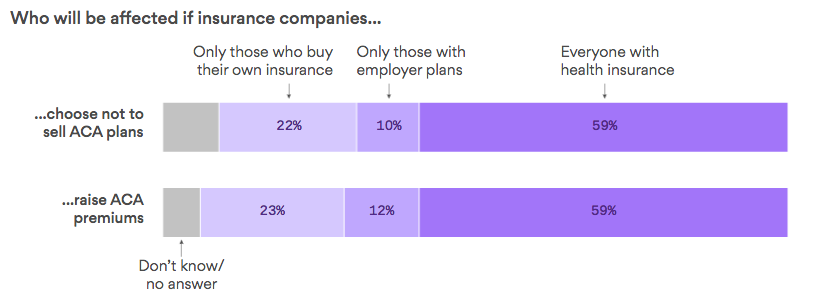
The chart based on our new Kaiser Tracking Poll shows the confusion. Just 23% of the American people know that rising premiums in the ACA marketplaces affect only people who buy their own insurance. More than seven out of 10 wrongly believe rising premiums in the marketplaces affect everyone or people who get coverage through their employer.

The public will be susceptible to spin and misrepresentation of the limited goals of Alexander-Murray: a bipartisan effort to stabilize the marketplaces by funding the cost-sharing reduction subsidies, providing more resources for open enrollment outreach, and expediting state waivers.

President Trump has added to the confusion. He recently pronounced the ACA “dead”, adding, “there is no such thing as Obamacare anymore.” Possibly that’s because he wishes it was dead. More likely, he was referring to the problems in the ACA marketplaces, which he has exaggerated.

Like thinking your whole house is falling down when just a part of the foundation needs shoring up, both he and the American people have an inaccurate picture of where the marketplaces fit in the ACA and where the ACA fits in the health system.

A few facts:

  • There are just 10 million people enrolled in the ACA marketplaces.
  • The law’s larger Medicaid expansion and consumer protections are popular and working well.
  • The far larger Medicare and Medicaid programs and employer based health system combined cover more than 250 million people, and are largely unaffected by developments in the ACA marketplaces.
  • Premiums for the 155 million people who get coverage through their employers rose a very modest 3% in 2017.

Some conservatives in Congress will hold out for repeal, and they’ll resist any legislation that they view as propping up Obamacare. But for everyone else, it’s important to understand the problem and get the facts.


Traveling The Valley Of The Shadow Of Death In 2017

http://healthaffairs.org/blog/2017/10/18/traveling-the-valley-of-the-shadow-of-death-in-2017/

Image result for Traveling The Valley Of The Shadow Of Death

My mother has a letter from her mother written in 1942, telling of the death from pneumonia of a middle-aged neighbor with whom my grandmother had spoken at the post office just a week earlier. For most of human history, that sudden turn to death has been the common experience. Few managed to live into old age; and even for elders, the dying was usually fairly abrupt. There was little risk of living long with dementia, Parkinson’s disease, heart failure, cirrhosis, serious injuries, childbirth complications, or other fatal illnesses. Diabetes was fatal within a few months in 1900. Now, most of us will instead experience a long period of decline in advanced old age. The period of being unable to take care of yourself (mobility, dressing, feeding, toileting) averages more than two years in the last phase of life. During that time, we each will need another person’s help every day—often around the clock. And our society has not even figured out how to talk about the situation, much less how to reorganize to make this newly expectable phase of life comfortable and meaningful, or affordable.

US society seems stuck in an era of “happy talk.” When a fireman pulls a child from a swimming pool, it seems appropriate to call it “saving a life.” But how many times have you seen the newspaper headline touting a new drug or device that will “save X thousands of lives,” when, at best, it will delay the dying of very sick and usually elderly people by some months before something else causes death? That may be a good thing, but it is illusory to claim that it is “saving lives.” Advocacy organizations around each eventually fatal illness promote prevention and cure, but none say what would be a better way to come to the end of life. Influential authors tout odd claims such as “Toward a State of Complete Well-Being,” which persuasively argues for investments in prevention and social determinants of health but does not give voice to the limitations imposed by illnesses associated with aging. Public policy falls into the same pattern, with enthusiasm for supporting development of a costly drug that will delay the progression of heart failure, but inattention to issues such as the struggles of family caregivers, the waiting lists for home-delivered meals, and the misfit of available housing with disabilities.

My mother now lives through the peculiar torment of progressive disability from frailty in a “care system” that is not designed for her situation: losing nearly half of her weight, barely able to get up from a chair, having a plethora of symptoms with no treatable etiology, and yet having enough heart, lungs, kidney, and liver functions to go on for a while. There will be no letter from a neighbor who is startled when she dies; neighbors will be astonished that she lived so long with such severe disabilities. Hospital care is readily available and paid for, but medications after hours are not available, and she must pay out of pocket for personal care. Hospitals, physicians, pharmacists, and civic leaders have not made plans as to how to serve large numbers of elderly people living in the community with serious and worsening disabilities.

Making workable plans would require adopting some novel perspectives and taking account of some salient facts that are often set aside. First, the life possibilities of an elderly person with increasing disabilities is profoundly dependent upon the surrounding community. Is housing accessible? Can you readily get help with minor home repairs, such as changing a light or fixing a gutter? Can you get food delivered, and can you get prepared meals delivered? Can you stay engaged with other people—family, neighbors, and church or club members? Are you considered an embarrassment when out in public with a walker or wheelchair—or an adult diaper? Are walk lights lit long enough for you to cross the street? Are there personal care aides trained to deal with disabilities and challenging behaviors at home, and can elders in need afford them? Are there physicians attuned to your physiology and preferences who will, when needed, come to your home?

None of these things can be made available just for one person; they all are traits that affect whole communities, and they are available to all or most in the community, or to no one. Yet, communities have little voice or resources. Instead, what happens to be available is mostly the result of chance developments and leadership opportunities that vary over time and across communities. Health care has geographically overlapping hospitals, insurers, and other providers, none of which are involved in community planning for elder care and often none of which are actually anchored in any particular community.

Second, the preferences and priorities of elders in this phase of life vary much more than in earlier phases. A 50-year-old with gall bladder attacks is very likely to have about the same preferences for medical care as any other 50-year-old with gall bladder attacks. But two 90-year-olds with frailty syndrome are likely to require substantial customization of their care plans. It matters whether one has a volunteer family caregiver, or a home on one floor, or assets in the bank to hire help. So, elder-driven care planning becomes a central activity, and one that is not yet well-developed or commonly done. We do not yet evaluate care planning; we have aspirational sets of documentation requirements but little actual documentation, and we don’t assure that elders and their families are really driving the choices.

Third, we need more reliable and reasonable financing plans. Working-age people still don’t realize that they need to provide for themselves in old age. Policies need to change to make vehicles for saving affordable and reliable. The Bipartisan Policy Center, a Washington, D.C., think tank committed to balanced policy development, encouraged federal government catastrophic coverage for long-term care when the need for substantial personal care persists for more than a few years. That would make it plausible for many people to save or insure for the first few years of needing long-term supports and services, which is all that most people will need. Other approaches are appealing. For example, by providing flexible hours and part-time work, employers of family caregivers can make it much easier for them to stay at work and still provide care to an elderly family member. The range of possibilities is substantial but largely unexplored in public discourse and policy development.

Fourth, sick and disabled elders living in the community need continuity and reliability across time, instead of the cut-up care system we provide. Remarkable efficiencies are possible if services in the home were allowed to be organized geographically. As much as half of our spending on home care can go to supporting the inefficiencies of having each provider organization spread across a large area.

A substantial revision of Medicare and Medicaid that would put these observations and the existing research together is in order. Call it MediCaring Communities. What would be required? Allow some communities to take on responsibility for monitoring and improving their elder-care system’s performance and enable them to shift resources from medical care to supportive services when appropriate. Let them be able to develop their workforce and improve their built environment. Enable geographic concentration of home care services to capitalize on efficiencies. Help these pioneer communities develop metrics to monitor the local system’s performance over time and to guide setting priorities and monitoring the effects of changes. Explore the possibilities for reliable financing. We could learn a great deal from the first few highly efficient and highly reliable community-anchored care systems for elders. Everyone would want their community to follow suit!

Dozens of revisions in delivery arrangements for elder care have been proven to be effective in improving care and reducing costs. The most comprehensive is PACE, the Program of All-Inclusive Care of the Elderly. PACE serves people who are disabled enough to qualify for nursing home care but who continue to live in the community with substantial support, and PACE provides all Medicare and Medicaid covered services, from enrollment to the end of life. More limited fixes, such as transitional care, have been effective. Our MediCaring Communities reform proposal would incorporate whatever improvements in service supply, quality, and delivery serve the priorities of the community. What’s novel about it would be the development of a deliberate local entity capable of some management of the community’s “system.” This entity could assure elder-directed care planning, adequate supportive services, appropriate medical care tailored to this population, monitoring of system performance, local priority setting, shifting of some resources from overuse of medical care, and implementation of improvements with evaluation to assure learning.

Long-term survival with serious disabilities for very large numbers of elderly people is already a major challenge, and one which will grow with the aging baby boomer population. The models that worked to provide and pay for hospital care for acute illnesses will not work for this new situation. We need an era of innovation and testing, shaped by the facts of the situation. We need a new set of policies for our new way of living at the end of our lives. Let’s try substantial innovations, mostly by relieving communities of the burdens of past policies and regulations, and let’s learn quickly so we can count on living comfortably and meaningfully in the last years of our lives.


What’s Next for CHIP?

http://www.commonwealthfund.org/publications/blog/2017/oct/whats-next-for-chip


The Children’s Health Insurance Program (CHIP) offers a critical health insurance pathway for children living in families with modest means. These families’ incomes exceed the basic Medicaid eligibility standard for children but they lack access to employer insurance for their children, either because none is offered or because of a phenomenon known as the “family glitch,” which bars working parents with affordable employer coverage for themselves from getting marketplace subsidies for their children.

CHIP fills these gaps, reaching nearly 9 million children. And because of its popularity, as well as a streamlined enrollment process built into the original law in 1997 and expanded under Affordable Care Act, CHIP has had a remarkable impact on children’s access to health insurance. By 2016, just 4 percent of U.S. children lacked health insurance. Yet Congress has still not reauthorized federal funding for this program.

Unlike Medicaid, which rests on a permanent federal funding authorization, CHIP funding authority must be periodically renewed. Administering CHIP is complex for states because they typically offer CHIP in two forms: coverage through Medicaid for children with incomes just above the Medicaid eligibility cutoff and a separate, companion program for children living in families with slightly higher incomes. As a result, there is a need to transition children between two sources of insurance coverage (and potentially separate managed care plans and provider networks) as family incomes fluctuate.

Fundamental to smooth program operation is reliable federal funding, which accounts for the lion’s share of CHIP program costs. The most recent federal extension came in 2015 as part of legislation that extended funding through September 30, 2017. Congress has therefore known about CHIP’s 2017 funding cliff for more than two years.  States have been unequivocal about the need for steady financing in order to avert coverage interruptions. In the face of continued financial instability, their agencies may need to cease enrollment and freeze coverage — and therefore access to care — for children already enrolled (along with some 370,000 pregnant women also covered through CHIP).

Congress failed to take up CHIP in advance of the deadline because the winter, spring, and summer were consumed by the ACA repeal-and-replace battle. CHIP never was part of this fight; none of the bills considered — even the proposals that would have fundamentally impaired Medicaid’s ability to function effectively for the nation’s 36 million poorest children — proposed to end CHIP. Indeed, the Graham-Cassidy bill would have built on CHIP. But only at the end of September, when the Senate set aside Graham-Cassidy, did Congress return to CHIP.

On October 4, committees in both the House of Representatives and the Senate completed their work on a CHIP extension. Both the House and Senate measures would extend federal CHIP funding for five years and both sides are in agreement on the proper federal CHIP funding level. In other words, the two committees are aligned on the policy.

The House CHIP measure also contains provisions to address other pressing matters such as a delay in scheduled reductions in federal Medicaid payments to hospitals that treat a disproportionate percentage of low-income patients and an increase in federal Medicaid payments to Puerto Rico to help the Commonwealth’s recovery from Hurricane Maria. The House CHIP measure is also part of a suite of other noncontroversial bills expected to move at the same time, including extension of the Health Center Grant Fund, which provides basic grant funding to the nation’s nearly 1,400 federally funded community health centers.

Congress still needs to determine the final contours of the bill, including whether to proceed with the controversial spending offsets the House has identified, in particular a $6.3 billion cut over 10 years to the Prevention and Public Health Trust Fund, which supports core public health services. As yet there is no word on next steps, even as states begin to fall over the edge of the fiscal cliff. Children covered through Medicaid CHIP are safe for the moment, although declining CHIP funding for Medicaid-enrolled children can be expected to trigger other offsetting Medicaid program cuts. But coverage for approximately 4 million children enrolled in separate CHIP programs is very much on the line.

Many hard decisions in a jam-packed fall schedule await Congress. Given the strong bipartisan support for CHIP and its totally predictable expiration, it is surprising — and unfortunate — that CHIP remains on the Congressional docket.

Healthcare Triage: Is Medicaid Coverage Better or Worse than Private Insurance?

Healthcare Triage: Is Medicaid Coverage Better or Worse than Private Insurance?

As we have discussed repeatedly here on HCT, it’s better for patients to have Medicaid than to be uninsured, contrary to critics of the program. But is having Medicaid, as those critics also say, much worse than having private insurance?

This episode was adapted from a column  Austin and I wrote for the Upshot. Links to further reading and sources can be found there.

Patients, Health Insurers Challenge Iowa’s Effort To Privatize Medicaid

http://www.npr.org/sections/health-shots/2017/10/07/555591770/patients-health-insurers-challenge-iowas-effort-to-privatize-medicaid

Iowa is one of 38 states that radically changed the way it runs Medicaid over the past few years. The state moved about 600,000 people on the government-run health program into care that is managed by for-profit insurance companies.

The idea is that the private companies would save the state money, but it has been a rocky transition in Iowa, especially for people like Neal Siegel.

Siegel is one of six disabled Iowans suing the state, alleging that Medicaid managed care, as it is known, deprives thousands of Iowans with disabilities the right to live safely in their homes.

Medicaid serves people with disabilities, low-income people and people in nursing homes. A combination of federal and state funds pays for the program. It covers 74 million people across the country these days, about half of whom are in Medicaid managed care.

Siegel, a former financial consultant, was in a hit-and-run bicycle crash four years ago that left him with a severe brain injury. He uses a wheelchair and can barely speak.

“I would probably put Neal at about 98 percent cognitive of what’s going on around him, but unfortunately not able to articulate it,” says Siegel’s girlfriend, Beth Wargo. “So it’s being trapped inside your own body.”

After the accident, Siegel qualified for Medicaid. He lived in a rehabilitation center for a while, and the lawsuit, filed in U.S. district court in June, says he was the victim of abuse and neglect while living there.

Eventually, he moved home with Wargo, where he is reliant on caregivers to assist him with all activities of daily life.

Then last year, Wargo says, they got a letter in the mail from AmeriHealth Caritas, the company that manages his care. Siegel’s budget for home help had been slashed by 50 percent, Wargo says. Siegel’s face lights up as Wargo talks about the lawsuit, and he manages to say, “Oh yeah,” when she mentions how happy they were that they could be part of it.

Cyndy Miller is the legal director with Disability Rights Iowa, the advocacy group that spearheaded the lawsuit.

“The system is too stressed right now with the way it’s being managed, and it’s not healthy for individuals with chronic or serious disabilities,” says Miller.

According to the lawsuit, the company claimed that spending on Siegel’s case was cut because it had exceeded a limit set in state policy. A spokesman for AmeriHealth Caritas said the company could not comment on ongoing litigation. The state has asked for the lawsuit to be dropped.

In addition to the suit, complaints about Medicaid from hospitals, doctors and patients have spiked in Iowa.

Iowa Department of Human Services Director Jerry Foxhoven defends moving the entire Medicaid population to managed care. He says more taxpayer dollars will be saved under private management.

But he says his agency is willing to make changes, especially for people like Neal, who have serious disabilities.

“Everything’s always on the table. We’re always looking at everything to say how do we best serve the people we’re trying to serve and be the best stewards of taxpayer dollars,” Foxhoven says.

For their part, the three companies with contracts in Iowa say in statements that the first 18 months have been successful. But they also have said to state officials that reimbursement rates were based on deeply flawed cost estimates provided to them before the project began.

They are now negotiating to get millions of dollars more in state funding.

So where is the savings? So far, no state has actually done a comprehensive review of whether private companies actually save Medicaid dollars, says Kelly Whitener, an associate professor with Georgetown University who studies managed care.

“You’d really need to be able to see are you saving money overall or not, and if you are spending less money, are you suppressing services that are needed? Or are you really finding efficiencies and only delivering care that families really need?” says Whitener.

For the moment, those questions don’t have definitive answers.

Meanwhile, Iowa has to balance its books. Republican Gov. Kim Reynolds had to tap more than $260 million of the state’s reserve fund this year, and officials expect next year’s budget will be even tougher to negotiate. Medicaid funding will likely be a large part of the discussion.

As ACA enrollment nears, administration keeps cutting federal support of the law

https://www.washingtonpost.com/politics/as-aca-enrollment-nears-administration-keeps-cutting-federal-support-of-the-law/2017/10/05/cc5995a2-a50e-11e7-b14f-f41773cd5a14_story.html?utm_term=.b9039864660d

Image result for sabotaging ACA


For months, officials in Republican-controlled Iowa had sought federal permission to revitalize their ailing health-insurance marketplace. Then President Trump read about the request in a newspaper story and called the federal director weighing the application.

Trump’s message in late August was clear, according to individuals who spoke on the condition of anonymity to discuss private conversations: Tell Iowa no.

Supporters of the Affordable Care Act see the president’s opposition even to changes sought by conservative states as part of a broader campaign by his administration to undermine the 2010 health-care law. In addition to trying to cut funding for the ACA, the Trump administration also is hampering state efforts to control premiums. In the case of Iowa, that involved a highly unusual intervention by the president himself.

And with the fifth enrollment season set to begin Nov. 1, advocates say the Health and Human Services Department has done more to suppress the number of people signing up than to boost it. HHS has slashed grants to groups that help consumers get insurance coverage, for example. It also has cut the enrollment period in half, reduced the advertising budget by 90 percent and announced an outage schedule that would make the HealthCare.gov website less available than last year.

The White House also has yet to commit to funding the cost-sharing reductions that help about 7 million lower-income Americans afford out-of-pocket expenses on their ACA health plans. Trump has regularly threatened to block them and, according to an administration official who was not authorized to speak publicly, officials are considering action to end the payments in November.

The uncertainty has driven premium prices much higher for 2018. A possible move by the Treasury Department to ease the requirement that most Americans obtain coverage could further erode a core element of the law.

On Friday, Sen. Margaret Wood Hassan (D-N.H.) called on the administration to abandon its “attempts to sabotage health care markets and raise health care costs for millions.” Such efforts, warn health advocates as well as state and local officials, will translate into more uninsured Americans.

“In Ohio, the Trump administration has already inflicted the damage,” said Lisa Hamler-Fugitt, executive director of the Ohio Association of Foodbanks. After its nearly $1.7 million enrollment-assistance grant was cut 72 percent last month, the group decided it no longer could effectively participate. “We are past the point of no return on this,” Hamler-Fugitt said.

HHS has told its regional administrators not to even meet with on-the-ground organizations about enrollment. The late decision, which department spokesman Matt Lloyd said was made because such groups organize and implement events “with their own agenda,” left leaders of grass-roots organizations feeling stranded.

“I don’t think it’s too much to ask the agency tasked with outreach and enrollment to be involved with that,” said Roy Mitchell, executive director for the Mississippi Health Advocacy Program, which receives no federal funding for its ACA efforts. “There’s money for HHS to fly around on private jets, but there’s not money and resources to do outreach in Mississippi.”

Administration officials make no apologies for actions scaling back federal support for the ACA, also known as Obamacare. Trump, Vice President Pence and those carrying out the law at different agencies take most every opportunity to claim that it is failing. HHS Secretary Tom Price’s abrupt resignation Friday, prompted by the furor over his use of expensive chartered planes for work trips, is not expected to shift this overall approach.

After failing to repeal and replace the Affordable Care Act, Republican leaders said it will “implode.” Health-care experts disagree, saying the ACA is stable under current law — but President Trump and congressional Republicans could change that. (Daron Taylor/The Washington Post)

“Obamacare has never lived up to enrollment expectations despite the previous administration’s best efforts,” Lloyd said in an email last week. “The American people know a bad deal when they see one, and many won’t be convinced to sign up for ‘Washington-knows-best’ health coverage that they can’t afford.”

Trump and his aides also are looking for ways to loosen the existing law’s requirements, now that the latest congressional attempt to repeal it outright has failed. The Treasury Department may broaden the ACA’s “hardship exemption” so that taxpayers don’t face costly penalties for failing to obtain coverage, a Republican briefed on the plan said. That is sure to depress enrollment among the younger, healthier consumers whom insurers count on to help buffer the health-care costs of sicker customers.

“We should fully expect the Trump administration to take a more activist route to deal with Obamacare, given the inability of Congress to move through with a repeal-and-replace bill,” said Lanhee Chen, a research fellow at Stanford University’s Hoover Institution.

While the law’s open enrollment period has attracted the most public attention, a more obscure battle within the administration over several states’ proposed changes for their marketplaces speaks volumes about the president’s approach to the law.

It was a Wall Street Journal article about Iowa’s request that provoked Trump’s ire, according to an individual briefed on the exchange. The story detailed how officials had just submitted the application for a Section 1332 waiver — a provision that allows states to adjust how they are implementing the ACA as long as they can prove it would not translate into lost or less-affordable coverage.

Iowa’s aim was to foster more competition and better prices. The story said other states hoping to stabilize their situations were watching closely.

Trump first tried to reach Price, the individual recounted, but the secretary was traveling in Asia and unavailable. The president then called Seema Verma, administrator of the Centers for Medicare and Medicaid Services, the agency charged with authorizing or rejecting Section 1332 applications. CMS had been working closely with Iowa as it fine-tuned its submission.

State Insurance Commissioner Doug Ommen has repeatedly described the “Iowa Stopgap Measure” as critical to expanding marketplace options there. The plan would abolish the ACA exchange there and convert consumer subsidies into a type of GOP-styled tax credit. New financial buffers would help insurers handle customers with particularly high medical expenses.

Without the measure, “over 20,000 middle class farmers, early retirees and self-employed Iowans will likely either go uninsured or leave Iowa,” Ommen warned in a Sept. 19 statement. Those who sign up for 2018 exchange coverage face premium rate increases of 57 percent on average from the single insurer participating.

Some administration officials are still pressing for the waiver to be granted, according to interviews with several Republicans. The HHS spokesman confirmed last week that Iowa’s application “has been deemed complete and is currently under review” but did not address the president’s directive on the matter.

Eliot Fishman oversaw such waivers at CMS during the previous administration and said in an interview that President Barack Obama weighed in on those decisions only in “unusual” cases” toward the end of the process.

“Things that are tough calls typically go to the president, but they go with a [staff] recommendation that often carries a great deal of weight,” said Fishman, now senior director of health policy for the liberal health-care advocacy group Families USA.

Iowa is not the only red state to chafe at the administration’s unwillingness to allow more flexibility.

On Friday, Oklahoma sent a letter to Price and Treasury Secretary Steven Mnuchin saying it was withdrawing its federal waiver request because administration officials had not provided an answer “after months of development, negotiation, and near daily communication over the past six weeks.”

“While we appreciate the work of your staff, the lack of timely waiver approval will prevent thousands of Oklahomans from realizing the benefits of significantly lower insurance premiums in 2018,” wrote Terry Cline, the state’s health secretary.

In at least one case, CMS has approved a waiver in a way that upended a state’s plan to maximize health coverage for its residents. Minnesota applied to CMS for permission to establish a reinsurance program, which can lower premiums by giving insurers a guarantee that they will have limited financial exposure for customers with particularly high medical expenses. The agency informed Gov. Mark Dayton (D) on Sept. 22 that it would provide $323 million for the program since the lower premiums would mean savings to the federal government on subsidies to Minnesotans with ACA health plans.

But, Verma added, the federal government also would cut $369 million in funding for a separate program aimed at residents who earn between 138 percent and 200 percent of the federal poverty level and don’t qualify for the same subsidies.

Minnesota’s entire congressional delegation, Democrats and Republicans alike, issued a joint statement saying they were “disappointed that our state is facing a last-minute penalty” and “exploring possible paths forward.”

Sen. Patty Murray (Wash.), the top Democrat on the Health, Education, Labor and Pensions Committee, said Trump should devote time to forging a bipartisan agreement to stabilize the ACA marketplaces.

“If he is only interested in sabotaging the market, that is a dangerous road for him to ride, because he will own it,” she said.

Senate Budget Won’t Let GOP Pursue Full Obamacare Repeal

https://www.bloomberg.com/news/articles/2017-09-29/senate-budget-allows-1-5-trillion-tax-cut-not-full-aca-repeal

Image result for Obamacare Repeal

Senate Republicans unveiled a fiscal 2018 budget resolution Friday that they intend to use to push through as much as $1.5 trillion of tax cuts in the coming months, but it won’t allow the GOP to pursue a full repeal of Obamacare.

The budget proposal would still allow Republicans to pursue a much narrower attack on the Affordable Care Act, including repealing the individual mandate to purchase coverage. The resolution also would let the GOP use the fast-track process to open up drilling in the Arctic National Wildlife Refuge.

The budget, authored by Senate Budget Chairman Mike Enzi, forecasts a balance in nine years through $5 trillion in largely unspecified spending cuts. Unlike the House budget proposed in July, Enzi’s blueprint doesn’t call for cuts to Medicaid or a partial privatization of Medicare.

“A pro-growth tax plan will move the U.S. economy forward and help to produce better jobs and bigger paychecks for every American,” Enzi, of Wyoming, said in an emailed statement.

The Senate draft is to be voted on by the Budget Committee next week, with floor votes planned later in October and a conference to resolve differences with the House after that. The House plans a floor vote on its budget plan next week.

Tax Cut

Once in place, the budget resolution would allow Republicans to bring up a tax-cut bill that would increase deficits by as much as $1.5 trillion, compared with a Congressional Budget Office baseline. Under the fast-track process, the GOP-controlled Senate could pass the proposal with no Democratic votes.

The budget sets a target for the Senate Finance to report back with its draft tax bill by Nov. 13.

“The Senate budget resolution drafted by Budget Committee Chairman Mike Enzi is a critical step to advance President Trump’s agenda to provide tax relief for the middle-class and unleash economic prosperity for all Americans,” said White House budget director Mick Mulvaney in a statement. “I urge the Senate to pass this resolution and come to a swift agreement with the House so President Trump can sign America-first tax relief into law this year.”

Senate Democratic leader Chuck Schumer of New York said the GOP plan would “blow a huge hole in the deficit and stack up debt, leading to cuts in programs that middle-class Americans rely on.”

Individual Tax Rate

President Donald Trump and Republican leaders announced a tax-cut plan Wednesday that would cut the top individual rate to 35 percent from the current 39.6 percent. It would let Congress decide whether to create a higher bracket for those at the top of the income scale. The rate on corporations would be set at 20 percent, down from the current 35 percent. Under Senate rules, any tax cuts that increase the deficit would have to expire in 10 years because the budget process can’t be used for long-term deficit increases.

The provision making it easier for Congress to allow oil and gas drilling in part of the Arctic National Wildlife Refuge was sought by Alaska Republican Dan Sullivan. Under the proposal, royalties from oil and gas production in the wildlife refuge would be raise revenue that could help offset at least $1 billion in tax cuts over a decade.

The proposal’s instructions to the Finance Committee could allow a partial repeal of Obamacare, although panel Chairman Orrin Hatch has said he will keep that separate from a tax overhaul. Republican leaders have said they won’t try again on the health-care law until fiscal 2019.

Balanced Budget

When Republicans attempted to use the 2017 budget process to repeal Obamacare earlier this year, they didn’t provide a 10-year plan for reducing the deficit.

The new Senate plan proposes a balanced budget within nine years, while leaving it to other committees to figure out how to achieve that. The proposal calls for $4.8 trillion in spending cuts over 10 years and $1.635 trillion in revenue losses, including the tax cuts. Balance by 2026 is achieved by assuming $1.2 trillion in economic growth, in part due to the tax cuts. Enzi claims to achieve a $197 billion surplus in 2027.

The Republican assumptions of robust economic benefits from the budget were called into question by a separate CBO analysis. CBO predicted that the budget would reduce economic growth in the first two years and slightly increase it in later years.

CBO estimated that annual real GDP growth in the first two years would average 1.3 percent, down from an average of 1.6 percent in CBO’s baseline. In later years, real GDP growth would be 2.0 percent, compared with 1.9 percent in the CBO baseline.

The budget, unlike the one proposed by Trump in May, would hold defense spending at the current budget cap instead of the president’s proposed $489 billion defense increase over 10 years. Non-defense discretionary appropriations — which fund domestic agencies like the Agriculture Department and National Institutes of Health — would be cut by $632 billion over 10 years compared with $1.6 trillion in Trump’s budget request.

While the Trump and House budget proposals contain a number of nonbinding policy suggestions to carry out their spending cuts, Senate Republicans — weary of policy infighting — are keeping things vague.

Medicare, Medicaid

The House budget seeks to make $203 billion in cuts in entitlements such as Medicare, Medicaid and food stamps, and it could be used to fast-track changes to the Dodd-Frank financial law. The Senate plan avoids those options.

The Senate proposal does allow adjustments to increase the defense spending caps. It also urges senators to revise the Children’s Health Insurance Program, improve management of wildfire-prevention funding, prevent private-pension bailouts and improve services to veterans.

The budget resolution doesn’t address Social Security, which will run a trillion-dollar-plus deficit in the coming 10 years. In the past, Republicans have sought to balance a “unified budget” that includes the program. This time, they are keeping it “off-budget.”

CBO says that without the Social Security accounting move, Enzi’s budget would never balance and would show a $424 billion deficit in 2027.

The nonpartisan Committee for a Responsible Federal Budget said in a statement it prefers the House budget. “We encourage the Senate to look to the House Budget Committee, which passed a budget calling for revenue-neutral tax reform and at least $200 billion of mandatory spending cuts on top of that,” it said.

Dynamic Scoring

The Senate plan renews authority for the CBO and Joint Committee on Taxation to use so-called dynamic scoring when evaluating bills — a move allowing lawmakers to assume that tax cuts will cause economic growth that would offset some of the revenue loss.

And it changes several rules to allow senators to rush a tax bill through, including abolishing the need for a CBO analysis at least 28 hours before a vote.

The Senate plan avoids other tricks, though. Enzi included provisions to keep appropriators from using phantom cuts known as “changes to mandatory programs” to offset discretionary spending increases.

The chairman also rejected pressure from some lawmakers to use a baseline number for tax revenue that would allow $450 billion in additional tax cuts. Instead, he stayed with the baseline used by the CBO.