Top 10 challenges facing physicians in 2017

http://medicaleconomics.modernmedicine.com/medical-economics/news/top-10-challenges-2017

2016 was a challenging year on many fronts for healthcare providers.

Physicians have just started to digest the Medicare Access and CHIP Reauthorization Act of 2015 (MACRA) and its changes to physician reimbursement. A long presidential election finally reached its conclusion, but the consequences of a Republican Congress and President-elect Donald J. Trump for U.S. doctors and patients remain unclear. And running a private practice did not get any easier. Balancing the need to deal with patients who won’t listen or won’t pay while also seeking positive patient satisfaction scores remains a daily struggle for many. 

These were just some of the challenges physician readers told Medical Economics they experienced this year and anticipate continuing for the foreseeable future. 

For the fourth consecutive year, Medical Economics reveals its list of obstacles physicians will face in the coming year and, more importantly, how to overcome them. For this latest presentation, we asked readers to tell us what challenges they face each day and where they needed solutions.

Here are their responses, starting with the biggest challenge of the coming year.

States That Leaned In on the Affordable Care Act Have Much to Lose

http://www.commonwealthfund.org/publications/blog/2017/jan/states-that-leaned-in

The Affordable Care Act (ACA) created health insurance marketplaces to make it easier for consumers to shop for and compare plan options in one place. As of December 24, 2016, over 11.5 million people had signed up for coverage through the marketplaces, and the U.S. Department of Health and Human Services projects that 13.8 million consumers will have selected a plan for 2017 by the close of this open enrollment period.

However, our new president and Congress are committed to the repeal of the ACA. Repeal could cause as many as 30 million to lose coverage, 9.3 million of whom receive federal premium assistance through the marketplaces. Nearly one-third of these enrollees reside in the 17 states that embraced the chance to set up and manage their own ACA marketplace.1  All but one of these states also expanded their Medicaid program and most incorporated the ACA’s consumer protections into their own state insurance laws, effectively adopting them as their own. These states not only embraced the ACA’s vision of improving access to affordable, quality health coverage, but also took full advantage of the flexibility for states provided under the law to design an insurance market to meet local needs.2

Within days of the ACA’s enactment, legislators, agency staff, and health care stakeholders from these states began working to develop the policy and operational infrastructure needed to build and maintain a sustainable health insurance marketplace. Doing so not only gave these states greater autonomy and flexibility to manage their insurance markets, but also allowed them to tailor public education and outreach efforts to their local population.


Medicaid’s Future: What Might ACA Repeal Mean?

http://www.commonwealthfund.org/publications/issue-briefs/2017/jan/medicaids-future-aca-repeal?omnicid=EALERT1152581&mid=henrykotula@yahoo.com

Image result for medicaid

Abstract

Issue: Republicans in Congress are expected to repeal portions of the Affordable Care Act (ACA) using a fast-track process known as budget reconciliation.

Goals: This issue brief examines how repeal legislation could affect Medicaid, the nations’s health care safety net, which insured 70 million people in 2016.

Findings and Conclusions:Partial-repeal legislation that passed Congress but was vetoed by President Obama in 2016 offers some insight but new legislation could go further. It could repeal the ACA’s Medicaid eligibility expansions for adults and children but also roll back other provisions, such as simplified enrollment and improvements in long-term services and supports for beneficiaries with disabilities. Additionally, the Trump Administration could expand use of demonstration authority to introduce deeper structural changes into Medicaid, such as eligibility restrictions tied to work, required premium contributions and lock-out for nonpayment, annual enrollment periods, and coverage limits and exclusions. Together, these changes would have far-reaching implications for Medicaid’s continued role as the nation’s safety-net insurer.

7 things you need to know about the future of Obamacare

http://www.latimes.com/politics/la-na-pol-obamacare-explainer-20170105-story.html?utm_campaign=KHN%3A+Daily+Health+Policy+Report&utm_source=hs_email&utm_medium=email&utm_content=40201659&_hsenc=p2ANqtz-9Uem4u-88vm0uSaKSUtpimygRZcnoFsTKnFjgSMV_-DO2M1uADZ2botlQqf2or2w1gLrjuw6jxaztyZOpFjfhhh2nvKQ&_hsmi=40201659

You’ve seen the headlines and you’ve heard the slogans: Obamacare is on the chopping block and President-elect Donald Trump is going to replace it with “something terrific.”

But what are the new president and Congress really going to do? How much of the current law will really go away? And what could “Trumpcare” look like?

In case it’s been a while since you read about the Affordable Care Act and the GOP replacement plans, here’s a refresher on the biggest Obamacare issues.

Beyond ‘Repeal and Replace,’ Further Health Reforms Loom

http://www.healthleadersmedia.com/leadership/beyond-repeal-and-replace-further-health-reforms-loom?spMailingID=10175220&spUserID=MTY3ODg4NTg1MzQ4S0&spJobID=1080402683&spReportId=MTA4MDQwMjY4MwS2#

Image result for Health Reforms

The old saying, “May you live in interesting times,” may sound like a blessing.

U.S. healthcare leaders know it is a curse.

All they’ve been working toward and preparing for since the Patient Protection and Affordable Care Act was enacted almost seven years ago has been turned upside down in the wake of the Republican election sweep.

Yet, for all their campaign promises to repeal the ACA, most congressional Republicans and President-elect Donald Trump must know that healthcare costs are too much for many Americans, and abolishing Obamacare with no replacement could be politically dangerous.

A report from consulting firm KPMG and an opinion piece published on LinkedIn by a Navigant executive predict that the Republican Congress and the executive branch will change the healthcare reform efforts initiated through the ACA, but the concept of value-based care will stay.

Governors signal support for Medicaid expansion

http://www.fiercehealthcare.com/payer/state-governors-signal-support-for-medicaid-expansion?utm_medium=nl&utm_source=internal&mkt_tok=eyJpIjoiTldOaE1qUm1ZMlV6T0dJNCIsInQiOiJVQWx2aDRmUXpsaGlUeEJcL0xFb1ZzcVFpbWp6ak1sU0VmUVY3Sk5BUHduNEVjeXNUUGw5emdwZVR6ajcrR0x1VnB0WFJaMWdWXC9tbG1SeDlEcVUxa3NPTmR5dEFEZ1dMYVFHdU1VOHJJRE1FSjR2ZGd0aEZxYzRLWUo1ckFTWVZ3In0%3D

Some governors—including two Republicans—are voicing support for Medicaid expansion even as lawmakers on Capitol Hill move toward repealing the Affordable Care Act.

In Michigan, Republican Gov. Rick Snyder wants Congress and President-elect Donald Trump to preserve the state’s unique version of Medicaid expansion even in the event of an ACA repeal, The Detroit News reported. The Healthy Michigan plan, which has seen enrollment surge past initial projections, requires recipients to contribute to health savings accounts and allows them to reduce their co-pays through healthy behaviors.

“I think it’s important that as they look at the Affordable Care Act … I hope they carefully look at the success we’ve had in Michigan, because we didn’t just do Medicaid expansion,” Snyder told the publication.

Hospitals Don’t Shift Costs From Medicare or Medicaid to Private Insurers

https://newsatjama.jama.com/2017/01/04/jama-forum-hospitals-dont-shift-costs-from-medicare-or-medicaid-to-private-insurers/

Image result for cost shifting

The Affordable Care Act (ACA) has allowed states to expand Medicaid. Medicaid pays hospitals prices that are lower than those paid by private insurers, although the price difference varies from state to state. Does this cause hospitals to charge private insurers even more to make up the difference, a cost shift?

Despite a substantial body of evidence to the contrary, many people believe hospitals shift costs in this way. For example, in 2014, Don George, MBA, the president and CEO of Blue Cross Blue Shield of Vermont wrote, “When government reimbursements are insufficient to cover the cost of the services a facility provides to Medicare or Medicaid beneficiaries, hospitals charge patients with private insurance enough to cover not only the cost of their services, but the shortfall created by government reimbursements as well.”

In truth, it’s been nearly 2 decades since any rigorous study has found evidence of substantial cost shifting. Recent work has found the opposite effect—when public programs pay hospitals less, so do private insurers. In a 2013 study published in Health Affairs, Chapin White, PhD, MPP, now a senior policy researcher at Rand Corporation, found that a 10% reduction in Medicare payments to hospitals was associated with a nearly 8% reduction in prices hospitals charge private insurers. Another study by him and Vivian Wu, PhD, now at the University of Southern California, published in Health Services Research in 2013, found that a reduction in hospital inpatient revenue from Medicare was associated with an even larger decline in total revenue, also suggesting hospitals cut prices charged to private payers.

After the Election, the Public Remains Sharply Divided on Future of the Affordable Care Act

http://connect.kff.org/after-the-election-the-public-remains-sharply-divided-on-future-of-the-affordable-care-act?ecid=ACsprvtkG7thn0KvqmasXGGSnW1I2ovnfcZhoigDXi-aw9Wa_OhWGcyqpjasxqgfF_XFOsbs0N1f&utm_campaign=KFF-2016-November-Tracking-Poll&utm_source=hs_email&utm_medium=email&utm_content=38490459&_hsenc=p2ANqtz–qXSbCJ4pmKneag47QgP5kargBeYht5Al3rljRS8wEAQj-n-71yE8rwo5xn_Bg9Nwp-C89R9o_HVKBqqv5G6aMyddn9g&_hsmi=38490459

november poll1.png

Among Those Who Favor Repeal, Arguments About Loss of Coverage for Those with Pre-Exiting Conditions Can Sway Some Opinions

Many Obamacare Provisions Remain Broadly Popular Across Party Lines, But Not its Mandate

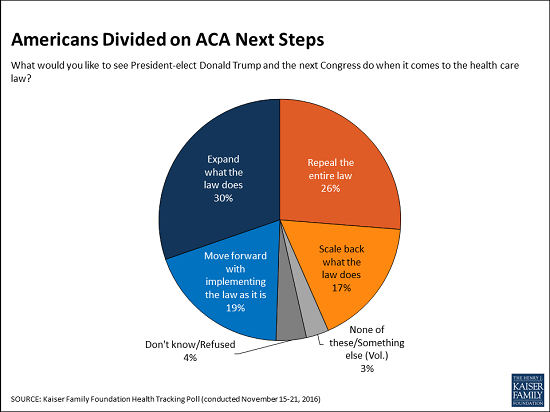
The first Kaiser Health Tracking Poll since the 2016 election finds that Americans are largely divided on the future of the Affordable Care Act even though many of the law’s major provisions remain quite popular across party lines.

The new survey finds that one fourth (26%) of Americans want to see President-elect Donald Trump and the next Congress repeal the entire law, and an additional 17 percent want them to scale back what the law does. This compares to 30 percent of the public who want to see the law expanded and 19 percent who want to see lawmakers move forward with implementing the law as it is.

The poll captures a slight uptick in the share of Americans who want lawmakers to scale back the law as well as a decrease in the share who want lawmakers to repeal the entire law.  This is largely driven by Republicans: About half (52%) of Republicans now say they want to see the Affordable Care Act repealed, down from 69 percent in October. At the same time, a quarter (24%) of Republicans now want to see the law scaled back, up from 11 percent in October.

Among the quarter (26%) of Americans that want to see the Affordable Care Act repealed, 31 percent want to see the health care law just repealed and not replaced. About two-thirds wants lawmakers to repeal the health care law and replace it with a Republican-sponsored alternative, with 42 percent wanting lawmakers to wait to repeal it until the details of a replacement plan have been figured out and 21 percent wanting lawmakers to repeal it immediately and figure out a replacement plan later.

Among those who want the law repealed, 38 percent (or 10% of the public overall) change their opinion after hearing the argument that repealing the ACA would mean that insurance companies could deny coverage to people with pre-existing conditions. A slightly smaller share change their opinion after hearing that more than 20 million Americans could lose their coverage.

Building A System That Works: The Future Of Health Care

http://healthaffairs.org/blog/2016/12/12/building-a-system-that-works-the-future-of-health-care/?utm_source=RealClearHealth+Morning+Scan&utm_campaign=4e312288c8-EMAIL_CAMPAIGN_2016_12_12&utm_medium=email&utm_term=0_b4baf6b587-4e312288c8-84752421

Blog_Burwell2

Nearly a century after Theodore Roosevelt’s Bull Moose Party first called for health insurance reform, the United States has made major advances in access, quality, and affordability.

In the six years since President Obama signed the Affordable Care Act (ACA) into law, 20 million more people have health insurance, and, for the first time in our history, more than nine out of every 10 Americans are insured. Growth in both premiums for employer coverage and overall Medicare spending has also slowed. The Centers for Medicare and Medicaid Services’ Actuaries now project that we are on track to spend $2.6 trillion less over the ACA’s first decade than was projected without the ACA back in 2010.

Even with this slow down, any increase in costs can be challenging for businesses monitoring expenses or families working through their budgets. That’s why stakeholders nationwide have been coming together to reshape the future of health care. Using new advancements in data, medicine, and the tools and resources provided by the Affordable Care Act, institutions across the country are building a health care system that works better for all Americans.

This work has gone on steadily for years — through political turmoil and challenges in the courts. Yet through each challenge, these reforms have endured.

They must continue to endure. The 20 million Americans who gained coverage cannot lose it again. The more than 129 million people with pre-existing conditions do not want to go back to a time when insurers could discriminate against them, or block them from coverage. Eleven million Medicare Part D beneficiaries cannot afford to lose the $2,000 they have each saved, on average, from the law’s work to begin closing the “donut hole.” The American people do not want to turn back our nation’s progress. Improvements need to be made, but they need to build on progress and not take us backwards in terms of access (the number of insured), affordability (costs to individuals, businesses, and taxpayers), and quality (the benefits that are being provided).

As the Obama Administration comes to a close, this piece lays out my vision for the future of health care. I share the steps we have taken to change how we pay for health care, incentivize coordination, and unlock health care data. This is the path forward—a system where innovative actors are putting the patient at the center—and, despite differences in health care, I firmly believe it is a vision on which we can all agree.

How will Trump change healthcare? 6 of the biggest questions answered

http://managedhealthcareexecutive.modernmedicine.com/managed-healthcare-executive/news/how-will-trump-affect-healthcare-6-biggest-questions-answered?cfcache=true&ampGUID=A13E56ED-9529-4BD1-98E9-318F5373C18F&rememberme=1&ts=02122016

Throughout his campaign and in the days following the election, President-elect Donald Trump said that one of his top priorities as the commander in chief would be to repeal and replace Obamacare, a major component of the Affordable Care Act (ACA). By having a Republican president as well as the GOP holding a majority in Congress (which also support its repeal), it’s likely that this will occur, says Ashraf Shehata, MBA, advisory leader for health plans and partner of the firm’s Global Healthcare Center of Excellence, KPMG.

But how do you go about replacing Obamacare when 20 million Americans are now obtaining healthcare coverage from it?