Hospitals Don’t Shift Costs From Medicare or Medicaid to Private Insurers

https://newsatjama.jama.com/2017/01/04/jama-forum-hospitals-dont-shift-costs-from-medicare-or-medicaid-to-private-insurers/

Image result for cost shifting

The Affordable Care Act (ACA) has allowed states to expand Medicaid. Medicaid pays hospitals prices that are lower than those paid by private insurers, although the price difference varies from state to state. Does this cause hospitals to charge private insurers even more to make up the difference, a cost shift?

Despite a substantial body of evidence to the contrary, many people believe hospitals shift costs in this way. For example, in 2014, Don George, MBA, the president and CEO of Blue Cross Blue Shield of Vermont wrote, “When government reimbursements are insufficient to cover the cost of the services a facility provides to Medicare or Medicaid beneficiaries, hospitals charge patients with private insurance enough to cover not only the cost of their services, but the shortfall created by government reimbursements as well.”

In truth, it’s been nearly 2 decades since any rigorous study has found evidence of substantial cost shifting. Recent work has found the opposite effect—when public programs pay hospitals less, so do private insurers. In a 2013 study published in Health Affairs, Chapin White, PhD, MPP, now a senior policy researcher at Rand Corporation, found that a 10% reduction in Medicare payments to hospitals was associated with a nearly 8% reduction in prices hospitals charge private insurers. Another study by him and Vivian Wu, PhD, now at the University of Southern California, published in Health Services Research in 2013, found that a reduction in hospital inpatient revenue from Medicare was associated with an even larger decline in total revenue, also suggesting hospitals cut prices charged to private payers.
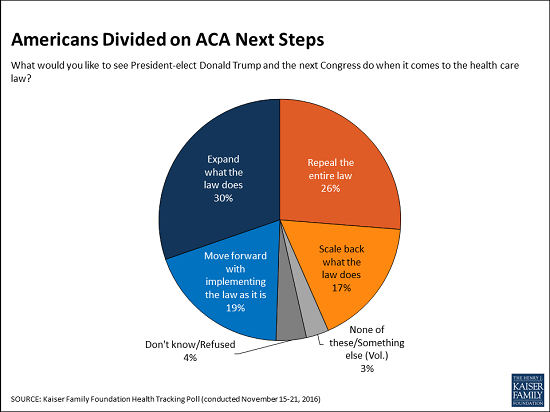
After the Election, the Public Remains Sharply Divided on Future of the Affordable Care Act

http://connect.kff.org/after-the-election-the-public-remains-sharply-divided-on-future-of-the-affordable-care-act?ecid=ACsprvtkG7thn0KvqmasXGGSnW1I2ovnfcZhoigDXi-aw9Wa_OhWGcyqpjasxqgfF_XFOsbs0N1f&utm_campaign=KFF-2016-November-Tracking-Poll&utm_source=hs_email&utm_medium=email&utm_content=38490459&_hsenc=p2ANqtz–qXSbCJ4pmKneag47QgP5kargBeYht5Al3rljRS8wEAQj-n-71yE8rwo5xn_Bg9Nwp-C89R9o_HVKBqqv5G6aMyddn9g&_hsmi=38490459

november poll1.png

Among Those Who Favor Repeal, Arguments About Loss of Coverage for Those with Pre-Exiting Conditions Can Sway Some Opinions

Many Obamacare Provisions Remain Broadly Popular Across Party Lines, But Not its Mandate

The first Kaiser Health Tracking Poll since the 2016 election finds that Americans are largely divided on the future of the Affordable Care Act even though many of the law’s major provisions remain quite popular across party lines.

The new survey finds that one fourth (26%) of Americans want to see President-elect Donald Trump and the next Congress repeal the entire law, and an additional 17 percent want them to scale back what the law does. This compares to 30 percent of the public who want to see the law expanded and 19 percent who want to see lawmakers move forward with implementing the law as it is.

The poll captures a slight uptick in the share of Americans who want lawmakers to scale back the law as well as a decrease in the share who want lawmakers to repeal the entire law.  This is largely driven by Republicans: About half (52%) of Republicans now say they want to see the Affordable Care Act repealed, down from 69 percent in October. At the same time, a quarter (24%) of Republicans now want to see the law scaled back, up from 11 percent in October.

Among the quarter (26%) of Americans that want to see the Affordable Care Act repealed, 31 percent want to see the health care law just repealed and not replaced. About two-thirds wants lawmakers to repeal the health care law and replace it with a Republican-sponsored alternative, with 42 percent wanting lawmakers to wait to repeal it until the details of a replacement plan have been figured out and 21 percent wanting lawmakers to repeal it immediately and figure out a replacement plan later.

Among those who want the law repealed, 38 percent (or 10% of the public overall) change their opinion after hearing the argument that repealing the ACA would mean that insurance companies could deny coverage to people with pre-existing conditions. A slightly smaller share change their opinion after hearing that more than 20 million Americans could lose their coverage.

Building A System That Works: The Future Of Health Care

http://healthaffairs.org/blog/2016/12/12/building-a-system-that-works-the-future-of-health-care/?utm_source=RealClearHealth+Morning+Scan&utm_campaign=4e312288c8-EMAIL_CAMPAIGN_2016_12_12&utm_medium=email&utm_term=0_b4baf6b587-4e312288c8-84752421

Blog_Burwell2

Nearly a century after Theodore Roosevelt’s Bull Moose Party first called for health insurance reform, the United States has made major advances in access, quality, and affordability.

In the six years since President Obama signed the Affordable Care Act (ACA) into law, 20 million more people have health insurance, and, for the first time in our history, more than nine out of every 10 Americans are insured. Growth in both premiums for employer coverage and overall Medicare spending has also slowed. The Centers for Medicare and Medicaid Services’ Actuaries now project that we are on track to spend $2.6 trillion less over the ACA’s first decade than was projected without the ACA back in 2010.

Even with this slow down, any increase in costs can be challenging for businesses monitoring expenses or families working through their budgets. That’s why stakeholders nationwide have been coming together to reshape the future of health care. Using new advancements in data, medicine, and the tools and resources provided by the Affordable Care Act, institutions across the country are building a health care system that works better for all Americans.

This work has gone on steadily for years — through political turmoil and challenges in the courts. Yet through each challenge, these reforms have endured.

They must continue to endure. The 20 million Americans who gained coverage cannot lose it again. The more than 129 million people with pre-existing conditions do not want to go back to a time when insurers could discriminate against them, or block them from coverage. Eleven million Medicare Part D beneficiaries cannot afford to lose the $2,000 they have each saved, on average, from the law’s work to begin closing the “donut hole.” The American people do not want to turn back our nation’s progress. Improvements need to be made, but they need to build on progress and not take us backwards in terms of access (the number of insured), affordability (costs to individuals, businesses, and taxpayers), and quality (the benefits that are being provided).

As the Obama Administration comes to a close, this piece lays out my vision for the future of health care. I share the steps we have taken to change how we pay for health care, incentivize coordination, and unlock health care data. This is the path forward—a system where innovative actors are putting the patient at the center—and, despite differences in health care, I firmly believe it is a vision on which we can all agree.

How will Trump change healthcare? 6 of the biggest questions answered

http://managedhealthcareexecutive.modernmedicine.com/managed-healthcare-executive/news/how-will-trump-affect-healthcare-6-biggest-questions-answered?cfcache=true&ampGUID=A13E56ED-9529-4BD1-98E9-318F5373C18F&rememberme=1&ts=02122016

Throughout his campaign and in the days following the election, President-elect Donald Trump said that one of his top priorities as the commander in chief would be to repeal and replace Obamacare, a major component of the Affordable Care Act (ACA). By having a Republican president as well as the GOP holding a majority in Congress (which also support its repeal), it’s likely that this will occur, says Ashraf Shehata, MBA, advisory leader for health plans and partner of the firm’s Global Healthcare Center of Excellence, KPMG.

But how do you go about replacing Obamacare when 20 million Americans are now obtaining healthcare coverage from it?

Major changes for Medicaid coming under Trump and the GOP

http://money.cnn.com/2016/11/21/news/economy/medicaid-trump/index.html

Image result for aca repeal

Donald Trump likely won’t let Medicaid collapse, but he will vastly change the health insurance program for low-income Americans.

Think less federal funding, more state control, fewer participants and higher costs for those in the program.

Here’s how Medicaid works now:

Nearly 73 million Americans are on Medicaid or the related Children’s Health Insurance Program (CHIP). The programs cost $509 billion in fiscal 2015, with the federal government shouldering 62% of the bill and states paying 38%.

Most enrollees are low-income children, pregnant women, parents, the disabled and the elderly. Under Obamacare, low-income adults with incomes of up to 138% of the poverty line — $16,400 for a single person — were allowed to sign up in states that opted to expand their Medicaid programs. So far, 31 states, plus the District of Columbia, have done so, adding about 15.7 million more people to the rolls since late 2013, just before the provision took effect. (This figure includes both those newly eligible under expansion and those who always met the criteria.)

While Democrats say the program is a vital part of the safety net, Republicans have long criticized it as being bloated, inefficient and rife with fraud. They want to limit the federal government’s financial responsibility, while giving states more direct control over whom to enroll and what kind of coverage participants receive.

On the campaign trail, Trump was emphatic about having the government provide coverage to the poor, even as he vowed to dismantle Obamacare.

“You cannot let people die on the street, ok?,” he said at a CNN town hall in February. “The problem is that everybody thinks that you people, as Republicans, hate the concept of taking care of people that are really, really sick and are gonna die. We gotta take care of people that can’t take care of themselves.”

California healthcare advocates rally against Trump

http://www.sacbee.com/news/politics-government/capitol-alert/article116320043.html

California Secretary of State Alex Padilla the Democratic National Convention in Philadelphia on Wednesday, July 27, 2016.

They backed Obamacare, and they’re not letting it go without a fight.

The federal healthcare overhaul could be one of the first casualties of President-Elect Donald Trump, who has joined the Republicans controlling Congress in vowing to dismantle the law. Since winning the presidency Trump has softened his stance somewhat, speaking favorably about popular provisions that prohibit insurers from turning away people with pre-existing conditions and allow people to stay on their parents’ plans until they turn 26.

Still, Trump’s election has California healthcare advocates on high alert, not to mention the state’s new U.S. senator. California could forfeit billions of federal dollars that support Medi-Cal, the insurance program for poor Californians, and subsidize private insurance purchases. They’re worried about the fate of Medicare, a program that Speaker Paul Ryan, R-Wisconsin, said has “serious problems because of Obamacare” and is “going broke.”

 A rally today in Los Angeles offers the latest example of a policy rift between California and Washington, D.C., with elected officials joining healthcare workers and patients for an event billed as a push to “protect our health care.” Among the expected speakers are Senate Health Committee chair Ed Hernandez, D-West Covina, Los Angeles County Health Agency Director Mitch Katz, and California Secretary of State Alex Padilla, whose public denunciations of Trump have become a recurring feature.

BY THE NUMBERS: 13.6 million is the number of Californians enrolled in Medi-Cal as of June 2016, the most recent data available, a net increase of about 800,000 from a year earlier and about double Medi-Cal enrollment a decade ago. The total includes almost 3.4 million people who became eligible for Medi-Cal under the state’s optional Obamacare expansion. The Legislative Analyst’s Office last week reported that Medi-Cal caseload should grow by about 100,000 annually through mid-2021 among families, children and people covered by ACA expansion. Enrollment among senior citizens and people with disabilities will grow by an estimated 50,000.

California Braces For Medi-Cal’s Future Under Trump And The GOP

California Braces For Medi-Cal’s Future Under Trump And The GOP

Dollar CutDollar Cut

California grabbed the first opportunity to expand Medicaid and ran with it, helping cut the number of uninsured people in half in a few short years.

Thanks in part to billions of dollars in federal funding, a third of California’s residents — including half its children — are insured by Medi-Cal, the state’s version of Medicaid.

Now, with the election of Donald Trump and a Republican-controlled Congress, the state that bet so heavily on the Medicaid expansion is bracing to see how much of its work will be undone. While no one knows yet exactly what will happen, many policymakers and advocates fear the federal government will end or severely limit funding for the expansion.

“There are no easy cuts in Medi-Cal,” said Stan Rosenstein, a former Medi-Cal administrator. Reduced federal funding “could have a major impact on the uninsurance rate, on the viability of our hospitals, and it could have a very negative impact on the economy.”

Medi-Cal cuts could restrict who is eligible for coverage, slash health care benefits, limit access to doctors and reduce payment rates to medical providers — already among the lowest in the nation, health policy experts and advocates said. Medi-Cal covers a host of services for low-income residents, including maternity care, prescription drugs, long-term care services, mental health treatment and hospital stays.

Laurel Lucia, a health care program manager at the University of California, Berkeley Labor Center, said a well-funded Medicaid program benefits everyone, not just those currently on the program.

“A lot of people are just a layoff away from needing Medicaid,” she said. “The Republican plans for Medicaid threaten to undermine that safety net.”

Cost, Not Choice, Is Top Concern of Health Insurance Customers

It is all about the price.

Millions of people buying insurance in the marketplaces created by the federal health care law have one feature in mind. It is not finding a favorite doctor, or even a trusted company. It is how much — or, more precisely, how little — they can pay in premiums each month.

And for many of them, especially those who are healthy, all the prices are too high.

The unexpected laser focus on price has contributed to hundreds of millions of dollars in losses among the country’s top insurers, as fewer healthy people than expected have signed up. And that has created two vexing questions: Will the major insurance companies stay in the marketplaces? And if they do, will the public have a wide array of plans to choose from — a central tenet of the 2010 Affordable Care Act?

“The marketplace has been and continues to be unsustainable,” said Joseph R. Swedish, chief executive of Anthem, one of the nation’s largest insurers.

Most Americans with health insurance get it through their employers or from government programs like Medicare and Medicaid. The marketplaces were created under the health care law to give the millions of people not covered in those ways a way to buy health plans.

While major insurers continue to make profits over all, they say that the economics of the marketplaces do not work for them. Insurers can offer marketplace plans at four different coverage tiers, and the government subsidizes the premiums for millions of people. The thinking was that enough healthy people would buy insurance to balance out the costs for the not-so-healthy.

But things are not going exactly as envisioned.


The Future of Health Care Mergers Under Trump

Though there has been a flurry of merger and acquisition activity in recent years, industry experts are unsure whether the merger momentum will continue under President-elect Donald Trump’s administration, according to The New York Times.

Here are five things to know about how M&A activity in the healthcare industry may be affected under the Trump administration.

1. President-elect Trump nominated Sen. Jeff Sessions (R-Ala.) to replace Attorney General Loretta Lynch. While it is unclear how the department will handle antitrust cases under Sen. Sessions, the impact from the change in leadership will not be felt immediately. The outcomes of the two major antitrust cases in the insurance market, the Anthem-Cigna and Aetna-Humana mergers, are expected to be decided before Mr. Trump takes office in January. However, the new administration might still have an impact on the mergers, particularly if either the companies or the government decide to appeal the decision, according to the article.

2. According to the article, there is little expectation the Department of Justice under President-elect Trump would drop the cases if the insurers lost and appealed. However, any agreed upon settlement deal may be less onerous to the insurers involved.

3. There is a chance the federal government’s approach to healthcare mergers may not change, according to the article. “There is a history of bipartisan support for antitrust enforcement in healthcare,” said Leslie Overton, a partner at Alston & Bird and a former DOJ official. “I don’t think we should expect a wholesale shift, based on the change from Democratic to Republican.”

4. The Federal Trade Commission’s position on M&A activity may change even less, according to industry experts interviewed by The New York Times. The independent agency is less subject to the political preferences of the president and of Congress.

5. Industry experts also suggest the possible repeal of the ACA will not impede the increasing M&A activity of the past few years. According to the article, hospitals may feel more pressure to join together if the ACA is repealed due to reduced Medicare and Medicaid payments and increased volumes of uninsured patients.

It’s Easy for Obamacare Critics to Overlook the Merits of Medicaid Expansion

At a national level, the expansion of Medicaid continues to yield benefits. Its coverage was increased, and its quality raised. Some states that have expanded Medicaid are even expecting net savings for the next few years. In states where Medicaid was expanded, hospitals had fewer uninsured visits.

Focusing on only the positives can be as misleading as focusing on only the negatives. Policy decisions, including those involving health, need to be considered in terms of trade-offs. It is true that providing Medicaid can cost the federal government, and even states, a lot of money, which can’t then be spent on other worthy pursuits. It is true that Medicaid reimburses physicians and hospitals less generously, and that it often leaves beneficiaries with fewer choices than private insurance might.

But when we look at the balance sheet for Medicaid — health benefits, financial security, societal improvements through education — it’s not hard to argue that money allocated to Medicaid is well spent.